
Global Analytics of Things Market Size & Forecast:
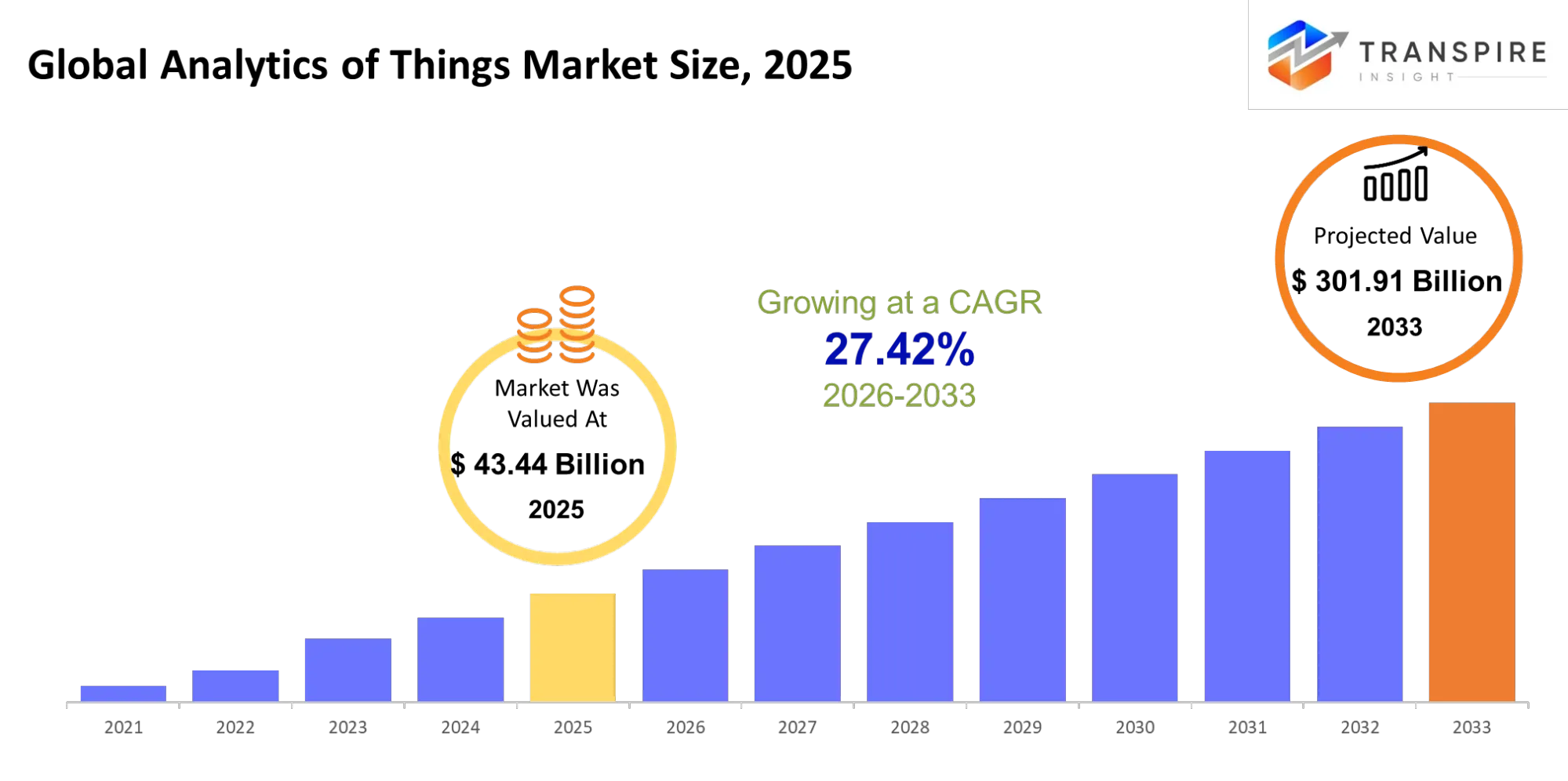
- Global Analytics of Things Market Size 2025: USD 43.44 Billion
- Global Analytics of Things Market Size 2033: USD 301.91 Billion
- Global Analytics of Things Market CAGR: 27.42%
- Global Analytics of Things Market Segments: By Type (Predictive Analytics Platforms, Real-time IoT Analytics, Edge Analytics Solutions, AI-driven IoT Analytics, Cloud IoT Analytics, Industrial IoT Analytics, Others); By Application (Smart Manufacturing, Healthcare Monitoring, Smart Cities, Connected Vehicles, Energy Management, Others); By End-User (Manufacturing Companies, Healthcare Providers, Government Agencies, Enterprises, Others); By Deployment (Cloud-based Platforms, On-premise Platforms, Hybrid Analytics Systems, AI-integrated Platforms, Others)
Global Analytics of Things Market Summary:
The Global Analytics of Things Market size is estimated at USD 43.44 Billion in 2025 and is anticipated to reach USD 301.91 Billion by 2033, growing at a CAGR of 27.42% from 2026 to 2033.
This market takes raw data from connected hardware, like factory robots or shipping fleets, and instantly turns it into useful action. A few years ago, companies just dumped sensor data into a cloud to review later. That changed when edge computing hardware became cheaper, allowing analytics to run directly on the machines themselves. The real tipping point hit during recent global supply chain jams, forcing logistics teams to stop guessing and pinpoint exactly where their operations were stalling. Now, instead of waiting for a critical motor to break and halt production, managers use predictive software to spot worn-out parts days in advance. Because fixing a problem early is much cheaper than dealing with a dead assembly line, industrial buyers are heavily funding these analytics setups.
Key Market Insights
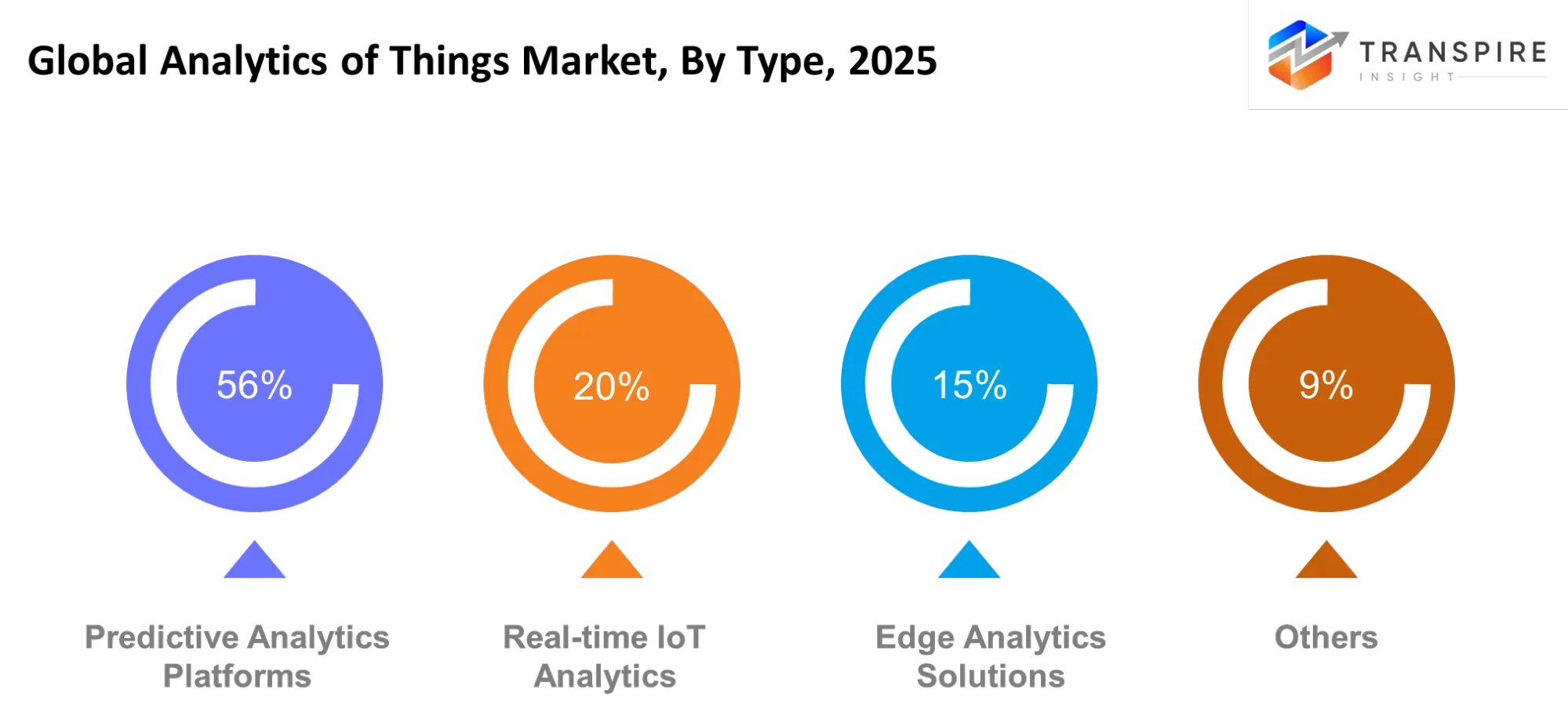
- Commanding a leading 56% share of the type segment, predictive analytics platforms are benefiting from industrial buyers trying to avoid sudden machine breakdowns, pushing IBM to roll out advanced machine learning models that catch motor wear-and-tear weeks before a failure happens.
- Securing a solid 39% share, the North American region is seeing a heavy push for absolute supply chain visibility, prompting Microsoft to integrate its Azure IoT tools with local logistics hubs so managers can track component delays minute-by-minute.
- Expanding fast with an 18.2% CAGR and a 26% market chunk, Asia Pacific is riding a wave of smart city and public transit upgrades, leading Hitachi Vantara to deploy intelligent sensor networks that help local governments reroute traffic and balance power grids on the fly.
- Holding down 20% of the type category, real-time IoT analytics are becoming essential for operators who cannot afford a second of lag, driving Splunk to upgrade its live dashboard tools to help IT teams spot network anomalies the instant a sensor goes offline.
- Covering 27% of regional sales, Europe is shifting heavily toward strict emission tracking and green energy management, pushing Siemens to introduce smart factory software that constantly monitors carbon output and automatically cuts power to idle machines.
- Growing faster than any other tech segment with a 19.1% CAGR, AI-driven IoT analytics are cashing in on the need for zero-touch automation, which recently drove Google Cloud to launch self-learning algorithms that adjust cooling and heating systems across entire commercial buildings without human input.
- Taking a 15% slice of the market, edge analytics solutions are solving the problem of weak internet connections on remote job sites, pushing Dell Technologies to build rugged, on-site servers that process heavy data directly on oil rigs rather than trying to send it back to a central cloud.
- Covering the final 8% of global sales, the Rest of the World market is experiencing a rapid modernization of basic infrastructure, driving Oracle to partner with regional telecom providers to roll out smart metering systems that track water and electricity usage in real-time.
What are the Key Drivers, Restraints, and Opportunities in the Global Analytics of Things Market?
Driver:
The true engine moving this market is the desperate need to eliminate unplanned mechanical downtime across massive industrial setups. Because a single stalled assembly line now costs manufacturers thousands of dollars a minute, facility managers are rapidly moving away from reactive repairs. This intense financial pressure is forcing the heavy adoption of edge-based predictive analytics, allowing operators to process sensor data right on the factory floor and catch failing parts weeks before they actually break.
Restraint:
The biggest roadblock holding this market back is the massive compatibility gap with legacy infrastructure. Most manufacturing plants and city grids are still running on heavy hardware built decades ago that simply doesn’t speak the same digital language as modern IoT platforms. Because completely ripping out and replacing these older machines costs an absolute fortune, many facility managers are stuck dealing with fragmented data silos that make unified, real-time analytics incredibly difficult to implement.
Opportunity:
The real future goldmine lies in closing the loop with fully autonomous, AI-driven interventions. Right now, software just alerts a human that a machine is running hot. The next massive wave of growth will come from platforms that automatically adjust a piece of equipment's speed or cooling systems on the fly without human input. Software companies investing heavily in these self-correcting AI algorithms will easily dominate the smart manufacturing space, especially across rapidly modernizing factory hubs in the Asia Pacific region.
Here is the revised section using the more natural, human-sounding tone, along with a brand-new real-world instance and source link from a different major tech player:
What Has the Impact of Artificial Intelligence Been on the Global Analytics of Things Market?
AI is completely shifting the Analytics of Things space by taking basic sensor networks and turning them into systems that can actually make decisions on their own.
Instead of just dumping raw data onto a dashboard for someone to read, local AI tools process the numbers right there on the equipment to keep things moving. On a factory floor, this means software can track a machine's heat and vibration levels, slowing it down automatically if it starts to run too hot—without anyone needing to press a button. Letting the system manage itself like this keeps the assembly lines running smoothly and cuts way down on wasted energy.
Predictive capabilities are also completely changing how facilities operate. Instead of reacting to a broken motor and halting a production line, IoT-connected AI tracks microscopic degradation patterns over time. This lets the software send predictive alerts, allowing maintenance teams to replace a cheap part weeks before a catastrophic, expensive failure occurs.
The main limitation holding this technology back is a massive integration gap. Older factory equipment usually lacks the precise digital sensors needed for AI, meaning companies must spend a fortune retrofitting legacy machinery just to feed the algorithms clean, usable data. In January 2026, Hitachi launched HMAX, a suite of solutions that brings physical AI directly to industrial infrastructure. By analyzing vast amounts of real-time IoT data, the platform allows operators in sectors like manufacturing and rail to automate predictive maintenance and optimize complex machinery without relying on constant manual checks.
Key Market Trends
People are sick of paying huge cloud storage bills just to park raw data they never use. Because of that, the industry is shifting analytics right down to the edge, where factory sensors and power grids process the math locally to keep things running without the lag.
- Moving away from central clouds. Instead of dealing with the cost and delay of sending massive data packages back and forth to a distant server, facilities are doing the heavy lifting right on the actual machines. It gets answers faster and cuts down on expensive bandwidth.
- Fixing it before it breaks. Maintenance teams used to just wait for a motor to burn out. Now, they lean on heat and vibration sensors to give them a heads-up weeks in advance, letting them swap out a cheap part before the whole line grinds to a halt.
- Digital twins replacing spreadsheets. Static charts are being swapped out for 3D virtual copies of the plant floor. Managers pull live sensor feeds into these digital models to run simulations and figure out where bottlenecks are going to happen before they actually do.
- Bringing IT and the factory floor together. Historically, the software crowd and the people running the physical equipment kept to themselves. Those walls are coming down because corporate wants a single screen that shows exactly what is happening across both the network and the physical hardware.
- AI living on tiny chips. Machine learning isn't locked in giant server rooms anymore. Developers are shrinking these algorithms down so they easily fit on cheap, battery-powered sensors monitoring remote oil valves or smart farm gear.
- Shifting from speed to sustainability. A few years back, IoT was strictly about making products faster. Now, with emission rules getting stricter, companies use those exact same sensors to track carbon footprints and figure out where they are bleeding idle power.
- Cameras acting as sensors. Fast 5G networks are letting factories use high-def video feeds as actual data points. Instead of just checking temperature gauges, computer vision watches the line to catch tiny product defects that a human inspector would easily miss.
- Security is no longer an afterthought. A while back, operators were just hooking cheap sensors up to the internet and hoping for the best. After a string of bad ransomware hits, enterprise buyers won't even look at an analytics platform unless zero-trust security is built in from day one.
Global Analytics of Things Market Segmentation
By Type
Predictive Analytics Platforms absolutely dominate this space, holding a massive 56% share of the market, while Real-time IoT Analytics (20%) and Edge Analytics Solutions (15%) follow closely behind. However, AI-driven IoT Analytics is the segment tearing ahead as the fastest-growing with a 19.1% CAGR. The growth logic here is entirely about avoiding expensive surprises. Facility managers are done reacting to broken machines; they want software that flags a failing motor weeks before it actually snaps. Looking ahead, passive data dashboards will basically become obsolete. The market is moving straight toward autonomous, closed-loop systems where the analytics platform doesn't just alert a mechanic, but actively adjusts a machine's settings to keep it running until the shift ends.
By Application
Smart Manufacturing heavily anchors the daily volume, while Smart Cities and Connected Vehicles are pushing massive new adoption curves. The unique growth logic here comes down to extreme cost control. Factories and urban planners are under massive pressure to cut energy waste and optimize logistics, meaning every robotic arm and traffic light needs to justify its power draw. By plugging these assets into real-time analytics, operators can squeeze maximum efficiency out of aging infrastructure. In the near future, these isolated applications are going to crash into each other. We won't just see standalone smart factories; we'll see connected ecosystems where manufacturing hubs automatically sync up with connected trucking fleets and regional energy grids to balance power and logistics simultaneously.
By End-User
Manufacturing Companies and massive Enterprises make up the heavyweight volume of the buyer pool, while Government Agencies and Healthcare Providers are scaling up fast to manage public infrastructure and patient vitals. The underlying push here is the fight against razor-thin operating margins. Plant managers and city officials simply don't have the budget to throw extra manpower at a problem, so they are leaning hard on analytics to automate their daily operations. To keep these buyers engaged, tech vendors are going to have to change how they sell. The future will see end-users completely ditching massive upfront software licenses in favor of performance-based contracts, where they literally only pay for the software based on how much downtime it actually prevented or energy it saved.
By Deployment
Cloud-based Platforms and On-premise setups historically carried the market, but Hybrid Analytics Systems and AI-integrated Platforms are quickly taking over all the new enterprise builds. The unique growth logic revolves entirely around latency and bandwidth costs. Operators quickly realized that pumping terabytes of raw factory data to a distant cloud every second is insanely expensive and creates dangerous lag. Hybrid setups are winning because they let the local network do the heavy math on the spot, only sending the final, polished reports up to the cloud. Looking forward, the pure cloud model for heavy industrial IoT is basically going to fade out. The industry will pivot heavily to edge-native deployments, where the predictive AI is baked right onto the physical sensor chips attached to the machinery.
What are the Key Use Cases Driving the Global Analytics of Things Market?
The biggest push for this technology comes straight from factory floors to prevent broken machinery. Plant managers use these platforms to catch tiny changes in a motor's heat or vibration, letting them replace a worn-out part long before it snaps and stops production.
Outside of manufacturing, the tech is heavily altering shipping fleets and energy grids. Logistics teams now track connected trucks to instantly reroute them around traffic, while local utilities monitor sudden power spikes to balance the grid and dodge neighborhood blackouts.
We are also seeing a major shift into city infrastructure. Local governments are baking this software directly into streetlights and water meters to automatically clear up traffic jams or find hidden pipeline leaks without sending out an inspection crew.
|
Report Metrics |
Details |
|
Market size value in 2025 |
USD 43.44 Billion |
|
Market size value in 2026 |
USD 55.35 Billion |
|
Revenue forecast in 2033 |
USD 301.91 Billion |
|
Growth rate |
CAGR of 27.42% from 2026 to 2033 |
|
Base year |
2025 |
|
Historical data |
2021 - 2024 |
|
Forecast period |
2026 - 2033 |
|
Report coverage |
Revenue forecast, competitive landscape, growth factors, and trends |
|
Regional scope |
United States; Canada; Mexico; United Kingdom; Germany; France; Italy; Spain; Denmark; Sweden; Norway; China; Japan; India; Australia; South Korea; Thailand; Brazil; Argentina; South Africa; Saudi Arabia; United Arab Emirates |
|
Key company profiled |
IBM, Microsoft, SAP, Oracle, Cisco, Google Cloud, AWS, Siemens, PTC, SAS Institute, Hitachi Vantara, Software AG, Splunk, TIBCO Software, Dell Technologies |
|
Customization scope |
Free report customization (country, regional & segment scope). Avail customized purchase options to meet your exact research needs. |
|
Report Segmentation |
By Type (Predictive Analytics Platforms, Real-time IoT Analytics, Edge Analytics Solutions, AI-driven IoT Analytics, Cloud IoT Analytics, Industrial IoT Analytics, Others); By Application (Smart Manufacturing, Healthcare Monitoring, Smart Cities, Connected Vehicles, Energy Management, Others); By End-User (Manufacturing Companies, Healthcare Providers, Government Agencies, Enterprises, Others); By Deployment (Cloud-based Platforms, On-premise Platforms, Hybrid Analytics Systems, AI-integrated Platforms, Others) |
Which Regions are Driving the Global Analytics of Things Market Growth?
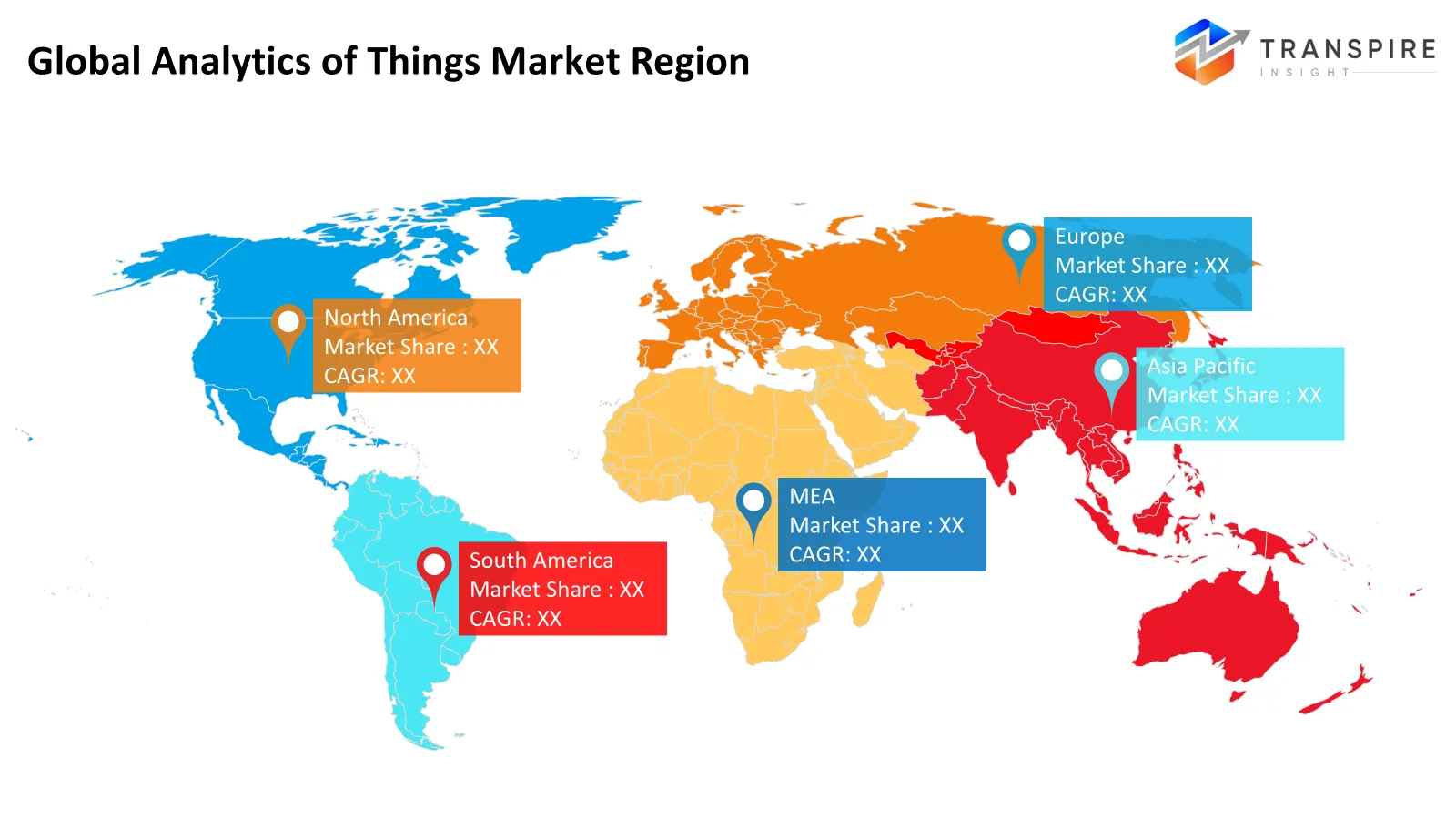
North America holds the biggest piece of the market right now, accounting for 39% of global sales. The main reason for this lead is that local corporations are pushing hard to bulletproof their supply chains and eliminate factory downtime. After dealing with severe logistics bottlenecks, manufacturers and shipping hubs are pouring money into tools that show exactly what is happening on the floor in real time. Backed by heavy funding from local tech companies and an already solid cloud network, industrial operators are leaning on predictive software simply because a broken machine or network crash costs them too much money to fix after the fact. · Microsoft heavily targets this industrial demand with Azure Stream Analytics on IoT Edge, allowing manufacturing safety systems and remote equipment to analyze sensor data in near real-time, instantly issuing commands to stop a machine or trigger alerts without relying on a constant cloud connection.
Europe sits in the number two spot, taking up 27% of the space. While buyers in North America are mostly worried about supply chain speed, European companies are buying into this tech to deal with tight environmental laws and green energy targets. Growth here is very steady because local governments are essentially forcing factories and utility grids to closely track their carbon footprints. To avoid heavy compliance fines, facility managers are installing smart factory systems that monitor real-time emissions and automatically optimize older machines when they aren't actively being used. · To address these strict environmental mandates, SAP launched its Product Footprint Management solution, leveraging IoT and advanced analytics to help companies calculate their environmental impact across production scenarios and proactively identify carbon emissions at the beginning of the product lifecycle.
Asia Pacific is growing faster than any other region, posting an 18.2% CAGR and currently covering 26% of the market. Things have really picked up here lately because local governments are throwing large budgets at smart city projects to upgrade older public infrastructure. Because these expanding mega-cities are struggling with traffic and power limits, urban planners are relying on AI sensor networks to automatically manage the local grids and keep cars moving. Looking forward, the biggest growth pocket will be brand-new industrial hubs, where tech companies are setting up algorithms that let manufacturing zones and urban centers essentially run and correct themselves. · Showcasing this massive shift in the region, Cisco officially unveiled its "Cisco Smart City" blueprint in India as a model for digital infrastructure, using the Internet of Everything to deploy connected education, smart buildings, connected transport, and smart parking via a pervasive physical sensor network.
Who are the Key Players in the Global Analytics of Things Market and how do they Compete?
The Analytics of Things space is fiercely competitive, with a massive turf war forming between traditional cloud computing giants and specialized industrial hardware makers. Instead of competing on how much raw data they can store, these vendors are fighting over edge processing capabilities. The main goal is zero-latency decision making, which forces companies to aggressively acquire AI startups and forge tight partnerships with legacy equipment manufacturers to bridge the gap between enterprise software and the physical factory floor.
AWS competes entirely on massive ecosystem scale and seamless integration. Rather than building physical sensors, AWS differentiates by offering highly flexible, pay-as-you-go IoT analytics tools that link directly into a company's existing cloud architecture. Their primary expansion approach relies on aggressive partnerships with third-party industrial integrators, pushing their AWS IoT Greengrass software onto existing factory equipment to lock enterprise buyers into their broader cloud environment.
Conversely, Siemens attacks the market from a strict industrial niche, competing on hardware-level innovation. They differentiate by physically understanding heavy machinery, bypassing generic IT dashboards to embed their analytics directly into the motor controls and grids they already manufacture. Siemens expands by upselling these autonomous, closed-loop software upgrades directly to their massive existing hardware customer base, offering a highly specialized, ready-to-use solution that generic cloud providers struggle to replicate.
Company List
- IBM
- Microsoft
- SAP
- Oracle
- Cisco
- Google Cloud
- AWS
- Siemens
- PTC
- SAS Institute
- Hitachi Vantara
- Software AG
- Splunk
- TIBCO Software
- Dell Technologies
Recent Development News
In June 2025, Nordic Semiconductor acquired Neuton.AI, a pioneer in fully automated TinyML solutions. By integrating Neuton's ultra-efficient neural network framework with Nordic's low-power wireless chips, this acquisition allows developers to deploy high-performance, predictive edge AI on extremely tiny, resource-constrained IoT sensors without draining battery life. [https://www.nordicsemi.com]
In October 2025, Siemens launched a specialized edge-native AI solution for manufacturing in direct collaboration with rhobot.ai. Instead of just passively monitoring data, this new platform runs directly on the factory edge to actively learn from and automatically adjust machine settings on the fly, immediately increasing production yields and preventing energy waste without needing a constant cloud connection. [https://news.siemens.com]
In November 2025, Cisco debuted its Unified Edge platform designed specifically to support distributed agentic AI workloads. Because traditional data centers struggle with the massive network traffic generated by AI agents, this new hardware integrates computing, storage, and security right at the source—like a factory floor or retail store—allowing heavy predictive models to run in real-time right where the data is actually generated. [https://newsroom.cisco.com]
What Strategic Insights Define the Future of the Global Analytics of Things Market?
The Global Analytics of Things Market is rapidly abandoning passive monitoring in favor of fully autonomous, self-healing industrial ecosystems. The future belongs to edge-native platforms that don't just alert engineers to a problem, but actively reconfigure machinery on the fly to prevent it.
However, a major hidden risk is algorithmic drift at the edge. As physical equipment ages and degrades over time, static AI models trained on day-one baseline data will start making dangerous, inaccurate operational decisions.
The most lucrative emerging opportunity lies in shifting from selling software licenses to performance-based contracts, where buyers strictly pay for the measurable downtime prevented or energy saved. To survive, tech vendors must stop pitching generic cloud dashboards. The winning strategy is to forge aggressive partnerships with legacy hardware manufacturers to embed lightweight, self-updating AI directly into the machine level, ensuring algorithms evolve alongside the physical assets they control.
Global Analytics of Things Market Segmentation:
By Type
- Predictive Analytics Platforms
- Real-time IoT Analytics
- Edge Analytics Solutions
- AI-driven IoT Analytics
- Cloud IoT Analytics
- Industrial IoT Analytics
- Others
By Application
- Smart Manufacturing
- Healthcare Monitoring
- Smart Cities
- Connected Vehicles
- Energy Management
- Others
By End-User
- Manufacturing Companies
- Healthcare Providers
- Government Agencies
- Enterprises
- Others
By Deployment
- Cloud-based Platforms
- On-premise Platforms
- Hybrid Analytics Systems
- AI-integrated Platforms
- Others
Regional Outlook
North America
- United States
- Canada
- Mexico
Europe
- Germany
- United Kingdom
- France
- Spain
- Italy
- Rest of Europe
Asia Pacific
- Japan
- China
- Australia & New Zealand
- South Korea
- India
- Rest of Asia Pacific
South America
- Brazil
- Argentina
- Rest of South America
Middle East & Africa
- Saudi Arabia
- United Arab Emirates
- South Africa
- Rest of the Middle East & Africa
Frequently Asked Questions
Find quick answers to common questions.
The Global Analytics of Things Market size was valued at USD 43.44 Billion in 2025 and is poised to reach USD 301.91 Billion by 2033, expanding at a 27.42% CAGR.
Key segments for the Global Analytics of Things Market are Type (Predictive Analytics Platforms, Real-time IoT Analytics, Edge Analytics Solutions, AI-driven IoT Analytics, Cloud IoT Analytics, Industrial IoT Analytics, Others), Application (Smart Manufacturing, Healthcare Monitoring, Smart Cities, Connected Vehicles, Energy Management, Others), End-User (Manufacturing Companies, Healthcare Providers, Government Agencies, Enterprises, Others), and Deployment (Cloud-based Platforms, On-premise Platforms, Hybrid Analytics Systems, AI-integrated Platforms, Others).
Growth is primarily driven by the desperate need to eliminate unplanned mechanical downtime across massive industrial setups, intense financial pressure to avoid reactive repairs, and the heavy corporate adoption of edge-based predictive analytics to catch failing parts weeks before an assembly line actually breaks down.
The global market is led by major manufacturers including IBM, Microsoft, SAP, Oracle, Cisco, Google Cloud, AWS, Siemens, PTC, SAS Institute, Hitachi Vantara, Software AG, Splunk, TIBCO Software, and Dell Technologies.
North America holds a massive 39% share of the overall market. This heavy lead is driven by a corporate push for absolute supply chain resilience, forcing logistics hubs and manufacturers to invest billions into real-time operational visibility. The region benefits from a highly mature cloud infrastructure and aggressive investments from local tech giants, making enterprise-grade edge computing highly accessible to heavy industries.
Significant commercial opportunities exist in closing the loop with fully autonomous, AI-driven interventions where platforms automatically adjust a piece of equipment's speed or cooling systems on the fly without human input. There is also a major opportunity for tech vendors to shift away from standard software licenses toward performance-based contracts, where buyers strictly pay for the measurable downtime prevented or energy saved.
- IBM
- Microsoft
- SAP
- Oracle
- Cisco
- Google Cloud
- AWS
- Siemens
- PTC
- SAS Institute
- Hitachi Vantara
- Software AG
- Splunk
- TIBCO Software
- Dell Technologies
About the Authors

Mayur Shinde
I am Mayur Shinde, a Senior Research Analyst at Transpire Insight, specializing in the Automotive & Transportation and Information & Communication Technology (ICT) Industry. My work focuses on analyzing emerging market trends, technological advancements, competitive landscapes, and industry developments to deliver accurate, data-driven insights. I am passionate about transforming complex market information into clear, actionable content that helps businesses, professionals, and decision-makers stay informed and make confident strategic decisions.

Chakradhar Khansole
Chakradhar serves as the Research Director at Transpire Insight, bringing over 8 years of experience in technology, innovation, and strategic market intelligence. He specializes in transforming complex market data into actionable business insights that enable organizations to make informed, growth-oriented decisions. Recognized for his strategic vision and analytical expertise, Chakradhar leads high-impact research initiatives, delivering comprehensive market assessments, competitive intelligence, and forward-looking industry analysis.
Recently Published Reports
-
Apr 2026
3D Optical Profiler Market
3D Optical Profiler Market Size, Share & Analysis Report By Type (Desktop 3D Optical Profiler, and Portable 3D Optical Profiler), By Technology (Confocal Technology, and White Light Interference), By End-Use Industry (Manufacturing, Research Institutions, Automotive, Aerospace and Defense, Medical Devices, and Other), and Geography (North America, Europe, Asia-Pacific, Middle East and Africa, South and Central America), 2021 - 2031
-
Apr 2026
Depth Sensor Market
Depth Sensor Market Size, Share & Analysis Report By Type (Infrared Depth Sensors, Time-of-Flight (ToF) Sensors, Stereo Vision Sensors, Structured Light Sensors, Ultrasonic Depth Sensors), By Application (Automotive, Robotics, Gaming, Consumer Electronics, Industrial Automation, Healthcare, Security & Surveillance, Others), By End Users (Automotive Manufacturers, Consumer Electronics Companies, Healthcare Providers, Industrial Companies, Security Agencies, Gaming Companies, Robotics Companies, Others), and Geography (North America, Europe, Asia-Pacific, Middle East and Africa, South and Central America), 2021 – 2031
-
Apr 2026
Digital Manufacturing Market
Digital Manufacturing Market Size, Share & Analysis Report By Component (Hardware, Software, and Services), By Technology (Robotics, 3D Printing, Internet of Things (IoT), and Others), By Application (Automotive and Transportation, Aerospace and Defense, Consumer Electronics, Industrial Machinery, and Others), By Process Type (Computer-Based Designing, Computer-Based Simulation, Computer 3D Visualization, Analytics, and Others), and Geography (North America, Europe, Asia-Pacific, Middle East and Africa, South and Central America), 2021 – 2031
-
Apr 2026
Digital Visa Services Market
Digital Visa Services Market Size, Share & Analysis Report By Type (Individual Travelers, Group Travelers), By Application (Tourism, Business Travel, Others), and Geography (North America, Europe, Asia-Pacific, Middle East and Africa, South and Central America), 2021 – 2031