
Asia Pacific Appetite Stimulant Market Summary
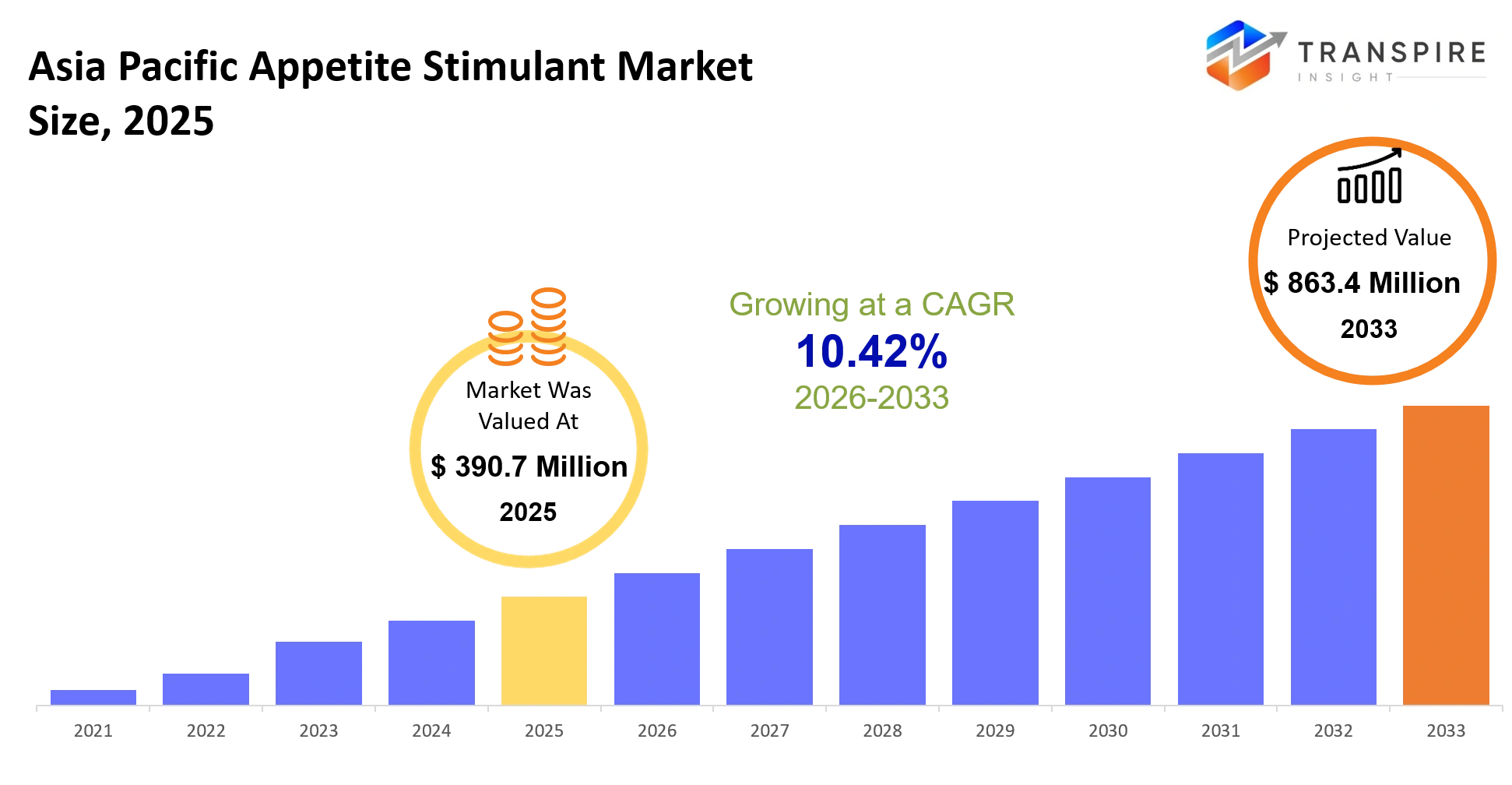
As per Transpire Insight Analysis the Asia Pacific Appetite Stimulant Market size is estimated at USD 390.7 Million in 2025 and is anticipated to reach USD 863.4 Million by 2033, growing at a CAGR of 10.42% from 2026 to 2033.
The Asia Pacific Appetite Stimulant Market kind of works for healthcare providers, caretakers, and nutrition oriented companies, because it deals with this ongoing shortfall of adequate food intake, specially for people facing appetite loss from chronic illnesses, aging up, recovery periods, or metabolic troubles. It’s also, in a way, about nudging better appetite so patients can keep up their nutrition, rather than letting everything go off track. In practice, these products assist in better nutritional results, because they keep calorie intake steadier and help patient health stay on track when normal, natural eating routines get disturbed, kind of out of sync.
Over the past 3–5 years, the whole landscape has moved toward clinically supported formulations. That shift has pharmaceutical players more focused on targeted therapies, plus more efficient delivery formats, because “how it’s given” matters almost as much as the active ingredients. One big turning point was the disruption created by the COVID-19 pandemic, which showed how nutritional vulnerabilities can get exposed fast in vulnerable groups. After that, people started paying much closer attention to supportive care solutions, more than before.
Right now, expansion is being pushed by the need for stronger handling of malnutrition risk, better healthcare infrastructure across Asia Pacific, and more thorough integration of appetite support products into long term patient care strategies, not just short interventions.
Asia Pacific Appetite Stimulant Market Size & Forecast:
- Asia Pacific Appetite Stimulant Market Size 2025: USD 390.7 Million
- Expected Market Value 2033: USD 863.4 Million
- Forecast CAGR: 10.42%
- Leading region in 2025: East Asia
- Fastest Growing region: South Asia
- Key Profile: Pfizer, Abbott Laboratories, Nestlé Health Science, Fresenius Kabi, GlaxoSmithKline, Cipla, Sun Pharmaceutical, Dr. Reddy's Laboratories, Viatris, Novartis, Sanofi, AstraZeneca, Amway, Himalaya Wellness, Bayer
Key Market Insights
- East Asia basically dominates the market , with around 45% share in 2025, mostly helped by advanced healthcare systems and the aging demographics. It feels like the whole balance is pretty much there already.
- South Asia is the fastest-moving region across 2025–2033, helped by healthcare expansion and clinical nutrition programs that keep getting wider.
- In terms of product type, pharmaceutical appetite stimulants lead the segments, taking close to 60% share, and that’s backed by prescription-based treatment adoption.
- On the other hand, nutritional supplements land as the second-largest segment, since preventive healthcare usage keeps rising across Asia Pacific.
- For formulations, liquid appetite stimulants are the fastest-growing through 2033, enabled by improved patient compliance ,and easier administration overall.
- When you look at applications, cancer-related appetite loss management stays in the lead with about 35% share, supported by the continued expansion of oncology care.
- Meanwhile, geriatric nutrition management is growing the quickest since older populations are increasing the need for nutritional intervention.
- By end users, hospitals and clinics are leading , with more than 50% share because institutional treatment protocols stay in place.
- And home healthcare providers are the fastest-growing end-user category as outpatient nutritional management expands after 2025.
What are the Key Drivers, Restraints, and Opportunities in the Asia Pacific Appetite Stimulant Market?
The main growth force shaping the Asia Pacific Appetite Stimulant Market is really the expansion of clinical nutrition programs tied to aging population numbers, and also chronic disease management. Healthcare providers have been moving more toward proactive nutritional intervention, after COVID-19 sort of exposed how vulnerable patients can be during recovery windows. In practice this shift in technology plus care-model approach has led to higher uptake of pharmaceutical formulations and specialized nutrition products, since many hospitals want better solutions for people who have reduced food intake. Also, stronger healthcare spending across China, India, and Southeast Asia is directly helping the market earn more revenue.
On the other hand the big restraint is the limited clinical standardization together with regulatory variation across Asia Pacific countries. When approval pathways differ widely, product launch timeframes stretch out, and compliance costs for manufacturers tend to go up. Smaller firms often hit slower market entry because clinical validation expectations, plus regional distribution obstacles, keep the expansion pace from moving quickly. Based on a Transpire Insight review of regional procurement announcements and launch schedules, supply chain concentration stays the main execution risk. Overall these limits may lower product availability, and that can in turn delay commercialization opportunities.
The next growth opportunity is kind of sitting in personalized nutrition tech, and in AI-enabled patient monitoring systems too. In Japan, South Korea, and India digital health investments are, well, creating the right kind of conditions for data based nutritional approaches. For companies that connect patient analytics with appetite management tools, there’s a chance to make treatment outcomes more precise, increase physician buy-in, and open fresh income streams in home healthcare markets.
What Has the Impact of Artificial Intelligence Been on the Asia Pacific Appetite Stimulant Market?
Artificial intelligence and digital technologies are slowly, maybe a bit inevitably, reshaping appetite management solutions across the Asia Pacific region by making patient monitoring easier, improving product planning, and helping with healthcare coordination. AI platforms can dig through patient records, nutritional trends, and treatment outcomes, so they can back tailored appetite stimulation approaches. Healthcare teams are also leaning on digital monitoring tools to follow calorie intake, medication reactions, and nutritional recovery progress, this way they don’t have to rely so much on manual check ups.
At the same time, machine learning models are being used by manufacturers for demand forecasting, to estimate regional product requirements from disease patterns, demographic shifts, and how much healthcare is being used in each area. With these insights , companies can fine tune inventory schedules a bit , and cut down on supply disruptions like it’s no big deal. In practice , advanced analytics can help day to day efficiency , because it supports faster clinical decisions, limits wasted resources, and also smooths out patient follow up routines, overall .
Still, AI adoption is held back by several practical issues: high integration costs, fragmented healthcare data systems, and a shortage of solid real-world datasets in many developing Asian markets. A lot of providers don’t have the digital foundation needed for reliable AI deployment, yet. But as connectivity gets better and healthcare digitization expands, artificial intelligence should become a more substantial engine for personalized appetite stimulant development and for distribution efficiency.
Key Market Trends
- In 2024–2025, a bunch of pharmaceutical companies upped their investments in clinical nutrition research, to build more targeted appetite management therapies, though it wasn’t always clear what the next step would be.
- Meanwhile, aging populations in Japan and China made the 2025 demand movement quicker for appetite support products, mainly those used in geriatric care settings.
- Digital health integration, which really took off after 2023, helped teams do remote monitoring of nutritional intake, and also track how patient treatment progress is going.
- In oncology supportive care, appetite management became a more visible priority during 2024, because hospitals started focusing harder on cancer patients.
- Liquid, or just easier-to-administer formulations got more market attention after 2025, mostly because compliance felt stronger among elderly patients who prefer simpler dosing.
- India and Southeast Asia also pulled in strategic healthcare investments after 2024, as manufacturers aimed at under served nutrition care markets, where needs were still widespread.
- And there were regulatory improvements across Asia Pacific markets after 2023, which in practice supported faster approval pathways for specialized healthcare products.
- Later on, AI driven healthcare analytics really came into the picture after 2025, while companies were trialing predictive nutrition management and some more personalized treatment planning, stuff like that.
- Lastly, medical nutrition providers expanded their partnerships after 2024, to help plug appetite solutions into wider patient recovery programs, kind of like a more connected care plan but slightly different, more integrated.
Asia Pacific Appetite Stimulant Market Segmentation
By Product Type :
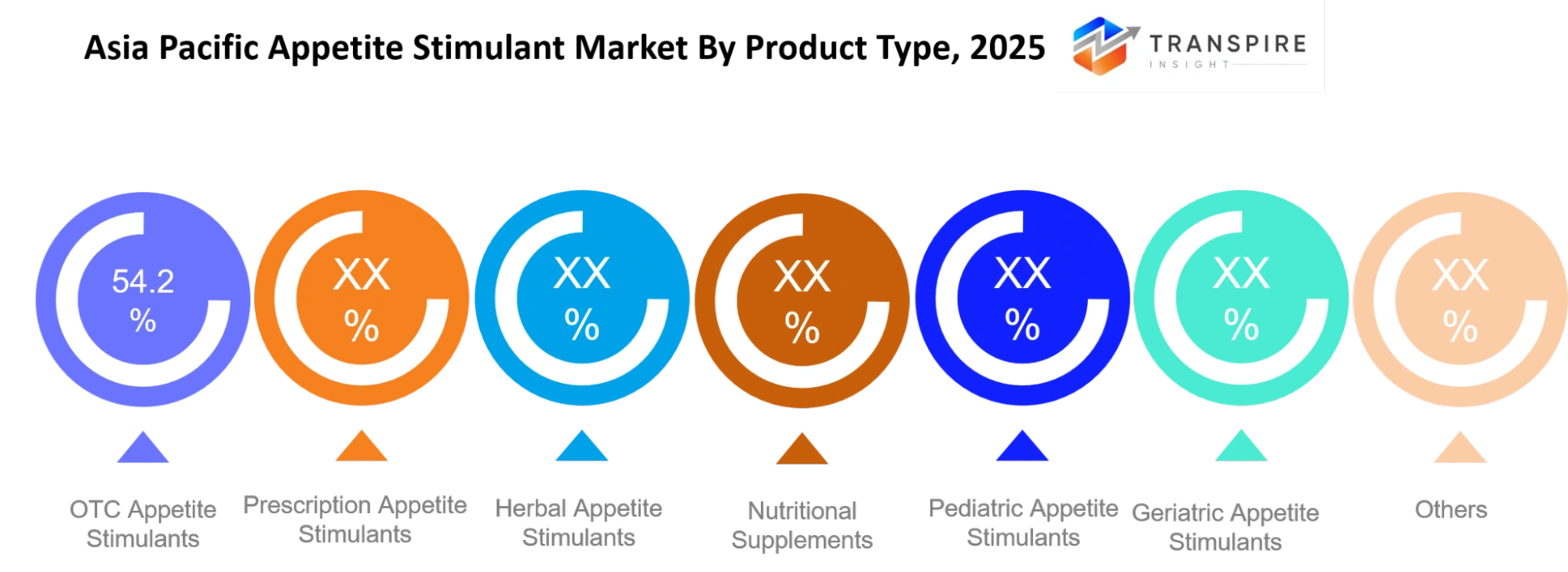
Prescription Appetite Stimulants take up a major place because they are guided by physicians for appetite loss that shows up with long-term illnesses, and also during recovery stages. OTC Appetite Stimulants help with broader reach through self-care outlets, while Herbal Appetite Stimulants pull in people who want plant-based nutrition kind of support. Nutritional Supplements keep getting more attention too, as healthcare providers concentrate on getting calorie intake up and keeping nutritional balance.
Pediatric Appetite Stimulants help kids who deal with feeding difficulties, and Geriatric Appetite Stimulants handle that age-related appetite drop. As product innovation rolls forward, with better formulations, and some tailored nutritional solutions, adoption should keep expanding across clinics, plus homecare spaces.
By Route of Administration :
Oral administration seems to win in adoption, mainly for convenience, easy usage, and generally better tolerance among patients who need appetite help over a longer term. Injectable solutions fit clinical settings where a quicker therapeutic effect is considered more urgent by healthcare professionals. Topical and a few other administration routes still look like smaller segments with limited use but they are slowly developing.
Manufacturers keep pushing to make dosing easier, and to improve patient compliance via newer delivery formats. Healthcare facilities will keep choosing the administration route based on treatment needs, the patient’s current condition, and the overall care environment, which makes sense in practice.
By Application :
Cancer-Related Cachexia shows up as a big use-case, partly because people in oncology are dealing with real nutritional hurdles while they’re on treatment. In the same way, HIV/AIDS care also relies on appetite enhancing solutions, mostly to help maintain nutritional condition during extended, long term support. Beyond that, malnutrition across at-risk groups makes even more room for appetite stimulant adoption— it is pretty noticeable.
On the geriatrics side, plus pediatric care, the demand keeps edging up, thanks to demographic shifts and more specific healthcare programs. Treatment teams are also more often folding appetite support into larger nutritional management plans, aiming for better recovery and overall results.
By Distribution Channel :
When it comes to where these products move, Hospital Pharmacies still act as the main distribution pathway, because clinical staff are the ones recommending appetite support items for inpatient settings and other specialized care situations. Retail Pharmacies stay helpful for outpatient users who want something quick and nearby, while Online Pharmacies are getting stronger too, with digital health growth, and— honestly— easier availability of products.
Drug Stores still serve local communities in a direct way, giving consumers accessible healthcare products. Distribution networks should keep improving through online marketplaces, better logistics systems, and wider access to healthcare across developing Asian regions.
By End User :
Hospitals are a key end-user slice, because appetite stimulant products help patients while they’re dealing with chronic illnesses , recovery stretches, and nutritional deficiencies . Clinics also play a part with outpatient care programs, whereas Rehabilitation Centers lean on nutritional support during the patient’s recovery and the full therapy process.
Homecare Settings keep growing too, since healthcare systems are pushing more remote patient management and longer term care solutions. Overall growth across these end-user groups will likely hinge on upgrades to healthcare infrastructure, changes in patient care models, and broader uptake of nutritional support practices.
What are the Key Use Cases Driving the Asia Pacific Appetite Stimulant Market?
The main use case within the Asia Pacific Appetite Stimulant Market is basically nutritional help for people who run into appetite loss because of medical issues, getting older, or needing recovery support. In practice, healthcare providers, hospitals, and caregivers create much of the demand, they use appetite stimulants to help raise nutritional intake for elderly patients, oncology patients, and individuals dealing with long term disease treatments.
More room is opening up in other areas, like pediatric healthcare and clinical nutrition programs, where specialists tackle poor appetite, along with growth related worries in children. At the same time, sports nutrition and wellness brands are also looking at appetite support products for guided dietary management, aimed at consumers with particular nutritional intentions or goals.
On the newer side, a kind of emerging pattern is showing up where personalized nutrition solutions, and digital health platforms that blend appetite tracking with supplement schedules, seem to be getting attention. Adoption could climb, especially because healthcare systems across Asia Pacific keep pushing preventive care, remote monitoring, and more individualized therapy paths, so there is a smoother fit with what people need each day.
|
Report Metrics |
Details |
|
Market size value in 2025 |
USD 390.7 Million |
|
Market size value in 2026 |
USD 431.4 Million |
|
Revenue forecast in 2033 |
USD 863.4 Million |
|
Growth rate |
CAGR of 10.42% from 2026 to 2033 |
|
Base year |
2025 |
|
Historical data |
2021 - 2024 |
|
Forecast period |
2026 - 2033 |
|
Report coverage |
Revenue forecast, competitive landscape, growth factors, and trends |
|
Regional scope |
Asia Pacific (India, China, Japan, Australia, South Korea, Rest of Asia Pacific) |
|
Key company profiled |
Pfizer, Abbott Laboratories, Nestlé Health Science, Fresenius Kabi, GlaxoSmithKline, Cipla, Sun Pharmaceutical, Dr. Reddy's Laboratories, Viatris, Novartis, Sanofi, AstraZeneca, Amway, Himalaya Wellness, Bayer . |
|
Customization scope |
Free report customization (country, regional & segment scope). Avail customized purchase options to meet your exact research needs. |
|
Report Segmentation |
By Product Type (Prescription Appetite Stimulants, OTC Appetite Stimulants, Herbal Appetite Stimulants, Nutritional Supplements, Pediatric Appetite Stimulants, Geriatric Appetite Stimulants, Others); By Route of Administration (Oral, Injectable, Topical, Others); By Application (Cancer-Related Cachexia, HIV/AIDS, Eating Disorders, Malnutrition, Geriatric Care, Pediatric Care, Others); By Distribution Channel (Hospital Pharmacies, Retail Pharmacies, Online Pharmacies, Drug Stores, Others); By End User (Hospitals, Clinics, Homecare Settings, Rehabilitation Centers, Others) |
Which Regions are Driving the Asia Pacific Appetite Stimulant Market Growth?
The Asia Pacific Appetite Stimulant Market is, really, mostly pushed forward by East Asia, which is estimated to hold around 35–40% share because of more mature healthcare infrastructure and a higher level of uptake in clinical nutrition solutions. There are strong pharmaceutical regulations too , plus hospital networks and government-backed elderly care initiatives. Together they make the adoption process feel a lot easier, or at least more natural for appetite stimulant products. East Asia also gets an extra boost from solid manufacturing strengths, continuous research investments, and long standing distribution pathways across China, Japan, and South Korea. This kind of edge should stay in place, as aging populations keep growing, and chronic disease management programs keep demand steady all the way through 2033.
South Asia on the other hand, feels like a different growth story, with momentum coming from wider healthcare reach, better medical facilities, and higher investments in nutritional care programs. In places like India , the market can generate dependable revenue as healthcare spending rises, pharmaceutical production grows, and more affordable treatment options become easier to find. Regulatory progress helps , and private healthcare expansion also supports steady advancement in the market. Plus, the region has a very large patient base, so even when healthcare penetration levels vary, there’s still a level of stable demand.
Southeast Asia is projected to see the quickest growth since healthcare modernization, urbanization, and better access to pharmaceutical products are moving things along for appetite stimulant adoption. As more capital goes into hospitals, community health programs, and nutritional support initiatives, new demand routes are opening across developing economies. At the same time, more healthcare providers, plus everyday consumers, are becoming aware that the market is expanding beyond the usual, traditional uses, too. All of this, in turn, is building opportunities for manufacturers and investors who want regional partnerships and localized product approaches during 2026–2033.
Who are the Key Players in the Asia Pacific Appetite Stimulant Market and How Do They Compete?
Competition in the Asia Pacific Appetite Stimulant market is moderately fragmented, with pharmaceutical groups, nutrition brands, and regional manufacturers going after position via product formulation, regulatory approvals, distribution reach and targeted healthcare use. Cost efficiency still matters a lot, especially in emerging economies, but firms that bring specialized formulations and stronger clinical proof try to stand apart. Meanwhile, bigger pharmaceutical players are defending share using wider portfolios, and smaller players are slipping into niche spaces aimed at pediatric nutrition, elderly care, and therapeutic supplementation, even if the entry moves are slower.
Pfizer Inc. competes by offering prescription-based healthcare solutions and leaning on global regulatory know-how, it uses its research strengths plus established medical networks to back specialized therapeutic products. Abbott Laboratories differentiates through clinical nutrition capability, it provides science backed nutritional items that link appetite support with broader patient care programs. Nestlé Health Science centers on personalized nutrition and medical nutrition solutions, and it keeps expanding through product innovation and healthcare partnerships. Bayer AG brings pharmaceutical research depth and regional distribution advantage, and it develops nutrition offerings for both consumers and healthcare channels. All of these players, they tend to combine scientific validation, regulatory compliance, and targeted expansion efforts, instead of depending only on price.
Company List
- Pfizer
- Abbott Laboratories
- Nestlé Health Science
- Fresenius Kabi
- GlaxoSmithKline
- Cipla
- Sun Pharmaceutical
- Dr. Reddy's Laboratories
- Viatris
- Novartis
- Sanofi
- AstraZeneca
- Amway
- Himalaya Wellness
- Bayer
Recent Development News
In April 2026, Rusan Healthcare launched the APOSAN 3ml Multi-Dose Pen in India. The product launch introduced an advanced delivery format for apomorphine therapy, demonstrating pharmaceutical companies’ focus on patient-friendly drug delivery systems that support appetite-related and neurological care segments. Sourcehttps://firstwordpharma.com/
In January 2025, Zuellig Pharma acquired Propan from ADP Pharma Corporation in the Philippines. The acquisition expanded Zuellig Pharma’s consumer healthcare portfolio by adding a recognized multivitamin and appetite stimulant brand, strengthening its position in the Philippine nutritional supplement segment. Sourcehttps://www.zuelligpharma.com/
What Strategic Insights Define the Future of the Asia Pacific Appetite Stimulant Market?
The Asia Pacific Appetite Stimulant market is moving, sorta toward more clinically integrated and personalized nutrition solutions in the next 5–7 years, driven by aging population trends, chronic disease management needs and, also by expanding healthcare access. There’s a less visible risk tied to regulatory tightening around appetite related supplements and pharmaceutical ingredients, that could end up restricting what products are available and raise compliance costs in the important markets. Meanwhile an opportunity is showing up with AI enabled nutritional monitoring platforms that combine patient data with more targeted appetite support therapies, particularly as some Asian healthcare systems get more digitally capable. Market players should focus on evidence based product development, build stronger regulatory capabilities, and create partnerships with healthcare providers, to help adoption actually stick. Firms that connect their appetite stimulant offerings to personalized care models rather than just traditional add-on supplementation are likely to be better placed for sustainable growth over the long haul.
Asia Pacific Appetite Stimulant Market Report Segmentation
By Product Type
- Prescription Appetite Stimulants
- OTC Appetite Stimulants
- Herbal Appetite Stimulants
- Nutritional Supplements
- Pediatric Appetite Stimulants
- Geriatric Appetite Stimulants
By Route of Administration
- Oral
- Injectable
- Topical
By Application
- Cancer-Related Cachexia
- HIV/AIDS
- Eating Disorders
- Malnutrition
- Geriatric Care
- Pediatric Care
By Distribution Channel
- Hospital Pharmacies
- Retail Pharmacies
- Online Pharmacies
- Drug Stores
By End User
- Hospitals
- Clinics
- Homecare Settings
- Rehabilitation Centers
Frequently Asked Questions
Find quick answers to common questions.
The expected Asia Pacific Appetite Stimulant Market size for the market will be USD 863.4 Million in 2033.
Key segments for the Asia Pacific Appetite Stimulant Market are By Product Type (Prescription Appetite Stimulants, OTC Appetite Stimulants, Herbal Appetite Stimulants, Nutritional Supplements, Pediatric Appetite Stimulants, Geriatric Appetite Stimulants, Others); By Route of Administration (Oral, Injectable, Topical, Others); By Application (Cancer-Related Cachexia, HIV/AIDS, Eating Disorders, Malnutrition, Geriatric Care, Pediatric Care, Others); By Distribution Channel (Hospital Pharmacies, Retail Pharmacies, Online Pharmacies, Drug Stores, Others); By End User (Hospitals, Clinics, Homecare Settings, Rehabilitation Centers, Others).
Major Asia Pacific Appetite Stimulant Market players are Pfizer, Abbott Laboratories, Nestlé Health Science, Fresenius Kabi, GlaxoSmithKline, Cipla, Sun Pharmaceutical, Dr. Reddy's Laboratories, Viatris, Novartis, Sanofi, AstraZeneca, Amway, Himalaya Wellness, Bayer.
The Asia Pacific Appetite Stimulant Market size is USD 390.7 Million in 2025.
The Asia Pacific Appetite Stimulant Market CAGR is 10.42% from 2026 to 2033.
- Pfizer
- Abbott Laboratories
- Nestlé Health Science
- Fresenius Kabi
- GlaxoSmithKline
- Cipla
- Sun Pharmaceutical
- Dr. Reddy's Laboratories
- Viatris
- Novartis
- Sanofi
- AstraZeneca
- Amway
- Himalaya Wellness
- Bayer
About the Authors

Pankaj Ghogare Patil
I am Pankaj Ghogare Patil, a Senior Research Analyst at Transpire Insight, specializing in the Pharmaceutical, Chemicals & Materials, Healthcare IT, and Biotechnology industry. My expertise lies in conducting comprehensive market research, analyzing industry trends, evaluating competitive landscapes, and translating complex data into actionable insights. At Transpire Insight, I closely follow emerging technologies, regulatory developments, and market innovations to create accurate, well-researched, and informative content that helps businesses and professionals make informed decisions. I am committed to producing credible, evidence-based articles that reflect industry best practices while making technical topics accessible and valuable for a broad audience.

Chakradhar Khansole
Chakradhar serves as the Research Director at Transpire Insight, bringing over 8 years of experience in technology, innovation, and strategic market intelligence. He specializes in transforming complex market data into actionable business insights that enable organizations to make informed, growth-oriented decisions. Recognized for his strategic vision and analytical expertise, Chakradhar leads high-impact research initiatives, delivering comprehensive market assessments, competitive intelligence, and forward-looking industry analysis.
Recently Published Reports
-
Jul 2026
Alopecia Treatment Market
Alopecia Treatment Market Size, Share & Analysis Report By Disease Type (Alopecia Areata, Cicatricial Alopecia, Traction Alopecia, Alopecia Totalis, Androgenetic Alopecia, Alopecia Universalis, and Other Disease Types), By Treatment Type (Topical Treatments, Oral Medications, Injectable Therapies, and Hair Transplantation), By Gender (Male, and Female), By Distribution Channel (Hospitals and Clinics, Retail Pharmacies, and Online Retailers), and Geography (North America, Europe, Asia-Pacific, Middle East and Africa, South and Central America), 2021 - 2031
-
Jul 2026
Medical Ultrasound Probe Market
Medical Ultrasound Probe Market Size, Share & Analysis Report By Type (Linear Type, Convex Type, Endocavitary Probe, Phased Array/Cardiac Probe, Transesophageal (TEE) Probe, and Others), By Application (Ophthalmology, Cardiology, Musculoskeletal, Oncology, Obstetrics & Gynecology, General Imaging, and Others), By End User (Hospitals & Clinics, Diagnostic Centers, Ambulatory Surgical Centers, and Others), and Geography (North America, Europe, Asia-Pacific, Middle East and Africa, South and Central America), 2021 – 2031
-
May 2026
Biosimilars Market
Biosimilars Market By Product Type (Monoclonal Antibodies, Recombinant Hormones, Erythropoietin, G-CSF, Others), By Indication (Oncology, Autoimmune Diseases, Blood Disorders, Diabetes, Others), By Manufacturing Type (In-House Manufacturing, Contract Manufacturing), By Distribution Channel (Hospital Pharmacies, Retail Pharmacies, Online Pharmacies), By Industry Analysis, Size, Share, Growth, Trends, and Forecasts 2021-2033
-
Apr 2026
Gastrointestinal Endoscopy Market
Gastrointestinal Endoscopy Market By Type (Rigid Gastrointestinal Endoscope, Flexible Gastrointestinal Endoscopes, Disposable Gastrointestinal Endoscope), By Procedure Type (Colonoscopy, Gastroscopy, Duodenoscopy, Enteroscopy, Flexible Sigmoidoscopy, Others), By Application (Diagnosis, Treatment), By End-Users (Hospitals, Ambulatory Surgical Centers, Specialty Clinics, Laboratories, Others), By Industry Analysis, Size, Share, Growth, Trends, and Forecasts 2021-2033