

Asia Pacific Air Cooled Heat Exchanger Market Summary
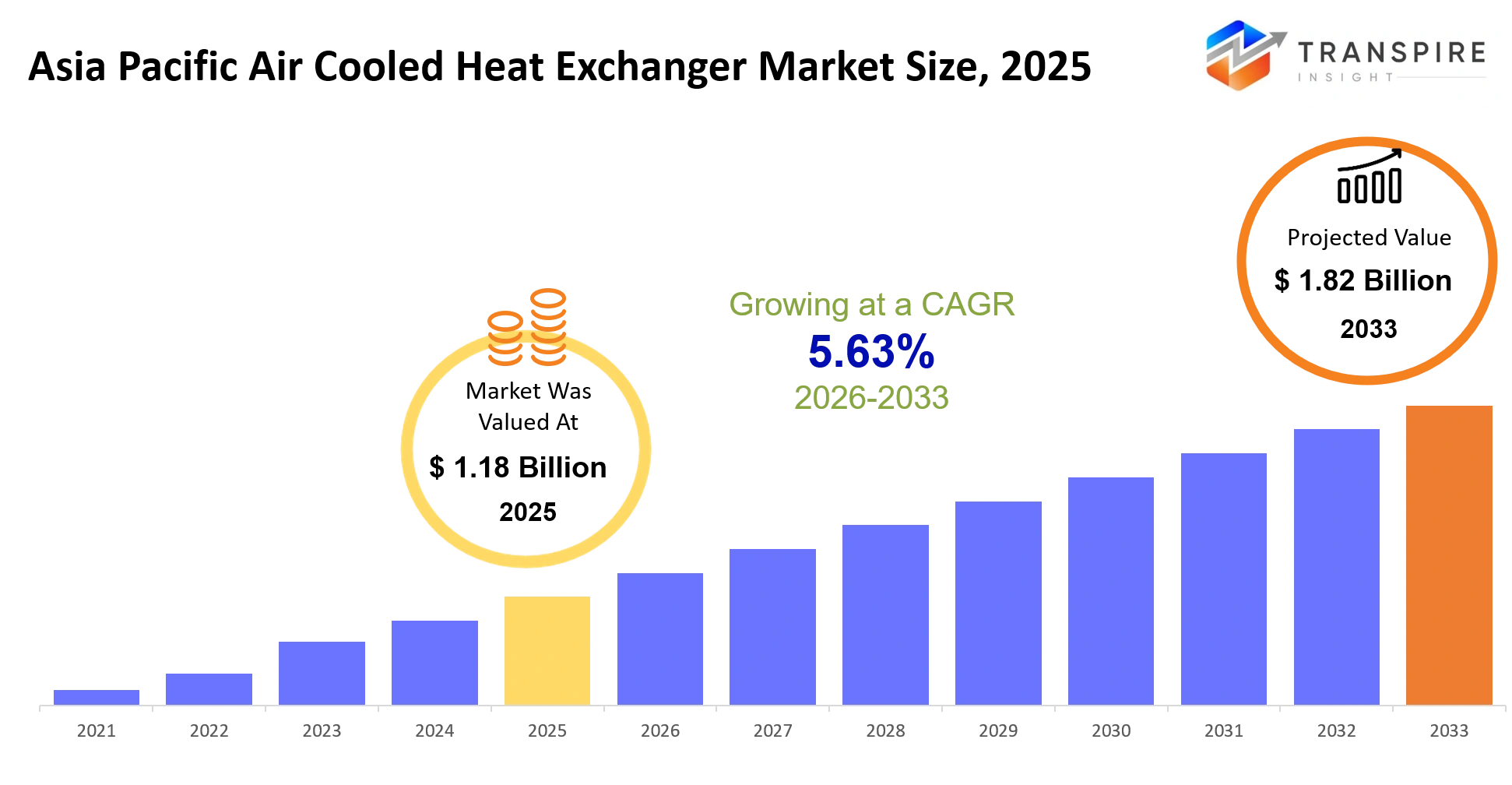
As per Transpire Insight Analysis the Asia Pacific Air Cooled Heat Exchanger Market size is estimated at USD 1.18 Billion in 2025 and is anticipated to reach USD 1.82 Billion by 2033, growing at a CAGR of 5.63% from 2026 to 2033.
The Asia Pacific Air Cooled Heat Exchanger Market kinda supports industries that need to move or draw off process heat, without depending on huge amounts of water. This makes day to day operations a lot more dependable in areas dealing with water scarcity or where cooling infrastructure is kinda limited. Refineries, petrochemical facilities, power generation sites, mining locations, and natural gas processing units use these setups to keep operating temperatures steady, while also cutting down on water consumption and making plant upkeep less complicated. Over the last, three to five years, investment has been sliding toward energy efficient, higher capacity exchanger designs, which matches industrial decarbonization goals and these tighter environmental requirements. During the pandemic, supply chain disruptions showed the downside of leaning on water intensive cooling systems and they also slowed down equipment procurement, so many operators started modernizing facilities with more resilient alternatives. Now as industrial expansion continues, and environmental compliance gets stricter, air cooled heat exchangers are turning into a preferred long term option. That shift is driving stronger replacement pull, wider use across new projects, and more stable revenue streams for equipment manufacturers as well as engineering contractors.
Asia Pacific Air Cooled Heat Exchanger Market Size & Forecast:
- Asia Pacific Air Cooled Heat Exchanger Market Size 2025: USD 1.18 Billion
- Expected Market Value 2033: USD 1.82 Billion
- Forecast CAGR: 5.63%
- Leading region in 2025: China
- Fastest Growing region: India
- Key Profile: SPX Cooling Technologies, Kelvion, Alfa Laval, Chart Industries, API Heat Transfer, Xylem, Hammon, Güntner, Thermax, Babcock & Wilcox, Johnson Controls, Baltimore Aircoil Company, Koch Heat Transfer, Tranter, Danfoss.
Key Market Insights
- China kind of dominated the regional market with about 42% share in 2025, backed by refinery upgrades, petrochemical investments and large-scale industrial capacity expansion that basically keeps going.
- India is projected to be the fastest-growing regional market during 2025–2033 , driven by new power generation, LNG and chemical processing projects, which is sort of the main story there.
- In the product segment, Forced draft air cooled heat exchangers led with nearly 48% market share in 2025, helped by wide industrial deployment plus lower operating expenses overall.
- Induced draft systems stayed as the second-largest segment, since operators kept focusing on improved thermal performance, especially for high-capacity industrial facilities that need it.
- Hybrid air cooled heat exchangers are forecast to show the quickest growth through 2033, supported by tougher water conservation targets, and also by efficiency upgrades.
- Petrochemical and refining applications accounted for around 36% market share in 2025, reflecting ongoing investment into process cooling infrastructure , not just one-off projects.
- Natural gas and LNG processing is expected to register the fastest application growth through 2033, supported by regional energy security investments and export capacity expansion plans.
- Oil and gas companies represented the leading end-user slice with approximately 39% share in 2025, mainly because they’re modernizing upstream and downstream facilities.
- Power generation will emerge as the fastest-growing end-user category during 2025–2033, supported by thermal plant upgrades, plus industrial electrification projects, which makes sense in practice.
What are the Key Drivers, Restraints, and Opportunities in the Asia Pacific Air Cooled Heat Exchanger Market?
The strongest growth driver is industrial investment that prioritizes water efficient thermal management, and honestly this focus is getting more attention lately. With tighter environmental regulations and stricter water withdrawal limits, refineries, LNG terminals, and chemical plants are replacing water based cooling systems faster than before. A lot of new industrial projects now specify air cooled systems during the design phase rather than coming back later for retrofitting. That change tends to cut long term operating costs, makes regulatory compliance feel less complicated , and also improves the overall project economics. So the outcome is more equipment orders, stronger engineering contracts, and more aftermarket service revenue across the regional heat exchange industry.
The largest restraint is still supply chain concentration for critical components like high performance fans, finned tubes, specialty alloys, and precision fabrication. Based on Transpire Insight review of regional procurement announcements and launch schedules, this concentration remains the main execution risk, even when demand looks healthy. Capacity expansion for those specialized inputs takes years of investment and qualification. If lead times stretch, project commissioning gets pushed out, annual equipment shipments get suppressed, and revenue recognition for manufacturers and EPC contractors gets delayed , sometimes quite noticeably.
There is a pretty big chance in digitally connected heat exchange systems that are actually plugged into industrial automation platforms. With AI-enabled monitoring , digital twins (or “virtual replicas” if you want), and more sophisticated control software, operators can tweak the airflow in a smarter way, cut energy consumption, and generally make equipment last longer. India plus Southeast Asia look especially attractive , since industrial parks and petrochemical complexes, and also LNG infrastructure are still ramping up. So these kinds of investments should keep generating steady demand for premium cooling technologies that are digitally enabled over the next ten years or so, even if the market mood shifts a bit.
What Has the Impact of Artificial Intelligence Been on the Asia Pacific Air Cooled Heat Exchanger Market?
Artificial intelligence and digital technologies are kinda changing, at this point, the way industrial cooling assets are designed, watched, and looked after across the regional thermal equipment industry. In modern air cooled heat exchanger installations you now see intelligent sensors, plus automated control systems, and cloud based analytics, all of them continuously steering fan speed, airflow distribution, and thermal performance based on whatever is happening in operation. The goal is pretty simple, reduce wasted energy while still keeping process temperatures steady even when production loads shift around.
Also machine learning models are stepping in for predictive maintenance. They can catch vibration anomalies, fouling patterns, bearing wear, and even that slow decline in heat transfer efficiency before a failure actually shows up. This lets operators plan maintenance during scheduled shutdowns, instead of waiting for unexpected breakdowns. Digital forecasting tools then help with spare parts planning and production timing, so plant availability goes up, while maintenance costs go down. A lot of industrial operators report actual measurable gains like better equipment uptime, reduced power draw, and more consistent regulatory compliance after putting in advanced monitoring platforms.
Still, AI adoption is not fully smooth. The rollout gets constrained by the integration costs which can be high, and by fragmented operational data in older facilities. Legacy control systems often do not have standardized digital interfaces, so big deployment becomes expensive and technically complicated. And the data quality, it can be inconsistent, which can hurt prediction accuracy when operating conditions are highly variable. Because of that some industrial users don’t see immediate returns, even if the idea sounds promising.
Key Market Trends
- Artificial intelligence and digital tools are kinda changing the way industrial cooling assets are built, watched, and kept up across the whole regional thermal equipment industry.
- Nowadays, many air cooled heat exchanger setups increasingly rely on smart sensors, automated control setups , and cloud based analytics that keep tweaking fan speed, airflow layout, and heat performance depending on what’s happening during operation.
- In practice this cuts down on wasted energy use, while still keeping process temperatures fairly stable even when production loads swing around.
- Also, machine learning is getting better at predictive maintenance, by spotting vibration oddities, fouling trends, bearing aging, and even drops in heat transfer efficiency before anything turns into a real failure.
- So operators can arrange maintenance during planned shutdown windows, rather than only reacting when equipment breaks unexpectedly.
- Digital forecasting tools help with spare parts forecasting and production timing too, which boosts plant availability and, at the same time, brings down maintenance expenses.
- A lot of industrial operators say they’ve seen clear gains in uptime, reduced power draw, and steadier regulatory compliance after installing advanced monitoring platforms.
- Still, AI adoption is limited by stuff like integration costs that can be high and operational data that is scattered across older facilities.
- Older control systems often don’t have standardized digital connections, so large scale rollout becomes expensive, and technically more complicated than it sounds at first.
- On top of that, inconsistencies in data quality can weaken prediction accuracy, especially when operating conditions vary a lot, so some industrial users don’t feel fast returns.
Asia Pacific Air Cooled Heat Exchanger Market Segmentation
By Product Type :
Forced Draft Heat Exchangers kinda take the front, since most industrial plants still care about stable airflow, smoother cooling cycles and maintenance that feels a bit simpler across big processing sites. You can see strong adoption going on in oil, gas , petrochemical and power generation projects , especially where steady thermal performance helps production stay uninterrupted. There’s also less hassle during installation and the operating performance stays dependable, which makes long term purchasing decisions feel more solid. With ongoing capacity expansion in industrial sectors, demand for this segment will keep getting a boost.
Induced Draft Heat Exchangers sit in the second-largest slice, mainly because cooling efficiency goes higher in tougher operating environments. Natural Draft Heat Exchangers are used in a smaller set of large scale facilities, where actual operating conditions let natural airflow work well. V-Type Heat Exchangers will likely show the fastest growth, since compact layouts support better heat transfer , while also cutting down land needs. A-Frame Heat Exchangers plus other specialized designs will keep serving situations that call for customized thermal performance, and site specific engineering work.
By Material :
Carbon steel is usually the go-to, in material selection, because it has a competitive cost, a respectable structural strength, and it actually fits the usual industrial operating conditions. It is also broadly available, plus there are well known fabrication skills, so companies can use it across refineries, chemical plants, and power stations. Even bigger infrastructure investments keep the demand steady, and that keeps carbon steel equipment in the mix. Plus, a long service life, tends to boost purchasing confidence, for industrial operators who do not want surprises.
Stainless steel stays near the top, as the second main material segment, largely because corrosion resistance helps reliability especially in tough processing environments. Aluminum is also still drawing more attention where lighter construction matters and the better thermal conductivity helps day to day operations. Titanium and copper alloys support more niche installations, where they need resistance against aggressive chemicals or extreme temperatures, and the project cannot compromise. Then there are the other materials, which keep showing up in tailored builds, designed around specific process requirements, even if those needs are a bit unusual.
By Application :
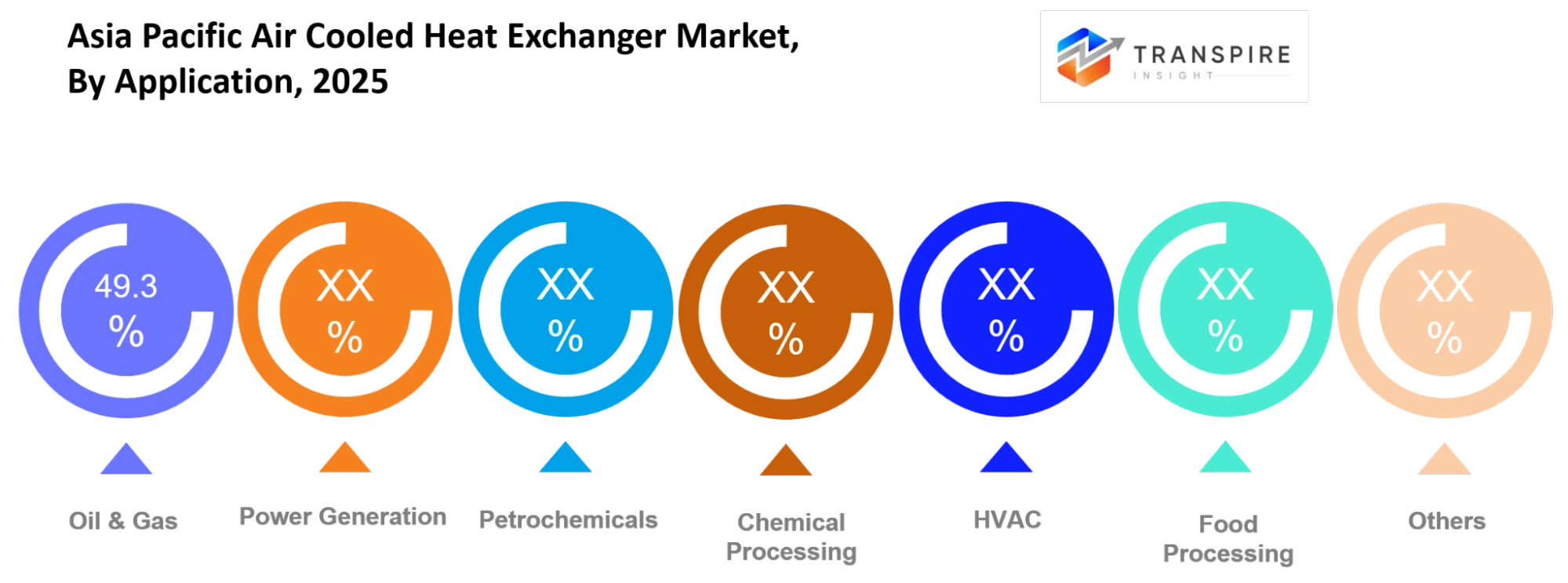
Oil & Gas keeps being the main use, mostly because upstream, midstream, and downstream facilities need dependable cooling for nonstop operations. The growth of refining capacity, LNG infrastructure, and gas processing projects also helps keep equipment buying steady across the region. With solid temperature control, operations run more efficiently, and you tend to see fewer production stops . Besides that, the long investment cycles naturally back replacement work for those older cooling systems.
Power Generation comes in as the next biggest category, since thermal plants are still modernizing their cooling infrastructure. Petrochemicals and chemical processing stay busy too , driven by capacity increases and process upgrades. HVAC and Food Processing should move up gradually, as industrial cooling needs keep getting more specialized. Other industrial uses will add more chances as well through customized engineering jobs, even if it sometimes feels slower at first.
By End User :
Oil & Gas Companies take up the largest share, mainly because ongoing production relies on good heat rejection across extraction, transport, and refining actions. On top of that, big capital spending keeps backing the placement of advanced cooling units at both new sites and older facilities. When operating conditions stay steady, maintenance needs tend to drop, and overall plant output goes up. Over time, longer-range infrastructure build outs also support longer replacement cycles for the equipment, or at least makes them more reliable.
Power Plants end up as the second-biggest end-user segment, driven by the modernization of thermal generation assets. Chemical Manufacturers keep growing their output, especially near major industrial hubs, while Industrial Facilities are expected to show the quickest growth as manufacturing investment speeds up across developing economies. Refineries and the other industrial users are likely to keep their purchasing patterns steady, largely because efficiency improvement programs plus capacity expansion initiatives help them do so.
By Cooling Type :
Dry Cooling Systems are leading, mostly because industrial operators need dependable cooling without making big water use. Over time, water conservation policies and tougher environmental rules still push adoption forward across power generation, petrochemical processing, and heavy manufacturing. When they depend less on water resources, operations become more flexible even in water stressed locations. Also, steady lifecycle performance helps people make calmer long term investment choices, not only immediate ones.
Hybrid Cooling Systems feel like the fastest growth lane, since operators try to trade cooling performance with reduced resource consumption. Closed Loop Cooling keeps showing up in plants that want controlled operating conditions, plus process reliability. And there are other cooling technologies too, they fit specialized industrial installations where the surroundings need a tailored thermal management approach. With continued technology improvements, deployments should expand further across complicated industrial applications.
What are the Key Use Cases Driving the Asia Pacific Air Cooled Heat Exchanger Market?
Oil and gas operations are basically the main use case, because continuous temperature control is kind of needed to keep things safe and running efficiently, not just once but all the time. Refineries, gas processing plants, and pipeline operators end up buying these systems in order to keep production steady while also lowering their dependence on process water especially in those water-constrained industrial zones.
At the same time, power generation and chemical processing are getting bigger too, since plant upgrades are more and more about thermal efficiency, plus meeting tougher environmental standards. Industrial facilities, alongside chemical manufacturers, are installing more advanced cooling equipment too, to back up capacity expansion, increase day to day operational reliability, and cut down maintenance interruptions that otherwise show up unexpectedly.
Then there are newer use cases starting to form, like in hydrogen production facilities and carbon capture projects, where dependable heat rejection really supports different process configurations. Buyers who are tied to clean energy infrastructure and advanced industrial manufacturing are looking at these systems to meet future environmental expectations, while also improving long term operating performance across next generation facilities.
|
Report Metrics |
Details |
|
Market size value in 2025 |
USD 1.18 Billion |
|
Market size value in 2026 |
USD 1.24 Billion |
|
Revenue forecast in 2033 |
USD 1.82 Billion |
|
Growth rate |
CAGR of 5.63% from 2026 to 2033 |
|
Base year |
2025 |
|
Historical data |
2021 - 2024 |
|
Forecast period |
2026 - 2033 |
|
Report coverage |
Revenue forecast, competitive landscape, growth factors, and trends |
|
Regional scope |
Asia Pacific (India, China, Japan, Australia, South Korea, Rest of Asia Pacific) |
|
Key company profiled |
SPX Cooling Technologies, Kelvion, Alfa Laval, Chart Industries, API Heat Transfer, Xylem, Hammon, Güntner, Thermax, Babcock & Wilcox, Johnson Controls, Baltimore Aircoil Company, Koch Heat Transfer, Tranter, Danfoss. |
|
Customization scope |
Free report customization (country, regional & segment scope). Avail customized purchase options to meet your exact research needs. |
|
Report Segmentation |
By Product Type (Forced Draft Heat Exchangers, Induced Draft Heat Exchangers, Natural Draft Heat Exchangers, V-Type Heat Exchangers, A-Frame Heat Exchangers, Others); By Material (Carbon Steel, Stainless Steel, Aluminum, Copper Alloys, Titanium, Others); By Application (Oil & Gas, Power Generation, Petrochemicals, Chemical Processing, HVAC, Food Processing, Others); By End User (Oil & Gas Companies, Power Plants, Chemical Manufacturers, Industrial Facilities, Refineries, Others); By Cooling Type (Dry Cooling Systems, Hybrid Cooling Systems, Closed Loop Cooling, Others). |
Which Regions are Driving the Asia Pacific Air Cooled Heat Exchanger Market Growth?
East Asia kind of dominates the Asia Pacific Air Cooled Heat Exchanger Market, with an estimated share near 46% of regional revenue, backed by broad industrial capacity in China, Japan , and South Korea. There are also government driven pushes for refining, petrochemicals, power generation and emission control upgrades. These moves, plus tight industrial efficiency regulations, keep regional demand getting more solid. On top of that, a rather mature manufacturing ecosystem , dependable domestic fabrication knowhow, and specialized component suppliers help keep production and deployment moving. Energy and process industries still put steady capital in place, which really reinforces the overall capability. With energy infrastructure continuing to grow, industrial modernization underway, and replacement demand for high-efficiency heat exchange systems staying strong, the region is likely to keep leading across the whole forecast period.
Southeast Asia sits as the second-largest regional market because demand gets spread across multiple rising industrial economies, and not just locked into one big manufacturing base. Foreign direct investment remains fairly stable, industrial policies are more predictable, and oil and gas, chemicals, and food processing projects keep expanding. So suppliers see steady pipeline after pipeline. Since industrial activity stays diversified across Indonesia, Thailand, Malaysia, and Vietnam, the market doesn’t lean too hard on any single end-use sector. At the same time , it supports more balanced equipment replacement cycles. Altogether, this mix of regulatory continuity, economic resilience, and long-term industrial investment makes Southeast Asia a dependable contributor to regional market revenue.
South Asia is likely to see the quickest growth through 2033, largely pushed by faster industrial growth and massive capital spending across energy, chemicals, and infrastructure , especially in India. In the last years, manufacturing incentives, industrial corridor rollout, plus the ongoing modernization of thermal power and refinery sites, have really boosted the appetite for efficient air cooled heat exchangers. At the same time, fast capacity additions in process industries and a higher take-up of energy efficient cooling approaches are opening up fresh windows for equipment builders and engineering contractors. Overall, this momentum should translate into appealing expansion prospects for newcomers , as well as investors looking for exposure to industrial capex from 2026 up to 2033.
Who are the Key Players in the Asia Pacific Air Cooled Heat Exchanger Market and How Do They Compete?
The competitive landscape in the Asia Pacific Air Cooled Heat Exchanger Market looks kinda moderately fragmented, international engineering firms are in the mix too, yet regional manufacturers are right there alongside them, often with customized fabrication options. In general, rivalry seems to hinge on thermal efficiency, engineering know how, lifecycle reliability, how well projects get executed, plus after sales support, and not only on price. Some established players keep pushing their market positions by doing tech upgrades, and also localizing production, while regional suppliers try to win faster project execution and more application specific designs for industrial customers.
SPX Cooling Technologies stands out because of advanced thermal engineering, cooling systems that are tailored, and broad service coverage for power and industrial facilities. It’s also extending its regional reach via engineering partnerships and modernization efforts, kinda in parallel. Kelvion Holding GmbH tends to compete with high performance heat transfer technology, wide ranging product customization, and digital monitoring tools that help operational efficiency, and that is backed by ongoing product development as well as regional manufacturing expansion. Alfa Laval meanwhile leans into energy efficient thermal offerings and process optimization, pairing solid engineering capability with investments in sustainable product lines and expanded customer assistance across Asia Pacific.
Chart Industries basically leans into specialized heat transfer know-how for LNG, industrial gas, and broader energy needs, so they end up with more edge on those really technically demanding jobs, while also expanding reach via acquisitions and a more cohesive product line. API Heat Transfer meanwhile competes by pushing application specific engineered solutions, and they back that up with flexible manufacturing, quick tailoring, and hands-on technical service. That setup helps them handle diverse requirements across petrochemical, power production, and industrial processing, sort of without a lot of hesitation.
Company List
- SPX Cooling Technologies
- Kelvion
- Alfa Laval
- Chart Industries
- API Heat Transfer
- Xylem
- Hammon
- Güntner
- Thermax
- Babcock & Wilcox
- Johnson Controls
- Baltimore Aircoil Company
- Koch Heat Transfer
- Tranter
- Danfoss
Recent Development News
In January 2026, Kelvion launched K°Focus Carbon Capture & Storage (CCS), a digital platform that helps customers select optimized heat exchange solutions for carbon capture applications. The launch strengthens Kelvion's technology portfolio for energy transition projects, supporting future demand for advanced air cooled heat exchangers across industrial markets.
Source: https://www.kelvion.com/
In August 2025, Apollo-managed Funds announced the acquisition of a majority stake in Kelvion from Triton. The transaction provides additional financial backing for Kelvion's expansion in thermal management technologies, including air cooled heat exchanger solutions serving industrial and energy transition applications.
Source: https://ir.apollo.com/
What Strategic Insights Define the Future of the Asia Pacific Air Cooled Heat Exchanger Market?
The Asia Pacific Air Cooled Heat Exchanger Market is expected to move a bit more toward higher value , energy efficient, and digitally connected cooling setups as industrial decarbonization, refinery modernization, LNG expansion, and tighter efficiency rules reshape capital spending over the next five to seven years . Growth will depend more and more on engineering ability and lifecycle performance rather than just production volume.
There is also a less visible worry , about where critical raw materials come from and how specialized fabrication capacity is clustered, this could make schedules longer and equipment prices higher, even if end user demand stays strong .
At the same time an opening is taking shape around air cooled heat exchangers meant for carbon capture plants, hydrogen generation, and advanced chemical processing, in these cases thermal efficiency needs go beyond typical specs . Firms that start early with localized manufacturing, digital monitoring features, and partnerships involving engineering, procurement and construction contractors, will likely be in a better spot to win long term industrial work and improve competitive staying power across 2026–2033.
Asia Pacific Air Cooled Heat Exchanger Market Report Segmentation
By Product Type
- Forced Draft Heat Exchangers
- Induced Draft Heat Exchangers
- Natural Draft Heat Exchangers
- V-Type Heat Exchangers
- A-Frame Heat Exchangers
By Material
- Carbon Steel
- Stainless Steel
- Aluminum
- Copper Alloys
- Titanium
By Application
- Oil & Gas
- Power Generation
- Petrochemicals
- Chemical Processing
- HVAC
- Food Processing
By End User
- Oil & Gas Companies
- Power Plants
- Chemical Manufacturers
- Industrial Facilities
- Refineries
By Cooling Type
- Dry Cooling Systems
- Hybrid Cooling Systems
- Closed Loop Cooling
Frequently Asked Questions
Find quick answers to common questions.
The expected Asia Pacific Air Cooled Heat Exchanger Market size for the market will be USD 1.82 Billion in 2033.
Key segments for the Asia Pacific Air Cooled Heat Exchanger Market are By Product Type (Forced Draft Heat Exchangers, Induced Draft Heat Exchangers, Natural Draft Heat Exchangers, V-Type Heat Exchangers, A-Frame Heat Exchangers, Others); By Material (Carbon Steel, Stainless Steel, Aluminum, Copper Alloys, Titanium, Others); By Application (Oil & Gas, Power Generation, Petrochemicals, Chemical Processing, HVAC, Food Processing, Others); By End User (Oil & Gas Companies, Power Plants, Chemical Manufacturers, Industrial Facilities, Refineries, Others); By Cooling Type (Dry Cooling Systems, Hybrid Cooling Systems, Closed Loop Cooling, Others).
Major Asia Pacific Air Cooled Heat Exchanger Market players are SPX Cooling Technologies, Kelvion, Alfa Laval, Chart Industries, API Heat Transfer, Xylem, Hammon, Güntner, Thermax, Babcock & Wilcox, Johnson Controls, Baltimore Aircoil Company, Koch Heat Transfer, Tranter, Danfoss.
The Asia Pacific Air Cooled Heat Exchanger Market size is USD 1.18 Billion in 2025.
The Asia Pacific Air Cooled Heat Exchanger Market CAGR is 5.63% from 2026 to 2033.
- SPX Cooling Technologies
- Kelvion
- Alfa Laval
- Chart Industries
- API Heat Transfer
- Xylem
- Hammon
- Güntner
- Thermax
- Babcock & Wilcox
- Johnson Controls
- Baltimore Aircoil Company
- Koch Heat Transfer
- Tranter
- Danfoss
About the Authors

Pankaj Ghogare Patil
I am Pankaj Ghogare Patil, a Senior Research Analyst at Transpire Insight, specializing in the Pharmaceutical, Chemicals & Materials, Healthcare IT, and Biotechnology industry. My expertise lies in conducting comprehensive market research, analyzing industry trends, evaluating competitive landscapes, and translating complex data into actionable insights. At Transpire Insight, I closely follow emerging technologies, regulatory developments, and market innovations to create accurate, well-researched, and informative content that helps businesses and professionals make informed decisions. I am committed to producing credible, evidence-based articles that reflect industry best practices while making technical topics accessible and valuable for a broad audience.

Chakradhar Khansole
Chakradhar serves as the Research Director at Transpire Insight, bringing over 8 years of experience in technology, innovation, and strategic market intelligence. He specializes in transforming complex market data into actionable business insights that enable organizations to make informed, growth-oriented decisions. Recognized for his strategic vision and analytical expertise, Chakradhar leads high-impact research initiatives, delivering comprehensive market assessments, competitive intelligence, and forward-looking industry analysis.
Recently Published Reports
-
May 2026
Healthcare Polymer Packaging Market
Healthcare Polymer Packaging Market Size, Share & Analysis Report By Packaging Type (Syringes, IV Bottles and Pouches, Clamshells, Blisters, Bottles & Jars, Containers, Tubes, IV Parental Packaging, Others), By Type (Regulated, Non-regulated), By Polymer Type (LDPE (Low-Density Polyethylene), HDPE (High-Density Polyethylene), Homo-polymer (Homo), Random Copolymer (Random), Block Copolymer (Block), PET, Polystyrene, Polyvinyl Chloride, Polyamide/EVOH, Others), and Geography (North America, Europe, Asia-Pacific, Middle East and Africa, South and Central America), 2021 - 2031
-
Apr 2026
Hydrophilic Tape (Waterstop) Market
Hydrophilic Tape (Waterstop) Market Size, Share & Analysis Report By Type (Bentonite-Based Hydrophilic Tape, Rubber-Based Hydrophilic Tape), By Application (Residential Buildings, Commercial Buildings, Infrastructure Projects), and Geography (North America, Europe, Asia-Pacific, Middle East and Africa, South and Central America), 2021 - 2031
-
Apr 2026
Metalens Market
Metalens Market Size, Share & Analysis Report By Type (Visible Light Metalens, and Infrared Metalens), By Application (Consumer Electronics, Automotive Electronics, Industrial, Medical, and Others), and Geography (North America, Europe, Asia-Pacific, Middle East and Africa, South and Central America), 2021 - 2031
-
Apr 2026
PBT Resin Market
PBT Resin Market Size, Share & Analysis Report By Type (Reinforced PBT Resin, Unreinforced PBT Resin), By Processing Method (Injection Molding, Extrusion, Blow Molding, Others), By End-User (Automotive, Electrical & Electronics, Consumer Appliances, Industrial Machinery, Medical Devices, Packaging, Others), and Geography (North America, Europe, Asia-Pacific, Middle East and Africa, South and Central America), 2021 - 2031