
Asia Pacific Air Conditioning And Ventilation System Market Summary
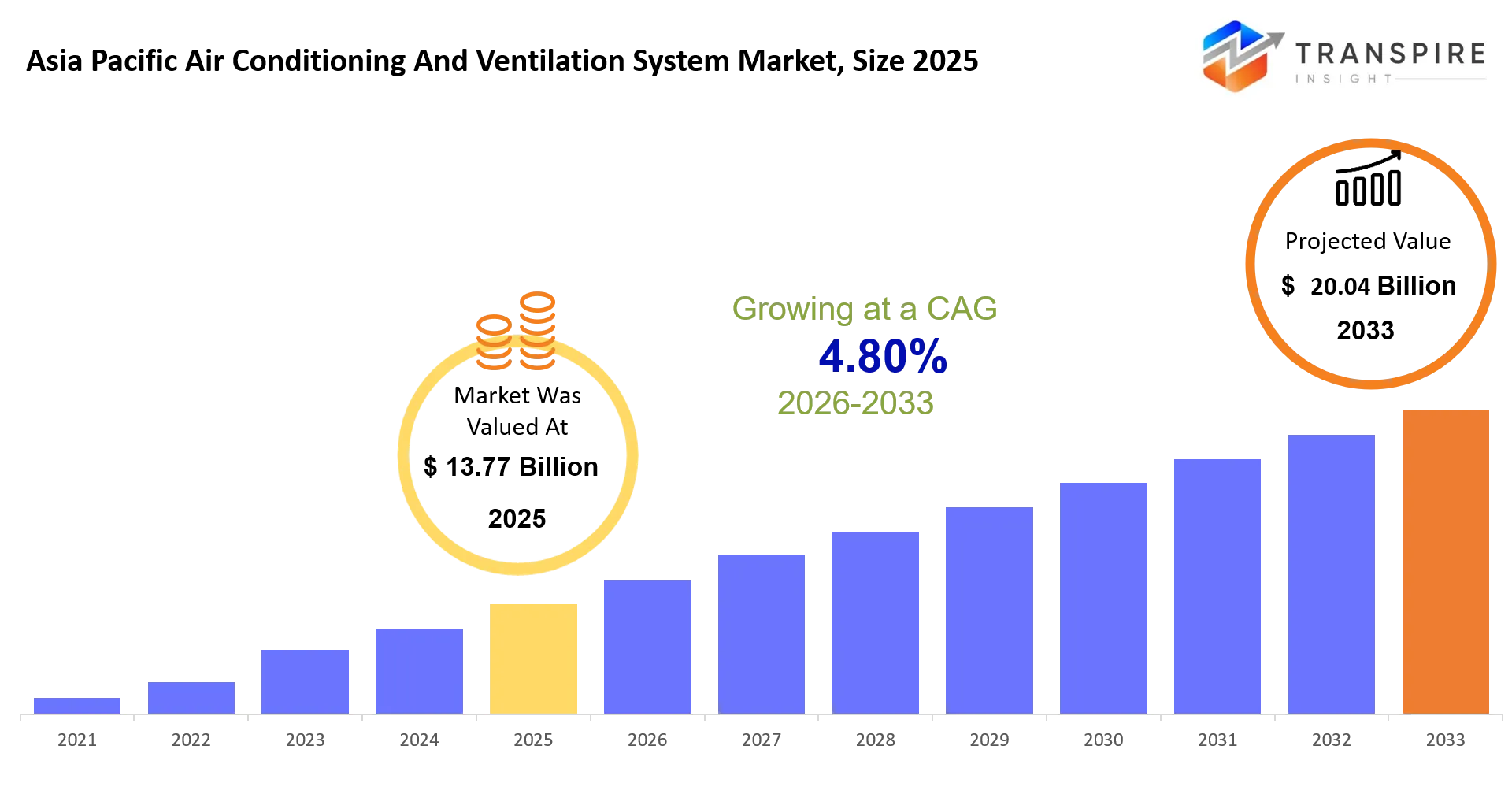
As per Transpire Insight Analysis the Asia Pacific Air Conditioning And Ventilation System Market size is estimated at USD 13.77 Billion in 2025 and is anticipated to reach USD 20.04 Billion by 2033, growing at a CAGR of 4.80% from 2026 to 2033.
The Asia Pacific Air Conditioning and Ventilation System Market works to keep factories, offices, hospitals, data centers, transport sites, and marine assets at steady, safe working temperatures while also guarding indoor air quality, shielding equipment, and bumping up energy performance a bit. Good climate management now seems pretty much required for staying on track with production, keeping staff comfortable, and meeting current building rules. In the past three to five years, the whole market has been tilting toward smarter, energy-savvy setups that come with connected sensors, variable-speed capabilities, and centralized building management platforms, you know. At the same time, tougher energy efficiency regulations and refrigerant shift policies have pushed faster equipment refresh cycles. Then the pandemic also threw supply chains off, which sort of nudged companies toward local regional manufacturing and a more varied sourcing approach. So a lot of organizations are swapping old installations for digital, lower-emission solutions, and that tends to cut operating expenses and make the systems more trustworthy. With construction activity rising alongside ongoing industrial modernization plus more data center investments, advanced air conditioning and ventilation systems should end up taking a larger portion of the region’s capital spending over time.
Asia Pacific Air Conditioning And Ventilation System Market Size & Forecast:
- Asia Pacific Air Conditioning And Ventilation System Market Size 2025: USD 13.77 Billion
- Expected Market Value 2033: USD 20.04 Billion
- Forecast CAGR: 4.80%
- Leading region in 2025: China
- Fastest Growing region: India
- Key Profile: Daikin Industries, Mitsubishi Electric, Panasonic, LG Electronics, Samsung Electronics, Carrier, Trane Technologies, Johnson Controls, Hitachi, Fujitsu General, Toshiba, Midea, Gree Electric, Blue Star, Voltas
Key Market Insights
- China kind of dominated the Asia Pacific Air Conditioning and Ventilation System Market in 2025, holding roughly 42% market share, it seems supported by large scale manufacturing, plus a lot of commercial construction, and also urban redevelopment that keeps pushing new demand.
- India, on the other hand, is projected to grow the quickest across 2025–2033, mainly because of industrial expansion , smart city spending, and better cooling infrastructure deployment becoming more common over time.
- When it comes to products, air conditioning systems led the segment with almost 68% market share in 2025, and that likely ties back to steady replacement needs and more commercial installations popping up.
- Ventilation systems landed as the second largest segment, gaining traction from stricter indoor air quality requirements in healthcare, education, and industrial facilities, with rules getting tighter.
- Smart integrated HVAC solutions should show the fastest growth through 2033, as digital building management and energy optimization turn into procurement priorities, and not just a “nice to have”.
- Commercial buildings accounted for about 39% of the market share in 2025, backed by office developments, retail complexes , hotels, and healthcare infrastructure.
- For applications, data centers are expected to become the fastest growing space during the forecast period, fueled by AI computing capacity and the ongoing expansion of cloud infrastructure.
- On the end user side, commercials represented nearly 45% market share in 2025, which fits with continued investment in high efficiency climate control systems across urban growth projects.
- Industrial end users are likely to expand the most quickly through 2033 as electronics, pharmaceuticals, and food processing plants move toward advanced environmental control technologies.
What are the Key Drivers, Restraints, and Opportunities in the Asia Pacific Air Conditioning And Ventilation System Market?
The strongest growth driver really comes from the shift toward high-efficiency cooling systems, kind of backed by tighter building energy regulations plus the refrigerant transition rules across a lot of Asia Pacific economies. Governments are rolling out tougher efficiency standards while commercial property owners are also dealing with higher electricity costs, so it becomes a combined pressure. In practice this means replacement cycles for older equipment are getting cut shorter, faster than before. New investments tend to line up with inverter-based systems, smarter controls, and integrated ventilation platforms, mostly because lower running costs help the total lifecycle economics. That straightforward financial upsides then supports higher project values and makes adoption happen more widely, across commercial, industrial, and institutional facilities
The biggest restraint, though, is still supply chain concentration for compressors, electronic controls, and specialized semiconductor components. Manufacturing capacity can't really diversify overnight, because suppliers need years to set up certified production and regional distribution networks. And from the Transpire Insight review of regional procurement announcements and launch schedules, this concentration stays the main execution risk. When components arrive late, it tends to push out installation schedules, delay retrofit projects, and then suppress annual revenue opportunities for equipment manufacturers and system integrators
The biggest opportunity is in AI-enabled building management, kind of tied to the ongoing ramp up of data center building across India and Southeast Asia. Big money in digital infrastructure really hinges on precise thermal management with ongoing performance monitoring, so not just one-time tuning. Building owners are putting more funds into predictive maintenance, also in connected air circulation systems,and cloud oriented energy optimization. Over time these choices will help premium product uptake,and at the same time they generate repeat software plus maintenance cash flow across the whole forecast window.
What Has the Impact of Artificial Intelligence Been on the Asia Pacific Air Conditioning And Ventilation System Market?
Artificial intelligence is kinda changing climate control systems, shifting them away from reactive equipment toward a sort of continuously optimized building asset. These days, most modern HVAC platforms are using AI more and more, to automate temperature regulation, ventilation balancing, occupancy driven airflow adjustment, plus energy consumption monitoring across commercial buildings, factories, hospitals, and even data centers. Connected sensors feed operating data into centralized management platforms and those platforms then adjust the equipment on their own, aiming to keep performance steady while also trimming out unnecessary power draw.
At the same time, machine learning has really helped predictive maintenance become more reliable. The algorithms look at compressor vibration, refrigerant pressure, fan performance, and energy usage patterns to spot failures before any real downtime shows up. Facility operators can then book maintenance during planned service windows instead of rushing in after a breakdown, which feels a lot more controlled. And these predictive models also strengthen demand forecasting by lining up cooling loads with occupancy levels and weather conditions. With that, operators can reduce peak electricity consumption, while still maintaining indoor comfort, more or less like it was intended.
Operational performance keeps getting better too, with higher equipment uptime, reduced maintenance costs, and stronger energy efficiency across big commercial sites. Digital twins plus AI assisted diagnostics also speed up troubleshooting and overall system tuning. Still, broad rollout is held back because integration costs are high, building data quality is inconsistent, and interoperability can be a problem between older HVAC equipment and newer digital control platforms, especially in older industrial or commercial properties.
Key Market Trends
- In 2022 inverter-based setups are taking a bigger slice of commercial projects as energy efficiency rules tighten up across China , Japan and South Korea , kind of all at once.
- Since around 2023 AI-enabled building management platforms have also been spreading quickly, letting facilities run automated energy optimization and try predictive upkeep for equipment , especially in big sites.
- And then between 2024 and 2026 data center building really picked up pace , so demand grew for precise cooling methods, with backup ventilation and nonstop environmental checking, which is kinda the whole point.
- Manufacturers have been boosting regional production capacity since 2023, largely to limit exposure to imported part shortages and those logistics headaches.
- Refrigerant transition policies rolled out across several Asia Pacific markets keep pushing the swap out of older systems that use high-global-warming-potential refrigerants, even when upgrades are disruptive.
- Smart sensors paired with IoT connectivity have become routine in premium commercial HVAC systems, so lifecycle monitoring is smoother and day to day performance stays more efficient.
- Daikin , Carrier , and Mitsubishi Electric have been putting more money into intelligent climate control technologies to keep a stronger edge across regional markets, yes even where competition feels tight.
- At the same time retrofit work has risen in older commercial buildings since 2022, owners seem more focused on lifecycle cost savings rather than chasing the lowest upfront equipment pricing.
- Finally, interest in integrated ventilation solutions has strengthened after tighter indoor air quality requirements showed up in healthcare, education, and public infrastructure projects , the demand just follows the rules.
Asia Pacific Air Conditioning And Ventilation System Market Segmentation
By Product Type :
Split air conditioners kept a fairly strong spot, since new housing, some smaller commercial jobs and replacement buying stayed active across the big economies. In most places, central air conditioning systems were still very common inside office buildings, shopping areas, airports, and big public or institutional sites, mainly because they need steady cooling performance without much variation. VRF systems also got more traction, as developers pushed for energy savings, easier setup pathways, and temperature regulation by specific zones. At the same time, ventilation solutions added noticeable market value because indoor air quality rules became tighter, especially in hospitals , schools, and other commercial buildings where air quality matters.
Air handling units helped on larger infrastructure projects too, by sorting airflow management and environmental control for industrial and commercial locations. Chillers remained a must-have for data centers, factories, hospitals, and bigger commercial complexes, because continuous cooling performance still counts as critical. Beyond that, other product groups served niche industrial and infrastructure needs, which opened more doors as construction and modernization kept expanding. Overall product diversification should keep working as a support for longer term revenue in multiple end-use industries, even when demand shifts.
By Technology :
Inverter systems took the lead in practice, mainly because energy efficiency rules, and electricity cost control, pushed more people to install them in both housing and commercial buildings. Non inverter systems kept working for price first projects where the smaller upfront spend stayed the main purchasing reason. Smart HVAC setups also moved forward bit by bit, thanks to digital building management platforms, which gave clearer operational insight and steadier system performance. Heat recovery ventilation started getting more focus too, since it can lower energy losses while still keeping indoor air quality in step with how newer buildings are designed.
At the same time, hybrid HVAC solutions opened up extra possibilities by mixing multiple technologies, so performance could stay efficient even when climate conditions shift. Building owners were choosing connected solutions more often, because those can enable predictive maintenance and energy fine tuning through centralized monitoring platforms. Some other technologies tackled specialized operating contexts that need customized climate handling, plus ventilation behavior that matches the environment. And over time, ongoing upgrades will likely support long term product replacement activity across the region, even as needs keep evolving.
By Application :
Commercial buildings seem to show up as the biggest application, mainly because office towers, retail centers, mixed-use developments and business parks all needed trustworthy cooling AND ventilation, pretty much every day during operations. Residential buildings also kept steady installation work going, thanks to urban housing expansion, and the ongoing replacement of older equipment . Industrial facilities went further into upgraded environmental control systems, not just for comfort but to protect production quality and keep stable working conditions during manufacturing. Healthcare facilities kept moving forward too, upgrading their ventilation setups in order to match tighter operational requirements and infection control standards .
On the hospitality side, projects adopted newer climate control systems to raise guest comfort, while trying to cut long-term operating costs. Educational institutions modernized building infrastructure using energy-efficient ventilation and cooling, supporting fresher indoor air in classrooms and labs. There were also other uses spreading out across transportation infrastructure, public buildings, and certain specialized commercial spaces . Overall, broader infrastructure spending is expected to keep fueling application diversity across regional markets.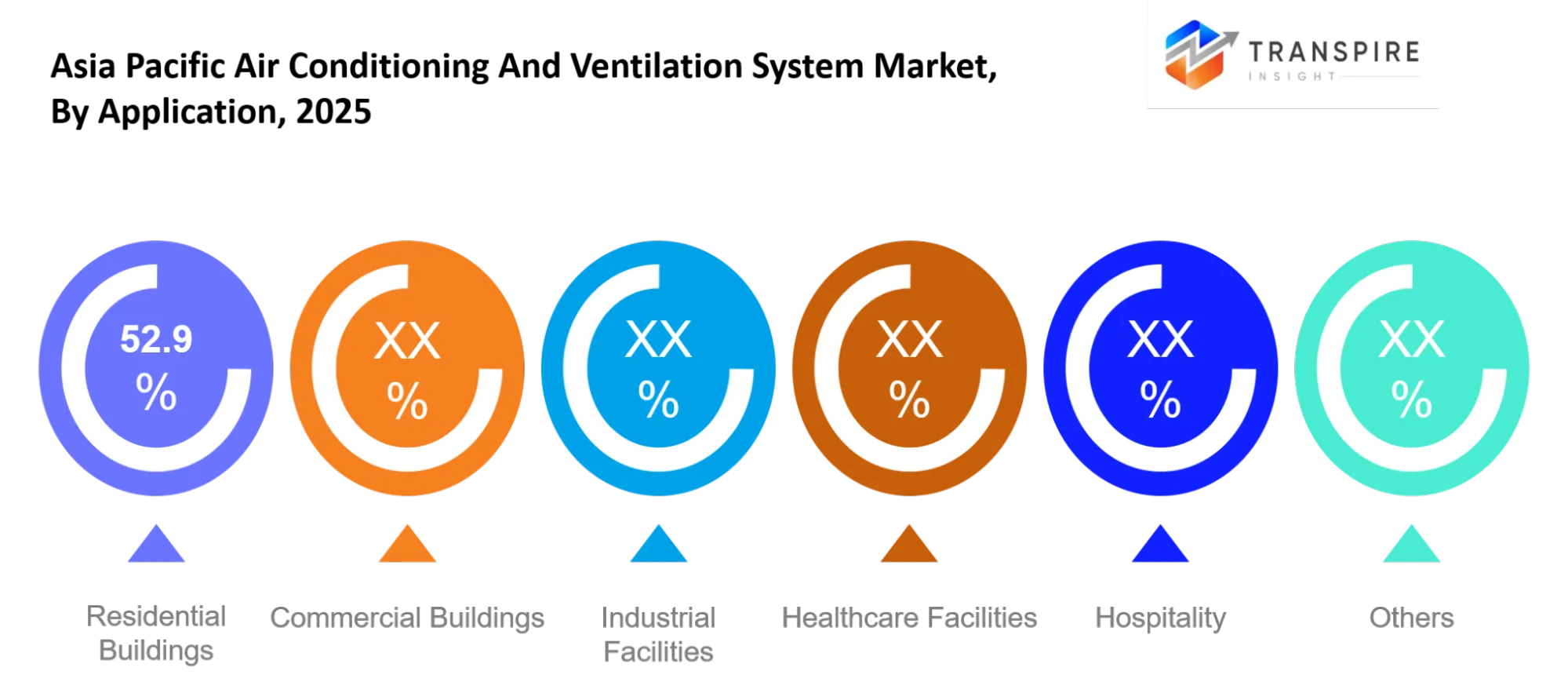
By End User :
Commercial end users actually made up a big share, mostly because companies kept investing in efficient cooling systems to bring down operating costs and kind of improve building performance. On the residential side, customers held pretty steady, driven by fresh housing developments along with the equipment replacement cycles that come up again and again. In industrial settings, facilities tended to adopt more advanced climate control technologies, not only for operational reliability but also to boost production efficiency, and to support regulatory compliance. Government projects also helped keep demand up, via spending on administrative buildings, transportation infrastructure, and public facilities, you know, the usual kinds of upgrades.
Meanwhile healthcare organizations pushed for more installation of advanced ventilation and air conditioning systems, basically to keep tighter environmental control inside hospitals and medical centers. A few other end-user groups added extra revenue too, through specialized facility upgrades and infrastructure development projects that were a bit more niche. Overall, long term investment across diverse industries will keep providing balanced growth chances for equipment suppliers as well as service providers.
By Distribution Channel :
OEM channels stayed in the lead for the reason that big commercial and industrial projects needed direct procurement, hands on technical support, and customized system integration. Meanwhile distributors helped keep strong regional coverage by dropping off equipment to contractors, installers, and maintenance providers across both mature and rising markets. Retail stores kept taking care of residential customers who wanted standard cooling goods and replacement units, nothing too fancy. Online sales also moved ahead pretty steadily since digital purchasing platforms made it easier to compare products, then place the order , with less back and forth.
Beyond that, the other distribution routes basically handled more specialized procurement needs for major infrastructure and industrial jobs. When manufacturers , distributors and installation companies had solid partnerships, product availability looked better and the after sales service quality was higher too. Digital sales platforms will still keep growing alongside traditional distribution networks, as purchasing habits gradually lean toward a blended online and offline model.
What are the Key Use Cases Driving the Asia Pacific Air Conditioning And Ventilation System Market?
Commercial buildings stay the biggest use case, mostly because office complexes, retail centers, mixed-use projects and business parks all need dependable cooling plus ventilation every day, not just sometimes. Because of this, property developers and facility managers end up buying advanced systems, to help cut energy costs, keep occupants comfortable, and also hit building efficiency requirements , so yeah this ends up being the largest driver of equipment revenue.
Industrial facilities, and healthcare buildings too , keep pushing adoption across the region. Electronics manufacturing plants use precision climate control for steadier production quality. At the same time hospitals upgrade ventilation systems, to keep indoor conditions regulated , and to meet tighter operational requirements that keep getting more demanding.
Also, data centers and semiconductor fabrication sites look like an increasingly important opportunity with solid long-term upside. High-performance computing, artificial intelligence infrastructure, and advanced chip production all depend on continuous temperature management and stable airflow. That’s what nudges spending toward specialized cooling technologies, which should then support higher demand for premium equipment through the forecast window.
|
Report Metrics |
Details |
|
Market size value in 2025 |
USD 13.77 Billion |
|
Market size value in 2026 |
USD 14.43 Billion |
|
Revenue forecast in 2033 |
USD 20.04 Billion |
|
Growth rate |
CAGR of 4.80% from 2026 to 2033 |
|
Base year |
2025 |
|
Historical data |
2021 - 2024 |
|
Forecast period |
2026 - 2033 |
|
Report coverage |
Revenue forecast, competitive landscape, growth factors, and trends |
|
Regional scope |
Asia Pacific (India, China, Japan, Australia, South Korea, Rest of Asia Pacific) |
|
Key company profiled |
Daikin Industries, Mitsubishi Electric, Panasonic, LG Electronics, Samsung Electronics, Carrier, Trane Technologies, Johnson Controls, Hitachi, Fujitsu General, Toshiba, Midea, Gree Electric, Blue Star, Voltas . |
|
Customization scope |
Free report customization (country, regional & segment scope). Avail customized purchase options to meet your exact research needs. |
|
Report Segmentation |
By Product Type (Split Air Conditioners, Central Air Conditioning Systems, VRF Systems, Ventilation Systems, Air Handling Units, Chillers, Others); By Technology (Inverter Systems, Non-Inverter Systems, Smart HVAC Systems, Heat Recovery Ventilation, Hybrid HVAC, Others); By Application (Residential Buildings, Commercial Buildings, Industrial Facilities, Healthcare Facilities, Hospitality, Educational Institutions, Others); By End User (Residential, Commercial, Industrial, Government, Healthcare, Others); By Distribution Channel (OEM, Distributors, Retail Stores, Online Sales, Others) |
Which Regions are Driving the Asia Pacific Air Conditioning And Ventilation System Market Growth?
China roughly made up about 42% of the regional revenue, and stayed the bigger market across Asia Pacific. Tough building efficiency rules, plus huge infrastructure efforts, and also required energy performance standards, all together helped push ongoing equipment turnover and fresh installations. With a wide manufacturing base, an expansive supplier web, and steady spending by both local and overseas HVAC firms, production capacity kept rising and product availability stayed solid. Add in the ongoing urban renewal, the commercial construction cycle, and the industrial modernization track, and the market leadership should hold up through most of the forecast timeframe.
Japan was next in line, basically the second largest regional market, mainly because of consistent investment, not some quick capacity jump. Building rules that stayed steady, predictable upkeep budgets, and a clear liking for top tier energy efficient systems created dependable swap demand in both homes and offices. Advanced manufacturing, well established distribution channels, and continuous technology upgrades supported dependable equipment sales year after year. So even with slower construction growth than in some fast moving emerging economies, this more balanced investment scene still enabled steady revenue growth.
India has come out as the fastest-growing regional market, after stronger infrastructure spending plus manufacturing expansion, and smart city development kind of pushed equipment installations forward. Alongside that, industrial corridor projects, commercial real estate development, and more money flowing into data centers made new openings for advanced cooling and ventilation systems, you know. There was also policy support for domestic manufacturing, and higher energy efficiency standards, that really helped lock in thicker project pipelines across a variety of industries. So the growth expected during 2026–2033 should produce solid opportunities for manufacturers, technology providers, and service firms looking at steady long-term regional expansion.
Who are the Key Players in the Asia Pacific Air Conditioning And Ventilation System Market and How Do They Compete?
Competition across the Asia Pacific Air Conditioning And Ventilation System Market is still sorta moderately consolidated, with big global names going up against capable regional suppliers too. In practice, the differentiation does not really sit in one place, it’s more like a bundle of things , technology innovation, energy efficiency, product reliability and after sales service, and yes pricing still matters a lot especially when projects are cost sensitive. Larger established manufacturers keep trying to hold market share via steady product upgrades, whereas the more specialized firms tend to lean into smart building solutions, digital controls, and premium commercial uses.
Daikin Industries stays competitive by pushing inverter technology, developing high-efficiency products, and keeping a wide manufacturing footprint throughout Asia. Mitsubishi Electric leans on intelligent building controls, advanced automation, and integrated commercial HVAC solutions, that together improve operational efficiency. Panasonic on the other hand is putting emphasis on indoor air quality technologies and connected climate control products, covering the evolving commercial and residential needs.
Carrier keeps expanding regionally through manufacturing investments, digital service platforms, and lifecycle support that’s meant to be more advanced for commercial customers. Johnson Controls blends building automation software with HVAC equipment, to enable centralized energy management and predictive maintenance options, especially for large facilities. Taken all together, these moves help with customer retention, raise operating performance, and back longer term growth across industrial, commercial , and institutional projects.
Company List
- Daikin Industries
- Mitsubishi Electric
- Panasonic
- LG Electronics
- Samsung Electronics
- Carrier
- Trane Technologies
- Johnson Controls
- Hitachi
- Fujitsu General
- Toshiba
- Midea
- Gree Electric
- Blue Star
- Voltas
Recent Development News
In May 2026, Daikin Industries and Delta Electronics signed a memorandum of understanding to develop integrated data center cooling solutions across Asia and Oceania. The partnership combines facility-level HVAC systems with liquid cooling technologies, strengthening advanced cooling capabilities for AI-driven data centers and expanding opportunities in high-performance thermal management. Source https://refindustry.com/
In March 2026, Daikin Industries established Daikin Chemical India Private Limited in Gurugram to expand technical support, sales, and marketing operations, with business activities beginning in April 2026. The investment strengthens the company's presence in India and supports long-term regional expansion across cooling and industrial technology markets.
Source https://www.daikin.com/
What Strategic Insights Define the Future of the Asia Pacific Air Conditioning And Ventilation System Market?
The Asia Pacific Air Conditioning And Ventilation System Market is going to drift toward more intelligent, stitched together climate management platforms where energy optimization , digital controls , and predictive maintenance all work in one flow , instead of each piece sitting by itself like standalone cooling equipment. That change is getting pulled forward by tighter building performance standards, more digital infrastructure being put in place, and steady investment into advanced manufacturing facilities. There’s also a less obvious risk, sort of like it hides in the background , and it’s the continued reliance on a fairly small supplier pool for compressors, power electronics, and other critical control components. That kind of bottleneck can slow down projects even when customer demand stays quite strong.
At the same time, a newer opportunity should appear around liquid cooling and hybrid thermal management setups for artificial intelligence data centers. This feels especially relevant across India and Southeast Asia as their digital infrastructure keeps expanding. For manufacturers, technology providers, and investors, the upside is in shoring up regional component sourcing, while also expanding software enabled service offerings. In other words, more recurring revenue, plus better day to day resilience when future supply chain disruptions show up again.
Asia Pacific Air Conditioning And Ventilation System Market Report Segmentation
By Product Type
- Split Air Conditioners
- Central Air Conditioning Systems
- VRF Systems
- Ventilation Systems
- Air Handling Units
- Chillers
By Technology
- Inverter Systems
- Non-Inverter Systems
- Smart HVAC Systems
- Heat Recovery Ventilation
- Hybrid HVAC
By Application
- Residential Buildings
- Commercial Buildings
- Industrial Facilities
- Healthcare Facilities
- Hospitality
- Educational Institutions
By End User
- Residential
- Commercial
- Industrial
- Government
- Healthcare
By Distribution Channel
- OEM
- Distributors
- Retail Stores
- Online Sales
Frequently Asked Questions
Find quick answers to common questions.
The Expected Asia Pacific Air Conditioning And Ventilation System Market size for the market will be USD 20.04 Billion in 2033.
Key segments for the Asia Pacific Air Conditioning And Ventilation System Market are By Product Type (Split Air Conditioners, Central Air Conditioning Systems, VRF Systems, Ventilation Systems, Air Handling Units, Chillers, Others); By Technology (Inverter Systems, Non-Inverter Systems, Smart HVAC Systems, Heat Recovery Ventilation, Hybrid HVAC, Others); By Application (Residential Buildings, Commercial Buildings, Industrial Facilities, Healthcare Facilities, Hospitality, Educational Institutions, Others); By End User (Residential, Commercial, Industrial, Government, Healthcare, Others); By Distribution Channel (OEM, Distributors, Retail Stores, Online Sales, Others).
Major Asia Pacific Air Conditioning And Ventilation System Market players are Daikin Industries, Mitsubishi Electric, Panasonic, LG Electronics, Samsung Electronics, Carrier, Trane Technologies, Johnson Controls, Hitachi, Fujitsu General, Toshiba, Midea, Gree Electric, Blue Star, Voltas .
The current Asia Pacific Air Conditioning And Ventilation System Market size is USD 13.77 Billion in 2025.
The Asia Pacific Air Conditioning And Ventilation System Market CAGR is 4.80% from 2026 to 2033.
- Daikin Industries
- Mitsubishi Electric
- Panasonic
- LG Electronics
- Samsung Electronics
- Carrier
- Trane Technologies
- Johnson Controls
- Hitachi
- Fujitsu General
- Toshiba
- Midea
- Gree Electric
- Blue Star
- Voltas
About the Authors

Kartik bhong
I am Kartik Bhong, a Senior Research Analyst at Transpire Insight, specializing in the Packaging, Manufacturing, and Construction industry. My work focuses on analyzing market trends, emerging technologies, industry regulations, and competitive landscapes to deliver accurate, data-driven insights. I am passionate about transforming complex industry information into clear, practical content that helps businesses, professionals, and decision-makers stay informed and make confident strategic decisions. Through continuous research and a strong commitment to accuracy, I strive to create reliable, well-researched content that reflects the latest developments across these dynamic industries and supports the vision of Transpire Insight in delivering valuable market intelligence.

Chakradhar Khansole
Chakradhar serves as the Research Director at Transpire Insight, bringing over 8 years of experience in technology, innovation, and strategic market intelligence. He specializes in transforming complex market data into actionable business insights that enable organizations to make informed, growth-oriented decisions. Recognized for his strategic vision and analytical expertise, Chakradhar leads high-impact research initiatives, delivering comprehensive market assessments, competitive intelligence, and forward-looking industry analysis.
Recently Published Reports
-
Apr 2026
Handling and Lifting Equipment Market
Handling and Lifting Equipment Market Size, Share & Analysis Report By Product (Cranes and Hoists, Forklifts, Conveyor Systems, Aerial Work Platforms, Others), By Application (E-Commerce, Automotive and Railway, Food and Beverages, Aviation, Others), and Geography (North America, Europe, Asia-Pacific, Middle East and Africa, South and Central America), 2021 - 2031
-
Apr 2026
HVAC Equipment Market
HVAC Equipment Market Size, Share & Analysis Report By Heating Equipment Type (Boilers and Furnaces, Heat Pumps, and Unitary Heaters), By Ventilation Equipment (Air Handling Units, Humidifiers and Dehumidifiers, Air Filters, and Fan Coiling Units), By Air Conditioning Equipment (Unitary Air Conditioners, Room Air Conditioners, Packaged Terminal Air Conditioners, and Chillers), By End User (Commercial, Residential, Industrial, and others), and Geography (North America, Europe, Asia-Pacific, Middle East and Africa, South and Central America), 2021 – 2031
-
Apr 2026
Refrigeration Valves Market
Refrigeration Valves Market Size, Share & Analysis Report By Type (Solenoid Valves, Expansion Valves, Check Valves, Service Valves, Others), By Application (Commercial Refrigeration, Industrial Refrigeration, Transport Refrigeration, Residential Refrigeration, Air Conditioning Systems), By End User (Food and Beverage Industry, Pharmaceutical Industry, HVAC Industry, Chemical Industry, Others), and Geography (North America, Europe, Asia-Pacific, Middle East and Africa, South and Central America), 2021 – 2031
-
Apr 2026
E-Commerce Packaging Materials Market
E-Commerce Packaging Materials Market By Material Type (Corrugated Boxes, Paper & Paperboard, Foam & Cushioning Materials, Plastic Packaging, Flexible Packaging, Protective Packaging, Others), By Product(Primary Packaging, Secondary Packaging, Tertiary Packaging), By Packaging Function (Protective Packaging, Branding & Presentation Packaging, Transit & Logistic Packaging, Sustainable Packaging, Tamper Evidence Packaging), By End-User (Retail & Consumer Goods, Electronic Appliances, Food & Beverages, Healthcare & Pharmaceutical, Fashion & Apparel, Home & Furnishing, Others); By Industry Analysis, Size, Share, Growth, Trends, and Forecasts 2021-2033