
United Kingdom Air Conditioning Systems Market Size & Forecast
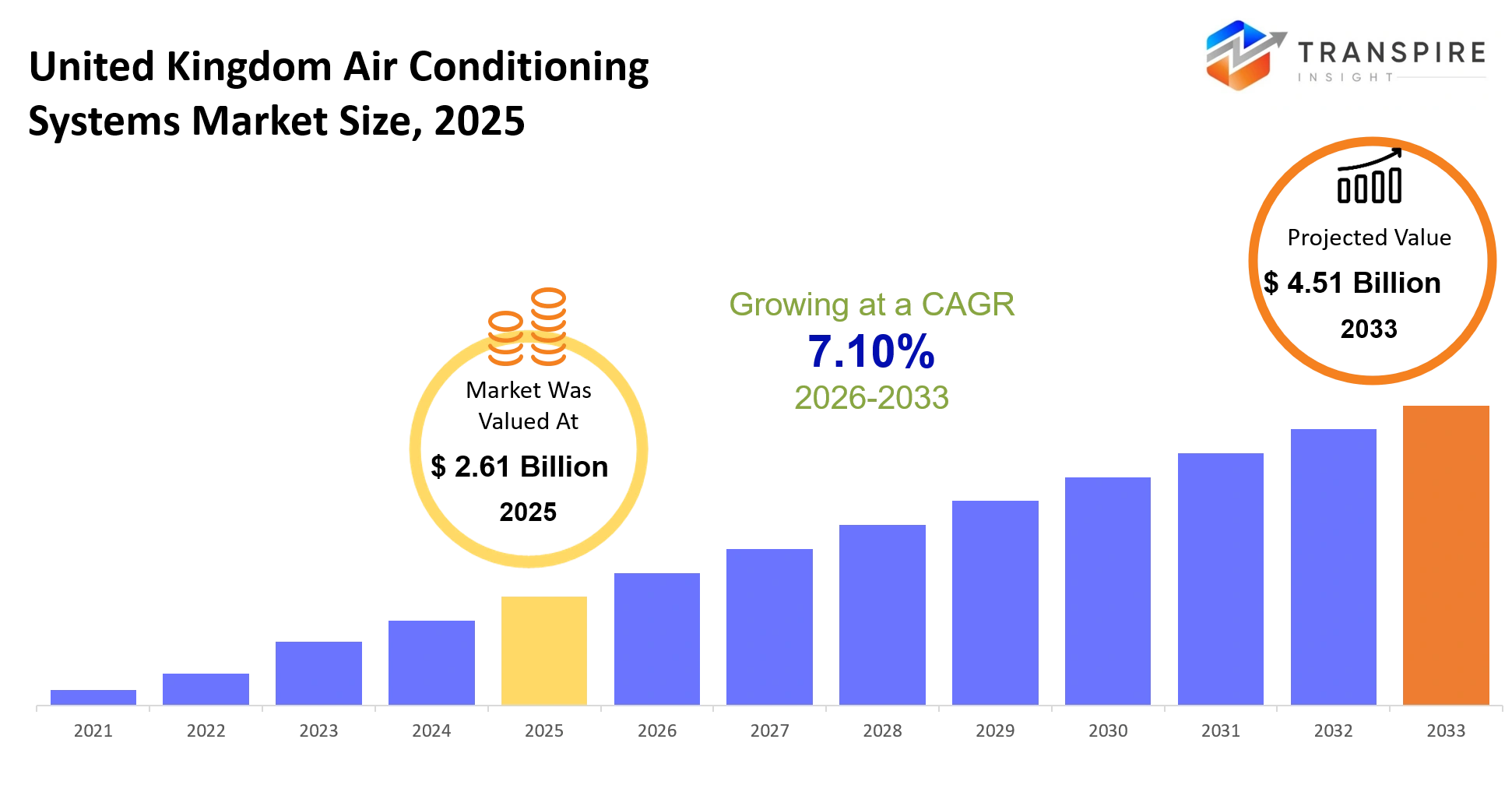
- United Kingdom Air Conditioning Systems Market Size 2025: USD 2.61 Billion
- United Kingdom Air Conditioning Systems Market Size 2026: USD 2.79 Billion
- United Kingdom Air Conditioning Systems Market Size 2033: USD 4.51 Billion
- United Kingdom Air Conditioning Systems Market CAGR: 7.10%
- United Kingdom Air Conditioning Systems Market Segments: By Product Type (Split AC, Window AC, VRF Systems, Packaged AC, Chillers, Others); By Technology (Inverter, Non-Inverter, Smart Controls, Others); By Capacity (Below 1 Ton, 1-2 Ton, Above 2 Ton, Others); By End User (Residential, Commercial, Industrial, Institutional, Others); By Distribution Channel (Direct Sales, Dealers, Online Retail, Others); By Installation Type (New Installation, Replacement, Retrofit, Others)
United Kingdom Air Conditioning Systems Market Summary
As per Transpire Insight Analysis, the United Kingdom Air Conditioning Systems Market was valued at USD 2.61 Billion in 2025, the market is set to nearly double to USD 4.51 Billion by 2033. In the UK, air conditioning has moved very much from being a rare, mainly commercial fixture to a common household buy. The market now encompasses all the equipment, installation, and maintenance required for cooling systems - found in our homes, offices, factories, hospitals, schools, and even data centres - ranging from a solitary split unit in a bedroom to massive chiller plants serving whole commercial buildings.
Two factors really altered the course of this market since 2021. Firstly, several scorching summer heatwaves, including that record-breaking 40. 3°C reading set at Coningsby back in July 2022, made residential cooling no longer just an occasional buy but rather something UK households actually factor into their budgets. Secondly, the phasing-out of high-GWP refrigerants under the UK's F-Gas Regulations forced manufacturers and fitters to switch their product lines towards lower-GWP inverter systems, thus increasing average unit costs whilst also making replacing existing units more logical than fixing them. This has all contributed to why growth here isn't just about the odd hotter summer. Rather it's a story of increased climate exposure coinciding with a regulatory reset simultaneously - and it's that unique combination which continues to keep replacement and new installation demands very high indeed, far beyond what a regular weather pattern would naturally generate.
Key United Kingdom Air Conditioning Systems Market Insights
- London and the South East really stand out - they make up most of our country's cooling demands, around 31% of our total capacity by 2025, thanks to lots of commercial offices and higher household incomes.
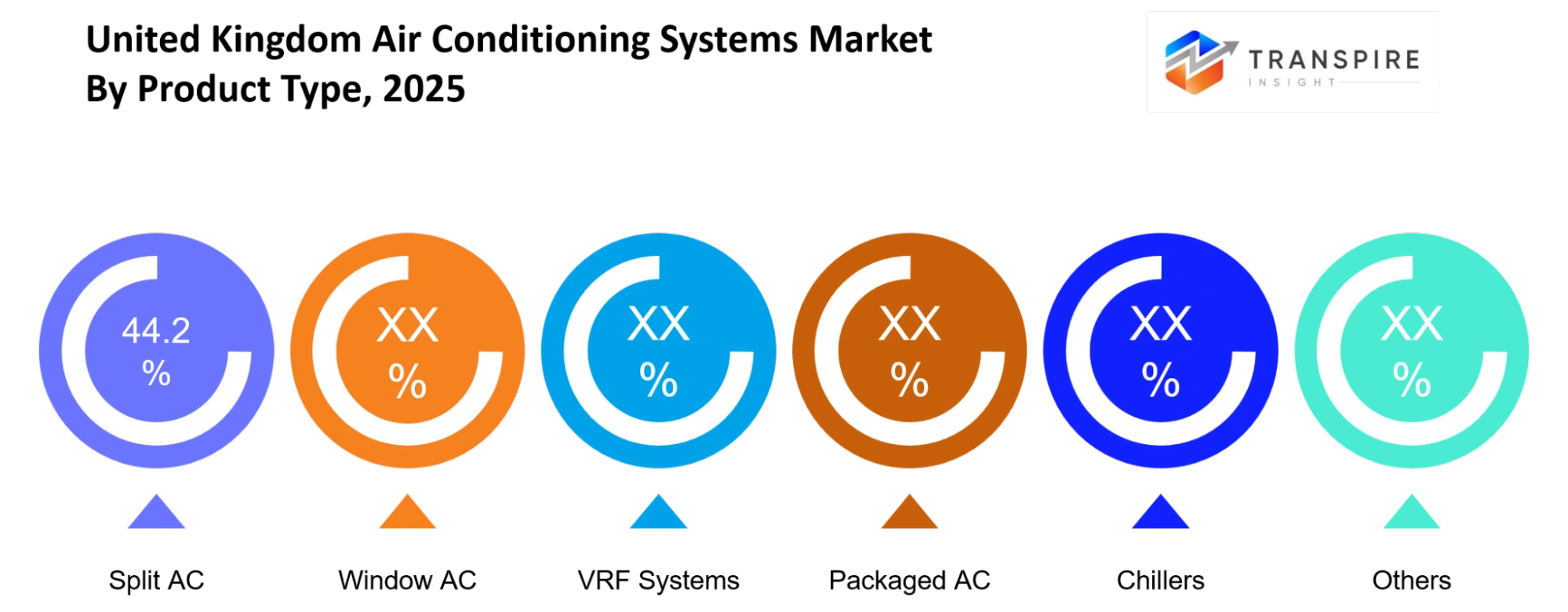
- Split AC systems are quite popular - about 44. 2% in 2025 - since they're well-suited to the UK's common housing style: lots of small rooms in terraced or semi-detached houses.
- VRF Systems (Variable Refrigerant Flow) are actually growing fast - over 9% year-on-year from 2033 onwards because commercial developers often choose this technology for large office renovations where they need multiple zones of air conditioning.
- Inverter technology is currently leading the way in terms of technology, with its adoption going up to more than 60% of all new unit sales in 2025 because F-Gas regulations and increasing energy costs really benefit variable-speed compressors.
- Smart Controls are actually the fastest-growing tech sub-segment right now - helped by smart thermostats bundled by installers and consumers becoming more familiar with controlling their heating and cooling using apps.
- Most of the UK's cooling demand falls within the 1-2 ton capacity range - matching the typical size of British rooms and small offices quite well.
- Household end-users actually represent the biggest and fastest-growing customer base - quite different from 10 years ago when commercial installations were dominating cooling equipment sales here in the UK.
- Dealers still hold onto the top spot as our main distribution channel - however, online retail is growing rapidly among DIY-inclined homeowners buying portable and lower-capacity split units themselves.
- More replacement installations happen every year than new ones in terms of unit numbers now - a result of F-Gas regulations forcing us to replace old R410A systems, making them more expensive to repair over time.
- Daikin and Mitsubishi Electric hold the largest combined share of the UK market - thanks to their long-established networks of dealers and credibility from their work on heat pumps too.
What are the Key Drivers, Restraints, and Opportunities in the United Kingdom Air Conditioning Systems Market?
Driver: Rising summer temperatures are turning cooling from an optional buy into a matter of health and comfort necessity. The Met Office recorded the UK's hottest day ever in July 2022 - and subsequent summers have repeated several-day spells over 30°C in southern England. Houses built for a temperate climate, with very little natural light and very high heat gain from big windows, get scorching hot very fast and stay that way all night long. This has driven a growing number of UK households, traditionally amongst the least air-conditioned in Europe, towards purchasing split AC units, with fitters seeing long summer waiting lists stretching weeks during heatwave periods.
Restraint: Electricity pricing really holds back adoption. UK household electricity costs increased significantly in 2022 because of spiking wholesale gas prices after the disturbance to European energy supplies, and although the price cap has helped reduce extreme peaks, the per-unit rate remains much higher than before 2021. Operating a cooling system during a heatwave, when power demand and price peak, creates a real affordability issue for lower and middle-class families that can't be fixed easily, because it's linked to the entire UK energy market - not just the air conditioning industry itself.
Opportunity: Heat pump crossover technology is our clearest opportunity for growth. Reversible air-to-air heat pump systems that give you both heating and cooling are becoming more popular as UK residents search for one appliance to replace old-fashioned gas boilers under the government's Boiler Upgrade Scheme, while also getting some cooling ability in the summer. Daikin and Mitsubishi Electric are actually expanding their UK-specific reversible product lines - they qualify for heat pump subsidy schemes - allowing a cooling purchase to benefit from heating decarbonisation incentives essentially for free.
What Has the Impact of Artificial Intelligence Been on the United Kingdom Air Conditioning Systems Market?
Artificial intelligence has really made its way into UK cooling systems - mainly via intelligent controls and integration into building management systems instead of actually being part of the mechanical equipment itself. Commercial VRF installations more and more come with machine learning-based load forecasting, adjusting the compressor's performance even before occupancy peaks occur rather than responding once temperatures have drifted away. You see this quite clearly in London office refurbishments, where Johnson Controls and Trane Technologies' building management platforms use past occupancy and weather information to cool areas well before employees get there, reducing those high peak demand bills.
On the residential side, integrating smart thermostats lets learning algorithms create a usage pattern for your home and adjusts cooling timetables all by itself, much like Nest and Hive did change our heating habits. Predictive maintenance is a bit smaller but growing fast too: linked VRF and chillers spot compressor degradation or refrigerant leak danger before it fails, which matters commercially since F-Gas regulations make losing refrigerant not just a compliance problem but also a costly one.
The obvious constraint is retrofitting costs. Most of the UK's current installed base - particularly in older housing stock and smaller commercial buildings - uses non-wired equipment, and adding smart control functionality to that existing base isn't always cost-effective when you compare it to the system's remaining useful life.
Key Market Trends
- Residential cooling penetration in the UK increased from less than 5% of households in 2020 to an estimated 8-9% by 2025 - still quite far below Southern European levels, which leaves a lot of room for growth.
- The F-Gas Regulation's refrigerant phase-down really got underway in 2024, prompting the replacement of R410A systems - pushing installers to stock lower-GWP alternatives like R32 and R454B instead.
- Specification of VRF systems in London's commercial refurbishments really took off because landlords were trying to improve their EPC ratings before the 2027 minimum energy efficiency standard deadline for commercial lets was enforced.
- Heat pump-AC crossover products started gaining more market share as UK households used Boiler Upgrade Scheme grants to justify buying combined heating and cooling systems altogether.
- Online retail sales of portable and low-capacity window units saw the biggest growth among all distribution channels during the 2022 and 2023 heatwaves, as consumers looked for some immediate cooling - no installation required!
- Smart control bundling became standard practice among the best installers by 2024, with app-based scheduling included in most mid-range and premium split AC packages nowdays.
- Demand for data centre cooling really exploded as UK investment in cloud infrastructure grew, creating a distinct high-value chiller and precision cooling sub-market separate from everyday commercial HVAC installations.
United Kingdom Air Conditioning Systems Market Segmentation
By Product Type
Split AC systems lead the product type segment with 44.2% of market revenue in 2025. Their compact indoor and outdoor unit design suits UK housing, which rarely has ducting infrastructure. VRF Systems are the fastest-growing category, favoured in multi-zone commercial refurbishments where landlords need zoned control without extensive ductwork. Window AC units hold a smaller, price-sensitive niche among renters who cannot install permanent equipment. Packaged AC and Chillers serve larger commercial and industrial buildings, with chiller demand rising alongside UK data centre construction. Over the forecast period, split and VRF systems will together account for the bulk of incremental market revenue.
By Technology
Inverter technology dominates new unit sales, now exceeding 60% share, as variable-speed compressors cut running costs and meet F-Gas efficiency expectations. Non-inverter units persist mainly in the lowest-price segment and in older commercial installations awaiting replacement. Smart Controls is growing fastest, propelled by installer bundling and consumer demand for app-based scheduling that helps manage electricity costs during peak-price hours, a genuinely UK-specific driver given the country's volatile energy pricing since 2022.
By Capacity
The 1-2 Ton band covers most UK demand, matching typical bedroom and small office dimensions. Below 1 Ton units serve single-room residential and rental installations where budget and simplicity matter most. Above 2 Ton systems serve larger commercial spaces, open-plan offices, and light industrial premises. Growth in the Above 2 Ton band is closely tied to commercial construction and refurbishment activity rather than household purchasing, making it more cyclical than the smaller capacity bands.
By End User
Residential end users have become the largest and fastest-growing segment, a shift from a decade ago when commercial demand dominated. Heatwave exposure and rising home cooling awareness are the direct causes. Commercial demand remains substantial, concentrated in London office stock and retail premises. Industrial and Institutional users, including hospitals and schools, generate steadier, less weather-driven demand tied to building compliance and occupant welfare standards rather than seasonal temperature spikes.
By Distribution Channel
Dealers remain the leading channel, valued for installation expertise and after-sales servicing, which UK buyers consider essential given the technical nature of refrigerant handling. Direct sales serve large commercial contracts where manufacturers work straight with facilities managers. Online retail is the fastest-growing channel, driven by portable and low-capacity unit sales to renters and DIY-inclined homeowners who prioritise speed of purchase over professional installation.
By Installation Type
Replacement installations now exceed new installations in unit volume, a direct consequence of F-Gas refrigerant rules making older systems costlier to service than to replace. New installation demand is concentrated in residential first-time buyers and commercial refurbishment projects. Retrofit installations, where cooling is added to buildings without prior AC infrastructure, are growing steadily as heatwave exposure pushes older housing stock and legacy commercial buildings toward first-time cooling adoption.
What are the Key Use Cases Driving the United Kingdom Air Conditioning Systems Market?
Residential summer cooling is the dominant use case, driven directly by the string of extreme heat events since 2022 that made UK homes, many built with heat retention rather than heat rejection in mind, genuinely uncomfortable and in some cases medically risky for elderly occupants during peak summer weeks.
Commercial office comfort and EPC compliance form the second major use case. London landlords are installing or upgrading VRF systems ahead of the 2027 minimum energy efficiency standard deadline, linking cooling system investment directly to a regulatory compliance calendar rather than tenant comfort requests alone. Data centre and server room cooling has also expanded as a distinct commercial use case tied to UK cloud infrastructure growth.
An emerging use case is combined heating and cooling through reversible heat pump systems, positioned at UK homeowners replacing gas boilers under decarbonisation incentives. This use case did not meaningfully exist before 2023 and is expected to become a defined sub-market by the end of the forecast period.
|
Report Metrics |
Details |
|
Market size value in 2025 |
USD 2.61 Billion |
|
Market size value in 2026 |
USD 2.79 Billion |
|
Revenue forecast in 2033 |
USD 4.51 Billion |
|
Growth rate |
CAGR of 7.10% from 2026 to 2033 |
|
Base year |
2025 |
|
Historical data |
2021 - 2024 |
|
Forecast period |
2026 - 2033 |
|
Report coverage |
Revenue forecast, competitive landscape, growth factors, and trends |
|
Regional scope |
United Kingdom (England, Scotland, Wales, Northern Ireland) |
|
Key companies profiled |
Daikin, Mitsubishi Electric, LG Electronics, Samsung, Carrier, Trane Technologies, Panasonic, Fujitsu General, Hitachi, Toshiba, Johnson Controls, Lennox, Bosch, Midea, Haier |
|
Customization scope |
Free report customization (country, regional & segment scope). Avail customized purchase options to meet your exact research needs. |
|
Report Segmentation |
By Product Type (Split AC, Window AC, VRF Systems, Packaged AC, Chillers, Others); By Technology (Inverter, Non-Inverter, Smart Controls, Others); By Capacity (Below 1 Ton, 1-2 Ton, Above 2 Ton, Others); By End User (Residential, Commercial, Industrial, Institutional, Others); By Distribution Channel (Direct Sales, Dealers, Online Retail, Others); By Installation Type (New Installation, Replacement, Retrofit, Others) |
Which Regions are Driving the United Kingdom Air Conditioning Systems Market Growth?
London and the South East lead the domestic market with approximately 31% of installed capacity in 2025. The concentration of commercial office stock, higher household incomes, and denser urban housing that traps heat more readily than rural properties all sustain this lead, and the region's EPC compliance deadlines are pulling forward commercial VRF investment ahead of the rest of the country.
The Midlands and North of England form a steadier, less weather-sensitive contributor to national revenue, where industrial and institutional cooling demand, tied to manufacturing facilities, hospitals, and universities, provides a more stable baseline than the heatwave-driven residential spikes seen in the South.
Scotland and Northern Ireland represent the fastest-growing, if smaller, regional markets, as cooling adoption expands from a near-zero historical base. Milder average temperatures have kept air conditioning rare in these regions, but new-build residential and commercial construction increasingly specifies cooling as standard, reflecting a broader UK-wide normalisation of AC ownership. Investors entering these markets should expect adoption to track new construction volume more closely than temperature trends, given the low existing installed base.
Who are the Key Players in the United Kingdom Air Conditioning Systems Market and How Do They Compete?
The UK market is moderately fragmented, with Japanese and Korean manufacturers holding the strongest brand recognition among UK installers and consumers. Competition centres on dealer network depth, F-Gas compliant product range breadth, and increasingly, heat pump crossover credibility, rather than price alone, since UK buyers value installer trust given the technical complexity of refrigerant-based systems.
Daikin holds the leading position in the UK residential and commercial segments through its long-established dealer network and its dual positioning in both air conditioning and heat pump heating, which lets it capture households making combined decarbonisation and cooling purchases. Mitsubishi Electric competes closely behind, leveraging a similarly strong reversible heat pump portfolio and a reputation for reliability that UK installers frequently cite when advising residential customers. LG Electronics and Samsung compete primarily on price-to-feature ratio and smart control integration, appealing to UK consumers already invested in each company's broader consumer electronics ecosystem.
In the commercial segment, Johnson Controls and Trane Technologies compete on building management system integration for large office and institutional contracts, while Carrier maintains a strong position in packaged and chiller systems for retail and light industrial premises. Midea and Haier are gaining share in the value segment of the residential market, undercutting established brands on price while expanding UK distribution through online retail and independent dealer partnerships.
United Kingdom Air Conditioning Systems Market Companies
- Daikin
- Mitsubishi Electric
- LG Electronics
- Samsung
- Carrier
- Trane Technologies
- Panasonic
- Fujitsu General
- Hitachi
- Toshiba
- Johnson Controls
- Lennox
- Bosch
- Midea
- Haier
Recent Developments
In March 2026, Daikin announced the expansion of its UK reversible heat pump-AC product line to qualify for an expanded set of Boiler Upgrade Scheme grant categories, aiming to capture households replacing gas boilers with combined heating and cooling systems. https://www.daikin.co.uk/news (Daikin UK Press Office).
In January 2026, Mitsubishi Electric opened a new UK training and distribution facility in the Midlands to expand installer certification capacity for its reversible Ecodan and air conditioning ranges, addressing a reported installer shortage limiting residential rollout speed. https://les.mitsubishielectric.co.uk/news (Mitsubishi Electric UK).
In April 2026, Johnson Controls secured a multi-site contract to retrofit VRF and building management systems across a portfolio of London commercial office buildings ahead of the 2027 minimum energy efficiency standard deadline. https://www.johnsoncontrols.com/uk (Johnson Controls UK Newsroom).
What Strategic Insights Define the Future of the United Kingdom Air Conditioning Systems Market?
Over the next five to seven years, the UK air conditioning market will be shaped less by summer temperature extremes and more by the country's broader decarbonisation policy, since reversible heat pump-AC systems increasingly bundle cooling into a heating replacement decision that already carries government subsidy support.
The hidden risk is grid capacity. Rapid growth in electric heat pump heating, combined with rising residential AC ownership, adds simultaneous summer and winter peak electricity demand that the UK grid's regional distribution networks were not originally sized for, and localised capacity constraints could slow installation approval timelines in dense urban areas before national grid investment catches up.
The opportunity not yet reflected in most market analyses is retrofit cooling for the UK's ageing social and institutional housing stock, where local authorities and housing associations are only beginning to budget for cooling as a health and safety requirement following coroner findings linking heat exposure to vulnerable resident deaths during recent heatwaves. The strategic recommendation for market participants is to build public sector procurement relationships now, since institutional retrofit contracts tend to be large, multi-year, and comparatively insulated from consumer price sensitivity.
United Kingdom Air Conditioning Systems Market Report Segmentation
By Product Type
- Split AC
- Window AC
- VRF Systems
- Packaged AC
- Chillers
- Others
By Technology
- Inverter
- Non-Inverter
- Smart Controls
- Others
By Capacity
- Below 1 Ton
- 1-2 Ton
- Above 2 Ton
- Others
By End User
- Residential
- Commercial
- Industrial
- Institutional
- Others
By Distribution Channel
- Direct Sales
- Dealers
- Online Retail
- Others
By Installation Type
- New Installation
- Replacement
- Retrofit
- Others
Frequently Asked Questions
Find quick answers to common questions.
The United Kingdom Air Conditioning Systems Market size is expected to reach USD 4.51 Billion by 2033.
The key segments are By Product Type (Split AC, Window AC, VRF Systems, Packaged AC, Chillers, Others); By Technology (Inverter, Non-Inverter, Smart Controls, Others); By Capacity (Below 1 Ton, 1-2 Ton, Above 2 Ton, Others); By End User (Residential, Commercial, Industrial, Institutional, Others); By Distribution Channel (Direct Sales, Dealers, Online Retail, Others); and By Installation Type (New Installation, Replacement, Retrofit, Others).
Major players include Daikin, Mitsubishi Electric, LG Electronics, Samsung, Carrier, Trane Technologies, Panasonic, Fujitsu General, Hitachi, Toshiba, Johnson Controls, Lennox, Bosch, Midea, and Haier.
The United Kingdom Air Conditioning Systems Market size is USD 2.61 Billion in 2025.
The United Kingdom Air Conditioning Systems Market CAGR is 7.10% from 2026 to 2033.
- Daikin
- Mitsubishi Electric
- LG Electronics
- Samsung
- Carrier
- Trane Technologies
- Panasonic
- Fujitsu General
- Hitachi
- Toshiba
- Johnson Controls
- Lennox
- Bosch
- Midea
- Haier
About the Authors

Chetan Dhatrak
I’m Chetan Dhatrak, a Senior Research Analyst at Transpire Insight, specializing in the Consumer Goods, Foods and Beverages industry. I focus on analyzing market trends, consumer behavior, competitive landscapes, and industry developments to deliver accurate, data-driven insights. My research at Transpire Insight is built on credible sources and in-depth analysis, helping businesses and readers better understand market dynamics, emerging opportunities, and evolving consumer preferences. I’m committed to creating reliable, well-researched content that supports informed decision-making and reflects the latest developments in the consumer goods and food & beverage sectors.

Chakradhar Khansole
Chakradhar serves as the Research Director at Transpire Insight, bringing over 8 years of experience in technology, innovation, and strategic market intelligence. He specializes in transforming complex market data into actionable business insights that enable organizations to make informed, growth-oriented decisions. Recognized for his strategic vision and analytical expertise, Chakradhar leads high-impact research initiatives, delivering comprehensive market assessments, competitive intelligence, and forward-looking industry analysis.
Recently Published Reports
-
Apr 2026
Bottled Water Market
Bottled Water Market Size, Share & Analysis Report By Product Type (Still Bottled Water, Carbonated Bottled Water, Functional Bottled Water, and Others), By Packaging (PET, Cans, and Others), By Sales Channel (Supermarkets/Hypermarkets, Convenience Stores/Drug Stores, Grocery Stores/Club Stores, Foodservice, and Others) and Geography (North America, Europe, Asia-Pacific, Middle East and Africa, South and Central America), 2021 - 2032
-
Apr 2026
Color Cosmetic Packaging Market
Color Cosmetic Packaging Market Size, Share & Analysis Report By Application (Mascara Packaging, Liquid Packaging, and Liquid Face), By Type (Tubes & Bottles, Pens & Markers, Compacts & Containers, and Droppers & Pumps), and Geography (North America, Europe, Asia-Pacific, Middle East and Africa, South and Central America), 2021 - 2031
-
Apr 2026
External Microphone For Camera Market
External Microphone For Camera Market Size, Share & Analysis Report By Type (Shotgun Microphone, Lavalier Microphone, and Others), By Application (Digital Camera, Professional Video Camera, and Others), and Geography (North America, Europe, Asia-Pacific, Middle East and Africa, South and Central America), 2021 - 2031
-
Apr 2026
Foot Orthotic Insoles Market
Foot Orthotic Insoles Market Size, Share & Analysis Report By Type (Pre-fabricated, and Custom-made), By Material (Thermoplastic, Composite Carbon Fiber, and Others), By Distribution Channel (Drug Stores, Hospitals & Clinics, and Others), and Geography (North America, Europe, Asia-Pacific, Middle East and Africa, South and Central America), 2021 - 2031