
Global Air Conditioning System Market Size & Forecast:
- Global Air Conditioning System Market Size 2025: USD 98.04 Billion
- Global Air Conditioning System Market Size 2033: USD 172.3 Billion
- Global Air Conditioning System Market CAGR: 7.32%
- Global Air Conditioning System Market Segments: By Type (Split Air Conditioners, Window Air Conditioners, Centralized Air Conditioning Systems, Portable Air Conditioners, VRF Systems, Smart Air Conditioning Systems, Others); By Application (Residential Buildings, Commercial Buildings, Industrial Facilities, Healthcare Facilities, Hospitality Sector, Others); By End-User (Households, Enterprises, Manufacturing Plants, Government Buildings, Others); By Technology (Inverter Technology, Non-inverter Technology, IoT-enabled Systems, Hybrid Cooling Systems, Others).
Global Air Conditioning System Market Summary:
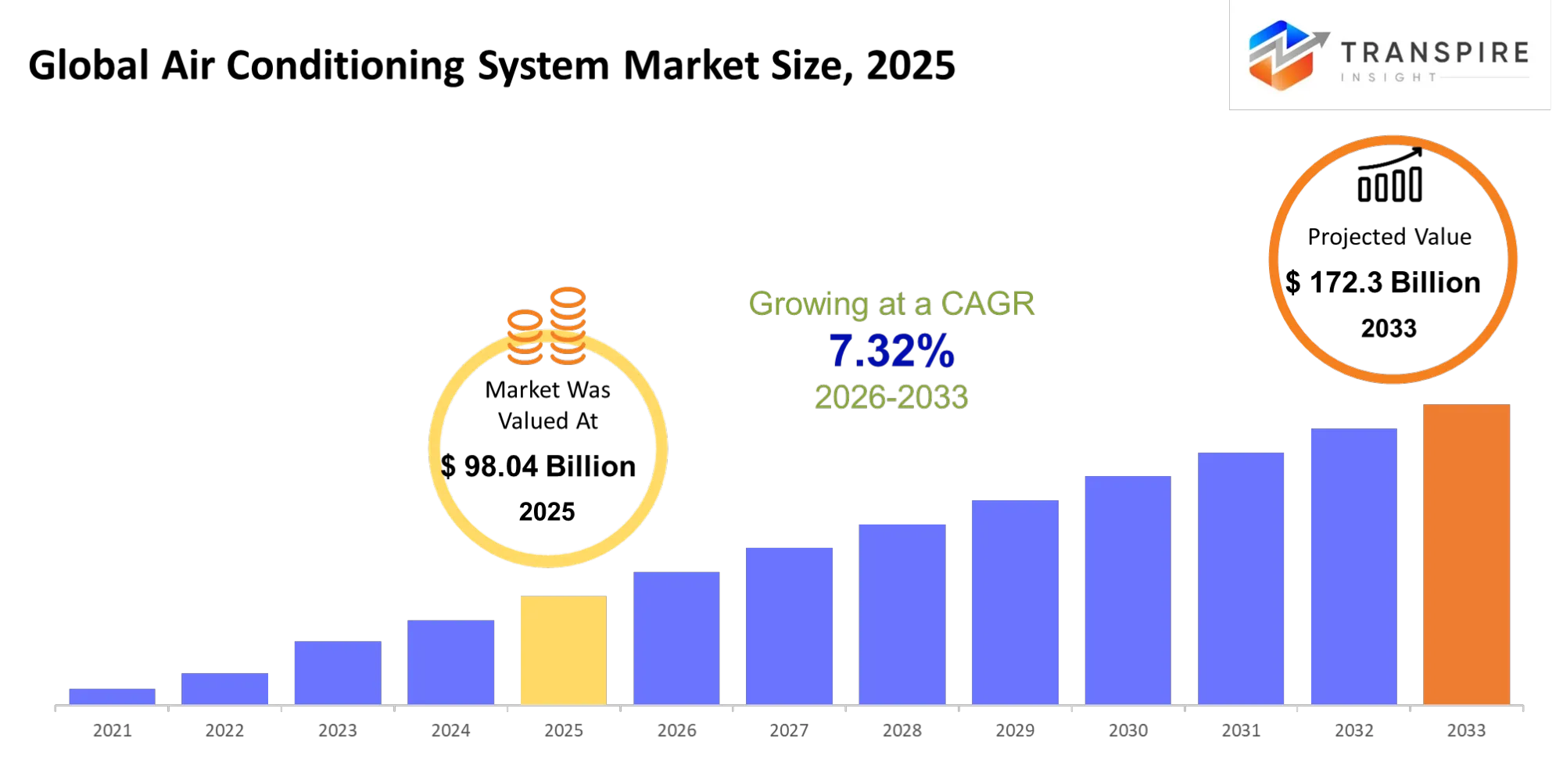
The Global Air Conditioning System Market size is estimated at USD 98.04 billion in 2025 and is anticipated to reach USD 172.3 billion by 2033, growing at a CAGR of 7.32% from 2026 to 2033.
Global Air Conditioning System Market comprises a cooling and ventilation system that is used to control the comfort and ventilation inside the premises of any residential, commercial, industrial, hospital, malls, and transport facilities in the world.
The market has transformed over the recent years from traditional coolers to smart, energy-efficient, and green coolers. The introduction of inverter technology and the Internet of Things (IoT) in HVAC systems is a significant structural change that has occurred in response to increasingly stringent energy-efficiency regulations and the rising cost of electricity.
A real-world factor was the post-pandemic emphasis on indoor air quality, resulting in a rising need for more sophisticated filtration and ventilation solutions in commercial buildings and healthcare settings. The demand is also being pushed by the effects of rapid urbanisation, increasing temperatures, and building activities. The market is growing steadily, with the adoption of modern air conditioning systems globally as consumers and businesses invest in the technology to boost disposable incomes and governments encourage green buildings.
Key Market Insights:
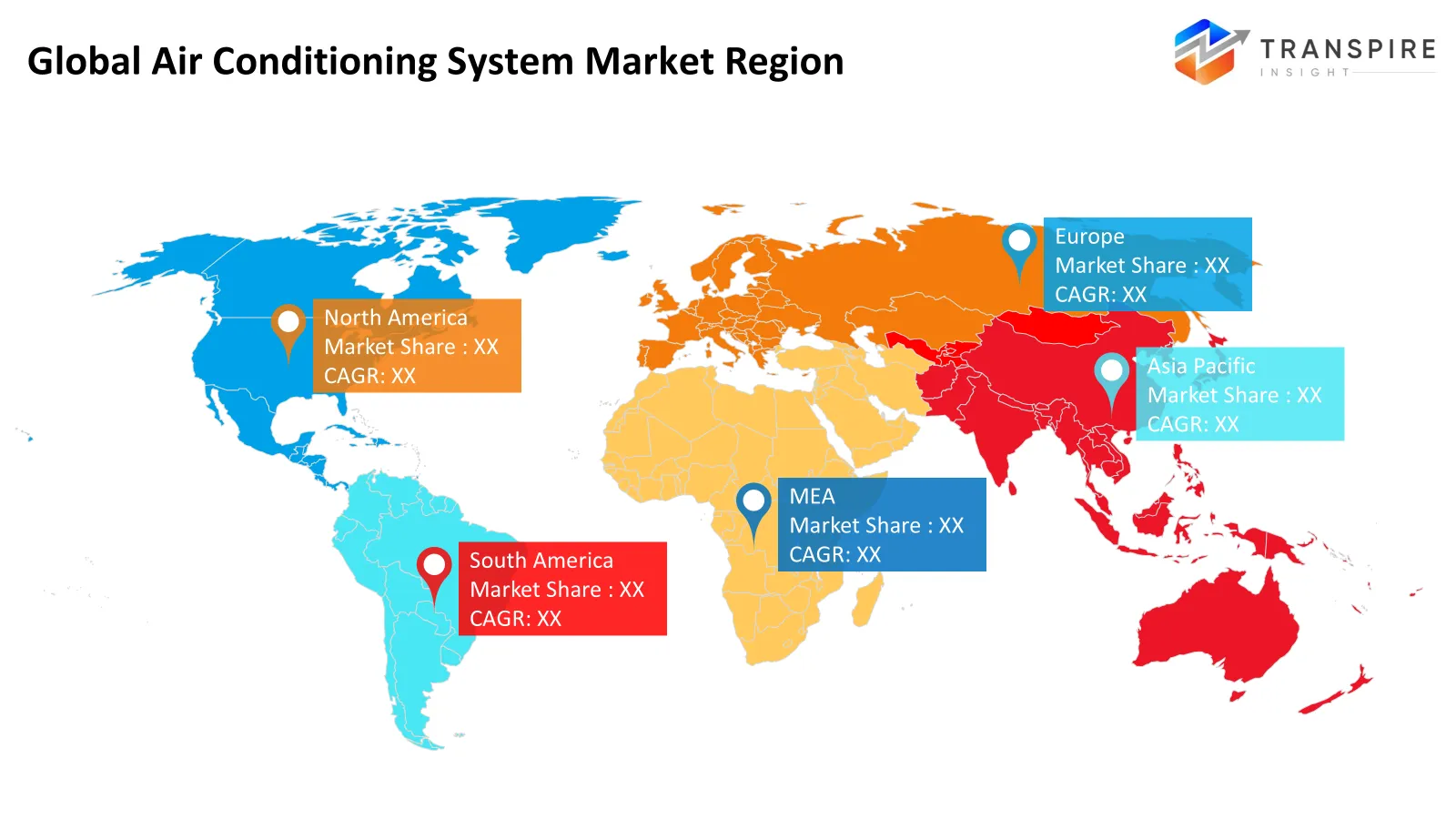
- Asia Pacific has 44% market share.
- North America has 25% market share.
- Europe has 23% market share.
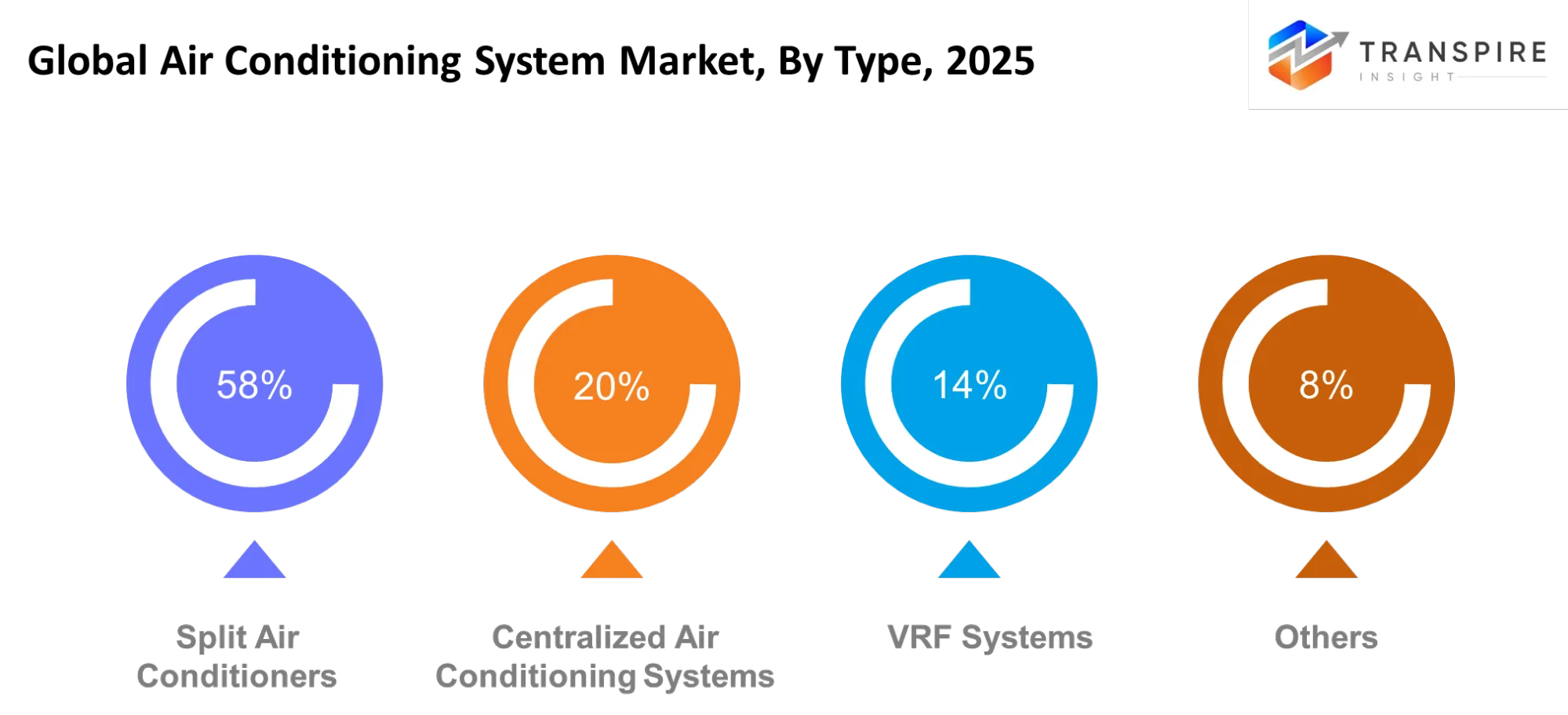
- The split air conditioners segment has 58% of the market share.
- Smart air conditioning systems are the fastest-growing segment with a CAGR of 12.2%.
- VRF Systems has 14% market share.
- Centralized air conditioning systems has 20% of the market share.
What are the Key Drivers, Restraints, and Opportunities in theGlobal Air Conditioning System Market?
Drivers
The Global Air Conditioning System Market is expanding based on four key factors. Climate change has driven an escalation in heatwaves, leading to increased installation of residential and commercial cooling systems in the Asia-Pacific, the Middle East, and North America. Second, the centralized HVAC systems are being pushed by the high-speed urban infrastructure projects such as smart cities, airports, malls, and data centers. At MCE 2026, Samsung Electronics showcased a centralized HVAC system in combination with FläktGroup solutions in Milan. The system integrated various cooling units, both indoor and outdoor, with a Building Management System (BMS) platform for data centers and industrial facilities, enhancing the need for smart and centralized HVAC infrastructure in the Global Air Conditioning System Market. In March 2026, Samsung Electronics launched a centralized HVAC system integrated with FläktGroup solutions at MCE 2026 in Milan. The system connected multiple indoor and outdoor cooling units via a Building Management System (BMS) platform for data centers and industrial facilities, thereby strengthening demand for smart, centralized HVAC infrastructure in the Global Air Conditioning System Market.
Restraints
There are some restraints in the market. While electricity consumption is a key factor to consider, so are increasing power prices, which remain a major constraint in price-sensitive areas, particularly in developing countries where power infrastructure is less stable. The second is the high installation and maintenance expense of sophisticated HVAC systems, which continues as the HVAC systems in commercial buildings are prone to costing a lot of money to install and require a high level of expertise to maintain, and environmental cooling needs have to be considered.
Opportunities
There are a number of avenues for future market growth. Commercial users are utilizing AI-powered predictive maintenance solutions to cut down on energy waste and repair expenses. The boom in investments in green buildings in Europe and Southeast Asia is driving the demand for green refrigerant systems. The market of green buildings in Europe and Southeast Asia is growing, and it is fuelling the demand for refrigerant systems with an eco-friendly approach. In areas where electricity is not always available, solar AC-powered systems are becoming more popular. Moreover, there is a significant demand for precision cooling technologies globally due to the growth of hyperscale data centers.
What Has the Impact of Artificial Intelligence Been on the Global Air Conditioning System Market?
AI has played a vital role in enhancing the efficiency and performance of the Global Air Conditioning System Market by allowing smarter cooling management and automated building operations. AI technologies in HVAC now enable sensors, occupancy tracking, and weather conditions to influence real-time energy consumption, temperature, and airflow. Commercial buildings, hospitals, hotels, and data centers are able to use this automation to save electricity and running costs. AI also enhances predictive maintenance, identifying abnormal compressor performance, refrigerant leaks, or airflow conditions before they become problematic, minimizing system downtime and repair costs. For larger facilities, advanced machine-learning algorithms can optimize the cooling load in several zones, which will increase equipment life and enhance the comfort in the building.
Finally, smart air conditioning systems that are connected to IoT platforms enable remote monitoring and centralized control, thus aiding in enhancing the operational efficiency of businesses while simultaneously adhering to energy efficiency and sustainability goals. AI-powered cooling, energy optimisation, and predictive maintenance offer Samsung Electronics its Bespoke AI wind-free air lineup to India. In January 2026, Samsung Electronics launched its Bespoke AI WindFree air conditioner lineup in India with AI-powered cooling, energy optimization, and predictive maintenance features. The launch strengthened the adoption of smart HVAC systems by improving automation, remote monitoring, and electricity savings in the Global Air Conditioning System Market.
Key Market Trends:
The Global Air Conditioning System Market is growing rapidly. It is moving from single-purpose cooling systems to intelligent climate control system solutions that optimize energy, automate systems, and improve indoor air quality.
- Inverter-type ACs are replacing fixed-split air conditioners as they consume less electricity and are more efficient in the long run.
- The market has moved from single coolers to the smart building market with smart HVACs and data-informed facilities management.
- AI technology in air conditioners is becoming more popular, offering consumers control via apps, voice commands, and automatic temperature settings.
- Now, post-pandemic, the demand for cool air has grown into demand for clean air and humidity control.
- The pace of refrigerant transition is increasing as manufacturers are looking to phase out high GGWPs and are now increasingly looking to eco-friendly alternatives due to environmental regulations.
- Commercial buildings are integrating predictive maintenance systems with IoT sensors that can detect any air flow or compressor problems before they break down.
- Two major industries that are generating demand for precision cooling solutions, which can ensure consistent operating conditions at all times in the data center and in semiconductor manufacturing.
- In areas where there is an unreliable power supply and the cost is high, solar-compatible or hybrid air conditioning systems are becoming more common.
- HVAC manufacturers are getting more interested in providing subscription-based monitoring and maintenance services.
Global Air Conditioning System Market Segmentation
By Type
Split Air Conditioners lead in the Global Air Conditioning System Market, accounting for approximately 58% market share. They are successful due to their ease of installation, reduced operating noise, compatibility with energy-efficient inverters, and widespread use in residential apartments, offices, and retail buildings. The segment's leadership is expected to remain ongoing owing to the expansion of housing projects in urban centres and the need to replace the existing cooling units.
The fastest-growing segment is the Smart Air Conditioning Systems to grow at a CAGR of 12.2%. The increase in the usage of temperature control with AI, smartphone connectivity, voice-assistance control, and energy-monitoring systems is driving the demand. The consumers and commercial users are increasingly opting for the automated cooling systems, which offer electricity savings and efficiency.
By Application
The dominance of Residential Buildings in the market is attributed to rapid urbanization, increased spending of the middle class, and increased installation of split and window air conditioners in apartments and independent houses. Supporting segment growth are extreme summer temperatures and growing housing construction activities.
The Healthcare Facilities segment is emerging as the fastest-growing application segment, as hospitals, laboratories, and diagnostic centers demand accurate temperature management, air purification, and a constant ventilation system. The HVAC upgrades are picking up pace worldwide as there is a push for advanced healthcare infrastructure investment post-pandemic. The investments in the advanced healthcare infrastructure post-pandemic are driving the HVAC upgrades worldwide.
By End-User
The households are the major end-user segment because the residential consumption of air conditioners accounts for the largest market in the world. The segment is growing with increasing disposable income, advancement in rural electrification, and the growth of demand for smart home appliances.
The rising popularity of centralized HVAC systems in offices, IT parks, retail stores, and commercial complexes is driving the growth of the enterprise end-user segment. More and more businesses are finding that investing in an energy-efficient cooling solution will not only help them save money on their costs in the long run, but it will also help to save the environment.
By Technology
The reason why Inverter Technology dominates the market is that its systems consume less electricity and operate at a lower noise level and cooling rate than traditional ones. The removal of the non-inverter units is increasing due to government energy-efficiency standards and increased consumer awareness of the advantages of these units.
With the advent of connected HVAC platforms, the technology segment of IoT-enabled Systems is the fastest-growing, enabling remote monitoring, predictive maintenance, and automated climate optimization. The emergence of smart building systems and AI-based energy management solutions is driving up the demand for intelligent cooling technologies.
What are the Key Use Cases Driving the Global Air Conditioning System Market?
The key application for the growth of the Global Air Conditioning System Market is the household application of the air conditioners, particularly the split type used in apartments and independent houses, and urban house developments. Household adoption is growing globally due to rising temperatures, better electrification, and a desire for cooling efficiency.
New applications are beginning to emerge in the commercial building sector, such as offices, shopping centers, airports, hotels, and educational facilities. Central HVAC and VRF systems are steadily becoming a growing part of building systems due to their ability to ensure building comfort, enhance energy efficiency, and ensure uninterrupted building operations in high-occupancy buildings.
Data centers, smart industrial plants, and healthcare facilities are the emerging application areas where it is crucial to maintain accurate temperature control. Air conditioners with AI and IoT capabilities are being applied to predictive maintenance, automation of airflow balancing, and air conditioning control in server rooms, laboratories, and pharmaceutical production facilities.
Report Metrics
|
Report Metrics |
Details |
|
Market size value in 2025 |
USD 98.04 Billion |
|
Market size value in 2026 |
USD 105.1 Billion |
|
Revenue forecast in 2033 |
USD 172.3 Billion |
|
Growth rate |
CAGR of 7.32% from 2026 to 2033 |
|
Base year |
2025 |
|
Historical data |
2021 - 2024 |
|
Forecast period |
2026 - 2033 |
|
Report coverage |
Revenue forecast, competitive landscape, growth factors, and trends |
|
Regional scope |
United States; Canada; Mexico; United Kingdom; Germany; France; Italy; Spain; Denmark; Sweden; Norway; China; Japan; India; Australia; South Korea; Thailand; Brazil; Argentina; South Africa; Saudi Arabia; United Arab Emirates |
|
Key company profiled |
Daikin, Carrier, LG Electronics, Samsung Electronics, Mitsubishi Electric, Panasonic, Trane Technologies, Hitachi, Toshiba, Fujitsu General, Midea Group, Gree Electric, Blue Star, Voltas, Lennox. |
|
Customization scope |
Free report customization (country, regional & segment scope). Avail customized purchase options to meet your exact research needs. |
|
Report Segmentation |
By Type (Split Air Conditioners, Window Air Conditioners, Centralized Air Conditioning Systems, Portable Air Conditioners, VRF Systems, Smart Air Conditioning Systems, Others); By Application (Residential Buildings, Commercial Buildings, Industrial Facilities, Healthcare Facilities, Hospitality Sector, Others); By End-User (Households, Enterprises, Manufacturing Plants, Government Buildings, Others); By Technology (Inverter Technology, Non-inverter Technology, IoT-enabled Systems, Hybrid Cooling Systems, Others). |
Which Regions are Driving the Global Air Conditioning System Market Growth?
Asia-Pacific is the dominating market with 44% of the market share. Rapid urbanization, increasing middle-class income, and extremely high demand for cooling in China, India, Japan, and Southeast Asia are driving the Global Air Conditioning System Market. The area is well known for its robust manufacturing base, significant residential building projects, and government incentives for energy-efficient products like inverter air conditioners. The growing frequency and intensity of heatwaves, coupled with urbanisation, are driving up residential and commercial HVAC installations. Panasonic launched a new line of Energy-efficient Air conditioners in India as part of its strategy of increasing its cooling business and manufacturing footprint in the region.
North America is the second-largest market, accounting for 25% market share, attributed to the replacement demand, developed HVAC infrastructure, and a high rate of adoption of centralized cooling systems. While the population growth is responsible for expansion in the Asia Pacific, technology upgrades, smart building retrofits, and energy-efficient commercial HVAC modernization are the drivers of growth in North America. The current regulatory framework is stable, the contractor network is well developed, and the demand for data centers is rising, which helps to ensure market stability in the long term. At the AHR Expo in the U.S., Daikin presented state-of-the-art commercial and data-center cooling solutions.
North America is also the fastest-growing region in the Global Air Conditioning System Market with an estimated CAGR of 11.3%. Recent growth has come from the increase in use of data centers and semiconductor facilities, heat pumps, AI-driven HVAC systems, and precision cooling technologies. The growth of the inverter-driven and connected HVAC system market will be driven by expanding electrification policies and demand for low-carbon commercial buildings. TCL launched all-inverter ducted heat pump platforms for the U.S. residential and light commercial market. In February 2026, TCL launched all-inverter ducted heat pump platforms designed specifically for the U.S. residential and light commercial market.
Who are the Key Players in the Global Air Conditioning System Market and how do they Compete?
The energy efficiency, smart automation, scale of manufacturing, and strength of distribution in the region are the key factors driving competition in the Global Air Conditioning System Market. AI-based cooling systems, inverter technology, eco-friendly refrigerants, and centralized HVAC solutions for commercial infrastructure are all putting companies up against it. With electricity savings, predictive maintenance, and connected building integration all becoming more and more important to the market, it is becoming very innovative. Manufacturers are also increasing their capacity locally and through strategic alliances to cut down on the cost of the supply chain and augment market penetration in the region.
Daikin Industries' core business is in the field of high-quality inverter-type HVAC and centralised commercial cooling infrastructures. The company makes its mark on the market with its innovative energy-saving compressor designs and strong networks of service providers in Asia and North America. Samsung Electronics' business model is to compete with smart air conditioners that use AI technology and are connected with IoT environments and mobile devices, targeting tech-savvy home consumers. LG Electronics focuses on dual inverter systems and air purification technologies, and is aggressively entering new, emerging Asian and Middle Eastern markets.
Carrier Global continues to build its footprint with large-scale commercial HVAC solutions and enterprise and healthcare building management solutions. Mitsubishi Electric's VRF systems and precision cooling technologies stand out in the field of industrial and data-center cooling solutions. To reduce costs and increase energy efficiency of the product, Panasonic Corporation is emphasising its energy-saving residential systems and localized expansion of manufacturing in India and Southeast Asia.
Global Air Conditioning System Market Companies
- Daikin
- Carrier
- LG Electronics
- Samsung Electronics
- Mitsubishi Electric
- Panasonic
- Trane Technologies
- Hitachi
- Toshiba
- Fujitsu General
- Midea Group
- Gree Electric
- Blue Star
- Voltas
- Lennox
Recent Development News
In April 2026, Haier Group launched its desert rose super heavy-duty air conditioner range powered by AI-AtmoX technology, offering automated cooling adjustment, occupancy sensing, and energy-saving functions for harsh summer environments.
(Source- https://www.haier.com)
In April 2026, Bosch Home Comfort Group introduced over 80 new Hitachi AC models in India, focused on energy efficiency, intelligent controls, and high-temperature cooling performance for residential users.
(Source- https://www.thermalcontrolmagazine.com)
What Strategic Insights Define the Future of the Global Air Conditioning System Market?
The Global Air Conditioning System Market is shifting towards intelligent, energy-saving, and connected cooling ecosystems instead of mere sales of AC units. AI-powered automation, predictive maintenance, eco-friendly refrigerants, and connectivity with smart building systems will become more critical for future competitions. Firms with a legacy of just traditional cooling technologies might gradually become less relevant as customers increasingly seek energy optimisation and digital control options.
One of the unstated dangers is the increasing pressure from environmental legislation that impacts high-emission refrigerants and power-hungry HVAC systems. The legacy product designs are still being used by many manufacturers, resulting in long-term compliance and retrofit issues. Meanwhile, a new market is forming in the area of precision cooling for data centres, semiconductor manufacturing plants, and medical facilities where the temperature must be maintained at a constant level at all times.
In terms of strategy, companies must invest in inverter technology, HVAC platforms based on the Internet of Things, and regional manufacturing growth, in order to cut costs and increase supply resiliency. The growing importance of partnerships with smart building developers and renewable energy providers for market positioning will become more significant.
Key Global Air Conditioning System Market Segmentation
By Type
- Split Air Conditioners
- Window Air Conditioners
- Centralized Air Conditioning Systems
- Portable Air Conditioners
- VRF Systems
- Smart Air Conditioning Systems
- Others
By Application
- Residential Buildings
- Commercial Buildings
- Industrial Facilities
- Healthcare Facilities
- Hospitality Sector
- Others
By End-User
- Households
- Enterprises
- Manufacturing Plants
- Government Buildings
- Others
By Technology
- Inverter Technology
- Non-inverter Technology
- IoT-enabled Systems
- Hybrid Cooling Systems
- Others
Regional Outlook
North America
- United States
- Canada
- Mexico
Europe
- Germany
- United Kingdom
- France
- Spain
- Italy
- Rest of Europe
Asia Pacific
- Japan
- China
- Australia & New Zealand
- South Korea
- India
- Rest of Asia Pacific
South America
- Brazil
- Argentina
- Rest of South America
Middle East & Africa
- Saudi Arabia
- United Arab Emirates
- South Africa
- Rest of the Middle East & Africa
Frequently Asked Questions
Find quick answers to common questions.
The Global Air Conditioning System Market size was valued at USD 98.04 billion in 2025 and is poised to reach USD 172.3 billion by 2033, expanding at a 7.32% CAGR.
Key segments for the Global Air Conditioning System Market are By Type (Split Air Conditioners, Window Air Conditioners, Centralized Air Conditioning Systems, Portable Air Conditioners, VRF Systems, Smart Air Conditioning Systems, Others); By Application (Residential Buildings, Commercial Buildings, Industrial Facilities, Healthcare Facilities, Hospitality Sector, Others); By End-User (Households, Enterprises, Manufacturing Plants, Government Buildings, Others); By Technology (Inverter Technology, Non-inverter Technology, IoT-enabled Systems, Hybrid Cooling Systems, Others).
The Global Air Conditioning System Market growth is primarily driven by rising global temperatures, rapid urbanization, increasing construction activities, growing demand for energy-efficient cooling systems, and the adoption of smart AI-enabled air conditioners in residential and commercial buildings.
The Global Air Conditioning System Market is led by major manufacturers, including Daikin, Carrier, LG Electronics, Samsung Electronics, Mitsubishi Electric, Panasonic, Trane Technologies, Hitachi, Toshiba, Fujitsu General, Midea Group, Gree Electric, Blue Star, Voltas, and Lennox.
Asia-Pacific holds around 44% share of the Global Air Conditioning System Market, driven by rapid urbanization, large-scale residential and commercial construction, rising middle-class income, and extremely high cooling demand in countries such as China, India, and Japan. Strong manufacturing capacity, government support for energy-efficient appliances, and increasing adoption of smart inverter air conditioners further strengthen the region’s global market dominance.
Commercial opportunities in the Global Air Conditioning System Market include AI-enabled predictive maintenance systems that help reduce energy and repair costs, rising investments in green buildings increasing demand for eco-friendly refrigerant systems, and growing adoption of solar-powered air conditioners in regions with unstable electricity supply.
- Daikin
- Carrier
- LG Electronics
- Samsung Electronics
- Mitsubishi Electric
- Panasonic
- Trane Technologies
- Hitachi
- Toshiba
- Fujitsu General
- Midea Group
- Gree Electric
- Blue Star
- Voltas
- Lennox
About the Authors

Chetan Dhatrak
I’m Chetan Dhatrak, a Senior Research Analyst at Transpire Insight, specializing in the Consumer Goods, Foods and Beverages industry. I focus on analyzing market trends, consumer behavior, competitive landscapes, and industry developments to deliver accurate, data-driven insights. My research at Transpire Insight is built on credible sources and in-depth analysis, helping businesses and readers better understand market dynamics, emerging opportunities, and evolving consumer preferences. I’m committed to creating reliable, well-researched content that supports informed decision-making and reflects the latest developments in the consumer goods and food & beverage sectors.

Chakradhar Khansole
Chakradhar serves as the Research Director at Transpire Insight, bringing over 8 years of experience in technology, innovation, and strategic market intelligence. He specializes in transforming complex market data into actionable business insights that enable organizations to make informed, growth-oriented decisions. Recognized for his strategic vision and analytical expertise, Chakradhar leads high-impact research initiatives, delivering comprehensive market assessments, competitive intelligence, and forward-looking industry analysis.
Recently Published Reports
-
Apr 2026
Bottled Water Market
Bottled Water Market Size, Share & Analysis Report By Product Type (Still Bottled Water, Carbonated Bottled Water, Functional Bottled Water, and Others), By Packaging (PET, Cans, and Others), By Sales Channel (Supermarkets/Hypermarkets, Convenience Stores/Drug Stores, Grocery Stores/Club Stores, Foodservice, and Others) and Geography (North America, Europe, Asia-Pacific, Middle East and Africa, South and Central America), 2021 - 2032
-
Apr 2026
Color Cosmetic Packaging Market
Color Cosmetic Packaging Market Size, Share & Analysis Report By Application (Mascara Packaging, Liquid Packaging, and Liquid Face), By Type (Tubes & Bottles, Pens & Markers, Compacts & Containers, and Droppers & Pumps), and Geography (North America, Europe, Asia-Pacific, Middle East and Africa, South and Central America), 2021 - 2031
-
Apr 2026
External Microphone For Camera Market
External Microphone For Camera Market Size, Share & Analysis Report By Type (Shotgun Microphone, Lavalier Microphone, and Others), By Application (Digital Camera, Professional Video Camera, and Others), and Geography (North America, Europe, Asia-Pacific, Middle East and Africa, South and Central America), 2021 - 2031
-
Apr 2026
Foot Orthotic Insoles Market
Foot Orthotic Insoles Market Size, Share & Analysis Report By Type (Pre-fabricated, and Custom-made), By Material (Thermoplastic, Composite Carbon Fiber, and Others), By Distribution Channel (Drug Stores, Hospitals & Clinics, and Others), and Geography (North America, Europe, Asia-Pacific, Middle East and Africa, South and Central America), 2021 - 2031