
United Kingdom Smart Air Conditioning Market Size & Forecast
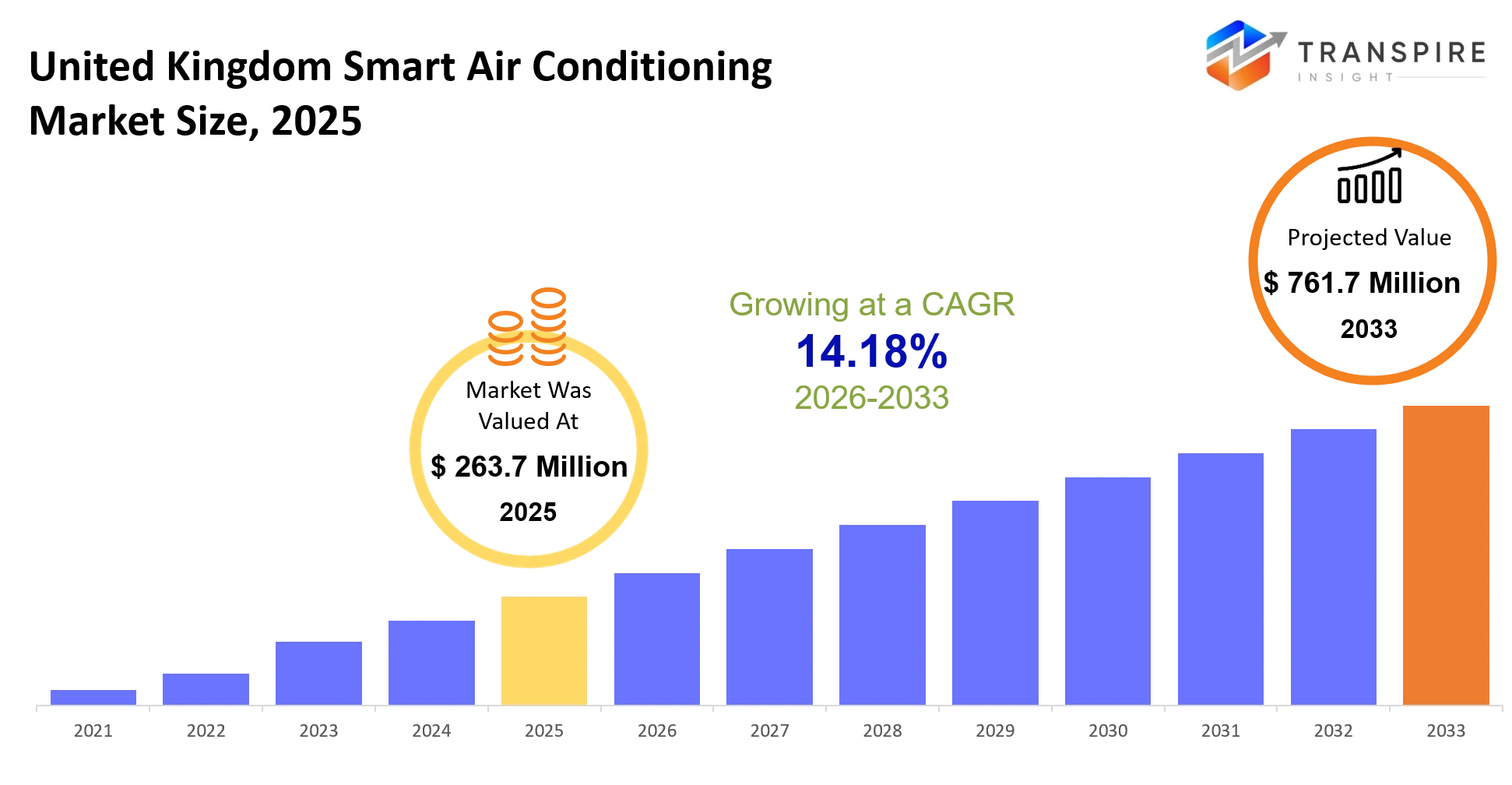
- United Kingdom Smart Air Conditioning Market Size 2025: USD 263.7 Million
- United Kingdom Smart Air Conditioning Market Size 2026: USD 301.1 Million
- United Kingdom Smart Air Conditioning Market Size 2033: USD 761.7 Million
- United Kingdom Smart Air Conditioning Market CAGR: 14.18%
- United Kingdom Smart Air Conditioning Market Segments: By Product Type (Smart Split AC, Smart Window AC, Smart Portable AC, Smart Central AC, Others); By Connectivity (Wi-Fi, Bluetooth, IoT, Voice Control, Others); By Technology (AI-Based Controls, Sensors, Energy Management, Others); By End User (Residential, Commercial, Industrial, Others); By Distribution Channel (Online, Offline, Direct Sales, Others); By Application (Homes, Offices, Hospitality, Healthcare, Others)
United Kingdom Smart Air Conditioning Market Summary
As per Transpire Insight Analysis, the United Kingdom Smart Air Conditioning Market was valued at USD 263.7 Million in 2025, the market is set to reach USD 761.7 Million by 2033. An intelligent air conditioner does more than cool a space. It reads the outside temperature forecast, adjusts its own compressor cycle to meet a target price under a time-of-use energy tariff, and allows a facilities manager to shut off an entire floor of unused offices from their phone. The UK smart air conditioning market covers all that connected hardware and software sitting on top of standard cooling equipment - sold into houses, offices, hospitals, and hotels.
Two things really changed this market since 2021. Firstly, UK summers got significantly hotter: the Met Office recorded the country's very first 40°C reading in July 2022, and cooling degree days have kept trending upward every year since then. Homes that never really needed air conditioning started buying them, and first-time buyers mostly picked out Wi-Fi-enabled units since retailers had almost stopped stocking simple models at similar prices. Secondly, the 2022 energy price crisis, when UK household electricity bills roughly doubled within a year, drove both domestic and commercial buyers towards units with actual energy management features instead of just a marketing label. The outcome is a market expanding not simply because many more units get sold, but also because each unit makes a lot more money via connectivity and software attached to it.
Key United Kingdom Smart Air Conditioning Market Insights
- London and the South East will comprise the biggest part of the UK's smart air conditioning market - approximately 38 per cent in 2025 - thanks to a lot more commercial offices per square mile and much higher household spending power.
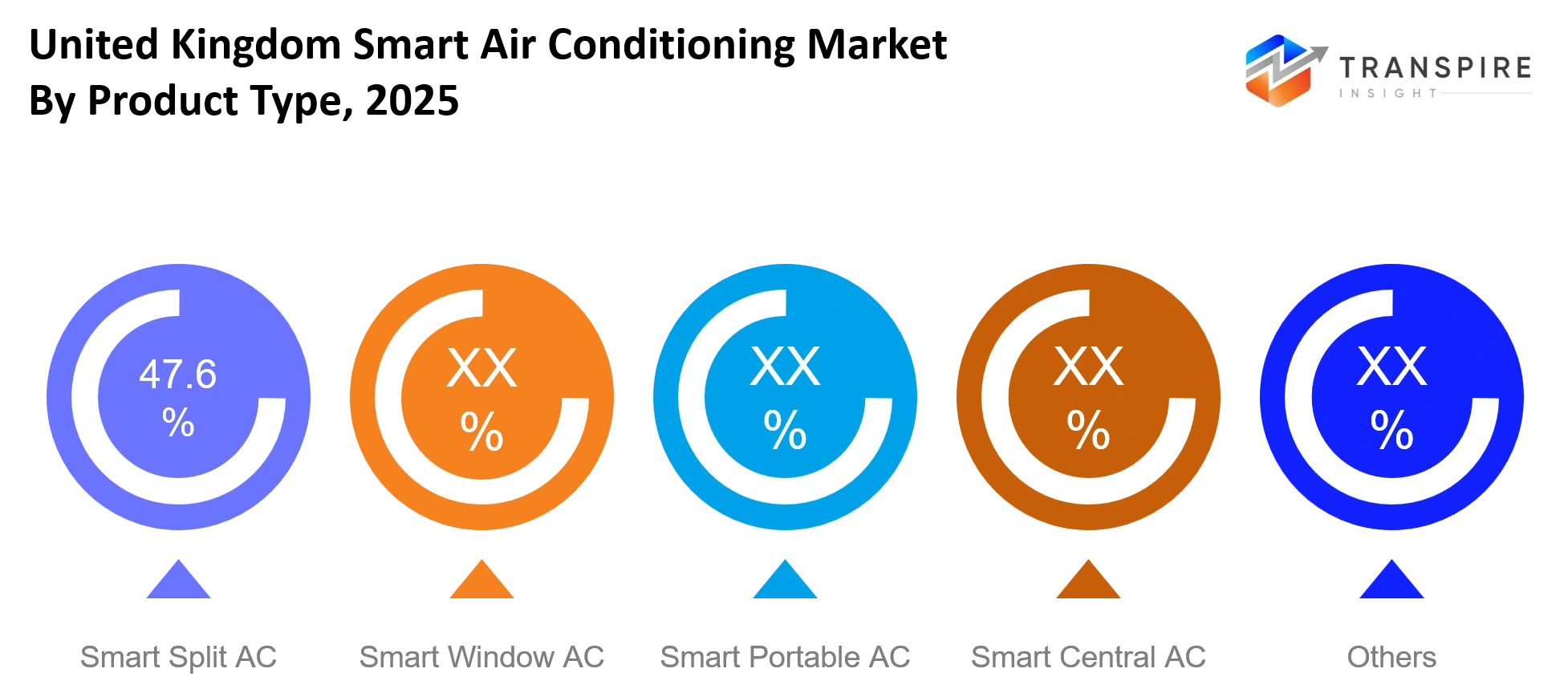
- Smart split AC units will be number one in terms of product type, making up 47. 6 per cent of our 2025 revenue, which is really the default option for most UK houses that don't have existing ducted cooling systems already set up.
- Wi-Fi connectivity will be the leader in the connectivity segment because it's in so many smart units sold here in the UK in 2025 - it doesn't need any extra equipment and can connect straight to your existing home internet connection.
- AI-based controls are actually the fastest-growing tech segment right now, with adoption really taking off since 2023 as makers integrate occupancy learning and temperature-adjusting algorithms into even mid-range units.
- Residential customers created the largest revenue share in 2025, mainly due to first-time AC buyers amongst households who've been dealing with several extremely hot UK summers since 2022.
- The Commercial user group is really expanding at the quickest rate, because UK office landlords are fitting out their buildings with smart HVAC controls to comply with the Minimum Energy Efficiency Standards (MEES) before 2027 EPC regulations get even stricter.
- Online sales grew very rapidly from 2021 to 2025, with some big UK retailers such as Currys and AO. com greatly expanding their online offerings of smart climate control products.
- Daikin and Mitsubishi Electric still hold the top spots in terms of UK installer partnerships, giving both these companies a bit of a structural edge in the higher-value commercial and multi-split residential installation area.
- Tado and Sensibo, two well-known UK-based smart thermostat and retrofit AC control specialsts, are gaining ground in the software-only retrofit segment - where people just add smart control to their existing non-smart AC unit instead of changing it all together.
What are the Key Drivers, Restraints, and Opportunities in the United Kingdom Smart Air Conditioning Market?
Driver: The primary driver is really the structural increase in UK cooling degree days. The Met Office actually confirmed 2022 was the UK's hottest year on record - and subsequent summers have kept temperatures at a level that were once rare extremes. Households used to think air conditioning was an unnecessary purchase in our relatively mild climate; that idea no longer applies for an increasingly bigger part of the population - especially in London and the South East, where urban heat island effects make rising baseline temperatures even worse. This really draws first-time buyers into the market - and they often opt for smart-enabled units because retailers have moved most of their shelf space away from basic models.
Restraint: The biggest restraint is the UK's very limited housing stock. A huge proportion of UK homes - particularly older Victorian and Edwardian terraced houses common in London - lack the wall cavity space or planning flexibility for installing permanent split systems, and lots are in conservation areas where external condenser units require planning permission. This is a deep-seated, not a cyclical, obstacle: it won't get fixed by lowering prices or better marketing and instead drives demand towards portable and window units, which have lower average selling prices and much smaller smart-feature margins than split systems, suppressing overall market revenue growth quite a bit compared to what unit volume alone would suggest.
Opportunity: The clearest opportunity is definitely integrating with UK domestic energy tariff structures. Since Ofgem allowed wider rollout of time-of-use tariffs and smart meters had been installed in more than 60% of UK households by 2025, smart AC units that can shift cooling loads to off-peak pricing windows really offer a measurable bill saving rather than just a comfort benefit. Octopus Energy's Agile tariff integrations with connected home devices show there's real consumer interest in this kind of pairing. Vendors who get direct API integration certified with major UK energy suppliers will position their units as a financial tool more so than a discretionary comfort purchase - widening the potential buyer base way beyond households that were always planning to buy AC regardless of price signals.
What Has the Impact of Artificial Intelligence Been on the United Kingdom Smart Air Conditioning Market?
Artificial intelligence really impacts the UK intelligent air conditioning market - through occupancy-driven automation, predictive energy cost optimization, and fault detection. Occupancy learning algorithms, quite common now in the mid-range and high-end models from Daikin and Mitsubishi Electric, follow your room's use patterns over about two to three weeks and then start pre-cooling or switching off units automatically - all without needing you to set a manual timer schedule yourself. Tado's UK-oriented smart control system adds weather forecast information to the occupancy learning, further decreasing unnecessary compressor activity whenever outside temperatures are about to naturally cool down.
Predictive cost optimization is perhaps the most commercially apparent AI application. Given the huge jump in 2022-23 UK energy prices, units that can move cooling loads towards cheaper rate windows really give homeowners a tangible, measurable financial benefit shown directly on their energy bill. Ambi Climate's retrofit AI controllers, attached to your existing non-intelligent units, have actually reported an average cooling energy decrease of around 20-30% for UK households on variable tariffs. Commercial building management systems expand this idea even further, using AI to balance zone-by-zone cooling demands against actual time-of-use electricity rates.
Really, the biggest constraint is data availability in retrofit situations. AI-based fault detection and predictive maintenance need many weeks of consistent sensor data to create a reliable starting point, which is quite challenging in rental properties with frequent tenant changes - something quite common in the UK housing market in London especially. Integration costs for adding AI sensors onto older non-intelligent AC equipment still presents a significant hurdle for lower-income families, keeping the most advanced AI functions mainly in new-builds and luxury units for now.
Key Market Trends
- London and the South East held roughly 38% of UK smart AC revenue in 2025, with the region's share expected to moderate slightly as northern England's cooling demand accelerates.
- Smart Split AC units captured 47.6% of product segment revenue in 2025, and the category has grown steadily each year since UK summer temperature records were broken in 2022.
- AI-Based Controls adoption roughly doubled between 2022 and 2025 across mid-range residential units, as manufacturers pushed occupancy and weather-responsive features down from premium to standard tiers.
- Online distribution share climbed from under 25% in 2020 to a substantially larger share by 2025, led by major UK retailers building dedicated smart climate categories.
- Commercial retrofit demand accelerated after 2023 as UK landlords faced Minimum Energy Efficiency Standards tightening ahead of the 2027 EPC deadline for commercial lets.
- Voice control integration expanded through 2023 and 2024 as Amazon Alexa and Google Home partnerships became a standard feature request among UK smart home buyers.
- Retrofit-only smart controllers from Tado, Sensibo, and Ambi Climate gained share as households sought smart features without replacing an existing working AC unit.
- Heat pump and reversible AC crossover products grew in the UK residential segment as government Boiler Upgrade Scheme incentives pushed households toward dual heating-cooling systems.
United Kingdom Smart Air Conditioning Market Segmentation
By Product Type
Smart Split AC holds the leading position at 47.6% of 2025 product revenue, the default retrofit choice for UK homes without ducted infrastructure. Its share reflects both installation flexibility and a wide price range spanning entry to premium tiers. Smart Window and Portable AC serve renters and conservation-area homes where planning restrictions block permanent installation, generating lower average revenue per unit. Smart Central AC remains niche, confined largely to new-build luxury housing and commercial fit-outs. Growth through 2033 favours split systems as landlords standardise retrofit specifications across rental portfolios ahead of efficiency regulation deadlines.
By Connectivity
Wi-Fi is the dominant connectivity method, fitted in the large majority of UK smart units sold in 2025, because it needs no separate hub and pairs directly with home broadband. Bluetooth trails as a proximity-only option in lower-cost portable units. IoT-layered systems, which mesh multiple devices into a single home automation network, are growing fastest in new-build housing where builders pre-wire for whole-home automation. Voice control has moved from novelty to expected feature, bundled into nearly all mid-range and premium Wi-Fi units by 2025 through Alexa and Google Home certification.
By Technology
AI-Based Controls are the fastest-growing technology category, now standard in premium units and increasingly present in mid-range products as occupancy learning chips fall in cost. Sensor-based systems, covering humidity, air quality, and presence detection, support both comfort and energy claims and are heavily marketed post-2022 alongside indoor air quality concerns. Energy Management technology, covering tariff-responsive scheduling and consumption reporting, has grown fastest in percentage terms since the 2022 UK energy price shock, as it is the feature buyers can point to as directly reducing their bill.
By End User
Residential buyers generated the largest 2025 revenue share, driven by first-time purchasers responding to consecutive hot UK summers. Commercial end users, spanning offices, retail, and mixed-use buildings, are growing fastest as landlords retrofit ahead of MEES deadlines, and each commercial installation carries higher average revenue through multi-zone software licensing. Industrial use remains a small, specialised segment tied to server room and cold-chain cooling, where reliability certification matters more than smart features. Other end users, including public sector estates, are growing steadily under NHS and local government decarbonisation programmes.
By Distribution Channel
Offline retail, including specialist HVAC installers and big-box electronics stores, still carries the largest transaction value because split system installation requires professional fitting that consumers typically bundle with in-store or trade purchase. Online distribution has grown fastest since 2021, led by Currys and AO.com building dedicated smart climate categories, and works best for portable and window units that need no professional installation. Direct sales, where manufacturers sell straight to large commercial and hospitality clients, generate the highest per-deal value but the smallest transaction count.
By Application
Homes represent the largest application segment by volume, tracking the residential end-user trend directly. Offices are the fastest-growing application as UK employers retrofit HVAC ahead of efficiency compliance deadlines and hybrid-work occupancy patterns make zone-level smart control more valuable than constant whole-floor cooling. Hospitality applications, particularly UK hotel chains, are adopting smart AC to support ESG reporting commitments. Healthcare applications remain smaller but are growing under NHS estate modernisation and decarbonisation funding programmes announced since 2023.
What are the Key Use Cases Driving the United Kingdom Smart Air Conditioning Market?
The dominant use case is residential retrofit cooling in homes without existing air conditioning. UK households that experienced the record 2022 heatwave and subsequent hot summers are installing their first cooling system, and the large majority default to a smart split unit that can be scheduled around variable energy tariffs. This use case links directly to the Smart Split AC product segment, which supplies most of this first-time purchase volume.
A closely related and expanding use case is office retrofit ahead of UK Minimum Energy Efficiency Standards deadlines. Commercial landlords are replacing legacy HVAC controls with zone-level smart systems that can demonstrate measurable efficiency gains for EPC compliance, linking this use case to the Commercial end-user and Offices application segments identified in the report's segmentation.
An emerging use case is smart AC paired with home battery and solar installations in UK households pursuing broader energy independence. As UK solar and battery storage uptake grows, households are configuring AC units to draw preferentially from stored solar power rather than the grid, a use case still niche in 2025 but positioned to expand meaningfully as UK domestic battery storage costs continue to fall through the forecast period.
|
Report Metrics |
Details |
|
Market size value in 2025 |
USD 263.7 Million |
|
Market size value in 2026 |
USD 301.1 Million |
|
Revenue forecast in 2033 |
USD 761.7 Million |
|
Growth rate |
CAGR of 14.18% from 2026 to 2033 |
|
Base year |
2025 |
|
Historical data |
2021 - 2024 |
|
Forecast period |
2026 - 2033 |
|
Report coverage |
Revenue forecast, competitive landscape, growth factors, and trends |
|
Regional scope |
United Kingdom (England, Scotland, Wales, Northern Ireland); London and South East; North England; Midlands; South West and Wales; Scotland |
|
Key companies profiled |
Daikin, LG Electronics, Samsung, Panasonic, Mitsubishi Electric, Carrier, Bosch, Johnson Controls, Midea, Haier, Honeywell, Sensibo, Tado, Ambi Climate, Fujitsu General |
|
Customization scope |
Free report customization (country, regional & segment scope). Avail customized purchase options to meet your exact research needs. |
|
Report Segmentation |
By Product Type (Smart Split AC, Smart Window AC, Smart Portable AC, Smart Central AC, Others); By Connectivity (Wi-Fi, Bluetooth, IoT, Voice Control, Others); By Technology (AI-Based Controls, Sensors, Energy Management, Others); By End User (Residential, Commercial, Industrial, Others); By Distribution Channel (Online, Offline, Direct Sales, Others); By Application (Homes, Offices, Hospitality, Healthcare, Others) |
Which Regions are Driving the United Kingdom Smart Air Conditioning Market Growth?
London and the South East lead the UK smart air conditioning market with roughly 38% of 2025 revenue. The region combines the country's highest concentration of commercial office space, the greatest household disposable income, and the strongest urban heat island effect, which pushes summer temperatures in central London measurably above surrounding rural areas. Installer density is also highest here, giving residents and businesses the shortest lead times for split system fitting, which supports faster conversion from purchase interest to completed installation than in other UK regions.
The Midlands and North England form a steadier, more gradually growing contributor to national revenue. Unlike London, growth here tracks closely with new-build housing completions and gradual commercial retrofit rather than acute heatwave-driven demand spikes, giving this region a more stable, less seasonally volatile revenue pattern that manufacturers value for production planning.
Scotland and Northern Ireland show the fastest growth rate off a small base, as historically low cooling demand meant these regions had almost no installed AC base before 2020. Recent above-average summer temperatures, even in traditionally cool areas, combined with new-build housing regulations increasingly specifying reversible heat pump and cooling systems, are opening a genuinely new demand pool. Investors entering the UK smart AC market should treat Scotland and Northern Ireland as an early-stage opportunity rather than a mature, price-competitive market.
Who are the Key Players in the United Kingdom Smart Air Conditioning Market and How Do They Compete?
The UK smart air conditioning market is moderately fragmented, with global HVAC manufacturers competing against specialist retrofit software companies for different parts of the value chain. Daikin and Mitsubishi Electric compete primarily on installer network depth and commercial specification relationships, while Tado, Sensibo, and Ambi Climate compete on software-only retrofit propositions that let consumers add smart control without replacing existing hardware. This split means the market does not have a single dominant basis of competition, and vendors must choose whether to compete as a hardware manufacturer, a software layer, or both.
Daikin holds the UK's strongest installer relationships built over decades of commercial HVAC supply, which it now leverages to cross-sell smart-enabled residential and light-commercial units through the same trade channel. Mitsubishi Electric differentiates through UK-specific product certification and a reputation for reliability in the commercial segment, supporting premium pricing on its smart multi-split systems. LG Electronics and Samsung compete through consumer smart home ecosystem integration, bundling AC control into their broader ThinQ and SmartThings platforms respectively, which appeals to buyers who already own other connected appliances from these brands.
Tado differentiates as a UK-focused retrofit specialist, building its smart thermostat reputation before extending into AC control, giving it strong brand recognition among UK consumers researching energy-saving devices independently of a new AC hardware purchase. Sensibo and Ambi Climate compete on price and rapid installation, targeting renters and conservation-area households who cannot install permanent hardware but want smart control layered onto an existing unit within minutes rather than requiring a professional visit.
United Kingdom Smart Air Conditioning Market Companies
- Daikin
- LG Electronics
- Samsung
- Panasonic
- Mitsubishi Electric
- Carrier
- Bosch
- Johnson Controls
- Midea
- Haier
- Honeywell
- Sensibo
- Tado
- Ambi Climate
- Fujitsu General
Recent Developments
In February 2026, Daikin announced the expansion of its UK residential heat pump and reversible AC production capacity to meet rising domestic demand tied to Boiler Upgrade Scheme incentives. The expansion strengthens Daikin's supply position ahead of anticipated 2026 to 2027 UK retrofit demand growth. https://www.daikin.co.uk/news (Daikin UK Press Office).
In January 2026, Tado entered a partnership with a major UK energy supplier to integrate its smart AC and thermostat control platform directly with time-of-use tariff pricing data, enabling automatic cooling schedule optimisation for cost savings. The partnership extends Tado's reach into the growing energy-tariff-linked smart cooling segment. https://www.tado.com/gb-en/press (Tado Press Room).
In March 2026, Mitsubishi Electric launched an updated commercial VRF smart control system certified for UK Minimum Energy Efficiency Standards compliance reporting, aimed at landlords retrofitting office buildings ahead of the 2027 EPC deadline. https://www.mitsubishielectric.co.uk/news (Mitsubishi Electric UK).
What Strategic Insights Define the Future of the United Kingdom Smart Air Conditioning Market?
Over the next five to seven years, the UK smart air conditioning market will be shaped less by whether households buy air conditioning at all and more by how deeply that hardware integrates with the UK's evolving energy pricing landscape. The underlying force is the continued rollout of time-of-use tariffs and smart meter coverage, which turns cooling equipment into an active participant in household energy cost management rather than a passive comfort appliance.
The hidden risk is planning and conservation-area restriction tightening in response to rising external condenser unit installation volumes in dense urban areas. As more households install split systems, local authorities in conservation zones may respond with stricter permitted development rules, which would push demand toward lower-margin portable and window units and compress overall market revenue growth relative to current projections.
The opportunity not yet reflected in most market analyses is bundling smart AC with UK domestic battery storage and solar installations. As battery storage costs continue falling, households pursuing energy independence represent a natural cross-sell audience for AC units that can prioritise stored solar power over grid electricity. The strategic recommendation is for manufacturers to build certified integration partnerships with UK solar and battery installers now, positioning smart AC as part of a home energy system rather than a standalone appliance.
United Kingdom Smart Air Conditioning Market Report Segmentation
By Product Type
- Smart Split AC
- Smart Window AC
- Smart Portable AC
- Smart Central AC
- Others
By Connectivity
- Wi-Fi
- Bluetooth
- IoT
- Voice Control
- Others
By Technology
- AI-Based Controls
- Sensors
- Energy Management
- Others
By End User
- Residential
- Commercial
- Industrial
- Others
By Distribution Channel
- Online
- Offline
- Direct Sales
- Others
By Application
- Homes
- Offices
- Hospitality
- Healthcare
- Others
Frequently Asked Questions
Find quick answers to common questions.
The United Kingdom Smart Air Conditioning Market size is expected to reach USD 761.7 Million by 2033.
The key segments of the United Kingdom Smart Air Conditioning Market are By Product Type (Smart Split AC, Smart Window AC, Smart Portable AC, Smart Central AC, Others); By Connectivity (Wi-Fi, Bluetooth, IoT, Voice Control, Others); By Technology (AI-Based Controls, Sensors, Energy Management, Others); By End User (Residential, Commercial, Industrial, Others); By Distribution Channel (Online, Offline, Direct Sales, Others); and By Application (Homes, Offices, Hospitality, Healthcare, Others).
Major players in the United Kingdom Smart Air Conditioning Market include Daikin, LG Electronics, Samsung, Panasonic, Mitsubishi Electric, Carrier, Bosch, Johnson Controls, Midea, Haier, Honeywell, Sensibo, Tado, Ambi Climate, and Fujitsu General.
The United Kingdom Smart Air Conditioning Market size is USD 263.7 Million in 2025.
The United Kingdom Smart Air Conditioning Market CAGR is 14.18% from 2026 to 2033.
- Daikin
- LG Electronics
- Samsung
- Panasonic
- Mitsubishi Electric
- Carrier
- Bosch
- Johnson Controls
- Midea
- Haier
- Honeywell
- Sensibo
- Tado
- Ambi Climate
- Fujitsu General
About the Authors

Chetan Dhatrak
I’m Chetan Dhatrak, a Senior Research Analyst at Transpire Insight, specializing in the Consumer Goods, Foods and Beverages industry. I focus on analyzing market trends, consumer behavior, competitive landscapes, and industry developments to deliver accurate, data-driven insights. My research at Transpire Insight is built on credible sources and in-depth analysis, helping businesses and readers better understand market dynamics, emerging opportunities, and evolving consumer preferences. I’m committed to creating reliable, well-researched content that supports informed decision-making and reflects the latest developments in the consumer goods and food & beverage sectors.

Chakradhar Khansole
Chakradhar serves as the Research Director at Transpire Insight, bringing over 8 years of experience in technology, innovation, and strategic market intelligence. He specializes in transforming complex market data into actionable business insights that enable organizations to make informed, growth-oriented decisions. Recognized for his strategic vision and analytical expertise, Chakradhar leads high-impact research initiatives, delivering comprehensive market assessments, competitive intelligence, and forward-looking industry analysis.
Recently Published Reports
-
Apr 2026
Bottled Water Market
Bottled Water Market Size, Share & Analysis Report By Product Type (Still Bottled Water, Carbonated Bottled Water, Functional Bottled Water, and Others), By Packaging (PET, Cans, and Others), By Sales Channel (Supermarkets/Hypermarkets, Convenience Stores/Drug Stores, Grocery Stores/Club Stores, Foodservice, and Others) and Geography (North America, Europe, Asia-Pacific, Middle East and Africa, South and Central America), 2021 - 2032
-
Apr 2026
Color Cosmetic Packaging Market
Color Cosmetic Packaging Market Size, Share & Analysis Report By Application (Mascara Packaging, Liquid Packaging, and Liquid Face), By Type (Tubes & Bottles, Pens & Markers, Compacts & Containers, and Droppers & Pumps), and Geography (North America, Europe, Asia-Pacific, Middle East and Africa, South and Central America), 2021 - 2031
-
Apr 2026
External Microphone For Camera Market
External Microphone For Camera Market Size, Share & Analysis Report By Type (Shotgun Microphone, Lavalier Microphone, and Others), By Application (Digital Camera, Professional Video Camera, and Others), and Geography (North America, Europe, Asia-Pacific, Middle East and Africa, South and Central America), 2021 - 2031
-
Apr 2026
Foot Orthotic Insoles Market
Foot Orthotic Insoles Market Size, Share & Analysis Report By Type (Pre-fabricated, and Custom-made), By Material (Thermoplastic, Composite Carbon Fiber, and Others), By Distribution Channel (Drug Stores, Hospitals & Clinics, and Others), and Geography (North America, Europe, Asia-Pacific, Middle East and Africa, South and Central America), 2021 - 2031