
Asia Pacific Adaptive AI Market Size & Forecast:
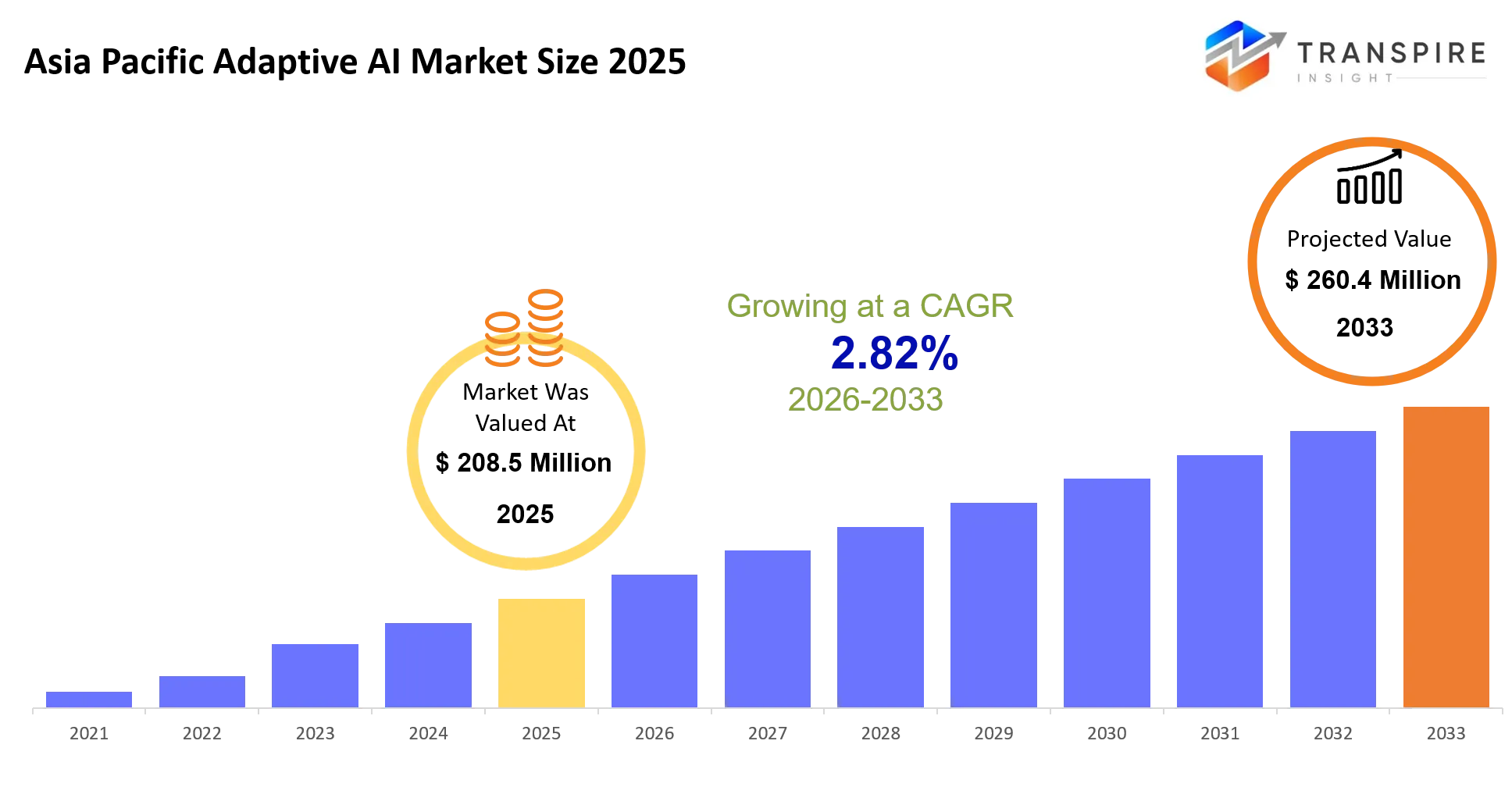
- Asia Pacific Adaptive AI Market Size 2025: USD 208.5 Million
- Asia Pacific Adaptive AI Market Size 2033: USD 260.4 Million
- Asia Pacific Adaptive AI Market CAGR: 2.82%
- Asia Pacific Adaptive AI Market Segments: By Technology (Machine Learning, Deep Learning, Reinforcement Learning, Generative AI, NLP, Computer Vision, Adaptive Analytics, Others); By Deployment (Cloud, On-Premise, Hybrid, Edge AI, SaaS, Private Cloud, Multi-Cloud, Others); By Application (Customer Service, Predictive Analytics, Fraud Detection, Process Automation, Personalization, Risk Management, Decision Intelligence, Others); By End User (BFSI, Healthcare, Retail, Manufacturing, IT & Telecom, Government, Education, Others)
Asia Pacific Adaptive AI Market Summary
The Asia Pacific Adaptive AI Market was valued at USD 208.5 Million in 2025. It is forecast to reach USD 260.4 Million by 2033. That is a CAGR of 2.82% over the period.
The Asia Pacific Adaptive AI Market is evolving from non-adaptive analytics toward an always learning system that adapts in real-time based on newly generated data. This means manufacturers will be able to streamline production processes, banks can identify and respond to emerging fraud behavior, healthcare facilities can develop patient specific treatment plans, and retailers will not have to wait for models to be updated manually in order to adjust pricing strategies and inventory. The region has witnessed a shift toward self-improving models embedded directly into enterprise operations over the last three to five years, rather than rely on rule based, or even regular re-training AI models. The pandemic was the impetus for such a change; after it became obvious that traditional forecasting was not flexible enough to accommodate for rapid demand changes, supply chain disruptions, and shortages, many organizations adopted adaptive AI to reduce decision cycle times and operational risk and to build resilient, data driven operations. This is likely to result in a more pervasive implementation and greater revenues in the broader adaptive AI market.
Key Market Insights
- Enterprise adoption of adaptive decision-making, automation, and real-time analytics across different verticals will contribute to significant growth of the Asia Pacific Adaptive AI market.
- In 2025, China holds the maximum regional market share of close to 40% due to investments in AI, digitization initiatives, and large-scale deployment by enterprises.
- India is expected to grow at the highest CAGR in the country market by 2032, owing to the growing cloud ecosystems, government driven initiatives for AI adoption, and increasing spending by enterprises for technological enhancement.
- With approximately 68% market share in 2025, solutions segment will dominate due to increased investments in adaptive machine learning platforms, intelligent automation technologies, etc.
- Services hold the second largest segment and are driven by demand for AI consulting, integration, monitoring, and managed support services.
- Fastest growing technology across the entire market by 2032, will be Reinforcement Learning, Self-learning AI systems which are capable of adapting continuously to the changes in environment.
- Enterprise Automation accounts for almost 35% of application revenue and will be the largest use-case with maximum adoption across Manufacturing, Banking, and Retail sectors.
- The fastest growing application by 2032 will be predictive analytics and dynamic risk management, for its high capabilities in accurate decision making in a dynamic situation.
- Large enterprises hold the largest market share of more than 60% due to large volume of data at their disposal and highest digital transformation budget.
- Small and medium enterprises will experience the highest CAGR through 2032 due to the increasing adoption of cloud based platforms and subscription based pricing model for various AI driven solutions.
What are the Key Drivers, Restraints, and Opportunities in the Asia Pacific Adaptive AI Market?
The increase in the market growth is driven by the transition from real-time predictive analytics to self-learning autonomous decision making. Current AI solutions need retraining when there is an unprecedented change in business conditions, but there is a growing demand from manufacturing, finance, healthcare, retail industries to use systems that adapt continuously to incoming data sources. High scalability and speed gained through cloud computing, edge AI and language models made it feasible to reduce time-to-market and complexity for vendors, to start charging recurring revenues for the AI-as-a-service and enterprise subscription solutions.
The main obstacle to the market growth is the lack of access to high-quality domain-specific training data along with the disconnected and fragmented regulations to manage the systems. An adaptive AI solution requires constant access to stable data as well as clear policies governing the operation of these models, and the underlying problems cannot be solved easily since many organizations use old IT infrastructure. Consequently, many businesses delay implementing the solutions, which will dampen adoption and impede market monetization.
Industrial adaptive AI deployed at the edge represents a major opportunity in the market growth. Manufacturers in China, Japan, Korea and India are significantly investing in smart factories that require adaptive AI solutions that optimize production, predict disruptions,and increase energy efficiency; this fusion between industrial automation and self-learning technology is anticipated to trigger the next chapter of market growth.
What Has the Impact of Artificial Intelligence Been on the Asia Pacific Adaptive AI Market?
AI itself is the catalyst in changing the dynamics of the Asia Pacific Adaptive AI Market through the enablement of more context-aware, autonomous and resilient enterprise systems. Organizations are increasingly relying on adaptive algorithms to enable the automation of workflow orchestration, monitoring of operating conditions, and automatic modification of business processes, all without any human involvement. Within the manufacturing sector, the application of AI has led to continuous optimization of manufacturing parameters and a decline in downtime, through the prediction of failures prior to their occurrence. While within the financial sector, adaptive models are employed to identify the latest trends in fraud, thereby improving the accuracy of the risk assessment process in a real-time environment and within retail outlets, the usage of adaptive AI is optimizing prices and managing inventories in relation to evolving consumer behavior.
In conjunction with this, machine learning models are also enhancing the ability of the models to provide predictive results. Enterprise solutions are increasingly utilizing predictive analytics to effectively forecast failures in equipment, optimize supply chain networks, and improve resource allocation. Such abilities result in double-digit increases in operational efficiency, reduced maintenance costs and an enhanced ability to make rapid business decisions. Adaptive AI also provides added benefit to compliance-related issues through automatic model updates in relation to new regulations and market dynamics.
However, integration poses a challenge to adoption. The large proportion of organizations that still utilize older systems and fractured data architectures increase the cost and time for the implementation of adaptive AI. Lack of readily available high quality training data is another cause that influences model efficiency.
Key Market Trends
- In the years since 2021 businesses have begun to replace static, retrained AI models with dynamic ones, increasing business speed by 40% on decision latency, the time lag between making a decision and observing an outcome from the model.
- Buyers are more readily adopting adaptive AI systems in the cloud, driving vendors away from their previously successful on-premise deployments; current new sales contracts will predominantly involve subscription revenue.
- Adoption of Generative AI post-2023 led to an increase in demand for models that dynamically define themselves, rather than being reliant on fixed training data.
- Enterprises within manufacturing in China, Japan and South Korea are increasingly implementing AI within the edge so that decisions about adjustments to production may be made instantaneously thereby increasing operational efficiency and decreasing unplanned downtime.
- Organizations within finance have transitioned away from rule-based detection of fraudulent activities to adaptive models that continuously learn to detect evolving transaction patterns, yielding increasingly accurate risk results year over year.
- Following the implementation of data privacy regulations beginning in 2021, vendor investments in Explainable AI have become very strong, making clear operation and governance critical competitive advantages.
- Competition has shifted from selling standalone applications to selling an integrated system of AI applications, and Microsoft, Google, IBM, and Oracle continue to enhance their portfolios of industry specific adaptive AI.
- The adoption of low code adaptive AI has begun in order to ensure that business users are capable of deploying and modifying models in reduced time without the requirement of significant data science expertise.
- The number of strategic partnerships between cloud providers and regional corporations have spiked significantly since 2022. Healthcare, Logistics and Retail remain key sectors benefiting from this partnership growth.
Asia Pacific Adaptive AI Market Segmentation
By Technology:
ML assists in identification and data-driven prediction through business operations. DL allows for interpretation and analysis of visual data, as well as the understanding of complex datasets. Reinforcement Learning assists in learning behaviors, by adjusting them to match evolving situations and business objectives.
Generative AI allows content, code, and simulations to be generated quickly, assisting with development cycles. NLP develops computer systems to be capable of understanding and responding to the human language, while Computer Vision can read, interpret, and understand visual input. Adaptive Analytics and other similar technologies assist in real-time decision updates, while ensuring that business operations continue efficiently even if market dynamics change.
By Deployment:
Cloud solutions reduce costs by reducing reliance on infrastructure, enhance scalability and accelerate deployments throughout organizations and across various industries. Traditional on-Premise environments ensure the security of data, by maintaining full control over company systems and meeting all relevant compliance requirements.
Organizations are leveraging various deployment alternatives, including Hybrid, Edge AI, SaaS, Private Cloud, and Multi-Cloud solutions to tailor their systems to fit their business needs and future long-term strategies.
By Application:
Customer Service still accounts for a significant adoption as adaptive systems improve accuracy of response and reduce time to resolution. Predictive Analytics and Fraud detection enable organizations to identify risks early and enhance business continuity and business planning in a changing business environment.
Process automation has a wide use as it helps organizations to automate mundane tasks thereby improving productivity. Personalization, Risk Management, Decision Intelligence etc are other applications which are facilitating in making effective business decisions. Machine learning ability of these systems enables enterprises to respond efficiently in accordance with the changes in customer behavior and business.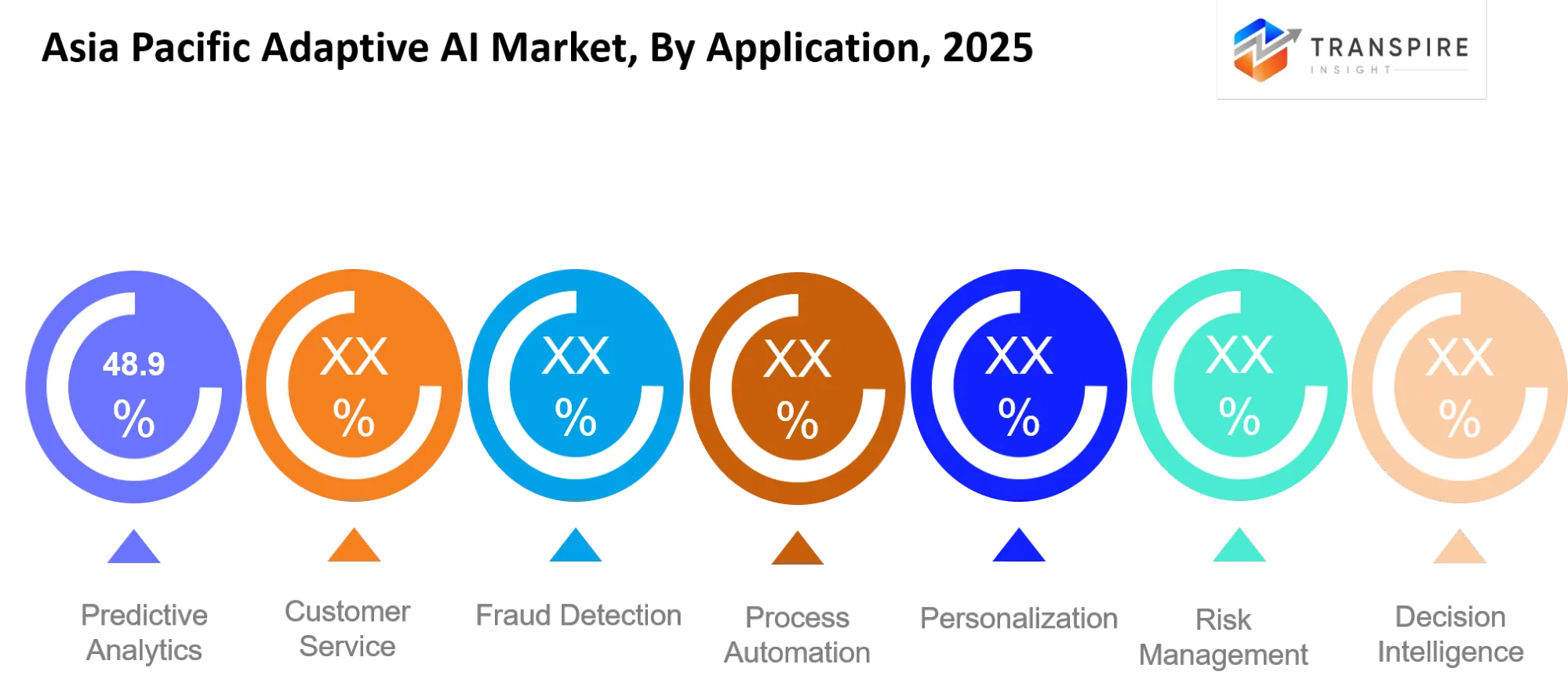
By End User:
The BFSI sector accounts for a significant end-user segment, as adaptive intelligence enables fraud prevention and customer experience, in addition to risk assessment. Healthcare systems can make use of adaptive models for diagnostics and patient management. Retail industry is using the systems for enhancing customer experience and optimizing inventory.
Manufacturing is employing the systems for production efficiency and quality control. The IT & Telecom sector is increasingly adopting the systems for optimization of their networks and other processes. The application in Government, Education sectors is gradually increasing, with digital transformation programs offering further scope for use of intelligent and responsive systems.
What are the Key Use Cases Driving the Asia Pacific Adaptive AI Market?
Predictive analytics has established itself as the top use case across the banking, manufacturing and retail sectors. Real-time data analysis assists enterprises in anticipating demand, spotting risks, optimizing operations, and reducing business risk. Faster decision making and business outcomes provide considerable commercial value and drive broad-based adoption across geographical regions.
Fraud detection and process automation, gaining popularity primarily in BFSI and manufacturing sectors, leverage adaptive systems to analyze transactions, spot deviations, and automate repetitive business tasks. The increased operational efficiency and reduction in cost of operations have encouraged further investment in intelligent business applications.
Adaptive cyber-security, personalized healthcare solutions are among some of the rising use cases that enterprises would leverage over the next couple of years. Continual learning algorithms provide enhanced threat detection capabilities, while also aiding personalized recommendations of appropriate medical treatments. Growth in digital infrastructure and increasing enterprise spending will drive adoption across the forecast period.
|
Report Metrics |
Details |
|
Market size value in 2025 |
USD 208.5 Million |
|
Market size value in 2026 |
USD 214.3 Million |
|
Revenue forecast in 2033 |
USD 260.4 Million |
|
Growth rate |
CAGR of 2.82% from 2026 to 2033 |
|
Base year |
2025 |
|
Historical data |
2021 - 2024 |
|
Forecast period |
2026 - 2033 |
|
Report coverage |
Revenue forecast, competitive landscape, growth factors, and trends |
|
Regional scope |
Asia Pacific (India, China, Japan, Australia, South Korea, Rest of Asia Pacific) |
|
Key company profiled |
Microsoft, Google, IBM, AWS, Oracle, SAP, NVIDIA, OpenAI, Salesforce, Adobe, Accenture, Infosys, TCS, HCLTech, DataRobot |
|
Customization scope |
Free report customization (country, regional & segment scope). Avail customized purchase options to meet your exact research needs. |
|
Report Segmentation |
By Technology (Machine Learning, Deep Learning, Reinforcement Learning, Generative AI, NLP, Computer Vision, Adaptive Analytics, Others); By Deployment (Cloud, On-Premise, Hybrid, Edge AI, SaaS, Private Cloud, Multi-Cloud, Others); By Application (Customer Service, Predictive Analytics, Fraud Detection, Process Automation, Personalization, Risk Management, Decision Intelligence, Others); By End User (BFSI, Healthcare, Retail, Manufacturing, IT & Telecom, Government, Education, Others) |
Which Regions are Driving the Asia Pacific Adaptive AI Market Growth?
China continues to lead in the Asia Pacific Adaptive AI Market owing to support from government, robust digital infrastructure, and large enterprise investments, thereby promoting widespread adoption. The national plan to foster growth and use of AI enables companies to deploy the same across manufacturing, healthcare, finance and retail operations. An established ecosystem of large cloud providers, immense data sources, expanding semiconductor industry all together further contribute to this, enabling a continued innovative environment for the whole region.
Japan is the second largest contributor in this market but strength is shown through stability more than market share. Enterprises are dedicated to long-term digital transformation efforts, with significant focus on security, stability and phased introduction of Adaptive AI technologies. High research strengths in AI, manufacturing facilities and stable spending by corporations have fueled continued market growth during periods of global economic vulnerability, thus enabling consistent revenue generation in the entire region.
India stands as the largest growth market in the Asia Pacific region, with its market transformation driven by broad digital transformation programs across diverse industries. Significant adoption of cloud technologies, push from government to use AI and increase in data center investment in the past couple of years has reshaped the dynamics for both technology providers and customers. Enterprises in the Indian market are keen on implementing adaptive AI solutions in order to augment customer interaction, operational efficiency and decision-making in the high-competitive market segments which will result in lucrative opportunities between 2026 and 2033 for potential investors.
Who are the Key Players in the Asia Pacific Adaptive AI Market and How Do They Compete?
The Asia Pacific Adaptive AI Market is intensely competitive due to the interplay between global tech firms, localized technology specialists, and dedicated software vendors. Although technology remains the fundamental battleground for innovation, flexibility of deployment, industry knowledge, and ecosystem collaboration are important purchasing considerations. Businesses are now heavily investing in adaptive learning capabilities, cloud interoperability, and industry-specific solutions, seeking to lock in customers and ensure steady recurring revenue growth.
IBM stands apart with enterprise grade adaptive AI platforms that integrate machine learning with explainable AI technologies. The company provides consulting services and solutions tailored to specific industries like finance, healthcare and manufacturing, enabling clients to navigate complex challenges. Microsoft competes by embedding its adaptive AI technologies throughout its cloud ecosystem, including office productivity software, applications and business services. Strong partnerships and local cloud investments are boosting Microsoft's presence and ensuring scalability for its business customers.
Google concentrates on advanced AI research and adaptive learning systems for processing enormous datasets efficiently. The company leverages its robust cloud platform and ongoing innovations to enter and scale in many industries. Oracle differentiates with integrated cloud services that connect enterprise business applications with intelligent decision-making tools based on its adaptive analytics technologies. Local cloud infrastructure investments and enterprise partnerships help Oracle to increase its reach and build a sustainable competitive advantage.
Company List
- Microsoft
- IBM
- AWS
- Oracle
- SAP
- NVIDIA
- OpenAI
- Salesforce
- Adobe
- Accenture
- Infosys
- TCS
- HCLTech
- DataRobot
Recent Development News
In February 2026, Microsoft announced plans to invest up to US$50 billion in artificial intelligence initiatives across developing economies, while expanding AI infrastructure and capabilities in India. The investment strengthens Asia Pacific's adaptive AI ecosystem by accelerating cloud, data center, and enterprise AI adoption across high-growth markets.
Source https://www.reuters.com/
In June 2025, IBM expanded Watson Orchestrate services to Singapore through a new AWS-based data center for Asia Pacific customers. The expansion improves data residency, regulatory compliance, and deployment flexibility, making adaptive AI solutions more accessible to enterprises across the region. Sourcehttps://www.ibm.com/
What Strategic Insights Define the Future of the Asia Pacific Adaptive AI Market?
The Asia Pacific Adaptive AI Market has its sights set on the day when smart systems will learn, make decisions, and adapt operations autonomously. Generative AI and edge technology will converge with enterprise specific data lakes that will enable enterprises to react instantly to business changes. During the next 5–7 years winning a market advantage will rely more on deploying adaptive systems in a secure fashion across several environments, rather than merely a higher degree of accuracy in the models.
A more obscure risk is market concentration with a small handful of cloud and AI infrastructure vendors. An over-reliance on a handful of services would translate into higher prices, reduce the interoperability of disparate systems and put enterprises at the mercy of any changes in regulation or geopolitical events. Simultaneously the opportunity at the industrial edge powered by adaptive AI is large given accelerated smart manufacturing investments in countries like India and Southeast Asia. The players in this market would do well to build expertise in domain specific adaptive models and invest in an open-architecture platform that enables them to provide better flexibility and customer retention at the cost of lower long term dependency on the platform.
Asia Pacific Adaptive AI Market Report Segmentation
By Technology
- Machine Learning
- Deep Learning
- Reinforcement Learning
- Generative AI
- NLP
- Computer Vision
- Adaptive Analytics
By Deployment
- Cloud
- On-Premise
- Hybrid
- Edge AI
- SaaS
- Private Cloud
- Multi-Cloud
By Application
- Customer Service
- Predictive Analytics
- Fraud Detection
- Process Automation
- Personalization
- Risk Management
- Decision Intelligence
By End User
- BFSI
- Healthcare
- Retail
- Manufacturing
- IT & Telecom
- Government
- Education
Frequently Asked Questions
Find quick answers to common questions.
The Asia Pacific Adaptive AI Market size is USD 260.4 Million in 2033.
Key Segments for the Asia Pacific Adaptive AI Market are By Technology (Machine Learning, Deep Learning, Reinforcement Learning, Generative AI, NLP, Computer Vision, Adaptive Analytics, Others); By Deployment (Cloud, On-Premise, Hybrid, Edge AI, SaaS, Private Cloud, Multi-Cloud, Others); By Application (Customer Service, Predictive Analytics, Fraud Detection, Process Automation, Personalization, Risk Management, Decision Intelligence, Others); By End User (BFSI, Healthcare, Retail, Manufacturing, IT & Telecom, Government, Education, Others).
Major Asia Pacific Adaptive AI Market Players are Microsoft, Google, IBM, AWS, Oracle, SAP, NVIDIA, OpenAI, Salesforce, Adobe, Accenture, Infosys, TCS, HCLTech, DataRobot.
The current Asia Pacific Adaptive AI Market size is USD 208.5 Million in 2025.
The Asia Pacific Adaptive AI Market CAGR is 2.82% from 2026 to 2033.
- Microsoft
- IBM
- AWS
- Oracle
- SAP
- NVIDIA
- OpenAI
- Salesforce
- Adobe
- Accenture
- Infosys
- TCS
- HCLTech
- DataRobot
About the Authors

Mayur Shinde
I am Mayur Shinde, a Senior Research Analyst at Transpire Insight, specializing in the Automotive & Transportation and Information & Communication Technology (ICT) Industry. My work focuses on analyzing emerging market trends, technological advancements, competitive landscapes, and industry developments to deliver accurate, data-driven insights. I am passionate about transforming complex market information into clear, actionable content that helps businesses, professionals, and decision-makers stay informed and make confident strategic decisions.

Chakradhar Khansole
Chakradhar serves as the Research Director at Transpire Insight, bringing over 8 years of experience in technology, innovation, and strategic market intelligence. He specializes in transforming complex market data into actionable business insights that enable organizations to make informed, growth-oriented decisions. Recognized for his strategic vision and analytical expertise, Chakradhar leads high-impact research initiatives, delivering comprehensive market assessments, competitive intelligence, and forward-looking industry analysis.
Recently Published Reports
-
Apr 2026
3D Optical Profiler Market
3D Optical Profiler Market Size, Share & Analysis Report By Type (Desktop 3D Optical Profiler, and Portable 3D Optical Profiler), By Technology (Confocal Technology, and White Light Interference), By End-Use Industry (Manufacturing, Research Institutions, Automotive, Aerospace and Defense, Medical Devices, and Other), and Geography (North America, Europe, Asia-Pacific, Middle East and Africa, South and Central America), 2021 - 2031
-
Apr 2026
Depth Sensor Market
Depth Sensor Market Size, Share & Analysis Report By Type (Infrared Depth Sensors, Time-of-Flight (ToF) Sensors, Stereo Vision Sensors, Structured Light Sensors, Ultrasonic Depth Sensors), By Application (Automotive, Robotics, Gaming, Consumer Electronics, Industrial Automation, Healthcare, Security & Surveillance, Others), By End Users (Automotive Manufacturers, Consumer Electronics Companies, Healthcare Providers, Industrial Companies, Security Agencies, Gaming Companies, Robotics Companies, Others), and Geography (North America, Europe, Asia-Pacific, Middle East and Africa, South and Central America), 2021 – 2031
-
Apr 2026
Digital Manufacturing Market
Digital Manufacturing Market Size, Share & Analysis Report By Component (Hardware, Software, and Services), By Technology (Robotics, 3D Printing, Internet of Things (IoT), and Others), By Application (Automotive and Transportation, Aerospace and Defense, Consumer Electronics, Industrial Machinery, and Others), By Process Type (Computer-Based Designing, Computer-Based Simulation, Computer 3D Visualization, Analytics, and Others), and Geography (North America, Europe, Asia-Pacific, Middle East and Africa, South and Central America), 2021 – 2031
-
Apr 2026
Digital Visa Services Market
Digital Visa Services Market Size, Share & Analysis Report By Type (Individual Travelers, Group Travelers), By Application (Tourism, Business Travel, Others), and Geography (North America, Europe, Asia-Pacific, Middle East and Africa, South and Central America), 2021 – 2031