Market Summary
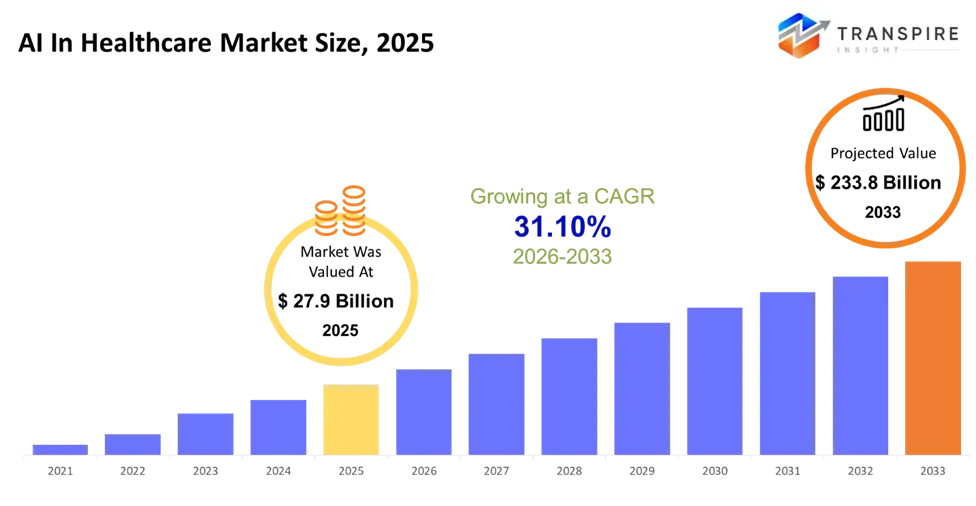
The global AI In Healthcare market size was valued at USD 27.6 billion in 2025 and is projected to reach USD 233.8 billion by 2033, growing at a CAGR of 31.10% from 2026 to 2033. In the AI in Healthcare Market, a trend is being observed, in which the healthcare industry is increasingly adopting advanced technology to facilitate quicker diagnosis, more informed treatment, and optimized management of healthcare. The application of artificial intelligence in healthcare enables the efficient handling of a growing amount of patient data while ensuring greater accuracy and minimizing manual handling of tasks. These factors are resulting in an increased demand for artificial intelligence in the healthcare industry because of a lack of human resources, growing healthcare costs, and personalized medicine requirements.
Market Size & Forecast
- 2025 Market Size: USD 27.9 Billion
- 2033 Projected Market Size: USD 233.8 Billion
- CAGR (2026-2033): 31.10%
- North America: Largest Market in 2026
- Asia Pacific: Fastest Growing Market
To learn more about this report,  Download Free Sample Report
Key Market Trends Analysis
- North America represents significant growth in AI adoption and healthcare expenditure to some extent. Supportive payment structures and cooperation of technology and healthcare sector players are strengthening its position. Africa and Latin America are expected to grow moderately in AI adoption in healthcare.
- In terms of adoption, the United States leads, driven by its strong digital infrastructure, a high level of patient data available, and considerable investment from the health and tech sectors. The growing application of AI in imaging, virtual assistants, and predictive tools is fueling adoption.
- Asia Pacific is recognized as the fastest-growing market due to the massive patient base as well as the increased adoption of digital healthcare infrastructure. Asia Pacific countries like China, India, and Japan use AI to compensate for the lack of doctors and make healthcare more accessible.
- The software component continues to lead as hospitals and medical institutions emphasize scalable and cloud-supported AI solutions. The need for continuous upgradation, integration with electronic health records, and increase in demand for clinical decision support systems maintains its leading position.
- Machine learning is currently charting the course in technology because it has numerous applications in diagnostics, tailored treatment decisions, and predictive analysis. It is able to make thousands of adjustments to enhance its predictive analysis each day by using real-life scenarios.
- The area of imaging & diagnostics leads as AI enhances accuracy, faster interpretation, and early disease identification. Increasing case volume & lack of trained radiology specialists have remained major drivers for the adoption of AI-based tools in diagnostics.
- Hospitals and clinics are the most dominant segment as they are bombarded from all sides to maximize the use of this technology to address the issue of handling a massive number of patients and also to minimize operational inefficiency.
So, Global AI in Healthcare Market is the combination of artificial intelligence tools and applications within the healthcare sector for better diagnostic, treatment, and monitoring, as well as administrative effectiveness. AI systems in the healthcare market analyze a massive amount of structured and unstructured data. The medical fraternity is adopting AI technology solutions in addressing issues like increasing patient volume, lack of healthcare professionals, and increasing healthcare costs. The use of medical image analysis, virtual assistants, and predictive analytics solutions enhances medical accuracy and lessened human effort. The growth of this market is facilitated through advances in machine learning, cloud technology, and data sharing or interoperability.
Furthermore, government and industry support for adoption and investment in the digital health industry are contributing to the growth of the market. The shift towards value-based models in healthcare systems makes a significant contribution to the adoption and development of artificial intelligence.
AI In Healthcare Market Segmentation
By Component
- Hardware
Hardware consists of processors, sensors, image systems, and networked medical devices that facilitate the computation of AI algorithms. The industry is driven by increasing adoption of image-based AI solutions, robot-assisted surgery solutions, and edge solutions in hospitals.
- Software
The core strength of the current technology is in the form of AI software. This is the backbone that provides diagnostic capabilities, predictive tools, and workflow optimization. The popularity of AI software is fueled by its scalability, with frequent updates and the ability to integrate easily with hospital information systems.
- Services
Services involve implementation, integration, training, and maintenance. The absence of in-house knowledge in the health providers has seen the use of managed and consulting services rise steadily.
To learn more about this report, Download Free Sample Report
By Technology
- Speech Recognition
- Speech recognition involves translating clinicician voice commands into structured clinical data. This innovation enhances accuracy in documentation, in addition to lessening clinician time expenditure on administration.
- Natural Language Processing (NLP)
NLP deals with the unstructured data in the healthcare domain, including clinical notes and prescriptions. With the rising demand in healthcare organizations for insights from vast amounts of clinical data in an unstructured format, the use of NLP has started growing.
- Machine Learning
Machine learning helps to develop predictive diagnostic capacities and risk profiling. Continuous learning from real-time data integrates it into the framework of personalized medicine.
- Context-Aware Processing
It is a technology that can adjust AI results in accordance with patient conditions and a medical setting. It increases relevance in a medical setting because it provides relevant and appropriate recommendations at the right times
By Application
- Imaging & Diagnostics
The use of AI improves accuracy in interpreting images and in early detection of diseases. Demand is fueled by rising image volumes and a shortage of professionals in radiology.
- Home Health
The technology has applications in remote monitoring, predictive warning systems, and virtual care. This industry is driven by the aging population and the trend of decentralized healthcare systems.
- Medical Devices and Robotics
Devices made possible by AI are improving the accuracy of surgery and patient monitoring. Hospitals are embracing the technology for better and risk-free results.
- Virtual Assistants
Virtual assistants make patient engagement and scheduling much more streamlined. What the assistant provides is an improved patient experience and relief from administrative burden.
- Others
This includes discovery, clinical trials, and revenue cycles. All these applications gather momentum given the time and cost-saving properties that AI has demonstrated.
By End User
- Hospitals & Clinics
Hospitals are leaders in adoption due to large numbers of patients and complicated processes. Artificial intelligence assists in better diagnosis, management, and quality of patient care.
- Medical Device Companies
These companies use integration of AI to enhance the intelligence of their devices. AI innovation enhances next-generation imaging and robotic systems.
- Diagnostic Centers
Diagnostic centers use AI to manage increasing test volumes proficiently. Faster improvement times and improved accuracy are key adoption drivers.
- Others
It includes research institutes, payers, and homecare organizations. The forces that influence the adoption in this sector include analytics, preventive healthcare, and optimization.
Regional Insights
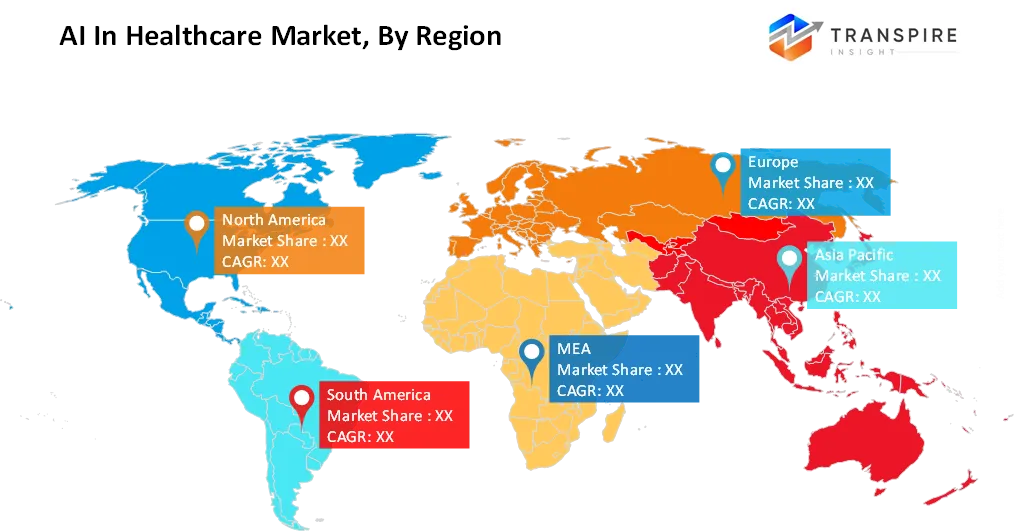
North America leads the market for global AI in the healthcare industry, with robust digital infrastructure and healthcare expenditure. The United States leads in adoption, and Canada and Mexico are following with constant development in digital healthcare strategies.
Europe presents a stable growth with the help of regulation and a country-level strategy for digital healthcare. Germany, the UK, and France concentrate on artificial intelligence for diagnostic and efficiency solutions in hospitals, whereas the Southern European countries present a gradual uptake in the public healthcare system.
The Asia Pacific region has emerged as the fastest-growing market due to a huge patient base and increased digitization. The adoption of technology is led by China and Japan, while India, South Korea, and Australia focus on AI technology in healthcare.
The South American market exhibits a moderate growth due to an improvement in health care infrastructure. Brazil is a leader in the use of technology in the region, particularly in the imaging and telemedicine segments. Other countries are slowly beginning the introduction of health care technology. The Middle East & Africa is an emerging market, driven by investment in the smart health infrastructure of Saudi Arabia and the UAE. Other regions, including South Africa, aim for better diagnostics and effectiveness in health care by selectively utilizing AI solutions.
To learn more about this report, Download Free Sample Report
Recent Development News
- September 2023, Anthropic has announced a significant expansion of its healthcare and life sciences capabilities, underscoring the trend among AI firms to incorporate large language models into medical processes that are HIPAA-regulated. The company has rolled out the "Claude for Healthcare" solution that will help healthcare organizations and consumers leverage the power of AI with HIPAA-compatible solutions.
(Source: https://www.businessinsider.com/anthropic-chases-openai-ai-heath-claude-2026-1
- In July 2025, Microsoft Corp. has launched Microsoft Dragon Copilot, the first artificial intelligence assistant designed for clinical workflow, with the integration of the respected natural-language voice dictation function of DMO and the ambient listening function of DAX. Microsoft Dragon Copilot, which falls under Microsoft Cloud for Healthcare, features the latest secure architecture, ensuring the delivery of improved experiences and outcomes for both patients and healthcare providers.
|
Report Metrics |
Details |
|
Market size value in 2025 |
USD 27.9 Billion |
|
Market size value in 2026 |
USD 35 Billion |
|
Revenue forecast in 2033 |
USD 233.8 Billion |
|
Growth rate |
CAGR of 31.10% from 2026 to 2033 |
|
Base year |
2025 |
|
Historical data |
2021 – 2024 |
|
Forecast period |
2026 – 2033 |
|
Report coverage |
Revenue forecast, competitive landscape, growth factors, and trends |
|
Regional scope |
North America; Europe; Asia Pacific; Latin America; Middle East & Africa |
|
Country scope |
United States; Canada; Mexico; United Kingdom; Germany; France; Italy; Spain; Denmark; Sweden; Norway; China; Japan; India; Australia; South Korea; Thailand; Brazil; Argentina; South Africa; Saudi Arabia; United Arab Emirates |
|
Key company profiled |
Microsoft Corporation, Alphabet Inc (Google), IBM Corporation, NVIDIA Corporation, Amazon Web Services, Inc., Intel Corporation, Siemens Healthineers AG, GE Healthcare, Philips Healthcare, Medtronic plc, Epic Systems Corporation, Oracle Corporation, Veradigm LLC, Johnson & Johnson Services, CitiusTech |
|
Customization scope |
Free report customization (country, regional & segment scope). Avail customized purchase options to meet your exact research needs. |
|
Report Segmentation |
By Component (Hardware, Software, Services), By Technology (Speech Recognition, Natural Language Processing, Machine Learning, Context-Aware Processing), By End User (Imaging & Diagnostics, Home Health, Medical Devices and Robotics, Virtual Assistants, Others), By End User (Hospitals & Clinics, Medical Device Companies, Diagnostic Centers, Others) |
Key AI In Healthcare Company Insights
Microsoft Corporation, Alphabet Inc. (Google), IBM Corporation, NVIDIA Corporation, Amazon Web Services, Inc., Intel Corporation, Siemens Healthineers AG, GE Healthcare, Philips Healthcare, Medtronic plc, Epic Systems Corporation, Oracle Corporation, Veradigm LLC, Johnson & Johnson Services Inc., and CitiusTech are a few key players in the global market for AI in the healthcare sector. These major players provide innovative applications of AI in health care in the form of diagnostics solutions, clinical decision support solutions, cloud health care solutions, health care imaging solutions, and complete health care solutions.
Key AI In Healthcare Companies:
- Microsoft Corporation
- Alphabet Inc (Google)
- IBM Corporation
- NVIDIA Corporation
- Amazon Web Services, Inc
- Intel Corporation
- Siemens Healthineers AG
- GE Healthcare
- Philips Healthcare
- Medtronic plc
- Epic Systems Corporation
- Oracle Corporation
- Veradigm LLC
- Johnson & Johnson Services
- CitiusTech
Global AI In Healthcare Market Report Segmentation
By Component
- Hardware
- Software
- Services
By Technology
- Speech Recognition
- Natural Language Processing
- Machine Learning
- Context-Aware Processing
By Application
- Imaging & Diagnostics
- Home Health
- Medical Devices and Robotics
- Virtual Assistants
- Others
By End User
- Hospitals & Clinics
- Medical Device Companies
- Diagnostic Centers
- Others
Regional Outlook
- North America
- United States
- Canada
- Mexico
- Europe
- Germany
- United Kingdom
- France
- Spain
- Italy
- Rest of Europe
- Asia Pacific
- Japan
- China
- Australia & New Zealand
- South Korea
- India
- Rest of Asia Pacific
- South America
- Brazil
- Argentina
- Rest of South America
- Middle East & Africa
- Saudi Arabia
- United Arab Emirates
- South Africa
- Rest of the Middle East & Africa
Frequently Asked Questions
Find quick answers to common questions.
The approximate AI In Healthcare Market size for the market will be USD 233.8 billion in 2033.
Key segments for the AI In Healthcare Market are By Component (Hardware, Software, Services), By Technology(Speech Recognition, Natural Language Processing, Machine Learning, Context-Aware Processing, Blockchain), By Application (Imaging & Diagnostics, Home Health, Medical Devices and Robotics), By End User (Hospitals & Clinics, Medical Device Companies, Diagnostic Centers, Others, Supply Chain & Traceability).
Major AI In Healthcare Market players are Microsoft Corporation, Alphabet Inc (Google), IBM Corporation, NVIDIA Corporation, Amazon Web Services, Inc.
The North America region is leading the AI In Healthcare Market.
The CAGR of the AI In Healthcare market is 31.10%.
- Microsoft Corporation
- Alphabet Inc (Google)
- IBM Corporation
- NVIDIA Corporation
- Amazon Web Services, Inc
- Intel Corporation
- Siemens Healthineers AG
- GE Healthcare
- Philips Healthcare
- Medtronic plc
- Epic Systems Corporation
- Oracle Corporation
- Veradigm LLC
- Johnson & Johnson Services
- CitiusTech
Recently Published Reports
-
Apr 2026
AI in Diabetic Retinopathy Market
AI in Diabetic Retinopathy Market Size, Share & Analysis Report By Type (Screening AI Systems, Diagnostic AI Systems, and Predictive AI Models), By Application Segment (Hospitals, Ophthalmology Clinics, Diagnostic Centers, and Research and Development), and Geography (North America, Europe, Asia-Pacific, Middle East and Africa, South and Central America), 2021 - 2031
-
Apr 2026
Psychometric Tests Market
Psychometric Tests Market Size, Share & Analysis Report By Type (Personality Tests, Ability/Aptitude Tests, Skill/Knowledge Tests, and Others), By Application (Talent Acquisition and Talent Management), and Geography (North America, Europe, Asia-Pacific, Middle East and Africa, South and Central America), 2021 – 2031
-
Apr 2026
Rare Biological Sample Collection Market
Rare Biological Sample Collection Market Size, Share & Analysis Report By Type (Isolation Kits & Reagent, Blood Collection Tubes, and Others), By Application (Oncology, Transcriptomics, Pharmacogenomics, and Others), and Geography (North America, Europe, Asia-Pacific, Middle East and Africa, South and Central America), 2021 – 2031
-
May 2026
Patient Lift Pendant Market
Patient Lift Pendant Market By Product Type (Wired Pendants, Wireless, Programmable), By Operation Type(Manual, Electric), By End-Users (Healthcare Professionals, Patients), By Application (Hospitals, Homecare, Rehabilitation Centers, Others), By Industry Analysis, Size, Share, Growth, Trends, and Forecasts 2021-2033
Our Clients
.jpg)