

Anticipatory Commerce Infrastructure Market Summary:
As per the Transpiring Insight Analysis, the Anticipatory Commerce Infrastructure Market size is estimated at USD 7.84 billion in 2025 and is anticipated to reach USD 33.46 billion by 2033, growing at a CAGR of 19.90% from 2026 to 2033.
The anticipatory commerce infrastructure market allows retailers and logistics providers to proactively stock, fulfil, and automate reordering based on a point in time rather than a transaction. Systems will use predictive signals to anticipate demand and push inventory closer to the point of sale and begin the replenishment process on their own. During the last three to five years, the industry evolved from reactive, order-led logistics to prescriptive, agent-led fulfilment networks. A structural shift involves the maturing of agentic AI and prescriptive analytics managing complex inventory flows and micro-fulfilment decisions on the fly. The policy and tariff landscape has unsettled cross-border flows and compelled firms to localize data and inventory, accelerating edge-based, privacy-friendly infrastructure investments. The market expands because predictive certainty simultaneously lowers fulfilment costs and delivery times, enabling same-day and zero-click commerce at scale. With improving AI models improving demand forecast and inventory visibility, firms can shorten order cycles, prevent stockouts, and defend margins, creating a virtuous cycle of adoption and earnings.
Anticipatory Commerce Infrastructure Market Size & Forecast:
- Global Market Size 2025: USD 7.84 Billion
- Expected Market Value (2033): USD 33.46 Billion
- Forecast CAGR (2026–2033): 19.90%
- Leading Region in 2025: North America
- Fastest Growing Region: Asia Pacific
- Key Company Profiles: Salesforce, Adobe, SAP, Oracle, Microsoft, Amazon Web Services, Google Cloud, IBM, NVIDIA, SAS Institute, Shopify, commercetools, Bloomreach, Dynamic Yield, Algolia

Key Anticipatory Commerce Infrastructure Market Insights:
Anticipatory commerce infrastructure is moving away from optimizing storefronts to real-time, API-first decisioning that is pre-positioning inventory and automating buying. Data quality, edge latency, and product schemas that are agent-ready are now more important than UX or marketing investments to achieve competitive advantage.
- Predictive Analytics Platforms account for 37%, and Salesforce and Adobe are making real-time customer graphs available to power inventory pre-positioning logic.
- SAP and Oracle are improving autonomous replenishment triggers associated with ERP and WMS; AI Commerce Engines make up 23% of the market.
- CDPs account for 16%, working alongside Microsoft and Google Cloud to stitch together customers' behavioural and transactional data in sub-seconds.
- Algolia and Bloomreach's capabilities for agent-driven discovery and zero-click checkout flows will be welcomed by Recommendation Engines, which represent 10%.
- Edge AI Infrastructure is growing at 9%, led by NVIDIA and IBM, which are working to provide on-fulfilment nodes to lower latency for on-device decisioning.
- Demand Forecasting Solutions account for 3%, with SAS Institute and AWS creating vertical-specific models to enhance location-level forecasting.
- Shopify and commercetools are scaling cloud-based commerce infrastructure and SaaS solutions to make it easier for mid-size retailers to adopt.
- The region has the highest share at 41% and includes hyperscale data facilities and digital twin simulations, allowing precise spatial inventory optimization across large networks.
- Quick commerce node growth and app-based grocery adoption in India and China are fueling the 22.0% CAGR for the Asia Pacific region, with a 25% share.
What are the Key Drivers, Restraints, and Opportunities in the Anticipatory Commerce Infrastructure Market?
Driver:
Growth is fueled by sophisticated agentic AI and predictive analytics, allowing autonomous inventory orchestration and multi-step, real-time decisioning. Adoption is being hastened by growing cost of labour, customer demand for same-day and zero-click fulfilment, and tariff-driven reconfiguration of supply chains. Autonomous mobile robots, micro-fulfilment networks and edge-centric decisioning engines enable order cycle times to shrink by 40% or more and warehousing throughput to increase by 35%, advancing unit economics and wider infrastructure deployment.
Restraint:
The market must overcome restrictive data privacy policies that prohibit cross-border tracking of consumers' behaviour, and cut down data flows by up to 25%. This remains a challenge due to the high frequency, granular signals that anticipatory models depend on being subject to growing regulation, leading to costly localization of data centers and privacy-enhancing technologies.
Opportunity:
Agentic browsers and GEO have the potential to fuel growth as they shift decision-making from storefronts into structured APIs, transforming inventory accuracy and pricing in real-time to strategic infrastructure. Investment in API-first machine-readable schemas for products and decision engines in real-time across North America and Western Europe can leverage competitive advantage. As more AI agents emerge as the primary discovery and checkout channels, vendors with seamless commerce data, truthful inventory streams, and automated decision engines will be able to seize value.
What Has the Impact of Artificial Intelligence Been on the Anticipatory Commerce Infrastructure Market?
AI has elevated anticipatory commerce from rule-based prediction to autonomous, agent-based activity. Predictive analytics and agentic AI currently execute inventory placement, trigger replenishments, and dynamically price, enabling fulfillment networks to adapt to real-time demand signals. Automation and optimization are seen in autonomous mobile robots and automated delivery vehicles executing dozens of daily orders with time-to-completion reductions of over 40%, edge AI infrastructure executing sub-second decisions at micro-fulfilment nodes, and autonomous delivery vehicles executing hundreds of deliveries per day.
Predictive analytics have been extended to demand-forecasting engines that fuse transactional, behavioural, and macro-environmental signals to pre-position inventory more accurately, mitigating out-of-stocks and excess inventory. Operational efficiencies have increased 35% through integration of cloud, edge, and private 5G into unified control platforms at scale, enabling scale and agility in fulfillment network operations. Yet cost and complexity of integration remains an obstacle. Deploying agentic systems across legacy ERP, WMS, retail-media and data platforms requires large CAPEX, data engineering, governance, cyber-security controls and change management to the retail workforce, constraining adoption across mid-market retailers and extension of timelines.
In May 2026, Amazon expanded its supply chain push with autonomous AI agents, automating procurement, inventory management, and logistics execution across its fulfilment network. This framework transitions operations from static tracking into self-directed decision-making to bypass manual bottlenecks.
https://distributionstrategy.com/2026/05/amazon-expands-ai-supply-chain-push-with-autonomous-agents/
Key Anticipatory Commerce Infrastructure Market Trends:
Anticipatory commerce is moving from prediction as an analytical task to prediction as a part of commerce execution. The competitive edge is now being shifted more towards the speed at which systems transcribe signals into action.
- Digital personalisation was heavily dominated by the recommendation engine, and platforms moved towards unified customer and transaction data.
- Demand forecasting evolved from seasonal forecasting to SKU- and location-level forecasting based on signals from the business.
- Edge AI entered the retail space with existing cameras and POS systems to facilitate quick local analytics and operations decisions.
- Dynamic pricing started to become more algorithmic, factoring in inventory, competition and local demand conditions to respond faster to these factors.
- Personalisation became more conversational and actionable by the introduction of multimodal AI and AI agents in the shopping journey.
- Retailers are increasingly putting forecasts into the fulfilment equation and pairing expected sales with the lowest possible stocking point.
- Transparency in AI regulation is driving commerce platforms to enhance disclosure, governance, and traceability of customer-facing AI.
- The market is shifting to autonomous commerce, in which predictive systems can suggest, reorder, price, and order within pre-defined business rules.
Anticipatory Commerce Infrastructure Market Segmentation
By Component:
The anticipatory commerce infrastructure market is led by Predictive Analytics Platforms, which has a 37% share in anticipatory commerce infrastructure, as the predominant platform that transforms early signals into inventory and fulfilment decisions. AI Commerce Engines comprise 23% and Customer Data Platforms 16%, respectively. This helps in delivering real-time personalization and unified customer insight. Recommendation Engines constitute 10%, entrenching predictive product discovery, while Edge AI Infrastructure has 9%, supporting low-latency decisioning. Demand Forecasting Solutions account for 3%, providing targeted models for pre-positioning of inventory and location-level demand planning.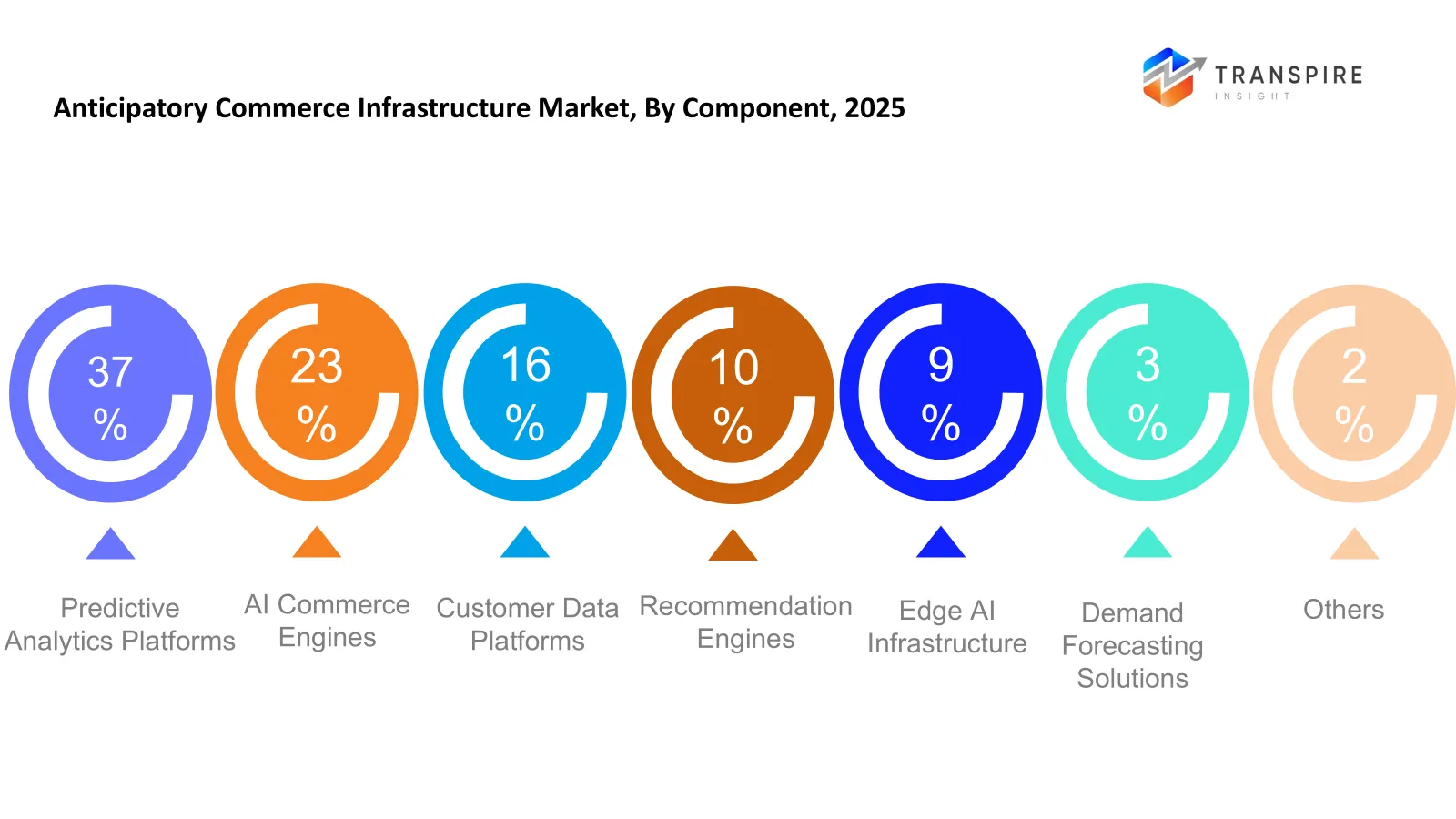
By Deployment:
Cloud-native architectures are the current rule of thumb because of elastic compute as well as centralized training of the predictive model; however, hybrid and edge computing deployments are on the rise as they are required to meet latency as well as data-sovereignty needs. SaaS platforms are the vehicle for mid-market adoption and bring simplicity in integration and enable iteration on the predictive model at a rapid pace.
By End User:
Leading the adoption are retailers and ecommerce companies under the heightened pressure to shrink fulfillment windows and deliver personalization at scale. Growth in deployment among FMCG brands, logistics and financial services firms is driven by the use of the predictive infrastructure to plan inventory, optimize routes, provide visibility of demand, combat fraud and assign risk scores for improved operational agility.
By Application:
Personalised shopping and inventory forecasting continue to emerge as the primary application area with a direct impact on revenues, conversion and cost efficiencies. Once these mature, businesses will turn to dynamic pricing, customer journey optimization and supply chain planning. The next phase of automation will be with automated purchasing and zero-click commerce, where AI agents will perform end-to-end transactions with minimal human interaction.
By Enterprise Size:
Large enterprises dominate the spending today, as their size, large data assets, and greater automation budgets give them precedence. However, SaaS platforms and modular edge solutions are reducing technology barriers for medium and small enterprises, paving the way for incremental deployment of predictive analytics, intelligent personalization, automated replenishment, and emerging agentic commerce functions.
What are the Key Use Cases Driving the Anticipatory Commerce Infrastructure Market?
In the Anticipatory commerce infrastructure market, hyper-scalers, enterprise software providers, and AI-native specialists compete aggressively with different cost innovation and niche strategies. Salesforce, Adobe, and SAP, who lead with innovation built into real-time customer graphs and autonomous replenishment logic for end-to-end orchestration.
Oracle and Microsoft focus on deep integration with predictive engines already tied to ERP, WMS, and cloud data warehouse to lower friction for big enterprises. AWS, Google Cloud, and IBM bring hyperscale infrastructure and edge AI for low-latency, globally distributed decisioning, while NVIDIA provides the GPU backbone for real-time inference at fulfilment nodes.
Shopify and commercetools target mid-market retailers with an API-first, modular approach, while Bloomreach, Dynamic Yield, and Algolia compete on differentiated recommendation and personalization engines optimized for agent-led discovery and zero-click checkout.
|
Report Metrics |
Details |
|
Market size value in 2025 |
USD 7.84 Billion |
|
Market size value in 2026 |
USD 9.39 Billion |
|
Revenue forecast in 2033 |
USD 33.46 Billion |
|
Growth rate |
CAGR of 19.90% from 2026 to 2033 |
|
Base year |
2025 |
|
Historical data |
2021 - 2024 |
|
Forecast period |
2026 - 2033 |
|
Report coverage |
Revenue forecast, competitive landscape, growth factors, and trends |
|
Regional scope |
United States; Canada; Mexico; United Kingdom; Germany; France; Italy; Spain; Denmark; Sweden; Norway; China; Japan; India; Australia; South Korea; Thailand; Brazil; Argentina; South Africa; Saudi Arabia; United Arab Emirates |
|
Key companies profiled |
Salesforce, Adobe, SAP, Oracle, Microsoft, Amazon Web Services, Google Cloud, IBM, NVIDIA, SAS Institute, Shopify, commercetools, Bloomreach, Dynamic Yield, Algolia. |
|
Customization scope |
Free report customisation (country, regional & segment scope). Avail customised purchase options to meet your exact research needs. |
|
Report Segmentation |
By Component (Predictive Analytics Platforms, AI Commerce Engines, Customer Data Platforms, Demand Forecasting Solutions, Recommendation Engines, Edge AI Infrastructure, Cloud Commerce Infrastructure, Others); By Deployment (Cloud-based, On-premise, Hybrid, Edge Computing, SaaS Platforms, Others); By End User (Retailers, E-commerce Companies, FMCG Brands, Financial Institutions, Logistics Providers, Telecom Companies, Others); By Application (Personalized Shopping, Inventory Forecasting, Dynamic Pricing, Customer Journey Optimization, Supply Chain Planning, Automated Purchasing, Others); By Enterprise Size (Large Enterprises, Medium Enterprises, Small Enterprises, Others) |
Which Regions are Driving the Anticipatory Commerce Infrastructure Market Growth?
North America takes the top spot at 41% owing to the magnitude of same-day retail intensity, installed fulfillment infrastructure, and hyper-scaler funding for digital twin and edge AI capabilities. Mature policy measures supporting data portability and open APIs allow for fast integration of predictive models into commerce stacks. Mature consumer expectations for ultra-fast delivery plus significant venture capital backing for agentic commerce startups all sustain its position as the world's leading market. In July 2026, ESW launched agentic commerce with Microsoft Copilot, directly connecting AI-driven product discovery to checkout workflows.
Europe has a 27% share in absolute scale but remains an attractive, relatively stable target due to clear data sovereignty and consumer privacy regulations. Europe's data markets are supported by continued hybrid and edge deployment adoption compliant with GDPR and upcoming AI governance policies, but unlike North America, another hyperscale-first approach, Europe's ecosystem is built on privacy-preserving, localized data centre investments and modular SaaS adoption among the mid-market retailers. In May 2026, SAP agreed to purchase Prior Labs to establish a globally leading frontier artificial intelligence lab in Europe. This strategic investment and acquisition reinforce the region's localized capabilities in developing advanced, privacy-compliant artificial intelligence models.
Asia Pacific constitutes a 25% share and 22.0% CAGR and is the fastest-growing region, underpinned by the rapid quick-commerce node proliferation and app-led grocery proliferation in India and China. Emerging new dynamics include the aggressive investment in micro-fulfilment networks and UPI-based instant payment infrastructure that support real-time, agent-ready commerce flows. The next horizon of opportunities is scaling of edge AI and autonomous fulfillment in dense city centre corridors, with latency and data locality as key competitive differentiators.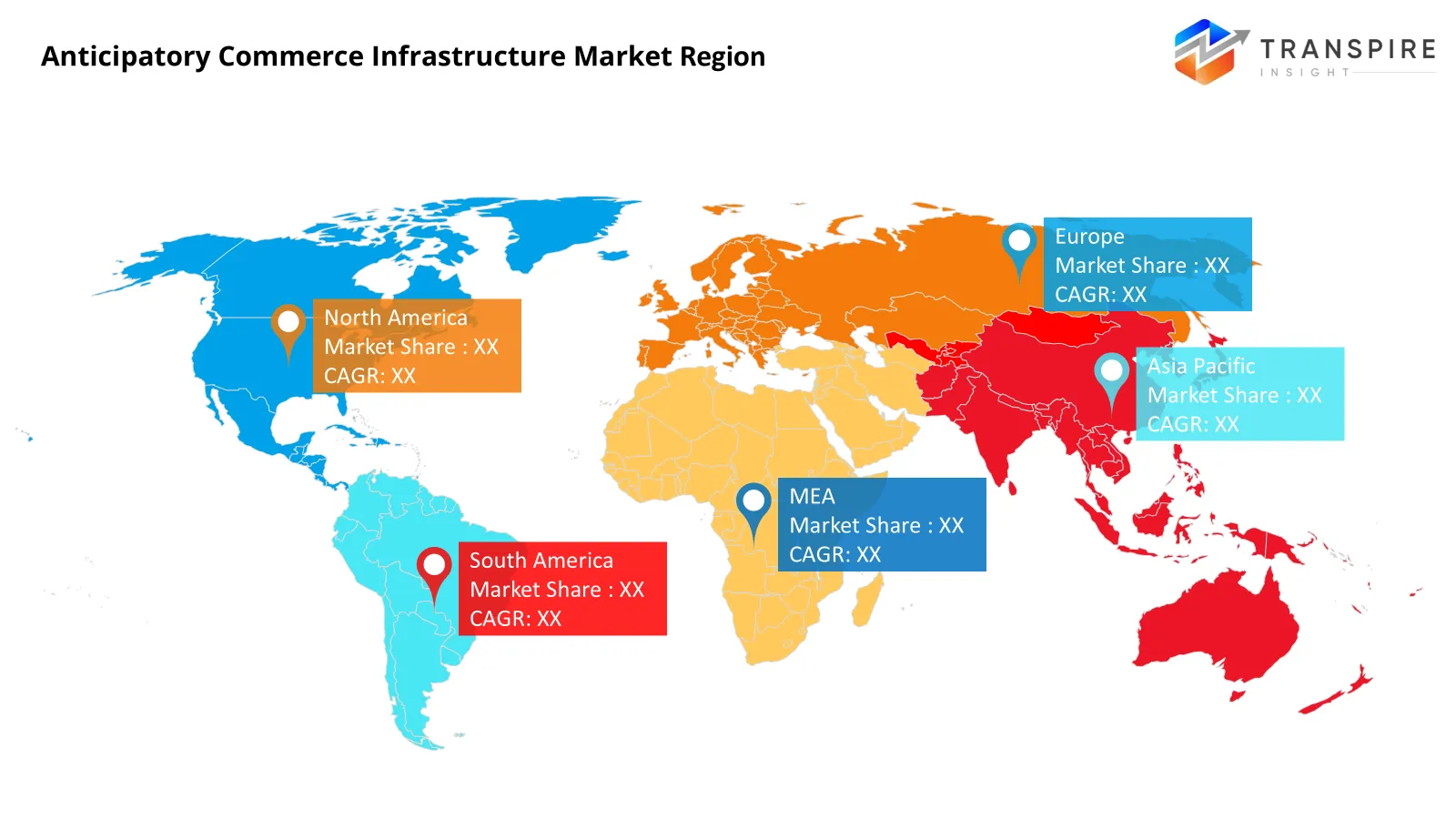
Who are the Key Players in the Anticipatory Commerce Infrastructure Market, and how do they Compete?
The anticipatory commerce infrastructure market is highly competitive among hyper-scalers, enterprise software vendors, and hyper-focused AI-native companies. Such competition is driven by marketing strategies, competition for consumers, technology leadership, and differentiation.
Salesforce, Adobe, and SAP emphasize innovation by infusing their platforms with real-time customer insights, predictive analytics, and autonomous commerce workflows to enhance end-to-end orchestration. Oracle and Microsoft prioritise integration at a foundational level by blending predictive engines into existing ERP, supply-chain, and cloud data stacks to facilitate faster implementation for large enterprise retailers. Amazon Web Services, Google Cloud, and IBM capitalize on hyperscale computing resources, AI services, and distributed infrastructure to provide low-latency insights and decision-making capabilities, as well as NVIDIA with high-performance accelerated computing for real-time inference of models across commerce and fulfillment environments. Shopify and commercetools take the API-first approach to attain niche differentiation by providing retailers the ability to deliver modular, agent-enabled commerce features more swiftly. In contrast, Bloomreach, Dynamic Yield, and Algolia seek differentiation by combining AI-enabled discovery, recommendations, and personalization solutions, aligning their platforms with the conversational commerce, predictive engagement, and nascent zero-click journeys of the future.
Key Players are:
- Salesforce
- Adobe
- SAP
- Oracle
- Microsoft
- Amazon Web Services
- Google Cloud
- IBM
- NVIDIA
- SAS Institute
- Shopify
- Commercetools
- Bloomreach
- Dynamic Yield
- Algolia
Recent Development News
- In April 2026, Visa launched Intelligent Commerce Connect, an infrastructure solution that enables merchants, agent builders, and commerce enablers to connect to AI-powered commerce across different networks, protocols, and token vaults. The launch lowers integration barriers and supports wider deployment of agent-initiated purchasing and anticipatory commerce workflows.
- In April 2026, Stripe expanded its Agentic Commerce Suite to let businesses sell products directly through AI applications and announced a partnership with Google for commerce inside AI Mode and the Gemini app. The development strengthens the infrastructure connecting product discovery, checkout, payments, and fraud controls within AI-led shopping journeys.
- In June 2026, Adyen launched Adyen Agentic, a modular API suite covering agentic product discovery, carting, and payments. The launch gives enterprises a single integration for selling through multiple AI commerce platforms, reducing the need to rebuild commerce infrastructure for each new AI channel.
What Strategic Insights Define the Future of the Anticipatory Commerce Infrastructure Market?
The market is moving toward agent-centric, API-first commerce, with the value of infrastructure migrating from the traditional front shop to decision engines in real-time, interoperable APIs and machine-readable product data. A hidden risk is the emerging fragmentation of data sovereignty and AI governance- localising models, cloud infrastructure and customer data within borders, raising operating costs and squeezing margins. An emerging opportunity is edge AI with autonomous fulfilment in APAC, with its highly granular quick-commerce networks, digital wallets and real-time payments rail, supporting zero-click ordering and real-time fulfilment. In the short term, market participants should focus on privacy-preserving, edge-native infrastructure, common APIs, and portable product-data architectures. These investments can accelerate responsiveness, enhance compliance agility, and mitigate dependence on central systems, positioning providers to participate in the next wave of agentic commerce and AI-enabled purchasing.
Key Segmentations are:
By Component
- Predictive Analytics Platforms
- AI Commerce Engines
- Customer Data Platforms
- Demand Forecasting Solutions
- Recommendation Engines
- Edge AI Infrastructure
- Cloud Commerce Infrastructure
- Others
By Deployment
- Cloud-based
- On-premise
- Hybrid
- Edge Computing
- SaaS Platforms
- Others
By End User
- Retailers
- E-commerce Companies
- FMCG Brands
- Financial Institutions
- Logistics Providers
- Telecom Companies
- Others
By Application
- Personalized Shopping
- Inventory Forecasting
- Dynamic Pricing
- Customer Journey Optimization
- Supply Chain Planning
- Automated Purchasing
- Others
By Enterprise Size
- Large Enterprises
- Medium Enterprises
- Small Enterprises
- Others
Regional Outlook
North America
- United States
- Canada
- Mexico
Europe
- Germany
- United Kingdom
- France
- Spain
- Italy
- Rest of Europe
Asia Pacific
- Japan
- China
- Australia & New Zealand
- South Korea
- India
- Rest of Asia Pacific
South America
- Brazil
- Argentina
- Rest of South America
Middle East & Africa
- Saudi Arabia
- United Arab Emirates
- South Africa
- Rest of the Middle East & Africa
Frequently Asked Questions
Find quick answers to common questions.
The Anticipatory Commerce Infrastructure Market size was valued at USD 7.84 billion in 2025 and is poised to reach USD 33.46 billion by 2033, expanding at a 19.90% CAGR.
Key segments for the Anticipatory Commerce Infrastructure Market are By Component (Predictive Analytics Platforms, AI Commerce Engines, Customer Data Platforms, Demand Forecasting Solutions, Recommendation Engines, Edge AI Infrastructure, Cloud Commerce Infrastructure, Others); By Deployment (Cloud-based, On-premise, Hybrid, Edge Computing, SaaS Platforms, Others); By End User (Retailers, E-commerce Companies, FMCG Brands, Financial Institutions, Logistics Providers, Telecom Companies, Others); By Application (Personalized Shopping, Inventory Forecasting, Dynamic Pricing, Customer Journey Optimization, Supply Chain Planning, Automated Purchasing, Others); By Enterprise Size (Large Enterprises, Medium Enterprises, Small Enterprises, Others).
Growth is primarily driven by maturing agentic AI and predictive analytics for autonomous inventory, rising same-day/zero-click fulfilment demand, and tariff-driven data/inventory localization, with labour costs and order-cycle compression accelerating micro-fulfilment, edge AI, and real-time decision engines.
The Anticipatory Commerce Infrastructure Market is led by major manufacturers including Salesforce, Adobe, SAP, Oracle, Microsoft, Amazon Web Services, Google Cloud, IBM, NVIDIA, SAS Institute, Shopify, commercetools, Bloomreach, Dynamic Yield, Algolia.
North America holds 41% of the market, supported by advanced cloud infrastructure, strong enterprise AI investment, mature digital commerce ecosystems, extensive first-party data, and early adoption of agentic commerce technologies.
Key opportunities include agentic commerce, edge AI, automated purchasing, predictive inventory optimization, AI-driven personalization, interoperable commerce APIs, and real-time pricing and fulfilment platforms.
- Salesforce
- Adobe
- SAP
- Oracle
- Microsoft
- Amazon Web Services
- Google Cloud
- IBM
- NVIDIA
- SAS Institute
- Shopify
- Commercetools
- Bloomreach
- Dynamic Yield
- Algolia
About the Authors

Mayur Shinde
I am Mayur Shinde, a Senior Research Analyst at Transpire Insight, specializing in the Automotive & Transportation and Information & Communication Technology (ICT) Industry. My work focuses on analyzing emerging market trends, technological advancements, competitive landscapes, and industry developments to deliver accurate, data-driven insights. I am passionate about transforming complex market information into clear, actionable content that helps businesses, professionals, and decision-makers stay informed and make confident strategic decisions.

Chakradhar Khansole
Chakradhar serves as the Research Director at Transpire Insight, bringing over 8 years of experience in technology, innovation, and strategic market intelligence. He specializes in transforming complex market data into actionable business insights that enable organizations to make informed, growth-oriented decisions. Recognized for his strategic vision and analytical expertise, Chakradhar leads high-impact research initiatives, delivering comprehensive market assessments, competitive intelligence, and forward-looking industry analysis.
Recently Published Reports
-
Apr 2026
3D Optical Profiler Market
3D Optical Profiler Market Size, Share & Analysis Report By Type (Desktop 3D Optical Profiler, and Portable 3D Optical Profiler), By Technology (Confocal Technology, and White Light Interference), By End-Use Industry (Manufacturing, Research Institutions, Automotive, Aerospace and Defense, Medical Devices, and Other), and Geography (North America, Europe, Asia-Pacific, Middle East and Africa, South and Central America), 2021 - 2031
-
Apr 2026
Depth Sensor Market
Depth Sensor Market Size, Share & Analysis Report By Type (Infrared Depth Sensors, Time-of-Flight (ToF) Sensors, Stereo Vision Sensors, Structured Light Sensors, Ultrasonic Depth Sensors), By Application (Automotive, Robotics, Gaming, Consumer Electronics, Industrial Automation, Healthcare, Security & Surveillance, Others), By End Users (Automotive Manufacturers, Consumer Electronics Companies, Healthcare Providers, Industrial Companies, Security Agencies, Gaming Companies, Robotics Companies, Others), and Geography (North America, Europe, Asia-Pacific, Middle East and Africa, South and Central America), 2021 – 2031
-
Apr 2026
Digital Manufacturing Market
Digital Manufacturing Market Size, Share & Analysis Report By Component (Hardware, Software, and Services), By Technology (Robotics, 3D Printing, Internet of Things (IoT), and Others), By Application (Automotive and Transportation, Aerospace and Defense, Consumer Electronics, Industrial Machinery, and Others), By Process Type (Computer-Based Designing, Computer-Based Simulation, Computer 3D Visualization, Analytics, and Others), and Geography (North America, Europe, Asia-Pacific, Middle East and Africa, South and Central America), 2021 – 2031
-
Apr 2026
Digital Visa Services Market
Digital Visa Services Market Size, Share & Analysis Report By Type (Individual Travelers, Group Travelers), By Application (Tourism, Business Travel, Others), and Geography (North America, Europe, Asia-Pacific, Middle East and Africa, South and Central America), 2021 – 2031