

Cloud Gaming Infrastructure Market Summery:
According to Transpire Insights, a detailed research report on the market reflects that the cloud gaming platform application segment dominates the global Cloud Gaming Infrastructure Market, accounting for approximately 76% of the total share worldwide. Microsoft Corporation leads the market with approximately (around USD 281.7 billion) in annual revenue and an estimated 19–23% global market share, making it the leading contributor to global market development, innovation, advanced cloud gaming infrastructure, expanding cloud computing capabilities, and growth dynamics.
Market SnapshotGlobal Cloud Gaming Infrastructure Market
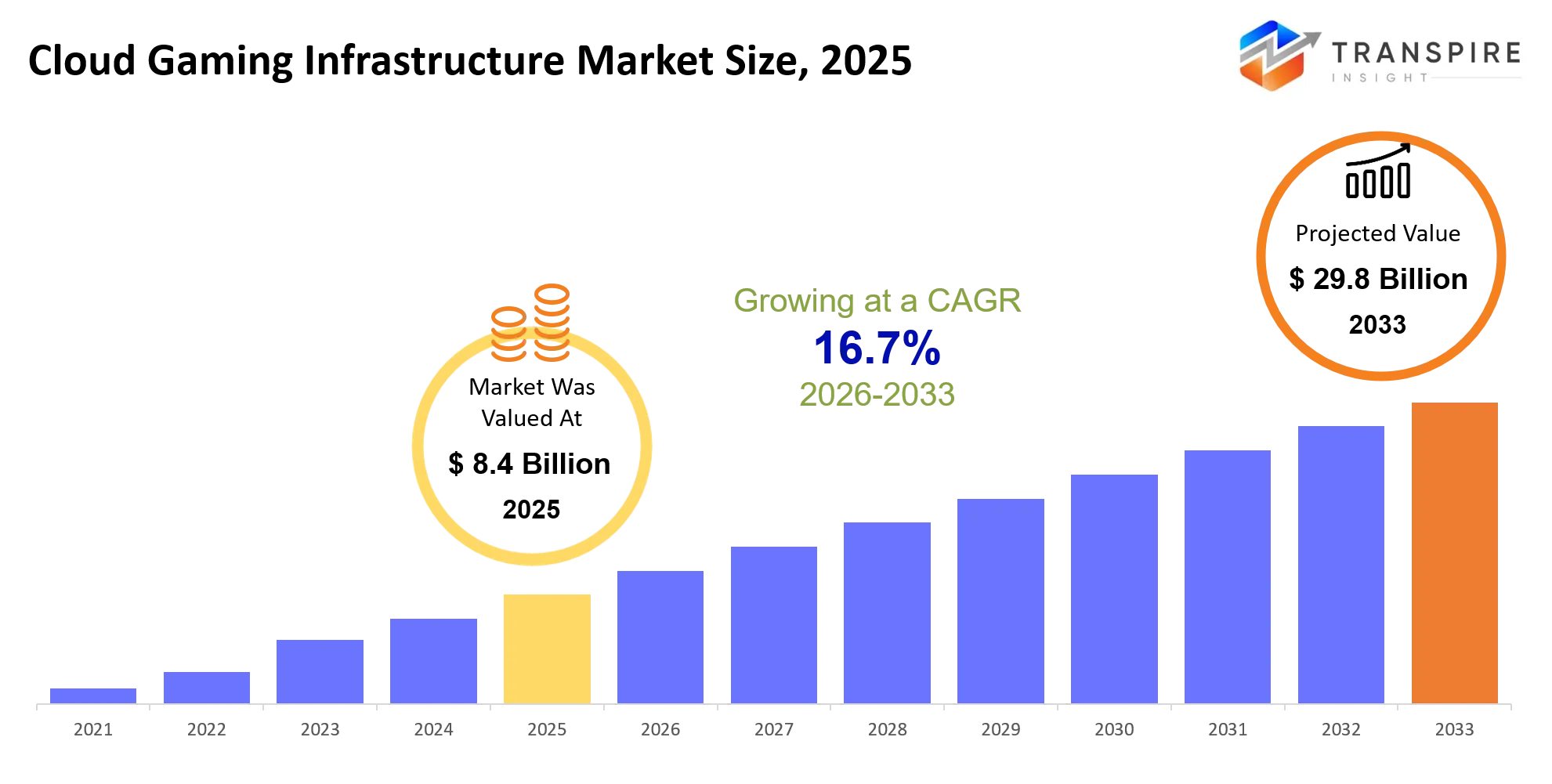
- Global Market Value (2025):USD 8.4 Billion.
- Expected Market Value (2026): USD 10.1 Billion.
- Estimated Market Value (2033): USD 29.8 Billion.
- Forecast CAGR (2026–2033): 16.7%
- Leading Region in 2025: Asia Pacific
- Second-largest Region: Europe
- Fastest Growing Region: North America
Introduction
Modern cloud gaming infrastructure technologies and advanced cloud computing solutions that facilitate high-performance game streaming, ultra-low latency, scalable computing resources, seamless multiplayer experiences, optimized network performance, and enhanced digital gaming services across gaming platforms, cloud service providers, telecommunications companies, game developers, data centers, enterprises, and end users comprise the Cloud Gaming Infrastructure Market. Advanced GPU-powered cloud servers, edge computing platforms, virtualization technologies, content delivery networks (CDNs), AI-powered resource management systems, high-speed networking infrastructure, cloud orchestration platforms, and next-generation cloud gaming technologies are examples of cloud gaming infrastructure solutions that address the changing needs of gaming companies, cloud service providers, telecom operators, game publishers, esports organizations, technology providers, and digital entertainment platforms.
Advanced GPU-accelerated cloud servers, AI-driven workload management systems, edge computing solutions, cloud-native gaming platforms, high-speed networking technologies, virtualization infrastructure, scalable cloud architectures, and intelligent resource allocation systems are examples of product innovations that improve functionality and performance. Cloud Gaming Infrastructure Market innovation enhances streaming quality, processing efficiency, network reliability, scalability, operational performance, and long-term platform stability through the use of advanced cloud computing technologies, high-performance graphics processing units (GPUs), optimized virtualization systems, intelligent traffic management, automated infrastructure monitoring, and innovative data center solutions. Improved gaming performance, reduced latency, enhanced user experiences, greater infrastructure flexibility, increased service availability, and reliable game streaming across interconnected global cloud ecosystems are all made possible by continuous product innovation. Cybersecurity regulations, cloud security standards, data privacy requirements, quality management systems, sustainability initiatives, network compliance frameworks, and industry-specific regulatory standards are all adhered to.
The demand for cloud gaming infrastructure solutions is being driven by a number of factors, including the growing adoption of cloud gaming services, increasing demand for high-quality game streaming, rising investments in hyperscale data centers, expanding deployment of 5G networks, and ongoing developments in artificial intelligence, edge computing, GPU virtualization, cloud-native platforms, content delivery networks, sustainable data center technologies, advanced networking infrastructure, and next-generation cloud computing solutions. These factors continue to accelerate the growth of the Cloud Gaming Infrastructure Market by supporting technological innovation, improving service scalability, and expanding global market penetration.
Market Highlights: -
- Asia Pacific is expected to grow at a rapid CAGR in the Global Cloud Gaming Infrastructure Market by holding nearly 42% of the share during the forecast period.
- North America is the fastest-growing region in the Global Cloud Gaming Infrastructure Market during the forecast period, holding around 31% share.
- Europe is anticipated to hold approximately 24% share of the Global Cloud Gaming Infrastructure Market over the predicted timeframe.
- By Component, the Servers segment dominated the market and holds nearly 47.3% share in 2025 and is projected to grow at a substantial CAGR during the forecast period.
- By Deployment, the Public Cloud segment dominated the market and holds almost 48.6% share in 2025 and is projected to grow at a substantial CAGR during the forecast period.
- By End User, the Gaming Service Providers segment dominated the market and holds approximately 36.8% share in 2025 and is projected to grow at a substantial CAGR during the forecast period.
- By Application, the AAA Games segment dominated the market and holds roughly 41.4% share in 2025 and is projected to grow at a substantial CAGR during the forecast period.
- By Device Type, the Smartphones segment dominated the market and holds around 44.1% share in 2025 and is projected to grow at a substantial CAGR during the forecast period.
- Growing Adoption of Cloud Gaming Platforms, Edge Computing, and High-Performance Cloud Infrastructure: Gaming service providers, cloud platform operators, telecommunications companies, game developers, esports organizations, enterprises, educational institutions, and individual gamers across Asia Pacific, North America, and Europe are increasingly investing in high-performance servers, GPU-accelerated cloud infrastructure, edge computing platforms, virtualization software, cloud streaming technologies, advanced networking equipment, AI-powered resource management, and low-latency cloud gaming solutions to deliver seamless gameplay, improve scalability, enhance user experiences, optimize infrastructure efficiency, support real-time game streaming, strengthen digital gaming ecosystems, and accelerate the global adoption of advanced cloud gaming infrastructure solutions.
How is the Cloud Gaming Infrastructure Market Growing Due to Technology?
The Cloud Gaming Infrastructure Market is growing as a result of continuous advancements in cloud computing technologies, GPU-accelerated computing, edge computing infrastructure, virtualization software, high-speed networking solutions, artificial intelligence (AI)-driven resource management, advanced data center technologies, and cloud-native gaming platforms. Superior gaming performance, ultra-low latency, enhanced graphics rendering, scalable computing resources, improved network efficiency, seamless game streaming, and long-term platform reliability are delivered by modern solutions such as high-performance servers, advanced GPUs, edge computing infrastructure, virtualization software, streaming platforms, intelligent networking equipment, cloud orchestration technologies, and high-capacity storage systems.
Innovations in artificial intelligence (AI)-powered infrastructure optimization, GPU virtualization, automated cloud resource allocation, Industrial Internet of Things (IIoT)-enabled data center management, predictive infrastructure maintenance, intelligent network monitoring platforms, sustainable cloud computing technologies, advanced cybersecurity solutions, smart workload balancing, and integrated cloud gaming automation enable infrastructure providers to develop cloud gaming platforms that are more scalable, reliable, secure, and efficient while complying with stringent cybersecurity regulations, cloud security standards, data privacy requirements, quality management systems, environmental sustainability initiatives, ISO compliance frameworks, and industry-specific certifications. These technological advancements are accelerating adoption across gaming service providers, telecommunications operators, enterprises, game developers, esports organizations, educational institutions, and individual gamers while improving streaming performance, infrastructure scalability, operational efficiency, network optimization, service reliability, user experience, and innovation across the Global Cloud Gaming Infrastructure Market.
Market Drivers
The Global Cloud Gaming Infrastructure Market is being driven by the growing demand for high-performance, low-latency, and scalable cloud gaming solutions and the increasing adoption of cloud-based gaming services by gaming service providers, telecommunications operators, enterprises, individual gamers, game developers, esports organizations, educational institutions, and cloud platform providers. The increasing deployment of high-performance servers, GPU-accelerated computing, storage systems, networking equipment, edge computing infrastructure, virtualization software, cloud streaming platforms, and advanced cloud technologies is driving demand for solutions that improve gaming performance, reduce latency, enhance scalability, optimize resource utilization, strengthen network reliability, and deliver seamless gaming experiences while addressing the growing need for efficient, secure, and cost-effective cloud gaming infrastructure. These advancements are encouraging infrastructure providers to invest in next-generation cloud computing technologies, AI-powered resource management, advanced networking solutions, sustainable data center infrastructure, and expanded cloud gaming service portfolios. Companies operating in the Global Cloud Gaming Infrastructure Market are expanding their infrastructure capabilities, improving platform performance, strengthening research and development initiatives, and creating new growth opportunities across the global digital gaming and cloud computing value chain.
For example,
NVIDIA continues to drive innovation in the Cloud Gaming Infrastructure Market by developing advanced GPU-accelerated cloud servers, AI-powered graphics processing technologies, edge computing solutions, virtualization software, cloud streaming platforms, and high-performance networking infrastructure that improve gaming performance, reduce latency, enhance scalability, strengthen platform reliability, support seamless game streaming, expand cloud gaming accessibility, and increase applications across gaming service providers, telecommunications operators, enterprises, esports organizations, educational institutions, and the global Cloud Gaming Infrastructure Market.
Restrain
The primary challenges facing the Global Cloud Gaming Infrastructure Market are increasing infrastructure deployment and operational costs, complex cloud computing requirements, and stringent regulations related to cybersecurity, data privacy, cloud compliance, network security, environmental sustainability, and regulatory governance. The deployment of advanced servers, GPU-accelerated computing systems, storage infrastructure, networking equipment, edge computing platforms, virtualization software, cloud streaming technologies, and high-performance data center solutions requires significant capital investments, advanced cloud architectures, intelligent workload management systems, automated infrastructure monitoring, sustainable data center operations, and continuous research and development initiatives, substantially increasing infrastructure and operational costs.
Analysis of Prices and Consumer Behaviour
The Global Cloud Gaming Infrastructure Market is experiencing increasing demand for high-performance, low-latency, scalable, and secure cloud gaming solutions as gaming service providers, telecommunications operators, enterprises, individual gamers, game developers, esports organizations, educational institutions, and cloud platform providers increasingly prioritize seamless game streaming, infrastructure reliability, network performance, and superior gaming experiences. Pricing is influenced by factors such as server and GPU costs, cloud computing technologies, data center infrastructure, deployment models, bandwidth requirements, storage capacity, energy consumption, operational expenses, cybersecurity investments, virtualization software, edge computing infrastructure, and advanced cloud management platforms. Buyers are increasingly evaluating cloud gaming infrastructure based on performance, scalability, latency optimization, security, reliability, operational efficiency, sustainability, and long-term return on investment rather than initial deployment costs alone.
Consumer behaviour is also shifting toward cloud gaming platforms powered by high-performance servers, GPU-accelerated computing, edge computing infrastructure, virtualization software, intelligent networking equipment, cloud streaming platforms, and AI-driven resource management technologies that improve gaming performance, reduce latency, support real-time multiplayer gaming, optimize infrastructure utilization, and deliver immersive gaming experiences across multiple devices.
Top Companies in the Global Cloud Gaming Infrastructure Market
- NVIDIA
- Microsoft
- Amazon Web Services
- Sony Interactive Entertainment
- Tencent Cloud
- Intel
- AMD
- IBM
- Oracle
- Alibaba Cloud
- Ubitus
- Blacknut
- Paperspace
- Boosteroid
Market Segmentation
The Global Cloud Gaming Infrastructure Market share is divided into five categories:Component,Deployment,Device Type ,End User,Application.
The Servers Cerealsdominated the market, accounting for nearly 47.3% in 2025, and is expected to rise at a significant CAGR during the forecast period.
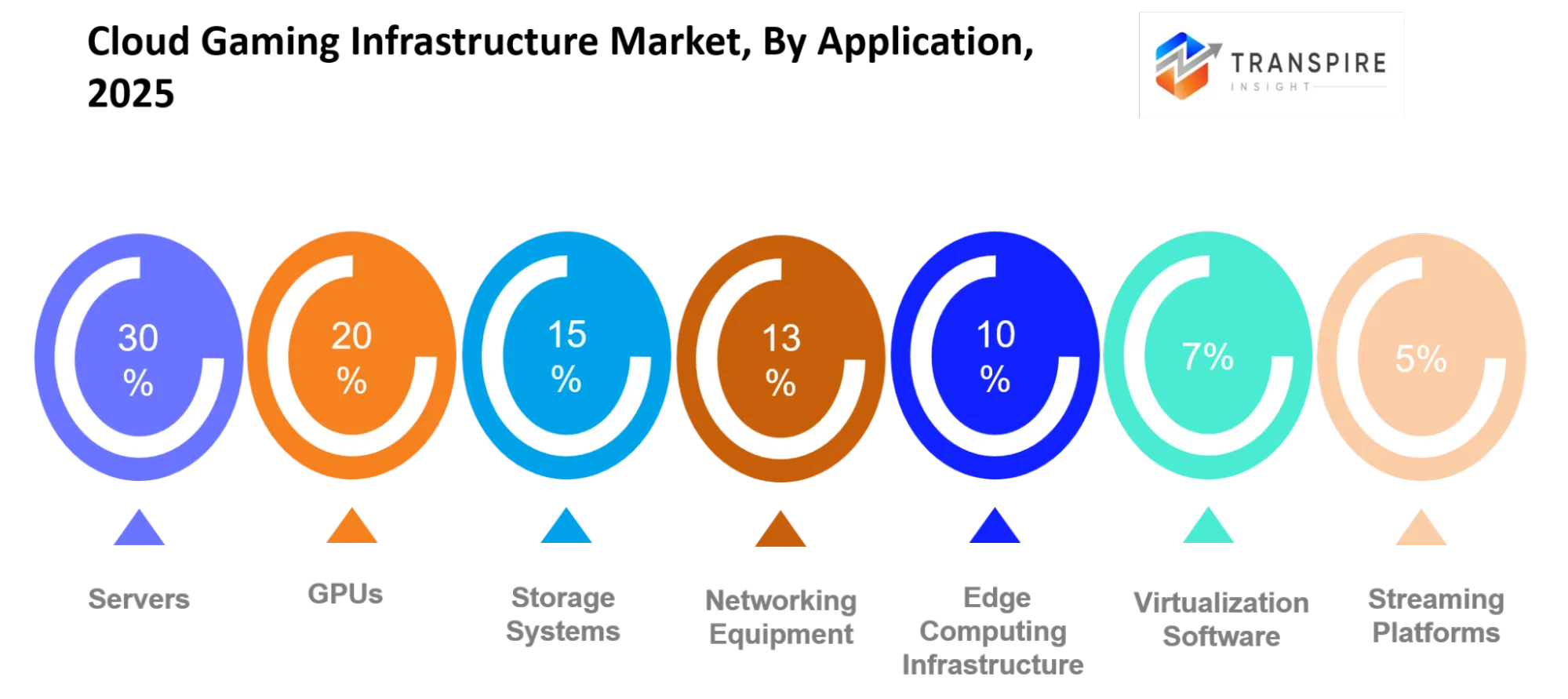
The GlobalCloud Gaming Infrastructure Marketis segmented. By Component Servers, GPUs, Storage Systems, Networking Equipment, Edge Computing Infrastructure, Virtualization Software, Streaming Platforms, Others.Among these, the Servers dominated the market, accounting for nearly 47.3% in 2025 and expected to increase at a significant CAGR during the forecast period.due to their high computing power, scalable cloud processing capabilities, low-latency performance, efficient game hosting, real-time rendering, multi-user support, and growing demand for seamless cloud gaming experiences.
The Public Cloudsegmentheld the greatest share of approximately 49.1% in 2025 and is expected to increase at a substantial CAGR over the forecast period.
The Global Cloud Gaming Infrastructure Market is segmented By Deployment Public Cloud, Private Cloud, Hybrid Cloud, Edge Cloud, On-premise, Multi-cloud, Distributed Cloud, Others.Among these, the Public Cloud segment held the greatest share of approximately 49.1% in 2025 and is expected to increase at a substantial CAGR over the forecast period. due to its scalability, cost efficiency, global accessibility, rapid deployment, flexible resource allocation, high-performance computing capabilities, seamless updates, and growing demand for cloud-based gaming services worldwide.
The Smartphonessegmentheld the greatest share of approximately 45.4%in 2025 and is expected to increase at a high CAGR over the forecast period.
The Global Cloud Gaming Infrastructure Market Market is segmented By Device Type Smartphones, PCs, Laptops, Smart TVs, Gaming Consoles, Tablets, VR Devices, Others. Among these the Smartphones segment held the greatest share of approximately 44.9% in 2025 and is expected to increase at a considerable CAGR over the projected period. due to their widespread adoption, high-speed internet connectivity, 5G availability, portability, affordable access, powerful mobile processors, growing mobile gaming audience, and increasing demand for anytime, anywhere cloud gaming experiences.
Regional Segment Analysis of the Global Cloud Gaming Infrastructure Market
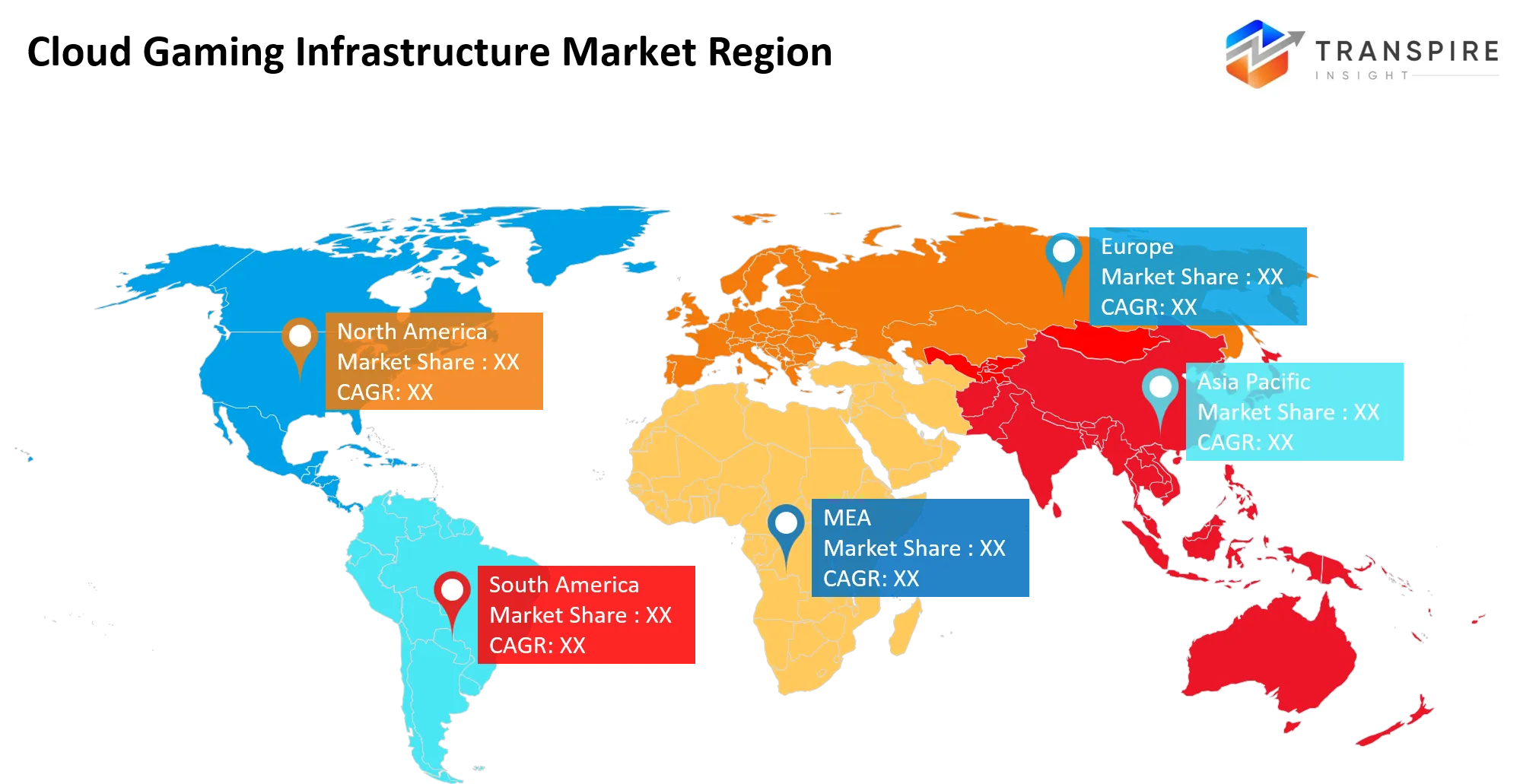
- North America (U.S., Canada, Mexico)
- Europe (Germany, France, U.K., Italy, Spain, Rest of Europe)
- Asia-Pacific (China, Japan, India, Rest of APAC)
- South America (Brazil and the Rest of South America)
- The Middle East and Africa (UAE, South Africa, Rest of MEA)
Asia Pacific is expected to grow at a rapid CAGR in the Global Cloud Gaming Infrastructure Market by holding nearly 42% of the share during the forecast period.
Over the forecast period, the Global Cloud Gaming Infrastructure Market is anticipated to expand rapidly in Asia Pacific, accounting for nearly 42% of the global market share. The region dominates the market due to increasing internet penetration, rapid deployment of 5G networks, expanding cloud computing infrastructure, rising smartphone adoption, growing gaming populations, and accelerating digital transformation across countries such as China, India, Japan, South Korea, Australia, and New Zealand. Market growth is further supported by increasing investments in high-performance servers, GPU-accelerated computing, edge computing infrastructure, virtualization software, cloud streaming platforms, advanced networking equipment, and scalable cloud data centers. Growing investments by gaming service providers, cloud platform operators, telecommunications companies, game developers, esports organizations, and technology providers, along with expanding applications across AAA games, casual games, esports, AR/VR gaming, mobile gaming, simulation games, and educational gaming, continue to accelerate regional market growth. Furthermore, supportive government initiatives promoting digital infrastructure, cloud computing, artificial intelligence, 5G connectivity, smart technologies, and data center development, coupled with rising public and private investments in advanced cloud infrastructure, edge computing technologies, AI-powered resource management, and next-generation networking solutions, are strengthening Asia Pacific's leadership in the Global Cloud Gaming Infrastructure Market.
Europe is anticipated to hold approximately 24% share of the Global Cloud Gaming Infrastructure Market over the predicted timeframe.
Over the course of the projected period, Europe is expected to hold approximately 24% of the Global Cloud Gaming Infrastructure Market. The region's growth is primarily driven by strong investments in cloud computing infrastructure, expanding deployment of 5G networks, increasing adoption of edge computing technologies, and rising demand for high-performance cloud gaming services across gaming service providers, telecommunications operators, enterprises, game developers, esports organizations, educational institutions, and digital entertainment platforms. Germany, France, the U.K., Italy, and Spain are among the countries prioritizing high-performance servers, GPU-accelerated computing, storage systems, networking equipment, edge computing infrastructure, virtualization software, cloud streaming platforms, and advanced cloud gaming technologies. Partnerships involving cloud infrastructure providers, gaming service providers, telecommunications companies, technology vendors, game developers, research institutions, government agencies, and data center operators are accelerating the development, deployment, and adoption of advanced cloud gaming infrastructure to improve streaming performance, reduce latency, enhance scalability, strengthen cybersecurity, support next-generation gaming services, and promote long-term market growth throughout Europe.
North America is anticipated to hold approximately 31% share of the Global Cloud Gaming Infrastructure Market over the predicted timeframe.
North America is anticipated to hold around 31% of the Global Cloud Gaming Infrastructure Market throughout the forecast period. The region's sustained growth is supported by a well-established cloud computing ecosystem, increasing deployment of hyperscale data centers, rising adoption of 5G connectivity, and strong demand for high-performance cloud gaming services. Growing investments by gaming service providers, telecommunications operators, cloud platform providers, technology companies, game developers, and enterprises, coupled with increasing deployment of high-performance servers, GPU-accelerated computing, storage systems, networking equipment, edge computing infrastructure, virtualization software, and cloud streaming platforms, are driving market expansion. Continuous advancements in artificial intelligence (AI)-powered infrastructure management, cloud-native computing, edge computing technologies, digital network optimization, sustainable data center operations, and advanced cybersecurity solutions are further strengthening the regional market. Additionally, ongoing efforts to improve streaming quality, reduce latency, enhance infrastructure scalability, expand cloud gaming service portfolios, optimize cloud operations, and accelerate the commercialization of next-generation cloud gaming infrastructure solutions continue to drive innovation, technology adoption, and long-term growth across North America in the Global Cloud Gaming Infrastructure Market.
Strategies for Market Growth in Non-Leading Regions
By developing scalable and cost-effective cloud gaming infrastructure utilizing high-performance servers, GPU-accelerated computing, storage systems, networking equipment, edge computing infrastructure, virtualization software, cloud streaming platforms, intelligent resource management technologies, and integrated cloud computing ecosystems, non-leading regions can accelerate growth in the Global Cloud Gaming Infrastructure Market. Through the establishment of regional data centers, advanced cloud computing hubs, localized infrastructure deployment capabilities, and value-added cloud gaming infrastructure and managed service offerings, these regions can strengthen digital ecosystems while reducing dependence on imported cloud computing infrastructure.
Commercialization and market penetration will be accelerated through strategic partnerships among cloud gaming infrastructure providers, cloud service providers, telecommunications operators, game developers, gaming service providers, data center operators, technology vendors, research institutions, universities, government agencies, and digital infrastructure providers. Enhancing infrastructure efficiency and market competitiveness requires continuous investments in workforce development, research and development, cloud computing technologies, artificial intelligence, edge computing, virtualization platforms, advanced networking infrastructure, sustainable data center operations, cybersecurity frameworks, and compliance with global cloud security standards, data privacy regulations, quality management systems, and environmental sustainability guidelines.
Government support through digital transformation initiatives, cloud computing development programs, 5G infrastructure expansion, artificial intelligence adoption policies, smart city initiatives, regulatory modernization, data center infrastructure development, digital connectivity programs, and investment promotion schemes can further accelerate technology adoption, attract domestic and foreign investments, strengthen regional cloud infrastructure capabilities, improve service accessibility, expand digital networks, and support the long-term growth of the Global Cloud Gaming Infrastructure Market across emerging economies.
Recent Development
In February 2026 –
NVIDIA (U.S.): Expanded its cloud gaming infrastructure portfolio with advanced GPU-accelerated cloud servers, AI-powered graphics processing technologies, edge computing infrastructure, virtualization software, and high-performance cloud streaming solutions. The innovation supports next-generation cloud gaming infrastructure, improves streaming performance, enhances graphics quality, reduces latency, strengthens infrastructure scalability, and advances sustainable cloud computing across gaming platforms, cloud service providers, telecommunications networks, and digital entertainment ecosystems.
In May 2026 –
Microsoft (U.S.): Strengthened its cloud gaming infrastructure portfolio by introducing enhanced cloud computing platforms, intelligent edge computing solutions, advanced virtualization technologies, scalable data center capabilities, and AI-driven cloud resource management for gaming service providers, enterprises, telecommunications operators, esports organizations, and game developers. The development supports advanced cloud gaming applications, improves infrastructure efficiency, enhances service reliability, increases platform scalability, and strengthens long-term growth across the Global Cloud Gaming Infrastructure Market.
Future Market Trends for the Global Cloud Gaming Infrastructure Market:
- Growing Adoption of Edge Computing and GPU-Accelerated Cloud Gaming Infrastructure: As gaming service providers increasingly prioritize ultra-low latency, high-performance game streaming, scalability, and seamless user experiences, infrastructure providers are expanding their cloud gaming portfolios, including high-performance servers, GPU-accelerated computing, edge computing infrastructure, virtualization software, cloud streaming platforms, advanced networking equipment, and intelligent resource management solutions to support next-generation cloud gaming services.
- Growing Demand for Scalable Multi-Cloud and High-Performance Gaming Infrastructure: To improve streaming quality, reduce latency, enhance computing efficiency, support real-time multiplayer gaming, and address the increasing demand for cloud-based gaming services, technology providers are increasingly deploying advanced cloud servers, storage systems, networking equipment, edge cloud platforms, virtualization technologies, AI-powered infrastructure management, and distributed cloud solutions that deliver superior scalability, security, and operational performance.
- Technological Innovations and Intelligent Cloud Infrastructure: To improve infrastructure performance, network reliability, cybersecurity, operational efficiency, sustainability, regulatory compliance, and support next-generation cloud gaming ecosystems, infrastructure providers are investing in artificial intelligence (AI)-powered resource optimization, Industrial Internet of Things (IIoT)-enabled data center management, automated cloud orchestration, predictive infrastructure maintenance, intelligent network monitoring platforms, sustainable cloud computing technologies, advanced virtualization systems, precision workload management, smart cybersecurity frameworks, and innovative edge computing solutions.
Market Segment
This study forecasts revenue at the global, regional, and country levels from 2020 to 2033. Transpire Insights has segmented the Global Cloud Gaming Infrastructure Market based on the below-mentioned segments.
Global Cloud Gaming Infrastructure Market, By Component
- Servers
- GPUs
- Storage Systems
- Networking Equipment
- Edge Computing Infrastructure
- Virtualization Software
- Streaming Platforms
- Others
Global Cloud Gaming Infrastructure Market, By Deployment
- Public Cloud
- Private Cloud
- Hybrid Cloud
- Edge Cloud
- On-premise
- Multi-cloud
- Distributed Cloud
- Others
Global Cloud Gaming Infrastructure Market, By Device Type
- Smartphones
- PCs
- Laptops
- Smart TVs
- Gaming Consoles
- Tablets
- VR Devices
- Others
Global Cloud Gaming Infrastructure Market, By End User
- Gaming Service Providers
- Telecom Operators
- Enterprises
- Individual Gamers
- Game Developers
- Esports Organizations
- Educational Institutions
- Others
Global Cloud Gaming Infrastructure Market, By Application
- AAA Games
- Casual Games
- Esports
- AR/VR Gaming
- Mobile Gaming
- Simulation Games
- Educational Gaming
- Others
Global Cloud Gaming Infrastructure Market , By Regional Analysis
North America
- US
- Canada
- Mexico
- US
- Canada
Europe
- Germany
- UK
- France
- Italy
- Spain
- Rest of Europe
Asia Pacific
- China
- Japan
- India
- South Korea
- Australia
- Rest of Asia Pacific
South America
- Brazil
- Argentina
- Rest of South America
Middle East & Africa
- UAE
- Saudi Arabia
- Qatar
- South Africa
- Rest of the Middle East & Africa
Frequently Asked Questions
Find quick answers to common questions.
The Servers segment dominates the Global Cloud Gaming Infrastructure Market, holding nearly 47.3% of the market share in 2025. High-performance servers provide scalable computing power, ultra-low latency, real-time game processing, and seamless cloud gaming experiences, making them essential for modern cloud gaming infrastructureThe Servers segment dominates the Global Cloud Gaming Infrastructure Market, holding nearly 47.3% of the market share in 2025. High-performance servers provide scalable computing power, ultra-low latency, real-time game processing, and seamless cloud gaming experiences, making them essential for modern cloud gaming infrastructure
The Public Cloud segment leads the market with approximately 48.6% share in 2025 due to its cost efficiency, scalability, global accessibility, rapid deployment, flexible resource allocation, and ability to deliver high-performance gaming services without requiring significant infrastructure investments
Asia Pacific is expected to dominate the Global Cloud Gaming Infrastructure Market by accounting for nearly 42% of the global market share, driven by expanding 5G infrastructure, increasing internet penetration, growing gaming populations, and rising investments in cloud computing and edge data centers
The market is driven by the increasing adoption of cloud gaming services, rapid deployment of 5G networks, advancements in edge computing, AI-powered infrastructure management, GPU-accelerated cloud computing, expanding hyperscale data centers, and growing demand for low-latency, high-quality game streaming
A key future trend is the growing adoption of AI-powered cloud infrastructure, edge computing, GPU virtualization, and multi-cloud gaming platforms, enabling lower latency, enhanced scalability, improved gaming performance, greater infrastructure efficiency, and seamless cross-device gaming experiences worldwide
- NVIDIA
- Microsoft
- Amazon Web Services
- Sony Interactive Entertainment
- Tencent Cloud
- Intel
- AMD
- IBM
- Oracle
- Alibaba Cloud
- Ubitus
- Blacknut
- Paperspace
- Boosteroid
About the Authors

Mayur Shinde
I am Mayur Shinde, a Senior Research Analyst at Transpire Insight, specializing in the Automotive & Transportation and Information & Communication Technology (ICT) Industry. My work focuses on analyzing emerging market trends, technological advancements, competitive landscapes, and industry developments to deliver accurate, data-driven insights. I am passionate about transforming complex market information into clear, actionable content that helps businesses, professionals, and decision-makers stay informed and make confident strategic decisions.

Chakradhar Khansole
Chakradhar serves as the Research Director at Transpire Insight, bringing over 8 years of experience in technology, innovation, and strategic market intelligence. He specializes in transforming complex market data into actionable business insights that enable organizations to make informed, growth-oriented decisions. Recognized for his strategic vision and analytical expertise, Chakradhar leads high-impact research initiatives, delivering comprehensive market assessments, competitive intelligence, and forward-looking industry analysis.
Recently Published Reports
-
Apr 2026
3D Optical Profiler Market
3D Optical Profiler Market Size, Share & Analysis Report By Type (Desktop 3D Optical Profiler, and Portable 3D Optical Profiler), By Technology (Confocal Technology, and White Light Interference), By End-Use Industry (Manufacturing, Research Institutions, Automotive, Aerospace and Defense, Medical Devices, and Other), and Geography (North America, Europe, Asia-Pacific, Middle East and Africa, South and Central America), 2021 - 2031
-
Apr 2026
Depth Sensor Market
Depth Sensor Market Size, Share & Analysis Report By Type (Infrared Depth Sensors, Time-of-Flight (ToF) Sensors, Stereo Vision Sensors, Structured Light Sensors, Ultrasonic Depth Sensors), By Application (Automotive, Robotics, Gaming, Consumer Electronics, Industrial Automation, Healthcare, Security & Surveillance, Others), By End Users (Automotive Manufacturers, Consumer Electronics Companies, Healthcare Providers, Industrial Companies, Security Agencies, Gaming Companies, Robotics Companies, Others), and Geography (North America, Europe, Asia-Pacific, Middle East and Africa, South and Central America), 2021 – 2031
-
Apr 2026
Digital Manufacturing Market
Digital Manufacturing Market Size, Share & Analysis Report By Component (Hardware, Software, and Services), By Technology (Robotics, 3D Printing, Internet of Things (IoT), and Others), By Application (Automotive and Transportation, Aerospace and Defense, Consumer Electronics, Industrial Machinery, and Others), By Process Type (Computer-Based Designing, Computer-Based Simulation, Computer 3D Visualization, Analytics, and Others), and Geography (North America, Europe, Asia-Pacific, Middle East and Africa, South and Central America), 2021 – 2031
-
Apr 2026
Digital Visa Services Market
Digital Visa Services Market Size, Share & Analysis Report By Type (Individual Travelers, Group Travelers), By Application (Tourism, Business Travel, Others), and Geography (North America, Europe, Asia-Pacific, Middle East and Africa, South and Central America), 2021 – 2031