Agentic AI In The Supply Chain And Logistics Market Summary:
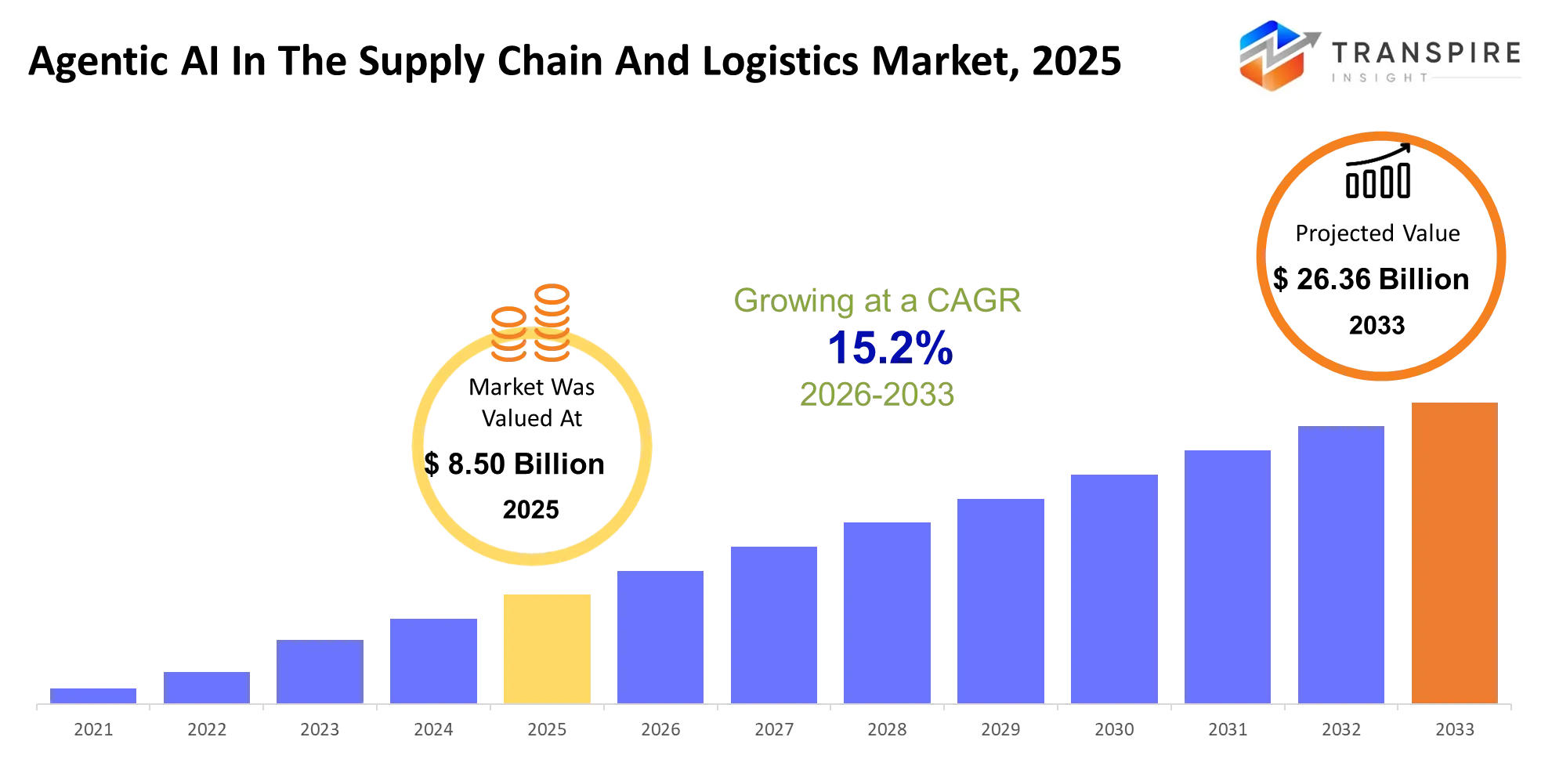
As per Transpire Insight, the Agentic AI In The Supply Chain and Logistics Market size is estimated at USD 8.50 billion in 2025 and is anticipated to reach USD 26.36 billion by 2033, growing at a CAGR of 15.2% from 2026 to 2033.
The Agentic AI in the Supply Chain and Logistics Market is changing how companies handle buying, keeping track of stock, moving goods, storing items and working with suppliers. Different from automation tools, agentic AI systems can look at information about work processes, make choices, and do tasks with very little help from people. In the last three to five years, there has been a shift from prediction models to decision-making systems within the context of supply chain systems, which have become connected as well. The rise in cloud computing technology, novel AI systems, and technologies that can use real-time data has been responsible for accelerating this transformation. Companies are investing in AI-based tools for improving their delivery accuracy, reducing costs, and responding to changes in market conditions.
Agentic AI In The Supply Chain And Logistics Market Size & Forecast:
- Market Size 2025: USD 8.50 Billion
- Expected Market Value (2033): USD 26.36 Billion
- Forecast CAGR (2026–2033): 15.2%
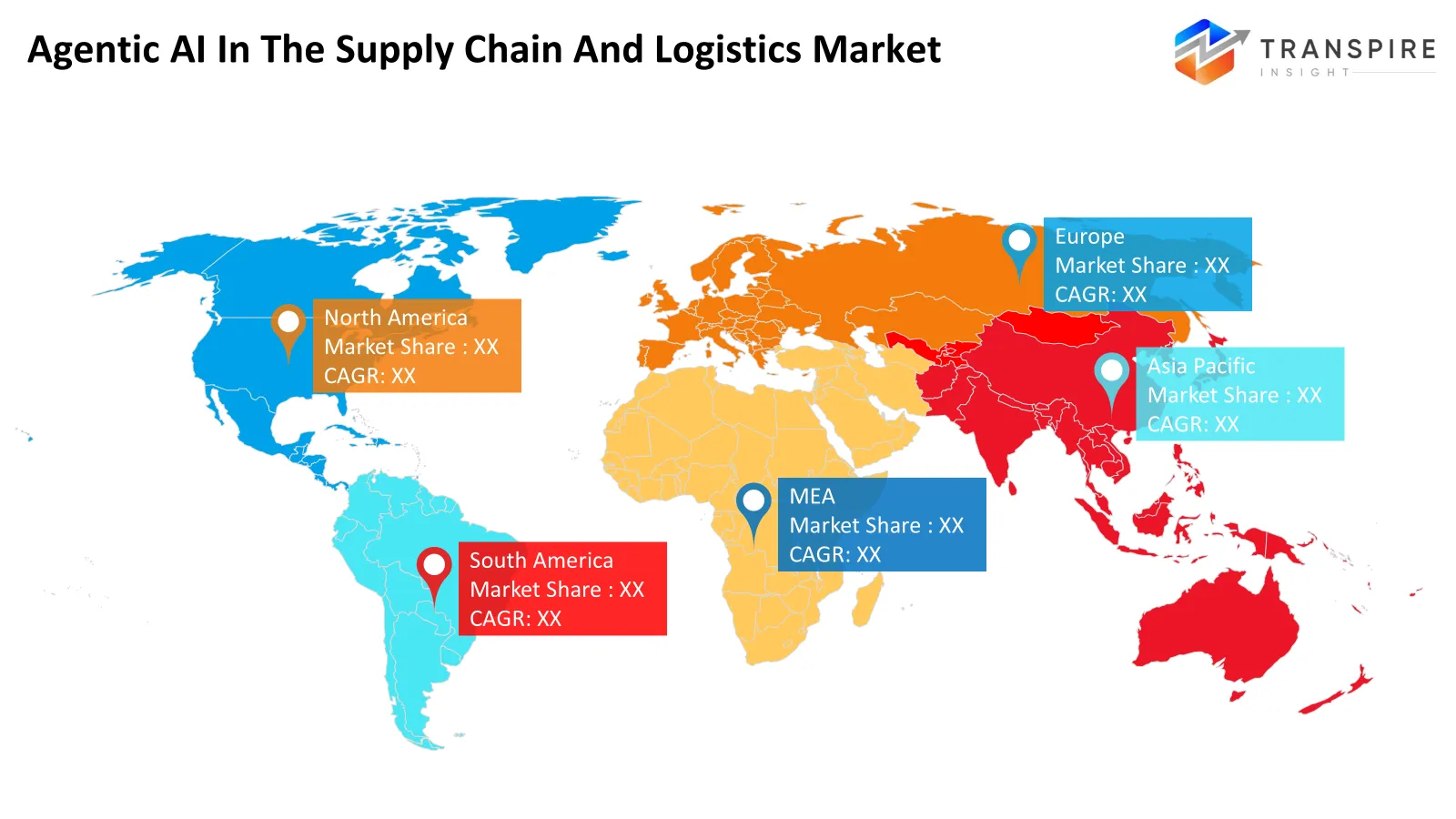
- Leading Region in 2025: North America
- Fastest Growing Region: Asia Pacific
- Key Company Profiles: Microsoft, IBM, Google, Amazon Web Services, Oracle, SAP, NVIDIA, Salesforce, Blue Yonder, Kinaxis, Manhattan Associates, o9 Solutions, Coupa Software, project44, FourKites
Key Market Insights:
The market is moving towards AI-enabled planning solutions to autonomous solutions that can coordinate actions across the supply chain.
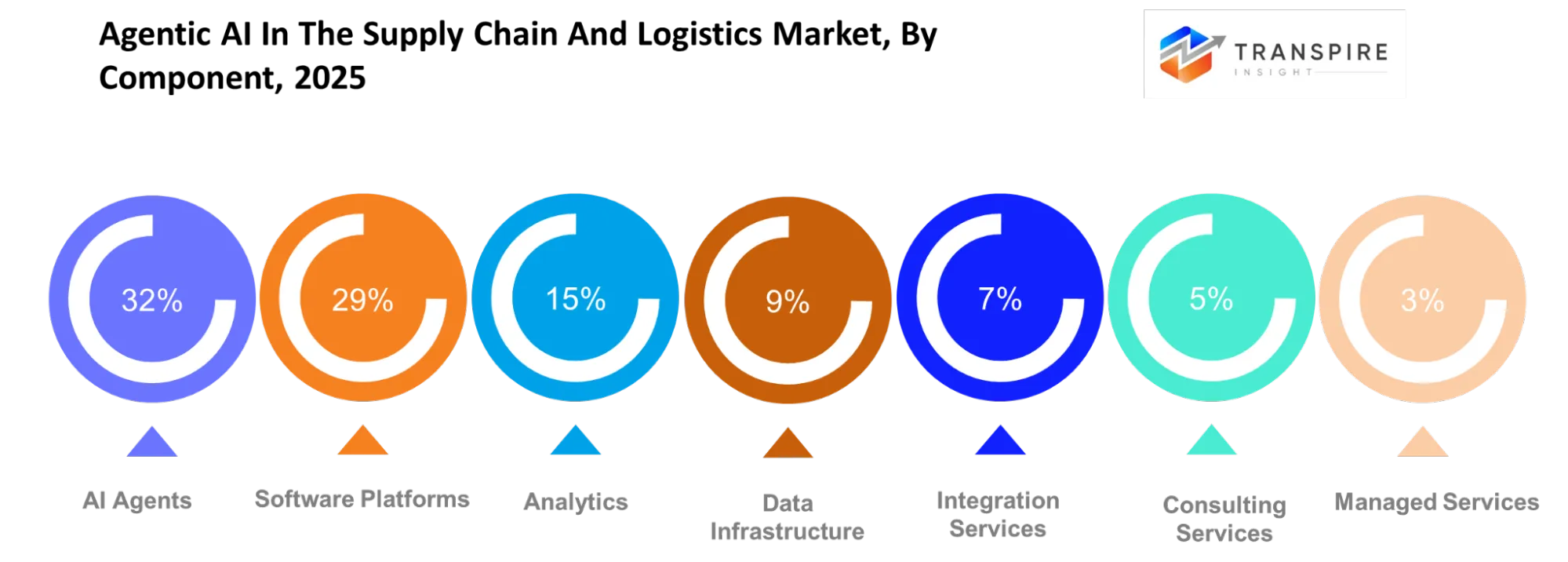
- The share of AI Agents holds 32.0% in the distribution of components since there is more demand for autonomous systems used in making operational decisions and executing operations.
- Software Platform accounts for 29.0% of the distribution of components thanks to the work of companies that provide AI environments for centralised operations.
- Analytics constitutes 15.0% of the distribution of components as businesses have resorted to the power of predictive intelligence to detect any changes in the pattern of demand or operational inefficiencies.
- Data Infrastructure is responsible for 9.0% because databases, cloud computing and real-time data processing have become vital.
- Integration Services have 7.0% because vendors are working on the integration of AI applications into enterprise resource planning and transportation management systems.
- Consulting Services account for 5.0% since it has become crucial for business organisations to seek advice when deploying AI in supply chains.
What are the Key Drivers, Restraints, and Opportunities in the Agentic AI In The Supply Chain And Logistics Market?
Drivers:
The increasing complexity of supply chains is driving organisations to deploy agentic AI to enhance decision-making capabilities. Transportation disruptions, varying inventory needs, and supplier issues have exposed the inefficiencies of traditional planning methods. Improvements in generative AI, machine learning, and cloud computing have made it feasible for agentic AI to process live data, take corrective measures, and automate processes. Resource efficiency, reduction in human intervention, and new avenues for enterprise software suppliers are some benefits provided by this technology.
Restraints:
High costs associated with implementation and integration of AI with existing enterprise systems act as restraining factors for many companies. Many organisations depend on multiple databases and old IT infrastructures, along with inconsistent data formats. Issues such as data privacy and decision transparency also motivate organisations to keep human intervention alive.
Opportunities:
The growth in multi-agent systems brings about opportunities for coordination of procurement activities, inventory control, warehouse operations, and transport through interconnected AI applications. The investments in technology in North America and Asia-Pacific in smart warehouses, cloud computing, and autonomous logistics can aid in the adoption of these technologies. Providers of solutions that possess cybersecurity, interoperability, and sector-specific capabilities will be well positioned to attract customers.
|
Driver |
Relative Impact on Growth (%) |
Geographic Relevance |
Impact Timeline |
Demand Strength |
Growth Mechanism |
Key Beneficiaries |
Major Constraint |
|
Increasing Adoption of Autonomous Supply Chain Operations |
28% |
North America, Europe |
Medium-term |
High |
Automates workflows and accelerates operational decisions |
Logistics providers, manufacturers, software vendors |
Limited trust in autonomous decision-making |
|
Growing Need for Real-Time Supply Chain Visibility |
22% |
North America, Asia Pacific |
Short-term |
High |
Enables real-time tracking and proactive disruption management |
Freight operators, retailers, supply chain managers |
Inconsistent data across supply networks |
|
Rising Demand for Operational Efficiency and Labour Cost Reduction |
18% |
North America, Europe, Asia Pacific |
Short-term |
High |
Reduces manual intervention and optimizes resource utilization |
Warehouse operators, logistics companies, manufacturers |
High implementation costs and skill shortages |
|
Advancements in Generative AI and Multi-Agent Systems |
17% |
North America, Asia Pacific |
Medium-term |
High |
Improves agent coordination and scalable automation |
AI developers, cloud providers, software vendors |
Legacy integration and poor data quality |
|
Increasing Focus on Supply Chain Resilience and Sustainability |
15% |
Europe, North America, Asia Pacific |
Long-term |
Medium |
Optimizes resources and strengthens supply chain traceability |
Manufacturers, logistics providers, technology vendors |
Regulatory complexity and limited sustainability data |
|
Total |
100% |
— |
— |
— |
— |
— |
— |
What Has the Impact of Artificial Intelligence Been on the Agentic AI In The Supply Chain And Logistics Market?
The use of artificial intelligence in supply chain and logistics practices involves the opportunity for firms to shift from process control performed by humans to fully autonomous decision-making. The use of agentic AI applications for coordination of inventory replenishment, transportation, collaboration with suppliers, and warehouse management is becoming popular. Such systems are capable of analysing operational data, identifying possible risks and taking actions in accordance with the company's goals. Predictive features help companies to calculate possible demand fluctuations, recognise possible delays in deliveries and predict shortages of inventory in advance. In transportation, such systems are used to analyse delivery routes, carriers' performance and the condition of shipments. In warehouses, companies start using intelligent systems for coordination of order processing, inventory distribution and workforce activities. Integration of multiple agentic systems allows for coordination between departments and companies involved in the supply chain. Such developments will help to provide greater visibility into operations, decrease routine administrative tasks and increase responsiveness to unforeseen situations. Implementation of such solutions still requires effort due to costs of integration, data inconsistencies, cybersecurity risks and the necessity of human involvement in case of significant decisions made by AI systems.
Instance:
In November 2026, C.H. Robinson extended the scope of operations of the AI agents to the fields of ocean shipping, air cargo and customs brokerage services. The AI agents have taken up tasks such as shipment bookings, freight quotations, and customs documentation and automated these tasks, which has decreased manual effort while increasing the efficiency of logistics processes.
Key Market Trends:
The trend of the market is shifting from using AI in isolation to connecting systems that can independently coordinate operations in the supply chain.
- Supply chain software solutions have gone from offering recommendation services to undertaking operational activities using self-operating autonomous AI agents.
- Companies are focusing on the need for integration platforms instead of automation services when it comes to procurement, inventory and logistics.
- From supporting customers to using generative AI in operational planning, supplier interaction and documentation of logistics activities.
- Logistics companies are increasingly using both human labour and a digital AI workforce in managing routine communications and logistics activities.
- Predictive supply chain management is moving towards proactive execution of actions to be able to deal with any disruptions before deliveries are affected.
- The need for cloud infrastructure is becoming paramount due to the need for scalable computing power for processing large volumes of operational data.
- Collaborations of multi-agent systems are becoming popular since specialised agents are capable of coordinating activities across different departments.
Agentic AI In The Supply Chain And Logistics Market Segmentation
By Component:
The component segment comprises AI Agents, Software Platforms, Analytics, Data Infrastructure, Integration Services, Consulting Services and Managed Services. AI Agents constitute 32.0% of the segment as a result of their function in the automation of tasks and business processes. Software Platforms make up 29.0% of the segment due to the demand for integrated supply chain systems. Analytics constitutes 15.0% of the segment, followed by Data Infrastructure with 9.0%. The Integration Services, Consulting Services and Managed Services hold 7.0%, 5.0% and 3.0% of the segment, respectively. Combined, AI Agents and Software Platforms constitute 61.0% of the component distribution.
By Application:
The applications are Demand Forecasting, Inventory Optimisation, Route Optimisation, Warehouse Automation, Procurement, Supplier Management and Order Management. Demand Forecasting assists firms in forecasting future requirements for the future, whereas Inventory Optimisation assists in better inventory management. Route Optimisation facilitates better delivery and transportation planning. Warehouse Automation enables better stock handling and order management. Procurement and Supplier Management assist in procurement operations and supplier management, while Order Management improves order handling.
By Deployment:
Deployment consists of Cloud, On-Premises, Hybrid, Private Cloud, Public Cloud, Edge and SaaS Cloud is a hot topic, as it delivers dynamic processing power and data on demand. Many organisations have on-premises deployment as part of their strategy to manage internal systems, workstations and critical data infrastructure. Hybrid takes the best of both cloud capabilities and on-premises hardware; private cloud and public cloud are options based on needs for security and scale. Edge is focused on producing high-speed processing for transportation hubs and warehouses, and SaaS delivers AI capability through a monthly subscription.
By Enterprise Size:
Enterprise Size segment includes Large Enterprises, Medium Enterprises, Small Enterprises, Startups, Multinational Corporations, Government Organisations, and SMEs. Large Enterprises and Multinational Corporations are important adopters of AI technology in logistics and transportation due to their extensive and complex supply chain networks and higher investments in technology. Medium-sized Businesses are using AI tools to optimise inventory planning and operational processes. Small Businesses and Startups can take advantage of cost-effective applications based on cloud computing. Government Organizations can also utilise this technology in procurement activities and logistics coordination.
By End User:
End user segmentation includes Retail and E-Commerce, Manufacturing, Transportation, Logistics Providers, Healthcare, Food and Beverage, and Automotive. Agentic AI can help retailers and e-commerce with inventory control and order fulfilment. It is useful for manufacturing in production planning and supplier coordination. Transportation and logistics firms get benefits from route optimisation and shipment tracking. Healthcare providers could enhance their operations through medical inventory management and pharmaceutical distribution through agentic AI technology. Also, food and beverage providers can make good use of stock planning. Automakers can facilitate their operations through component procurement and logistics.
By Agent Type:
Agent type segmentation includes Planning Agents, Optimisation Agents, Procurement Agents, Warehouse Agents, Transportation Agents, Customer-Service Agents, and Multi-Agent Systems. Planning agents help businesses with operations scheduling, and Optimisation Agents help with resource allocation. Procurement agents automate procurement processes, while Warehouse Agents deal with stock handling and orders. Transportation agents facilitate shipment tracking and delivery planning. Customer service agents help in answering routine questions and logistics coordination. Multi-Agent Systems are the fastest-growing segment, with an anticipated CAGR above 35%.
What are the Key Use Cases Driving the Agentic AI In The Supply Chain And Logistics Market?
AI-based software platforms and agents are being used to facilitate supply chain operations that were earlier heavily dependent on manual coordination. An important example of the use of AI is the optimisation of inventory. In this regard, AI-based agents evaluate the stock levels, purchase behaviour, and supplier availability to make recommendations for carrying out replenishment operations. It should be noted that this particular application of AI is highly related to the introduction of AI agents and software platforms. Another application area of AI is the coordination of transport and warehouse operations. Companies are using intelligent systems to evaluate the route for deliveries, track shipments, manage warehouse operations and handle delays. Procurement and supplier management operations are also benefiting from automated communication and procurement processes. Some of the emerging applications of AI include multi-agent systems that are coordinating planning, procurement, inventory and transport operations.
|
Report Metrics |
Details |
|
Market size value in 2025 |
USD 8.50 Billion |
|
Market size value in 2026 |
USD 9.79 Billion |
|
Revenue forecast in 2033 |
USD 26.36 Billion |
|
Growth rate |
CAGR of 15.2% from 2026 to 2033 |
|
Base year |
2025 |
|
Historical data |
2021 - 2024 |
|
Forecast period |
2026 - 2033 |
|
Report coverage |
Revenue forecast, competitive landscape, growth factors, and trends |
|
Regional scope |
United States; Canada; Mexico; United Kingdom; Germany; France; Italy; Spain; Denmark; Sweden; Norway; China; Japan; India; Australia; South Korea; Thailand; Brazil; Argentina; South Africa; Saudi Arabia; United Arab Emirates |
|
Key company profiled |
Microsoft, IBM, Google, Amazon Web Services, Oracle, SAP, NVIDIA, Salesforce, Blue Yonder, Kinaxis, Manhattan Associates, o9 Solutions, Coupa Software, project44, FourKites |
|
Customization scope |
Free report customization (country, regional & segment scope). Avail customized purchase options to meet your exact research needs. |
|
Report Segmentation |
Component (AI Agents, Software Platforms, Analytics, Data Infrastructure, Integration Services, Consulting Services, Managed Services); Application (Demand Forecasting, Inventory Optimization, Route Optimization, Warehouse Automation, Procurement, Supplier Management, Order Management); Deployment (Cloud, On-Premises, Hybrid, Private Cloud, Public Cloud, Edge, SaaS); Enterprise Size (Large Enterprises, Medium Enterprises, Small Enterprises, Startups, Multinational Corporations, Government Organizations, SMEs); End User (Retail & E-Commerce, Manufacturing, Transportation, Logistics Providers, Healthcare, Food & Beverage, Automotive); Agent Type (Planning Agents, Optimization Agents, Procurement Agents, Warehouse Agents, Transportation Agents, Customer-Service Agents, Multi-Agent Systems) |
Which Regions Are Driving the Agentic AI In The Supply Chain And Logistics Market Growth?
North America:
North America leads the Agentic AI in the Supply Chain and Logistics Market with a share of 39.8%, owing to the presence of traditional enterprise software players, sophisticated cloud infrastructure and high investment in AI technologies. The presence of leading technology companies and large logistics companies will aid in the commercialisation of autonomous supply chain solutions. High investments in digital transformation and automation in enterprises will drive regional market growth.
In October 2026, the company launched new AI agents for ocean, air, and customs logistics to automate the process of freight forwarding, including cargo quotation, booking, and customs documentation. This is another example of using agentic AI to enhance logistics efficiency and automate complex supply chain activities.
Europe:
Europe holds a share of 21.0% in the market, thanks to the well-established manufacturing sector, cross-border transportation network, and focus on efficiency. In comparison to North America, the region has industrial automation, robust logistics infrastructure, and the use of digital technology in manufacturing and logistics. A focus on data protection, cybersecurity, and the proper deployment of AI technology will influence technology purchase decisions. Investments in smart manufacturing plants and sustainable logistics activities will drive market adoption.
In October 2026, the Italy-based Logistics Reply developed its LEA AI Agent Authority Model, which allows companies to control the degree of autonomy of AI agents operating in warehouse execution. It will facilitate the deployment of agentic AI in warehouse execution and logistics management.
https://www.reply.com/en/newsroom/news/logistics-reply-introduces-the-lea-ai-agent-authority-model
Asia Pacific:
The Asia-Pacific region accounts for 29.5% of the market share and has been identified as the fastest-growing region, with a CAGR expected to be more than 30%. The fast growth in digital commerce and manufacturing infrastructure investments is making way for opportunities in the implementation of autonomous supply chains. Countries like China, India, Japan, and South Korea are building up their tech infrastructure by investing in automation, cloud, and smart manufacturing.
In August 2026, the Japanese NEC introduced its NEC SCM AI Agent that can autonomously support supply chain processes such as demand forecasting, procurement, production planning, inventory management, and logistics optimisation. This is another example of agentic AI usage to improve supply chain coordination and efficiency in Asia Pacific.
https://jpn.nec.com/press/202608/20260828_01.html
Who are the Key Players in the Agentic AI In The Supply Chain And Logistics Market, and how do they compete?
The competition in the Agentic AI in the Supply Chain and Logistics Market includes enterprise software vendors, cloud computing firms, logistics players and dedicated AI providers. The companies distinguish themselves by autonomous workflows, predictive intelligence, flexibility of integration and sector-specific solutions. Instead of competing just by the price of the software, the market players try to improve efficiency and to generate business outcomes. Oracle and SAP specialise in AI integration within the enterprise resource planning and supply chain management systems. The strength of these companies lies in their existing enterprise connections and networked business applications. The key distinguishing features of Blue Yonder are AI planning, forecasting and supply chain execution capabilities. In turn, the unique competitive advantage of Kinaxis is concurrent planning and rapid operational decisions. The market positions of the companies are reinforced by product innovation and corporate partnership.IBM, Microsoft and Google Cloud compete in the cloud computing infrastructure, AI development platforms and enterprise automation.
Agentic AI In The Supply Chain And Logistics Market Companies
- Microsoft
- IBM
- Amazon Web Services
- Oracle
- SAP
- NVIDIA
- Salesforce
- Blue Yonder
- Kinaxis
- Manhattan Associates
- o9 Solutions
- Coupa Software
- project44
- FourKites
|
Company |
Est. Revenue Share Range |
Key Offerings |
Strategic Positioning |
Geographic Strength |
Technology Focus |
|
SAP SE |
Estimated 5–8% |
SAP Joule Agents, SAP IBP, Digital Supply Chain, Joule Studio |
Enterprise supply chain integration leadership |
Europe, North America, Asia Pacific |
Context-aware agents, knowledge graphs, workflow orchestration |
|
Oracle Corporation |
Estimated 4–7% |
Fusion Cloud SCM, Oracle AI Agents, Transportation Management, Inventory Management |
Integrated cloud supply chain automation |
North America, Europe, Asia Pacific |
Generative AI, autonomous workflows, predictive analytics |
|
Microsoft Corporation |
Estimated 4–7% |
Dynamics 365 SCM, Copilot, Azure AI Foundry, AI Agent Framework |
Enterprise AI ecosystem leadership |
North America, Europe, Asia Pacific |
Multi-agent systems, cloud AI, intelligent automation |
|
Blue Yonder |
Estimated 3–6% |
Cognitive Solutions, Luminate Planning, Inventory Ops Agent, Warehouse Management |
Specialized planning and execution leadership |
North America, Europe, Asia Pacific |
Cognitive AI, demand sensing, predictive optimization |
|
Kinaxis Inc. |
Estimated 3–5% |
Kinaxis Maestro, Maestro Agents, Agent Studio, RapidResponse |
Real-time planning specialization |
North America, Europe, Asia Pacific |
Composable agents, concurrent planning, decision intelligence |
|
o9 Solutions |
Estimated 2–4% |
Digital Brain, APEX, Digital IBP, AI Planning Agents |
Integrated enterprise planning differentiation |
North America, Europe, Asia Pacific |
Neuro-symbolic AI, knowledge graphs, digital twins |
|
Manhattan Associates |
Estimated 2–4% |
Manhattan Active WM, Active TM, Agent Foundry, AI Agents |
Cloud-native logistics execution specialization |
North America, Europe, Asia Pacific |
Agentic AI, microservices, workflow orchestration |
|
C.H. Robinson |
Estimated 1–3% |
Lean AI, Always On Logistics Planner, AI Freight Quoting, Freight Management |
Logistics-native automation leadership |
North America, Europe, Asia Pacific |
Logistics AI, multi-agent automation, shipment intelligence |
|
IBM Corporation |
Estimated 1–3% |
watsonx Orchestrate, Supply Chain Solutions, Planning Analytics, AI Control Towers |
Enterprise AI integration differentiation |
North America, Europe, Asia Pacific |
Foundation models, AI agents, hybrid cloud |
|
NVIDIA Corporation |
Estimated 1–3% |
NVIDIA NeMo, NIM, Omniverse, Intelligent Warehouse Blueprint |
AI infrastructure technology leadership |
North America, Asia Pacific, Europe |
AI agents, robotics simulation, digital twins |
Recent Development News
- In January 2026, Penske Logistics introduced an AI platform created by Augment after a pilot project lasted for six months. The solution helps improve freight status information and shipment communication by being integrated with current transportation management systems. https://www.gopenske.com/newsroom/penske-logistics-expands-ai-visibility/
- In November 2025, DHL Supply Chain extended its cooperation with HappyRobot to use agentic AI in operations communication and coordination. It is used for appointment scheduling, driver follow-up, and warehouse coordination in order to cut down routine administrative tasks. https://group.dhl.com/en/media-relations/press-releases/2025/dhl-boosts-operational-efficiency-and-customer-communications-with-happyrobots-ai-agents.html
What Strategic Insights Define the Future of the Agentic AI In The Supply Chain And Logistics Market?
The future of the Agentic AI in the Supply Chain and Logistics Market will be based on the shift from individual AI technologies towards connected autonomous systems that will be able to handle entire operational workflows. Software providers that offer capabilities such as predictive intelligence, enterprise integration and multi-agent coordination are expected to have a competitive advantage. One of the hidden risks is the increasing reliance on flawed operational data, which will result in poor decision-making by autonomous systems, which is an issue that exists among interconnected supply chain activities. Another potential risk is maintaining the transparency and security of the AI-driven activities in line with business goals. The opportunity is in the creation of industry-specific multi-agent solutions for procurement, inventories, logistics, and warehousing coordination, particularly within Asia-Pacific. It will be important to focus on scalable solutions, robust data infrastructure, and human supervision capability. Companies demonstrating measurable cost reduction will have more options to transform AI investments into commercial success.
Key Segmentations are:
Component
- AI Agents
- Software Platforms
- Analytics
- Data Infrastructure
- Integration Services
- Consulting Services
- Managed Services
Application
- Demand Forecasting
- Inventory Optimization
- Route Optimization
- Warehouse Automation
- Procurement
- Supplier Management
- Order Management
Deployment
- Cloud
- On-Premises
- Hybrid
- Private Cloud
- Public Cloud
- Edge
- SaaS
Enterprise Size
- Large Enterprises
- Medium Enterprises
- Small Enterprises
- Startups
- Multinational Corporations
- Government Organizations
- SMEs
End User
- Retail & E-Commerce
- Manufacturing
- Transportation
- Logistics Providers
- Healthcare
- Food & Beverage
- Automotive
Agent Type
- Planning Agents
- Optimization Agents
- Procurement Agents
- Warehouse Agents
- Transportation Agents
- Customer-Service Agents
- Multi-Agent Systems
By Regional Analysis
North America
- US
- Canada
- Mexico
Europe
- Germany
- UK
- France
- Italy
- Spain
- Russia
- Rest of Europe
Asia Pacific
- China
- Japan
- India
- South Korea
- Australia
- Rest of Asia Pacific
South America
- Brazil
- Argentina
- Rest of South America
Middle East & Africa
- UAE
- Saudi Arabia
- Qatar
- South Africa
- Rest of the Middle East & Africa
Frequently Asked Questions
Find quick answers to common questions.
The agentic AI in the supply chain and logistics market size was valued at USD 8.50 billion in 2025 and is poised to reach USD 26.36 billion by 2033, expanding at a 15.2% CAGR.
Key segments for the agentic AI in the supply chain and logistics market are Component (AI Agents, Software Platforms, Analytics, Data Infrastructure, Integration Services, Consulting Services, Managed Services); Application (Demand Forecasting, Inventory Optimization, Route Optimization, Warehouse Automation, Procurement, Supplier Management, Order Management); Deployment (Cloud, On-Premises, Hybrid, Private Cloud, Public Cloud, Edge, SaaS); Enterprise Size (Large Enterprises, Medium Enterprises, Small Enterprises, Startups, Multinational Corporations, Government Organizations, SMEs); End User (Retail & E-Commerce, Manufacturing, Transportation, Logistics Providers, Healthcare, Food & Beverage, Automotive); Agent Type (Planning Agents, Optimization Agents, Procurement Agents, Warehouse Agents, Transportation Agents, Customer-Service Agents, Multi-Agent Systems).
Growth is primarily driven by increasing adoption of AI-powered automation, rising demand for real-time supply chain visibility, the need to reduce logistics and operational costs, growing use of predictive analytics for demand forecasting, and the adoption of autonomous decision-making systems to improve warehouse management, inventory control, and transportation efficiency.
The market is led by major manufacturers including Microsoft, IBM, Google, Amazon Web Services, Oracle, SAP, NVIDIA, Salesforce, Blue Yonder, Kinaxis, Manhattan Associates, o9 Solutions, Coupa Software, Project44, and FourKites.
North America has a share of 39.8% in the market of agentic AI in supply chain and logistics. The major driving force behind this market domination lies in the presence of major tech giants in this region, early adoption of artificial intelligence for automation, better digital infrastructure, and innovations in the supply chain. Furthermore, there is rising demand for logistics optimisation, predictive decision-making, and warehouse automation.
Commercial opportunities that arise from the increased implementation of autonomous supply chains, AI demand forecasting, warehouse automation, and real-time routing optimisation. Furthermore, the integration of agent intelligence with IoT, cloud, and enterprise software allows for creating opportunities for the development of technological solutions for the logistics industry in new markets.
- Microsoft
- IBM
- Amazon Web Services
- Oracle
- SAP
- NVIDIA
- Salesforce
- Blue Yonder
- Kinaxis
- Manhattan Associates
- o9 Solutions
- Coupa Software
- project44
- FourKites
About the Authors

Mayur Shinde
I am Mayur Shinde, a Senior Research Analyst at Transpire Insight, specializing in the Automotive & Transportation and Information & Communication Technology (ICT) Industry. My work focuses on analyzing emerging market trends, technological advancements, competitive landscapes, and industry developments to deliver accurate, data-driven insights. I am passionate about transforming complex market information into clear, actionable content that helps businesses, professionals, and decision-makers stay informed and make confident strategic decisions.

Chakradhar Khansole
Chakradhar serves as the Research Director at Transpire Insight, bringing over 8 years of experience in technology, innovation, and strategic market intelligence. He specializes in transforming complex market data into actionable business insights that enable organizations to make informed, growth-oriented decisions. Recognized for his strategic vision and analytical expertise, Chakradhar leads high-impact research initiatives, delivering comprehensive market assessments, competitive intelligence, and forward-looking industry analysis.
Recently Published Reports
-
Apr 2026
ATV & UTV Market
ATV & UTV Market Size, Share & Analysis Report By Type (ATV, and UTV), By Variants (Less Than 400 CC, 400 CC To 800 CC, and More Than 800 CC), and Geography (North America, Europe, Asia-Pacific, Middle East and Africa, South and Central America), 2021 - 2031
-
Apr 2026
Automotive Central Gateway Module Market
Automotive Central Gateway Module Market Size, Share & Analysis Report By Type (Ethernet Central Gateway Module, CAN Central Gateway Module, LIN Central Gateway Module, and FlexRay), By Application (Powertrain Control, Body Control, Infotainment System, Advanced Driver Assistance Systems (ADAS), and Others), By End User (Passenger Vehicles, and Commercial Vehicles), and Geography (North America, Europe, Asia-Pacific, Middle East and Africa, South and Central America), 2021 - 2031
-
Apr 2026
Automotive Engine Oil Filter Market
Automotive Engine Oil Filter Market Size, Share & Analysis Report By Filter Type (Fuel Filter, Engine Oil Filter, Hydraulic Oil Filter, and Others), By Filter Media (Cellulose, Synthetic, and Micro), By Sales Channel (OEMs, and Aftermarket), By Vehicle Type (Passenger Cars, Light Commercial Vehicles, Heavy Duty Trucks, Buses and Coaches, and Off-road Vehicles), and Geography (North America, Europe, Asia-Pacific, Middle East and Africa, South and Central America), 2021 - 2031
-
Apr 2026
Automotive Parts Aluminium Die Casting Market
Automotive Parts Aluminium Die Casting Market Size, Share & Analysis Report By Production Process (Pressure Die Casting, Vacuum Die Casting, Squeeze Die Casting, Gravity Die Casting), By Application (Body Parts, Engine Parts, Transmission Parts, Battery And Related Components, Other Application Types), and Geography (North America, Europe, Asia-Pacific, Middle East and Africa, South and Central America), 2021 - 2031
Our Clients