
Europe AI Agents Market Size & Forecast:
- Europe AI Agents Market Size 2025: USD 1.85 Billion
- Europe AI Agents Market Size 2033: USD 42.09 Billion
- Europe AI Agents Market CAGR: 47.81%
- Europe AI Agents Market Segments: By Component (Software, Services, Platforms, Others); By Deployment (Cloud, On-Premise, Hybrid, Others); By Agent Type (Conversational Agents, Autonomous Agents, Multi-Agent Systems, Others); By Technology (Machine Learning, NLP, Computer Vision, Reinforcement Learning, Others); By End User (BFSI, Healthcare, Retail, Manufacturing, IT & Telecom, Others); By Enterprise Size (Large Enterprises, SMEs, Others).
Europe AI Agents Market Summary
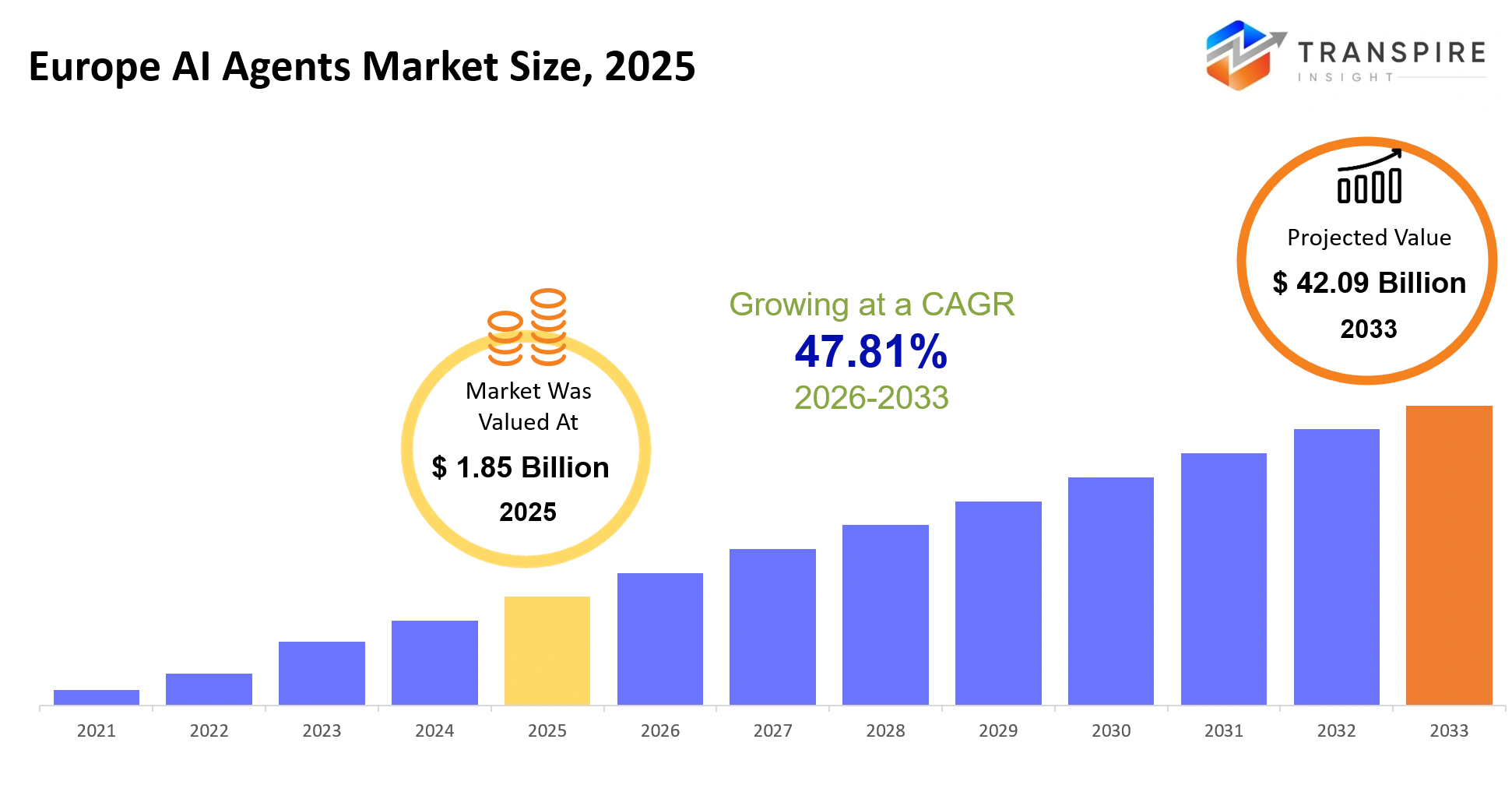
The Europe AI Agents Market was valued at USD 1.85 Billion in 2025. It is forecast to reach USD 42.09 Billion by 2033. That is a CAGR of 47.81% over the period.
The Europe AI Agents market is about software systems that can make decisions and do things on their own. These systems can handle customer service plan how to get things from one place to another fix problems before they happen and look at a lot of data in time. This means that people do not have to watch over these systems all the time and things can get done faster.
In the five years the market has changed from using simple automation tools to using AI Agents that can think for themselves. These AI Agents use language models and can look at a lot of data. They can even understand things that are not written down in a way. This means that systems can do things on their own and make decisions without people telling them what to do. The pandemic made a lot of changes. Caused problems with getting things from one place to another. This showed that old automation systems were not working well. So now companies, in Europe are using AI Agents to get things done faster make decisions and get more work done without hiring more people. This is making the companies that make software for AI Agents money.
Key Market Insights
- Western Europe has the part of the Europe AI Agents Market with about 48 percent in 2025 because a lot of big companies in Germany, UK and France are using Europe AI Agents.
- The Nordic countries are growing fast from 2025 to 2030 because they started using automation early on and they have very good digital infrastructure.
- Central and Eastern Europe are also adopting Europe AI Agents steadily because it is cheap to outsource work and there are centers that deliver services using Europe AI Agents.
- Most of the Europe AI Agents Market uses software-based agents with about 52 percent because companies are moving away from simple automation and towards systems that can make decisions using Europe AI Agents.
- The biggest segment is hybrid Europe AI Agents that combine oversight with automated tasks in industries that have a lot of rules.
- autonomous Europe AI Agents are growing the fastest until 2030 because many companies are adopting a new way of building their systems that puts Europe AI Agents first.
- The main uses of Europe AI Agents are in IT operations and customer service with 40 percent of the Europe AI Agents Market because they can save companies a lot of money.
- The fastest growing use of Europe AI Agents is in supply chain orchestration because companies want to reduce the risks of things going wrong by using Europe AI Agents. Big companies are using
- Europe AI Agents the most with 60 percent because they have more money to spend on Europe AI Agents and they are trying to transform their businesses digitally.
- medium sized companies are the fastest growing group of users because they can now use Europe AI Agents easily with platforms that are based on cloud computing.
- Some of the companies in the Europe AI Agents Market are **Microsoft, Google, IBM, Salesforce, SAP and ServiceNow** and they are all trying to get companies to use Europe AI Agents.
What are the Key Drivers, Restraints, and Opportunities in the Europe AI Agents Market?
Driver
The Europe AI Agents Market is growing mainly because companies are starting to use AI in their software. This change happened after big language models became available for use in 2023. These models help AI systems do tasks not just analyze data. As companies in Europe add AI agents to their cloud platforms, customer relationship management systems and planning tools they work efficiently. This efficiency directly increases their software subscription revenue. Speeds up their digital transformation.
Restraint
One major challenge is that it's hard to integrate AI agent systems with fragmented systems that many European organizations still use. These organizations often have a mix of on-premise and cloud systems, which makes it difficult to deploy AI agents smoothly. This leads to implementation times and higher customization costs delaying the full adoption of AI agents. As a result companies don't see revenue growth quickly as they would like especially in regulated sectors like banking, healthcare and public administration where there are strict compliance rules.
Opportunity
There's an opportunity for AI agents that are designed for specific industries in Europe like financial compliance, logistics and industrial maintenance. Countries such as Germany and the Netherlands are investing in AI pilot programs for manufacturing and supply chains. Companies like SAP and Microsoft are creating AI agent ecosystems that are integrated into business workflows. This opens the way, for AI agents that are tailored to sectors and can bring real productivity gains to European companies.
What Has the Impact of Artificial Intelligence Been on the Europe AI Agents Market?
Artificial intelligence and digital technologies are changing how scrubber performance systems and marine emission control technology work. They help monitor, optimize and track compliance automatically across vessel operations. AI control platforms now automate exhaust gas cleaning. They adjust scrubber settings like flow rate, pH balance and pressure based on fuel quality and engine load. This reduces work and ensures consistency in meeting sulphur emission requirements in European waters.
Machine learning models are used for maintenance. They analyze real-time sensor data from marine emission control systems to detect signs of problems. This helps fleet operators schedule maintenance ahead of time. It reduces downtime and extends equipment life. Several shipping fleets have seen vessel uptime and stable fuel efficiency. This is due to engine-scrubber coordination especially during long voyages.
AI integration improves compliance reporting. It automates emissions documentation. Reduces manual data errors. This lowers costs and audit risks.. There are challenges. Limited internet connectivity at sea restricts real-time data transmission. High integration costs, with vessel infrastructure also slow down large-scale deployment.
Key Market Trends
- Since 2023 companies have moved away from using chatbots. Started using autonomous AI agents that can do many tasks at once in areas like money, human resources and buying things.
- Microsoft Google and Salesforce made their AI agent platforms better from 2024 to 2026 which made companies compete with each other to automate their work of just having good software.
- Companies in Europe like to use AI agents that work with the systems they already have which means they do not need automation tools anymore.
- After the EU AI Act was introduced companies started spending money on making sure their AI agents are fair and can be explained and that they follow the rules.
- Between 2024 and 2026 special AI agents were made for banking, healthcare and manufacturing which helped companies follow the rules and automate their work.
- After 2025 many companies started using AI agents that work together to do complex tasks instead of just using one AI agent.
- Now companies want to see results from using AI agents like saving money making decisions faster and being more accurate.
- SAP and ServiceNow made their AI agents better which changed their software from managing data to actually doing things on its own.
- More small and medium sized companies started using AI agents after cloud-based platforms made it cheaper and easier to use them.
- To be better, than others companies need to have their way of using data because buyers want AI agents that understand their specific needs, not just general AI agents.
Europe AI Agents Market Segmentation
By Component:
Software is still the leading part of the Europe AI Agents Market. This is because many businesses are using AI-driven automation tools. They invest a lot in software that can run workflows on its own and help with decision-making. Services are also growing as companies need help integrating, consulting and deploying AI agents. More and more businesses are looking for managed services so they can use AI faster without having to hire technical staff.Platforms are becoming more important as businesses move to AI systems. These systems combine data, models and workflows. They help businesses deploy AI in a way across many functions and industries. Other components are still used for cases where businesses need customized AI solutions. The components are changing to be more integrated and scalable.
By Deployment:
Cloud deployment is leading the Europe AI Agents Market. This is because it is flexible, scalable and cheaper. Businesses prefer cloud systems because they can roll out AI agents faster and update them easily. Hybrid deployment is growing as businesses try to balance data security with cloud efficiency. This is especially important for industries that are regulated.
On-premise deployment is still used in some sectors like BFSI and healthcare. This is because they have data governance rules. These systems give businesses control over their data. Other deployment models are used for testing and transitional AI environments. The trends show that businesses want secure architecture.
By Agent Type:
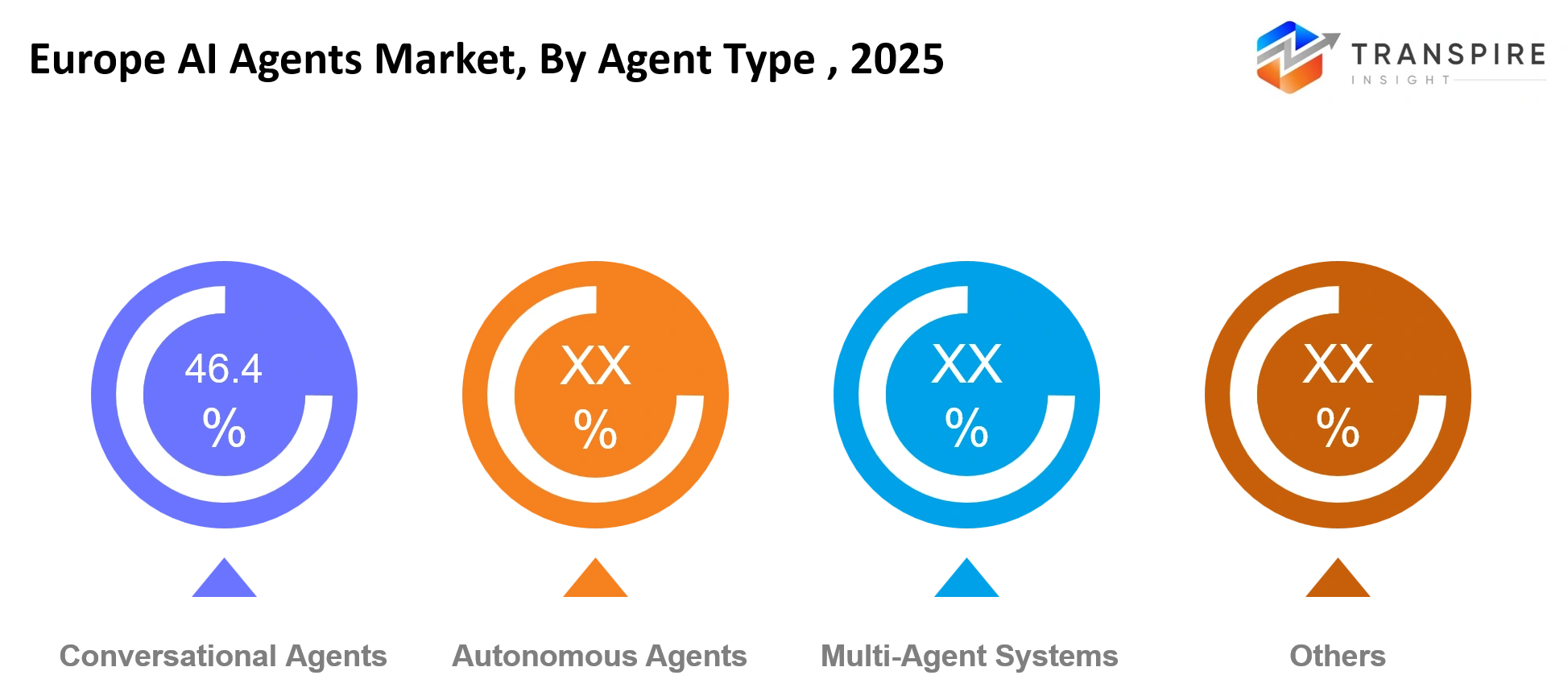
Conversational agents are the popular in the Europe AI Agents Market. This is because they are widely used in customer service and enterprise communication. They help improve response time and reduce workload. Autonomous agents are growing rapidly as businesses adopt systems that can execute tasks on their own.Multi-agent systems are emerging as solutions. They coordinate AI agents for complex workflows. These systems improve efficiency in large-scale enterprise operations. Other agent types are still used for automation cases. The agents are evolving to be more autonomous and coordinated.
By Technology:
Machine learning is still the core technology in the Europe AI Agents Market. This is because it is used for analytics and decision automation. NLP technologies are expanding rapidly as businesses deploy language-based AI systems. Reinforcement learning supports decision systems that improve over time.Computer vision plays a growing role in security applications. Other technologies support AI functions across enterprise environments. Technology integration increases system intelligence and accuracy. Businesses combine AI technologies to improve agent performance.
By End User:
BFSI leads the Europe AI Agents Market. This is because they strongly adopt AI for fraud detection compliance monitoring and customer service automation. Healthcare is expanding AI usage in diagnostics and patient management. Retail is increasing adoption for customer engagement and inventory optimization.IT and telecom sectors adopt AI agents for network management and service automation. Other industries contribute through automation needs. The demand growth reflects efficiency priorities, across sectors.
By Enterprise Size:
Large enterprises dominate the Europe AI Agents Market. This is because they have investment capacity and complex operational structures. SMEs are the growing segment. This is because cloud-based AI platforms reduce entry barriers. Enterprises of all sizes are adopting AI-driven automation tools. The trends show broadening adoption across business scales.
What are the Key Use Cases Driving the Europe AI Agents Market?
The Europe AI Agents Market is really about customer service automation. This is the thing that people are using it for. Companies in Europe are using agents a lot in areas like banking, retail and IT services. They do this to handle a lot of questions from customers answer them quickly and make their work easier. This helps companies to be more efficient and save money.
Companies are also starting to use AI agents to automate their work and make predictions. This is happening in manufacturing and supply chain management. For example manufacturing companies are using AI agents to schedule maintenance and make production better. Banks are using them to detect fraud and make sure they are following the rules. This helps companies to be more accurate and not have to do much work by hand.
There are some things that AI agents are being used for. Some companies are using them to make decisions on their own. Others are using them to coordinate logistics. Even healthcare companies are starting to use AI agents to help patients and automate administrative tasks. These are areas, for AI agents but they have a lot of potential. As companies start to use technology more and more AI agents will become even more important. The Europe AI Agents Market will likely see a lot of growth as companies start to use AI agents in exciting ways.
|
Report Metrics |
Details |
|
Market size value in 2025 |
USD 1.85 Billion |
|
Market size value in 2026 |
USD 2.73 Billion |
|
Revenue forecast in 2033 |
USD 42.09 Billion |
|
Growth rate |
CAGR of 47.81% from 2026 to 2033 |
|
Base year |
2025 |
|
Historical data |
2021 - 2024 |
|
Forecast period |
2026 - 2033 |
|
Report coverage |
Revenue forecast, competitive landscape, growth factors, and trends |
|
Regional scope |
Europe |
|
Key company profiled |
OpenAI, Microsoft, Google, IBM, Salesforce, SAP, Oracle, ServiceNow, AWS, NVIDIA, UiPath, Cognigy, Aleph Alpha, Mistral AI, Dataiku. |
|
Customization scope |
Free report customization (country, regional & segment scope). Avail customized purchase options to meet your exact research needs. |
|
Report Segmentation |
By Component (Software, Services, Platforms, Others); By Deployment (Cloud, On-Premise, Hybrid, Others); By Agent Type (Conversational Agents, Autonomous Agents, Multi-Agent Systems, Others); By Technology (Machine Learning, NLP, Computer Vision, Reinforcement Learning, Others); By End User (BFSI, Healthcare, Retail, Manufacturing, IT & Telecom, Others); By Enterprise Size (Large Enterprises, SMEs, Others). |
Which Regions are Driving the Europe AI Agents Market Growth?
North America leads the Europe AI Agents Market due to early enterprise AI adoption, strong hyperscaler presence, and advanced cloud infrastructure that supports large-scale deployment of autonomous systems. The region benefits from mature digital ecosystems where enterprises already operate integrated ERP, CRM, and cloud platforms, enabling faster AI agent integration. Strong investment from Microsoft, Google, and IBM further accelerates enterprise rollout of agent-based automation. Regulatory clarity in enterprise AI governance also supports scalable deployment across financial services, healthcare, and technology sectors.
Western Europe remains a stable and high-value contributor due to strict data protection frameworks and structured digital transformation programs across Germany, France, and the United Kingdom. Unlike North America’s speed-driven adoption, this region focuses on compliance-first deployment, ensuring AI agents meet regulatory and audit requirements. Industrial enterprises and public sector organizations drive consistent demand for workflow automation, particularly in manufacturing, BFSI, and logistics. Continuous investment in secure cloud infrastructure supports steady adoption despite slower implementation cycles.
Asia-Pacific emerges as the fastest-growing region due to rapid enterprise digitization, expanding cloud infrastructure, and government-led AI initiatives in countries such as India, Singapore, and China. Recent investments in digital public infrastructure and enterprise SaaS adoption have accelerated demand for AI agent platforms. The shift toward cost-efficient automation across SMEs and large enterprises has created strong adoption momentum. Over 2026–2033, this growth will attract global vendors to localize solutions and build region-specific AI agent ecosystems.
Who are the Key Players in the Europe AI Agents Market and How Do They Compete?
The Europe AI Agents Market shows a moderately consolidated competitive structure where a small group of global cloud and enterprise software providers control core platforms, while new entrants compete through specialized autonomous agent solutions. Competition is primarily driven by technology capability, especially the ability to integrate large language models with enterprise workflows, rather than pricing alone. Incumbents are actively defending their positions by embedding AI agents into existing ERP, CRM, and cloud ecosystems, while startups focus on niche automation use cases and faster deployment models for SMEs.
Microsoft advances its strategy through deep integration of AI agents into its Azure and Microsoft 365 ecosystem, enabling seamless workflow automation across enterprise productivity tools. Its advantage comes from unified cloud infrastructure and enterprise-scale deployment capability. The company expands through continuous upgrades to Copilot-based agent systems and partnerships with large European enterprises for regulated industry adoption.
SAP focuses on embedding AI agents directly into enterprise resource planning workflows, giving it a strong position in manufacturing and industrial sectors across Europe. Its differentiation lies in process-level integration within core business systems rather than standalone AI tools. Expansion is driven by partnerships with industrial clients and deployment of AI-enabled supply chain and finance automation modules.ServiceNow builds its competitive advantage through workflow orchestration AI agents that automate IT service management and enterprise operations. Its platform differentiates through end-to-end service automation capabilities across IT, HR, and customer support functions. The company expands through enterprise SaaS adoption in European mid-to-large organizations transitioning toward autonomous operations.
Google strengthens its position through generative AI agent frameworks integrated into Google Cloud and enterprise analytics platforms. Its advantage lies in advanced model capability and scalable cloud infrastructure. Expansion is driven by enterprise AI partnerships and deployment of agent-based productivity solutions across digital-first organizations.
Company List
- Salesforce
- SAP
- Oracle
- ServiceNow
- Amazon Web Services
- NVIDIA
- UiPath
- Cognigy
- Aleph Alpha
- Mistral AI
- Dataiku
Recent Development News
In September 2025, OpenAI and Microsoft announced a sovereign AI collaboration for Germany, partnering with SAP and Azure infrastructure to deliver secure AI agent systems for public sector workflow automation. The initiative enables AI agents to support administrative processes such as document handling and data analysis while meeting strict European data sovereignty and compliance requirements.
Surce: https://openai.com
In April 2026, Microsoft and OpenAI updated their partnership agreement to expand flexibility for multi-cloud and third-party collaboration in AI agent development, reducing earlier exclusivity constraints tied to Azure deployment. The change allows enterprises in Europe to deploy AI agents across diverse infrastructure environments, improving scalability and adoption across regulated industries.
Source: https://blogs.microsoft.com
In June 2026, Microsoft introduced Project Solara, an “agent-first” platform designed to replace traditional app-based workflows with AI agents capable of executing cross-platform tasks autonomously. This development strengthens enterprise adoption of AI agents by enabling direct integration into devices and enterprise systems for productivity automation and workflow execution.
Source: https://www.reuters.com
What Strategic Insights Define the Future of the Europe AI Agents Market?
The Europe AI Agents Market is moving toward fully autonomous enterprise execution systems where AI agents will evolve from task assistants into primary decision-making layers within business software. This shift is driven by rapid integration of generative AI into cloud ecosystems and the growing need for enterprises to reduce operational complexity while improving speed of execution. Over the next 5 to 7 years, adoption will concentrate around agent-first enterprise platforms that unify data, workflows, and decision logic into continuous automated systems.
A less visible risk is increasing dependence on a small group of hyperscaler ecosystems, which could create vendor lock-in and limit interoperability across enterprise environments. This concentration risk may slow innovation diversity and raise long-term switching costs for enterprises, especially in regulated European industries that require flexible infrastructure control.
An emerging opportunity lies in sovereign AI agent infrastructure developed under EU data governance frameworks, particularly in Germany, France, and the Nordics. These environments will support secure, localized deployment of enterprise agents for regulated sectors. Market participants should prioritize building interoperable, compliance-ready AI agent platforms that can operate across hybrid and sovereign cloud environments to secure long-term enterprise contracts and regional scalability.
Europe AI Agents Market Report Segmentation
By Component
- Software
- Services
- Platforms
- Others
- By Deployment
- Cloud
- On-Premise
- Hybrid
- Others
By Agent Type
- Conversational Agents
- Autonomous Agents
- Multi-Agent Systems
- Others
- By Technology
- Machine Learning
- NLP
- Computer Vision
- Reinforcement Learning
- Others
By End User
- BFSI
- Healthcare
- Retail
- Manufacturing
- IT & Telecom
- Others
- By Enterprise Size
- Large Enterprises
- SMEs
- Others
Frequently Asked Questions
Find quick answers to common questions.
The expected Europe AI Agents Market size for the market will be USD 42.09 Billion in 2033.
Key segments for the Europe AI Agents Market are By Component (Software, Services, Platforms, Others); By Deployment (Cloud, On-Premise, Hybrid, Others); By Agent Type (Conversational Agents, Autonomous Agents, Multi-Agent Systems, Others); By Technology (Machine Learning, NLP, Computer Vision, Reinforcement Learning, Others); By End User (BFSI, Healthcare, Retail, Manufacturing, IT & Telecom, Others); By Enterprise Size (Large Enterprises, SMEs, Others).
Major Europe AI Agents Market players are OpenAI, Microsoft, Google, IBM, Salesforce, SAP, Oracle, ServiceNow, AWS, NVIDIA, UiPath, Cognigy, Aleph Alpha, Mistral AI, Dataiku.
The Europe AI Agents Market size is USD 1.85 Billion in 2025.
The Europe AI Agents Market CAGR is 47.81% from 2026 to 2033.
- OpenAI
- Microsoft
- IBM
- Salesforce
- SAP
- Oracle
- ServiceNow
- Amazon Web Services
- NVIDIA
- UiPath
- Cognigy
- Aleph Alpha
- Mistral AI
- Dataiku
About the Authors

Mayur Shinde
I am Mayur Shinde, a Senior Research Analyst at Transpire Insight, specializing in the Automotive & Transportation and Information & Communication Technology (ICT) Industry. My work focuses on analyzing emerging market trends, technological advancements, competitive landscapes, and industry developments to deliver accurate, data-driven insights. I am passionate about transforming complex market information into clear, actionable content that helps businesses, professionals, and decision-makers stay informed and make confident strategic decisions.

Chakradhar Khansole
Chakradhar serves as the Research Director at Transpire Insight, bringing over 8 years of experience in technology, innovation, and strategic market intelligence. He specializes in transforming complex market data into actionable business insights that enable organizations to make informed, growth-oriented decisions. Recognized for his strategic vision and analytical expertise, Chakradhar leads high-impact research initiatives, delivering comprehensive market assessments, competitive intelligence, and forward-looking industry analysis.
Recently Published Reports
-
Apr 2026
3D Optical Profiler Market
3D Optical Profiler Market Size, Share & Analysis Report By Type (Desktop 3D Optical Profiler, and Portable 3D Optical Profiler), By Technology (Confocal Technology, and White Light Interference), By End-Use Industry (Manufacturing, Research Institutions, Automotive, Aerospace and Defense, Medical Devices, and Other), and Geography (North America, Europe, Asia-Pacific, Middle East and Africa, South and Central America), 2021 - 2031
-
Apr 2026
Depth Sensor Market
Depth Sensor Market Size, Share & Analysis Report By Type (Infrared Depth Sensors, Time-of-Flight (ToF) Sensors, Stereo Vision Sensors, Structured Light Sensors, Ultrasonic Depth Sensors), By Application (Automotive, Robotics, Gaming, Consumer Electronics, Industrial Automation, Healthcare, Security & Surveillance, Others), By End Users (Automotive Manufacturers, Consumer Electronics Companies, Healthcare Providers, Industrial Companies, Security Agencies, Gaming Companies, Robotics Companies, Others), and Geography (North America, Europe, Asia-Pacific, Middle East and Africa, South and Central America), 2021 – 2031
-
Apr 2026
Digital Manufacturing Market
Digital Manufacturing Market Size, Share & Analysis Report By Component (Hardware, Software, and Services), By Technology (Robotics, 3D Printing, Internet of Things (IoT), and Others), By Application (Automotive and Transportation, Aerospace and Defense, Consumer Electronics, Industrial Machinery, and Others), By Process Type (Computer-Based Designing, Computer-Based Simulation, Computer 3D Visualization, Analytics, and Others), and Geography (North America, Europe, Asia-Pacific, Middle East and Africa, South and Central America), 2021 – 2031
-
Apr 2026
Digital Visa Services Market
Digital Visa Services Market Size, Share & Analysis Report By Type (Individual Travelers, Group Travelers), By Application (Tourism, Business Travel, Others), and Geography (North America, Europe, Asia-Pacific, Middle East and Africa, South and Central America), 2021 – 2031