
Middle East and Africa Real-Time Decision-Making AI Agents Market Size & Forecast:
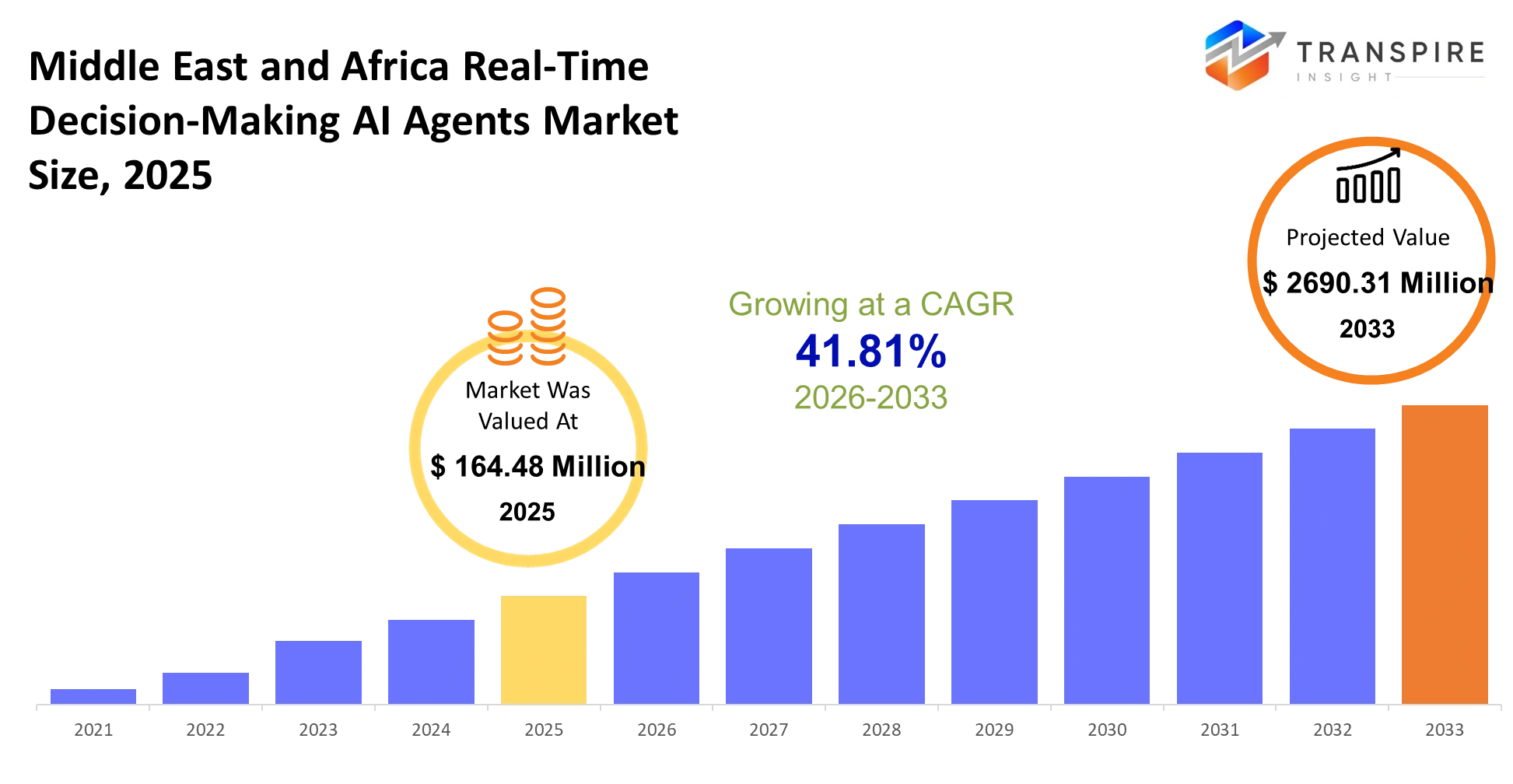
- Middle East and Africa Real-Time Decision-Making AI Agents Market Size 2025: USD 164.48 Million
- Middle East and Africa Real-Time Decision-Making AI Agents Market Size 2033: USD 2690.31 Million
- Middle East and Africa Real-Time Decision-Making AI Agents Market CAGR: 41.81%
- Middle East and Africa Real-Time Decision-Making AI Agents Market Segments: By Type (Software Agents, Decision Engines, Predictive Agents, Others); By Application (Finance, Healthcare, Retail, Manufacturing, Customer Support, Others); By End-User (Enterprises, BFSI, Healthcare Providers, Retailers, IT Companies, Others); By Deployment (Cloud, Edge, Hybrid, Others)
To learn more about this report,  Download Free Sample Report
Middle East and Africa Real-Time Decision-Making AI Agents Market Summary
The Middle East and Africa Real-Time Decision-Making AI Agents Market was valued at USD 164.48 Million in 2025. It is forecast to reach USD 2690.31 Million by 2033. That is a CAGR of 41.81% over the period.
The Middle East and Africa real-time decision-making AI agents market lets enterprises and public systems do automation for time-critical choices, across finance, energy, logistics, and regulated infrastructure. In real life these setups take in live operational inputs from things like transactions, sensors, and internal enterprise platforms, then they can kick off autonomous steps, like fraud blocking or grid balancing, or even supply chain rerouting, without waiting on a human to sign off.
Over the last 3 to 5 years there’s been a big structural move. Teams started leaving centralized analytics dashboards behind, and they leaned more into distributed agent-based architectures that sit inside day to day operational routines. Part of this came from sovereign cloud rules in the Gulf where local data processing is required, so the way AI systems get deployed and expanded has changed a lot. Another push, more urgency, has been tighter financial compliance enforcement plus the post-2022 supply chain volatility. That combination showed how delays happen in manual and semi-automated decision processes across banking and logistics networks.
Because of all this, companies now focus on low-latency automation and AI that matches regulatory expectations. So the demand grows for modular agent platforms that can run across hybrid cloud and edge. And it all adds up to more enterprise AI spending, since many orgs are swapping reactive decision tools for continuous autonomous decision systems that are plugged directly into their core operations, not just reports somewhere in the back.
Key Market Insights
- Gulf Cooperation Council is basically leading with around 52% share in 2026, mostly because of those sovereign cloud policies and also because there are heavy enterprise AI infrastructure investments going on across UAE, and Saudi Arabia.
- North Africa meanwhile is the quickest mover with a projected 19% CAGR (2025–2030) , and this is tied to banking digitization as well as telecom AI modernization, kind of a two-track push there.
- In the Middle East and Africa Real-Time Decision-Making AI Agents Market, the decision engine segment holds the biggest slice at 38% , mainly from enterprise-grade compliance requirements and the need for automation at scale.
- On the product side, predictive agent systems look like the fastest-growing segment as organizations shift from reactive analytics toward autonomous forecasting models, between 2025 and 2029.
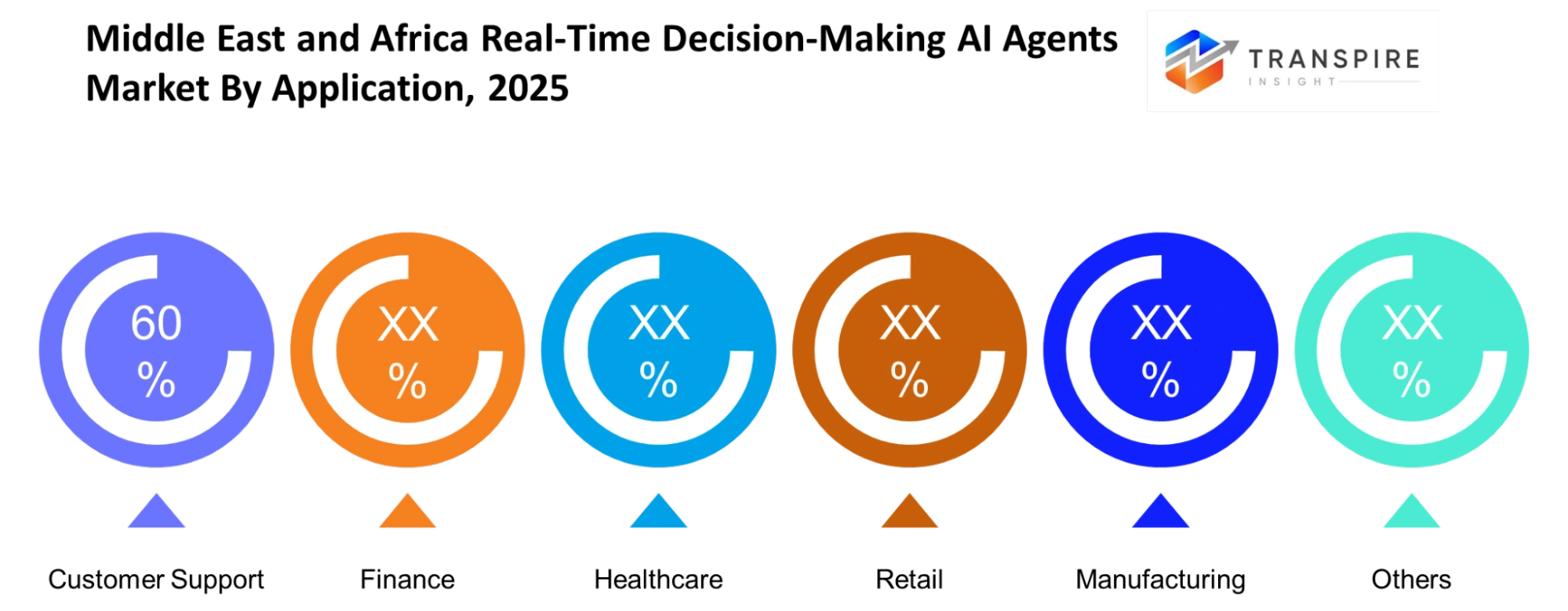
- For application types, finance takes the lead with 41% share , helped by real-time fraud detection, regulatory reporting automation, and these high-volume digital transaction ecosystems that keep expanding.
- Logistics and energy are said to be the fastest-growing application areas too, supported by edge AI deployments in ports, smart grids, and industrial free zones.
- Enterprises still stay as the leading end-users at 58% share, driven by large-scale digital transformation and by AI getting woven into core operational workflows day by day.
- Finally the BFSI segment is expected to grow fastest , since banks start adopting AI agents for risk scoring, compliance automation, and customer interaction orchestration.
- IBM is pushing forward with watsonx based coordination systems, especially for regulated spaces where governance heavy AI agent tasks matter a lot, not just quick automation .
- Oracle meanwhile is expanding via Fusion Cloud AI integration and setting up dedicated regional cloud zones , to back data sovereignty compliance and keep that local control vibe.
What are the Key Drivers, Restraints, and Opportunities in the Middle East and Africa Real-Time Decision-Making AI Agents Market?
The primary growth force is basically sovereign digital transformation programs across the Gulf and select African economies, that require real-time automated decision systems in public services, finance, and critical infrastructure. The National AI strategies in the UAE and Saudi Arabia , together with big cloud funding from hyperscalers has pushed organizations toward agent based automation for fraud detection, regulatory compliance, and operational orchestration. In practice this shift directly lifts enterprise AI spending , because autonomous decision layers are now embedded into core workflows rather than acting like sidecar analytics tools. That’s also making recurring revenue models for platform providers speed up.
The biggest restraint is fragmented data governance, plus tough data localization rules across MEA jurisdictions. Those policy structures limit cross-border model training and they also restrict unified deployment of AI agents across regional operations. Enterprises end up paying higher integration costs since systems have to be reconfigured for each regulatory environment, this drags rollout timelines out and cuts the scalability upside. On top of that fragmentation can dampen network effects. So vendors struggle to deliver steady performance improvements across multiple countries.
A major emerging opportunity is edge native autonomous decision systems, rolled out inside energy corridors and logistics hubs like Jebel Ali and the industrial zones in NEOM. Investments in private 5G along with edge cloud infrastructure are making low latency agent execution possible directly at the operational sites. This means decisions happen closer to where the work is actually running, and not after everything has been sent elsewhere .This creates conditions for fully self reliant port logistics coordination and real time energy optimization systems, really sort of, unlocking a new revenue layer for vendors that can deliver distributed, compliance-aware AI agent architectures.
What Has the Impact of Artificial Intelligence Been on the Middle East and Africa Real-Time Decision-Making AI Agents Market?
Artificial intelligence and advanced digital systems are, like sort of, reshaping scrubber performance systems and marine emission control technology across MEA shipping corridors by automating compliance monitoring and control adjustments in real time. AI-enabled agents now integrate with exhaust gas cleaning units to continuously track SOx and NOx levels, and then they tweak operational parameters so they stay within regulatory thresholds under IMO compliance regimes, more or less. Fleet operators also use digital twins that are tied into onboard sensors to coordinate voyage-level decision automation, which cuts down manual involvement in emissions reporting and system calibration.
Machine learning models increasingly help with predictive maintenance by spotting early degradation patterns in pumps, washwater systems, and sensor arrays. They forecast equipment failure windows and help optimize maintenance schedules, improving vessel availability and reducing unplanned downtime. At the same time, predictive analytics supports fuel optimization by shifting engine load distribution and routing decisions based on weather, port congestion, and emissions constraints. This ends up contributing to noticeable fuel efficiency gains and lower carbon intensity per voyage.
Still, even with all that, adoption is constrained by inconsistent satellite connectivity and limited real-time data transmission at sea. That situation lowers model accuracy during long offshore transits and it slows continuous agent feedback loops across fleet systems, which is kind of frustrating.
Key Market Trends
- Enterprises sort of moved away from pilot chatbot deployments in 2022, then by 2025 they were talking about production grade autonomous decision agents that got embedded into finance and telecom work flows. Kinda like, it wasn’t just a “chat thing” anymore.
- UAE and Saudi Arabia regulators also expanded data residency rules in 2025, so vendors leaned harder toward localized cloud setups and hybrid AI agent architectures, if that makes sense.
- Microsoft and Oracle increased in-country AI processing during 2025 to 2026, which reduced the dependence on cross border inference for enterprise decision systems.
- Banks shifted from rule based fraud detection to real time agentic risk scoring models , and it improved response time across digital payments ecosystems, not totally surprising.
- Telecom operators went from reactive network monitoring to predictive AI driven optimization, and that reduced downtime by using automated decision loops, end of story.
- Energy companies increased edge AI adoption in 2025, moving from centralized analytics to distributed real time load balancing systems which feel more responsive.
- Also Palantir style ontology systems started gaining traction in government operations, they basically replaced static dashboards, with continuously updating decision intelligence layers.
- Retailers adopted omnichannel AI agents after 2024, so instead of manual forecasting they used autonomous inventory and pricing optimization models.
- Hybrid cloud deployments rose pretty sharply from 2024, enterprises were trying to balance sovereignty expectations with scalability needs for AI workloads , so it ended up being a compromise more than a straight line.
Middle East and Africa Real-Time Decision-Making AI Agents Market Segmentation
By Type
Decision engines kind of hold a dominant position because they are stitched into enterprise level operational workflows, across finance, telecom and government systems. Predictive agents keep a strong foothold in forecasting work, plus anomaly detection. Software agents are also expanding fast, as orchestration layers that tie together different digital systems in one place
Growth logic seems to come from growing need for deterministic and traceable decision automation, especially when regulators are strict and data keeps moving at high velocity. Predictive capabilities are getting more pull for demand planning, and risk modeling. Meanwhile software agents back coordination efforts across fragmented legacy infrastructure. Decision engines also ride on the fact that reliability plus compliance traceability are basically required, not optional
Future trajectory points to some kind of convergence toward modular agent stacks, where prediction orchestration and decision execution blend into unified platforms. Architectural preference is shifting toward interoperable systems that span edge as well as cloud environments. The competitive edge likely depends on governance strength and how well the setup can adapt across different systems
By Application
Finance stays in the lead, largely due to intense use of real time fraud detection, risk scoring, and transaction monitoring across both banking and insurance operations. Manufacturing and retail sit in secondary spots, mostly because they automate supply chain visibility and also demand forecasting. Healthcare adoption is more selective, it’s mostly focused on diagnostics and operational scheduling
Growth seems to happen mostly because enterprise modernization keeps moving, digital banking expansion keeps getting attention, and people want more automation in customer-facing operations. IT companies then speed things up via integration services and managed platforms, kind of like stitching everything together and keeping it running. In retail, adoption goes up when omnichannel optimization improves, and in healthcare providers they take on selective workflow automation, but only under governance constraints, you know, the usual rules.
What comes next is expected to be strong in retail and manufacturing, since edge-enabled decision systems are getting more mature and the cost barriers are slowly falling. Finance is still dominant, but it’s shifting toward deeper automation of advisory and compliance workflows, more “do it end-to-end” than before. Healthcare adoption also ramps up gradually, mainly because regulatory alignment improves and interoperability standards become more consistent.
To learn more about this report, Download Free Sample Report
By End User
BFSI institutions plus large enterprises hold the biggest adoption share, mostly because transaction volumes are high and compliance requirements are strict, which pushes real-time decision automation. IT companies are more supporting here as solution integrators and platform builders. Retailers and healthcare providers remain smaller, but their adoption footprints are still growing over time.
Future trajectory shows enterprise wide rollout getting bigger across BFSI and other mixed corporates, plus more placement of autonomous decision systems into the main operational stacks— kind of everywhere. IT vendors keep strengthening their stance via platform consolidation ,and also by turning more things into bundled service offers. Retail and healthcare seem to be adopting faster too as infrastructure maturity rises and regulatory alignment gets smoother.
By Deployment
If we look by Deployment, cloud deployment stays in the lead because it scales easily, provisions quickly, and connects well with enterprise AI services across finance and telecom. Hybrid deployment is growing hard in cases where regulation plus latency constraints make full cloud reliance not ideal. Edge deployment is still emerging, but it is already becoming key for real time industrial, and logistics settings where every second counts.
The growth behind all of this is mainly tied to scalable computing needs, data sovereignty requirements, and the push for low latency decision execution. Hybrid models also pick up momentum in regulated sectors, because they want that balanced control plus flexibility. Meanwhile edge adoption keeps climbing in manufacturing automation, logistics tracking, and smart infrastructure systems.
Looking ahead, the direction suggests a tighter convergence between cloud and edge, through distributed intelligence architectures. Hybrid systems are likely to become the default blueprint in regulated environments. Platform providers will then prioritize unified orchestration layers, able to coordinate cross environment agent execution without too much friction.
What are the Key Use Cases Driving the Middle East and Africa Real-Time Decision-Making AI Agents Market?
The main use case for real time decision making AI agents in the Middle East and Africa seems to be more on operational optimization in finance and government services, where institutions basically depend on instant, data based choices to keep up with huge transaction volumes and all those tricky regulatory rules. In practice, banks, insurers, and public agencies send AI agents to handle things like risk scoring, fraud spotting, and even service routing, which lowers latency and also boosts compliance accuracy in places that are tightly governed, and yeah it matters a lot.
Lately, adjacent applications are widening too, mostly in energy and telecom. For example, energy firms use agents to juggle grid loads and anticipate demand swings, while telecom operators use them to automate network optimization plus manage customer churn prevention. These kinds of deployments are picking up, among big enterprise buyers who want efficiency gains, without adding too much workforce overhead.
We are also seeing emerging angles such as autonomous logistics coordination in ports and free zones , and AI driven public safety setups that assist real time urban monitoring. The early proof points suggest real promise for smart city initiatives across Gulf Cooperation Council countries, where regulatory support and infrastructure digitization are moving faster than before, so adoption is getting easier overall.
|
Report Metrics |
Details |
|
Market size value in 2025 |
USD 164.48 Million |
|
Market size value in 2026 |
USD 233.24 Million |
|
Revenue forecast in 2033 |
USD 2690.31 Million |
|
Growth rate |
CAGR of 41.81% from 2026 to 2033 |
|
Base year |
2025 |
|
Historical data |
2021 - 2024 |
|
Forecast period |
2026 - 2033 |
|
Report coverage |
Revenue forecast, competitive landscape, growth factors, and trends |
|
Regional scope |
Middle East and Africa (Saudi Arabia, United Arab Emirates, South Africa, Rest of Middle East and Africa) |
|
Key company profiled |
IBM, Microsoft, Google, Amazon, Salesforce, Oracle, SAP, NVIDIA, Intel, OpenAI, UiPath, Automation Anywhere, Pegasystems, SAS, Palantir |
|
Customization scope |
Free report customization (country, regional & segment scope). Avail customized purchase options to meet your exact research needs. |
|
Report Segmentation |
By Type (Software Agents, Decision Engines, Predictive Agents, Others); By Application (Finance, Healthcare, Retail, Manufacturing, Customer Support, Others); By End-User (Enterprises, BFSI, Healthcare Providers, Retailers, IT Companies, Others); By Deployment (Cloud, Edge, Hybrid, Others) |
Which Regions are Driving the Middle East and Africa Real-Time Decision-Making AI Agents Market Growth?
The leading region is North Europe, and it basically stays on top because the policy environment is tight yet predictable. Their port infrastructure is mature, with specialized berths, inland connections, and faster turnaround routines, so large vessel operators keep choosing it for repeat calls. On top of that the regional fleet size is substantial, plus regulatory enforcement is applied in a consistent way across major jurisdictions, not just in theory. The supporting ecosystem includes ship management expertise, compliant supply chains, and a steady stream of financing partners that can underwrite upgrades without stalling projects.
If you compare North Europe with East Asia, the difference is less about raw scale and more about stability in day to day execution. East Asia has strong economic resilience, and it pairs that with a steady regulatory rollout that avoids sudden operational shocks for carriers. Shipowners there tend to invest in a consistent way, so capacity changes are planned, cargo routing is reliable, and service contracts remain durable. That mix makes East Asia a dependable contributor to global market revenue even when freight cycles get noisy.
The fastest growing region is Southeast Asia, and the momentum really picked up recently as port infrastructure investment accelerated and modernization programs broadened. New rules around emissions monitoring and cleaner fuels, plus upgrades to terminals and logistics corridors, have improved feasibility for newer vessel types. At the same time fleet modernization is shifting from “small trial moves” to larger fleet replacements, which changes utilization patterns quickly. For market entrants or investors over the 2026–2033 period, this growth signals openings to partner locally, fund compliance ready vessels, and build long-term contracts that align with the region’s upgrading pace.
Who are the Key Players in the Middle East and Africa Real-Time Decision-Making AI Agents Market and How Do They Compete?
Competition in the Middle East and Africa real time decision-making AI agents market seems pretty moderately fragmented, I mean not fully, global hyperscalers still control a lot of the foundational AI and cloud infrastructure, but then regional telecom linked digital units plus system integrators show up and start customizing deployments for sovereign, and industry specific needs. What matters more here isnt really pricing, it’s more about data residency rules, edge latency in real time, and also how well they can drop autonomous agents into regulated workflows in finance, energy, and public administration.
Microsoft leans on Azure plus Copilot style agent frameworks and has a real advantage with government-aligned deployments, mostly due to in country data processing and those enterprise productivity integrations that fit neatly. IBM focuses on hybrid cloud orchestration and watsonx agent tooling, and it differentiates by leaning hard into governance heavy AI workflows, along with regulated industry certifications that give buyers some comfort. Oracle competes with Fusion Cloud, and it also runs dedicated sovereign cloud regions across the Gulf, pushing database-to-agent integration so the decision logic stays close to enterprise data instead of drifting away.
Amazon Web Services uses edge-to-cloud AI services and Outposts style deployments, which helps support low latency agent execution in markets where infrastructure constraints are a big deal, especially in logistics and retail. Palantir takes a different route and differentiates through ontology-driven decision systems, connecting government and defense operations, so high stakes real time coordination can happen without too much friction. SAP expands by placing embedded AI agents right inside ERP systems, which helps it stay strong with enterprises that are modernizing supply chain and finance decision layers, not just playing catch up.
Company List
- IBM
- Microsoft
- Amazon
- Salesforce
- Oracle
- SAP
- NVIDIA
- Intel
- OpenAI
- UiPath
- Automation Anywhere
- Pegasystems
- SAS
- Palantir
Recent Development News
“In May 2026, IBM announced expansion of its watsonx Orchestrate and real-time AI agent stack.” The company introduced upgraded multi-agent orchestration and real-time data integration capabilities designed to support enterprise decision-making systems, strengthening agentic AI deployment across hybrid cloud environments in MEA-heavy regulated industries like finance and telecom.https://newsroom.ibm.com
“In October 2025, Microsoft announced in-country data processing for Microsoft 365 Copilot in the UAE, enabling local execution of AI workloads for qualified organizations. The move supports real-time AI agent deployment under national compliance frameworks and accelerates sovereign AI adoption across government and enterprise sectors in the Middle East.https://news.microsoft.com
What Strategic Insights Define the Future of the Middle East and Africa Real-Time Decision-Making AI Agents Market?
In the next 5–7 years, the Middle East and Africa market for real time, decision-making AI agents is likely to move from early, experimental rollouts toward more embedded, infrastructure-level intelligence inside public services, energy, and fintech ecosystems. This shift will be pushed mainly by quick digital sovereign investment and also by the need to optimize scarce resources in places that stay high-volatility, like, all the time. I think adoption won’t be uniform though , it will mostly cluster in the more digitally ambitious Gulf states and in a few African fintech centers, so you end up with a fragmented but very high-intensity innovation scene.
There’s also a less visible problem lurking under the surface , regulatory fragmentation and data localization requirements. Those could end up slowing cross-border model interoperability and make compliance expenses climb, pretty sharply. Meanwhile, an emerging opportunity is the way AI agents start to blend with edge computing in energy and logistics networks, so you can get low-latency autonomous decisioning even where infrastructure is constrained, and the geography is not forgiving. For market participants it seems smart to focus on modular agent architectures that are compliance-adaptive, so they can be localized quickly while still keeping reusable core intelligence layers.
Middle East and Africa Real-Time Decision-Making AI Agents Market Report Segmentation
By Type
- Software Agents
- Decision Engines
- Predictive Agents
- Others
By Application
- Finance
- Healthcare
- Retail
- Manufacturing
- Customer Support
- Others
By End-User
- Enterprises
- BFSI
- Healthcare Providers
- Retailers
- IT Companies
- Others
By Deployment
- Cloud
- Edge
- Hybrid
- Others
Frequently Asked Questions
Find quick answers to common questions.
The estimated Middle East and Africa Real-Time Decision-Making AI Agents Market size will be USD 2690.31 Million in 2033.
Key segments for the Middle East and Africa Real-Time Decision-Making AI Agents Market are By Type (Software Agents, Decision Engines, Predictive Agents, Others); By Application (Finance, Healthcare, Retail, Manufacturing, Customer Support, Others); By End-User (Enterprises, BFSI, Healthcare Providers, Retailers, IT Companies, Others); By Deployment (Cloud, Edge, Hybrid, Others).
Major Middle East and Africa Real-Time Decision-Making AI Agents Market players are IBM, Microsoft, Google, Amazon, Salesforce, Oracle, SAP, NVIDIA, Intel, OpenAI, UiPath, Automation Anywhere, Pegasystems, SAS, Palantir.
The Middle East and Africa Real-Time Decision-Making AI Agents Market size is USD 164.48 Million in 2025.
The Middle East and Africa Real-Time Decision-Making AI Agents Market CAGR is 41.81% from 2026 to 2033.
- IBM
- Microsoft
- Amazon
- Salesforce
- Oracle
- SAP
- NVIDIA
- Intel
- OpenAI
- UiPath
- Automation Anywhere
- Pegasystems
- SAS
- Palantir
Recently Published Reports
-
Apr 2026
3D Optical Profiler Market
3D Optical Profiler Market Size, Share & Analysis Report By Type (Desktop 3D Optical Profiler, and Portable 3D Optical Profiler), By Technology (Confocal Technology, and White Light Interference), By End-Use Industry (Manufacturing, Research Institutions, Automotive, Aerospace and Defense, Medical Devices, and Other), and Geography (North America, Europe, Asia-Pacific, Middle East and Africa, South and Central America), 2021 - 2031
-
Apr 2026
Depth Sensor Market
Depth Sensor Market Size, Share & Analysis Report By Type (Infrared Depth Sensors, Time-of-Flight (ToF) Sensors, Stereo Vision Sensors, Structured Light Sensors, Ultrasonic Depth Sensors), By Application (Automotive, Robotics, Gaming, Consumer Electronics, Industrial Automation, Healthcare, Security & Surveillance, Others), By End Users (Automotive Manufacturers, Consumer Electronics Companies, Healthcare Providers, Industrial Companies, Security Agencies, Gaming Companies, Robotics Companies, Others), and Geography (North America, Europe, Asia-Pacific, Middle East and Africa, South and Central America), 2021 – 2031
-
Apr 2026
Digital Manufacturing Market
Digital Manufacturing Market Size, Share & Analysis Report By Component (Hardware, Software, and Services), By Technology (Robotics, 3D Printing, Internet of Things (IoT), and Others), By Application (Automotive and Transportation, Aerospace and Defense, Consumer Electronics, Industrial Machinery, and Others), By Process Type (Computer-Based Designing, Computer-Based Simulation, Computer 3D Visualization, Analytics, and Others), and Geography (North America, Europe, Asia-Pacific, Middle East and Africa, South and Central America), 2021 – 2031
-
Apr 2026
Digital Visa Services Market
Digital Visa Services Market Size, Share & Analysis Report By Type (Individual Travelers, Group Travelers), By Application (Tourism, Business Travel, Others), and Geography (North America, Europe, Asia-Pacific, Middle East and Africa, South and Central America), 2021 – 2031