

Additive Manufacturing and Materials Market Summary:
According to Transpire Insights, a detailed research report on the market reflects that the polymers material segment dominates the global Additive Manufacturing and Materials Market, accounting for approximately 55% of the total market share in 2025. Mordor Intelligence Stratasys Ltd. leads the market with approximately USD 551.1 million in annual revenue in 2025 and an estimated 20–25% market share, making it a leading contributor to additive manufacturing market development, innovation, advanced 3D printing materials and technology, expanded manufacturing capabilities, and overall market growth dynamics.
Market Snapshot
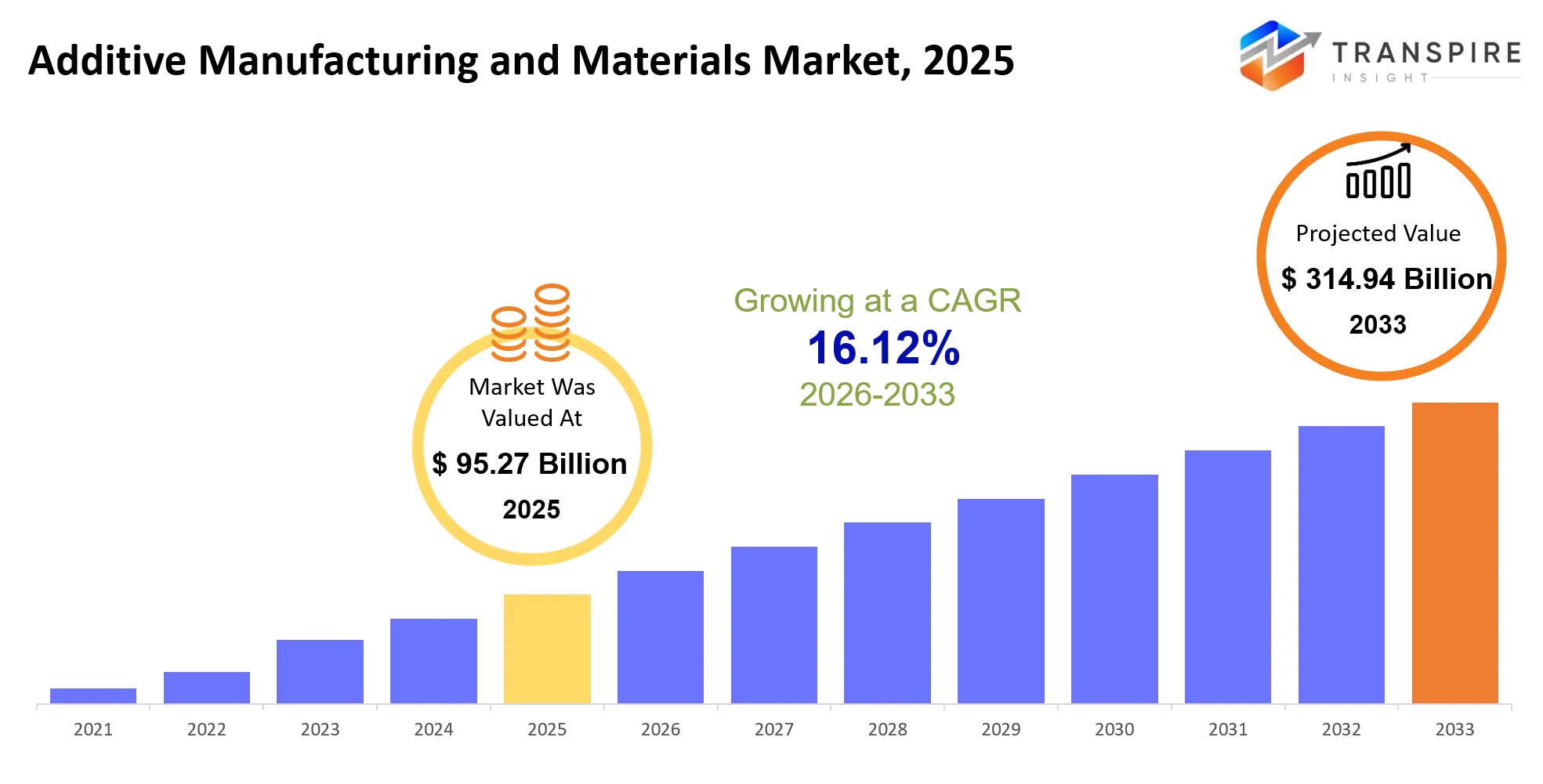
- Global Market Value (2025): USD 95.27 Billion.
- Expected Market Value (2026): USD 110.63 Billion.
- Estimated Market Value (2033): USD 314.94 Billion.
- Forecast CAGR (2026–2033): 16.12%
- Leading Region in 2025: North America
- Second-largest Region: Asia Pacific
- Fastest Growing Region: Europe
Introduction
The Additive Manufacturing and Materials Market is the worldwide market for the technologies, systems, services, and raw materials involved in creating physical items using the layering technique of additive manufacturing from digital representations. Additive Manufacturing (AM) defined by the ISO/ASTM 52900 standard as "the fabrication of objects through the sequential addition of material layers," as opposed to the removal (subtractive) techniques like traditional CNC machining and the shaping process (formative) like injection molding. Although more commonly referred to as 3D Printing, reports generally use "Additive Manufacturing" for its commercial significance. Additive Manufacturing & Materials Markets are greatly benefited by design flexibility, part consolidation, efficient use of material, rapid prototyping, and customization. Industrial 3D printing technology allows manufacturers to manufacture complex lattice structures and geometries that are hard to manufacture with traditional machining or casting methods. Part consolidation helps in saving the number of parts, weight, assembly time, and possible failure points. In layer-by-layer building technique, wastage of material is minimized as compared to subtractive manufacturing process. Moreover, the direct production from computer aided design helps in accelerating the prototyping process and reducing the need for tooling.
For instance:-
The Additive Manufacturing and Material market in North America is seeing tremendous growth, due to substantial investment in R&D and heavy funding by the government. The investment is mainly centered on the development of lightweight aircraft, medical devices, and electric vehicles.
Market Highlights: -
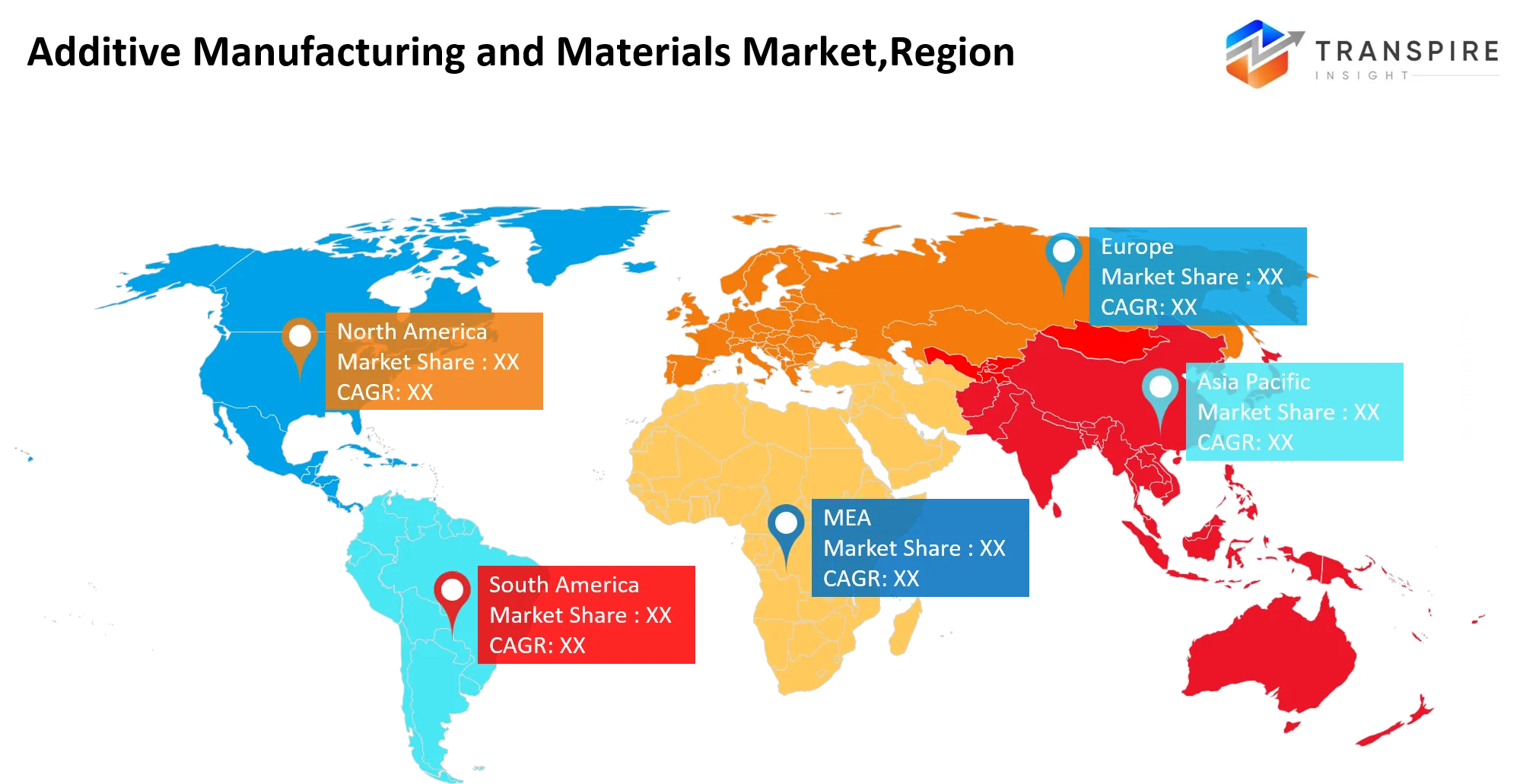
- North America is anticipated to hold roughly 40% share of the Additive Manufacturing and Materials Market over the predicted timeframe.
- Asia Pacific is expected to grow at a rapid CAGR in the Additive Manufacturing and Materials Market by holding roughly35% of the share during the forecast period.
- Europe is anticipated to hold roughly25% share of the Additive Manufacturing and Materials Market over the predicted timeframe.
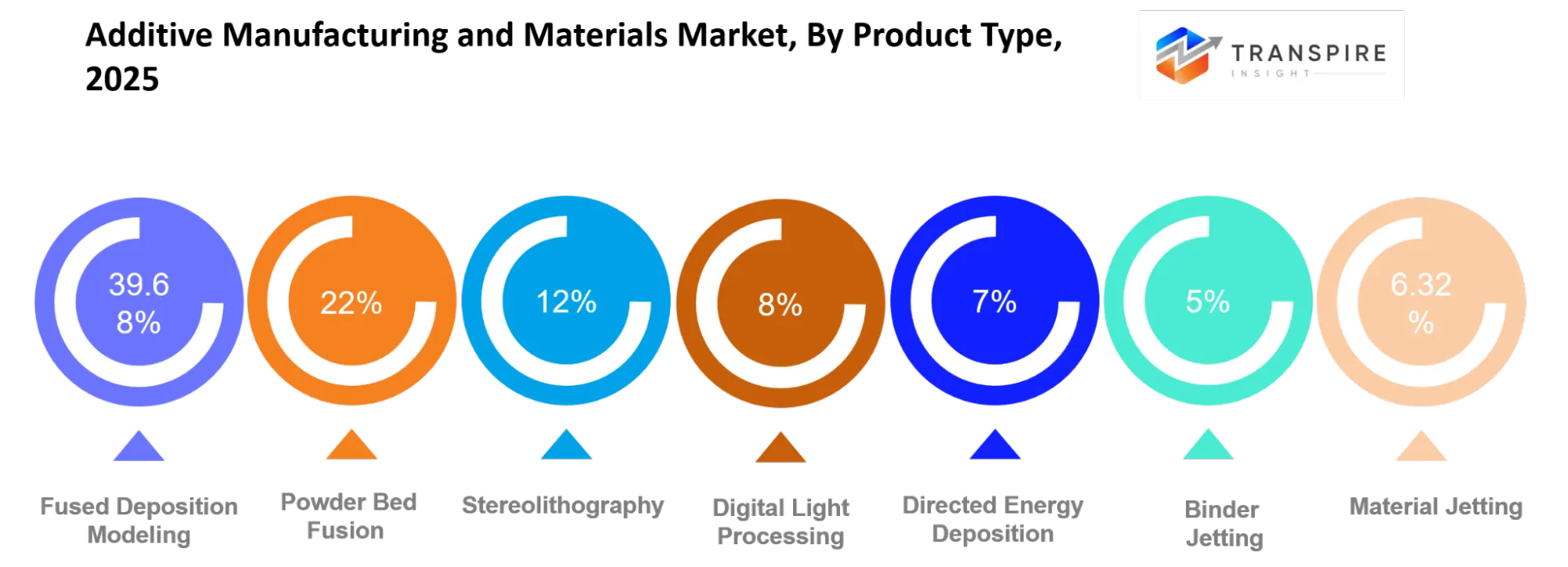
- By technology, the Fused Deposition Modeling segment dominated the market and holds nearly 39% share in 2025 and is projected to grow at a substantial CAGR during the forecast period.
- By application, the Prototyping segment dominated the market and holds nearly 45% share in 2025 and is projected to grow at a substantial CAGR during the forecast period.
- By end user, the Automotive segment dominated the market and holds nearly 20% share in 2025 and is projected to grow at a substantial CAGR during the forecast period.
- The NAMS 2026 event brought advancements to India’s additive manufacturing landscape through product launch, strategic partnerships, defense applications, and deliberations on advanced materials.
How is Technology Driving Growth in the Additive Manufacturing and Materials Market?
The Additive Manufacturing & Materials Market is moving forward using advanced printers, AI-driven software solutions, hybrid manufacturing, and advanced materials. The Additive Industrial PBF, DED, and multi-material technologies provide more complicated geometries, large-size repairs, and precise manufacturing. AI-based generative design, simulation, digital twins, and cloud technologies provide optimized design and material deposition, as well as defect detection in order to improve the manufacturing process. Hybrid manufacturing combines additive manufacturing with 5-axis CNC machining in order to obtain better tolerances and better surface finish. At the same time, such advanced materials as advanced plastics, carbon fiber reinforced materials, conductive copper powders, and aerospace titanium alloys are being used in additive manufacturing.
|
Report Metrics |
Details |
|
Market size value in 2025 |
USD 95.27 Billion |
|
Market size value in 2026 |
USD 110.63 Billion |
|
Revenue forecast in 2033 |
USD 314.94 Billion |
|
Growth rate |
CAGR of 16.12% from 2026 to 2033 |
|
Base year |
2025 |
|
Historical data |
2021 - 2024 |
|
Forecast period |
2026 - 2033 |
|
Report coverage |
Revenue forecast, competitive landscape, growth factors, and trends |
|
Regional scope |
United States; Canada; Mexico; United Kingdom; Germany; France; Italy; Spain; Denmark; Sweden; Norway; China; Japan; India; Australia; South Korea; Thailand; Brazil; Argentina; South Africa; Saudi Arabia; United Arab Emirates |
|
Key company profiled |
Stratasys, 3D Systems, EOS, Materialise, GE Additive, HP, Desktop Metal, Nikon SLM Solutions, Markforged, Renishaw, ExOne, Formlabs, Velo3D, Carbon, Ultimaker |
|
Customization scope |
Free report customization (country, regional & segment scope). Avail customized purchase options to meet your exact research needs. |
|
Report Segmentation |
By Technology (Fused Deposition Modeling, Powder Bed Fusion, Stereolithography, Digital Light Processing, Directed Energy Deposition, Binder Jetting, Material Jetting, Others); By Material (Plastics, Metals, Ceramics, Composites, Resins, Wax, Biomaterials, Others); By Application (Prototyping, Tooling, Production Parts, Medical Devices, Aerospace Components, Automotive Parts, Consumer Products, Others); By End User (Aerospace & Defense, Automotive, Healthcare, Industrial Machinery, Consumer Products, Construction, Education & Research, Others); By Printer Type (Desktop, Industrial, Large-format, Metal, Polymer, Ceramic, Hybrid, Others); By Process (Extrusion, Vat Photopolymerization, Powder Bed Fusion, Material Jetting, Binder Jetting, Sheet Lamination, Directed Energy Deposition, Others); By Enterprise Size (Large Enterprises, SMEs, Startups, Research Institutes, Universities, Government, Contract Manufacturers, Others) |
Market Drivers
In addition, the Additive Manufacturing and Materials Market is fueled by the growing demand for lightweight and complicated components in the aerospace and automotive sectors that contribute to fuel economy and low emissions. The healthcare sector personalization trend is helping drive greater acceptance of AM technologies through customized implants, restorations, and medical devices. Defense-related applications are growing due to the ability to make use of 3D printing on-demand, which can help manufacture spare parts locally. The falling cost of materials and technologies is enabling the move from prototype fabrication to industrial manufacturing. In addition, the goal of sustainability is driving the need for recycled materials such as metal powder and polymers. Additive Manufacturing and Materials Market is quite advantageous because of efficient utilization of materials, design freedom, customizations, and improved supply chains. Layered formation of objects in the additive manufacturing process significantly decreases wastage of material as opposed to conventional subtractive manufacturing processes, thus providing cost-efficiency and sustainable manufacturing practices. With 3D printing technology, it is possible to create intricate lattices, honeycomb structures, and consolidated parts, which are not easy to be created using the conventional methods. Moreover, additive manufacturing is quite useful for creating customized products, personalized implants for medical use, and industrial tools without much requirement for tooling.
For Instance: -
- The Russian additive manufacturing and materials market is expanding due to the development of its manufacturing industry. Investments into 3D printing and metal powders are made by the government driven by the demand for aerospace, defense, and local production requirements.
- There is huge growth within South Africa's additive manufacturing and materials market due to the contribution made by industries such as aerospace, medical, and automotive industries. South Africa is fast becoming a key advanced manufacturing nation within Africa due to continuous government funding and increased private investments into 3D printing.
Restrain
Some of the obstacles to the Additive Manufacturing and Materials market include high prices of advanced feedstock material for polymers and metal powder, volatile supply chains, and threats related to intellectual property in digital files. The stringent regulations regarding environment, health, and safety require companies to comply with numerous restrictions, whereas large expenditures on equipment and materials may prevent SMEs from adopting AM technologies.
|
Driver |
Relative Impact on Growth (%) |
Geographic Relevance |
Impact Timeline |
Demand Strength |
Growth Mechanism |
Key Beneficiaries |
Major Constraint |
|
1. Rising Adoption of Industrial 3D Printing |
27% |
North America, Europe, Asia-Pacific |
Short-term |
High |
Accelerates production, tooling, prototyping, and customized manufacturing |
Printer manufacturers, material suppliers, AM service providers, industrial users |
High equipment costs restrict SME adoption |
|
2. Growing Aerospace & Defense Applications |
23% |
North America, Europe, Asia-Pacific |
Medium-term |
High |
Enables lightweight components, complex geometries, repairs, and localized production |
Aerospace OEMs, defense contractors, metal AM providers, powder suppliers |
Certification requirements extend production qualification cycles |
|
3. Advanced Materials & High-Performance Feedstocks |
19% |
North America, Europe, Asia-Pacific |
Medium-term |
High |
Expands applications through stronger, lighter, temperature-resistant materials |
Material producers, printer vendors, aerospace, automotive, healthcare manufacturers |
High costs and limited material availability constrain adoption |
|
4. AI, Generative Design & Process Automation |
17% |
North America, Europe, Asia-Pacific |
Long-term |
High |
Optimizes designs, detects defects, improves productivity, and reduces material waste |
Software vendors, printer manufacturers, engineering firms, manufacturers |
Integration complexity and limited skilled workforce |
|
5. Sustainable & Localized Manufacturing |
14% |
Europe, North America, Asia-Pacific |
Long-term |
Medium |
Reduces material waste, inventories, transportation needs, and supply-chain dependence |
Manufacturers, contract producers, material recyclers, end users |
Recycling standards and feedstock consistency remain challenging |
Analysis of Prices and Consumer Behaviour
In the market of Additive Manufacturing and Materials, plastics represent the most dominating share with an estimated 55.12% of the market share in 2025 owing to the increasing demand for applications like prototyping, tooling and production. High Performance Thermoplastics (HPTPs) are forecast to register a CAGR of 17.62% through 2031 driven by rising demand for thermal properties and flame smoke toxicity compliance. Around 39.68% of the total market was held by Fused Deposition Modeling (FDM) in 2025 owing to its extensive application in applications ranging from prototyping to manufacturing. Aerospace & Defense contributed to around 54.90% of the total market value in 2025 owing to the rising use of lightweight and performance demanding components. Purchasing considerations include material performance, dimensional accuracy, process capability, certifications and production consistencies; industrial customers seek qualified sellers, procurement agreements and manufacturing capabilities.
|
Investment Factor |
Why It Matters to Investors |
Opportunity |
Investment Implication |
|
Industrial Production Expansion |
Production adoption expands recurring industrial demand |
Tooling, fixtures, production parts, digital manufacturing |
Medium-term investment opportunity in scalable production platforms |
|
Advanced Materials Development |
Performance materials unlock higher-value applications |
Metal powders, high-performance polymers, composites, ceramics |
Long-term opportunity across specialized material supply chains |
|
Aerospace & Defense Adoption |
Mission-critical applications support qualified production demand |
Lightweight components, spare parts, repair, defense manufacturing |
Medium-to-long-term opportunity in certified AM solutions |
|
AI, Automation & Digital Manufacturing |
Automation improves productivity, quality, and process consistency |
AI optimization, process monitoring, digital twins, software |
Long-term opportunity in software-enabled AM ecosystems |
|
Healthcare & Customized Manufacturing |
Personalization supports specialized, higher-value applications |
Implants, prosthetics, dental devices, patient-specific components |
Medium-to-long-term opportunity in regulated medical applications |
|
Localized & Sustainable Manufacturing |
Distributed production reduces supply-chain dependencies |
On-demand production, recycled materials, regional AM services |
Long-term opportunity in resilient manufacturing networks |
Who are the Key Players in the Additive Manufacturing and Materials Market and how do they compete?
The competitiveness of the international market of additive manufacturing and materials is possible due to the presence of companies specializing in innovative printing technologies, materials, solutions tailored to specific industries, and creation of global manufacturing networks. Not only competing through their technological capabilities but also with the help of precise systems, modern metals and polymers, software integration, automation, and production scalability, such a competitive strategy will bring about continual development of products and allow for more flexibility, efficiency, and optimal costs in manufacturing.
Stratasys strengthens its market position through the development of biomaterials advanced industrial 3D printing systems and metal additive manufacturing technologies. 3D Systems stands out among its competitors through the development of high-performance metal additive manufacturing systems aimed at aerospace, automotive, medical, and industrial purposes. EOS creates its competitive advantage through integrated polymer and metal additive manufacturing solutions, advanced materials, and production technologies for industrial manufacturing.
Top Companies in the Additive Manufacturing and Materials Market
- Stratasys
- 3D Systems
- EOS
- Materialise
- GE Additive
- HP
- Desktop Metal
- Nikon SLM Solutions
- Markforged
- Renishaw
- ExOne
- Formlabs
- Velo3D
- Carbon
- Ultimaker
|
Company |
Est. Revenue Share Range |
Key Offerings |
Strategic Positioning |
Geographic Strength |
Technology Focus |
|
Stratasys |
1.0–2.0% |
FDM, PolyJet, SAF, P3, industrial polymers, materials, software, services |
Diversified polymer AM platform with enterprise focus |
North America, Europe, Asia-Pacific |
FDM, PolyJet, SAF, P3, connected software ecosystem |
|
3D Systems |
0.8–1.5% |
SLA, SLS, DMP, Figure 4, materials, healthcare solutions, services |
Broad technology portfolio with application specialization |
North America, Europe, Asia-Pacific |
SLA, SLS, metal PBF, DLP, healthcare AM |
|
EOS |
0.8–1.4% |
Metal and polymer systems, metal powders, materials, software, services |
Integrated industrial metal and polymer solutions provider |
Europe, North America, Asia-Pacific |
Laser powder-bed fusion and industrial polymer AM |
|
HP |
0.5–1.0% |
Multi Jet Fusion, Metal Jet, polymer materials, industrial printing systems |
Industrial scale-up through productivity and cost efficiency |
North America, Europe, Asia-Pacific |
Multi Jet Fusion, Metal Jet, agent-based printing |
|
Materialise |
0.3–0.7% |
Magics, CO-AM, Mimics, 3D printing services, medical software |
Software-led ecosystem and specialized AM services |
Europe, North America, Asia-Pacific |
AM software, build preparation, workflow automation |
|
Nikon SLM Solutions |
0.3–0.7% |
NXG XII 600, NXG 600E, metal AM services, software |
Large-format metal AM and production-scale specialization |
Europe, North America, Asia-Pacific |
Multi-laser metal PBF and large-format printing |
|
Renishaw |
0.3–0.6% |
RenAM 500 systems, TEMPUS, metal materials, AM software, services |
Precision engineering and end-to-end metal AM |
Europe, North America, Asia-Pacific |
Metal PBF, process monitoring, automation, metrology |
|
Formlabs |
0.3–0.6% |
Form 4, Form 4L, Fuse SLS systems, resins, powders |
Accessible professional AM with integrated materials ecosystem |
North America, Europe, Asia-Pacific |
SLA, SLS, automated workflows, advanced materials |
|
Markforged |
0.15–0.35% |
FX-series, Metal X, industrial composites, metal materials, software |
Industrial composite and metal manufacturing specialization |
North America, Europe, Asia-Pacific |
Continuous-fiber composites, metal extrusion, cloud software |
|
Desktop Metal |
0.15–0.35% |
Shop System, Studio System, X-Series, ExOne platforms, PureSinter |
Binder-jetting specialization for scalable production applications |
North America, Europe, Asia-Pacific |
Metal binder jetting, DLP, sintering, ceramics |
Market Segmentation
The Additive Manufacturing and Materials Market share is divided into seven categories: By technology, material, application, end user, printer, process and enterprise size.
The Fused Deposition Modeling dominated the market, accounting for nearly 39% in 2025 and is expected to rise at a significant CAGR during the forecast period.
The Additive Manufacturing and Materials Market is segmented by technology into Fused Deposition Modeling, Powder Bed Fusion, Stereolithography, Digital Light Processing, Directed Energy Deposition, Binder Jetting, Material Jetting, Others. Among these, the Fused Deposition Modeling segment dominated the market, accounting for nearly 39% in 2025 and expected to increase at a significant CAGR during the forecast period. Fused Deposition Modeling (FDM) held a leading market share of close to 39% in 2025 owing to its economic benefits, material versatility, ease of operation, and application in rapid prototyping and low-volume manufacturing. The use of FDM is gaining momentum in applications such as automotive, aerospace, healthcare, education, and consumer industries.
The Prototyping dominated the market, accounting for nearly 45% in 2025, and is expected to rise at a significant CAGR during the forecast period.
The Additive Manufacturing and Materials Market is segmented ceramics by application into Prototyping, Tooling, Production Parts, Medical Devices, Aerospace Components, Automotive Parts, Consumer Products, Others. Among these, the Prototyping segment dominated the market, accounting for nearly 45% in 2025 and expected to increase at a significant CAGR during the forecast period. Prototyping was the most dominant segment within the industry with an approximate market share of 45 percent in 2025 due to rising need for fast product development, design verification, and testing that is economical. Additive manufacturing helps in quick iteration, complicated geometry, and customization of prototypes in the automotive, aerospace, healthcare, and consumer sectors.
The Automotive dominated the market, accounting for nearly 20% in 2025 and is expected to rise at a significant CAGR during the forecast period.
The Additive Manufacturing and Materials Market is segmented by end user into Aerospace & Defense, Automotive, Healthcare, Industrial Machinery, Consumer Products, Construction, Education & Research, Others. Among these, the Automotive segment dominated the market, accounting for nearly 20% in 2025 and expected to increase at a significant CAGR during the forecast period. The Automotive segment held the highest market share of almost 20% in 2025 on account of the rising use of additive manufacturing technology in the area of rapid prototyping, lightweight components, customizing parts, tooling, and complicated designs of automobiles. Increasing preference for electric vehicles, shortened product development cycle time, and manufacturing optimization are fueling the growth of the market.
Regional Segment Analysis of the Additive Manufacturing and Materials Market:
- North America (U.S., Canada, Mexico)
- Europe (Germany, France, U.K., Italy, Spain, Rest of Europe)
- Asia-Pacific (China, Japan, India, Rest of APAC)
- South America (Brazil and the Rest of South America)
- The Middle East and Africa (UAE, South Africa, Rest of MEA)
North America is the fastest-growing region in the Additive Manufacturing and Materials Market during the period, holding roughly 40% share.
North America is expected to grow at a rapid CAGR in the Additive Manufacturing and Materials Market holding roughly 40% share during the forecast period. Additive Manufacturing and Materials Market in North America is the fastest growing region and it accounts for around 40% of the market, which is fueled by high demand from the aerospace and defense industry, modern automotive manufacturing, health care sector, and heavy investment in industrial 3D printing. Increasing use of metal additive manufacturing, local manufacturing, digital manufacturing, and rapid prototyping is propelling regional market growth.
Asia Pacific is the fastest-growing region in the Additive Manufacturing and Materials Market during the period, holding roughly 35% share.
Asia Pacific is the fastest-growing region in the Additive Manufacturing and Materials Market during the forecast period, holding roughly 35% share during the forecast period. The Asia-Pacific region leads in terms of growth in the Additive Manufacturing and Materials market with about 35% of the market share due to the increase in manufacture of automotive, aerospace, electronics, and health care products. Automation of industries, governments' involvement in advanced manufacturing, growing use of 3D printing technology, and investment in local manufacturing and rapid prototyping have fueled its growth.
Europe is expected to grow at a rapid CAGR in theAdditive Manufacturing and Materials Market, holding roughly 25% of the share during the forecast period.
Europe is expected to grow at a rapid CAGR in the Additive Manufacturing and Materials Market holding roughly 25% share during the forecast period. Europe is projected to record rapid growth in the Additive Manufacturing and Materials Market, representing about 25% market share, due to high demand from aerospace, automotive, healthcare, and industrial manufacturing industries. Growing use of technologies like 3D printing, sustainable manufacturing, light weighting, digital manufacturing, and innovations by government bodies are also aiding market growth.
Strategies for Market Growth in Non-Leading Regions:
Non-leading regions can develop themselves using effective additive manufacturing technologies that are scalable. Local production of 3D-printed parts and additives, as well as setting up regional additive manufacturing facilities, will result in lower dependence on imports and decreased cost of production. The development of strategic alliances with material suppliers, equipment producers, aerospace companies, automobile producers, and industrial distributors will enhance the penetration of additive manufacturing solutions into the market. Training and professional improvement in additive manufacturing processes, material development, quality assurance, and standards of 3D-printed products will be necessary in order to raise the level of awareness about additive manufacturing. Moreover, flexible financial sources, long-term supply contracts, and contract manufacturing will allow making additive manufacturing solutions cheaper and promote them among enterprises. Collaborative initiatives with government, research, and industrial manufacturing activities along with digital marketing will increase access to additive manufacturing technologies and materials.
Future Market Trends for the Additive Manufacturing and Materials Market: -
- Transition to Industrial Maturity: The industry is moving past the era of novelty around rapid prototyping to reliable, repeatable and documented processes for mass production.
- Advanced Materials Development: High-performance metal powders, biocompatible medical polymers and high-temperature refractory alloys are finding their place in aerospace and nuclear industries.
- Artificial Intelligence & Generative Design: Machine Learning software is improving optimization of complicated internal structures, lattices and weight reduction prior to printing a first layer.
- Distributed On-Demand Manufacturing: The defense and manufacturing industries are increasingly employing field-ready, containerized 3D printing technology to print spare parts on-site in hours.
- Hybrid Manufacturing: The combination of layer-based additive manufacturing and CNC machining guarantees complicated internal lattices along with precise surface finishes.
Recent Development
- In March 2026: GE Aerospace made a manufacturing investment worth $1 billion in the U.S., with the expansion of 3D printing capabilities for metals in Cincinnati. This investment is an indication of growth in the additive manufacturing capacity within the aerospace sector. In addition to that, this development indicates advancements in the use of advanced materials.
- In September 2026: Instruct3D developed Additive Build Intelligence which is a platform that uses physics-based optimization, sensors, and analytics to predict and prevent any problems that may arise during the building process of metals in order to enhance the reliability of this process. This technology enhances the process of quality verification, efficiency in manufacturing and use of new materials.
This study forecasts revenue at global, regional and country levels from 2020 to 2033. Transpire Insights has segmented the Additive Manufacturing and Materials Market based on the below-mentioned segments:
Additive Manufacturing and Materials Market, By Technology
- Fused Deposition Modeling
- Powder Bed Fusion
- Stereolithography
- Digital Light Processing
- Directed Energy Deposition
- Binder Jetting
- Material Jetting
- Others
Additive Manufacturing and Materials Market, By Material
- Plastics
- Metals
- Ceramics
- Composites
- Resins
- Wax
- Biomaterials
- Others
Additive Manufacturing and Materials Market, By Application
- Prototyping
- Tooling
- Production Parts
- Medical Devices
- Aerospace Components
- Automotive Parts
- Consumer Products
- Others
Additive Manufacturing and Materials Market, By End User
- Aerospace & Defense
- Automotive
- Healthcare
- Industrial Machinery
- Consumer Products
- Construction
- Education & Research
- Others
Additive Manufacturing and Materials Market, By Printer Type
- Desktop
- Industrial
- Large-format
- Metal
- Polymer
- Ceramic
- Hybrid
- Others
Additive Manufacturing and Materials Market, By Process
- Extrusion
- Vat Photo polymerization
- Powder Bed Fusion
- Material Jetting
- Binder Jetting
- Sheet Lamination
- Directed Energy Deposition
- Others
Additive Manufacturing and Materials Market, By Enterprise Size
- Large Enterprises
- SMEs
- Startups
- Research Institutes
- Universities
- Government
- Contract Manufacturers
- Others
Additive Manufacturing and Materials Market, By Regional Analysis
North America
- US
- Canada
- Mexico
Europe
- Germany
- UK
- France
- Italy
- Spain
- Russia
- Rest of Europe
Asia Pacific
- China
- Japan
- India
- South Korea
- Australia
- Rest of Asia Pacific
South America
- Brazil
- Argentina
- Rest of South America
Middle East & Africa
- UAE
- Saudi Arabia
- Qatar
- South Africa
- Rest of the Middle East & Africa
Frequently Asked Questions
Find quick answers to common questions.
The market is projected to reach USD 314.94 billion by 2033, growing at a 16.12% CAGR during 2026–2033.
Fused Deposition Modeling (FDM) dominates, accounting for nearly 39% share in 2025, driven by affordability and material versatility
Prototyping dominates with approximately 45% share in 2025, supported by rapid product development, design validation, testing, and customization.
North America leads with roughly 40% share, supported by aerospace, defense, automotive, healthcare, and advanced manufacturing investments.
Key players include Stratasys, 3D Systems, EOS, Materialise, GE Additive, HP, Desktop Metal, Renishaw, Formlabs, and Markforged.
- Stratasys
- 3D Systems
- EOS
- Materialise
- GE Additive
- HP
- Desktop Metal
- Nikon SLM Solutions
- Markforged
- Renishaw
- ExOne
- Formlabs
- Velo3D
- Carbon
- Ultimaker
About the Authors

Pankaj Ghogare Patil
I am Pankaj Ghogare Patil, a Senior Research Analyst at Transpire Insight, specializing in the Pharmaceutical, Chemicals & Materials, Healthcare IT, and Biotechnology industry. My expertise lies in conducting comprehensive market research, analyzing industry trends, evaluating competitive landscapes, and translating complex data into actionable insights. At Transpire Insight, I closely follow emerging technologies, regulatory developments, and market innovations to create accurate, well-researched, and informative content that helps businesses and professionals make informed decisions. I am committed to producing credible, evidence-based articles that reflect industry best practices while making technical topics accessible and valuable for a broad audience.

Chakradhar Khansole
Chakradhar serves as the Research Director at Transpire Insight, bringing over 8 years of experience in technology, innovation, and strategic market intelligence. He specializes in transforming complex market data into actionable business insights that enable organizations to make informed, growth-oriented decisions. Recognized for his strategic vision and analytical expertise, Chakradhar leads high-impact research initiatives, delivering comprehensive market assessments, competitive intelligence, and forward-looking industry analysis.
Recently Published Reports
-
May 2026
Healthcare Polymer Packaging Market
Healthcare Polymer Packaging Market Size, Share & Analysis Report By Packaging Type (Syringes, IV Bottles and Pouches, Clamshells, Blisters, Bottles & Jars, Containers, Tubes, IV Parental Packaging, Others), By Type (Regulated, Non-regulated), By Polymer Type (LDPE (Low-Density Polyethylene), HDPE (High-Density Polyethylene), Homo-polymer (Homo), Random Copolymer (Random), Block Copolymer (Block), PET, Polystyrene, Polyvinyl Chloride, Polyamide/EVOH, Others), and Geography (North America, Europe, Asia-Pacific, Middle East and Africa, South and Central America), 2021 - 2031
-
Apr 2026
Hydrophilic Tape (Waterstop) Market
Hydrophilic Tape (Waterstop) Market Size, Share & Analysis Report By Type (Bentonite-Based Hydrophilic Tape, Rubber-Based Hydrophilic Tape), By Application (Residential Buildings, Commercial Buildings, Infrastructure Projects), and Geography (North America, Europe, Asia-Pacific, Middle East and Africa, South and Central America), 2021 - 2031
-
Apr 2026
Metalens Market
Metalens Market Size, Share & Analysis Report By Type (Visible Light Metalens, and Infrared Metalens), By Application (Consumer Electronics, Automotive Electronics, Industrial, Medical, and Others), and Geography (North America, Europe, Asia-Pacific, Middle East and Africa, South and Central America), 2021 - 2031
-
Apr 2026
PBT Resin Market
PBT Resin Market Size, Share & Analysis Report By Type (Reinforced PBT Resin, Unreinforced PBT Resin), By Processing Method (Injection Molding, Extrusion, Blow Molding, Others), By End-User (Automotive, Electrical & Electronics, Consumer Appliances, Industrial Machinery, Medical Devices, Packaging, Others), and Geography (North America, Europe, Asia-Pacific, Middle East and Africa, South and Central America), 2021 - 2031