
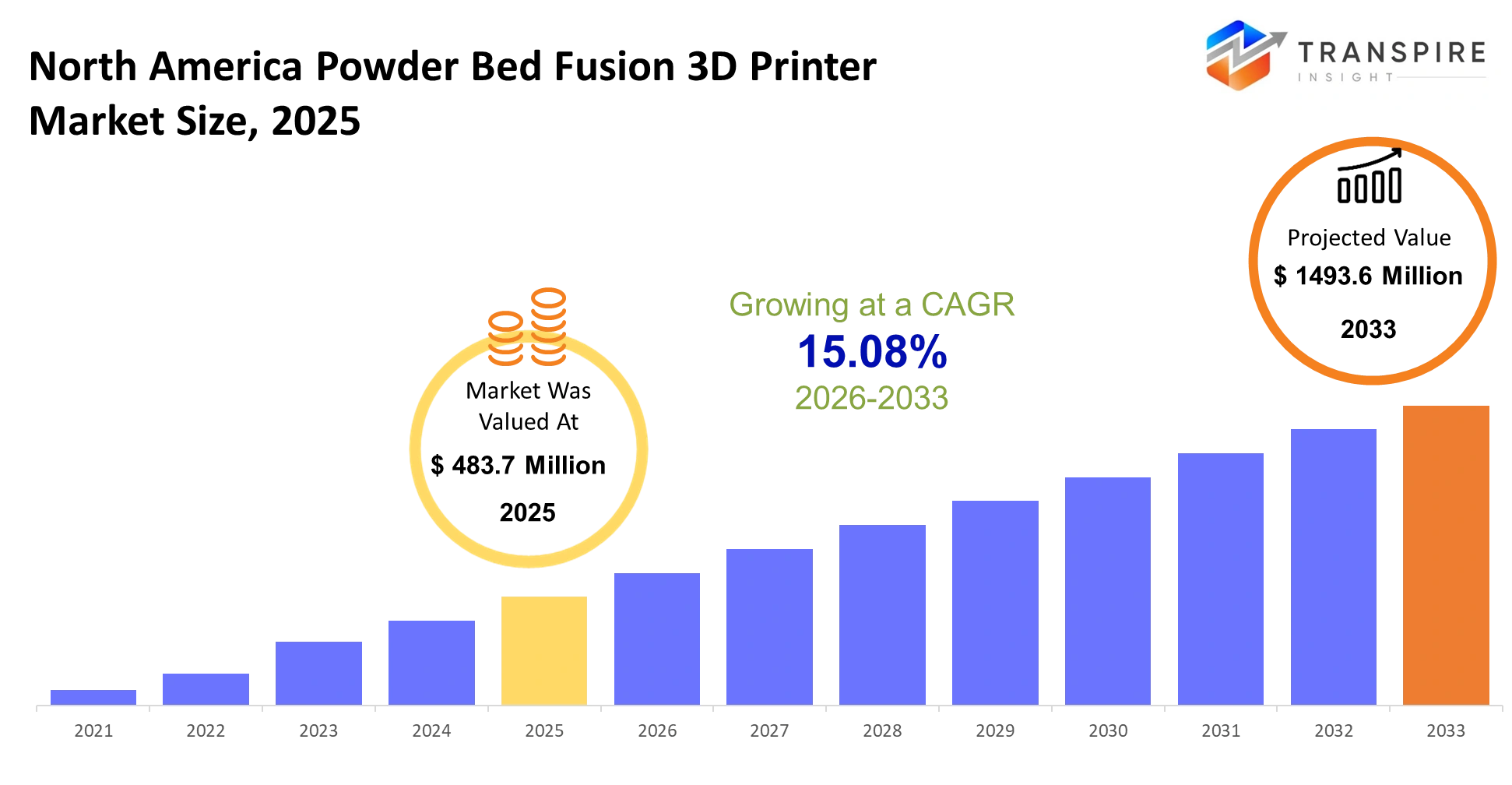
North America Powder Bed Fusion 3D Printer Market Size & Forecast:
- North America Powder Bed Fusion 3D Printer Market Size 2025: USD 483.7 Million
- North America Powder Bed Fusion 3D Printer Market Size 2033: USD 1493.6 Million
- North America Powder Bed Fusion 3D Printer Market CAGR: 15.08%
- North America Powder Bed Fusion 3D Printer Market Segments: By Technology (Laser-Based, Electron Beam), By Material (Metal, Polymer), By Application (Aerospace, Automotive, Healthcare), By End-User (Industrial, Research).
To learn more about this report,  Download Free Sample Report
North America Powder Bed Fusion 3D Printer Market Summary:
The North America Powder Bed Fusion 3D Printer Market size is estimated at USD 483.7 Million in 2025 and is anticipated to reach USD 1493.6 Million by 2033, growing at a CAGR of 15.08% from 2026 to 2033. The Powder Bed Fusion 3D Printer market in North America which includes Canada and the United States and Mexico operates within advanced manufacturing because it combines precision engineering with industrial-scale custom manufacturing. The market will continue its current trend which produces low-volume products that require complex manufacturing processes especially for aerospace and medical equipment production. Customers choose equipment which minimizes both the time needed for post-processing and the amount of energy used during the process. The market will be influenced by three factors which include software-based calibration, material tracking capabilities, and enhanced safety regulations. Local production will be mandated by governments while manufacturers will improve their multi-laser systems and metal powder technologies to meet certification standards and enhance digital production efficiency.
Key Market Trends & Insights:
The demand patterns in North America will change because industries will start producing specialized products instead of creating general prototypes. The aerospace suppliers and defense contractors will focus on producing certified systems which can be built reliably for their operations. Buyers will expect products with tighter tolerances that require less human operation. The growth of digital inventories will lead companies to use on-demand printing instead of maintaining spare part inventories, which will alter how procurement teams assess supplier relationships and long-term value.
Material innovation will extend beyond conventional alloys toward development of specialized powders that scientists created to maintain performance during high stress and extreme temperature conditions. Manufacturers will invest in powders that offer improved recyclability without degrading part integrity. The company will achieve waste reduction while fulfilling its sustainability objectives. The printer manufacturers will form deeper partnerships with material science firms which will create bundled ecosystems that retain customers through approved material-machine partnerships.
The process of software integration will become the main method through which systems deployment and scaling operations will proceed. Engineers will use advanced simulation tools to forecast distortion outcomes which will help them decrease their failure rate during the printing process. Remote monitoring and fleet management will be possible through cloud-connected platforms which enable monitoring capabilities across different facilities. The rise of cybersecurity threats will lead defense-related production companies to require secure data pipelines and encrypted design transfers which will determine how vendors create their digital systems.
Regulatory agencies will establish stricter compliance requirements for businesses that operate in the healthcare and aviation industries which require mandatory certification. Authorities will push for clearer documentation of print parameters, material origins, and post-processing steps. Organizations will begin to implement standardized workflows which will create systems that can directly handle audits. The demand for operational training will increase which will force businesses to budget for personnel expenses who can manage both machine operation and digital design validation tasks.
North America Powder Bed Fusion 3D Printer Market Segmentation
By Technology
Laser-Based- The properties of laser-based systems which produce high precision results and maintain consistent surface quality through their complete surface coverage make them the leading technology. The manufacturing process will depend on multi-laser systems because they permit higher production rates while maintaining exacting standards of quality. The equipment will enable manufacturers to process additional metal types which will help aerospace and medical device companies achieve their required operational benchmarks. The combination of improved thermal management systems and new scan methods will create more dependable production processes which will result in less defects and lower manufacturing costs.
Electron Beam- Electron beam technology will gain traction in applications where high-temperature processing and material strength are critical. The systems operate in a vacuum environment which prevents contamination while producing parts with enhanced structural integrity. The aerospace industry will find value in these systems because they can process reactive metals including titanium. The technology currently faces high initial costs but improvements in beam control combined with faster production speeds will create better value for companies that work with specialized products.
To learn more about this report, Download Free Sample Report
By Material
Metal- Metal powders will continue to be essential for powder bed fusion. Metal powders will maintain their importance to powder bed fusion in industries which require their strength and accuracy. The development of titanium and aluminum and nickel-based alloys will continue until they achieve better flowability and consistent performance. The industry will devote its efforts to creating recyclable materials which preserve the strength of their products. The growing need for certification will require companies to establish metal powder traceability systems which will affect their choice of suppliers and procurement methods in all sectors.
Polymer- Polymer-based powder bed fusion will expand in applications where lightweight structures and cost efficiency matter. The new polymers will provide better thermal resistance together with mechanical strength which allows them to be used in functional parts instead of only prototypes. The automotive and consumer goods industries will use these materials because they enable fast production processes. The enhanced powder reuse system together with reduced energy needs will make polymer systems more appealing for sustainable manufacturing methods.
By Application
Aerospace- The aerospace sector will continue to use advanced manufacturing techniques because it needs parts that possess both lightweight characteristics and high-strength attributes. The technology of powder bed fusion will permit manufacturers to create complex products which achieve lower weight without losing their necessary operational capabilities. The industry will use this technology to produce fuel nozzles and brackets and engine components. Certification standards will determine the methods used to create and test components which will force businesses to implement advanced monitoring technologies that guarantee uniform product quality throughout their manufacturing processes.
Automotive- Automotive companies will use powder bed fusion to develop prototypes and conduct small-scale production operations. The ability to produce complex parts quickly will enable shorter development times while making it easier to create customized products. Electric vehicle manufacturers, in particular, will use this technology to create lightweight structures and components for managing heat. The technology remains expensive but its speed enhancements together with better material efficiency will create more viable solutions for niche markets and high-performance applications.
Healthcare- Healthcare applications will expand as customization becomes more important in patient care. The technology of powder bed fusion enables manufacturers to create customized implants and prosthetics which match the specific body needs of each patient. The combination of biocompatible materials with exact manufacturing techniques will lead to improved patient outcomes. The relationship between hospitals and medical device companies and manufacturers will develop through partnerships which both organizations need to meet regulatory standards. The focus will remain on accuracy and safety together with the capacity to create complicated solutions that match specific patient needs.
By End-User
Industrial- Industrial users will adopt powder bed fusion technology for both production work and tooling purposes. The technology will enable on-demand manufacturing which decreases the requirement for maintaining extensive product stockpiles. Existing production lines will receive system integration from companies which will merge conventional production systems with additive manufacturing techniques. The company will achieve efficiency improvements through two main factors which include decreased material waste and faster product delivery to customers. Industrial operators will search for machines which deliver dependable performance together with expandable capabilities and stable production results as competition intensifies.
Research- Research institutions will play a critical role in advancing powder bed fusion capabilities. Universities and innovation centers will test new materials together with process parameters and design techniques. Their research will shape the future development of commercial systems. The government and private organization funding will drive research into developing high-performance applications. The testing environments will serve as industrial adoption testing sites which connect research work with industrial production at scale.
Regional Insights
The United States will continue to lead as the main hub for powder bed fusion technology because strong aerospace and defense and medical manufacturing industries back this technology. Companies will keep making investments into high-performance systems that have the ability to fulfill demanding certification standards. Federal initiatives that promote domestic manufacturing will result in changes to procurement procedures which will lead companies to adopt regional manufacturing networks. U.S. industries will prioritize additive system integration with their current production systems because digital manufacturing technology continues to evolve.
Canada will establish itself as a research-oriented partner through its universities and innovation centers which will develop material science and process optimization. Academic institutions will collaborate with private manufacturers to create specialized applications which will have particular value in aerospace and energy industries. Government-backed funding programs will support experimentation and commercialization efforts. Canadian companies will focus on sustainable practices through their research into effective powder recycling and energy-efficient manufacturing processes which support national environmental goals.
Mexico will increase its participation in international business activities because it will use its existing strengths in automotive and industrial manufacturing. Companies will use powder bed fusion technology to create prototypes and produce small quantities of products. Customers will choose products based on their price sensitivity which leads them to select systems that deliver both performance and cost efficiency. Mexican manufacturers will adopt additive manufacturing systems to improve production speed through nearshoring trends which allow them to better serve North American business partners who are changing their requirements.
The United States and Canada and Mexico will strengthen their collaboration to improve supply chain resilience and exchange technological expertise throughout the region. Cross-border partnerships will allow organizations to exchange knowledge about material validation and process standardization. Manufacturers will achieve better market access through gradual improvements in regulatory alignment between different markets. The region will develop its additive manufacturing capabilities to meet industrial and commercial needs because industries require fast customization and digital workflow solutions.
Recent Development News
Industrial Reality Check and Market Recalibration (United States)
The United States industrial sector has reached a point where actual operational activities begin to replace previous promotional activities. The AMS 2025 event demonstrated how additive manufacturing companies now adjust their revenue expectations after their actual revenue results fell below their initial revenue forecasts. The manufacturers have shifted their investment priorities and operational focus areas because they now prioritize system reliability and cost management and traditional production system compatibility instead of full system replacement.
Expansion into Consumer and High-Volume Manufacturing (United States & Region)
Powder bed fusion technology now enables production at both consumer and large-scale manufacturing sites. Major manufacturers have begun using the technology to create commercial products which include titanium components that manufacturers produce through additive processes for reduced raw material consumption. The industry now moves from specialized industrial applications towards standard production practices, which will enable sustainable and efficient manufacturing that provides design flexibility throughout the entire product development lifecycle.
|
Report Metrics |
Details |
|
Market size value in 2025 |
USD 483.7 Million |
|
Market size value in 2026 |
USD 558.3 Million |
|
Revenue forecast in 2033 |
USD 1493.6 Million |
|
Growth rate |
CAGR of 15.08% from 2026 to 2033 |
|
Base year |
2025 |
|
Historical data |
2021 – 2024 |
|
Forecast period |
2026 – 2033 |
|
Report coverage |
Revenue forecast, competitive landscape, growth factors, and trends |
|
Regional scope |
North America (Canada, The United States, and Mexico) |
|
Key company profiled |
EOS GmbH, SLM Solutions Group AG, GE Additive, HP Inc., Renishaw plc, 3D Systems Corporation, Stratasys Ltd., TRUMPF Group, Desktop Metal Inc., Velo3D Inc., Nikon SLM Solutions, DMG MORI Co. Ltd., Farsoon Technologies, Xact Metal Inc., Markforged Holding Corporation. |
|
Customization scope |
Free report customization (country, regional & segment scope). Avail customized purchase options to meet your exact research needs. |
|
Report Segmentation |
By Technology (Laser-Based, Electron Beam), By Material (Metal, Polymer), By Application (Aerospace, Automotive, Healthcare), By End-User (Industrial, Research). |
Key North America Powder Bed Fusion 3D Printer Market Company Insights
The North American powder bed fusion 3D printer market will see its main companies from Canada, Mexico and the United States develop competition through their extensive funding of materials research and software development, and their industrial collaborations. The machine product offerings and complete system packages from 3D Systems and EOS and SLM Solutions will enable these companies to maintain their market power. General Electric and Renishaw and Desktop Metal will keep developing their metal processing technologies to boost their manufacturing operations. The market will experience rising competition because new companies will launch budget-oriented products which will motivate existing businesses to innovate for success.
Company List
- EOS GmbH
- SLM Solutions Group AG
- GE Additive
- HP Inc.
- Renishaw plc
- 3D Systems Corporation
- Stratasys Ltd.
- TRUMPF Group
- Desktop Metal Inc.
- Velo3D Inc.
- Nikon SLM Solutions
- DMG MORI Co. Ltd.
- Farsoon Technologies
- Xact Metal Inc.
- Markforged Holding Corporation
North America Powder Bed Fusion 3D Printer Market Report Segmentation
By Technology
- Laser-Based
- Electron Beam
By Material
- Metal
- Polymer
By Application
- Aerospace
- Automotive
- Healthcare
By End-User
- Industrial
- Research
Frequently Asked Questions
Find quick answers to common questions.
The Approximate North America Powder Bed Fusion 3D Printer Market size for the Market will be USD 1493.6 Million in 2033.
Key Segments for the North America Powder Bed Fusion 3D Printer Market By Technology (Laser-Based, Electron Beam), By Material (Metal, Polymer), By Application (Aerospace, Automotive, Healthcare), By End-User (Industrial, Research).
Major Players in the North America Powder Bed Fusion 3D Printer Market are EOS GmbH, SLM Solutions Group AG, GE Additive, HP Inc., Renishaw plc, 3D Systems Corporation, Stratasys Ltd., TRUMPF Group, Desktop Metal Inc., Velo3D Inc., Nikon SLM Solutions, DMG MORI Co. Ltd., Farsoon Technologies, Xact Metal Inc., Markforged Holding Corporation.
The Current North America Powder Bed Fusion 3D Printer Market size is USD 483.7 Million in 2025.
The North America Powder Bed Fusion 3D Printer Market CAGR is 15.08%.
- EOS GmbH
- SLM Solutions Group AG
- GE Additive
- HP Inc.
- Renishaw plc
- 3D Systems Corporation
- Stratasys Ltd.
- TRUMPF Group
- Desktop Metal Inc.
- Velo3D Inc.
- Nikon SLM Solutions
- DMG MORI Co. Ltd.
- Farsoon Technologies
- Xact Metal Inc.
- Markforged Holding Corporation
Recently Published Reports
-
Apr 2026
Handling and Lifting Equipment Market
Handling and Lifting Equipment Market Size, Share & Analysis Report By Product (Cranes and Hoists, Forklifts, Conveyor Systems, Aerial Work Platforms, Others), By Application (E-Commerce, Automotive and Railway, Food and Beverages, Aviation, Others), and Geography (North America, Europe, Asia-Pacific, Middle East and Africa, South and Central America), 2021 - 2031
-
Apr 2026
HVAC Equipment Market
HVAC Equipment Market Size, Share & Analysis Report By Heating Equipment Type (Boilers and Furnaces, Heat Pumps, and Unitary Heaters), By Ventilation Equipment (Air Handling Units, Humidifiers and Dehumidifiers, Air Filters, and Fan Coiling Units), By Air Conditioning Equipment (Unitary Air Conditioners, Room Air Conditioners, Packaged Terminal Air Conditioners, and Chillers), By End User (Commercial, Residential, Industrial, and others), and Geography (North America, Europe, Asia-Pacific, Middle East and Africa, South and Central America), 2021 – 2031
-
Apr 2026
Refrigeration Valves Market
Refrigeration Valves Market Size, Share & Analysis Report By Type (Solenoid Valves, Expansion Valves, Check Valves, Service Valves, Others), By Application (Commercial Refrigeration, Industrial Refrigeration, Transport Refrigeration, Residential Refrigeration, Air Conditioning Systems), By End User (Food and Beverage Industry, Pharmaceutical Industry, HVAC Industry, Chemical Industry, Others), and Geography (North America, Europe, Asia-Pacific, Middle East and Africa, South and Central America), 2021 – 2031
-
Apr 2026
E-Commerce Packaging Materials Market
E-Commerce Packaging Materials Market By Material Type (Corrugated Boxes, Paper & Paperboard, Foam & Cushioning Materials, Plastic Packaging, Flexible Packaging, Protective Packaging, Others), By Product(Primary Packaging, Secondary Packaging, Tertiary Packaging), By Packaging Function (Protective Packaging, Branding & Presentation Packaging, Transit & Logistic Packaging, Sustainable Packaging, Tamper Evidence Packaging), By End-User (Retail & Consumer Goods, Electronic Appliances, Food & Beverages, Healthcare & Pharmaceutical, Fashion & Apparel, Home & Furnishing, Others); By Industry Analysis, Size, Share, Growth, Trends, and Forecasts 2021-2033