

Japan Porous Ceramics Market Size & Forecast:
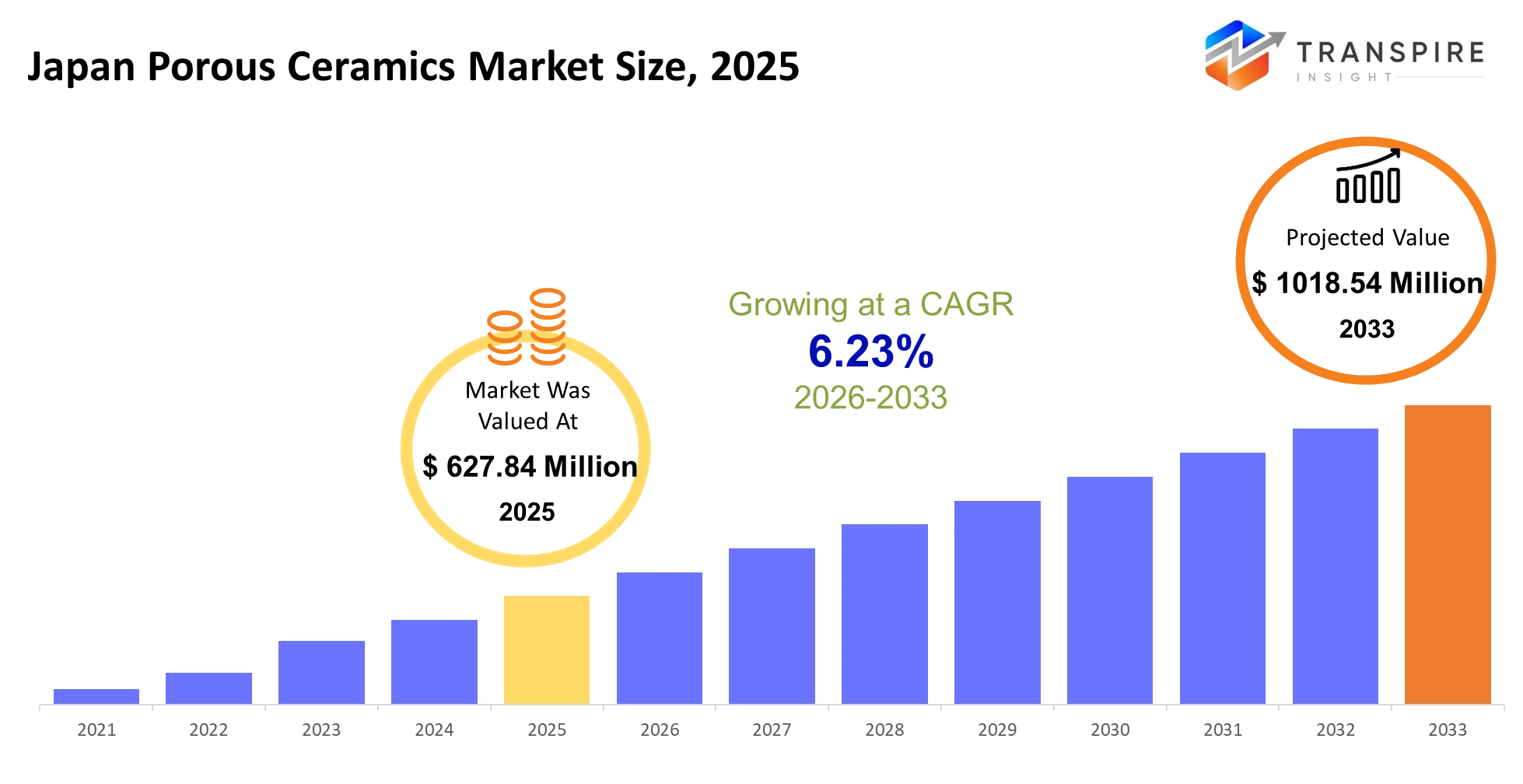
- Japan Porous Ceramics Market Size 2025: USD 627.84 Million
- Japan Porous Ceramics Market Size 2033: USD 1018.54 Million
- Japan Porous Ceramics Market CAGR: 6.23%
- Japan Porous Ceramics Market Segments: By Type (Alumina Ceramics, Silicon Carbide Ceramics, Zirconia Ceramics, Others); By Application (Filtration, Insulation, Catalyst Support, Biomedical Applications, Others); By End-User (Chemical Industry, Healthcare, Industrial Sector, Electronics Industry, Others); By Form (Blocks, Tubes, Plates, Others).
To learn more about this report,  Download Free Sample Report
Japan Porous Ceramics Market Summary
The Japan Porous Ceramics Market was valued at USD 627.84 Million in 2025. It is forecast to reach USD 1018.54 Million by 2033. That is a CAGR of 6.23% over the period.
Japanese porous ceramics serve as precise filtration and separation materials which also function as thermal management systems for chemical processing plants and water treatment facilities and semiconductor manufacturing sites and emission control technologies. They function as industrial industrial systems which need to eliminate tiny particles while maintaining extreme temperatures without using their normal filters that break down in high-temperature and corrosive environments. The market has transitioned to specially engineered ceramic materials which enable semiconductor-grade applications to achieve ultra-fine filtration and extend product lifespan during the past three to five years.
The stricter environmental regulations in Japan which control waste discharge from industrial operations serve as the main reason for this transformation together with the increasing domestic semiconductor production and establishment of local supply chains. The need for manufacturers to implement better filtration systems has created a market for advanced porous ceramics which manufacturers use in water recycling and exhaust treatment and precision manufacturing processes to enhance their specialized component procurement value.
Key Market Insights
- The Kanto region dominates the Japan Porous Ceramics Market with approximately 38 to 42 percent market share because of its semiconductor clusters and industrial manufacturing concentration.
- The Kansai region is the fastest-growing through 2030, driven by clean energy infrastructure and advanced materials R&D expansion. The Japan Porous Ceramics
- The market expands because both regional industrial modernization and export-focused manufacturing centers develop throughout the country.
- Alumina-based porous ceramics hold the leading share of around 40% due to durability in chemical and thermal filtration systems.
- Silicon carbide ceramics rank second-largest, widely used in high-temperature exhaust and semiconductor processing units.
- The fastest-growing market segment for advanced nano-structured ceramics exists because customers need ultra-precision filtration systems from 2024 until 2030.
- The Japan Porous Ceramics Market shows industrial filtration as its main usage because it represents about 45% of total market share.
- Semiconductor manufacturers lead end-user demand with nearly 35% share, driven by precision filtration and contamination control needs.
- Through 2030, the renewable energy and hydrogen systems market will show the highest growth rate among end-user sectors.
- The company establishes strategic alliances with electronics and chemical businesses to improve its supply chain operations and develop customized materials.
What are the Key Drivers, Restraints, and Opportunities in the Japan Porous Ceramics Market?
The semiconductor and precision manufacturing ecosystem of Japan is expanding at a fast rate which serves as the main driving force behind this development. The government supports domestic chip production development through its initiatives which impose strict contamination control standards that boost the use of porous ceramics for wafer processing and gas filtration and ultra-clean industrial environments. The global supply chain disruptions together with the push for technological self-reliance drove this change which led to increased adoption of high-purity ceramic components and higher revenues for material suppliers.
Engineered porous ceramics present a major limitation because their production process involves complex operations which require high production expenses. The manufacturing process needs precise control over sintering operations together with high-quality material components which creates limitations on production capacity for medium-sized industrial facilities. The existing structural obstacle prevents companies from using alternative filters which will take time to reach market acceptance in budget-sensitive sectors while decreasing potential sales growth despite high customer demand.
The market for hydrogen energy and next-generation fuel systems presents a significant business opportunity through the rising applications of porous ceramics in filtration and gas diffusion and thermal stability functions. The hydrogen infrastructure projects which Japan is developing and the pilot fuel cell installations which Japan is launching will create new customer demand for these technologies. The Japan Porous Ceramics Market will benefit from its position as an early adopter of clean energy technologies and advanced industrial decarbonization solutions which will result from energy transition investment growth.
What Has the Impact of Artificial Intelligence Been on the Japan Porous Ceramics Market?
The design and monitoring and maintenance processes of scrubber performance systems and high-temperature ceramic filtration units in Japan's industrial and maritime environment become advanced through artificial intelligence and modern digital technologies. The AI-based control systems of exhaust gas cleaning technology continuously monitor sensor data to modify their operating parameters which lead to improved airflow resistance and particulate capture efficiency. The chemical plant and semiconductor facility operations benefit from enhanced stability and reduced need for manual control throughout the operation of porous ceramic-based filtration modules.
Machine learning models are also being applied for predictive maintenance, where historical operating data and vibration or pressure signals are used to forecast clogging, thermal degradation, or micro-crack formation in ceramic filters. The predictive tools enable shipping operators to maintain their maritime emission control systems through better maintenance scheduling which leads to a 10 to 15 percent increase in vessel availability during optimized deployment periods.
AI integration enables better fuel efficiency and regulatory compliance through its ability to maintain scrubber systems in their ideal pressure and temperature operation range which decreases energy waste and enhances SOx and NOx reduction performance. The main challenge for adoption emerges from the combination of expensive integration requirements and the restricted real-time connectivity that exists in offshore areas. The system stops vessels from sending data continuously at sea which decreases the accuracy of The system stops vessels from sending data continuously at sea which decreases the accuracy of digital transmission at different sea states resulting in a delay of complete digital transformation across Japan's Porous Ceramics Market ecosystem.
Key Market Trends
- The Japanese semiconductor investments which began in 2022 have required suppliers of porous ceramic materials to boost their ultra-fine filtration production rates by 20% because these materials are needed for contamination-sensitive manufacturing facilities.
- The manufacturing industry has transitioned from using standard alumina parts to adopting silicon carbide materials because they provide better protection against thermal shock which has developed since 2021.
- The chemical processing industry and wastewater treatment plants have intensified their filtration system upgrades because of the stricter industrial discharge standards which became effective after 2020.
- The companies NGK Insulators and Kyocera Corporation increased their research and development budget for micro-porosity engineering between 2023 and 2025.
- The replacement interval improvements which range from 15 to 25 percent have led customers to focus more on lifecycle costs than on initial product costs since 2023.
- The domestic supply chain established stronger local operations after global logistics disruptions which occurred in 2021.
- The domestic supply chain now relies less on imported advanced ceramic materials because it developed stronger local supply operations.
- The adoption of additive manufacturing has grown continuously since 2024 and this development enables manufacturers to create more advanced products with shorter timeframes for product development.
- The hydrogen infrastructure testing programs which started in Kansai in 2023 established new performance standards which gas diffusion ceramic systems must meet.
- Industrial operators use AI-based monitoring platforms to enhance their filter performance prediction capabilities while decreasing unplanned maintenance events by more than 10 percent.
Japan Porous Ceramics Market Segmentation
By Type:
The Japan porous ceramics market considers alumina ceramics as essential materials because they provide advanced thermal protection and corrosion resistance and maintain their mechanical properties. Solid applications exist in both filtration systems and insulation applications because these systems need to operate effectively during extreme conditions. Industrial processing continues to require materials that maintain consistent performance throughout their operational life.
Silicon carbide ceramics have become more popular because their thermal conductivity and wear resistance properties make this material appropriate for use in high-temperature industrial environments. Zirconia ceramics provide essential value through their ability to withstand wear and maintain chemical resistance in applications that demand precise results. The other category includes specialty porous ceramics developed for niche technical uses, which help the market to expand by providing both unique products and wider industrial acceptance.
By Application:
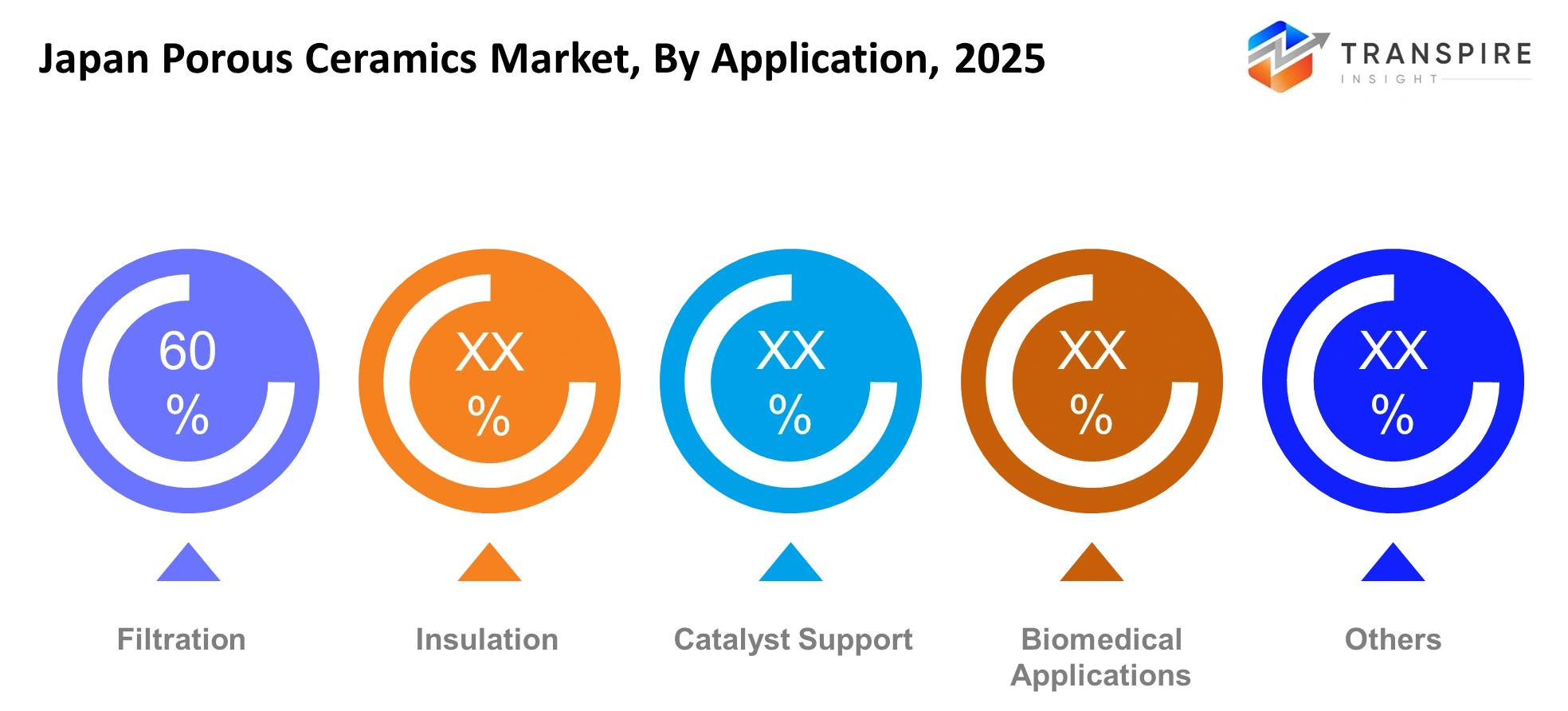
Porous ceramics permit industrial operations to use liquid and gas purification systems because of their capability to serve as one of the main application fields in filtration. The system achieves efficient quality control through its controlled pore structure, which enables effective separation. The Japanese environmental movement will create ongoing demand for filtration products that serve both treatment facilities and manufacturing plants.
The insulation and catalyst support functions of porous ceramics create strong market demand through their ability to enhance thermal management and boost chemical processing performance. The development of biomedical applications is now proceeding at a steady pace because advanced material properties enable the creation of medical implants and specialized healthcare instruments. Other applications include both laboratory and technical processing functions, which enable different business opportunities through their ability to provide consistent results throughout different operational scenarios.
To learn more about this report, Download Free Sample Report
By End-User:
The chemical industry needs filtration systems and separation systems and catalyst support systems which makes it a significant market sector. The use of porous ceramics enables users to achieve stable operational processes and maintain consistent product quality throughout their industrial operations. The manufacturing and heavy processing industries produce constant market requirements because production systems need materials that can withstand high temperatures and maintain their strength.
The electronics and healthcare sectors are experiencing slow growth in this particular market. The medical field requires precision medical components that need stable porous structures while the electronics industry requires advanced ceramic materials for insulation and technical processing requirements. Research institutions and specialized engineering sectors use their products to study new commercial applications.
By Form:
Industries rely on blocks because their larger structural forms create support systems for both filtration units and insulation systems which are needed in industrial operations. The formats provide design flexibility while making it simple to install equipment used in heavy-duty operations. The demand for ceramic structures will remain consistent because industrial projects require ceramic materials that provide reliable performance during their operations.
Tubes and plates are used in applications that require both accurate shape dimensions and smooth integration with existing systems especially in their use for filtration channels and technical assemblies. The other forms include specialized designs that industrial and biomedical sectors need to meet their particular needs. Japanese companies will promote innovative development through their increasing demand for customized ceramic solutions which will also drive advancement in dedicated manufacturing processes for specific applications.
What are the Key Use Cases Driving the Japan Porous Ceramics Market?
The Japanese porous ceramics market exists because companies need ultra-fine industrial filtration which serves both semiconductor manufacturing and chemical production processes. Porous ceramics become essential because these applications need to remove contaminants with complete accuracy while handling high-temperature and corrosive operational conditions.
The technology now extends its usage to include wastewater treatment systems and exhaust emission control systems which heavy industrial plants operate. Electronics manufacturers are increasingly deploying ceramic filtration media in closed-loop water recovery systems, while automotive component producers use them to improve particulate capture and thermal resistance in emission control applications.
New applications will emerge for hydrogen fuel infrastructure systems and solid oxide fuel cell technology. Japanese clean energy transition policies support pilot projects which test porous ceramic components for gas diffusion layers and thermal insulation modules. Advanced medical sterilization equipment and next-generation battery manufacturing also present strong long-term potential.
|
Report Metrics |
Details |
|
Market size value in 2025 |
USD 627.84 Million |
|
Market size value in 2026 |
USD 666.98 Million |
|
Revenue forecast in 2033 |
USD 1018.54 Million |
|
Growth rate |
CAGR of 6.23% from 2026 to 2033 |
|
Base year |
2025 |
|
Historical data |
2021 - 2024 |
|
Forecast period |
2026 - 2033 |
|
Report coverage |
Revenue forecast, competitive landscape, growth factors, and trends |
|
Country scope |
Japan |
|
Key company profiled |
Kyocera, CoorsTek, Morgan Advanced Materials, Saint-Gobain, CeramTec, NGK Insulators, Ibiden, 3M, Rauschert, Blasch Precision Ceramics, McDanel, Applied Ceramics, Elan Technology, Refractron, Schunk Group. |
|
Customization scope |
Free report customization (country, regional & segment scope). Avail customized purchase options to meet your exact research needs. |
|
Report Segmentation |
By Type (Alumina Ceramics, Silicon Carbide Ceramics, Zirconia Ceramics, Others); By Application (Filtration, Insulation, Catalyst Support, Biomedical Applications, Others); By End-User (Chemical Industry, Healthcare, Industrial Sector, Electronics Industry, Others); By Form (Blocks, Tubes, Plates, Others). |
Which Regions are Driving the Japan Porous Ceramics Market Growth?
The Kanto region leads the Japan Porous Ceramics Market because it has many semiconductor fabrication plants and advanced chemical processing facilities and its industrial policies help domestic technology manufacturing.Direct government incentives provide stronger support for supply chain resilience which protects high-value materials needed by Tokyo and Kanagawa and their industrial areas. The region contains a network of research institutions, precision equipment suppliers, and advanced ceramics manufacturers, which help businesses develop their products at a faster rate. Government backing together with existing infrastructure and deep expertise in the field enables Kanto to remain the top region for using porous ceramics.
The Kansai region operates as a distinct market system which enables continuous product demand for electronics and automotive parts and specialty chemical manufacturing. The industrial ecosystem of Kansai maintains operational stability because it protects the region from economic downturns which impact particular industries. The manufacturing hubs of Osaka, Kyoto, and Kobe have established their presence in the market, which they continue to strengthen through their investments in process efficiency improvements and contamination control technologies.The market revenue from Kansai shows reliable growth because the region uses responsible capital spending practices and implements gradual technological advancements.
Kyushu has become the fastest-growing regional market because of the substantial semiconductor and clean energy infrastructure investments which began in 2023. The construction of new fabrication facilities together with their associated supply chain systems has created a strong need for advanced filtration systems and thermal control products. The local government backing industrial growth together with hydrogen development initiatives has created stronger demand in the region. The period from 2026 to 2033 presents Kyushu as a high-potential growth area which provides market entrants and investors with chances to build partnerships in the developing advanced materials market.
Who are the Key Players in the Japan Porous Ceramics Market and How Do They Compete?
The Japanese Porous Ceramics Market shows moderate consolidation because domestic manufacturers hold most valuable market segments while international companies operate in limited industrial markets. Material engineering accuracy together with product performance for specific uses stands as the primary factor that drives competition between companies instead of product prices. Existing companies maintain their market position by establishing complete technical relationships with their semiconductor and chemical processing and industrial filtration business partners. The long qualification cycles that require reliability and purity standards and operational lifespan certification create major hurdles for new companies because buyers prefer these certified attributes over cheaper options.
The contamination-sensitive manufacturing environments of Kyocera Corporation become protected through advanced materials engineering and customized solutions. The company uses its pore structure technology to create semiconductor-grade filtration solutions that provide process consistency for its customers. The company develops new market opportunities through partnerships with electronics manufacturers to create new products. The industrial filtration and emission control systems of NGK Insulators receive unique protection through its thermal durability and extensive ceramic processing abilities. The company establishes its strength through its ability to merge material science knowledge with established relationships from its industrial infrastructure.
CoorsTek competes through technical specifications because its products serve specialized markets that need extreme purity and protection against corrosion. Saint-Gobain uses its worldwide research and development capabilities to create new porous materials which it applies in Japanese industrial facilities through local partnerships. Murata Manufacturing develops its business operations through ceramic technology development which it applies to advanced electronic products and precision components used in fast-growing technical markets.
Company List
- Kyocera
- CoorsTek
- Morgan Advanced Materials
- Saint-Gobain
- CeramTec
- NGK Insulators
- Ibiden
- 3M
- Rauschert
- Blasch Precision Ceramics
- McDanel
- Applied Ceramics
- Elan Technology
- Refractron
- Schunk Group
Recent Development News
In January 2026, Kyocera Corporation launched new advanced ceramic product lines including 3D-printed silicon carbide components. These innovations enhance precision manufacturing and expand applications of porous and high-performance ceramics in semiconductor and industrial markets.
Source: https://ggsceramic.com/
In January 2026, NGK Insulators, Ltd. advanced development of ceramic membranes for carbon capture applications. This technology development supports the growing use of porous ceramics in environmental solutions, particularly in emissions control and carbon capture systems.
Source: https://ggsceramic.com/
What Strategic Insights Define the Future of the Japan Porous Ceramics Market?
The Japan Porous Ceramics Market will shift from its current state to specialized application-specific solutions during the next five to seven years which will replace its existing capacity-driven industrial supply model. The Japanese government initiates this change because it wants to enhance semiconductor production capabilities and develop hydrogen infrastructure and create more resistant precision manufacturing methods. Suppliers who provide materials that meet specific operational needs will gain additional market value through their ability to deliver materials with more consistent pore sizes and better thermal performance and special filter capabilities.
A risk exists because of our reliance on specific raw materials and processing methods. The industry needs high-purity alumina and silicon carbide materials which both face supply chain interruptions that create risks for production costs and essential industrial customer qualification efforts. The company will experience a profit decline because of rising operational expenses although its revenue continues to expand.
Kyushu's semiconductor ecosystem presents an emerging opportunity which will be fulfilled through new fabrication facilities that require advanced contamination control materials. The best approach for market players involves making present investments into joint application development work with chip manufacturers and clean energy system builders. The early technical alignment process will produce qualification advantages which later competitors will find hard to achieve.
Japan Porous Ceramics Market Report Segmentation
By Type
- Alumina Ceramics
- Silicon Carbide Ceramics
- Zirconia Ceramics
By Application
- Filtration
- Insulation
- Catalyst Support
- Biomedical Applications
By End-User
- Chemical Industry
- Healthcare
- Industrial Sector
- Electronics Industry
By Form
- Blocks
- Tubes
- Plates
Frequently Asked Questions
Find quick answers to common questions.
The Japan Porous Ceramics Market size is USD 1018.54 Million in 2033.
Key segments for the Japan Porous Ceramics Market are By Type (Alumina Ceramics, Silicon Carbide Ceramics, Zirconia Ceramics, Others); By Application (Filtration, Insulation, Catalyst Support, Biomedical Applications, Others); By End-User (Chemical Industry, Healthcare, Industrial Sector, Electronics Industry, Others); By Form (Blocks, Tubes, Plates, Others).
Major Japan Porous Ceramics Market players are Kyocera, CoorsTek, Morgan Advanced Materials, Saint-Gobain, CeramTec, NGK Insulators, Ibiden, 3M, Rauschert, Blasch Precision Ceramics, McDanel, Applied Ceramics, Elan Technology, Refractron, Schunk Group.
The Japan Porous Ceramics Market size is USD 627.84 Million in 2025.
The Japan Porous Ceramics Market CAGR is 6.23% from 2026 to 2033.
- Kyocera
- CoorsTek
- Morgan Advanced Materials
- Saint-Gobain
- CeramTec
- NGK Insulators
- Ibiden
- 3M
- Rauschert
- Blasch Precision Ceramics
- McDanel
- Applied Ceramics
- Elan Technology
- Refractron
- Schunk Group
Recently Published Reports
-
Apr 2026
Healthcare Polymer Packaging Market
Healthcare Polymer Packaging Market Size, Share & Analysis Report By Packaging Type (Syringes, IV Bottles and Pouches, Clamshells, Blisters, Bottles & Jars, Containers, Tubes, IV Parental Packaging, Others), By Type (Regulated, Non-regulated), By Polymer Type (LDPE (Low-Density Polyethylene), HDPE (High-Density Polyethylene), Homo-polymer (Homo), Random Copolymer (Random), Block Copolymer (Block), PET, Polystyrene, Polyvinyl Chloride, Polyamide/EVOH, Others), and Geography (North America, Europe, Asia-Pacific, Middle East and Africa, South and Central America), 2021 - 2031
-
Apr 2026
Hydrophilic Tape (Waterstop) Market
Hydrophilic Tape (Waterstop) Market Size, Share & Analysis Report By Type (Bentonite-Based Hydrophilic Tape, Rubber-Based Hydrophilic Tape), By Application (Residential Buildings, Commercial Buildings, Infrastructure Projects), and Geography (North America, Europe, Asia-Pacific, Middle East and Africa, South and Central America), 2021 - 2031
-
Apr 2026
Metalens Market
Metalens Market Size, Share & Analysis Report By Type (Visible Light Metalens, and Infrared Metalens), By Application (Consumer Electronics, Automotive Electronics, Industrial, Medical, and Others), and Geography (North America, Europe, Asia-Pacific, Middle East and Africa, South and Central America), 2021 - 2031
-
Apr 2026
PBT Resin Market
PBT Resin Market Size, Share & Analysis Report By Type (Reinforced PBT Resin, Unreinforced PBT Resin), By Processing Method (Injection Molding, Extrusion, Blow Molding, Others), By End-User (Automotive, Electrical & Electronics, Consumer Appliances, Industrial Machinery, Medical Devices, Packaging, Others), and Geography (North America, Europe, Asia-Pacific, Middle East and Africa, South and Central America), 2021 - 2031