
Jan 14, 2026
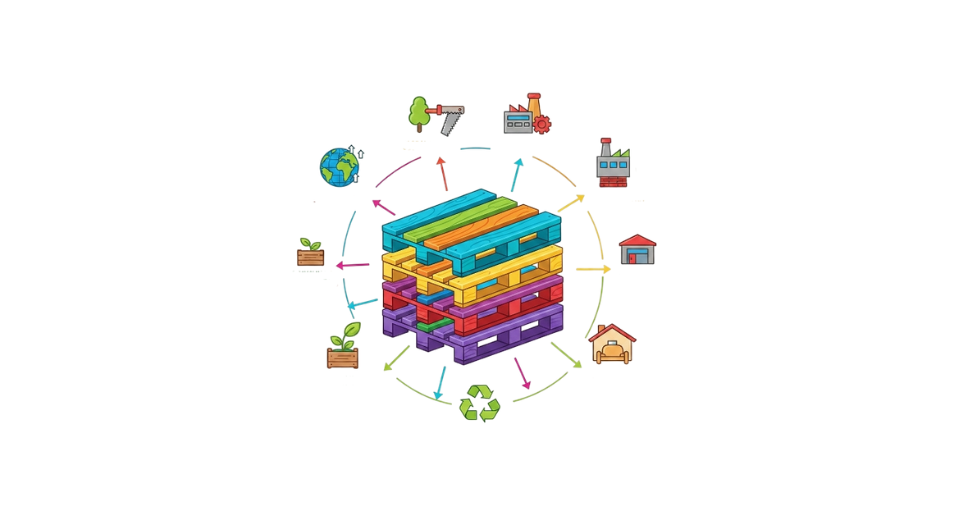
The report “Wood Pallets Market By Wood Type (Softwood, Hardwood), By Product Type(Block Wooden Pallet, Stringer Wooden Pallet, Engineered Molded Wood Pallet,), By End Use (Logistics & Transportation, Automotive, Food & Beverages, Chemicals, Pharmaceuticals, Manufacturing)” is expected to reach USD 37.85 billion by 2033, registering a CAGR of 7.40% from 2026 to 2033, according to a new report by Transpire Insight.
The international wooden pallet market remains an essential part of the logistics and supply chain management system, acting as a standard base for the storage, management, and shipment of products. The wooden pallet has gained popularity for being economically viable, highly durable, and versatile enough to be applied in a range of industries, from the automobile sector to the pharmaceutical, food, and chemical industries. With more companies adopting the concept of transporting products through palletized cargo, the requirement for wooden pallets has gradually increased. The growth of markets is also fueled by the rising number of e-commerce as well as third-party logistics companies, resulting in increased demand for efficient warehouse management systems. Pallets ensure simplification of material handling systems, as they reduce damage during the handling of products. Additionally, there are regulations that ensure controlled exports, such as ISPM-15, which promotes the use of treated wood pallets to meet international standards.
Market trends are also influenced by the sustainability factor. Hardwood pallets that could be repaired and reused and thus more environment-friendly and participating in cost savings compared to the competition likely to dispose of more pallets and consume more cost at the same time. There is an increased integration of pallet recycling and pallet pooling services into business operations based on corporate social responsibilities and the idea of the circular economy. The market should experience moderate but stable growth over the next few years, driven by industrial production, export production, and infrastructure development in emerging markets. Rising investments in logistics automation and increased use of engineered and molded wood pallets due to regulatory and durability reasons should contribute positively to this trend. In essence, wood pallets should be considered an essential part of international trade, as they demonstrate efficiency, dependability, and sustainability.
The Softwood segment is projected to witness the highest CAGR in the Wood Pallets market during the forecast period.
According to Transpire Insight, The dominance of softwood pallets in the market is due to their cost-effectiveness, lightness, and easy availability, which make them appropriate for high-volume logistics as well as export shipments. Softwood pallets mostly serve the needs of fast-moving goods-based industries better because they are practical means for temporary storage and transportation activities without hurting operational efficiency. These pallets are easier to repair and replace, thus further supporting companies in optimizing their supply chain costs.
Besides softwood pallets find an extensive range of applications in those geographic regions of the world where timber resources are abundant and cost-sensitive markets are the drivers of procurement decisions. The lower weight of softwood pallets translates to easy transportation which saves money.
The Block Wooden Pallet segment is projected to witness the highest CAGR in the Wood Pallets market during the forecast period.
Block pallets are found to be the choice of preference in automated and large-scale logistics operations due to their four-way functionality, which allows easy access by forklifts and pallet jacks. Block pallets offer greater stability and supporting efficiency than stringer pallets, which render them very useful in applications involving heavy shipments and repeated movement of products in the manufacturing and distributions fields.
Additionally, block pallets can facilitate international business because they can withstand longer transport times as well as repeated cycles of handling. Also, as companies continue to invest more in automated storage and retrieval systems in their warehouses, especially in North America as well as Europe, block pallets are being preferred due to compatibility. Thus, they ensure that they are the largest product segment of the wooden pallet industry.
The Logistics & Transportation segment is projected to witness the highest CAGR in the Wood Pallets market during the forecast period.
According to Transpire Insight, The logistics and transportation sector accounts for the largest share of end-use in the wooden pallet market. Because of this, wooden pallets cannot do without being important to efficient handling of loads, safe storage, and damage-free shipment of merchandise throughout supply chains. This has been boosted more by the growth of e-commerce and third-party logistical services that have increased the volumes of goods palletized while moving around globally.
Notably, logistics service providers prefer wooden pallets for their versatility and conformance to the international standard for shipment. The standardization of pallet solutions offers perfect integrations with already existing warehouse management systems and material handling equipment. Continuous growth in both industrial and retail logistics, together with the expansion in cross-border trade, ensures strong demand from this sector and keeps it as the top-end segment in the market.
The North America region is projected to witness the highest CAGR in the Wood Pallets market during the forecast period.
The wooden pallet market in North America leads the global market, with supply chain maturity, sophisticated warehousing facilities, and the adoption of pallet pools being the primary drivers. The United States, with its highest contribution to the market, prospers as a result of increased e-commerce, manufacturing, and its extensive retail infrastructure. The adoption of sustainability measures focusing on the reuse and rebuilding of pallets has aided the market, helping logistics firms cut costs without compromising efficiency.
Moreover, the increasing integration of technology, such as RFID, for tracking and handling, further encourages the use of common wood pallets, especially block pallets, in the North American logistic sector. Such companies in Canada and Mexico are also adopting similar moves for improved efficiency between borders. The region of North America has been identified as the most opportune for expansion due to continuous manufacturing, infrastructure development, and technology adoption over the next five years.
Key Players
The top 15 players in the Wood Pallets market include CHEP, Brambles Limited, PalletOne Inc., PECO Pallet Inc., Universal Forest Products, Inc., Millwood Inc., Kamps Pallets, Loscam, Falkenhahn AG, ORBIS Corporation, CABKA Group GmbH, Schoeller Allibert Group B.V., United Pallet Services Inc., Inka Paletten GmbH, and PGS Group.
Drop us an email at:
Call us on:
+91 7666513636

 inquiry@transpireinsight.com
 APAC:+91 7666513636
 Address





