
Sep 10, 2026
Market Forecast
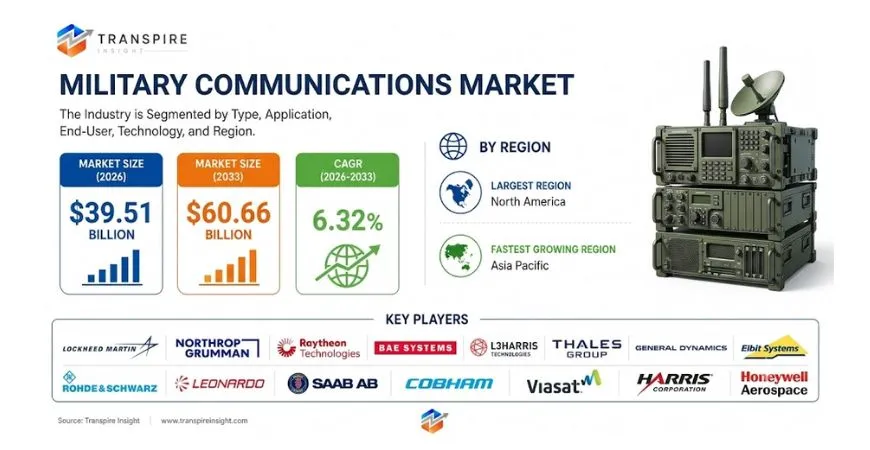
The global military communications market was valued at USD 37.16 billion in 2025 and is projected to grow from USD 39.51 billion in 2026 to USD 60.66 billion by 2033, at a CAGR of 6.32% through the forecast period, according to a new report by Transpire Insights.
Sustained international tensions, the operational lessons of modern conflict in Ukraine and the Middle East - and also ambitious military modernization programs across NATO, Indo-Pacific, and Gulf Cooperation Council countries - are causing the biggest, longest-running investment cycle in military communications capabilities we've seen in years. The convergence of satellite communications, software-defined radios, and AI-aided network management is really creating a much more effective and reliable communications structure that defense organizations are investing heavily in building and keeping up.
Military Communications Market Growth & Trends
The war in Ukraine has actually given us some real-world operational validation of many military communications capability priorities that were once just theoretical objectives. The role of commercial satellite communications - especially Starlink - in maintaining Ukrainian operational connectivity even when there were attacks on fixed infrastructure showed the huge strategic value of low Earth orbit satellite communications as an additional resource to military SATCOM. This also highlighted the weakness of tactical radio communications to electronic warfare, making NATO very interested in anti-jam and frequency-hopping communication systems that keep connections going in highly contested electromagnetic environments.
Joint all-domain command and control - the concept of linking sensors, shooters, and commanders across all military domains through a single communications and data network - is the theoretical framework driving the largest US, UK, and Australian military communications investment initiatives. Creating JADC2 demands not just radio communications upgrades but also fully integrating satellite links, tactical data links, and secure network infrastructure into a unified communications structure that can really survive in a peer-level conflict environment, creating massive procurement demand across all categories of military communications systems.
Emerging Economies & Technology
The Asia Pacific region is growing the fastest for military communications, pushed by the defense modernization plans of Japan, South Korea, India, and Australia - all of whom are significantly increasing their defense budgets and putting a high priority on communications capability as a fundamental requirement for modern military operations. Japan's greatly expanded defense budget - aiming for 2% of GDP by the end of the decade - includes quite a bit of investment in communications and C4ISR systems. Australia's Integrated Investment Programme is investing in satellite, tactical radio, and indigenous communications capabilities as part of its response to the Defence Strategic Review.
AI-assisted military communication systems are the most technically evolving part of market growth right now. AI applications in military communications cover cognitive radio - which automatically picks out the best frequencies so as to evade jamming and interference, network management systems that dynamically reroute traffic even when networks are failing, and predictive analytics that detect potential communication security weaknesses before an opponent takes advantage of them. The speed at which AI technology is improving in consumer telecommunications really opens up opportunities for transferring technology over to military communications - which developers are very much pursuing via dual-use technology programs.
Tactical Radio Systems Segment
Tactical radio systems make up 51% of the entire global military communications market - the biggest segment by far. Software-defined radios that can be updated for different waveforms, frequency ranges, and encryption methods give us all the adaptability required for today's multi-theater military missions - one radio platform doing many jobs instead of specialized single-purpose radios like we saw in previous generations of tactical communications equipment. L3Harris's Falcon series, Thales's SYNAPS system, and other major suppliers' Harris-Radio systems are the well-established players in this space.
Soldier-worn tactical communications are getting quite a bit more R&D funding lately because dismounted infantry fighting in cities and very difficult terrain need ultra-portable, high-speed, and highly secure communication links that older squad radio systems just can't deliver. Wearable antenna systems, biometrically secured communication devices, and mesh networking software creating robust communications within small teams without needing any infrastructure are some key capabilities really driving tactical radio system investment.
AI-assisted communication systems represent the fastest-growing segment
AI-aided military communication systems are expanding at a CAGR of 11. 5 percent - the highest rate in the market. Autonomous frequency management, electronic warfare countermeasures, and AI-driven network resilience tools are all moving out of research programs and into operational deployment within military communications infrastructure itself. The US Army's Integrated Tactical Network and the UK's Digital Backbone programs both include AI-assisted network management as a key capability requirement.
Transfer of commercial technology into military AI communications really is speeding up our capability development timeline quite significantly. Machine learning techniques created for commercial wireless network optimization, natural language processing for voice communication transcription and analysis, and computer vision for imagery interpretation within the tactical picture distribution system are all being applied to military communication applications that take full advantage of existing commercial AI development investment.
North America - largest regional market
North America holds 44% of the global military communications market - the biggest regional share. The United States is the world's largest military communications spender, with various programs spanning satellite communications - AEHF, WGS, and the evolving commercial satellite augmentation plan - tactical radio systems like the Manpack and vehicle-mounted SDR programs, and the overarching JADC2 architecture investment that integrates all communications layers into a unified network concept itself.
Canada participates in the North American military communications market through NORAD modernization - the Northern Warning System replacement and Over-the-Horizon radar program - and also through its involvement in the Five Eyes intelligence sharing infrastructure that demands highly secure interoperable communications with US, UK, Australian, and New Zealand defense organizations. L3Harris, Northrop Grumman, and Raytheon all have significant Canadian defense businesses operating alongside their primary US operations.
Asia Pacific - The Fastest-Growing Region
Asia Pacific really moves forward at a CAGR of 10. 6 percent - the very best regional rate in our market. Japan's defense communications investments - encompassing satellite communications, tactical radio updates, and highly secure command network infrastructure - form part of the biggest single national programs in the area. South Korea's military communications modernization efforts under its Defense Reform 2. 0 program generate quite a lot of procurements all over tactical radios, SATCOM, and ultra-secure network infrastructure itself.
India's home-grown defense communications ambitions - building up a truly sovereign secure communications capability instead of relying on imported systems even for highly sensitive military applications - create investments in both developing indigenous communication systems via the Defense Research and Development Organisation itself and also making selective international purchases for those capabilities that aren't currently feasible domestically. HAL and BEL actually develop domestic military radios and highly secure communications platforms under the "Make in India" defense initiative itself.
What Are the Recent Developments in the Military Communications Market?
Q4 2024 – L3Harris Technologies: Received a US Army contract for next-generation Falcon software-defined radios incorporating enhanced anti-jam SATCOM waveform capability and AI-assisted frequency management, delivering a planned 15,000 radio systems for initial Army fielding.
Q4 2024 – Thales Group: Secured a contract with the French Armed Forces for CONTACT tactical communications network upgrade, providing wideband tactical radio systems supporting simultaneous voice, video, and data transmission across land, air, and naval platforms.
Q1 2025 – Viasat: Launched a new low Earth orbit SATCOM terminal for military ground vehicle installation, achieving significantly higher data throughput than legacy geostationary SATCOM terminals while delivering resilience through LEO constellation diversity unavailable from single GEO satellite dependence.
Q2 2025 – Northrop Grumman: Received a DARPA contract for AI-assisted electronic warfare and cognitive communications research, developing machine learning systems that autonomously detect, classify, and counter adversary jamming attempts in contested electromagnetic environments.
Q2 2025 – Rohde & Schwarz: Won a NATO member contract for software-defined tactical radio systems incorporating ESSOR waveform compatibility, enabling interoperable communications between the purchasing nation's forces and other ESSOR-equipped NATO partner nations in multinational operations.
Q3 2025 – General Dynamics: Delivered the first production units of its Manpack tactical radio incorporating AI-driven network mesh capability, enabling automatic route optimisation around degraded network nodes without requiring operator intervention in austere operating environments.
About Transpire Insight
Turning Complex Data into Clear, Actionable Market Intelligence
In today’s hyper-competitive and fast-moving economy, guessing isn’t a business strategy. To lead your industry, launch game-changing products, or scale into new geographies, you need precise, reliable market intelligence, not just high-level noise.
At Transpire Insight, we are a full-service market research, data analytics, and strategic consulting firm. We help corporate leaders, innovators, and investors navigate complex market shifts with absolute confidence.
By combining rigorous primary research, deep statistical modeling, and hands-on domain expertise, we convert raw data into high-impact strategic roadmaps that drive measurable growth.
What Drives Us
Markets don’t stand still, and neither do we. Our core mission is simple: to empower organizations with verified, technology-enabled insights that remove guesswork from strategic planning.
Whether you are evaluating a niche technological shift, assessing supply chain dynamics, or looking for high-growth target segments, our intelligence gives you a decisive competitive edge.
Why Leading Enterprises Trust Transpire Insight
We don't offer one-size-fits-all research. Our analysts specialize in dedicated verticals—from Biotechnology and Semiconductors to Advanced Automotive, Clean Energy, and Industrial Manufacturing. We speak your industry's language and understand the specific nuances, regulatory shifts, and economic drivers shaping your market.
Syndicated Market Reports: In-depth, turn-key research studies covering market size, share, competitive benchmarking, and multi-year forecasts.
Customized Market Intelligence: Tailored research engagements built around your exact business questions, specific product lines, or targeted regional dynamics.
Strategic Consulting: On-demand analytical support, entry-strategy planning, and direct consultation to help you act on data with speed and accuracy.
Reliable forecasts demand ground-truth data. Our research process combines comprehensive desk research with extensive primary interviews across key industry stakeholders including C-suite executives, supply chain leaders, procurement heads, and subject matter experts. Every report undergoes strict validation to ensure maximum precision and relevance.
Our Core Sectors
We provide continuous tracking and deep-dive analytical coverage across high-impact industries:
Manufacturing and Construction
Let’s Shape Your Growth Strategy Together
Whether you are preparing for your next fiscal cycle, analyzing market entry barriers, or looking for deep-dive quantitative data, Transpire Insight is your trusted intelligence partner.
Ready to gain a clearer view of your market?
Email Us: [email protected]
Speak to Our Analyst: +91 7666513636
Want to dive deeper? Head over to www.transpireinsight.com or join our community on Twitter, LinkedIn, and Facebook for the latest updates

 [email protected]
 APAC:+91 7666513636
 Address


