
Jan 27, 2026
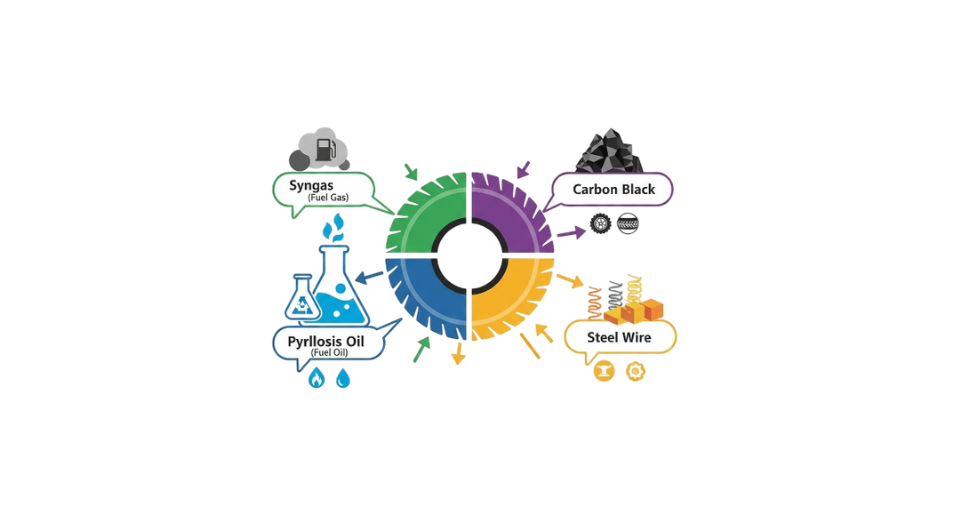
The report “Tire Pyrolysis Products Market By Product Type (True Pyrolysis Oil (TPO), Recovered Carbon Black (rCB), Steel & Inorganics, Gases (Syngas), Others), By Process (Batch Process, Continuous Process, Semi?Continuous Process), By Scale (Small Scale Plants, Medium Scale Plants, Large Scale Plants) and By End Use (Automotive, Industrial, Chemical Manufacturing, Paints & Coatings, Construction & Transportation, Others)” is expected to reach USD 12.9 billion by 2033, registering a CAGR of 11.50% from 2026 to 2033, according to a new report by Transpire Insight.
The global Tire Pyrolysis Products Market is expanding highly due to rising environmental issues, regulatory pressure on responsible tire waste disposal, and the ever-increasing need for the development of sustainable fuels and materials. The tire pyrolysis technology generates several products, including True Pyrolysis Oil (TPO), Recovered Carbon Black (rCB), steel, and syngas, which find several applications in the automotive, industrial, and chemical sectors, including the conventional fuels market, making it an environmentally acceptable way to obtain fuels and products. The development of several different technologies, including continuous and semi-continuous processes, has helped the tire pyrolysis market to expand worldwide. However, it is observed that market expansion is driven by increasing business activity in various nations, with a focus on developing nations where demand for energy is high and favorable policies promote recycling programs. TPO has now turned out to be a revenue generator as it serves as a source of fuel and chemicals, and rCB has been increasingly used in tire tread, plastic, and coating applications as a renewable alternative to carbon black. Steel recycling ensures better economics to a pyrolysis plant in terms of producing syngas. There is a strong need to construct medium and large plants to improve business activity, as these plants have a high yield of products.
Initiatives aimed at promoting sustainability and circular economy concepts are also favoring tire pyrolysis development and increasing its uptake across the global market. The encouragement of investors and governments of different nations towards eco-friendly waste-to-energy solutions is an added factor bolstering the tire recycling business. The technological upgrade and modularization of plant facilities help existing and new plants attain optimality and quality of tire-based materials. The focus of players within the tire recycling business today is rising as they aim at generating high-end products such as oil and carbon black grades, thereby enhancing the business’s profitability and competitiveness. The addition of energy recuperation within tire recycling facilities helps companies comply with environment regulations and save operating costs.
Overall, it is evident from the market growth rate chart that the market is slated for gradual growth in the coming years with pressures from regulation, industrialization, and awareness of sustainable waste management practices. While emerging markets such as Asia Pacific and South America are focusing on implementing medium and large-scale pyrolysis plants, developed markets such as North America and Europe are focusing on the development of new technologies to improve efficiency and increase their outputs.
The True Pyrolysis Oil (TPO) segment is projected to witness the highest CAGR in the Tire Pyrolysis Products during the forecast period.
According to Transpire Insight, The largest product segment out of the tire pyrolysis segment is True Pyrolysis Oil. This is primarily due to the different uses it is put to. First off, it is used as a source of fuel. Pyrolysis oil is useful in replacing conventional fuel used in different industrial processes. Additionally, it is used in the production of different intermediary compounds. The prospects presented by this product segment is also attributed to the technology used in the process. The product is attributed to the demand for energy globally, changes in the cost of crude oil, and the ongoing debate on global warming. Another reason is the existence of regulations demanding environmentally responsible ways of disposing of used tires.
TPO also contributes significantly to the generation of revenue for medium and large-scale plants, which is increasingly used in various markets, both developed and emerging, due to its efficiency and versatility for meeting the demand for industrial fuel. Additionally, investments in refining and upgrade processes for the production of TPO enhance its market position for generating premium quality fuel oils and chemical feedstocks. Further, the segment has a relatively strong market position for generating revenues due to strategic alliances established by various industries, which rely on the availability of various technologies for their operations. Overall, TPO has a strong market position for generating market share due to its intrinsic value.
The Continuous Process segment is projected to witness the highest CAGR in the Tire Pyrolysis Products during the forecast period.
Continuous pyrolysis processes will be representative of the top technology segment; these can provide high production capacity, efficiency, and quality consistency of the product. In contrast to batch systems, continuous operations relate more with medium- and large-scale plants, where industrial-scale output of TPO, rCB, and syngas is crucial. This process minimizes downtime, enhances energy utilization, and thus makes this process quite attractive to investors looking at operational efficiency with rapid returns on investment. Continuous processes are also in tune with the increasing emphasis laid down by regulatory bodies on environmental compliance and sustainability of operations since they ensure optimized feedstock conversion and reduced emissions.
These pyrolysis plants have the highest level of adoption in mature market segments like Europe and North America, due to high energy and raw material requirements from sector segments like industry and automobiles. Countries in emerging market segments, like Asia Pacific, also use continuous technology to cater to increasing energy and raw material needs of rising sector segments like industry. Technological upgrades, modular construction, and mechanization all point to an increased reliance on continuous technology in tire pyrolysis oil plant construction, which speaks vastly of its long-term market prospects.
The Large Scale Plants segment is projected to witness the highest CAGR in the Tire Pyrolysis Products during the forecast period.
According to Transpire Insight, Large-scale pyrolysis plants dominate the market due to the economies of scale and availability of these plants to serve the large demand of the industries requiring rCB, syngas, and TPO. Large-scale pyrolysis plants have the most efficient and technologically advanced continuous and semi-continuous methods of pyrolysis, which have the lowest production costs per unit of feedstock processed. Large-scale plants have the capability to produce large quantities, which is required by the industries requiring pyrolysis products, such as the automotive, chemical, and energy sectors.
Investments in large scale facilities are mainly present in countries with robust regulatory environments, indicating healthy underlying industrial activity. This includes investment in North America, Europe, and Asia Pacific. These investments help in generating predictable revenue through off-take agreements with large industrial/automobile customers, helping in the manufacture of grades of TPO as well as rCB, satisfying stringent product standards.
The Automotive segment is projected to witness the highest CAGR in the Tire Pyrolysis Products during the forecast period.
The most dominant end-use segment of the tire pyrolysis market is the automobile industry due to end of life tire recycling and sustainable sources of carbon black materials for tire manufacturing. The recycled carbon blacks offer similar tire performance at significantly lower environmental and business costs and are considered extremely attractive for both OEM and service industries. The use of such recycled carbon blacks is perfectly consistent with sustainability agendas within the automobile industry and removes the need for petroleum-based materials.
Additionally, the segment enjoys sustained demand stability. Tire demand will keep rising along with tire production. Further, expansion of the market presence of tire manufacturers in regions like Asia Pacific and North America, along with stringent regulations promoting tire recycling ensure sustained growth. Moreover, the presence of Pyrolysis units dedicated to the production of automotive-grade rCB and TPO tends to enter into offtake contracts with tire manufacturers. Subsequently, this boosts their demand for rCB. Adding high-quality rCB to tires and rubber products enhances the strength of the automotive segment, which remains a top segment by end-use applications.
The North America region is projected to witness the highest CAGR in the Tire Pyrolysis Products during the forecast period.
North America is an important regional market for tire pyrolysis products with stringent environmental regulations and well-established waste management systems. The United States is the largest sub-region of North America with many operating medium and large-scale continuous and batch reactor-based tire pyrolysis plants with capacities across the board for producing TPO, rCB, and syngas for industries and vehicles. Regulatory incentives are playing an important role in the rapid adoption of tire recycling technologies, particularly continuous reactor-based tire recycling due to its process operational benefits and superior product yield.
Further, the market growth in this region receives an added impetus from growing demand for products from automotive and chemical industries, which increasingly rely on sustainable alternatives of traditional feedstocks and energy sources, obtained from the process of pyrolysis. Investments made in R&D and technological upgrades also help the region’s dominance story, ensuring market players meet quality and environmental demands. The North American market also gets a boost from its logistics and supply infrastructure, along with technological leaders cooperating with feedstock and consumer partners, making it a growth market for the global tire pyrolysis market.
Key Players
The top 15 players in the Tire Pyrolysis Products market include Klean Industries, Scandinavian Enviro Systems, Pyrolysis Technologies LLC, Black Bear Carbon B.V., EcoGreen Enterprises, Novum Energy Australia Pty Ltd, Entyr Limited, Enespa AG, Niutech Environment Technology Corporation, Delta?Energy Group, City Circle Group (CCG), Bolder Industries, Waverly Carbon Ltd, Reoil SP.o.o., and Pyrum Innovations AG.
Drop us an email at:
Call us on:
+91 7666513636

 inquiry@transpireinsight.com
 APAC:+91 7666513636
 Address





