
Feb 23, 2026
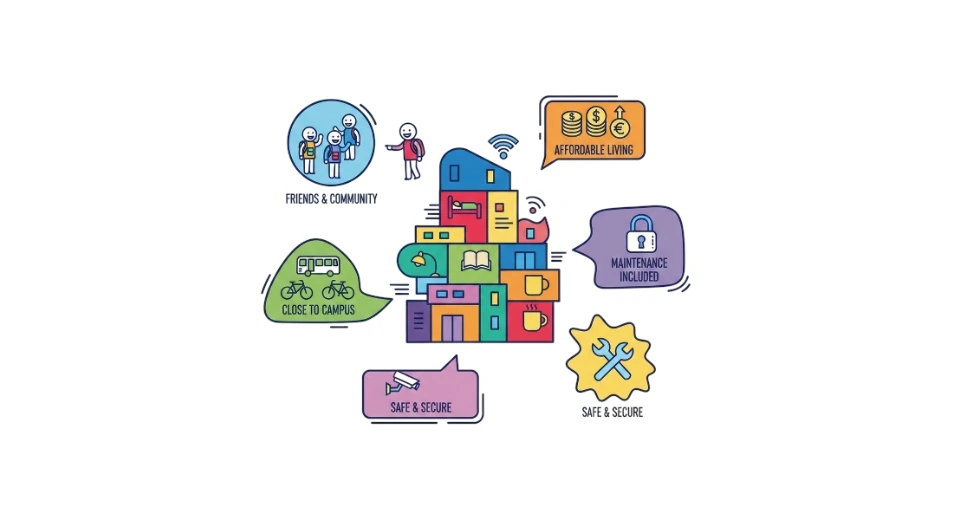
The report “Student Accommodation Market By Accommodation Type (On-Campus Accommodation, Off-Campus Accommodation), By Room Type (Single Room, Shared Room, Studio Apartment, Ensuite Room), By Duration of Stay (Short-Term (Less than 6 Months), Long-Term (6–12 Months), Extended Stay (More than 12 Months)) and By End User (Undergraduate Students, Postgraduate Students, International Students, Domestic Students)” is expected to reach USD 115.00 billion by 2033, registering a CAGR of 7.80% from 2026 to 2033, according to a new report by Transpire Insight.
The student accommodation sector is a niche real estate market that aims to deliver residential infrastructure specifically designed for the tertiary education sector. It includes university-owned residence, privately operated purpose-built student accommodation, and managed off-campus solutions. This market is driven by the convergence of the expansion of higher education, demographic changes, and real estate investment trends in the sector. The main drivers of the global market are the increasing number of students in higher education institutions and the continued growth of international student mobility. The increasing concentration of universities in Tier 1 cities has led to a shortage of housing, which has fueled the development of professionally managed accommodation assets. Private providers are increasing capacity to close the gap between demand and supply, especially in established education centers.
However, investment into student housing has improved as the sector shows relatively stable occupancy patterns, which are in sync with academic cycles. Institutional investors and real estate funds consider the sector a defensive and income-producing asset class, thanks to stable leasing patterns and a diversified resident base. Premiumization of the sector, with a focus on integrated amenities and online leasing platforms, is improving revenue streams. In addition, changing student preferences for privacy, security, and community-driven living spaces are redefining development patterns. Developers are concentrating on studio product, ensuite rooms, and flexible lease terms to meet changing consumer demands. As the global education sector and urban infrastructure evolve, the student housing sector is poised for medium- to long-term growth.
The Off-Campus Accommodation segment is projected to witness the highest CAGR in the Student Accommodation during the forecast period.
According to Transpire Insight, Off-campus accommodation leads in revenue share due to the limited capacity of on-campus housing and the growing trend of involving the private sector. The fast growth in enrollment numbers in urban universities has outpaced the development of institutional housing, leading to a high demand for purpose-built student housing. The private sector uses scale, management expertise, and integration with amenities to differentiate their offerings and command high rental returns.
The market gets a boost from the influx of institutional capital, which helps it expand into Tier 1 and Tier 2 university cities. Improved living conditions, security, and integrated services appeal to both local and international students. As universities collaborate with private developers to fill the housing gap, off-campus accommodation continues to show sustainable growth patterns.
The Studio Apartment segment is projected to witness the highest CAGR in the Student Accommodation during the forecast period.
Studio apartments are the most popular type of room layout in high-end student residential schemes. This is because of the growing demand for privacy, autonomy, and self-contained facilities. International and postgraduate students, in particular, value autonomy and convenience, which has led to high occupancy levels in this sector.
From an investment viewpoint, studios offer higher revenue per bed compared to shared accommodation. There is a growing trend among developers to allocate more space to compact but efficient room layouts to maximize revenue yield and meet student demands. In major education centers with higher disposable income, studio layouts continue to outperform in terms of pricing and retention.
The Long-Term (6–12 Months) segment is projected to witness the highest CAGR in the Student Accommodation during the forecast period.
According to Transpire Insight, The majority of the revenue generated in the market is from long-term stays that are in line with the academic calendar. This segment ensures that the revenue generated is predictable and that the occupancy rate is stable.
The reason why the long-term stay is the dominant segment is that it is in line with the academic structure of undergraduate and postgraduate courses offered around the world. The pricing strategies and packages offered by the operators are designed around the full academic year, ensuring that tenant retention is high.
The Undergraduate Students segment is projected to witness the highest CAGR in the Student Accommodation during the forecast period.
The biggest source of demand comes from undergraduate students because of the large number of enrollments. Freshers also need organized accommodation near the university, thereby promoting demand for managed accommodation formats. Affordability and proximity are key factors in this segment.
This segment also helps operators reap scale economies, allowing them to occupy large numbers of properties and have a stable leasing cycle. With the annual intake model, this segment of demand helps operators have a stable revenue stream. The expansion of tertiary education in emerging markets further boosts the growth trajectory of this segment.
The North America region is projected to witness the highest CAGR in the Student Accommodation during the forecast period.
North America is at the forefront of the student housing market, thanks to the well-established presence of institutions and the extensive university infrastructure. The United States is the major revenue-generating country, thanks to the large-scale private players and property management systems. The high number of foreign students and the redevelopment of old dormitories further boost the market.
The region has an established real estate investment system, with REITs and long-term investment strategies. The Canadian market is growing steadily with the increasing number of foreign students, while the Mexican market is a reflection of the developing private sector. The structured regulatory system and demand-driven market keep North America at the top.
Key Players
The top 15 players in the Student Accommodation market include Greystar Real Estate Partners, LLC, Unite Group plc, GSA Group, Scape Australia Group Pty Ltd, Yugo Group Holdings Limited, American Campus Communities, Inc., Campus Living Villages Pty Ltd, Mapletree Investments Pte Ltd, The Michaels Organization, Harrison Street Real Estate Capital LLC, Article Student Living, The Preiss Company, CA Ventures LLC, Brookfield Asset Management Ltd., and IQ Student Accommodation.
Drop us an email at:
Call us on:
+91 7666513636

 inquiry@transpireinsight.com
 APAC:+91 7666513636
 Address





