

Market Summary
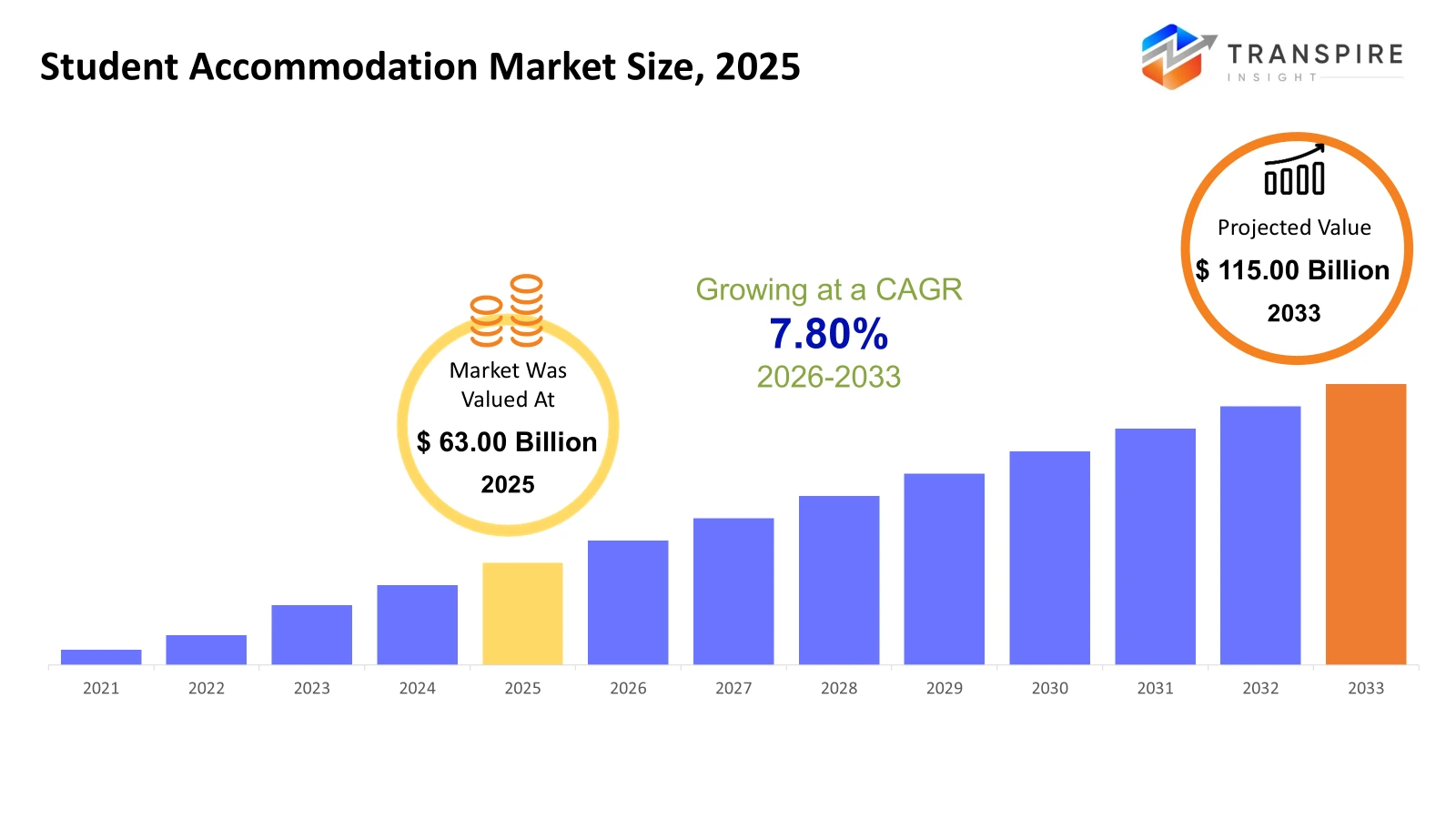
The global Student Accommodation market size was valued at USD 63.00 billion in 2025 and is projected to reach USD 115.00 billion by 2033, growing at a CAGR of 7.80% from 2026 to 2033. The growing global number of tertiary students, especially in emerging markets, is increasing the structural demand base for purpose-built and managed student housing assets
Market Size & Forecast
- 2025 Market Size: USD 63.00 Billion
- 2033 Projected Market Size: USD 115.00 Billion
- CAGR (2026-2033): 7.80%
- North America: Largest Market in 2026
- Asia Pacific: Fastest Growing Market
To learn more about this report,  Download Free Sample Report
Key Market Trends Analysis
- North America reflects robust institutional investment and a high level of penetration for purpose-built student accommodation, with enrollment-driven demand stability and a growing preference for amenity-rich assets located near Tier 1 university clusters.
- The United States drives revenue growth with significant university enrollments, an established private sector presence, and a growing trend of redevelopment of legacy dormitory infrastructure into contemporary, high-performing student housing product.
- The Asia Pacific market reflects rapid growth fueled by significant youth demographics, urbanization, and a growing trend of outbound and inbound student mobility patterns in Tier 1 and Tier 2 education markets.
- Off-campus accommodation drives revenue share, fueled by private sector developers, upscale amenities, and higher rental income in metropolitan academic centers.
- Single rooms and studio apartments reflect a growing adoption trend as students increasingly value privacy, security, and flexible accommodation options.
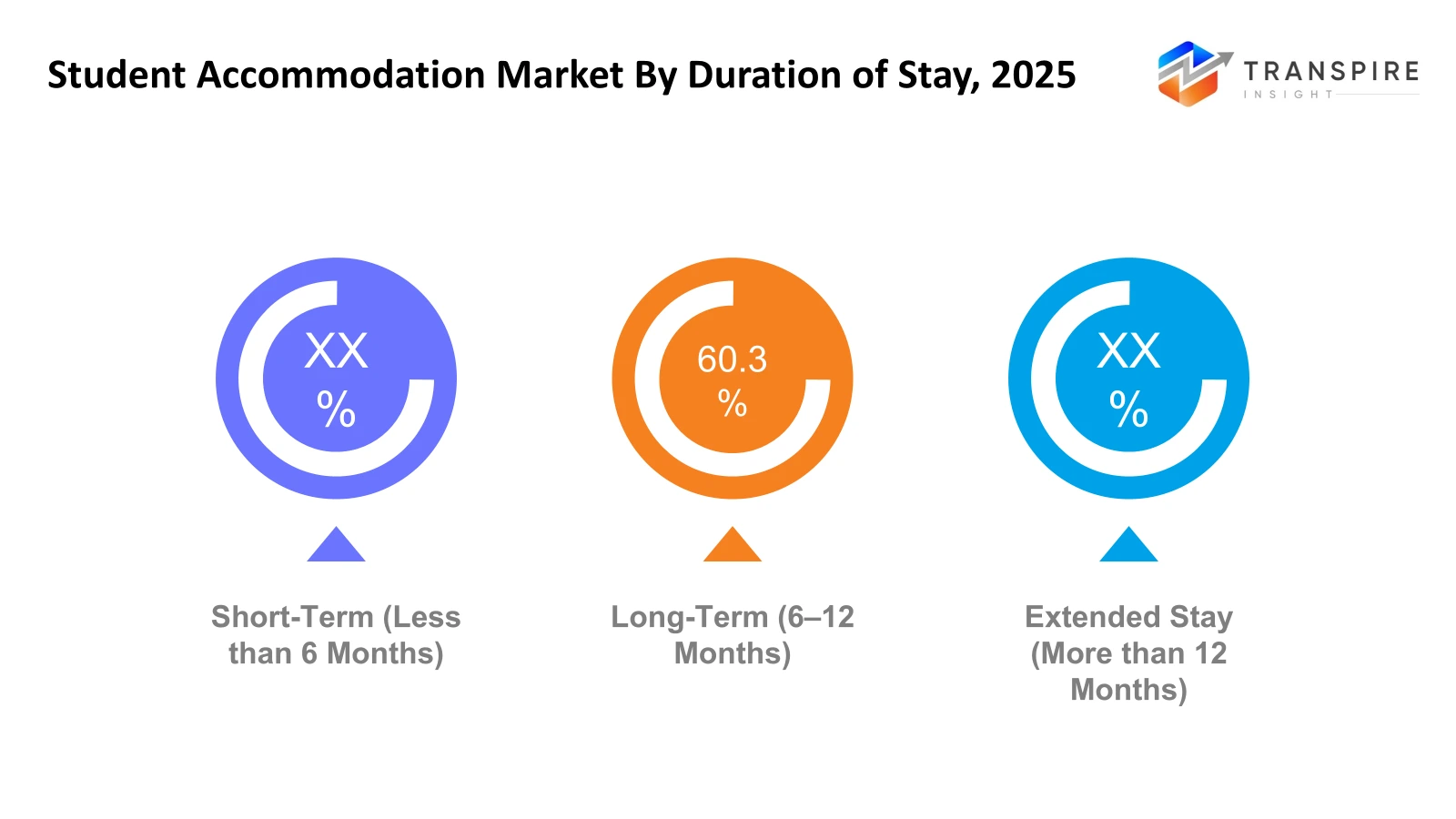
- Long-stay duration drives revenue contribution, reflecting academic cycles and offering stable revenue streams for operators.
- Undergraduate students comprise the largest source of occupancy, driving volume demand in both university-owned and private sector-operated student housing assets.
So, The student accommodation market consists of organized and semi-organized residential infrastructure exclusively designed for tertiary-level students. It encompasses university-owned dormitories, purpose-built student accommodations developed by the private sector, and rental housing designed for academic demographics. The sector exists at the nexus of real estate, educational infrastructure, and demographic mobility trends. Demand is directly linked to the growth of higher education enrollments, international student mobility, and urbanization of academic institutions. The rising scarcity of housing in academic cities has fueled the demand for professionally managed, secure, and amenity-integrated accommodation structures. The sector is perceived as a defensive real estate investment class due to its stable occupancy cycles, which are directly linked to academic intake cycles.
Operational factors are shaped by rental yields, construction costs, land accessibility, and regulatory environments that support the development of student housing. Online accommodation booking systems and flexible leasing options are improving accessibility and transparency. With the rise of university international partnerships and the development of hybrid learning models, the sector is undergoing transformation with the development of diversified accommodation offerings and service-oriented value propositions.
Student Accommodation Market Segmentation
By Accommodation Type
- On-Campus Accommodation
The on-campus accommodation market is a relatively stable one, fueled by the ownership of universities and the guaranteed proximity to educational facilities. Demand is directly tied to enrollment numbers and the number of international students entering the country. Capacity issues and aging infrastructure in the developed market are driving renovation and expansion projects.
- Off-Campus Accommodation
The off-campus accommodation market is a substantial market share, fueled by private providers and real estate investors. Purpose-built student accommodation and off-campus rentals provide overflow demand and high-end options. Urbanization and increased student mobility are driving the growth of this market. Competitive pricing and improved amenities are the primary differentiators in the urban market.
By Room Type
- Single Room
Single rooms are preferred for their privacy and concentrated study environments, especially among postgraduate and international students. The increasing need for personal space post-pandemic has fueled the growth of this market. Providers tend to charge a premium for single rooms due to their higher bed-space revenue. However, supply is affected by land and construction expenses.
- Shared Room
Shared rooms are still the most economical option and are in high demand among budget-conscious students, especially in developing countries. This market is fueled by high occupancy levels and space optimization. However, there is a gradual shift in demand towards semi-private or hybrid offerings. Cost remains the key driver for growth.
- Studio Apartment
Studio apartments are the luxury segment, offering fully self-contained living units. International students and long-stay residents drive this market due to their need for autonomy. Higher rental returns make this segment attractive to private investors and institutional players. Accessibility and proximity to universities have a major bearing on pricing.
- Ensuite Room
Ensuite rooms offer a balance between privacy and cost by providing private bathrooms along with shared common spaces. This type of accommodation is currently gaining popularity in purpose-built student accommodation schemes, as it offers an optimal solution for maximizing revenue while ensuring student comfort. This demand is particularly high in the European and Asia Pacific regions.
By Duration of Stay
- Short-Term (Less than 6 Months)
Short-term stays are driven by exchange programs, internships, and short academic programs. This market enjoys the benefits of flexible leasing options and furnished apartments. The operator typically uses higher monthly charges to compensate for the shorter stay duration. The market growth is linked to global trends in academic mobility.
- Long-Term (6–12 Months)
Long-term stays represent the primary revenue stream for the market, corresponding with traditional academic year schedules. The consistent occupancy levels ensure predictable revenue for the operator. Universities and private institutions value this market for its operational advantages. The demand is directly tied to annual enrollment cycles.
- Extended Stay (More than 12 Months)
Extended stays are typical of postgraduate, research, and international students. This market ensures stable occupancy and lower turnover costs. This market is most applicable in research-driven institutions and education centers in urban areas. The operator typically packages amenities to retain extended-stay customers.
To learn more about this report, Download Free Sample Report
By End User
- Undergraduate Students
Undergrads form the biggest demand source due to larger enrollment numbers. First-year students may favor on-campus or organized housing settings. Accessibility and affordability are major influencing factors. This demand source fuels maximum occupancy and regular demand patterns.
- Postgraduate Students
Postgrads value privacy, autonomy, and flexible tenures. Demand for studios and single-occupancy rooms is higher in this demand source. Longer stay periods and research engagements shape housing preferences. Expansion in graduate offerings worldwide fuels this demand source.
- International Students
International students contribute substantially to high-end and specialized housing demand. Safety, facilities, and all-inclusive pricing structures are major drivers. Exchange rate variations and visa regulations shape the growth trajectory of this demand source. Prime education centers in North America, Europe, and Australia derive maximum benefit from this demand source.
- Domestic Students
Domestic students represent the base demand driver in various geographies. Sensitivity to pricing and the need to commute affect housing decisions. In emerging markets, the primary housing options are shared and economy accommodations. Enrollment trends in urban universities remain a key driver for steady demand.
Regional Insights
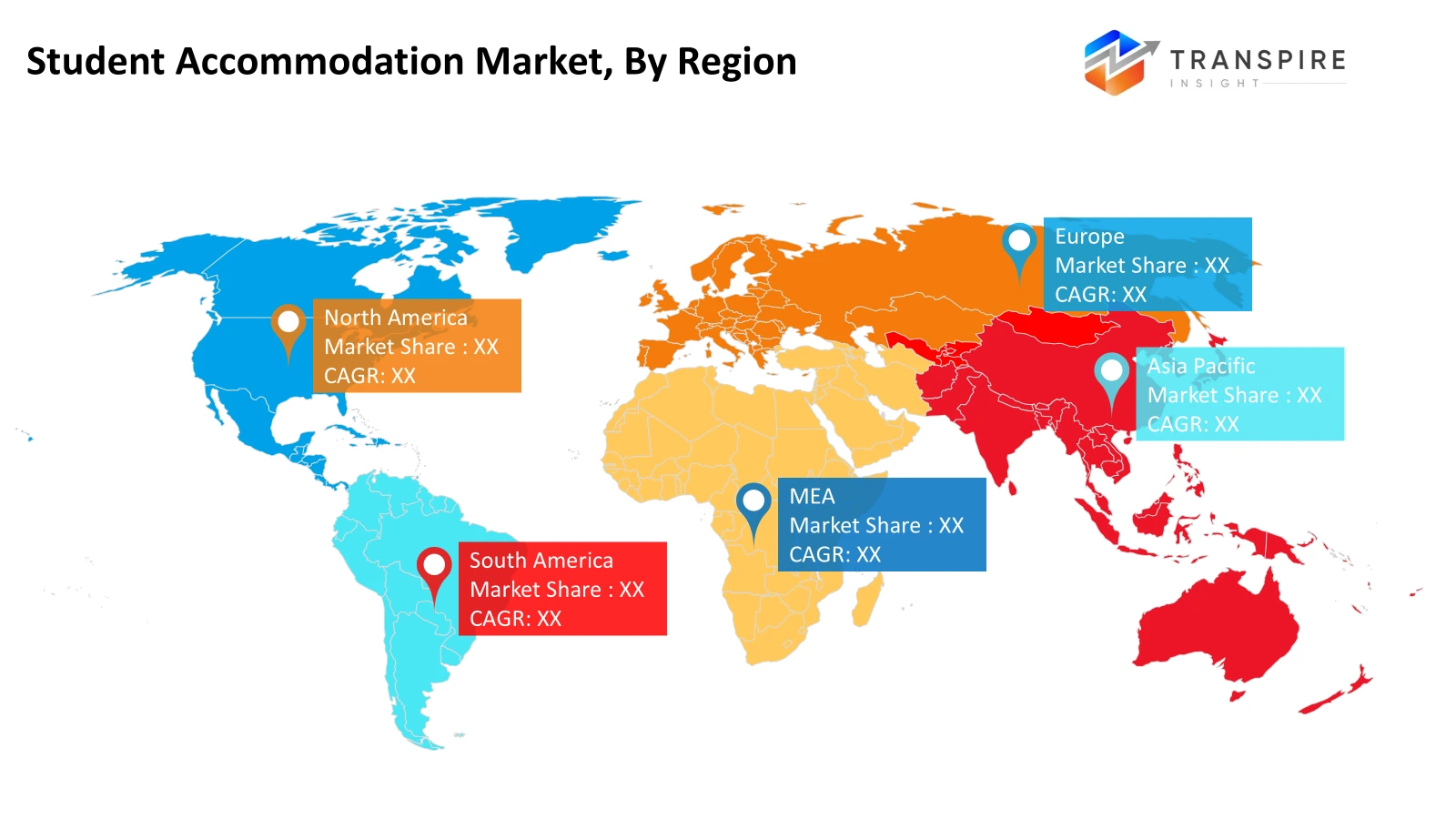
North America is a mature market with high institutional penetration. The United States is the main Tier 1 node with strong university clusters, while Canada is a Tier 2 market that is growing fast. Mexico is an emerging Tier 2 market that is developing around urban education hubs. Europe is a region with high cross-border mobility, thanks to its integrated education structures. The United Kingdom and Germany are Tier 1 investment nodes, while France, Spain, and Italy are Tier 2 markets that are seeing growing private sector involvement. The Rest of Europe is a market that is slowly institutionalizing its student housing assets.The Asia Pacific region is led by Tier 1 markets like China, Australia, and Japan, thanks to their large domestic and international student populations. India and South Korea are high-growth Tier 2 markets, while the Rest of Asia Pacific is an emerging market with slowly growing institutional interest. South America is still a developing region, with Brazil being the Tier 1 market and Argentina being a Tier 2 market. The Middle East & Africa region is growing with education investment-based Tier 1 markets in Saudi Arabia and the United Arab Emirates, with South Africa and the Rest of the region being Tier 2 markets.
To learn more about this report, Download Free Sample Report
Recent Development News
- October 2025, Greystar made an announcement regarding a A$1.6 b expansion in the student housing sector through its brand Accolade by Greystar, managing 4,084 beds in major university cities such as Sydney and Melbourne. The move is expected to double the existing number of beds in Australia by 2027.
(Source:https://www.greystar.com/business/about-greystar/newsroom/greystar-commences-student-housing-rollout)
- In March 2025, M&G Real Estate revealed the acquisition of a £135m purpose-built student accommodation (PBSA) scheme in Stratford, East London, taking the firm’s student housing portfolio to over £900m and 8,000 beds. The 500-bed development is scheduled for the 2028/29 academic year and aims for high sustainability levels, meeting a gap in a key education location.
(Source:https://www.mandg.com/news-and-media/press-releases/asset-management/2025/27-03-2025-2)
|
Report Metrics |
Details |
|
Market size value in 2025 |
USD 63.00 Billion |
|
Market size value in 2026 |
USD 68.00 Billion |
|
Revenue forecast in 2033 |
USD 115.00 Billion |
|
Growth rate |
CAGR of 7.80% from 2026 to 2033 |
|
Base year |
2025 |
|
Historical data |
2021 – 2024 |
|
Forecast period |
2026 – 2033 |
|
Report coverage |
Revenue forecast, competitive landscape, growth factors, and trends |
|
Regional scope |
North America; Europe; Asia Pacific; Latin America; Middle East & Africa |
|
Country scope |
United States; Canada; Mexico; United Kingdom; Germany; France; Italy; Spain; Denmark; Sweden; Norway; China; Japan; India; Australia; South Korea; Thailand; Brazil; Argentina; South Africa; Saudi Arabia; United Arab Emirates |
|
Key company profiled |
Greystar Real Estate Partners, LLC, Unite Group plc, GSA Group, Scape Australia Group Pty Ltd, Yugo Group Holdings Limited, American Campus Communities, Inc., Campus Living Villages Pty Ltd, Mapletree Investments Pte Ltd, The Michaels Organization, Harrison Street Real Estate Capital LLC, Article Student Living, The Preiss Company, CA Ventures LLC, Brookfield Asset Management Ltd., and IQ Student Accommodation |
|
Customization scope |
Free report customization (country, regional & segment scope). Avail customized purchase options to meet your exact research needs. |
|
Report Segmentation |
By Accommodation Type (On-Campus Accommodation, Off-Campus Accommodation), By Room Type (Single Room, Shared Room, Studio Apartment, Ensuite Room), By Duration of Stay (Short-Term (Less than 6 Months), Long-Term (6–12 Months), Extended Stay (More than 12 Months)) and By End User (Undergraduate Students, Postgraduate Students, International Students, Domestic Students) |
Key Student Accommodation Company Insights
Greystar Real Estate Partners, LLC has been a leading player in the international student housing industry due to its vertically integrated property management, development, and investment services. Greystar has been operating large-scale purpose-built student housing properties in North America, Europe, and Asia Pacific. The company’s diversified property portfolio, strong capital base, and management acumen enable it to expand effectively in Tier 1 university markets. Greystar’s focus on high-end amenities, technology-driven leasing platforms, and asset repositioning strategies improves its competitive positioning in the dynamic student housing industry.
Key Student Accommodation Companies:
- Greystar Real Estate Partners, LLC
- Unite Group plc
- GSA Group
- Scape Australia Group Pty Ltd
- Yugo Group Holdings Limited
- American Campus Communities, Inc.
- Campus Living Villages Pty Ltd
- Mapletree Investments Pte Ltd
- The Michaels Organization
- Harrison Street Real Estate Capital LLC
- Article Student Living
- The Preiss Company
- CA Ventures LLC
- Brookfield Asset Management Ltd.
- IQ Student Accommodation
Global Student Accommodation Market Report Segmentation
By Accommodation Type
- On-Campus Accommodation
- Off-Campus Accommodation
By Room Type
- Single Room
- Shared Room
- Studio Apartment
- Ensuite Room
By Duration of Stay
- Short-Term (Less than 6 Months)
- Long-Term (6–12 Months)
- Extended Stay (More than 12 Months)
By End User
- Undergraduate Students
- Postgraduate Students
- International Students
- Domestic Students
Regional Outlook
- North America
- United States
- Canada
- Mexico
- Europe
- Germany
- United Kingdom
- France
- Spain
- Italy
- Rest of Europe
- Asia Pacific
- Japan
- China
- Australia & New Zealand
- South Korea
- India
- Rest of Asia Pacific
- South America
- Brazil
- Argentina
- Rest of South America
- Middle East & Africa
- Saudi Arabia
- United Arab Emirates
- South Africa
- Rest of the Middle East & Africa
Frequently Asked Questions
Find quick answers to common questions.
The approximate Student Accommodation Market size for the market will be USD 115.00 billion in 2033.
Key segments for the Student Accommodation Market By Accommodation Type (On-Campus Accommodation, Off-Campus Accommodation), By Room Type (Single Room, Shared Room, Studio Apartment, Ensuite Room), By Duration of Stay (Short-Term (Less than 6 Months), Long-Term (6–12 Months), Extended Stay (More than 12 Months)) and By End User (Undergraduate Students, Postgraduate Students, International Students, Domestic Students).
Major Student Accommodation Market players are Huawei Technologies Co., Ltd., Sungrow Power Supply Co., Ltd., SMA Solar Technology AG, ABB Ltd., Schneider Electric SE.
The North America region is leading the Student Accommodation Market.
The CAGR of the Student Accommodation Market is 7.80%.
- Greystar Real Estate Partners, LLC
- Unite Group plc
- GSA Group
- Scape Australia Group Pty Ltd
- Yugo Group Holdings Limited
- American Campus Communities, Inc.
- Campus Living Villages Pty Ltd
- Mapletree Investments Pte Ltd
- The Michaels Organization
- Harrison Street Real Estate Capital LLC
- Article Student Living
- The Preiss Company
- CA Ventures LLC
- Brookfield Asset Management Ltd.
- IQ Student Accommodation
Recently Published Reports
-
Apr 2026
Bottled Water Market
Bottled Water Market Size, Share & Analysis Report By Product Type (Still Bottled Water, Carbonated Bottled Water, Functional Bottled Water, and Others), By Packaging (PET, Cans, and Others), By Sales Channel (Supermarkets/Hypermarkets, Convenience Stores/Drug Stores, Grocery Stores/Club Stores, Foodservice, and Others) and Geography (North America, Europe, Asia-Pacific, Middle East and Africa, South and Central America), 2021 - 2032
-
Apr 2026
Color Cosmetic Packaging Market
Color Cosmetic Packaging Market Size, Share & Analysis Report By Application (Mascara Packaging, Liquid Packaging, and Liquid Face), By Type (Tubes & Bottles, Pens & Markers, Compacts & Containers, and Droppers & Pumps), and Geography (North America, Europe, Asia-Pacific, Middle East and Africa, South and Central America), 2021 - 2031
-
Apr 2026
External Microphone For Camera Market
External Microphone For Camera Market Size, Share & Analysis Report By Type (Shotgun Microphone, Lavalier Microphone, and Others), By Application (Digital Camera, Professional Video Camera, and Others), and Geography (North America, Europe, Asia-Pacific, Middle East and Africa, South and Central America), 2021 - 2031
-
Apr 2026
Foot Orthotic Insoles Market
Foot Orthotic Insoles Market Size, Share & Analysis Report By Type (Pre-fabricated, and Custom-made), By Material (Thermoplastic, Composite Carbon Fiber, and Others), By Distribution Channel (Drug Stores, Hospitals & Clinics, and Others), and Geography (North America, Europe, Asia-Pacific, Middle East and Africa, South and Central America), 2021 - 2031