
Apr 03, 2026
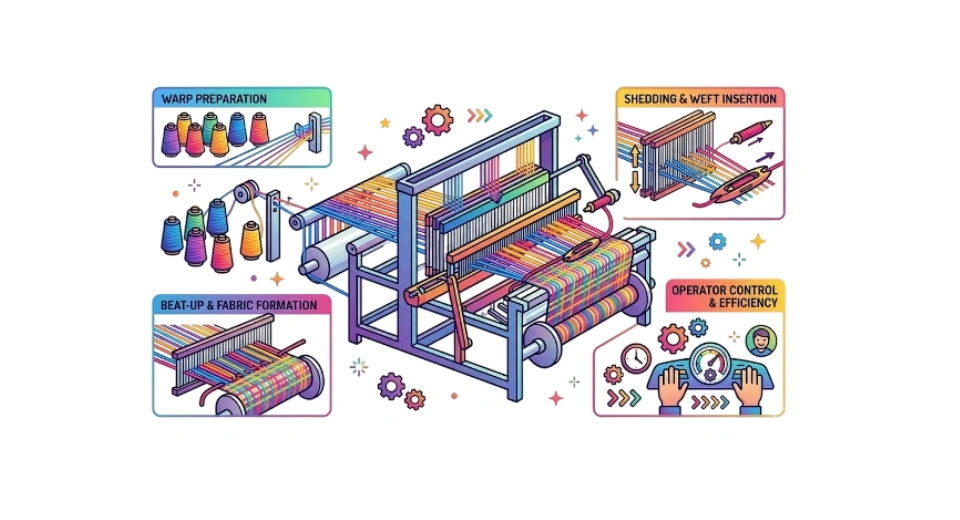
The textile industry depends heavily on machines that can produce fabric quickly and with good quality. Weaving machines play a key role in this process by turning yarn into fabric used in clothing, home textiles, and industrial materials. This strong demand supports the Global Weaving Machine Market. The market reached USD 6.9 billion in 2024 and is expected to grow to USD 7.21 billion in 2025. By 2033, the market will likely reach nearly USD 9.68 billion, growing at a CAGR of 4.30% during the forecast period according to Transpire Insights.
Air jet looms lead the Global Weaving Machine Market and account for about 45% of total demand. These machines use air to move yarn through the loom at very high speed. The system enables manufacturers to create fabric products at a faster and more effective pace. Air jet looms provide textile mills with two main advantages which include high productivity rates and stable fabric quality.
Textile mills continue to expand production to meet rising demand for fabrics across the world. Daily requirements include clothing, home furnishings, and industrial textiles. Weaving machines help manufacturers produce large volumes of fabric quickly. Companies invest in advanced weaving technology because textile product demand is increasing, and they want to enhance their production capacity while cutting down manufacturing expenses.
Rapier looms also play an important role in the Global Weaving Machine Market. The machines use multiple yarn types to create fabrics that meet high-quality standards. The system enables users to create intricate designs through its various features. Water jet looms use synthetic fibers for fast production but projectile looms deliver efficient performance with heavy fabrics. The production needs of different fabric types require particular equipment solutions.
The Global Weaving Machine Market experiences strong demand because of the need for fabrics which clothing manufacturers require to produce their products. Weaving machines provide the solution because clothing production requires factories to maintain constant access to fabric materials. The fashion industry demands efficient fabric production because fashion trends require quick manufacturer responses to market demand. The industry requires development of new weaving technologies to meet this demand.
Market expansion receives support from technical textiles because these materials find application in multiple industries. These materials find applications across various sectors including automotive and construction and healthcare. Products such as seat belts and airbags require industrial fabrics which need to use materials that provide both strength and durability. Weaving machines enable the production of these materials through their ability to create materials with exacting standards and excellent craftsmanship.
The Global Weaving Machine Market serves its primary customers through industrial manufacturing companies and textile manufacturing facilities. Textile mills use these machines to produce fabric in large quantities. Manufacturers use these machines to develop unique materials which serve various industrial purposes. Both groups need dependable equipment which helps them achieve their production targets.
The Global Weaving Machine Market recognizes Asia Pacific as its key region because China India and Bangladesh maintain strong textile production across their territories. These countries have large textile industries and export fabrics and garments worldwide. The market continues to expand because demand for textiles keeps growing in these areas.
The Global Weaving Machine Market is experiencing ongoing changes which result from technological advancements. Current machines operate at higher speeds while consuming less power and delivering superior fabric results. Certain machines feature digital control systems which enable production monitoring and error minimization. The improvements enable manufacturers to achieve better operational results while decreasing their waste output.
The market depends on automation as a crucial element. Automated weaving machines decrease the amount of required manual labor while they boost production efficiency. The system maintains product quality through entire production runs which extend beyond one manufacturing cycle. The need for advanced weaving machines increases as industries adopt automated processes.
The textile industry has begun to adopt sustainability practices as a vital requirement. Manufacturers have shifted their attention toward waste reduction and energy consumption mitigation. Modern weaving machines help manufacturers achieve this objective through their ability to decrease material waste while increasing operational efficiency. The company achieves environmental compliance through this system which enables production to continue at normal levels.
The Global Weaving Machine Market will experience growth in the upcoming years due to rising textile demand and expanding industrial applications and ongoing technological advancements. The weaving machine market will maintain its significance in the textile industry because of ongoing expansion in textile production.
Drop us an email at:
Call us on:
+91 7666513636

 inquiry@transpireinsight.com
 APAC:+91 7666513636
 Address





