

Global Weaving Machine Market Size & Forecast:
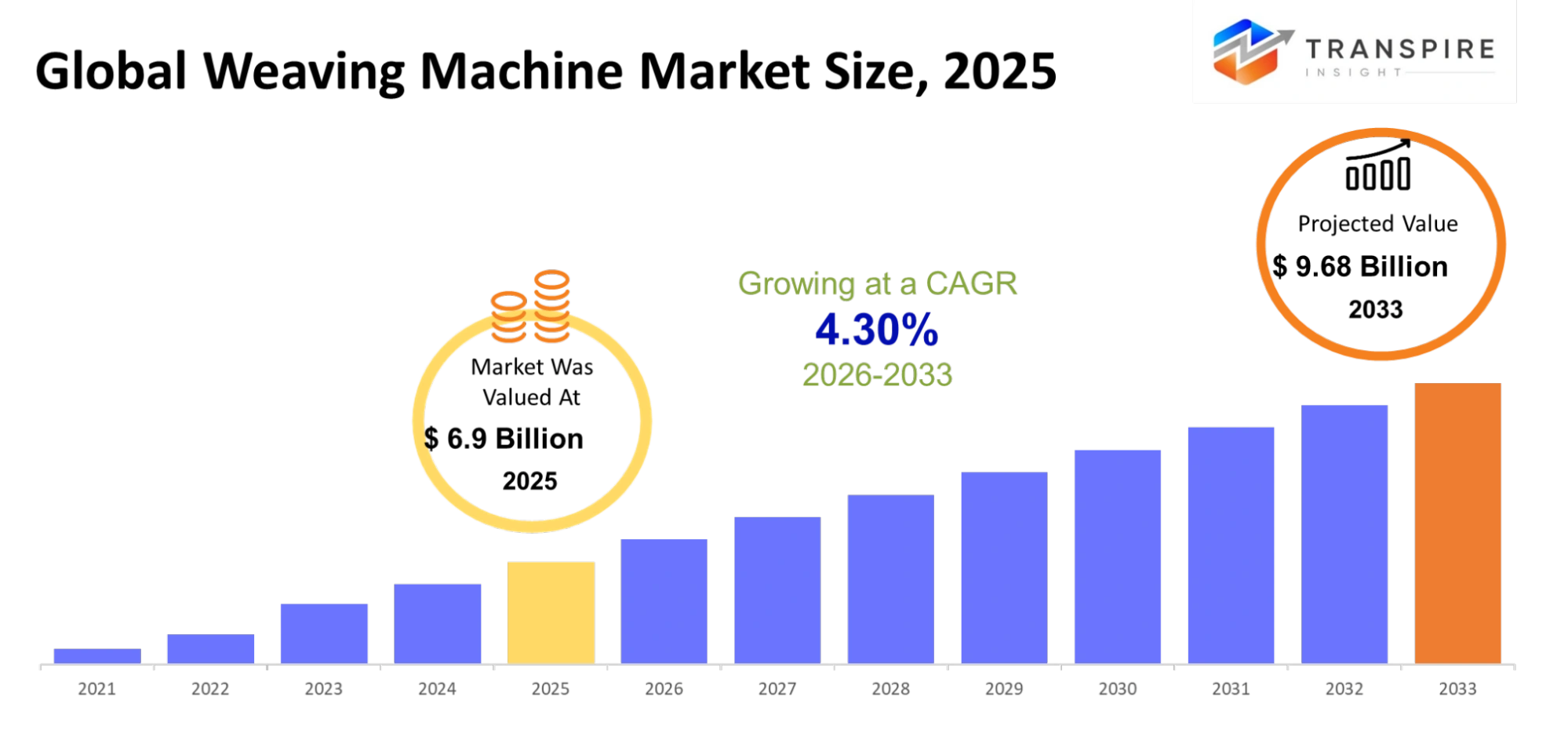
Global Weaving Machine Market Size 2025: USD 6.9 Billion
Global Weaving Machine Market Size 2033: USD 9.68 Billion
Global Weaving Machine Market CAGR: 4.30%
Global Weaving Machine Market Segments: By Machine Type (Air Jet Loom, Water Jet Loom, Rapier Loom, Projectile Loom), By Application (Textile Industry, Technical Textiles, Apparel Manufacturing), By End-User (Industrial Manufacturers, Textile Mills).
To learn more about this report,  Download Free Sample Report
Global Weaving Machine Market Summary:
The Global Weaving Machine Market was valued at USD 6.9 billion in 2025 and is forecast to reach USD 9.68 billion by 2033, growing at a CAGR of 4.30% from 2026 to 2033. Weaving machines, or looms, are the production equipment used to interlace warp and weft yarns into fabric. The type of machine chosen for a given operation depends on the yarn type, fabric construction, required production speed, and whether the fabric is destined for apparel, home textiles, or a technical application. Four main machine types divide the market: air jet, water jet, rapier, and projectile looms, each suited to a different range of materials and production requirements.
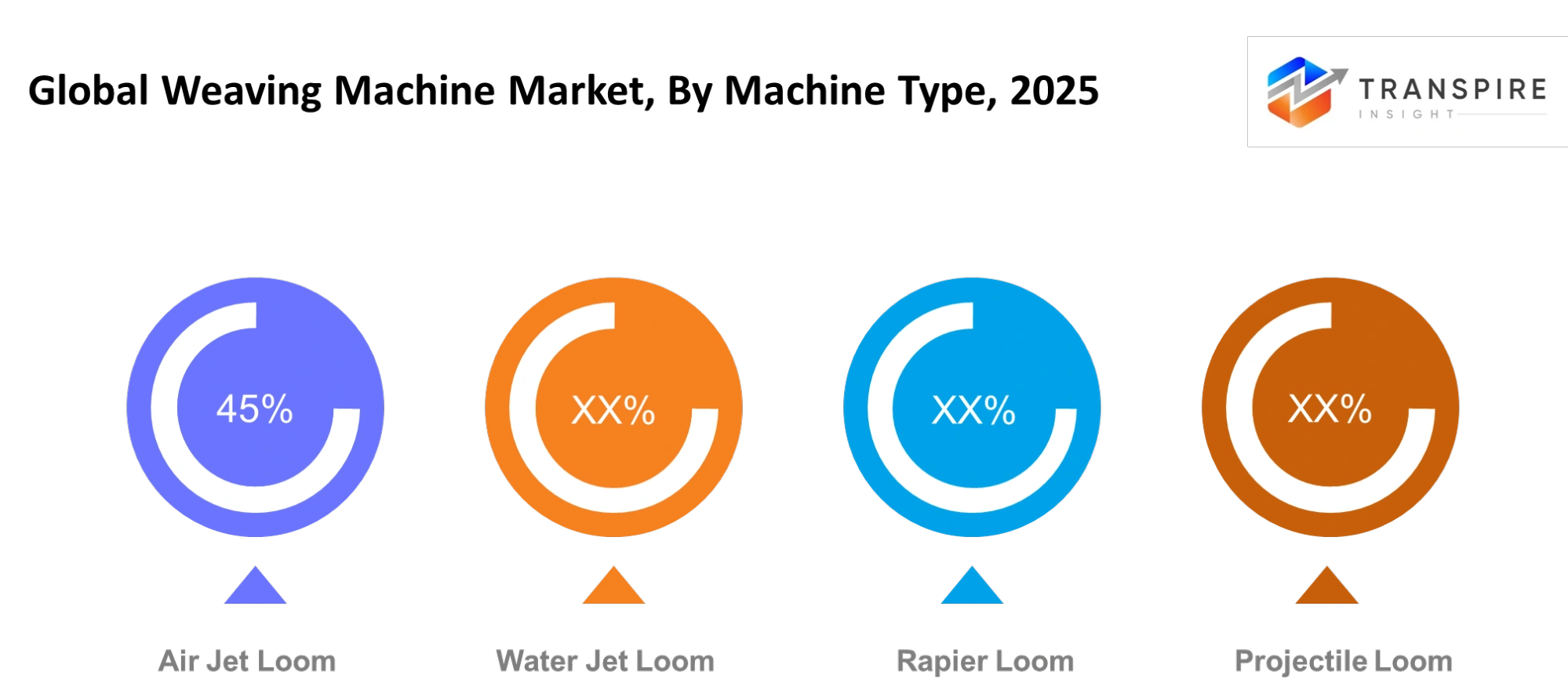
Air jet looms are the largest segment. The reason is straightforward: air jet looms are the fastest option available for weaving light-to-medium weight fabrics from spun yarns, particularly cotton and cotton blends. At weaving speeds that can exceed 1,000 picks per minute on modern machines, they suit the high-volume production of shirting, sheeting, denim, and similar commodity fabrics that form the backbone of global textile output. Their dominance reflects where the bulk of the world's fabric production actually sits.
Rapier looms cover the widest range of materials and fabric constructions of any loom type. They handle multifilament and textured yarns, heavier fabrics, complex weave structures, and yarns that air or water jet weft insertion would damage. Their flexibility makes them the standard choice for technical textiles and premium apparel fabrics where the specific construction of the weave is part of the product's performance specification.
Water jet looms occupy a narrower niche, suited to smooth synthetic filament yarns where water-based weft insertion works well, and the fabric can tolerate moisture during weaving. They are fast and cost-effective for that specific application but cannot substitute for air jet or rapier machines across a broader material range. Projectile looms are the oldest shuttle-free technology still in commercial use and handle very wide fabrics and heavy industrial constructions that other loom types cannot manage at comparable width.
Key Market Trends & Insights:
- Technical textiles are a growing application area, pulling demand toward rapier looms capable of handling the specialty yarns and complex weave structures that automotive, geotextile, and medical fabric applications require.
- China remains the largest single buyer of weaving equipment, and purchasing cycles at Chinese textile mills have an outsized effect on global machine demand in any given year.
- Machine manufacturers are integrating electronic dobby and jacquard systems, automated warp and weft monitoring, and remote diagnostics as standard features on mid-range and high-end platforms, reducing the skills gap required to run modern a shift towards Industry 4.0 in textile machinery, which stakeholders should consider for future strategic planning.
- Energy consumption per meter of fabric produced has become a critical factor for large mills operating under cost pressures or sustainability mandates. Machine suppliers are responding with design changes that reduce compressed air use in air jet systems and drive energy in all loom types, aligning with global sustainability trends and potential future regulations.
Global Weaving Machine Market Segmentation
By Machine Type
- Air Jet Loom: Air jet looms are the largest machine type in the Global Weaving Machine Market, accounting for approximately 45% of total revenue. They use a blast of compressed air to carry the weft yarn across the shed, allowing weaving speeds that are significantly higher than rapier or projectile systems on compatible materials. Air jet looms are well suited to spun yarns, particularly cotton, polyester-cotton blends, and viscose, at light to medium fabric weights. The main limitations are compressed air consumption, which is the primary energy cost of operation, and the restriction to yarns smooth and light enough to be carried reliably by the air stream. Fabric types produced on air jet looms include shirting, denim, bed sheeting, poplin, and a wide range of basic apparel constructions. High-speed air jet machines from leading manufacturers operate at reed widths of 190 to 250 cm and are standard equipment in large-volume textile mills across Asia.
- Water Jet Loom: Water jet looms insert the weft yarn using a pressurized jet of water. They are fast and mechanically simpler than rapier systems, but their application is limited to smooth synthetic filament yarns, primarily polyester and nylon, that can tolerate wetting without degradation or dimensional change. Water jet looms are common in the production of polyester taffeta, satin, lining fabrics, and some microfiber constructions. They are prevalent in China and Japan, where synthetic filament fabric production is concentrated. The segment's share of the Global Weaving Machine Market is smaller than air jet because the range of materials and fabrics they can produce is narrower. Mills weaving a product mix that includes natural or blended yarns need air jet or rapier equipment for those constructions.
- Rapier Loom: Rapier looms use a mechanical carrier, either a rigid or flexible rapier, to pass the weft across the shed. The mechanical weft insertion mechanism makes them compatible with a much wider range of yarn types than air or water jet systems, including textured yarns, multifilament, metallic yarns, chenille, slub yarns, and heavier constructions that jet insertion would damage or cannot reliably carry. Rapier looms are the standard machine for technical textiles, upholstery fabrics, jacquard weaves, terry cloth, denim in heavier weights, and any application where the fabric specification requires a yarn type or weave structure that air or water jet cannot accommodate. Their flexibility makes them more expensive to buy and slower to run than air jet looms on comparable fabrics, but for the product range they cover, they are the only practical machine type.
- Projectile Loom: Projectile looms use a small metal projectile to carry the weft yarn across the full width of the shed, then return the projectile independently for the next pick. The key advantage is working width: projectile looms can weave fabrics several meters wide, which makes them the machine of choice for industrial fabrics, heavy woolen goods, wide coating substrates, and technical constructions where the required fabric width exceeds what rapier or air jet machines can manage. They are the oldest of the four shuttle-free loom types still in active production and have a smaller and more specialized install base than air jet or rapier machines. Sulzer Ruti, now part of the broader industry supply chain, was historically the dominant name in projectile technology, and many older machines remain in service at mills producing heavy industrial fabrics.
To learn more about this report, Download Free Sample Report
By Application
- Textile Industry: The textile industry is the largest application segment in the Global Weaving Machine Market, covering the production of fabrics for home textiles, basic apparel constructions, and commodity fabric categories. Bed sheeting, toweling, shirting, lining, and curtain fabrics are all produced on looms sold into this segment. Mills operating in this space compete on cost per meter of output, which drives investment toward high-speed air jet and water jet machines on materials where those technologies are compatible. Demand for weaving equipment in this segment follows the broader textile production cycle, which is closely tied to apparel and home goods consumption in end markets and to the competitiveness of manufacturing locations on input costs.
- Technical Textiles: Technical textiles are fabrics manufactured for functional performance rather than appearance, covering applications in automotive interiors and structural composites, geotextiles for civil engineering, filtration media, medical textiles, ballistic protection fabrics, and reinforcement materials for construction and aerospace. This segment drives demand for rapier and, in some cases, projectile looms, because technical textile specifications typically call for materials and fabric structures that air or water jet looms cannot produce. Technical textiles have grown as a share of total fabric output because they carry higher margins than commodity fabrics and because the applications that use them, electric vehicles, infrastructure, medical devices, tend to be less price-sensitive than apparel. Equipment sold into this segment is typically more specialized and higher-value than standard commodity loom platforms.
- Apparel Manufacturing: Apparel manufacturing drives demand for weaving equipment across all four machine types, with the specific loom type depending on the fabric being produced. Volume shirting and trousers go on air jet lines. Denim uses both air jet and rapier depending on weight and construction. Suit fabrics, coatings, and structured woven apparel go on rapier machines. The apparel segment is large but price-sensitive, and weaving equipment investment in apparel-focused mills is closely tied to the order pipeline from brands and retailers. Shifts in sourcing geography, including moves from established to lower-cost production regions, affect where equipment investment happens rather than whether it happens, since fabric production follows the assembly operations.
By End-User
- Industrial Manufacturers: Industrial manufacturers include producers of technical textiles, filtration media, geotextiles, automotive fabrics, and composite reinforcement materials. This end-user category buys weaving equipment for applications where fabric performance specifications are tight and the production process must be qualified against specific customer or regulatory requirements. Machine selection is driven by the material and weave structure the application demands rather than by cost per unit of output. Equipment lifecycles tend to be longer than in commodity textile mills because the product range is more stable and the machines are not replaced simply to gain a speed or cost advantage on a standard fabric construction.
- Textile Mills: Textile mills are the largest end-user category in the Global Weaving Machine Market. They include large-scale integrated mills weaving commodity fabrics for apparel and home textiles, as well as smaller specialty mills weaving premium apparel fabrics, home furnishing materials, and niche constructions. Mills buy weaving equipment on capital expenditure cycles that reflect fabric demand in their end markets, the age and condition of their existing machine park, and competitive pressure from mills in other regions that have invested in newer equipment. In Asia, particularly in China, India, Bangladesh, and Vietnam, large mills operate hundreds or thousands of looms, and a single purchase program at one of these facilities can be significant enough to move a supplier's quarterly order intake.
Country Insights
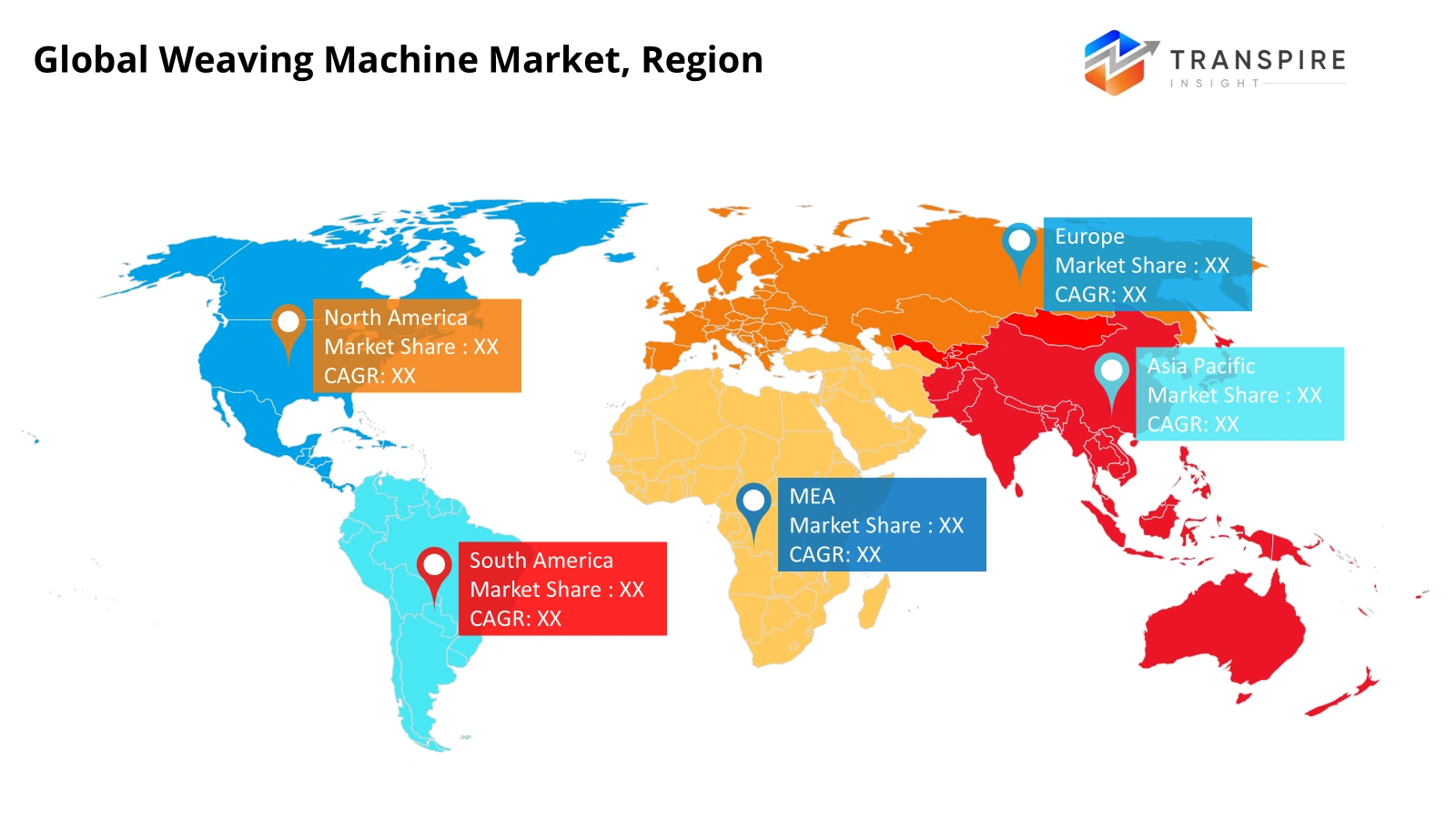
Asia-Pacific is the dominant region in the Global Weaving Machine Market, accounting for the largest share of both machine sales and installed capacity. China is the single largest market by a wide margin. Chinese textile mills operate a massive installed base of looms across cotton, synthetic, and technical textile production, and the pace of equipment replacement and capacity expansion in China sets the tone for global weaving machine sales in most years. Chinese machine manufacturers, including RIFA, Jiangsu Jinsheng, Ningbo Cixing, and Qingdao Haijia, have grown to compete effectively in the mid-range segment domestically and in export markets across Southeast Asia and South Asia.
India is the second-largest textile producer in Asia and has been growing its weaving capacity, particularly in technical textiles and man-made fiber fabrics. Government initiatives to expand textile manufacturing have supported equipment investment, and Indian mills have been buyers of both domestic and imported looms. Bangladesh and Vietnam buy weaving equipment as their fabric production sectors develop alongside their dominant apparel assembly industries.
Europe hosts the major loom manufacturers, including Picanol in Belgium, Itema and SMIT in Italy, Dornier in Germany, and Van de Wiele in Belgium. These companies sell globally and compete at the premium end of the market on machine performance, software capability, and service network breadth. European domestic weaving production is concentrated in technical textiles and premium apparel fabrics, where the volume does not match Asia but the fabric value per meter is significantly higher.
The Americas and Middle East are smaller markets for new weaving equipment. Turkey is an active market within the broader region, with a large integrated textile industry that invests in both air jet and rapier equipment. Brazil has a significant domestic textile sector that buys weaving machines for both apparel and technical applications. North American weaving capacity is limited relative to these regions, with domestic production concentrated in technical and industrial textiles.
To learn more about this report, Download Free Sample Report
Recent Development News
Several leading manufacturers in the Global Weaving Machine Market have released updated loom platforms with integrated sensor networks that monitor warp tension, weft insertion timing, and fabric construction in real time, feeding data to mill management systems for quality control and predictive maintenance. The practical benefit is a reduction in defect rates and unplanned downtime on lines running continuous high-speed production.
There is also product development activity around reduced compressed air consumption in air jet systems. Compressed air is the largest energy input in air jet weaving, and machines that reduce air consumption per pick while maintaining insertion reliability offer mills a running cost advantage that compounds over the multi-year life of the equipment. This has become a more active selling point as energy costs have remained elevated in major producing regions.
Report Metrics
|
Report Metrics |
Details |
|
Market size value in 2025 |
USD 6.9 Billion |
|
Market size value in 2026 |
USD 7.21 Billion |
|
Revenue forecast in 2033 |
USD 9.68 Billion |
|
Growth rate |
CAGR of 4.30% from 2026 to 2033 |
|
Base year |
2025 |
|
Historical data |
2021 - 2024 |
|
Forecast period |
2026 - 2033 |
|
Report coverage |
Revenue forecast, competitive landscape, growth factors, and trends |
|
Country scope |
Global |
|
Key company profiled |
Toyota Industries Corporation, Tsudakoma Corporation, Picanol Group, Itema Group, Dornier GmbH, RIFA Textile Machinery Co. Ltd., Jiangsu Jinsheng Industry Co. Ltd., SMIT Textile S.p.A., Ningbo Cixing Co. Ltd., Van de Wiele Group, Qingdao Haijia Machinery Co. Ltd., Zhejiang Rifa Textile Machinery Co. Ltd., Lindauer Dornier GmbH, Saurer Group, Karl Mayer Group. |
|
Customization scope |
Free report customization (country, regional & segment scope). Avail customized purchase options to meet your exact research needs. |
|
Report Segmentation |
By Machine Type (Air Jet Loom, Water Jet Loom, Rapier Loom, Projectile Loom), By Application (Textile Industry, Technical Textiles, Apparel Manufacturing), By End-User (Industrial Manufacturers, Textile Mills). |
Key Global Weaving Machine Company Insights
The Global Weaving Machine Market has a clear split between European and Japanese manufacturers at the premium end and Chinese manufacturers competing in the mid-range and value segments. The European and Japanese builders, including Picanol, Itema, Toyota Industries, Tsudakoma, Dornier, and Van de Wiele, hold the established positions in high-speed air jet, premium rapier, and specialty weaving applications. Their competitive advantages are machine longevity, global service networks, software and electronics integration, and the depth of application engineering they can provide to mills running demanding fabric specifications.
Chinese manufacturers have closed the technology gap in standard loom categories over the past fifteen years and now sell a substantial share of the mid-range looms installed in Asian mills. RIFA, Jiangsu Jinsheng, Ningbo Cixing, and Qingdao Haijia compete primarily on price and domestic market access, though some have extended their export reach into South and Southeast Asia and Africa. The competitive boundary between Chinese and European or Japanese machines sits at the point where software capability, consistent precision at high speeds, and long-term parts availability become the deciding factors.
Company List
- Toyota Industries Corporation
- Tsudakoma Corporation
- Picanol Group
- Itema Group
- Dornier GmbH
- RIFA Textile Machinery Co. Ltd.
- Jiangsu Jinsheng Industry Co. Ltd.
- SMIT Textile S.p.A.
- Ningbo Cixing Co. Ltd.
- Van de Wiele Group
- Qingdao Haijia Machinery Co. Ltd.
- Zhejiang Rifa Textile Machinery Co. Ltd.
- Lindauer Dornier GmbH
- Saurer Group
- Karl Mayer Group
Global Weaving Machine Market Report Segmentation
By Machine Type
- Air Jet Loom
- Water Jet Loom
- Rapier Loom
- Projectile Loom
By Application
- Textile Industry
- Technical Textiles
- Apparel Manufacturing
By End-User
- Industrial Manufacturers
- Textile Mills
Frequently Asked Questions
Find quick answers to common questions.
The Global Weaving Machine Market is expected to reach approximately USD 9.68 billion by 2033.
Key segments include Machine Type (Air Jet Loom, Water Jet Loom, Rapier Loom, Projectile Loom), Application (Textile Industry, Technical Textiles, Apparel Manufacturing), and End-User (Industrial Manufacturers, Textile Mills).
Major players include Toyota Industries Corporation, Tsudakoma Corporation, Picanol Group, Itema Group, Dornier GmbH, RIFA Textile Machinery Co. Ltd., Jiangsu Jinsheng Industry Co. Ltd., SMIT Textile S.p.A., Ningbo Cixing Co. Ltd., Van de Wiele Group, Qingdao Haijia Machinery Co. Ltd., Zhejiang Rifa Textile Machinery Co. Ltd., Lindauer Dornier GmbH, Saurer Group, and Karl Mayer Group.
The Global Weaving Machine Market size is approximately USD 6.9 billion in 2025.
The Global Weaving Machine Market is expected to grow at a CAGR of 4.30% from 2026 to 2033.
- Toyota Industries Corporation
- Tsudakoma Corporation
- Picanol Group
- Itema Group
- Dornier GmbH
- RIFA Textile Machinery Co. Ltd.
- Jiangsu Jinsheng Industry Co. Ltd.
- SMIT Textile S.p.A.
- Ningbo Cixing Co. Ltd.
- Van de Wiele Group
- Qingdao Haijia Machinery Co. Ltd.
- Zhejiang Rifa Textile Machinery Co. Ltd.
- Lindauer Dornier GmbH
- Saurer Group
- Karl Mayer Group
Recently Published Reports
-
Apr 2026
Handling and Lifting Equipment Market
Handling and Lifting Equipment Market Size, Share & Analysis Report By Product (Cranes and Hoists, Forklifts, Conveyor Systems, Aerial Work Platforms, Others), By Application (E-Commerce, Automotive and Railway, Food and Beverages, Aviation, Others), and Geography (North America, Europe, Asia-Pacific, Middle East and Africa, South and Central America), 2021 - 2031
-
Apr 2026
HVAC Equipment Market
HVAC Equipment Market Size, Share & Analysis Report By Heating Equipment Type (Boilers and Furnaces, Heat Pumps, and Unitary Heaters), By Ventilation Equipment (Air Handling Units, Humidifiers and Dehumidifiers, Air Filters, and Fan Coiling Units), By Air Conditioning Equipment (Unitary Air Conditioners, Room Air Conditioners, Packaged Terminal Air Conditioners, and Chillers), By End User (Commercial, Residential, Industrial, and others), and Geography (North America, Europe, Asia-Pacific, Middle East and Africa, South and Central America), 2021 – 2031
-
Apr 2026
Refrigeration Valves Market
Refrigeration Valves Market Size, Share & Analysis Report By Type (Solenoid Valves, Expansion Valves, Check Valves, Service Valves, Others), By Application (Commercial Refrigeration, Industrial Refrigeration, Transport Refrigeration, Residential Refrigeration, Air Conditioning Systems), By End User (Food and Beverage Industry, Pharmaceutical Industry, HVAC Industry, Chemical Industry, Others), and Geography (North America, Europe, Asia-Pacific, Middle East and Africa, South and Central America), 2021 – 2031
-
Apr 2026
E-Commerce Packaging Materials Market
E-Commerce Packaging Materials Market By Material Type (Corrugated Boxes, Paper & Paperboard, Foam & Cushioning Materials, Plastic Packaging, Flexible Packaging, Protective Packaging, Others), By Product(Primary Packaging, Secondary Packaging, Tertiary Packaging), By Packaging Function (Protective Packaging, Branding & Presentation Packaging, Transit & Logistic Packaging, Sustainable Packaging, Tamper Evidence Packaging), By End-User (Retail & Consumer Goods, Electronic Appliances, Food & Beverages, Healthcare & Pharmaceutical, Fashion & Apparel, Home & Furnishing, Others); By Industry Analysis, Size, Share, Growth, Trends, and Forecasts 2021-2033