
Aug 04, 2026
By Transpire Insight
Description
According to a research report published by Transpire Insight, the ship leasing market size is projected to grow from USD 45,209 million in 2026 to USD 62,516 million by 2035, at a CAGR of 14.23% during the forecast period 2026-2035. Expanding seaborne trade fuels the demand for modern shipping capacity. High upfront vessel costs drive operators toward flexible leasing structures. Strict environmental rules push companies to lease eco-friendly ships without buying them directly.
Introduction
The ship leasing market offers flexible financing and vessel charters to ocean transport operators globally. Leasing allows shipping carriers to expand fleet capacity while reducing capital outlay and managing financial risk. As trade volume grows and international environmental standards tighten, operators turn to leasing providers for modern, fuel-efficient ships. This asset-light model provides essential flexibility during shifting market conditions. Consequently, leasing firms now supply a vital portion of the commercial fleet across container, tanker, and dry bulk sectors.
Recent Development News
Stay Ahead of Emerging Opportunities with Expert Market Insights by Transpire Insight
Transpire Insight provides comprehensive, data-driven market intelligence to support smarter business decisions. Our research is rooted in comprehensive analysis, authoritative predictions, and industry expertise, enabling organizations to make informed decisions in rapidly evolving markets. In-depth analysis of market segmentation, competitive positioning, regional trends, and emerging investment opportunities in high-growth areas. We blend accuracy with actionable intelligence, empowering companies to uncover new avenues for growth, bolster strategic decision-making, and stay ahead in a dynamic market.
Download the exclusive Ship Leasing Market sample report today to uncover expert insights, emerging trends, and the opportunities defining the future of the industry.
Ship Leasing Market Size & Statistics
Regional Growth and Demand Analysis by Transpire Insight
In North America, the market is anchored by the United States and Canada, where major ports, fast technological change, and rising economic growth continue to expand demand for leased tonnage, while the region includes the U.S. and Canada among the countries covered in vessel time-, bareboat-, and voyage-chartering revenue. An increase in the number of ship leasing firms operating in the region, alongside currently low interest rates, has reinforced North America's leadership position even as growth elsewhere accelerates.
Asia-Pacific's growth is being propelled by China, Japan, South Korea, and India. China holds approximately 65% of the shipbuilding order book, making local Chinese leasing houses the seamless, cost-effective financing route since the ships are built domestically. Chinese leasing houses backed by state-owned banks are expanding their portfolios, with top players now managing asset bases exceeding HK$43.8 billion, while a 2.3% projected rise in maritime trade volumes is boosting demand for fresh tonnage across the region. South Korea and Japan add proximity to leading shipyards, enabling comprehensive "build-and-lease" options that traditional Western banks struggle to match, while India's emergence as a major trading power and its expanding manufacturing base add further leasing opportunities.
Top 15 Trends in the Ship Leasing Market
Proceed to Checkout to purchase the exclusive Ship Leasing Market report and gain instant access to in-depth market intelligence, strategic analysis, and future growth opportunities.
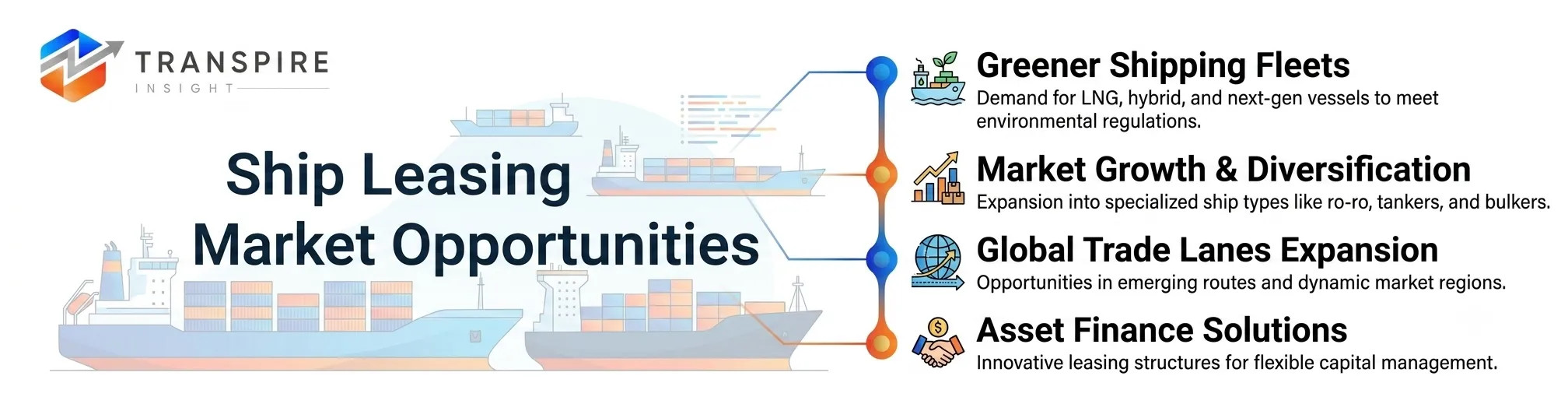
Traditional commercial banks are exiting due to tougher capital rules, letting specialized leasing firms fill the void, shifting the industry from ownership to usership.
Shipowners increasingly use sale-and-leaseback structures to free capital from existing fleets, funding the sizable financial demands of the energy transition.
Leasing firms are transitioning toward eco-friendly, dual-fuel vessels to meet sustainability standards, exemplified by Bocomm Leasing's $650 million dual-fuel tanker deal with Shell.
China holds roughly 65% of the shipbuilding order book, making local Chinese leasing houses the natural, cost-effective financing choice for new vessels.
LNG and gas carriers are the hottest leasing segment, as energy-security priorities push demand; China's largest lessor invested $150 million in three LNG carriers.
Asia-Pacific commands 22% of market share as the primary catalyst for vessel supply and financing, growing at a CAGR of 15.8% through 2033.
List of Top 25 Companies Leading the Ship Leasing Market
Customize the exclusive Ship Leasing Market report today to receive tailored insights, country-specific analysis, and business-focused market intelligence.
1. ICBC Financial Leasing Co., Ltd.
Operates one of the largest state-backed maritime lease portfolios globally.
Founded: 2007 | HQ: Beijing, China.
Why It Ranks: Holds massive total asset value across diverse international vessel classes.
Regional Dominance: Strongest presence across Asia-Pacific while supporting container trade routes.
Product Line: Bareboat charters, finance leases, and eco-vessel funding for commercial fleets.
2. CSSC (Hong Kong) Shipping Company Limited
First shipyard-affiliated leasing platform listed on the Hong Kong Stock Exchange.
Founded: 2012 | HQ: Hong Kong.
Why It Ranks: Controls a huge modern fleet deeply tied to major shipbuilders.
Regional Dominance: Dominates Asian shipbuilding finance with extensive international trade reach.
Product Line: Operating leases, finance leases, and specialized sale-and-leaseback maritime deals.
3. CMB Financial Leasing Co., Ltd.
One-liner Fact: Key subsidiary of China Merchants Bank backing large-scale newbuilding projects.
Founded: 2008 | HQ: Shanghai, China
Why It Ranks: Manages immense capital deployment into maritime transport assets.
Regional Dominance: Holds massive influence across East Asian ports and transatlantic shipping lanes.
Product Line: Long-term bareboat leases, sale-and-leaseback structures, and green shipping loans.
4. Bocomm Financial Leasing Co., Ltd.
Premier Chinese bank-backed lessor with extensive international commercial ship holdings.
Founded: 2007 | HQ: Shanghai, China.
Why It Ranks: Ranks near the top for total funded shipping asset volume.
Regional Dominance: Dominates Asian capital markets while serving container carrier lines.
Product Line: Structured ship leases, bareboat charters, and fleet renewal financing plans.
5. Seaspan Corporation (Atlas Corp.)
World's largest independent containership lessor serving major ocean liners.
Founded: 2000 | HQ: Hong Kong.
Why It Ranks: Operates a massive fleet of container vessels under fixed charters.
Regional Dominance: Commands major transpacific, Asia-Europe, and intra-Asian container trade corridors.
Product Line: Long-term time charters, container vessel leasing, and fleet management.
6. SFL Corporation Ltd.
Features an unbroken quarter-century track record of regular dividend distributions.
Founded: 2003 | HQ: Hamilton, Bermuda.
Why It Ranks: Maintains a multi-billion-dollar charter backlog across diversified maritime asset classes.
Regional Dominance: Widespread footprint across European, North American, and Asian energy routes.
Product Line: Tanker leases, container charters, car carriers, and dry bulk vessels.
7. Ship Lease, Inc.
Focuses specifically on mid-sized and smaller container ships for liners.
Founded: 2007 | HQ: London, United Kingdom.
Why It Ranks: High profitability backed by locked-in, long-term operator charter contracts.
Regional Dominance: Strong position along intra-regional trade routes across Europe and Asia.
Product Line: Fixed-rate time charters and mid-size containership operating lease agreements.
8. Ocean Yield ASA
Norwegian vessel owner targeting long-term charter contracts with fixed yields.
Founded: 2012 | HQ: Lysaker, Norway.
Why It Ranks: Strong balance sheet backed by stable cash flows from counterparties.
Regional Dominance: Highly prominent across Northern European maritime and offshore energy sectors.
Product Line: Bareboat charters, eco-friendly tankers, gas carriers, and container ships.
9. Triton International Limited
Dominates intermodal container leasing supporting ocean freight trade flows.
Founded: 1980 | HQ: Hamilton, Bermuda.
Why It Ranks: Unmatched market scale in intermodal transport equipment and vessel support.
Regional Dominance: reach spanning major ports across North America, Europe, Asia.
Product Line: Operating leases, master leases, and customized equipment purchase-leaseback options.
10. Costamare Inc.
Decades-long history delivering container and dry bulk shipping charter services.
Founded: 1975 | HQ: Monaco.
Why It Ranks: Flexible capital structure allowing fleet adjustments across maritime business cycles.
Regional Dominance: Strong market presence throughout Mediterranean, Transatlantic, and Asian shipping lanes.
Product Line: Dry bulk vessel charters, containership leasing, and vessel management services.
Schedule a meeting with our market experts to discuss the exclusive Ship Leasing Market report and identify the best research solution for your organization.
Conclusion
The ship leasing market remains vital for modern ocean trade. Leasing offers operators crucial financial flexibility while reducing the heavy burden of direct vessel ownership. Leading firms drive industry growth by supplying modern, energy-efficient ships that satisfy strict international environmental standards. As trade volumes rise and eco-friendly technologies advance, ship leasing provides the capital and assets needed to keep sea transport moving efficiently. This dynamic market will continue supporting sustainable maritime growth well into the future.


Send us a brief description of your challenge and we'll get back to you within 24 hours.

 [email protected]
 APAC:+91 7666513636
 Address


