
Nov 16, 2026
By Transpire Insight
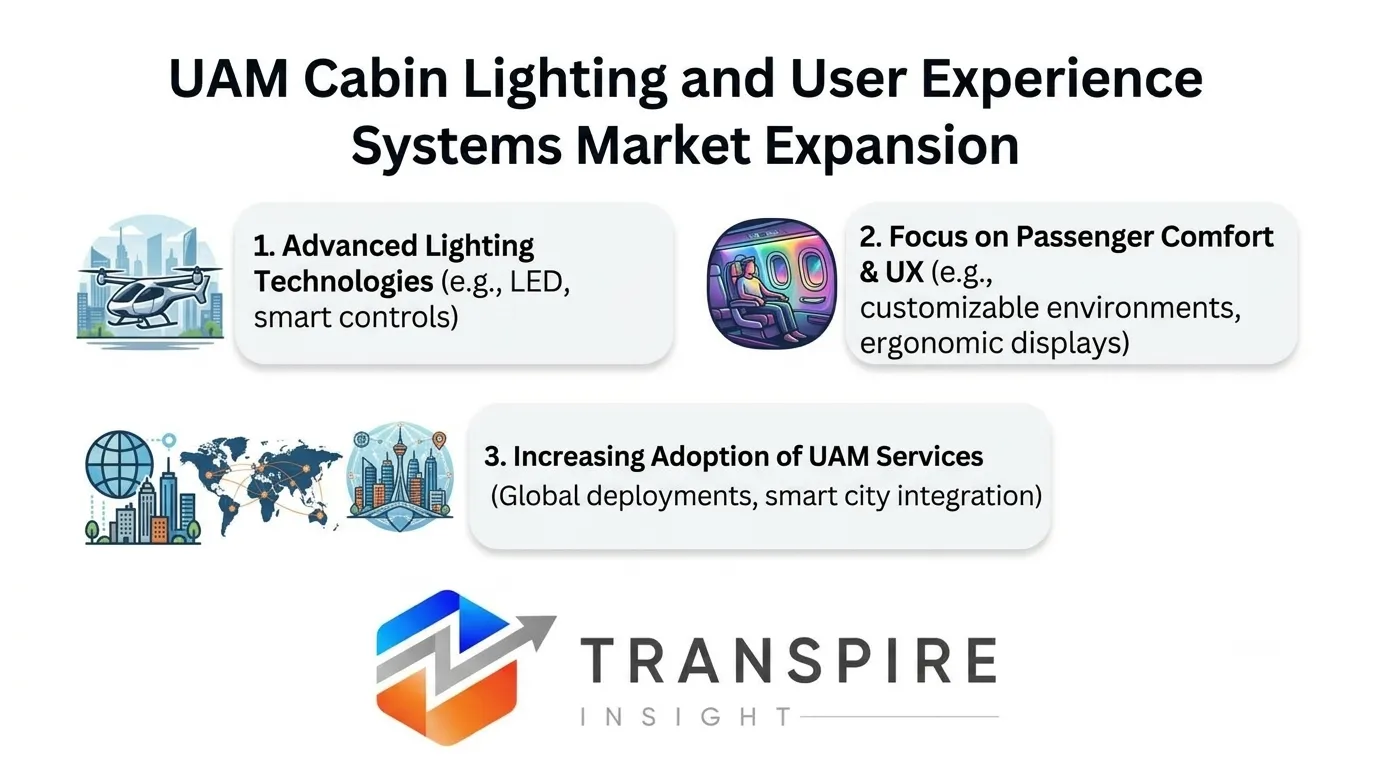
Description
According to a research report published by Transpire Insight, the global UAM Cabin Lighting and User Experience Systems Market was valued at USD 16.8 million in 2026 and is projected to reach approximately USD 24.11 million in 2027. Based on the forecast CAGR of 43.51%, the market is expected to reach approximately USD 433.76 million by 2035, compared with USD 210.6 million in 2033. The rapid development of urban air mobility, increasing investment in electric vertical take-off and landing (eVTOL) aircraft, and demand for passenger-focused aircraft interiors are supporting market expansion. Manufacturers are concentrating on lightweight LED lighting, adaptive cabin illumination, digital passenger interfaces, ambient lighting controls, connectivity, and integrated cabin management systems. North America led the market in 2025, followed by Europe, while Asia Pacific is projected to record the fastest growth.
Introduction
Passengers entering an electric vertical take-off and landing (eVTOL) aircraft expect clear information, comfortable lighting, accessible controls, and an interior that feels safe. These requirements are creating a specialized market for UAM cabin lighting and user experience systems.
Unlike conventional commercial aircraft, UAM vehicles are being designed around shorter journeys, compact cabins, limited passenger capacity, and frequent aircraft turnaround. Cabin equipment therefore needs to occupy less space, consume less electrical power, and remain easy to maintain.
Lighting is one part of the system. LED ceiling illumination, reading lights, ambient lighting, emergency indicators, illuminated controls, and adaptive brightness settings contribute to the passenger environment. User experience systems extend further into digital displays, passenger information interfaces, cabin connectivity, environmental controls, and communication between passengers and aircraft operators.
The competitive structure includes two groups. Established aerospace equipment suppliers such as Astronics, Collins Aerospace, Diehl Aviation, Safran, and Honeywell bring aircraft certification and cabin-system experience. Meanwhile, UAM developers such as Joby Aviation, Archer Aviation, Vertical Aerospace, Eve Air Mobility, and Wisk Aero are developing the aircraft platforms that will determine future cabin requirements.
The distinction is significant. Not every eVTOL manufacturer produces its own cabin lighting, and not every conventional aircraft lighting supplier has announced a dedicated UAM contract.
Recent Development News
March 2026: Joby Aviation announced the first flight of its FAA-conforming aircraft intended for Type Inspection Authorization (TIA) testing. The development marked progress toward aircraft certification and commercial passenger operations. As eVTOL platforms move closer to operational service, cabin equipment suppliers face growing requirements for production-ready lighting, passenger interfaces, and integrated aircraft systems.
April 2026: Vertical Aerospace completed a two-way piloted transition flight with its full-scale Valo eVTOL aircraft. The milestone demonstrated the aircraft's transition between helicopter-style and airplane-style flight modes under regulatory design-organisation oversight. Continued aircraft development provides an opportunity for suppliers of lightweight cabin equipment and passenger-focused interior technologies.
September 2026: Wisk Aero published its design approach for the passenger experience inside its Generation 6 autonomous eVTOL aircraft. The company highlighted cabin experience as a major consideration in developing an autonomous air taxi, with attention to passenger expectations and the differences between conventional aviation and urban transportation. This development reinforces the importance of designing cabin systems around the passenger rather than simply adapting existing commercial aircraft interiors.
Stay Ahead of Emerging Opportunities with Expert Market Insights by Transpire Insight
Transpire Insight provides market intelligence covering emerging aerospace technologies, competitive developments, market sizing, regional demand, and future industry opportunities.
Our research examines the relationship between aircraft manufacturing, cabin equipment suppliers, technology integration, and passenger experience requirements. We assess established manufacturers alongside emerging UAM developers to identify potential supply-chain opportunities.
The research supports manufacturers, investors, component suppliers, aerospace engineering companies, and business strategists evaluating the commercial potential of next-generation aircraft cabin technologies.
UAM Cabin Lighting and User Experience Systems Market Size & Statistics
Regional Growth and Demand Analysis by Transpire Insight
North America
North America held the leading position in the UAM Cabin Lighting and User Experience Systems Market in 2025. The region benefits from established aerospace manufacturing capabilities, aircraft equipment suppliers, technology development, and investment in electric aviation.
The United States is particularly important because several UAM developers are advancing eVTOL aircraft programs. Joby Aviation, Archer Aviation, Wisk Aero, and BETA Technologies are developing different aircraft platforms for future passenger and specialized transportation applications.
The supplier ecosystem includes Astronics Corporation, Collins Aerospace, Honeywell Aerospace, Luminator Technology Group, and other established aerospace technology companies. Their experience in aircraft lighting, electrical systems, cabin equipment, and certification provides a foundation for participation in emerging UAM programs.
Europe
Europe represented the second-largest regional market in 2025. Germany, France, the United Kingdom, and other European aerospace manufacturing centres support the development of aircraft interiors, lighting technologies, and integrated cabin equipment.
Diehl Aviation, Safran, SCHOTT, STG Aerospace, and Oxley Group are relevant suppliers within the broader aircraft cabin and lighting industry.
Vertical Aerospace is also an important participant in the European UAM ecosystem through its Valo aircraft development program. As European eVTOL developers advance aircraft certification and manufacturing readiness, demand for lightweight cabin equipment and passenger interface technologies is expected to gain attention.
Asia Pacific
Asia Pacific is projected to register the fastest growth during the forecast period. The region combines established aerospace manufacturing capabilities, growing electric aviation investment, and expanding interest in advanced urban transportation.
China is an important market because of its domestic eVTOL manufacturers and developing low-altitude aviation ecosystem. EHang and AutoFlight are among the companies advancing passenger-carrying electric aircraft platforms.
Japan, South Korea, India, and other regional markets also offer opportunities through aerospace manufacturing, electronics development, urban transportation investment, and technology partnerships.
Local manufacturing capabilities in LEDs, electronic components, displays, sensors, and connectivity systems provide additional opportunities for suppliers targeting next-generation aircraft interiors.
Top 15 Trends in the UAM Cabin Lighting and User Experience Systems Market
Lightweight LED Cabin Lighting Becoming a Preferred Technology
Weight and electrical power consumption are major design considerations for electric aircraft. Traditional aircraft lighting arrangements are being replaced or supplemented by LED technologies that support compact installation, controllable brightness, and longer operating life.
For UAM developers, lighting modules need to fit within restricted cabin dimensions without adding unnecessary electrical or structural loads. Suppliers with experience in aerospace-qualified LED products have an advantage when aircraft manufacturers evaluate cabin equipment.
Adaptive Ambient Lighting Supporting Passenger Comfort
Ambient lighting provides more than basic cabin visibility. Different brightness levels and lighting temperatures can help distinguish boarding, passenger seating, normal flight, and arrival activities.
UAM operators are particularly interested in passenger acceptance because many customers will be experiencing vertical take-off and landing transportation for the first time. Cabin illumination that is comfortable and easy to understand becomes part of the overall passenger experience.
Digital Passenger Interfaces Expanding Cabin Functionality
Passenger experience systems increasingly involve digital displays and accessible information interfaces. Passengers need clear information about boarding, seating, flight progress, safety instructions, and arrival procedures.
Compact digital interfaces can reduce dependence on separate physical controls. However, aircraft manufacturers must balance screen functionality with readability, reliability, accessibility, and certification requirements.
Integrated Cabin Management Systems Gaining Attention
UAM cabins require coordination between lighting, passenger information, electrical distribution, and other onboard functions. Integrated cabin management architectures provide a way to coordinate these systems through common control arrangements.
This creates opportunities for established aerospace suppliers with experience in aircraft electronics and cabin integration. It also increases the importance of compatibility between lighting modules, control units, sensors, and aircraft electrical systems.
Demand for Low-Power and Compact Cabin Electronics
Electric propulsion makes energy management an important aircraft design consideration. Cabin electronics compete for limited electrical capacity alongside propulsion-related systems, flight controls, communications, and other aircraft functions.
Suppliers are therefore expected to focus on compact equipment, efficient LED drivers, simplified wiring, and reliable electronic controls. Lower component weight and reduced installation complexity are also relevant purchasing considerations.
Autonomous UAM Aircraft Creating New User Experience Requirements
Autonomous aircraft introduce a different passenger interaction model. Without a conventional onboard pilot responsible for routine passenger communication, digital instructions and automated information systems become more significant.
Wisk Aero's Generation 6 development illustrates the attention being given to passenger experience in autonomous air taxi design. Passenger-facing systems must communicate instructions clearly and support confidence throughout the journey.
List of Top 30 Companies in the UAM Cabin Lighting and User Experience Systems Market
The following companies represent established aircraft lighting and cabin-system suppliers alongside aircraft developers shaping the UAM market. The list considers relevant product capabilities, aerospace experience, aircraft development activity, and participation in the broader aviation supply chain as of November 2026. It is not a verified ranking by UAM cabin lighting revenue or confirmed supplier contracts.
Established Cabin Lighting and Aerospace System Suppliers
UAM and eVTOL Aircraft Developers
Astronics Corporation is an established aerospace technology supplier with capabilities in aircraft lighting, electrical power, connectivity, and cabin systems. Its experience in developing aircraft-qualified lighting and electronic equipment makes it relevant to emerging eVTOL programs.
The company also identifies eVTOL aircraft as an opportunity for its lighting, power, connectivity, sensing, and interior technologies.
Headquarters: East Aurora, New York, USA.
Why It Ranks: Established aircraft lighting expertise, integrated aerospace technologies, and explicit eVTOL system development capabilities.
Product Line: Aircraft cabin lighting, emergency lighting, electrical power systems, connectivity equipment, and customized aircraft interior technologies.
Collins Aerospace supplies aerospace equipment and integrated technologies across commercial, business, and military aviation. Its aircraft cabin portfolio includes lighting, passenger service equipment, connectivity, and cabin electronics.
Its established relationships with aircraft manufacturers and extensive engineering capabilities position it among the relevant suppliers for future UAM cabin integration programs.
Headquarters: Charlotte, North Carolina, USA.
Why It Ranks: Broad aerospace equipment portfolio, aircraft integration experience, and established cabin technology capabilities.
Product Line: Aircraft interior lighting, passenger service systems, cabin management technologies, connectivity, and aircraft electronics.
Diehl Aviation is a major aircraft cabin equipment manufacturer with experience in cabin systems, interior structures, passenger service components, and integrated technologies.
Its cabin management architecture connects functions such as lighting, passenger signs, calls, and other cabin operations. These capabilities are relevant to compact aircraft interiors where several functions need to operate through coordinated control systems.
Headquarters: Überlingen, Germany.
Why It Ranks: Integrated cabin equipment expertise, aircraft interior engineering, and cabin management technologies.
Product Line: Cabin lighting integration, passenger service systems, cabin management, aircraft interiors, and interior structures.
Safran is a major aerospace equipment manufacturer with operations across aircraft systems, propulsion, and cabin interiors. Through Safran Cabin, the company develops aircraft interior equipment and integrated cabin solutions.
Its experience in certified aircraft equipment, cabin design, and passenger-facing technologies provides a strong foundation for potential participation in future UAM interior programs.
Headquarters: Paris, France.
Why It Ranks: International aerospace presence, cabin integration expertise, and established aircraft equipment capabilities.
Product Line: Aircraft cabin interiors, passenger service units, cabin equipment, lighting-related integration, and interior systems.
Honeywell Aerospace provides aerospace technologies covering avionics, aircraft systems, connectivity, and cabin-related equipment.
Its experience in aircraft electronics and integrated systems is relevant to the development of user experience technologies for UAM vehicles. Compact control architectures, connectivity, and electronic integration are important areas for future aircraft cabin development.
Headquarters: Charlotte, North Carolina, USA.
Why It Ranks: Aerospace electronics expertise, aircraft system integration, and established aviation technology capabilities.
Product Line: Aircraft electronics, avionics, connectivity systems, control technologies, and cabin-related systems.
Luminator Technology Group has experience in aircraft interior and exterior lighting, along with passenger information and display technologies.
The company's combination of illumination and information systems is relevant to UAM cabin designs that require clear passenger communication within limited cabin space.
Headquarters: Plano, Texas, USA.
Why It Ranks: Aircraft lighting experience and passenger information technology capabilities.
Product Line: Aircraft interior lighting, emergency lighting, passenger information displays, and illuminated signage.
STG Aerospace specializes in aircraft cabin lighting and emergency exit marking technologies. Its portfolio includes LED cabin lighting and photoluminescent safety systems.
Through its wider group capabilities, the company also has access to business aviation lighting, switches, and cabin management solutions.
Headquarters: Cwmbran, United Kingdom.
Why It Ranks: Specialist cabin illumination, emergency lighting expertise, and aircraft certification experience.
Product Line: LED cabin lighting, emergency exit marking systems, photoluminescent lighting, lighting controls, and cabin management solutions.
SCHOTT is a technology company with expertise in specialty glass, advanced materials, and lighting-related applications. Its materials and illumination capabilities are relevant to aircraft interior applications where durability, weight, optical performance, and design flexibility matter.
The company participates in the broader commercial aircraft interior lighting supply chain.
Headquarters: Mainz, Germany.
Why It Ranks: Specialty materials expertise, optical technologies, and aviation-related lighting applications.
Product Line: Specialty glass, optical components, lighting-related technologies, and advanced material solutions for industrial and aerospace applications.
Bruce Aerospace specializes in aircraft lighting systems and related aviation components. Its products serve aircraft interior and exterior lighting requirements across different aviation applications.
Its experience in aircraft lighting equipment makes the company relevant to suppliers being considered for future compact aircraft cabin applications.
Headquarters: Hauppauge, New York, USA.
Why It Ranks: Dedicated aircraft lighting expertise and specialized aviation equipment portfolio.
Product Line: Aircraft interior lighting, emergency lighting, exterior illumination, and related lighting equipment.
Cobalt Aerospace develops aircraft cabin lighting and associated interior technologies. Its specialist focus provides an alternative to larger aerospace equipment suppliers.
The company's lighting-related capabilities are relevant to aircraft manufacturers seeking compact and differentiated illumination solutions for new cabin configurations.
Headquarters: United Kingdom.
Why It Ranks: Specialist aircraft lighting capabilities and participation in the commercial aviation cabin equipment supply chain.
Product Line: Aircraft cabin lighting, LED illumination, and related aircraft interior lighting technologies.
How UAM Aircraft Developers Influence Cabin Lighting and User Experience Demand
Aircraft developers are not interchangeable with equipment suppliers. Their role is different: they establish the aircraft architecture, cabin dimensions, passenger capacity, electrical requirements, and interface expectations that determine what lighting and user experience products will be needed.
Joby Aviation, Archer Aviation, Vertical Aerospace, and Eve Air Mobility are advancing piloted eVTOL platforms. Wisk Aero is developing an autonomous passenger aircraft, while EHang and AutoFlight are important participants in China's passenger eVTOL sector.
These programs create potential opportunities for lighting manufacturers, cabin electronics suppliers, display developers, and aerospace engineering companies. Actual supplier selection will depend on aircraft certification, technical compatibility, production schedules, and commercial agreements.
Opportunities for Manufacturers and Investors
The market offers opportunities beyond the manufacture of LED lighting units. Suppliers can target integrated lighting controllers, compact passenger displays, illuminated safety equipment, aircraft-qualified connectors, cabin sensors, and software-based passenger interfaces.
Companies entering this market should prioritize three practical requirements: aerospace qualification, low-weight product design, and compatibility with aircraft electrical and control architectures.
For smaller technology companies, partnering with established aerospace suppliers or aircraft developers offers a more realistic entry route than attempting to supply complete cabin systems independently.
Conclusion
The UAM Cabin Lighting and User Experience Systems Market is moving from early aircraft design requirements toward the development of production-ready passenger environments. Its growth depends on the progress of eVTOL aircraft programs, certification, manufacturing readiness, and the commercial adoption of urban air mobility services.
Astronics, Collins Aerospace, Diehl Aviation, Safran, Honeywell Aerospace, and specialist lighting manufacturers bring established aviation capabilities to this developing supply chain. Meanwhile, Joby, Archer, Vertical Aerospace, Eve, Wisk, and Asian eVTOL developers are shaping the cabin requirements that suppliers will need to meet.
For businesses considering market entry, the strongest starting point is to identify aircraft programs progressing toward certification and determine which cabin components remain open to external suppliers. Product qualification, integration capability, and early relationships with aircraft developers will matter more than entering the market with a generic lighting portfolio.


Send us a brief description of your challenge and we'll get back to you within 24 hours.

 [email protected]
 APAC:+91 7666513636
 Address


