
Nov 16, 2026
By Transpire Insight
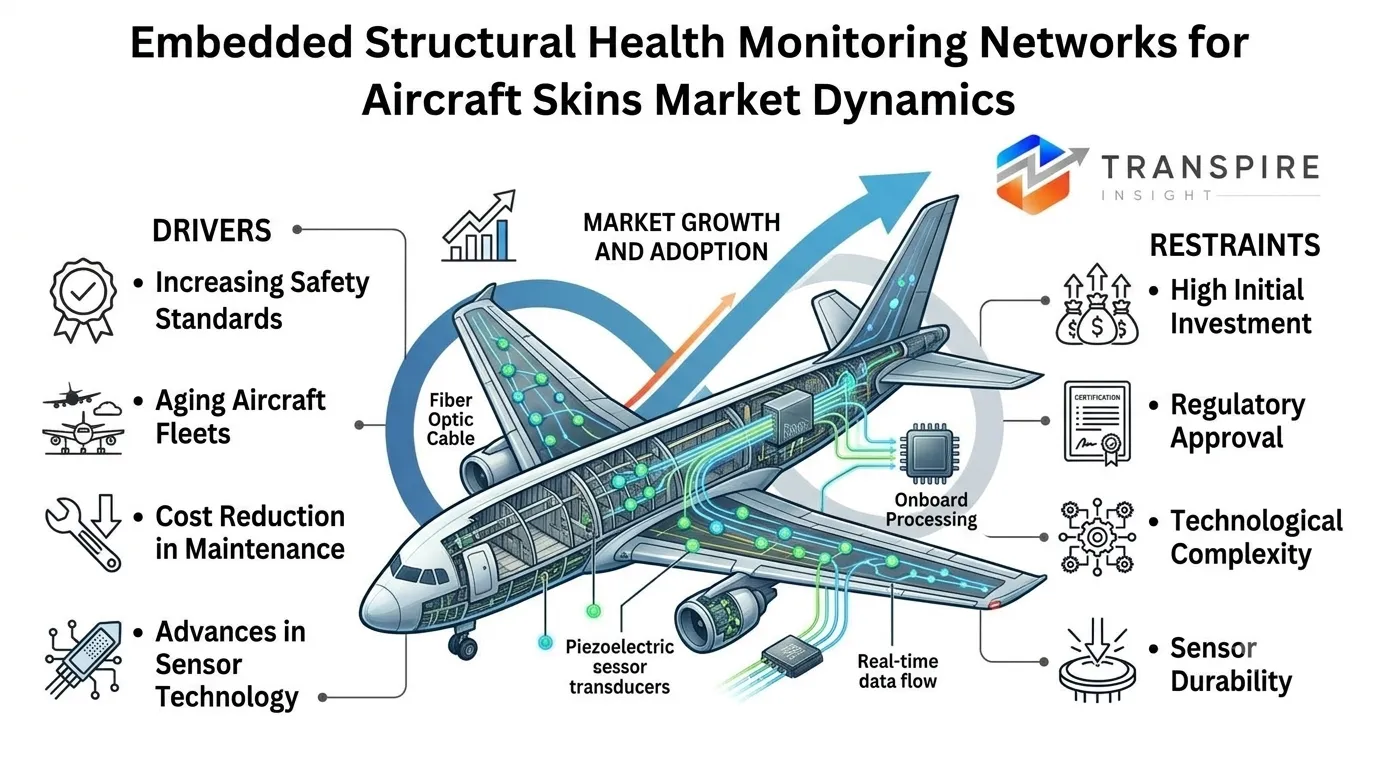
Description
According to a research report published by Transpire Insight, the global Embedded Structural Health Monitoring Networks for Aircraft Skins Market was valued at USD 15.52 billion in 2026 and is projected to grow at a CAGR of 8.24% during the 2027–2035 forecast period. Based on this growth rate, the market is estimated to reach approximately USD 16.80 billion in 2027 and USD 31.63 billion by 2035. Increasing aircraft production, demand for continuous structural monitoring, adoption of lightweight composite materials, and the need to reduce aircraft inspection and maintenance costs are supporting market expansion. Aerospace manufacturers and technology suppliers are developing embedded sensor networks, fiber-optic sensing systems, piezoelectric sensors, wireless monitoring technologies, and data-processing platforms to detect structural damage and monitor aircraft skin conditions throughout the aircraft lifecycle.
Introduction
An aircraft skin is more than an external protective covering. It forms part of the aircraft's structural framework and must withstand pressure changes, vibration, aerodynamic loads, temperature variations, fatigue, and repeated flight cycles.
Small structural defects deserve attention. Cracks, corrosion, delamination, and impact damage can develop beneath aircraft surfaces or inside composite structures without being immediately visible during routine inspections.
Embedded Structural Health Monitoring (SHM) Networks for Aircraft Skins address this challenge by integrating sensors and monitoring components into aircraft structures. These networks collect information about strain, temperature, vibration, acoustic emissions, and structural changes. The collected data helps engineers identify potential damage and assess structural conditions.
The technology is particularly relevant to aircraft manufactured with carbon-fiber-reinforced polymers and other advanced composite materials. Conventional visual inspection and scheduled non-destructive testing remain necessary, but embedded monitoring provides an additional source of information between inspection intervals.
The competition involves several technology groups. Aerospace manufacturers, sensor specialists, structural monitoring companies, avionics suppliers, and engineering technology providers contribute different components to the market. Honeywell, Safran, Collins Aerospace, Meggitt, TE Connectivity, HBK, and other established suppliers have capabilities relevant to aircraft sensing, monitoring, and structural diagnostics.
Recent Development News
February 2026: Testia, an Airbus company, presented its Lifecycle Structural Health Monitoring approach at JEC World 2026. The company highlighted a monitoring platform designed to synchronize different sensor data streams, including strain, acceleration, and environmental measurements. Its approach connects continuous structural monitoring with conventional non-destructive testing.
June 2026: Platinum Eagle Aerospace announced the commercial launch of FLEX AI, an aircraft structural health trending and monitoring platform. The system tracks aircraft structural loads, stress, strain, and fatigue accumulation to identify developing anomalies and support predictive maintenance decisions.
June 2026: PhotonFirst and Curtiss-Wright announced a collaboration to develop next-generation flight test instrumentation solutions using fiber-optic sensing technology. The partnership focuses on lightweight and accurate aerospace data acquisition for aircraft testing and performance monitoring.
October 2026: Bell Textron and PhotonFirst signed a Memorandum of Understanding to advance fiber-optic sensing for structural health monitoring applications on Bell aircraft. The collaboration will explore monitoring aircraft structures through lightweight optical sensor networks, with an emphasis on reducing wiring complexity and improving structural condition information.
Stay Ahead of Emerging Opportunities with Expert Market Insights by Transpire Insight
Transpire Insight provides market intelligence covering aerospace technologies, aircraft manufacturing, structural monitoring systems, advanced sensors, and aviation maintenance. Our research examines market size, competitive positioning, regional demand, technology developments, and industry growth forecasts.
We assess the companies developing sensing hardware, embedded monitoring networks, diagnostic software, and aircraft structural technologies. The research is intended to help aerospace manufacturers, technology suppliers, investors, engineering companies, and procurement professionals evaluate market opportunities and competitive developments.
Embedded Structural Health Monitoring Networks for Aircraft Skins Market Size & Statistics
Regional Growth and Demand Analysis by Transpire Insight
North America
North America held the leading regional position in 2025, supported by its established aerospace manufacturing industry, defense aviation programs, aircraft engineering capabilities, and structural monitoring technology providers.
The United States has a particularly developed ecosystem of aircraft manufacturers, aerospace suppliers, and sensor technology companies. Boeing, Lockheed Martin, Northrop Grumman, Honeywell, Collins Aerospace, Acellent Technologies, and Luna Innovations participate in different parts of the aerospace monitoring value chain.
The region also benefits from research activity involving composite materials, embedded sensing, aircraft diagnostics, and predictive maintenance. Aircraft manufacturers and operators are interested in collecting structural information during operation rather than relying exclusively on scheduled inspections.
Europe
Europe represented the second-largest regional market in 2025. Its position is supported by aircraft manufacturing, advanced composite engineering, aerospace research, and established sensor and avionics suppliers.
Airbus, Safran, BAE Systems, GKN Aerospace, and several specialist technology companies contribute to the regional aerospace ecosystem. Germany, France, the United Kingdom, the Netherlands, and Italy have established aerospace engineering and manufacturing capabilities.
PhotonFirst, HBK, Smart Fibres, and other European technology suppliers are relevant to fiber-optic sensing, structural measurement, and embedded monitoring applications. The development of lighter aircraft structures and advanced composite components also creates opportunities for distributed monitoring systems.
Asia Pacific
Asia Pacific is projected to record the fastest growth during the forecast period. Increasing aircraft manufacturing activity, expansion of commercial aviation, defense modernization, and investment in domestic aerospace capabilities are supporting regional demand.
China, Japan, India, and South Korea are important markets for aerospace manufacturing and technology development. Aircraft programs involving advanced composite materials and increasingly complex structures require reliable methods for detecting fatigue, impact damage, and material deterioration.
South Korea's aerospace industry provides a relevant example. Acellent Technologies was contracted as the structural health monitoring system supplier for Korea Aerospace Industries' KF-21 aircraft program. Such programs demonstrate the role of specialist monitoring suppliers in military aircraft development.
Regional growth will also depend on the availability of qualified sensor suppliers, integration expertise, aerospace certification capabilities, and investment in aircraft research and development.
Top 15 Trends in the Embedded Structural Health Monitoring Networks for Aircraft Skins Market
Embedded Fiber-Optic Sensor Networks Expanding Aircraft Monitoring Capabilities
Fiber-optic sensing is gaining attention because one optical fiber can support multiple measurement points. Fiber Bragg Grating (FBG) technology measures changes in reflected light to determine parameters such as strain and temperature.
For aircraft skins, this offers a way to monitor structural behavior across selected areas without installing a separate conventional electrical sensor at every measurement location.
The technology also provides immunity to electromagnetic interference. Weight, installation complexity, optical interrogation equipment, and long-term sensor reliability remain important engineering considerations.
Piezoelectric Sensors Supporting Large-Area Structural Monitoring
Piezoelectric sensors generate electrical responses when mechanical stress is applied. In structural monitoring applications, they can also be used to generate guided waves that travel through aircraft structures.
Changes in the received signals help engineers identify damage, cracks, and other structural abnormalities.
Research published in 2025 on expandable piezoelectric sensor networks for aircraft smart skins addressed the challenge of creating lightweight, large-area monitoring networks with shared signal transmission wiring. This is particularly relevant to aircraft structures, where additional cabling increases weight and complicates installation.
Predictive Maintenance Increasing Demand for Continuous Monitoring
Traditional aircraft maintenance relies on scheduled inspections, operational records, and non-destructive testing. Embedded monitoring adds another layer of information by collecting structural measurements during aircraft operation.
Engineers can use accumulated strain, load, vibration, and fatigue information to assess structural behavior and identify unusual changes.
Predictive monitoring does not replace mandatory inspections or approved maintenance procedures. Its commercial value lies in helping maintenance teams identify where closer investigation is needed.
Smart Composite Aircraft Skins Creating New Opportunities
Aircraft manufacturers increasingly use composite materials to reduce structural weight and achieve specific mechanical performance requirements. However, impact damage and internal delamination are not always visible during external inspections.
Embedding sensors during composite manufacturing creates an opportunity to monitor structural conditions from the beginning of an aircraft component's service life.
The main engineering challenge is ensuring that sensors and associated wiring do not compromise the strength, durability, manufacturing quality, or certification of the composite structure.
Integration of Structural Health Monitoring with Digital Twins
Digital twin technology connects engineering models with operational information collected from physical aircraft structures. SHM sensor networks provide measurements that can be used to update structural models and compare actual performance with expected behavior.
This integration supports fatigue analysis, load assessment, damage evaluation, and maintenance planning.
The quality of the results depends on accurate sensor calibration, reliable data transmission, appropriate models, and validation against physical inspection findings.
Wireless Monitoring Networks Reducing Aircraft Wiring Complexity
Conventional monitoring systems can require extensive wiring between sensors, data acquisition equipment, and processing units. Additional wiring increases installation effort and adds weight.
Wireless sensor architectures aim to reduce these requirements by transmitting measurements through wireless communication systems. For aircraft applications, power consumption, electromagnetic compatibility, cybersecurity, transmission reliability, and aviation certification remain important design requirements.
List of Top 20 Companies Leading the Embedded Structural Health Monitoring Networks for Aircraft Skins Market
The following companies represent established aerospace manufacturers, specialist structural health monitoring providers, sensor technology developers, and aerospace component suppliers active in the market ecosystem as of 2026.
The list considers technology relevance, aerospace industry participation, structural monitoring capabilities, aircraft manufacturing relationships, and product portfolios. It is a competitive shortlist, not an audited ranking by market share or revenue. Some companies supply complete SHM solutions, while others contribute sensors, aircraft structures, avionics, or integration capabilities.
Headquarters: Toulouse, France
Airbus is a major aircraft manufacturer with extensive experience in composite airframe structures, aircraft engineering, and structural testing. Its activities in advanced aircraft structures make the company an important participant in the development and integration of structural monitoring technologies.
Why It Ranks: Global aircraft manufacturing operations, composite structure expertise, and participation in aircraft lifecycle monitoring development.
Product and Technology Focus: Aircraft structural systems, composite airframe components, structural testing, damage assessment, and lifecycle SHM integration.
Headquarters: Arlington, Virginia, USA
Boeing participates in commercial and defense aircraft manufacturing, with extensive engineering capabilities involving metallic and composite airframe structures. Structural condition assessment and aircraft health monitoring are relevant to its aircraft development and maintenance activities.
Why It Ranks: Extensive aircraft engineering operations, advanced structural materials expertise, and large commercial and defense aviation programs.
Product and Technology Focus: Composite aircraft structures, structural testing, aircraft diagnostics, engineering analysis, and aircraft health monitoring integration.
Headquarters: Sunnyvale, California, USA
Acellent specializes in structural health monitoring systems designed for aerospace and other engineering applications. Its SMART Layer technology uses distributed sensor networks integrated into thin carrier films, with diagnostic hardware and software for structural assessment.
The company develops systems for monitoring composite damage, fatigue cracks, and impact events in aircraft structures.
Why It Ranks: Direct specialization in aircraft structural health monitoring and integrated sensor-network technology.
Product and Technology Focus: SMART Layer sensors, SHM Composite software, ScanGenie data acquisition hardware, impact monitoring, and embedded structural monitoring systems.
Headquarters: Roanoke, Virginia, USA
Luna Innovations develops fiber-optic sensing and measurement technologies used in structural monitoring and aerospace applications. Its sensing systems measure parameters including strain and temperature, supporting the assessment of structural performance.
Why It Ranks: Fiber-optic sensing expertise and experience in advanced measurement systems for aerospace and other demanding applications.
Product and Technology Focus: Distributed fiber-optic sensing, optical interrogators, strain measurement, temperature monitoring, and structural condition monitoring.
Headquarters: Alkmaar, Netherlands
PhotonFirst specializes in photonic sensing technologies, particularly fiber Bragg Grating-based measurement systems. Its technology supports structural monitoring applications where multiple sensing points are required across lightweight structures.
The company's aerospace involvement includes projects involving aircraft, rotorcraft, and other advanced platforms.
Why It Ranks: Specialist fiber-optic sensing capabilities and documented aerospace structural monitoring collaborations.
Product and Technology Focus: Fiber-optic sensors, FBG sensing systems, optical interrogation, strain monitoring, temperature measurement, and structural monitoring solutions.
Headquarters: Paris, France
Safran is an established aerospace and defense technology group with activities across aircraft propulsion, avionics, electronics, and aerospace equipment. Its sensor and electronics capabilities are relevant to aircraft monitoring and data acquisition applications.
Why It Ranks: International aerospace presence, advanced electronics expertise, and participation in aircraft equipment and monitoring technologies.
Product and Technology Focus: Aerospace sensors, inertial measurement systems, aircraft electronics, avionics, and monitoring-related equipment.
Headquarters: Darmstadt, Germany
HBK provides measurement, testing, data acquisition, and analysis technologies for aerospace engineering. Its systems help engineers evaluate aircraft structures, composite materials, vibration, and mechanical performance.
Why It Ranks: Established aerospace measurement capabilities and strong relevance to structural testing and sensor-based monitoring.
Product and Technology Focus: Strain sensors, accelerometers, data acquisition systems, structural testing equipment, and engineering analysis software.
Headquarters: Toulouse, France
Testia provides aerospace inspection, testing, and structural integrity solutions. Its work includes non-destructive testing and structural health monitoring for aircraft and composite structures.
The company focuses on connecting monitoring data with inspection and maintenance processes.
Why It Ranks: Direct aerospace structural inspection expertise and development of lifecycle SHM approaches.
Product and Technology Focus: Structural health monitoring, non-destructive testing, composite inspection, damage assessment, and aircraft structural integrity solutions.
Headquarters: Boston, Massachusetts, USA
Metis Design develops engineering technologies and monitoring solutions for aerospace and advanced structural applications. Its work in structural health monitoring and smart structures makes it relevant to embedded aircraft monitoring networks.
Why It Ranks: Aerospace-oriented engineering expertise and specialization in structural monitoring applications.
Product and Technology Focus: Structural monitoring systems, sensor integration, aircraft diagnostics, and advanced engineering solutions.
Headquarters: Bracknell, United Kingdom
Smart Fibres specializes in fiber-optic sensing technologies used for measuring strain, temperature, and structural behavior. Its sensing solutions are relevant to applications involving advanced composite structures and distributed measurements.
Why It Ranks: Fiber-optic sensor specialization and relevance to structural measurement applications.
Product and Technology Focus: Fiber Bragg Grating sensors, optical sensing systems, strain measurement, temperature monitoring, and structural monitoring solutions.
Emerging Technology Opportunities in Aircraft Structural Health Monitoring
Development of Lightweight Embedded Sensor Networks
Aircraft manufacturers are looking for monitoring networks that add minimal weight to the aircraft structure. Traditional wiring arrangements can increase installation complexity, particularly when sensors must cover large wing and fuselage surfaces.
Distributed piezoelectric sensors and fiber-optic networks offer alternative approaches. Their integration into composite manufacturing processes is an important area of technology development.
Growing Adoption of Acoustic Emission Monitoring
Acoustic emission monitoring detects elastic waves produced by structural changes, including crack development and material damage. Sensors collect these signals and transmit them to diagnostic systems for further analysis.
For aircraft applications, the technology provides an additional method of identifying structural events that require engineering investigation.
Increasing Demand for Composite Damage Detection
Composite aircraft structures require specialized inspection techniques because internal damage does not always appear on the external surface. Delamination, disbonding, impact damage, and matrix cracking are important monitoring targets.
Sensor networks integrated into composite panels provide information about structural changes that conventional external inspection might not immediately identify.
Expansion of Aircraft Digital Health Monitoring Platforms
Structural monitoring software is becoming an important part of the technology value chain. Sensor hardware generates measurements, while software processes the information and identifies unusual structural behavior.
The integration of monitoring platforms with aircraft maintenance databases and digital engineering models creates opportunities for aerospace software developers and technology suppliers.
Increasing Collaboration Between Aircraft Manufacturers and Sensor Developers
Partnerships between aircraft manufacturers and specialist sensing companies are helping advance structural monitoring applications. These collaborations allow sensor developers to test technologies against aircraft-specific engineering requirements.
The October 2026 Bell–PhotonFirst agreement is an example of this development. Such collaborations also highlight the importance of evaluating sensing technologies in real aircraft operating environments.
Conclusion
The Embedded Structural Health Monitoring Networks for Aircraft Skins Market is moving toward greater integration of sensors, structural diagnostics, and aircraft engineering systems. Demand for lightweight composite structures, continuous condition assessment, and predictive maintenance is creating opportunities for specialist monitoring companies and established aerospace manufacturers.
Acellent Technologies, Luna Innovations, PhotonFirst, HBK, and Testia have particularly relevant capabilities in sensing, structural monitoring, and aerospace inspection. Airbus, Boeing, Safran, Lockheed Martin, and other aircraft manufacturers contribute through structural engineering, platform development, and system integration.
For investors and technology suppliers, the most practical area to examine is the integration of lightweight sensor networks into composite wing and fuselage structures. Comparing fiber-optic sensing, piezoelectric networks, and wireless monitoring systems by aircraft application will help identify the strongest commercial opportunities through 2035.


Send us a brief description of your challenge and we'll get back to you within 24 hours.

 [email protected]
 APAC:+91 7666513636
 Address


