
Global Embedded Structural Health Monitoring Networks for Aircraft Skins Market Summary:
According to Transpire Insights, a detailed research report on the market reflects that the commercial aircraft application segment dominates the global Global Embedded Structural Health Monitoring Networks for Aircraft Skins Market, accounting for approximately 73% of the total share worldwide. Airbus SE leads the market with approximately (around USD 74.3 billion) in annual revenue and an estimated 19–23% global market share, making it the leading contributor to global market development, innovation, advanced embedded structural health monitoring network technologies for aircraft skins, expanding manufacturing capabilities, and growth dynamics.
Market Snapshot
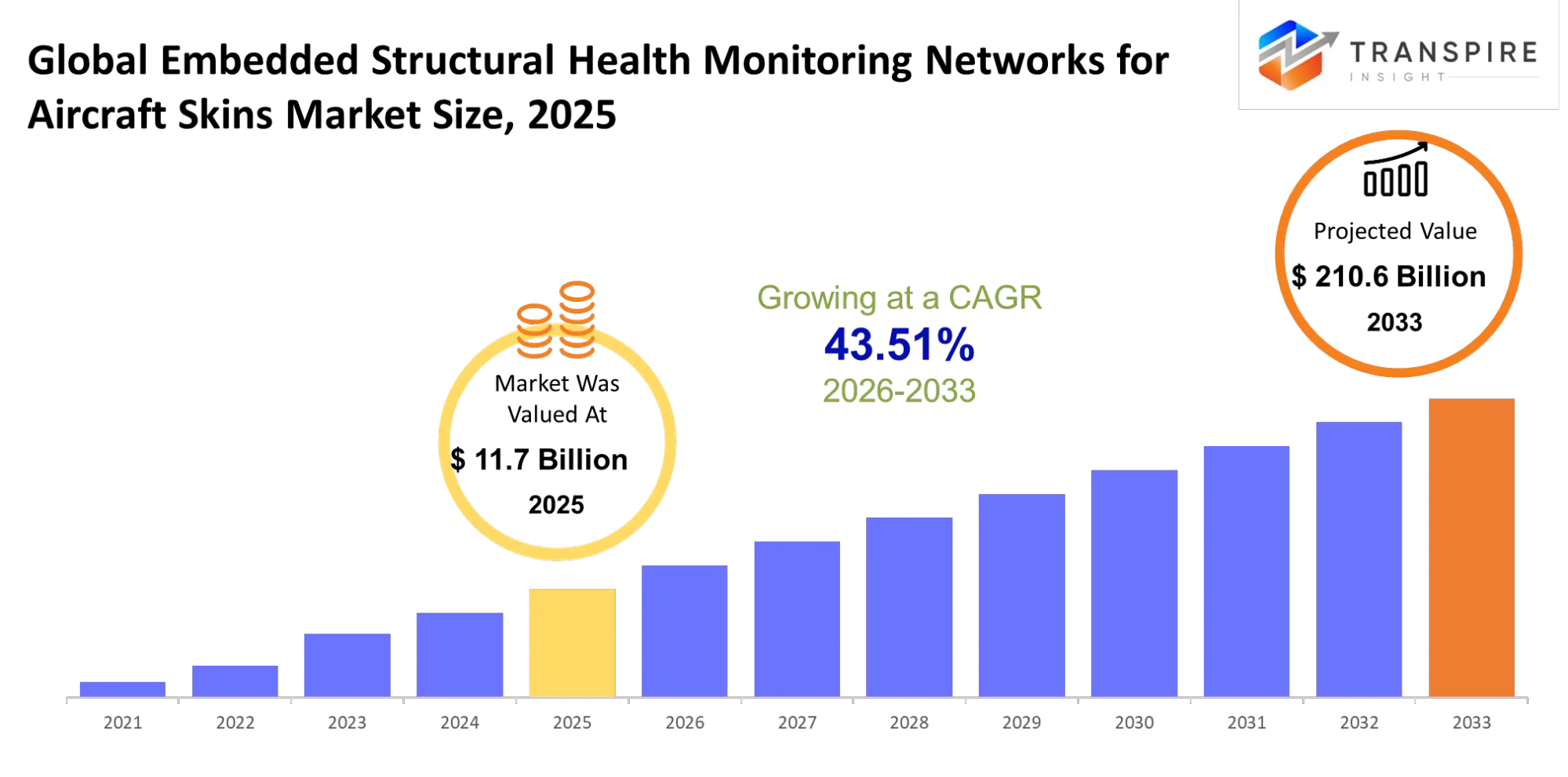
- Global Market Value (2025): USD 14.34 Billion.
- Expected Market Value (2026): USD 15.52 Billion.
- Estimated Market Value (2033): USD 27.01 Billion.
- Forecast CAGR (2026–2033): 8.24%.
- Leading Region in 2025: North America
- Second-largest Region: Europe
- Fastest Growing Region: Asia Pacific
Introduction
The market for "embedded structural health monitoring (SHM) networks for aircraft skins" includes hardware, software, and sensors that are integrated directly into the composites of the fuselage and wings. The aerospace industry is moving from planned human inspections to predictive maintenance thanks to these networks' ability to detect cracks, corrosion, and impacts in real time. A system of permanently installed, built-in sensor networks (such as fiber optics or piezoelectric transducers) that are directly integrated into an aircraft's primary structure or composite material skin is known as embedded structural health monitoring, or ESHM. Its main objective is to continuously assess the airframe's structural integrity by automatically identifying impacts, fatigue, and concealed cracks in real-time. Elimination of Unscheduled Downtime: Operators switch to predictive maintenance by continuously transmitting structural data. This maximizes fleet availability and avoids unplanned groundings. Reduction of safety margins, strict safety margins (up to 2.0) for composite airplane skins are required by aviation rules. The data required to safely lower these margins is provided via real-time, embedded monitoring, which can result in up to 5% savings on fuel and direct operating costs. Reduced upkeep expenses, early detection of microcracks or scarcely visible impact damage (BVID) stops them from developing into significant structural failures, thereby reducing the cost of expensive repairs. Improved aircraft weight efficiency, complicated cabling and surface-mounted sensors add needless weight. Direct integration of lightweight piezoelectric transducers and fiber-optic sensors into the composite layup ensures complete skin coverage while lowering overall weight.
- For instance: The market for embedded structural health monitoring (SHM) networks for aircraft skins is estimated to be worth USD 0.80 billion and is expected to expand at a compound annual growth rate (CAGR) of 12.4% to reach USD 2.90 billion by 2036. Due to strict FAA restrictions and significant investments from major aircraft manufacturers, North America dominates the world with over 37% of the market.
Key Market Highlights: -
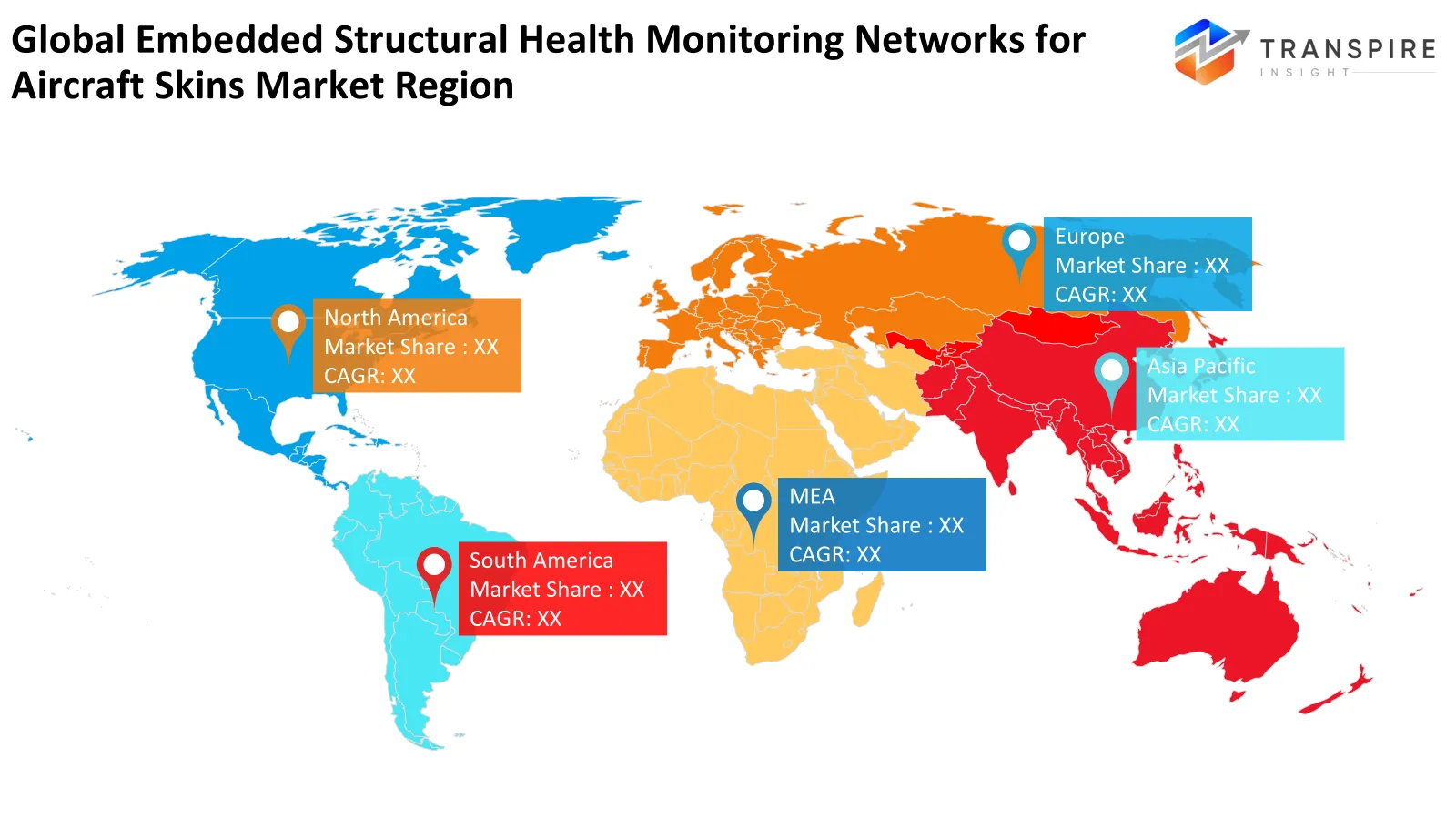
- North America is anticipated to hold nearly 35% share of the Global Embedded Structural Health Monitoring Networks for Aircraft Skins Market over the predicted timeframe.
- Europe is expected to grow at a rapid CAGR in the Global Embedded Structural Health Monitoring Networks for Aircraft Skins Market by holding around 25% of the share during the forecast period.
- Asia Pacific is anticipated to hold roughly 21% share of the Global Embedded Structural Health Monitoring Networks for Aircraft Skins Market over the predicted timeframe.
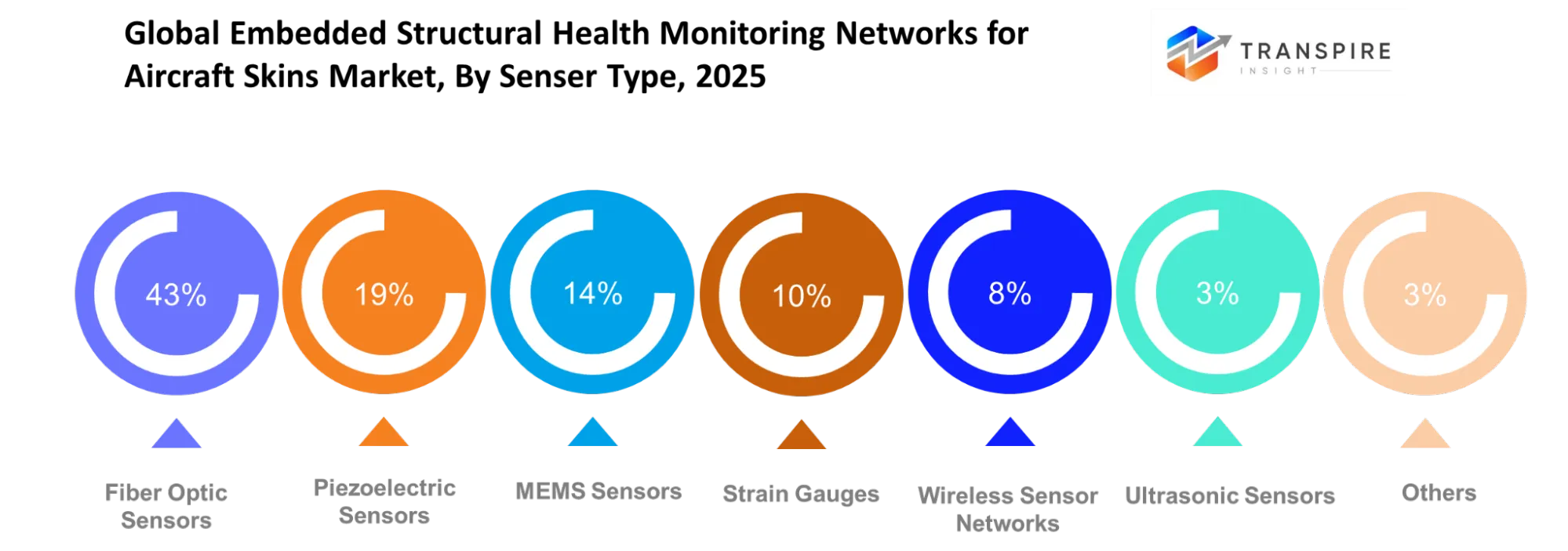
- By Sensors type, the MEMS Sensors segment dominated the market and holds around 35% share in 2025 and is projected to grow at a substantial CAGR during the forecast period.
- By aircraft type, the Commercial Aircraft segment dominated the market and holds roughly 35% share in 2025 and is projected to grow at a substantial CAGR during the forecast period.
- By end user, the Component Manufacturers segment dominated the market and holds nearly 51% share in 2025 and is projected to grow at a substantial CAGR during the forecast period.
- By application, the aircraft fuselage segment dominated the market and holds nearly 38% share in 2025 and is projected to grow at a substantial CAGR during the forecast period.
- India: Government initiatives supporting semiconductor manufacturing, advanced sensors and indigenous aerospace technologies are strengthening the development of embedded structural health monitoring solutions. Financial assistance programs further encourage innovation in aerospace materials, electronics, and monitoring systems.
How is Technology Driving Growth in the Global Embedded Structural Health Monitoring Networks for Aircraft Skins Market?
The development of embedded structural health monitoring networks for aircraft skins is being propelled by cutting-edge technology like as digital twins, wireless IoT systems, artificial intelligence, and lightweight sensors. Without adding a lot of weight, real-time measurements of structural strain, vibration, and damage development are made possible via fiber optic sensors and piezoelectric transducers. While digital twins offer thorough structural insights, AI and machine learning enhance anomaly detection and predictive maintenance accuracy. Wireless IoT-enabled networks facilitate effective monitoring of both current and elderly aircraft fleets, improve scalability, and make integration easier.
Market Drivers
Making the switch to condition-based maintenance, or predictive maintenance, traditional, calendar-based major inspections, which need keeping aircraft out of service for days or weeks, are being abandoned by airlines. Because embedded sensor networks such as piezoelectric transducers and fiber Bragg gratings provide continuous data, operators can maximize fleet availability by performing maintenance only when necessary. Growing utilization of composite materials and lightweight composites play a major role in the skins of modern aircraft, such as the Airbus A350 and Boeing 787. Composite damage, such as interior delamination from bird strikes or ground handling, is frequently imperceptible to the unaided eye, in contrast to metals. For the safe assessment of these hidden structural flaws, embedded skin sensors are essential. Safety requirements and regulatory compliance, airworthiness regulations are being tightened by aviation regulatory agencies such as the European Union Aviation Safety Agency (EASA) and the Federal Aviation Administration (FAA). By offering specific, in-flight data, structural monitoring assists operators in adhering to these strict safety regulations. Operational cost and fuel savings, due to strict aviation standards, composite constructions must have large safety margins and be oversized. Engineers can safely minimize these safety margins by using permanently attached SHM sensor systems, which will result in weight savings and a possible 2–5% reduction in direct operational and fuel expenses. Digital twin utilization, by smoothly integrating data into analytical software, a "digital twin" of the aircraft is created that precisely forecasts when particular repairs will be required.
- For Instance: -The market for aircraft skins incorporated structural health monitoring (SHM) networks is expanding at a compound annual growth rate (CAGR) of about 12.4%. The larger aerospace and defense materials market in South Africa is estimated to be worth about $350 million. Instead of direct OEM, investment here is concentrated on composite manufacturing and predictive MRO (Maintenance, Repair, and Operations).
Restrain
Additional weight, power needs, stringent aviation certification, high implementation costs, and challenging operating circumstances are some of the issues structural health monitoring (SHM) systems must deal with. Long-term dependability, regulatory approval, sensor durability, and aircraft integration complexity continue to be major obstacles to widespread use in the aerospace sector.
Analysis of Prices and Consumer Behaviour
The growing need for predictive maintenance, improved flight safety, minimized downtime of the airplane, and enhanced efficiency are the factors that are driving the demand for the global embedded structural health monitoring networks for airline skins. The advanced embedded SHM systems are estimated to have a cost of about 20% to 40% more than that of the conventional structural inspection methods since the technologies require the use of aerospace-grade sensors, fiber optic technology, piezoelectric systems, acquisition technologies, and data analytics. The fiber optic monitoring technology has the highest market share among other technologies due to their lightweight feature, precision, durability, and also immunity to electromagnetic interference. The commercial and defense sectors represent the largest share of the market since they require the capability of real-time monitoring, reliability of the system, and adherence to the relevant regulations.
Top Companies in the Global Embedded Structural Health Monitoring Networks for Aircraft Skins Market
- Airbus
- Boeing
- Collins Aerospace
- Honeywell
- Safran
- BAE Systems
- Northrop Grumman
- Lockheed Martin
- Spirit AeroSystems
- GKN Aerospace
- Luna Innovations
- Acellent Technologies
- Hexcel
- HBM FiberSensing
- Smart Fibres
Market Segmentation
The Global Embedded Structural Health Monitoring Networks for Aircraft Skins Market share is divided into five categories: By sensor type, aircraft type, monitoring type, end user and application.
The MEMS Sensors dominated the market, accounting for nearly 35% in 2025 and is expected to rise at a significant CAGR during the forecast period.
The Global Embedded Structural Health Monitoring Networks for Aircraft Skins Market is segmented by sensors type into, Fiber Optic Sensors, Piezoelectric Sensors, Strain Gauges, MEMS Sensors, Ultrasonic Sensors, Acoustic Emission Sensors, Wireless Sensor Networks, Others Among these, the MEMS Sensors segment dominated the market, accounting for nearly 35% in 2025 and expected to increase at a significant CAGR during the forecast period. Because of their lightweight design, small size, low power consumption, affordability, and high sensitivity, the MEMS Sensors category led the market in 2025, with a nearly 35% share. Real-time monitoring, predictive maintenance, and enhanced safety are supported by their simple integration into aircraft structures.
The Component Manufacturers dominated the market, accounting for nearly 51% in 2025, and is expected to rise at a significant CAGR during the forecast period.
The Global Embedded Structural Health Monitoring Networks for Aircraft Skins Market is segmented by end user into Aircraft OEMs, MRO Providers, Defense Organizations, Airlines, Research Institutes, Space Agencies, Component Manufacturers, Others. Among these, the Component Manufacturers segment dominated the market, accounting for nearly 51% in 2025 and expected to increase at a significant CAGR during the forecast period. Due to their crucial role in creating and delivering cutting-edge SHM components, such as sensors, data acquisition units, and embedded systems, the Component Manufacturers segment led the market in 2025, with a roughly 51% share. The demand for dependable monitoring solutions, modernization initiatives, and rising aircraft production all contribute to the segment's expansion.
The aircraft fuselage dominated the market, accounting for nearly 38% in 2025 and is expected to rise at a significant CAGR during the forecast period.
The Global Embedded Structural Health Monitoring Networks for Aircraft Skins Market is segmented by application into Aircraft Fuselage, Aircraft Wings, Aircraft Skins, Tail Structures, Engine Nacelles, Composite Structures, Cabin Structures, Others. Among these, the aircraft fuselage segment dominated the market, accounting for nearly 38% in 2025 and expected to increase at a significant CAGR during the forecast period. Due to its crucial structural role and high exposure to stress, fatigue, and damage concerns, the aircraft fuselage segment led the market in 2025, with a nearly 38% share. Growth in this market is also fueled by the growing use of composite materials and the need for ongoing structural monitoring systems.
Regional Segment Analysis of the Global Embedded Structural Health Monitoring Networks for Aircraft Skins Market:
- North America (U.S., Canada, Mexico)
- Europe (Germany, France, U.K., Italy, Spain, Rest of Europe)
- Asia-Pacific (China, Japan, India, Rest of APAC)
- South America (Brazil and the Rest of South America)
- The Middle East and Africa (UAE, South Africa, Rest of MEA)
North America is the fastest-growing region in the Global Embedded Structural Health Monitoring Networks for Aircraft Skins Market during the period, holding nearly 35% share.
North America is expected to grow at a rapid CAGR in the Global Embedded Structural Health Monitoring Networks for Aircraft Skins Market holding roughly 35% share during the forecast period. Due to the presence of top aerospace manufacturers, sophisticated aviation infrastructure, high aircraft fleet modernization activities, robust R&D investments, and growing adoption of predictive maintenance technologies, North America is the fastest-growing region in the global market for embedded structural health monitoring networks for aircraft skins, accounting for roughly 35% of the market
Europe is expected to grow at a rapid CAGR in the Global Embedded Structural Health Monitoring Networks for Aircraft Skins Market, holding around 25% of the share during the forecast period.
Europe is expected to grow at a rapid CAGR in the Global Embedded Structural Health Monitoring Networks for Aircraft Skins Market holding around 25% share during the forecast period. Due to its strong aerospace manufacturing capabilities, cutting-edge research programs, strict aircraft safety regulations, fleet modernization initiatives, and growing adoption of predictive maintenance technologies, Europe is expected to grow at a rapid compound annual growth rate (CAGR) in the global embedded structural health monitoring networks for aircraft skins market, holding around 25% of the market during the forecast period.
Asia Pacific is the fastest-growing region in the Global Embedded Structural Health Monitoring Networks for Aircraft Skins Market during the period, holding roughly 21% share.
Asia Pacific is the fastest-growing region in the Global Embedded Structural Health Monitoring Networks for Aircraft Skins Market during the forecast period, holding around 21% share during the forecast period. With a 21% market share, Asia-Pacific is the fastest-growing region in the global market for embedded structural health monitoring networks for aircraft skins. This is because of growing aircraft production, growing aviation fleets, rising aerospace investments, growing adoption of advanced monitoring technologies, and government initiatives supporting the development of aviation infrastructure.
Strategies for Market Growth in Non-Leading Regions:
The advancement of non-leading regions by means of efficient embedded technologies for structural health monitoring (SHM) implementation will favor companies that make aerospace components of small and medium sizes, as well as technology suppliers and service providers. Local SHM capabilities for sensor production, integration technologies, and monitoring solutions will help avoid relying on foreign technologies and save on implementation costs. At the same time, forging partnerships with aircraft manufacturers, airlines, state-defense institutions, aerospace suppliers, and maintenance, repair, and overhaul (MRO) companies will enhance the penetration of SHM solutions on the market. To boost the understanding of sensor integration, structural health monitoring, data analytics, calibration process, and aerospace certification standards, substantial training programs will be needed.
Future Market Trends for the Global Embedded Structural Health Monitoring Networks for Aircraft Skins Market: -
1.Change to Predictive & Condition-Based Maintenance (CBM): Embedded networks offer continuous visibility into localized stress, strain, and micro-cracking in place of regular, laborious human inspections, which are frequently necessary for composite aircraft skins. This reduces direct operating costs (DOC) and grounding downtime.
2.Digital twins and AI adoption: In order to forecast structural wear and lifecycle, sensor data from aircraft skins are increasingly combined with Digital Twin technology, which creates a virtual, real-time reproduction of the actual airframe.
3.FOS or fiber optic sensor Dominance: Heavy wired sensors are quickly being replaced by distributed FOS networks, such as Fiber Bragg Grating arrays. They can be easily included into composite layups without sacrificing aerodynamic profiles, are lightweight, and are resistant to electromagnetic interference.
4.Growth of Advanced Air Mobility (AAM): Strict, lightweight health monitoring is necessary for the developing eVTOL (electric vertical takeoff and landing) and UAV industries. Continuous health data collection is essentially required from day one because of regulatory safety requirements for these innovative airframes.
5.Smart Skins and Self-Healing Materials: R&D is concentrating on "smart skin" architectures that combine actuators and sensors. Reflexive, self-healing composites that may partially repair mechanical characteristics after identifying impact or microdamage are the direction of future advances.
Recent Development
- In June 2026: Aerospace technology developers and industry stakeholders advanced integrated sensor-ready coating technologies designed to incorporate embedded sensing capabilities within aircraft skin structures. These multifunctional coatings support real-time monitoring of fatigue, stress, and impact-related damage, enabling improved condition-based maintenance strategies and contributing to the future advancement of intelligent structural health monitoring networks for aircraft applications.
- In January 2026: Aerospace researchers and technology developers advanced mechatronic smart skin technologies through the integration of flexible sensor arrays and embedded electronic systems within aircraft structural materials. These innovations enhance self-perception, real-time structural condition monitoring, and self-diagnosis capabilities, supporting the future development of intelligent embedded structural health monitoring networks for aircraft skins.
- In March 2026: Defense aerospace researchers and industry stakeholders advanced next-generation nanocomposite aircraft skin technologies by exploring the integration of lightweight composite materials with embedded structural health monitoring sensors. These developments support enhanced real-time damage detection, improved structural performance, and the future evolution of intelligent aircraft monitoring systems for advanced aerospace applications.
This study forecasts revenue at global, regional and country levels from 2020 to 2033. Transpire Insights has segmented the Global Embedded Structural Health Monitoring Networks for Aircraft Skins Market based on the below-mentioned segments:
Global Embedded Structural Health Monitoring Networks for Aircraft Skins Market, By Sensor Type
- Fiber Optic Sensors
- Piezoelectric Sensors
- Strain Gauges
- MEMS Sensors
- Ultrasonic Sensors
- Acoustic Emission Sensors
- Wireless Sensor Networks
- Others
Global Embedded Structural Health Monitoring Networks for Aircraft Skins Market, By Aircraft Type
- Commercial Aircraft
- Military Aircraft
- Business Jets
- Regional Aircraft
- Cargo Aircraft
- UAVs
- eVTOL Aircraft
- Others
Global Embedded Structural Health Monitoring Networks for Aircraft Skins Market, By Monitoring Type
- Real-time Monitoring
- Fatigue Monitoring
- Crack Detection
- Impact Detection
- Corrosion Monitoring
- Load Monitoring
- Predictive Maintenance
- Others
Global Embedded Structural Health Monitoring Networks for Aircraft Skins Market, By End User
- Aircraft OEMs
- MRO Providers
- Defense Organizations
- Airlines
- Research Institutes
- Space Agencies
- Component Manufacturers
- Others
Global Embedded Structural Health Monitoring Networks for Aircraft Skins Market, By Application
- Aircraft Fuselage
- Aircraft Wings
- Aircraft Skins
- Tail Structures
- Engine Nacelles
- Composite Structures
- Cabin Structures
- Others
Global Embedded Structural Health Monitoring Networks for Aircraft Skins Market, By Regional Analysis
North America
- United States
- Canada
- Mexico
Europe
- Germany
- United Kingdom
- France
- Italy
- Spain
- Russia
- Rest of Europe
Asia Pacific
- China
- Japan
- India
- South Korea
- Australia
- Rest of Asia Pacific
South America
- Brazil
- Argentina
- Rest of South America
Middle East & Africa
- Saudi Arabia
- United Arab Emirates
- Qatar
- South Africa
- Rest of the Middle East & Africa
Frequently Asked Questions
Find quick answers to common questions.
Predictive maintenance, composite aircraft adoption, safety regulations, fleet modernization, and advanced sensor technologies are accelerating market growth.
MEMS sensors dominate due to lightweight design, affordability, sensitivity, low power consumption, and integration efficiency in aircraft monitoring systems.
Aircraft fuselage leads due to high stress exposure, fatigue risks, and demand for continuous structural damage monitoring.
Asia Pacific shows strong growth due to increasing aircraft production, aviation expansion, investments, and aerospace technology development initiatives.
AI and digital twins enable predictive maintenance, accurate damage detection, real-time analysis, and improved aircraft lifecycle management.
- Airbus
- Boeing
- Collins Aerospace
- Honeywell
- Safran
- BAE Systems
- Northrop Grumman
- Lockheed Martin
- Spirit AeroSystems
- GKN Aerospace
- Luna Innovations
- Acellent Technologies
- Hexcel
- HBM FiberSensing
- Smart Fibres
About the Authors

Tejashri Dhatrak
I am Tejashri Dhatrak, a Senior Research Analyst at Transpire Insight, specializing in the Aerospace and Defence sector. My work focuses on analyzing industry trends, defence technologies, market developments, and emerging innovations that shape the global aerospace and security landscape. At Transpire Insight, I research complex topics, evaluate credible sources, and transform technical insights into accurate, well-structured, and easy-to-understand content for industry professionals and decision-makers. My goal is to provide reliable, research-backed information that helps readers stay informed about defence capabilities, aerospace advancements, strategic developments, and the evolving dynamics of the global defence ecosystem.

Chakradhar Khansole
Chakradhar serves as the Research Director at Transpire Insight, bringing over 8 years of experience in technology, innovation, and strategic market intelligence. He specializes in transforming complex market data into actionable business insights that enable organizations to make informed, growth-oriented decisions. Recognized for his strategic vision and analytical expertise, Chakradhar leads high-impact research initiatives, delivering comprehensive market assessments, competitive intelligence, and forward-looking industry analysis.
Recently Published Reports
-
Apr 2026
Aerospace Fluoropolymers Market
Aerospace Fluoropolymers Market Size, Share & Analysis Report By Type (PTFE, FEP, PFA, ETFE, and Others), By Application (Electrical Insulation, Seals & Gaskets, Coatings, and Others), By End User (Commercial Aviation, Military Aviation, General Aviation, and Others), and Geography (North America, Europe, Asia-Pacific, Middle East and Africa, South and Central America), 2021 - 2031
-
Apr 2026
Airborne SATCOM System Market
Airborne SATCOM System Market Size, Share & Analysis Report By Type (SATCOM Terminals, Transceivers, Airborne Radio, Modems and Routers, SATCOM Radomes, and Other), By Application (Government and Defense and Commercial), and Geography (North America, Europe, Asia-Pacific, Middle East and Africa, South and Central America), 2021 – 2031
-
Apr 2026
Ship Leasing Market
Ship Leasing Market Size, Share & Analysis Report By Vessel Type (Container Ships, Bulk Carriers, Tankers, and Specialized Vessels), By Lease Duration (Short-Term Lease (Less than 1 year), Medium-Term Lease (1-5 years), and Long-Term Lease (More than 5 years)), By Lease Type (Bareboat Charter, Time Charter, Financial Lease, and Others), By End-User Industry (Oil and Gas, Manufacturing and Industrial, Automotive, Agriculture and Food, Retail and Consumer Goods, and Others), and Geography (North America, Europe, Asia-Pacific, Middle East and Africa, South and Central America), 2021 – 2031
-
Apr 2026
Thread Rolling Dies Market
Thread Rolling Dies Market Size, Share & Analysis Report By Type (Flat Thread Rolling Dies, Circular (Cylindrical) Dies, Tangential Thread Rolling Dies, Planetary Thread Rolling Dies, and Other Types), By Material Type (High-Speed Steel (HSS), Carbide, Tool Steel, Alloy Steel, and Other Specialized Alloys), By Distribution Channel (Direct Sales, Distributors and Dealers, and Online Platforms), By Application (Automotive Industry, Aerospace and Defense, Construction and Infrastructure, Industrial Machinery, Electronics and Electrical Components, Medical Devices, and Fastener Production), and Geography (North America, Europe, Asia-Pacific, Middle East and Africa, South and Central America), 2021 – 2031
Our Clients