
Jun 27, 2026
By Transpire Insight
Description
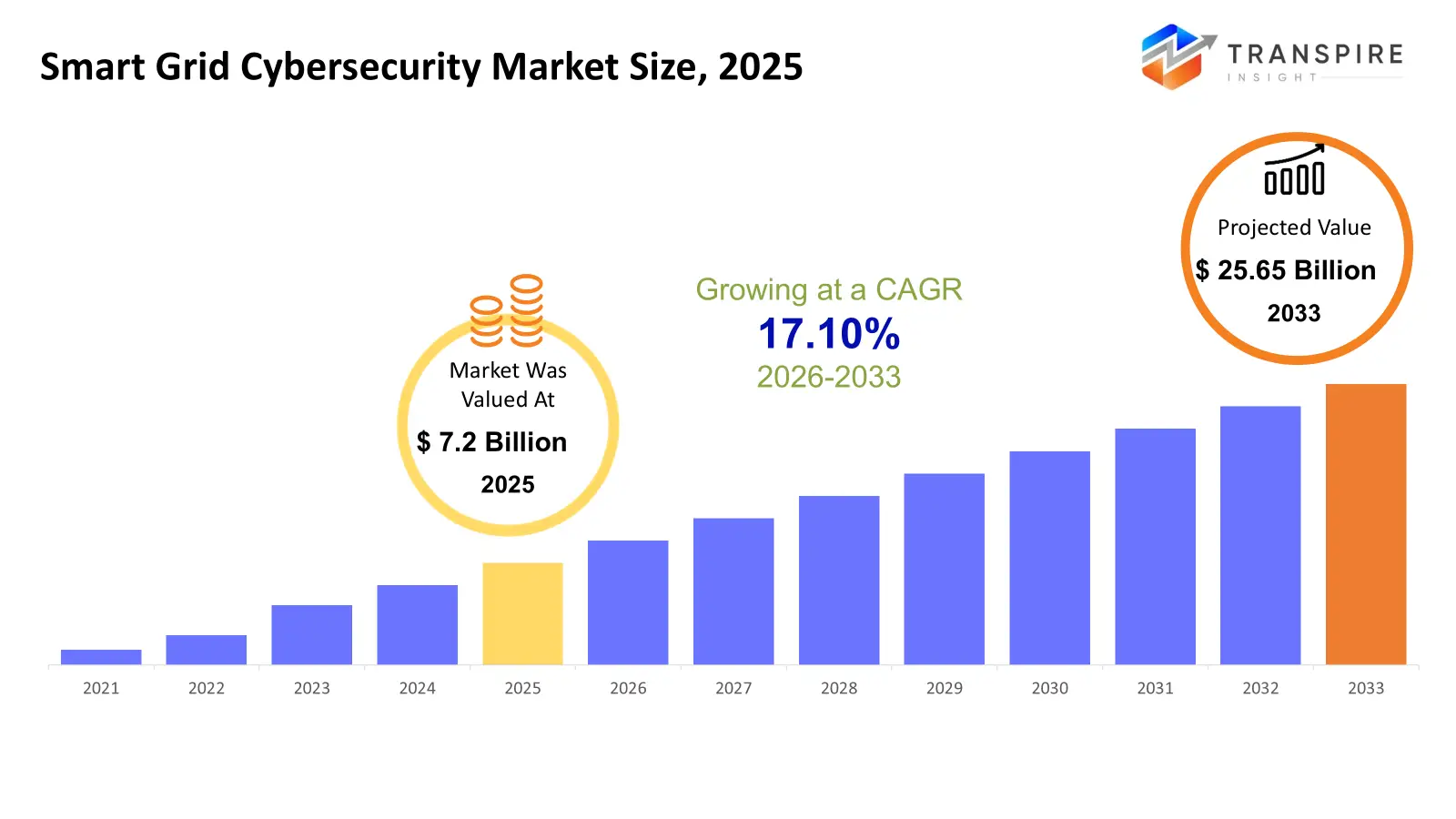
According to a research report published by Transpire Insight, the global smart grid cybersecurity market size is projected to grow from USD 8.9 billion in 2026 to USD 26 billion by 2035, at a CAGR of 18.1% during the forecast period 2026-2035. Market growth is being fueled by the push towards modernizing the grid, ongoing cybersecurity risks to energy assets, and government regulations. Entry points are further expanded by the integration of renewable energy sources and the rollout of smart meters, which makes it imperative for utility companies to spend a significant amount on their cybersecurity.
Introduction
The smart grid cybersecurity market is a niche market that specializes in safeguarding smart electrical grids against digital vulnerabilities. The smart grid is being transformed by the integration of various IoT devices, sensors, and smart meters into traditional power networks, making them extremely susceptible to data breaches and malicious interference. This market offers high-end software and hardware solutions and services for the protection of key energy infrastructure.
Recent Development News:
February 2026: UL Solutions Introduces Industry-First Distributed Energy Security Certification. Addressing the rapidly growing risks of localized power systems, UL Solutions officially launched the sector’s first dedicated cybersecurity certification program. This standard explicitly targets the digital protection of microgrids, battery energy storage systems (BESS), and electric vehicle (EV) charging infrastructure, ensuring new decentralized assets meet strict operational resilience baselines before connecting to the primary grid.
April 2026: Siemens Launches Next-Generation Managed Detection and Response (MDR) Service. To combat increasingly sophisticated threats against critical energy utilities, Siemens introduced an advanced MDR service specifically optimized for power grid environments. The new system provides 24/7 continuous monitoring across both information technology (IT) and operational technology (OT) layers, allowing grid operators to intercept and isolate anomalies at smart substations before they cause physical disruptions.
Stay Ahead of Emerging Opportunities with Expert Market Insights by Transpire Insight
Transpire Insight provides comprehensive and data-driven market intelligence that can help with smarter business decisions. Our research is rooted in comprehensive analysis, authoritative predictions, and industry knowledge, enabling organizations to make informed decisions in fast-evolving markets. In-depth analysis of market segmentation, competitive positioning, regional trends, and emerging investment opportunities in high-growth areas. We blend accuracy with actionable intelligence, empowering companies to uncover new avenues for growth, bolster strategic decision-making, and stay ahead in a dynamic global market.
Download the exclusive Smart Grid Cybersecurity Market today to uncover expert insights, emerging trends, and the opportunities defining the future of the industry.
Smart Grid Cybersecurity Market Size & Statistics
Regional Growth and Demand Analysis by Transpire Insight:
North America is expected to dominate the market share during the forecast period in the smart grid cybersecurity market. North America is the leading region for smart grid cybersecurity, as it offers the most prominent Smart Grid cybersecurity technology providers, high infrastructure levels of advanced metering infrastructure, and regulations such as NERC CIP (North American Electric Reliability Corporation critical infrastructure protection). Today, the U.S. is the largest market for Smart Grid Cybersecurity, with a mature government program of funding electrical grid modernization, ongoing digitalization of private electrical grid utilities, and increased national security concerns to protect electrical grid systems from foreign attack. As of 2026, some of the energy and security technology companies in the United States have undertaken software and platform production activities aimed at manufacturing superior threat detection systems that would enhance next-generation electrical transmission and distribution networks.
Asia-Pacific is anticipated to witness the highest growth rate during the forecast period in the smart grid cybersecurity market. It is expected that the Asia-Pacific region will register rapid growth due to accelerating urbanization, massive infrastructure expansion programs, widespread installation of millions of smart meters, and heavy digital transformation of traditional power sectors. China, India, Japan, and South Korea are some of the rapidly growing nations regarding utility digitalization activities that drive the demand for advanced operational technology (OT) network security. In 2026, there has been a significant increase in grid modernization and renewable energy integration programs by major state-owned and private power distribution enterprises in China and India. This was done with the aim of ensuring robust, energy-efficient cybersecurity systems capable of defending heavily connected distribution lines and smart substations against sophisticated digital intrusions.
Top 15 Trends in the Smart Grid Cybersecurity Market
Download the exclusive Smart Grid Cybersecurity Market today to uncover expert insights, emerging trends, and the opportunities defining the future of the industry.
As smart grids enter the digitized and connected era, they are becoming a greater target for cyber attacks. With the digitization and connectivity of smart grids, the risk of cyber attacks is growing. Attackers go after power distribution systems, disrupting them. Advanced cybersecurity is an expensive investment for utilities to ensure the reliability of the national energy infrastructure.
AI identifies irregular patterns in the operation of the grid. AI systems can process vast amounts of data in real-time, helping to identify cyber threats in real time and minimise potential damage or downtime significantly.
Smart meters and IoT sensors improve energy efficiency but increase vulnerability. Each connected device becomes a potential entry point for attackers, requiring stronger authentication, encryption, and continuous monitoring systems.
Stricter cybersecurity restrictions are being enforced on energy utilities by governments. Compliance frameworks help to establish uniform protection measures, audit and reporting protocols, making critical power infrastructure more resilient to cyber threats.
Energy trading becomes more transparent and secure with the help of blockchain technology. It helps to prevent data tampering and to facilitate secure peer-to-peer transactions in smart grids, thereby increasing trust and lowering the risk of fraud.
Zero-trust models assume that no user and no device will be considered trusted. The continuous verification process enhances the security of smart grids, reducing the risk of insider attacks and unauthorized access in interconnected energy systems and digital platforms.
Top 25 Companies Leading the Smart Grid Cybersecurity Market
Download the exclusive Smart Grid Cybersecurity Market today to uncover expert insights, emerging trends, and the opportunities defining the future of the industry.
Leading Smart Grid Cybersecurity Companies
The top 25 companies dominating the smart grid cybersecurity market.
IBM delivers enterprise-grade security intelligence to protect global critical power grid assets.
Founded: 1911 | HQ: Armonk, New York, USA.
Why It Ranks: It deploys unmatched cognitive threat analytics via its robust QRadar platform.
Regional Dominance: Holds extensive operational market share across corporate utilities throughout North America.
Product Line: Offers advanced security information, identity management, and automated incident response systems.
Siemens deeply integrates native digital defenses directly into industrial automation grid hardware.
Founded: 1847 | HQ: Munich, Germany.
Why It Ranks: Leverages massive engineering expertise to secure critical power distribution and transmission.
Regional Dominance: Commands absolute market leadership across Western Europe and Middle Eastern grids.
Product Line: Delivers ruggedized network switches, security consulting, and protective operational technology software.
Cisco provides secure foundational network architecture for modern digital utility communication lines.
Founded: 1984 | HQ: San Jose, California, USA.
Why It Ranks: Dominates global market share in internet protocol routing and grid switches.
Regional Dominance: Drives massive technological deployment throughout North American and European power grids.
Product Line: Manufactures industrial firewalls, secure gateways, and automated zero-trust network architectures.
Schneider Electric designs highly secure energy management systems for electrical distribution networks.
Founded: 1836 | HQ: Rueil-Malmaison, France.
Why It Ranks: Successfully unifies cybersecurity protocols across complex operational and informational technology barriers.
Regional Dominance: Establishes major industrial market influence within European and Asia-Pacific utilities.
Product Line: Deploys secure EcoStruxure software platforms, smart meters, and terminal control units.
Honeywell specializes in safeguarding complex industrial control operations from sophisticated digital threats.
Founded: 1906 | HQ: Charlotte, North Carolina, USA.
Why It Ranks: Provides comprehensive managed security services designed specifically for utility asset protection.
Regional Dominance: Maintains a dominant market position across major United States energy infrastructures.
Product Line: Offers advanced cybersecurity monitoring dashboards, risk managers, and digital defense consulting.
GE Vernova delivers specialized grid defense solutions for massive power generation plants.
Founded: 1892 | HQ: Cambridge, Massachusetts, USA.
Why It Ranks: Protects vital utility control rooms using deep proprietary electrical engineering knowledge.
Regional Dominance: Retains long-standing structural dominance throughout global energy and utility markets.
Product Line: Provides secure grid automation software, protection relays, and remote monitoring tools.
BAE Systems provides defense-grade intelligence solutions to secure vital national infrastructure.
Founded: 1999 | HQ: London, United Kingdom.
Why It Ranks: Employs advanced military-level threat intelligence to prevent hostile nation-state grid attacks.
Regional Dominance: Acts as the primary security supplier across the United Kingdom's defense sectors.
Product Line: Delivers high-level network forensics, threat detection, and tactical digital defense consulting.
Fortinet engineers high-speed digital security fabrics for harsh electrical substation environments.
Founded: 2000 | HQ: Sunnyvale, California, USA.
Why It Ranks: Delivers top-rated firewall performance with dedicated operational technology protection protocols.
Regional Dominance: Expanding rapidly across emerging smart grid projects throughout the Asia-Pacific region.
Product Line: Produces FortiGate next-generation firewalls, secure access switches, and endpoint tracking.
Palo Alto Networks offers comprehensive zero-trust visibility across industrial power networks.
Founded: 2005 | HQ: Santa Clara, California, USA.
Why It Ranks: Leads market innovation with automated cloud-delivered threat defense and prevention systems.
Regional Dominance: Commands substantial market share across major corporate utility providers in America.
Product Line: Provides specialized industrial firewalls, cloud security platforms, and threat intelligence.
ABB delivers comprehensive security architectures tailored for modern digitalized electrical substations.
Founded: 1988 | HQ: Zurich, Switzerland.
Why It Ranks: Seamlessly integrates strong cyber resilience directly into heavy physical power infrastructure.
Regional Dominance: Holds dominant market shares across European and Latin American power networks.
Product Line: Supplies secure substation automation systems, control software, and digital industrial equipment.
Download the exclusive Smart Grid Cybersecurity Market today to uncover expert insights, emerging trends, and the opportunities defining the future of the industry.
Conclusion
The smart grid cybersecurity market has entered a critical stage, from perimeter security to full-fledged zero-trust architectures. With the rapid digitisation of the grid, massive smart meter deployments, and increasing threats from nation states, the security of Operational Technology (OT) is now a national security issue. The move toward smart grids with converged renewable resources and decentralized assets makes investing in strong utilities' digital defenses essential. The market is well equipped for continued active growth and will become a cornerstone for energy resilience in the future.


Send us a brief description of your challenge and we'll get back to you within 24 hours.

 inquiry@transpireinsight.com
 APAC:+91 7666513636
 Address


