
Oct 30, 2026
By Transpire Insight
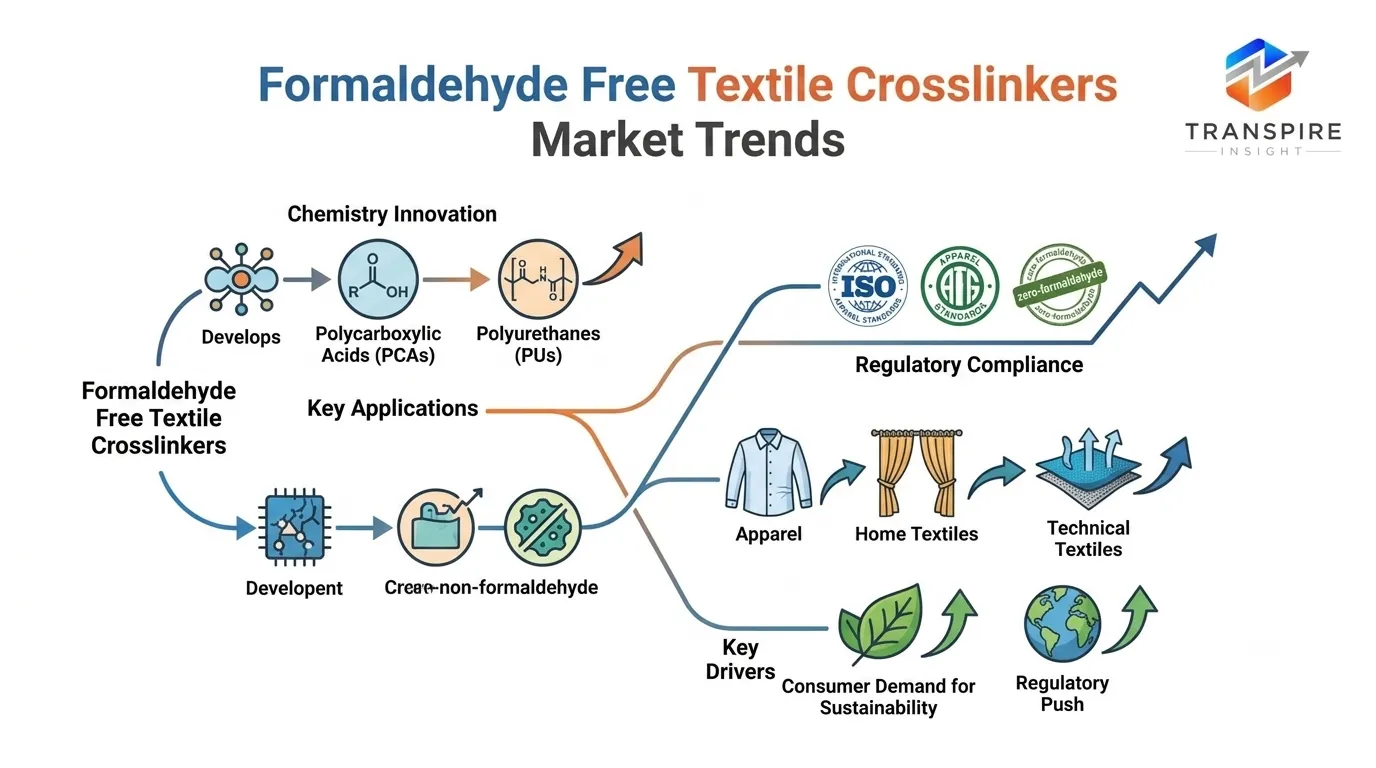
Description
According to a research report published by Transpire Insight, the formaldehyde-free textile crosslinkers market size is projected to grow from USD 456.27 billion in 2026 to USD 747.12 billion by 2035, at an 8.12% CAGR during the 2027-2035 forecast period. Tightening environmental regulations regarding toxic emissions, rising consumer demand for eco-friendly apparel, and zero-tolerance policies by major fashion brands against skin-irritating residues drive formaldehyde-free textile crosslinker market growth.
Introduction
The formaldehyde-free textile crosslinkers market focuses on non-toxic chemical formulations, such as polycarboxylic acids and polyurethane architectures, designed to replace traditional melamine and urea-formaldehyde resins. These crosslinking agents impart essential wrinkle resistance, dimensional stability, and durable press performance to cellulosic fabrics without releasing hazardous formaldehyde vapors. The market is expanding rapidly due to strict sustainability standards and growing consumer preference for eco-friendly, non-hazardous textiles.
Recent Development News
March 2026: Polycarboxylic acid formulations expanded their adoption across Asia-Pacific finishing mills as chemical suppliers introduced low-temperature curing agents to reduce thermal processing energy requirements.
August 2026: Leading textile auxiliary manufacturers updated their formaldehyde-free product portfolios to align with revised European Union eco-certification requirements for sustainable textile processing.
Stay Ahead of Emerging Opportunities with Expert Market Insights by Transpire Insight
Transpire Insight provides comprehensive, data-driven market intelligence to support smarter business decisions. Our research is rooted in comprehensive analysis, authoritative predictions, and industry expertise, enabling organizations to make informed decisions in rapidly evolving markets. We provide in-depth analysis of market segmentation, competitive positioning, regional trends, and emerging investment opportunities in high-growth areas. We blend accuracy with actionable intelligence, empowering companies to uncover new avenues for growth, bolster strategic decision-making, and stay ahead in a dynamic market.
Formaldehyde-Free Textile Crosslinkers Market Size & Statistics
The Market Size for Formaldehyde-Free Textile Crosslinkers Was Estimated to be Worth USD 456.27 Billion in 2026.
The Market Size is Going to Expand at a CAGR of 8.12% between 2026 and 2035.
The Formaldehyde-Free Textile Crosslinkers Market Size is anticipated to reach USD 747.12 Billion by 2035.
Asia Pacific is projected to drive the highest demand during the forecast period, accounting for 43% of the formaldehyde-free textile crosslinkers market.
North America is projected to grow the fastest during the forecast period at a CAGR of 12.6% in the formaldehyde-free textile crosslinkers market.
Regional Growth and Demand Analysis by Transpire Insight
Asia Pacific leads demand because export-oriented mills across China, India, Bangladesh, Vietnam, and Japan must meet the chemical compliance requirements of apparel brands. Country outlooks show how strong this shift is, with Vietnam projected at a 9.2% CAGR, Bangladesh at 8.9%, and India at 8.5%, as mills replace legacy formaldehyde-based resins with polycarboxylic acid systems for wrinkle-resistant cotton finishing. suppliers are localizing their offerings too. Archroma recently introduced formaldehyde-free crosslinking solutions built on bio-based formulations and low-temperature curing, which help regional finishers cut energy use while passing buyer audits.
North America is expanding quickly, supported by stringent environmental regulations, a well-established textile chemicals industry, and rising investment in green chemistry. Finishers serving apparel, home textile, and industrial applications are adopting formaldehyde-free systems to protect fabric performance while staying compliant, and the United States is estimated to grow at a 6.2% CAGR. Suppliers are reinforcing this momentum, with Huntsman recently expanding its sustainable textile chemicals portfolio through next-generation formaldehyde-free crosslinkers designed for better fabric performance and energy-efficient processing. Demand is further lifted by Asian mills supplying North American apparel chains, which need compliant chemistry to keep those export orders.
Top 15 Trends in the Formaldehyde Free Textile Crosslinkers Market
Polycarboxylic acid chemistries dominate formaldehyde-free finishing because they deliver strong wrinkle resistance and durability on cotton, helping mills replace legacy resins without sacrificing fabric performance.
Bio-based crosslinkers derived from renewable feedstocks are attracting finishers seeking lower environmental footprints, supporting brand sustainability targets while meeting expected wrinkle resistance and wash-durability requirements.
Low-temperature curing technologies cut energy use and processing time, lowering operating costs while protecting fabric strength, which makes formaldehyde-free systems commercially much easier to adopt.
Tightening chemical safety regulations, particularly REACH amendments in Europe, are forcing textile finishers to retire formaldehyde-releasing resins and qualify compliant alternatives across apparel production.
apparel brands and retailers increasingly audit suppliers for chemical compliance, pushing mills to adopt formaldehyde-free finishing as a condition of winning export orders abroad.
Export-oriented mills in Vietnam, Bangladesh, and India are upgrading finishing chemistries to serve North American and European buyers, creating strong volume demand for compliant crosslinkers.
List of Top 25 Companies Leading the Formaldehyde-Free Textile Crosslinkers Market
1. Archroma
leader providing innovative, sustainable color and specialty chemical solutions for textiles.
Founded: 2013 | HQ: Pratteln, Switzerland.
Why It Ranks: Market leader in eco-friendly, certified zero-formaldehyde textile processing technologies.
Regional Dominance: Strong market leadership across Europe, Asia-Pacific, and the Americas.
Product Line: EarthColors, Arkofix zero-formaldehyde resin lines, Smartrepel hydro-repellent solutions.
2. Huntsman Corporation
pioneer in advanced specialty chemical solutions and high-performance textile auxiliaries.
Founded: 1970 | HQ: The Woodlands, Texas, USA.
Why It Ranks: High market penetration with specialized non-formaldehyde finishing chemistry portfolios.
Regional Dominance: Extensive presence in North America, Europe, and Asia-Pacific.
Product Line: AVITERA SE dyes, Oleophobol, and non-formaldehyde durable press crosslinkers.
3. CHT Group
Major supplier of specialized textile chemicals, silicone materials, and finishing agents.
Founded: 1953 | HQ: Tübingen, Germany.
Why It Ranks: Premier developer of bio-based crosslinking formulations for sustainable textile processing.
Regional Dominance: Dominant footprint across Europe and expanding Asia-Pacific operations.
Product Line: Beritex, Tubingal, and eco-certified formaldehyde-free resin finishing agents.
4. Wacker Chemie AG
Worldwide supplier of hyper-pure silicones and specialty polymers for advanced textiles.
Founded: 1914 | HQ: Munich, Germany.
Why It Ranks: Unrivaled technical leadership in silicone-based textile softeners and crosslinkers.
Regional Dominance: Strong manufacturing and commercial footprint across Europe and Asia.
Product Line: WACKER FINISH silicone emulsions and specialty polycarboxylic crosslinking agents.
5. BASF SE
The world's largest chemical producer supplying high-efficiency functional textile processing agents.
Founded: 1865 | HQ: Ludwigshafen, Germany.
Why It Ranks: Exceptional R&D capabilities delivering non-formaldehyde finishing and resin chemistry.
Regional Dominance: market presence spanning Europe, the Americas, and Asia-Pacific.
Product Line: Fixapret non-formaldehyde resins, Lurapret binders, and Helizarin systems.
6. Pulcra Chemicals
Specialist in engineered chemical solutions for natural and synthetic fiber processing.
Founded: 1935 | HQ: Geretsried, Germany.
Why It Ranks: Top supplier of eco-compliant functional crosslinkers for technical apparel finishes.
Regional Dominance: Strong operational setup across Europe, North America, and Asia.
Product Line: Non-formaldehyde crosslinking additives, Belfasin, and Nonex textile finishes.
7. Evonik Industries
specialty chemicals leader manufacturing eco-friendly functional additives for textiles.
Founded: 2007 | HQ: Essen, Germany.
Why It Ranks: Industry innovator in polyurethane and organo-silicon crosslinking chemical architectures.
Regional Dominance: Powerful presence in Europe, North America, and Greater China.
Product Line: TEGOPREN, TEGOSIV, and specialty non-formaldehyde textile processing agents.
8. Dow Chemical Company
chemical titan producing advanced silicone and acrylic polymers for textiles.
Founded: 1897 | HQ: Midland, Michigan, USA.
Why It Ranks: Unmatched material science innovation supporting sustainable fiber treatment technologies.
Regional Dominance: Strong dominance in the Americas, Europe, and Asia-Pacific regions.
Product Line: DOWSIL textile silicones and non-formaldehyde binder and crosslinking technologies.
9. Allnex
leader in coating resins and sustainable specialty crosslinking chemical agents.
Founded: 2013 | HQ: Frankfurt, Germany.
Why It Ranks: Recognized authority in non-formaldehyde curing agents and green coating chemistries.
Regional Dominance: Extensive distribution and manufacturing presence in Europe and North America.
Product Line: CYMEL formaldehyde-free series, specialty curing agents, and polymer crosslinkers.
10. Covestro AG
Leading manufacturer of high-tech polymer materials and waterborne polyurethane dispersants.
Founded: 2015 | HQ: Leverkusen, Germany.
Why It Ranks: Market leader in waterborne polyurethane crosslinkers for sustainable textile coatings.
Regional Dominance: Robust market coverage across Europe, North America, and Asia-Pacific.
Product Line: Impranil polyurethane dispersions and Bayhydur eco-friendly crosslinking hardeners.
Conclusion
The transition toward eco-friendly textile processing continues to elevate the importance of formaldehyde-free crosslinkers. Driven by rigorous international health standards and eco-certifications, leading chemical producers are continuously optimizing polycarboxylic acid and polyurethane formulations. As major apparel brands strictly enforce zero-formaldehyde limits, market players that prioritize sustainable R&D, energy-efficient curing, and robust regional supply networks are well-positioned to dominate the future landscape of textile finishing.


Send us a brief description of your challenge and we'll get back to you within 24 hours.

 inquiry@transpireinsight.com
 APAC:+91 7666513636
 Address


