

Global Formaldehyde Free Textile Crosslinkers Market Summary:
According to Transpire Insights, a detailed research report on the market reflects that the cotton textiles application segment dominates the Global Formaldehyde Free Textile Crosslinkers Market, accounting for approximately 57% of the total share worldwide. Archroma AG leads the market with approximately (around USD 1.8 billion) in annual revenue and an estimated 17–21% global market share, making it the leading contributor to global market development, innovation, advanced formaldehyde-free textile crosslinking technologies, sustainable textile finishing solutions, expanding eco-friendly wrinkle-resistant fabric treatment capabilities, and overall market growth dynamics.
Market Snapshot
- Global Market Value (2025):USD 425.6 Million.
- Expected Market Value (2026): USD 456.6 Million.
- Estimated Market Value (2033): USD 747.7 Million.
- Forecast CAGR (2026–2033): 7.30%
- Leading Region in 2025: Asia Pacific
- Second-largest Region: Europe
- Fastest Growing Region: North America
Introduction
The Formaldehyde Free Textile Crosslinkers Market comprises advanced chemical finishing agents used to enhance wrinkle resistance, dimensional stability, durability, and fabric performance without releasing formaldehyde. These solutions utilize environmentally friendly crosslinking technologies to meet stringent environmental regulations while ensuring high-quality textile finishing across apparel, home textiles, technical textiles, and industrial fabric applications.
Formaldehyde-Free Crosslinking: Ensures durable textile finishing without formaldehyde emissions. Enhanced Fabric Performance, Improves wrinkle resistance, dimensional stability, and durability. Sustainable Textile Processing, Supports eco-friendly manufacturing and regulatory compliance. Regulatory Compliance: Meets global environmental and consumer safety standards for textile finishing.
- For instance: - Growing demand for sustainable textiles, stringent environmental regulations, and increasing consumer preference for eco-friendly apparel are driving the adoption of advanced formaldehyde-free textile crosslinkers.

Key Market Highlights: -
- Asia Pacific is expected to grow at a rapid CAGR in the Global Formaldehyde Free Textile Crosslinkers Market by holding nearly 43% of the share during the forecast period.
- North America is the fastest-growing region in the Global Formaldehyde Free Textile Crosslinkers Market during the period, holding around 28% share.
- Europe is anticipated to hold approximately 25% share of the Global Formaldehyde Free Textile Crosslinkers Market over the predicted timeframe.
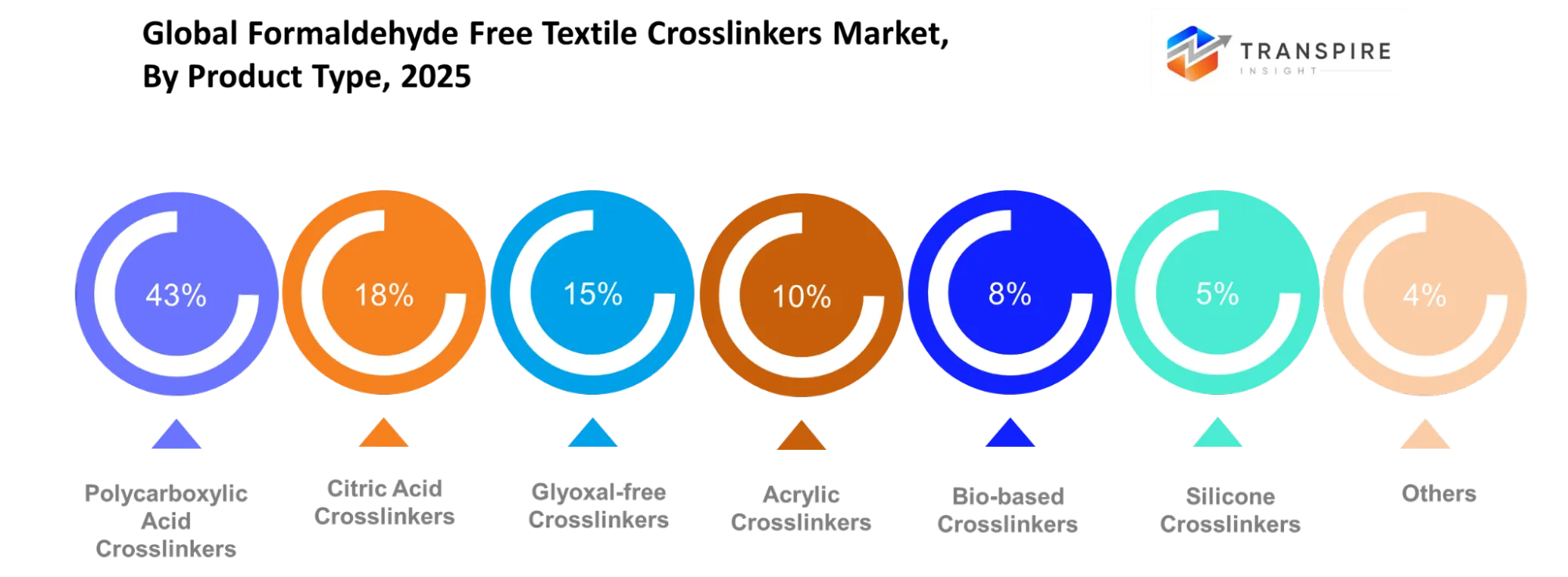
- By Product Type, the Polycarboxylic Acid Crosslinkers segment dominated the market and holds nearly 41.2% share in 2025 and is projected to grow at a substantial CAGR during the forecast period.
- By Fiber Type, the Cotton segment dominated the market and holds almost 36.8% share in 2025 and is projected to grow at a substantial CAGR during the forecast period.
- By End User, the Textile Mills segment dominated the market and holds approximately 31.5% share in 2025 and is projected to grow at a substantial CAGR during the forecast period.
- By Application, the Wrinkle-resistant Finishing segment dominated the market and holds roughly 39.4% share in 2025 and is projected to grow at a substantial CAGR during the forecast period.
- By Distribution Channel, the Direct Sales segment dominated the market and holds around 37.1% share in 2025 and is projected to grow at a substantial CAGR during the forecast period.
- Growing Demand for Sustainable Textile Finishing and Stringent Environmental Regulations: Textile manufacturers, apparel brands, chemical companies, and textile processing facilities across Asia Pacific, North America, and Europe are increasing investments in formaldehyde-free crosslinking technologies, bio-based textile chemicals, and sustainable finishing solutions to improve fabric performance, comply with global environmental standards, and support eco-friendly textile production.
How is Technology Driving Growth in the Formaldehyde Free Textile Crosslinkers Market?
The market for formaldehyde free textile crosslinkers is expanding due to continuous advancements in sustainable textile chemistry, polymer science, and textile finishing technologies. Modern solutions such as polycarboxylic acid crosslinkers, bio-based crosslinking agents, silicone-based formulations, hybrid crosslinking systems, and low-temperature curing technologies provide enhanced fabric durability, improved wrinkle resistance, and superior environmental performance. Innovations in green chemical synthesis, catalyst optimization, energy-efficient curing processes, nanotechnology-based finishing, and digital process control enable textile manufacturers to achieve consistent fabric quality while complying with stringent environmental regulations. These technological developments are driving wider adoption across textile mills, apparel manufacturers, home textile producers, industrial textile manufacturers, and textile chemical companies while improving finishing efficiency, product performance, operational productivity, and sustainable textile manufacturing.
Market Drivers
The global market for formaldehyde free textile crosslinkers is being driven by growing demand for sustainable textile processing and increasingly stringent environmental and consumer safety regulations. The rising adoption of eco-friendly textile finishing technologies, green manufacturing practices, and formaldehyde-free fabric treatments is accelerating demand for advanced crosslinking agents that ensure high-performance textile finishing while minimizing environmental impact. These trends are encouraging manufacturers and textile chemical companies to invest in bio-based formulations, low-emission finishing technologies, and innovative crosslinking solutions. In the Global Formaldehyde Free Textile Crosslinkers Market, companies are expanding sustainable product portfolios, enhancing textile finishing performance, improving regulatory compliance, and creating new growth opportunities.
- For Instance: - Archroma continues to advance sustainable textile finishing by developing high-performance formaldehyde-free crosslinking solutions that improve fabric durability, support global environmental compliance, and enhance eco-friendly textile manufacturing.
Restrain
The main obstacles to the Global Formaldehyde Free Textile Crosslinkers Market are high production costs and stringent environmental and performance compliance requirements. Manufacturing expenses are further increased by advanced bio-based raw materials, sustainable chemical formulations, low-temperature curing technologies, and continuous research and development activities. Complex formulation processes, limited availability of eco-friendly raw materials, and higher production costs compared to conventional formaldehyde-based crosslinkers limit widespread adoption. These factors may hinder the large-scale commercialization and market growth of formaldehyde free textile crosslinkers.
Analysis of Prices and Consumer Behaviour
The mid-range equipment segment dominates the Formaldehyde Free Textile Crosslinkers Market, contributing approximately 59% of total sales due to its strong adoption among textile mills, apparel manufacturers, and textile chemical companies seeking a balance of performance, sustainability, and cost-effectiveness. Premium formaldehyde-free crosslinkers are typically priced 35–50% higher because of advanced bio-based formulations, superior wrinkle resistance, enhanced fabric durability, and compliance with stringent environmental standards. Mid-range products account for nearly 56% of total purchase volume, driven by increasing demand for sustainable textile finishing, regulatory compliance, and eco-friendly textile manufacturing. Consumer buying behavior is increasingly influenced by finishing performance, environmental compliance, product quality, operational efficiency, long-term durability, and compatibility with textile processing systems, resulting in higher adoption of advanced formaldehyde-free crosslinking solutions across textile manufacturing applications.
Top Companies in the Global Formaldehyde Free Textile Crosslinkers Market
- Archroma
- Huntsman Corporation
- Rudolf Group
- Tanatex Chemicals
- NICCA Chemical
- Sarex Chemicals
- Pulcra Chemicals
- Dow
- BASF
- Evonik Industries
- CHT Group
- Kyung-In Synthetic
- Dystar
- Fineotex Chemical
- Kemin Industries
Market Segmentation:
The Global Formaldehyde Free Textile Crosslinkers Market share is divided into five categories: Product Type, Fiber Type , Application, End User, Distribution.
The Polycarboxylic Acid Crosslinkersdominated the market, accounting for nearly 41.2% in 2025, and is expected to rise at a significant CAGR during the forecast period.
The Global Formaldehyde Free Textile Crosslinkers Market is segmented .By Product Type (Polycarboxylic Acid Crosslinkers, Citric Acid Crosslinkers, Glyoxal-free Crosslinkers, Bio-based Crosslinkers, Acrylic Crosslinkers, Silicone Crosslinkers, Hybrid Crosslinkers, Others. Among these, the Polycarboxylic Acid Crosslinkers dominated the market, accounting for nearly 41.2% in 2025 and expected to increase at a significant CAGR during the forecast period.because they provide excellent wrinkle resistance, superior fabric durability, low formaldehyde emissions, compatibility with cotton textiles, compliance with global environmental regulations, and cost-effective performance for sustainable textile finishing.
The Cottonsegmentheld the greatest share of approximately 36.8% in 2025 and is expected to increase at a substantial CAGR over the forecast period.
The GlobalFormaldehyde Free Textile Crosslinkers Market is segmented.By Fiber Type (Cotton, Polyester, Blended Fabrics, Linen, Rayon, Technical Textiles, Nonwoven Fabrics, Others. Among these, the Cotton segment held the greatest share of approximately 36.8% in 2025 and is expected to increase at a substantial CAGR over the forecast period.because it is the most widely used natural fiber, requiring durable wrinkle-resistant finishing, offering excellent compatibility with formaldehyde-free crosslinkers, and meeting growing demand for sustainable.
TheWrinkle-resistant Finishingsegmentheld the greatest share of approximately 39.4%in 2025 and is expected to increase at a high CAGR over the forecast period.
The Global Formaldehyde Free Textile Crosslinkers Market is segmented.By Application (Wrinkle-resistant Finishing, Easy-care Finishing, Performance Apparel, Home Textiles, Medical Textiles, Industrial Textiles, Protective Clothing, Others. Among these, the Wrinkle-resistant Finishing segment held the greatest share of approximately 39.4% in 2025 and is expected to increase at a considerable CAGR over the projected period. because it enhances fabric appearance, improves durability, reduces ironing requirements, extends garment lifespan, meets consumer demand for easy-care textiles, and supports sustainable, high-performance textile manufacturing.
Regional Segment Analysis of the Global Formaldehyde Free Textile Crosslinkers Market
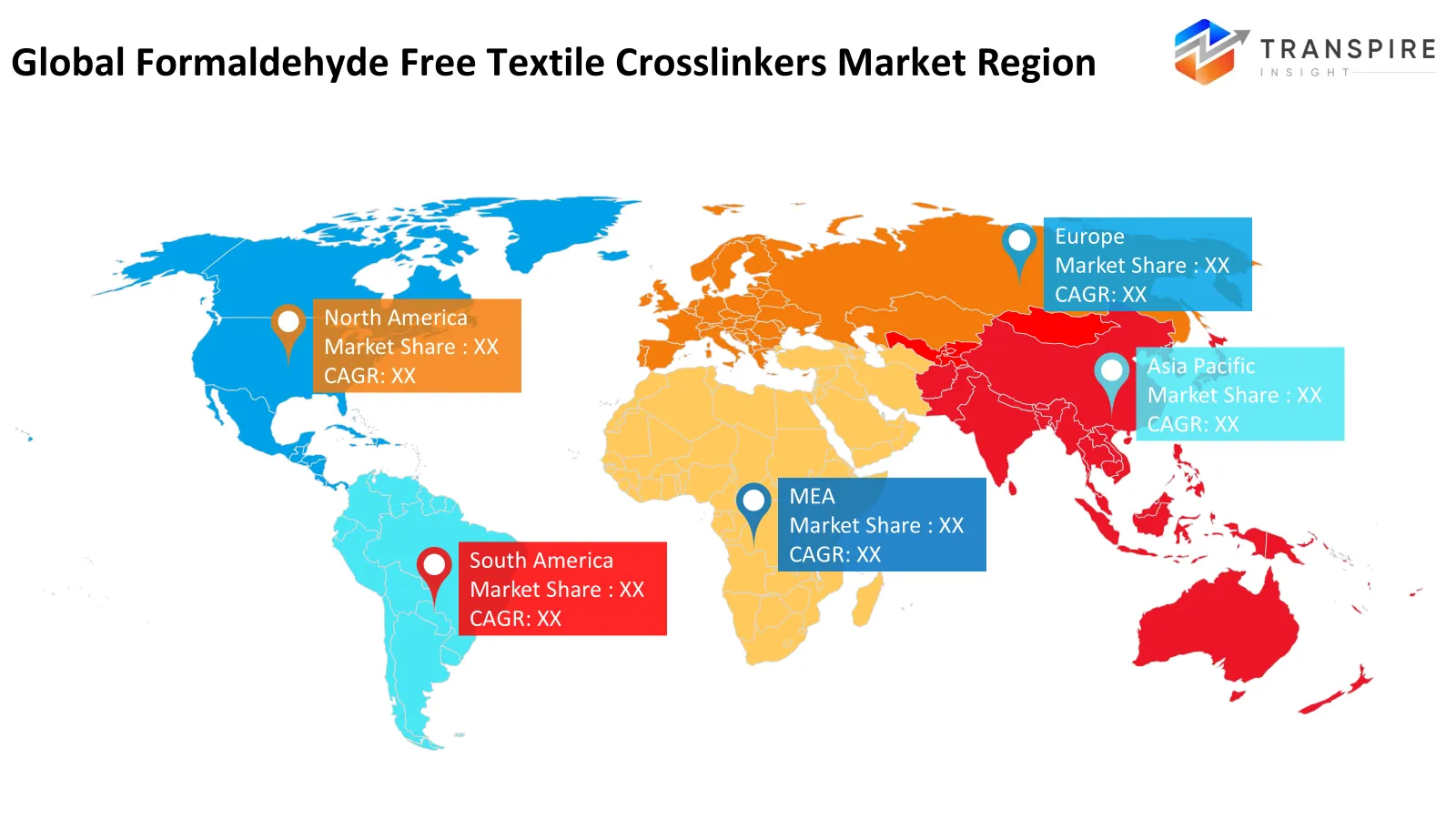
- North America (U.S., Canada, Mexico)
- Europe (Germany, France, U.K., Italy, Spain, Rest of Europe)
- Asia-Pacific (China, Japan, India, Rest of APAC)
- South America (Brazil and the Rest of South America)
- The Middle East and Africa (UAE, South Africa, Rest of MEA)
Asia Pacific is expected to grow at a rapid CAGR in the Global Formaldehyde Free Textile Crosslinkers Market by holding nearly 43% of the share during the forecast period.
Over the course of the forecast period, the Global Formaldehyde Free Textile Crosslinkers Market is anticipated to rise rapidly in Asia Pacific. It makes up about 43% of the market. The region dominates this market because of rapid growth in textile manufacturing, increasing adoption of sustainable textile processing, stringent environmental regulations, and expanding apparel production activities, particularly in China, India, Bangladesh, Vietnam, and Japan. Demand is further fueled by growing investments in eco-friendly textile chemicals, export-oriented garment manufacturing, and green production technologies. Additionally, the increasing focus on sustainable fashion, high-performance fabric finishing, and compliance with global environmental standards is strengthening Asia Pacific's position as the leading regional market.
Europe is the fastest-growing region in the Global Formaldehyde Free Textile Crosslinkers Market during the period, holding approximately 25% share.
With an estimated 25% of the Global Formaldehyde Free Textile Crosslinkers Market share throughout the projection period, Europe is expected to grow at the highest rate. The region's expansion is driven by stringent environmental and chemical safety regulations, increasing demand for sustainable textile finishing, and strong investments in eco-friendly textile manufacturing technologies. Countries such as Germany, Italy, France, and the U.K. are emphasizing green textile production, compliance with global environmental standards, and high-performance fabric finishing. Collaborations between textile manufacturers, chemical companies, research institutes, and apparel brands are accelerating the adoption of advanced formaldehyde-free crosslinking solutions, supporting long-term market growth across Europe.
North America is anticipated to hold approximately 28% share of the Global Indoor Air Quality Multi-Pollutant Sensor Calibration Test Equipment Market over the predicted timeframe.
North America is estimated to account for nearly 28% of the Global Formaldehyde Free Textile Crosslinkers Market over the forecast period. The region is expected to grow steadily, supported by stringent environmental regulations, widespread adoption of sustainable textile manufacturing practices, and a well-established textile chemicals industry. Rising demand for eco-friendly textile finishing solutions, increasing investments in green chemistry technologies, and continuous advancements in high-performance crosslinking formulations further contribute to market growth. Furthermore, efforts to improve regulatory compliance, enhance fabric performance, and expand sustainable textile production across apparel, home textiles, and industrial textile applications are driving innovation, product adoption, and commercialization across North America.
Strategies for Market Growth in Non-Leading Regions:
Non-leading regions can spur growth by establishing cost-effective and scalable production infrastructure for formaldehyde-free textile crosslinkers using advanced green chemistry, bio-based formulations, low-temperature curing technologies, and sustainable manufacturing processes. This will reduce reliance on imported textile chemicals and strengthen regional textile manufacturing ecosystems by developing local production and formulation capabilities. Strategic collaborations with textile mills, apparel manufacturers, textile chemical companies, research institutes, technology providers, and government agencies will help accelerate commercialization and market penetration. Investments in workforce training, R&D, advanced polymer technologies, bio-based raw materials, process automation, and energy-efficient production techniques are crucial for improving product performance and operational efficiency. Additionally, government support for sustainable textile manufacturing programs, green chemistry initiatives, manufacturing incentives, and environmental compliance regulations can improve accessibility, attract investment, and accelerate the long-term expansion of the Global Formaldehyde Free Textile Crosslinkers Market in emerging economie worldwide.
Future Market Trends for the Global Formaldehyde Free Textile Crosslinkers Market: -
- Rising Adoption of Bio-Based and Sustainable Crosslinking Technologies, as manufacturers focus on improving environmental performance and textile quality, companies are increasingly developing bio-based formulations, low-emission crosslinkers, and energy-efficient curing technologies to ensure sustainable textile finishing and regulatory compliance.
- Growing Demand for Eco-Friendly Textile Finishing Solutions, textile mills, apparel manufacturers, and home textile producers are increasingly integrating formaldehyde-free crosslinkers, green chemistry formulations, and advanced finishing technologies to enhance fabric durability, wrinkle resistance, and sustainable textile production.
- Technological and Product Innovations, companies are investing in advanced polymer chemistry, low-temperature curing technologies, catalyst optimization, hybrid crosslinking systems, and digital process control to improve finishing performance, reduce energy consumption, enhance production efficiency, and support next-generation sustainable textile manufacturing solutions.
Recent Development
- February 24, 2026 – Archroma (Switzerland): Introduced advanced formaldehyde-free textile crosslinking solutions featuring enhanced bio-based formulations and low-temperature curing technology. The innovation improves wrinkle resistance, fabric durability, supports global environmental compliance, and strengthens sustainable textile finishing applications.
- May 15, 2026 – Huntsman Corporation (U.S.): Expanded its sustainable textile chemicals portfolio with next-generation formaldehyde-free crosslinkers designed for improved fabric performance and energy-efficient processing. The update enables superior textile finishing quality, enhances production efficiency, and supports environmentally responsible textile manufacturing.
Market Segment
This study forecasts revenue at global, regional, and country levels from 2020 to 2033. Transpire Insights has segmented the Global Formaldehyde Free Textile Crosslinkers Market based on the below-mentioned segments:
Global Formaldehyde Free Textile Crosslinkers Market, By Product Type
- Polycarboxylic Acid Crosslinkers
- Citric Acid Crosslinkers
- Glyoxal-free Crosslinkers
- Bio-based Crosslinkers
- Acrylic Crosslinkers
- Silicone Crosslinkers
- Hybrid Crosslinkers
- Others
Global Formaldehyde Free Textile Crosslinkers Market, By Fiber Type
- Cotton
- Polyester
- Blended Fabrics
- Linen
- Rayon
- Technical Textiles
- Nonwoven Fabrics
- Others
Global Formaldehyde Free Textile Crosslinkers Market, By End User
- Textile Mills
- Apparel Manufacturers
- Home Textile Producers
- Industrial Textile Manufacturers
- Textile Chemical Companies
- Contract Finishers
- Research Institutes
- Others
Global Formaldehyde Free Textile Crosslinkers Market, By Application
- Wrinkle-resistant Finishing
- Easy-care Finishing
- Performance Apparel
- Home Textiles
- Medical Textiles
- Industrial Textiles
- Protective Clothing
- Others
Global Formaldehyde Free Textile Crosslinkers Market, By Distribution Channel
- Direct Sales
- Textile Chemical Distributors
- Online B2B Platforms
- Regional Dealers
- Exporters
- OEM Supply
- Wholesalers
- Others
Global Shoppable Short Video Products Market, By Regional Analysis
North America
- United States
- Canada
- Mexico
Europe
- Germany
- United Kingdom
- France
- Italy
- Spain
- Russia
- Rest of Europe
Asia Pacific
- China
- Japan
- India
- South Korea
- Australia
- Rest of Asia Pacific
South America
- Brazil
- Argentina
- Rest of South America
Middle East & Africa
- Saudi Arabia
- United Arab Emirates
- Qatar
- South Africa
- Rest of the Middle East & Africa
Frequently Asked Questions
Find quick answers to common questions.
They provide durable wrinkle resistance and fabric performance while eliminating formaldehyde emissions, helping textile manufacturers comply with stringent environmental regulations and meet growing consumer demand for sustainable textiles.
They offer excellent wrinkle resistance, superior fabric durability, low formaldehyde emissions, compatibility with cotton fabrics, and cost-effective performance while meeting global environmental and safety standards.
Cotton is the most widely used natural fiber and requires effective wrinkle-resistant finishing. It is highly compatible with formaldehyde-free crosslinkers, making it ideal for sustainable textile manufacturing.
Asia Pacific leads the market due to its large textile manufacturing base, expanding apparel production, growing adoption of sustainable textile processing, and stringent environmental regulations.
Market growth is driven by increasing demand for eco-friendly textile finishing, stringent environmental regulations, advancements in sustainable crosslinking technologies, and rising investments in green textile manufacturing.
- Archroma
- Huntsman Corporation
- Rudolf Group
- Tanatex Chemicals
- NICCA Chemical
- Sarex Chemicals
- Pulcra Chemicals
- Dow
- BASF
- Evonik Industries
- CHT Group
- Kyung-In Synthetic
- Dystar
- Fineotex Chemical
- Kemin Industries
About the Authors

Pankaj Ghogare Patil
I am Pankaj Ghogare Patil, a Senior Research Analyst at Transpire Insight, specializing in the Pharmaceutical, Chemicals & Materials, Healthcare IT, and Biotechnology industry. My expertise lies in conducting comprehensive market research, analyzing industry trends, evaluating competitive landscapes, and translating complex data into actionable insights. At Transpire Insight, I closely follow emerging technologies, regulatory developments, and market innovations to create accurate, well-researched, and informative content that helps businesses and professionals make informed decisions. I am committed to producing credible, evidence-based articles that reflect industry best practices while making technical topics accessible and valuable for a broad audience.

Chakradhar Khansole
Chakradhar serves as the Research Director at Transpire Insight, bringing over 8 years of experience in technology, innovation, and strategic market intelligence. He specializes in transforming complex market data into actionable business insights that enable organizations to make informed, growth-oriented decisions. Recognized for his strategic vision and analytical expertise, Chakradhar leads high-impact research initiatives, delivering comprehensive market assessments, competitive intelligence, and forward-looking industry analysis.
Recently Published Reports
-
May 2026
Healthcare Polymer Packaging Market
Healthcare Polymer Packaging Market Size, Share & Analysis Report By Packaging Type (Syringes, IV Bottles and Pouches, Clamshells, Blisters, Bottles & Jars, Containers, Tubes, IV Parental Packaging, Others), By Type (Regulated, Non-regulated), By Polymer Type (LDPE (Low-Density Polyethylene), HDPE (High-Density Polyethylene), Homo-polymer (Homo), Random Copolymer (Random), Block Copolymer (Block), PET, Polystyrene, Polyvinyl Chloride, Polyamide/EVOH, Others), and Geography (North America, Europe, Asia-Pacific, Middle East and Africa, South and Central America), 2021 - 2031
-
Apr 2026
Hydrophilic Tape (Waterstop) Market
Hydrophilic Tape (Waterstop) Market Size, Share & Analysis Report By Type (Bentonite-Based Hydrophilic Tape, Rubber-Based Hydrophilic Tape), By Application (Residential Buildings, Commercial Buildings, Infrastructure Projects), and Geography (North America, Europe, Asia-Pacific, Middle East and Africa, South and Central America), 2021 - 2031
-
Apr 2026
Metalens Market
Metalens Market Size, Share & Analysis Report By Type (Visible Light Metalens, and Infrared Metalens), By Application (Consumer Electronics, Automotive Electronics, Industrial, Medical, and Others), and Geography (North America, Europe, Asia-Pacific, Middle East and Africa, South and Central America), 2021 - 2031
-
Apr 2026
PBT Resin Market
PBT Resin Market Size, Share & Analysis Report By Type (Reinforced PBT Resin, Unreinforced PBT Resin), By Processing Method (Injection Molding, Extrusion, Blow Molding, Others), By End-User (Automotive, Electrical & Electronics, Consumer Appliances, Industrial Machinery, Medical Devices, Packaging, Others), and Geography (North America, Europe, Asia-Pacific, Middle East and Africa, South and Central America), 2021 - 2031