
Wearable Devices Technology in Sport Market Summary:
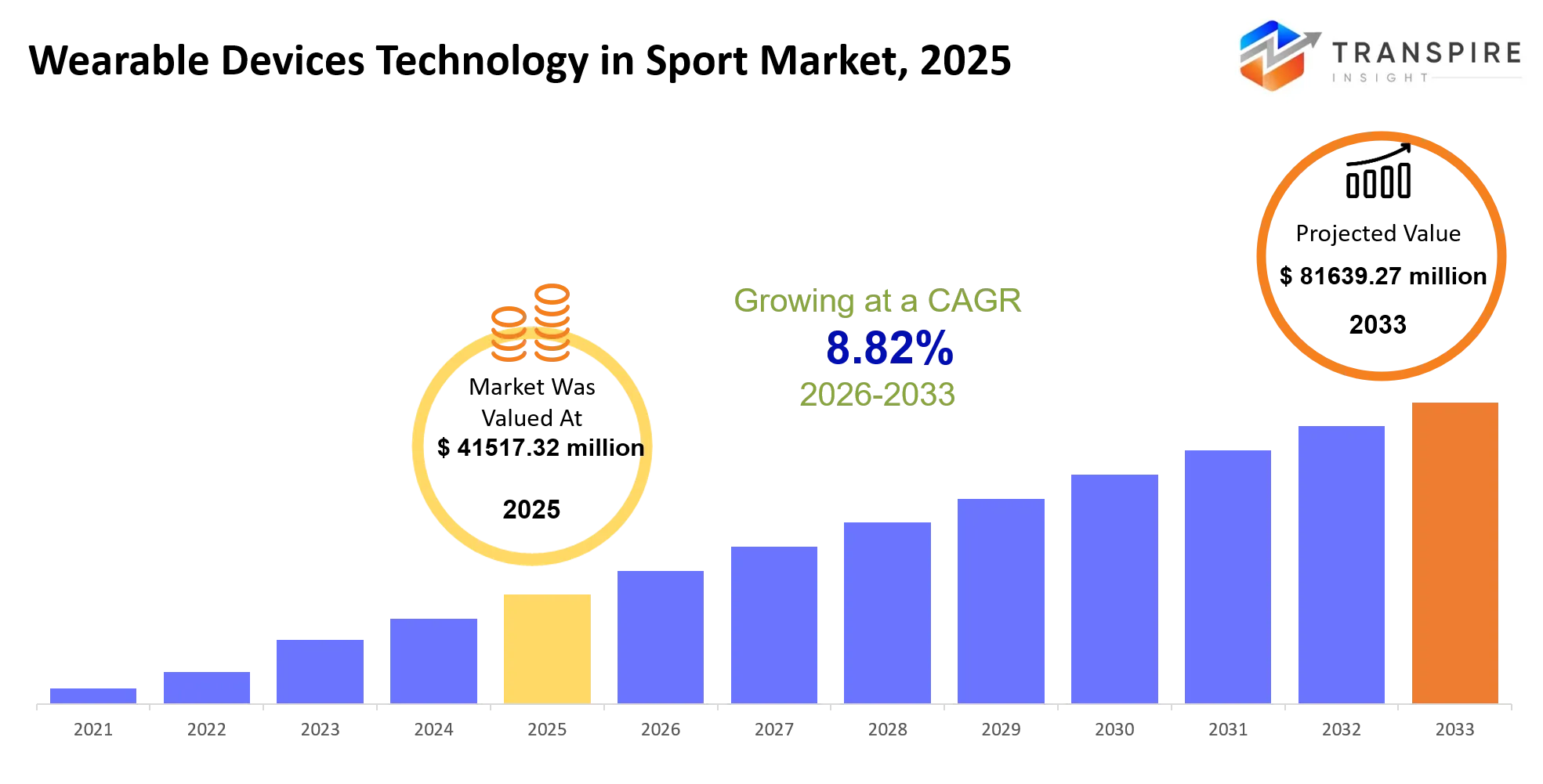
As per Transpire Insight Analysis, the Wearable Devices Technology in Sport Market size is estimated at USD 41517.32 million in 2025 and is anticipated to reach USD 81639.27 million by 2033, growing at a CAGR of 8.82% from 2026 to 2033.
The Wearable Devices Technology in Sport Market provides technology that assists athletes, trainers, fitness enthusiasts and sports organisations in measuring performance, movements, fitness and health parameters. Over the past three to five years, the market has moved beyond simple activity monitoring. The market focuses on connected and data-driven sports monitoring. A key development in the market is the use of GPS, biometrics, motion sensors, cloud technology and analytics powered by intelligence. This evolution in the market is due to the need for customised training and real-time feedback on performance, which has resulted in the use of such wearables in professional as well as recreational sports. Development in textile technology and advancements in electronics have also changed the way performance data is gathered since it is no longer restricted to devices that can be worn on the wrists. Since the connected wearable devices are now able to provide useful insights, the market is witnessing huge adoption from the athletes' side.
Wearable Devices Technology in Sport Market Size & Forecast:
- Market Size 2025: USD 41517.32 million
- Expected Market Value (2033): USD 81639.27 million
- Forecast CAGR (2026–2033): 8.82%
- Leading Region in 2025: North America
- Fastest Growing Region: Asia Pacific
- Key Company Profiles: Apple, Garmin, Fitbit, Polar Electro, WHOOP, Catapult Sports, STATSports, Samsung, Huawei, Xiaomi, Wahoo Fitness, Suunto, COROS, PlayerMaker, FORM
Key Market Insights:
The market is transitioning from basic fitness tracking into devices that integrate the functions of health monitoring, sports performance metrics, and intelligent analysis.
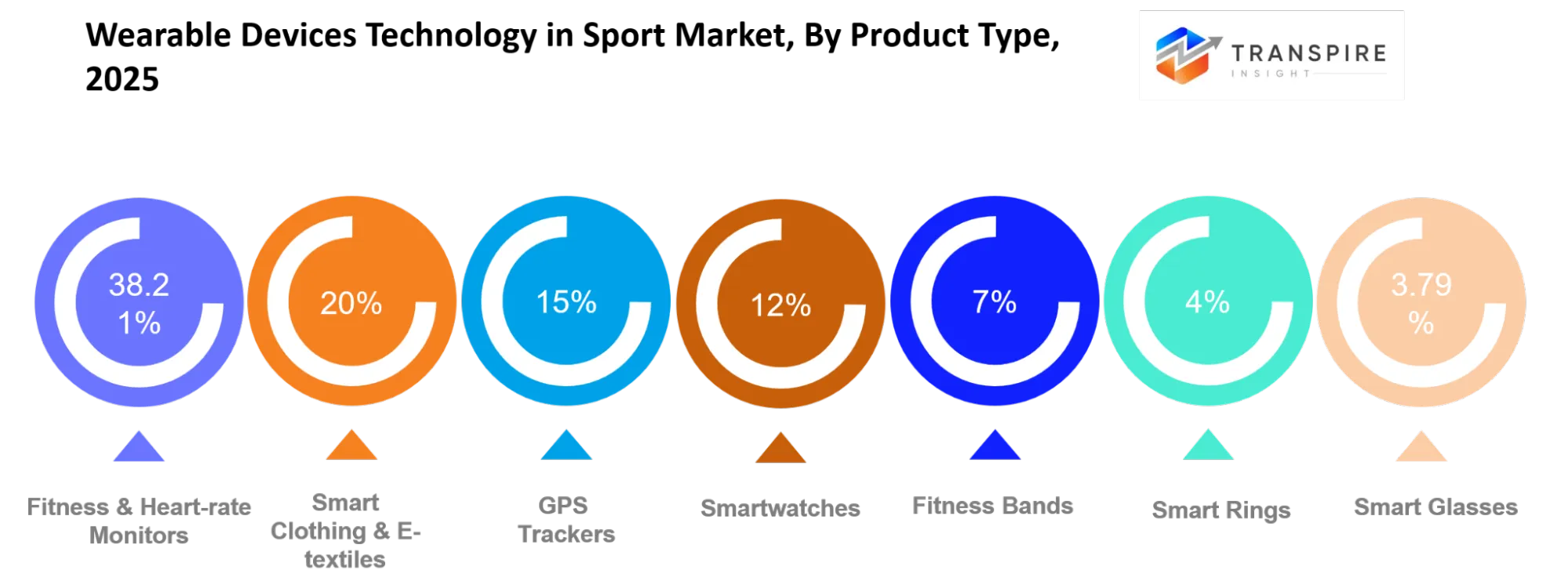
- Fitness & Heart-rate Monitors constitute 38.21% and continue to dominate the market due to their application in continuous heart rate and workout monitoring.
- Smart Clothes & E-Textiles are 20% because of their increasing use for monitoring physical performance while participating in sports activities.
- GPS Trackers are 15% and contribute to the development of outdoor sports through tracking of locations, distance, speed, and movements.
- Smartwatches are 12% and integrate health monitoring, sports activities, connectivity, and activity monitoring functionalities.
- Fitness Bands are 7% and attract people interested in easy-to-use options for monitoring daily physical activity and exercise routines.
- Smart Rings are 4% because of the increased demand for portable devices that can monitor health, activity, and recovery. Smart Glasses are 2%.
What are the Key Drivers, Restraints, and Opportunities in the Wearable Devices Technology in Sport Market?
Drivers
The wearable devices technology in sport market is fueled by the increasing number of connected devices that offer real-time data regarding the performance, movement, and wellness of the athletes and fitness enthusiasts. The trend towards evidence-based training has prompted sports organisations to adopt wearable devices together with coaching and analytics platforms for making better training decisions.
Restraints
The difficulty in integrating the various types of wearable devices, databases, and sports management systems. The cost of using the device, its compatibility with other devices and software, and the accuracy of data provided could pose a limitation on its use.
Opportunities
opportunity is the evolution of smart clothing, AI analysis, and the wearables ecosystem. Smart Clothing & E-textiles have been identified as the fastest-growing device category. This creates an opportunity for companies to develop technology where performance data can be collected through the clothes of athletes.
What Has the Impact of artificial intelligence on wearable device technology in the sports market?
AI is transforming wearable sports technology by allowing the analysis of collected data for making rapid decisions and drawing insights based on athletes' information. The algorithms may analyse information from heart rate monitors, GPS devices, motion sensors, and sleep trackers to determine workload patterns, estimate recovery levels, and create personalised training programs. Recent studies have pointed out several uses for AI in terms of performance optimisation, injury risk estimation, return-to-play, and athlete well-being. The technology also enables higher operational efficiency through automation of the process of analysing athlete information. For instance, platforms like AthletAI leverage wearable data, cloud data, and AI-driven analytics to recognise patterns in athletes' performance and development over time. AI implementation faces several challenges related to data quality and the accuracy of the analysis, integration of different technologies, and the necessity to have an expert to interpret results. Hence, current research proves the usefulness of AI as a decision-supporting technology.
Instance
In May 2026, WHOOP developed new AI-powered features that leverage continual biometric data for delivering more personalised coaching and insights. According to WHOOP, their AI has the capability to detect patterns in their members' data, which can help in making recommendations in areas such as recovery, training, and lifestyle.
Key Market Trends:
market trends evolving from merely activity tracking to integration into a system which integrates performance tracking, health monitoring, and analytics. The industry is also becoming more integrated in terms of the wearable format, providing athletes and sports organisations with a wealth of information.
- Wearable devices have evolved from simple activity trackers into multifunctional devices that monitor fitness, health, and sports performance.
- Monitoring heart rate is becoming more associated with performance monitoring, as this allows monitoring of the level of exercise intensity and bodily reactions.
- Smart Clothing & E-textiles become more popular as wearable technology evolves from wrist devices to sensors integrated into sports garments.
- GPS wearables become more associated with outdoor exercises, as this allows athletes to track movements and locations and monitor their performance.
- Smartwatches are evolving from common devices for fitness monitoring to more advanced sports and health monitoring through sensors and connected applications.
- AI analytics are evolving the way of interpreting data from wearables by focusing on automatic performance analysis.
Wearable Devices Technology in Sport MarketSegmentation
By Device type
Fitness & Heart-rate Monitors enjoy the most dominant market share of 38.21%, owing to their widespread adoption in terms of monitoring the level of exercise and physiological performance. Smart Clothing & E-textiles constitute 20% and are growing because of the increasing application of sensors in sportswear, whereas GPS Trackers occupy 15% due to their application in outdoor performance monitoring. Smart Watches contribute 12%, while Fitness Bands contribute 7%, Smart Rings contribute 4%, Smart Glasses contribute 2%, and Others contribute 1.79%. The segment is slowly shifting towards connected devices with wider performance data.
By Sport
Soccer/Football, Basketball, Running, Cycling, Swimming, Tennis, and Golf constitute the important spheres for which wearable technologies are essential for performance tracking and training. In running and cycling, it is useful to apply GPS and motion tracking, while swimming and other types of sports demand technologies adapted to specific sport tracking conditions. Future development will be associated with creating wearables that will analyze their data depending on the sport requirements.
By End User
Professional Teams & Leagues are an important end-user segment due to wearable data that can be applied to training, performance tracking, and athlete monitoring. Fitness Centres and Individual Athletes constitute important adoption segments for wearables as their availability increases. Sports Academies, Healthcare Providers, Amateur Teams, and Rehabilitation Centres also contribute to expanding wearable adoption markets.
By Application
Performance Monitoring is the most relevant use case, whereas Fitness Tracking, Injury Prevention, Athlete Training, Health Monitoring, Sports Analytics, and Recovery Monitoring increase the importance of wearables' use cases. Due to the presence of sensors and analytics, the user can get past the basics of activity monitoring to performance and recovery monitoring. In the future, more attention will be paid to integration of these applications into connected wearable products.
By Site
Headband, Handheld, Arm & Wrist, Shoe Sensor, Chest Strap, Smart Clothing, and Glasses offer various opportunities to collect sports and health data. Arm & Wrist devices are still feasible for daily monitoring purposes, and the shoe sensors and chest straps are able to gather sports-specific information. Smart Clothing and Glasses allow distributing sensors across the human body and making monitoring even easier through hands-free devices.
By Distribution
The online channel is convenient as a platform for purchasing wearable products; however, in order to select the product based on the requirements for sports, customers will be able to use the following distribution channels. Speciality Sports Stores and Brand Stores. Mass Retail, Fitness Centres, Sports Clubs, and Direct Sales are other possible distribution channels.
By Technology
The technology base of the market consists of GPS, Heart Rate Monitoring, Motion Sensors, Biometric Sensors, AI Analytics, IoT Connectivity, and Cloud Analytics. GPS and heart rate monitoring meet traditional sport monitoring requirements, whereas motion and biometric sensors allow for more precise metrics. AI Analytics, IoT Connectivity, and Cloud Analytics help expand the market towards systems capable of processing data from wearable devices.
What are the Key Use Cases Driving the Wearable Devices Technology in Sport Market?
Use case of fitness and heart rate monitoring facilitated by the strong market share of Fitness & Heart-rate Monitors in the device portfolio. Athletes make use of data collected via wearables to track their exercise intensity, activity, and training performance. Additional use cases will come from areas of performance monitoring, fitness monitoring, athlete training, health monitoring, and recovery monitoring. Professional sports teams, fitness facilities, as well as individual athletes may use wearable devices to gather data during training sessions and physical activities. New use cases in the field of injury prevention, sports analytics, and AI-powered performance analysis are emerging. Wearable devices that could be used to collect data outside traditional wrist wearables can become available thanks to Smart Clothing & E-textiles
|
Report Metrics |
Details |
|
Market size value in 2025 |
USD 41517.32 million |
|
Market size value in 2026 |
USD 45178.08 million |
|
Revenue forecast in 2033 |
USD 81639.27 million |
|
Growth rate |
CAGR of 8.82%from 2026 to 2033 |
|
Base year |
2025 |
|
Historical data |
2021 - 2024 |
|
Forecast period |
2026 - 2033 |
|
Report coverage |
Revenue forecast, competitive landscape, growth factors, and trends |
|
Regional scope |
United States; Canada; Mexico; United Kingdom; Germany; France; Italy; Spain; Denmark; Sweden; Norway; China; Japan; India; Australia; South Korea; Thailand; Brazil; Argentina; South Africa; Saudi Arabia; United Arab Emirates |
|
Key company profiled |
Apple, Garmin, Fitbit, Polar Electro, WHOOP, Catapult Sports, STATSports, Samsung, Huawei, Xiaomi, Wahoo Fitness, Suunto, COROS, PlayerMaker, FORM |
|
Customization scope |
Free report customization (country, regional & segment scope). Avail customized purchase options to meet your exact research needs. |
|
Report Segmentation |
By Device Type (Fitness & Heart-rate Monitors, Smart Clothing & E-textiles, GPS Trackers, Smartwatches, Fitness Bands, Smart Rings, Smart Glasses, Others); By Sport (Soccer/Football, Basketball, Running, Cycling, Swimming, Tennis, Golf, Others); By End User (Professional Teams & Leagues, Fitness Centers, Individual Athletes, Sports Academies, Healthcare Providers, Amateur Teams, Rehabilitation Centers, Others); By Application (Performance Monitoring, Fitness Tracking, Injury Prevention, Athlete Training, Health Monitoring, Sports Analytics, Recovery Monitoring, Others); By Site (Headband, Handheld, Arm & Wrist, Shoe Sensor, Chest Strap, Smart Clothing, Glasses, Others); By Distribution (Online, Specialty Sports Stores, Mass Retail, Brand Stores, Fitness Centers, Sports Clubs, Direct Sales, Others); By Technology (GPS, Heart-rate Monitoring, Motion Sensors, Biometric Sensors, AI Analytics, IoT Connectivity, Cloud Analytics, Others) |
Which Regions are Driving the Wearable Devices Technology in Sport MarketGrowth?
North America
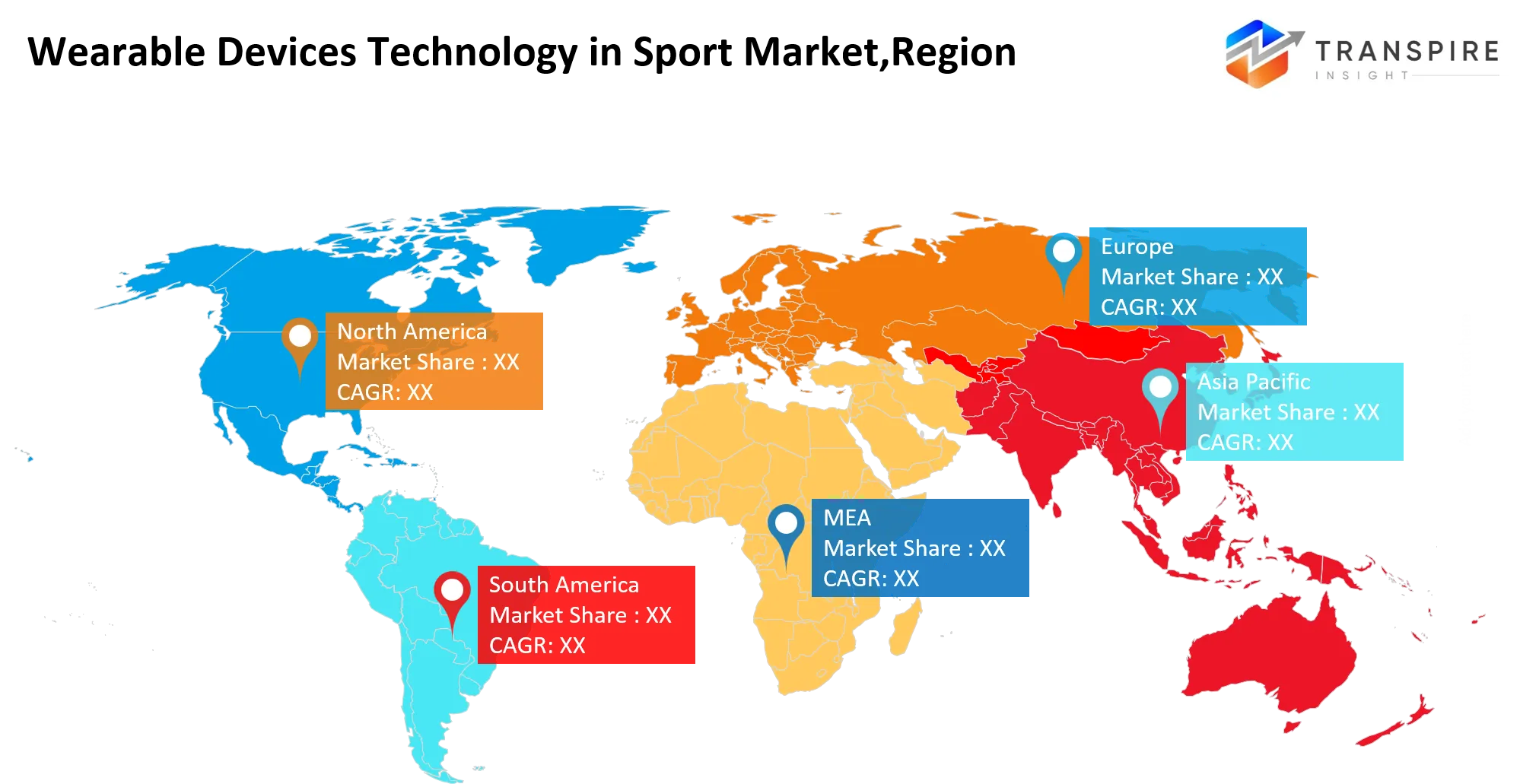
North America leads the market in terms of its regional share with 41.72% because of the established sports technology environment and widespread use of wearable fitness and performance tracking solutions. The region has an advanced digital infrastructure with the presence of sports-related organisations and technology vendors that facilitate the use of wearable devices. The interest in performance and health data keeps fueling the market growth.
In May 2026, WHOOP entered into a long-term strategic partnership with the Boston Red Sox, becoming the Official Health and Fitness Wearable of the team. As part of the agreement, wearable technology and performance metrics from WHOOP would assist the team’s athletes, along with the growth of wearable data in professional baseball.
Europe
Europe holds a market share of 28% and has a stable market position due to its established sports and healthcare infrastructure. Europe is actively using wearable technologies for training, fitness, and recovery purposes for athletes.
In January 2026, Polar introduced its wearable sports technology through a strategic partnership with Motorola, which would allow Motorola’s new smartwatch to offer the sleep, training, activity, performance, and recovery functionalities of Polar’s product line. This shows the continuous implementation of sports science-based wearable technology in Europe’s fitness and sports technology scene
https://www.polar.com/en/media-room/polar-expands-powered-by-polar-through-partnership-with-motorola
Asia Pacific
The Asia Pacific market accounts for 22% of the market share and is currently the fastest-growing market with a 7.1% CAGR. Digital fitness technology acceptance, higher involvement in sports, and availability of connected devices are some factors that are driving regional growth. This market is expected to present additional opportunities due to the availability of wearable technologies.
In May 2026, Huawei introduced two new products – the HUAWEI WATCH FIT 5 Pro and the HUAWEI WATCH GT Runner 2 in Thailand during an event in Bangkok, extending the sports-focused range of wearables in the Asia Pacific region.
https://consumer.huawei.com/en/press/events/2026/huawei-innovative-product-launch-may-07
Who are the Key Players in the Wearable Devices Technology in Sport Market and how do they compete?
The Wearable Devices Technology in Sport Market is made up of organisations such as Apple, Garmin, WHOOP, Catapult Sports, Polar, Samsung, Fitbit, and STATSports. The main areas of competition among the firms are sensor accuracy, specialised sports functionality, health tracking, software integration, and data platforms. There has also been a trend towards ecosystem competition in the recent analysis of the industry, whereby firms integrate devices and digital analytics. Garmin employs an innovation and sports specialisation competitive strategy, whereby the firm relies on GPS technology, training, long-lasting batteries, and specialised activities in sports such as running, cycling, and outdoor sports. Expansion of the firm is done by expanding its sports offerings and its connected training ecosystem. Apple utilises an ecosystem innovation strategy through health sensors, fitness functions, connectivity, and software integration through its Apple Watch.
Wearable Devices Technology in Sport Marketcompanies
- Apple
- Garmin
- Fitbit
- Polar Electro
- WHOOP
- Catapult Sports
- STATSport
- Samsung
- Huawei
- Xiaomi
- Wahoo Fitness
- Suunto
- COROS
- PlayerMaker
Recent Development News
In July 2025, Garmin purchased MYLAPS, a sports technology firm specialising in timing and performance. This acquisition increased the capacity to manage races, provide live tracking services, and analyse performances.
In September 2026, Apple introduced Apple Watch Ultra 4, which has a new Health Sensing System along with heart-rate and HRV measurements at high frequency, a readiness score, and more efficient GPS functionality.
https://www.apple.com/newsroom/2026/09/apple-unveils-apple-watch-ultra-4
What Strategic Insights Define the Future of the Wearable Devices Technology in Sport Market?
The wearable devices technology in the sports market is evolving into a connected system that includes wearable devices, sensor technologies, AI analytics, and cloud computing. Future developments will be based on how well manufacturers will be able to turn data about athletic performance and health into useful insights for athletes, coaches, fitness enthusiasts, and sports organisations. Smart Clothing & E-textiles present a new direction for development because they allow extending wearables beyond the standard wristwear, while AI can help with personalising athletes' training, recovery, and performance evaluation. One of the concealed threats is the problem of data precision and integration of various wearable devices with digital sports platforms. Manufacturers who improve sensor technology, interoperability of devices, and data interpretation will offer higher value for customers. It is recommended for companies operating in this market to pay attention to sports-specific solutions, connected technology platforms, and AI-powered analytics, while remaining accessible to professionals and individuals at the same time.
By Device Type
- Fitness & Heart-rate Monitors
- Smart Clothing & E-textiles
- GPS Trackers
- Smartwatches
- Fitness Bands
- Smart Rings
- Smart Glasses
- Others
By Sport
- Soccer/Football
- Basketball
- Running
- Cycling
- Swimming
- Tennis
- Golf
- Others
By End User
- Professional Teams & Leagues
- Fitness Centers
- Individual Athletes
- Sports Academies
- Healthcare Providers
- Amateur Teams
- Rehabilitation Centers
- Others
By Application
- Performance Monitoring
- Fitness Tracking
- Injury Prevention
- Athlete Training
- Health Monitoring
- Sports Analytics
- Recovery Monitoring
- Others
By Site
- Headband
- Handheld
- Arm & Wrist
- Shoe Sensor
- Chest Strap
- Smart Clothing
- Glasses
- Others
By Distribution
- Online
- Specialty Sports Stores
- Mass Retail
- Brand Stores
- Fitness Centers
- Sports Clubs
- Direct Sales
- Others
By Technology
- GPS
- Heart-rate Monitoring
- Motion Sensors
- Biometric Sensors
- AI Analytics
- IoT Connectivity
- Cloud Analytics
- Others
Frequently Asked Questions
Find quick answers to common questions.
The wearable devices technology in sport market size was valued at USD 41517.32 million in 2025 and is poised to reach USD 81639.27 million by 2033, expanding at a 8.82% CAGR
Key segments for the wearable devices technology in sport market are By Device Type (Fitness & Heart-rate Monitors, Smart Clothing & E-textiles, GPS Trackers, Smartwatches, Fitness Bands, Smart Rings, Smart Glasses, Others); By Sport (Soccer/Football, Basketball, Running, Cycling, Swimming, Tennis, Golf, Others); By End User (Professional Teams & Leagues, Fitness Centers, Individual Athletes, Sports Academies, Healthcare Providers, Amateur Teams, Rehabilitation Centers, Others); By Application (Performance Monitoring, Fitness Tracking, Injury Prevention, Athlete Training, Health Monitoring, Sports Analytics, Recovery Monitoring, Others); By Site (Headband, Handheld, Arm & Wrist, Shoe Sensor, Chest Strap, Smart Clothing, Glasses, Others); By Distribution (Online, Specialty Sports Stores, Mass Retail, Brand Stores, Fitness Centers, Sports Clubs, Direct Sales, Others); By Technology (GPS, Heart-rate Monitoring, Motion Sensors, Biometric Sensors, AI Analytics, IoT Connectivity, Cloud Analytics, Others)
Growth is primarily driven by increased athlete performance monitoring, increased use of smartwatches and fitness bands, increased use of AI and big data in sports, increased awareness of health and fitness, and growth in connected sports technology.
The market is led by major manufacturers including Apple, Garmin, Fitbit, Polar Electro, WHOOP, Catapult Sports, STATSports, Samsung, Huawei, Xiaomi, Wahoo Fitness, Suunto, COROS, PlayerMaker, FORM
The North American region accounts for a 41.72% share of the world’s wearables technology in the sports market due to the significant popularity of products such as smartwatches, fitness bands, GPS gadgets and heart-rate sensors. In addition, advanced sporting facilities, consumer expenditure, prominent technological players and AI and real-time performance analysis are some other contributing factors of North America’s dominance in the market.
Opportunities within the technology market for wearable devices in sport market include performance analysis using AI, health and fitness monitoring in real time, smart clothes and electronic textiles, customized solutions for training, integration with sports and healthcare apps, as well as the increasing popularity of wearables with amateur sportsmen and fitness users.
- Apple
- Garmin
- Fitbit
- Polar Electro
- WHOOP
- Catapult Sports
- STATSport
- Samsung
- Huawei
- Xiaomi
- Wahoo Fitness
- Suunto
- COROS
- PlayerMaker
About the Authors

Avinash Kumar
I’m Avinash Kumar, a Senior Research Analyst at Transpire Insight, with expertise in the Electronics and Semiconductor and Energy & Power industry. My work focuses on analyzing emerging technologies, market trends, industry developments, and innovation across these sectors. I specialize in transforming complex technical and market insights into clear, research-backed content that helps professionals, businesses, and decision-makers stay informed. Through continuous industry research and data-driven analysis, I strive to deliver accurate, reliable, and practical perspectives on the latest advancements shaping the semiconductor and energy landscape.

Chakradhar Khansole
Chakradhar serves as the Research Director at Transpire Insight, bringing over 8 years of experience in technology, innovation, and strategic market intelligence. He specializes in transforming complex market data into actionable business insights that enable organizations to make informed, growth-oriented decisions. Recognized for his strategic vision and analytical expertise, Chakradhar leads high-impact research initiatives, delivering comprehensive market assessments, competitive intelligence, and forward-looking industry analysis.
Recently Published Reports
-
Apr 2026
Fiber Optic Faceplates Market
Fiber Optic Faceplates Market Size, Share & Analysis Report By Type (< 300 mm2, 300-350 mm2, and > 350 mm2, By Application (Night Vision, Holographic Imaging, Medical, and Others), and Geography (North America, Europe, Asia-Pacific, Middle East and Africa, South and Central America), 2021 - 2031
-
Apr 2026
High Temperature Superconductors Market
High Temperature Superconductors Market Size, Share & Analysis Report By Type (1G HTS, and 2G HTS), By Application (Power Cable, Fault Current Limiter, and Transformer), and Geography (North America, Europe, Asia-Pacific, Middle East and Africa, South and Central America), 2021 - 2031
-
Apr 2026
Industrial Plugs and Socket Market
Industrial Plugs and Socket Market Size, Share & Analysis Report By Type (Industrial Plugs, Industrial Sockets), By Current (Up to 32 A, 32 to 125 A, Above 125 A), By Protection (Dustproof and Splash Proof, Waterproof, Explosion Proof), By End User (Heavy Industries, Oil and Gas, Chemicals and Pharmaceuticals, Power Generation, Others), and Geography (North America, Europe, Asia-Pacific, Middle East and Africa, South and Central America), 2021 - 2031
-
Apr 2026
InGaAs Avalanche Photodiodes Market
InGaAs Avalanche Photodiodes Market Size, Share & Analysis Report By Type (1100 - 1700 nm, and 1000 - 1600 nm), By Application (Missile Warning System, Muzzle Flash Detection, Wafer Defect Inspection, Laser Rangefinders, and Others), and Geography (North America, Europe, Asia-Pacific, Middle East and Africa, South and Central America), 2021 - 2031