
Water and Wastewater Treatment Technologies Market Summary:
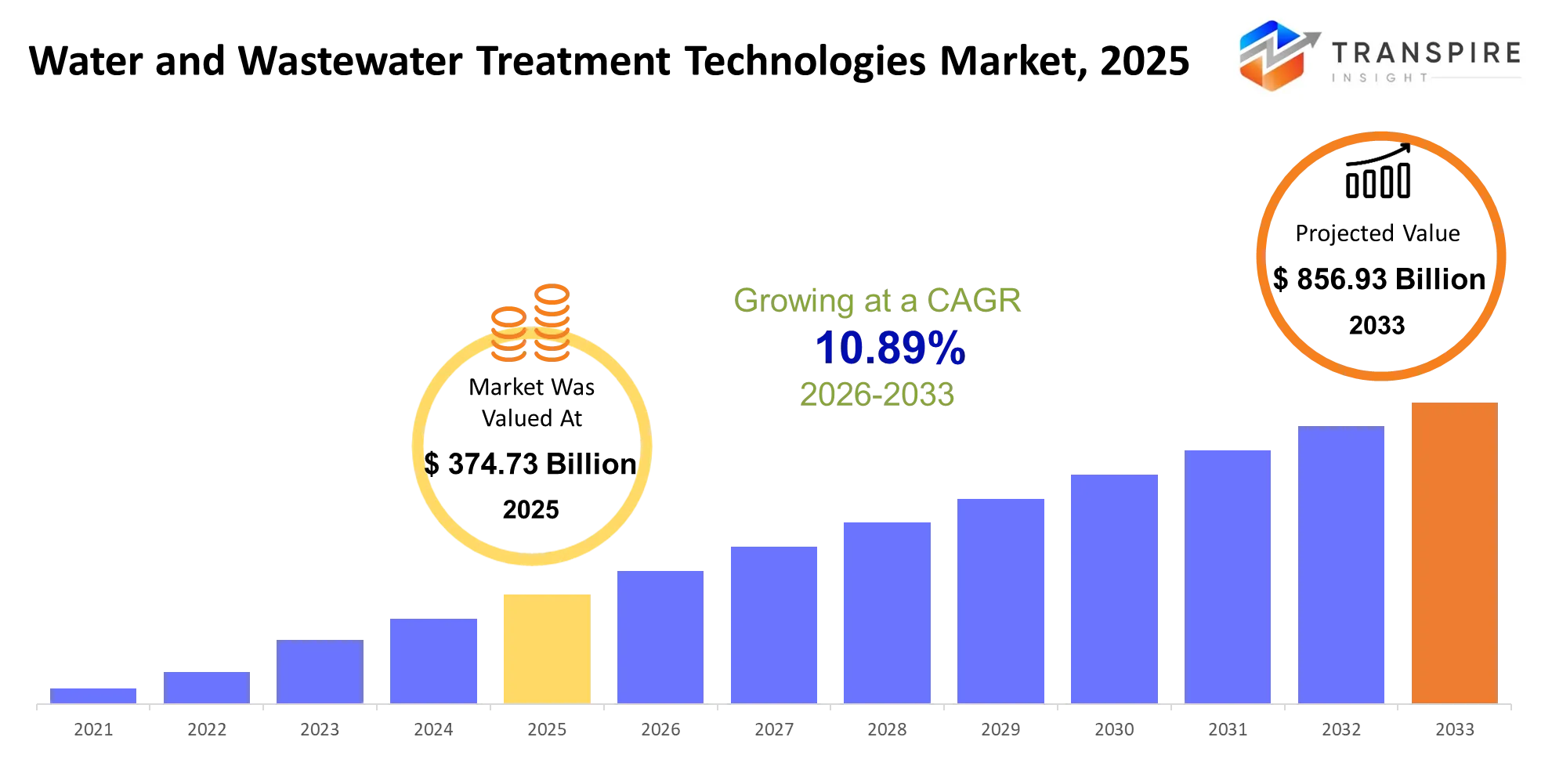
As per Transpire Insight, the Water and Wastewater Treatment Technologies Market size is estimated at USD 374.73 billion in 2025 and is anticipated to reach USD 856.93 billion by 2033, growing at a CAGR of 10.89% from 2026 to 2033.
The international water and wastewater treatment technologies market supports the collection, treatment, recycling, and proper disposal of water originating from municipalities and industries. In the past three to five years, the market has changed from old ways of treating water to systems that save water, remove hard-to-remove pollutants and make better use of resources. A big change has been using membrane filtration, biological treatment, getting nutrients back from waste and using digital tools to watch how things are working. People are trying to get results from treatment while using less money and effort. Rules about the quality of wastewater and hard-to-remove pollutants have also made people want to spend more on treatment plants. At a time of water scarcity, more factories are being built, and old treatment systems are making it more important to reuse water again instead of always relying on new water. These reasons are making cities and companies update their treatment plant methods and spend on technologies that can handle more complicated wastewater.
Water and Wastewater Treatment Technologies Market Size & Forecast:
- Market Size 2025: USD 374.73 Billion
- Expected Market Value (2033): USD 856.93 Billion
- Forecast CAGR (2026-2033): 10.89%
- Leading Region in 2025: Asia-Pacific
- Fastest Growing Region: North America
- Key Company Profiles: Veolia, Xylem, Suez, DuPont, Ecolab, Pentair, Kurita Water Industries, AECOM, Black & Veatch, Aquatech, Siemens, Thermax, WABAG, REMONDIS, Mott MacDonald
Key Market Insights:
The market is moving away from simple contaminant removal to more complex processes involving treatment, water reuse, and resource recovery. Companies that sell treatment technologies are coupling their equipment with digital tools for optimisation.
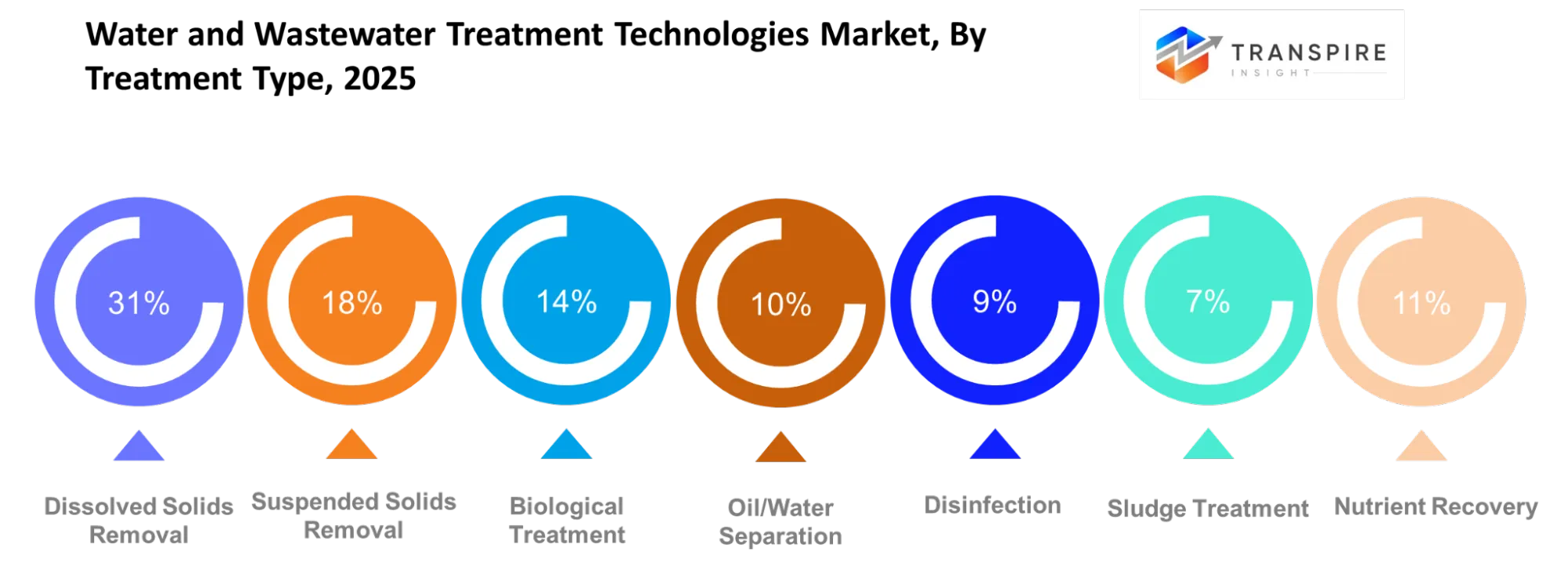
- Dissolved solids removal constitutes the highest market share of 31.02% owing to the process of reverse osmosis and filtration techniques for water reclamation and desalination applications.
- Suspended solids removal holds 18.00% due to the need for physical separation for the treatment of municipal and industrial wastewater.
- Biological treatment is 14.00%, while nutrient recovery applications have started drawing interest since there is a need for improved pollutant removal and resource recovery.
- Disinfection constitutes 9.00% because there is a continued need for disinfected water to conform to health and quality standards.
- Sludge treatment is 7.00% due to the rising need among treatment operators to cut sludge volumes and improve value recovery from residuals.
- Nutrient recovery constitutes 6.00% owing to the shift towards recovery of useful resources such as nitrogen and phosphorus.
What are the Key Drivers, Restraints, and Opportunities in the Water and Wastewater Treatment Technologies Market?
Drivers:
Driving growth is the rising pressure on the available freshwater supply. The need to treat and reuse water in water-intensive industries and cities has increased due to the potential for reducing reliance on fresh water and ensuring operational reliability. Tightening regulations are another major factor, especially when operators of wastewater facilities have to adhere to more stringent specifications regarding the water being discharged.
Restraints:
The high initial cost involved in constructing the advanced treatment facilities. Modern membrane plants, advanced biological treatments, automation technologies, and contaminant removal technologies require a considerable amount of investment, especially in the case of old facilities that would need to be upgraded.
Opportunities:
Opportunity in integrating water treatment, water recycling and water resource recovery. Wastewater can increasingly be used as feedstock for industrial processes while at the same time recovering valuable resources from the water treatment process stream. Digital control systems, automation, membranes and nutrient recovery technologies can facilitate this transition. Investments in regional municipal infrastructure and industrial water reuse initiatives will hence open doors to technology providers who can offer integrated water treatment solutions.
What Has the Impact of artificial intelligence on the Water and Wastewater Treatment Technologies Market?
AI is revolutionising monitoring, process control, and response to different water conditions in the field of water and wastewater treatment plants. AI-based applications have the ability to examine the operating data generated by sensors and processing equipment to detect abnormal trends, make estimations about process performance, and facilitate faster decision-making. Unlike treatment facilities that operate within fixed parameters, AI-based applications allow using data-driven modelling to adapt the process according to changes in flow, contamination level, energy requirements, and equipment condition.
Predictions are especially helpful when it comes to maintenance. AI algorithms can study the behaviour of the equipment and detect any signs of its potential malfunction that could result in disruptions of facility operations. implementation of AI technologies has certain constraints. The first one lies in the need for reliable historical and live data, which cannot be ensured in old plants with poor sensor coverage and incompatible control systems.
Instance:
In February 2025, Veolia partnered with Mistral AI in order to introduce generative AI in the management and monitoring of water and wastewater plants, thus allowing managers of the plants to utilise the power of AI in their operations.
Key Market Trends:
The trend in the market is now towards wastewater treatment and recovery for reuse purposes instead of wastewater disposal. Wastewater is being viewed as a resource that can provide recoverable water rather than just being treated as a waste.
- Membrane treatment has received more focus as water treatment plants need to remove contaminants and produce high-quality water suitable for reuse.
- Digital monitoring has been developed to give operators an idea of what is going on with the treatment process, equipment and energy use.
- Water treatment plants are increasingly adopting resource recovery, especially in cases where nutrients, biogas or reusable water can bring added revenue.
- Biological water treatment is evolving as the focus shifts towards optimising the removal of pollutants with reduced energy use.
- Water reuse has become not just an additional use of water but rather a strategy for water-intensive industries and municipalities that are experiencing water stress.
- Industrial companies are increasingly exploring closed-loop and semi-closed-loop water systems to minimise water input and output.
Water and Wastewater Treatment Technologies Market Segmentation
By Treatment Type:
Dissolved Solids Removal is the biggest market segment at a share of 31.02%, driven by applications that involve the need to remove dissolved solids such as minerals and other impurities from the water. Suspended Solids Removal holds a share of 18.00%, while Biological Treatment takes up 14.00%, showing the significance of biological processes in municipal and industrial plants. Oil/Water Separation accounts for 10.00%, Disinfection makes up 9.00%, Sludge Treatment 7.00%, Nutrient Recovery 6.00%, while Other Types take 4.98%. Biological Treatment and Nutrient Recovery show the largest scope for growth in the future, with a CAGR of 7.04%.
By Technology:
Membrane Filtration, Reverse Osmosis, Ultrafiltration, Activated Sludge, MBR, UV Treatment, and Desalination constitute the main technology categories. Membrane filtration and reverse osmosis are especially pertinent to dissolved solids removal, water recycling, and desalination applications. Ultrafiltration provides an additional stage of physical separation, but the activated sludge process is still relevant in biological wastewater treatment. The MBR technology involves both biological treatment and membrane separation and can ensure high-quality treatment. UV treatment is free from chemicals used in conventional disinfection techniques, while desalination technologies increase the amount of available water resources by converting salt water into freshwater.
By End User:
Municipal, Food & Beverage, Oil & Gas, Pulp & Paper, Healthcare, Chemicals, Power Generation, and Others constitute the main end user categories. Municipal installations need treatment plants for the treatment of drinking water, sewage, and wastewater management, but the needs of industrial installations are related to the development of special processes based on contaminants and production requirements. Food and beverage installations provide water streams with organic substances and process residuals, while oil and gas installations are in need of wastewater with hydrocarbons.
By Water Type:
The market comprises Drinking Water, Industrial Wastewater, Municipal Wastewater, Process Water, Seawater, Brackish Water, Recycled Water, and Others. The drinking-water market is still centred around producing water for drinking purposes, whereas industrial and municipal wastewater markets are concerned about removal of different types of contaminants. The process water market is used in manufacturing processes to ensure that water used for production meets the necessary quality standards. The seawater and brackish water markets are becoming increasingly relevant amid the limitation of conventional freshwater resources. Recycled Water is becoming more prominent as well because of its reusability after treatment, either for industrial or municipal purposes.
By Application:
The market consists of Water Reuse, Desalination, Industrial Treatment, Municipal Treatment, Resource Recovery, PFAS Removal, Nutrient Removal, and Others. Water Reuse market becomes more strategically significant as it allows replacing some amount of freshwater with treated water. The desalination market serves as an alternative water resource for coastal and water-stressed countries. Resource Recovery has emerged as an additional application of wastewater treatment plants that focuses on valuable products of the treatment process.
What are the Key Use Cases Driving the Water and Wastewater Treatment Technologies Market?
Dissolved Solids Removal is a key use case with practical applications, especially in situations when municipalities and industries have to treat water for reuse, desalination, or other processes. Reverse osmosis and other filtration technologies are now increasingly applied when traditional treatment processes are not sufficient to deliver water of the required quality. Industrial water treatment is also one of the main areas of applicability. Food and beverage, oil and gas, chemical, health care, pulp and paper, and power generation industries are among those that need water treatment facilities tailored to the specific needs. Other emerging uses include nutrient recovery, PFAS removal, advanced resource recovery, and digital treatment optimisation. Nutrient recovery, in particular, will be helpful in transforming wastewater treatment plants into systems that can not only clean up the water but also recover it along with other materials and energy sources.
|
Report Metrics |
Details |
|
Market size value in 2025 |
USD 374.73 Billion |
|
Market size value in 2026 |
USD 415.53 Billion |
|
Revenue forecast in 2033 |
USD 856.93 Billion |
|
Growth rate |
CAGR of 10.89% from 2026 to 2033 |
|
Base year |
2025 |
|
Historical data |
2021 - 2024 |
|
Forecast period |
2026 - 2033 |
|
Report coverage |
Revenue forecast, competitive landscape, growth factors, and trends |
|
Regional scope |
United States; Canada; Mexico; United Kingdom; Germany; France; Italy; Spain; Denmark; Sweden; Norway; China; Japan; India; Australia; South Korea; Thailand; Brazil; Argentina; South Africa; Saudi Arabia; United Arab Emirates |
|
Key company profiled |
Veolia, Xylem, Suez, DuPont, Ecolab, Pentair, Kurita Water Industries, AECOM, Black & Veatch, Aquatech, Siemens, Thermax, WABAG, REMONDIS, Mott MacDonald |
|
Customization scope |
Free report customization (country, regional & segment scope). Avail customized purchase options to meet your exact research needs. |
|
Report Segmentation |
Treatment Type (Dissolved Solids Removal, Suspended Solids Removal, Oil/Water Separation, Biological Treatment, Disinfection, Sludge Treatment, Nutrient Recovery, Others); Technology (Membrane Filtration, Reverse Osmosis, Ultrafiltration, Activated Sludge, MBR, UV Treatment, Desalination, Others); End User (Municipal, Food & Beverage, Oil & Gas, Pulp & Paper, Healthcare, Chemicals, Power Generation, Others); Water Type (Drinking Water, Industrial Wastewater, Municipal Wastewater, Process Water, Seawater, Brackish Water, Recycled Water, Others); Application (Water Reuse, Desalination, Industrial Treatment, Municipal Treatment, Resource Recovery, PFAS Removal, Nutrient Removal, Others) |
Which Regions are Driving the Water and Wastewater Treatment Technologies Market Growth?
North America:
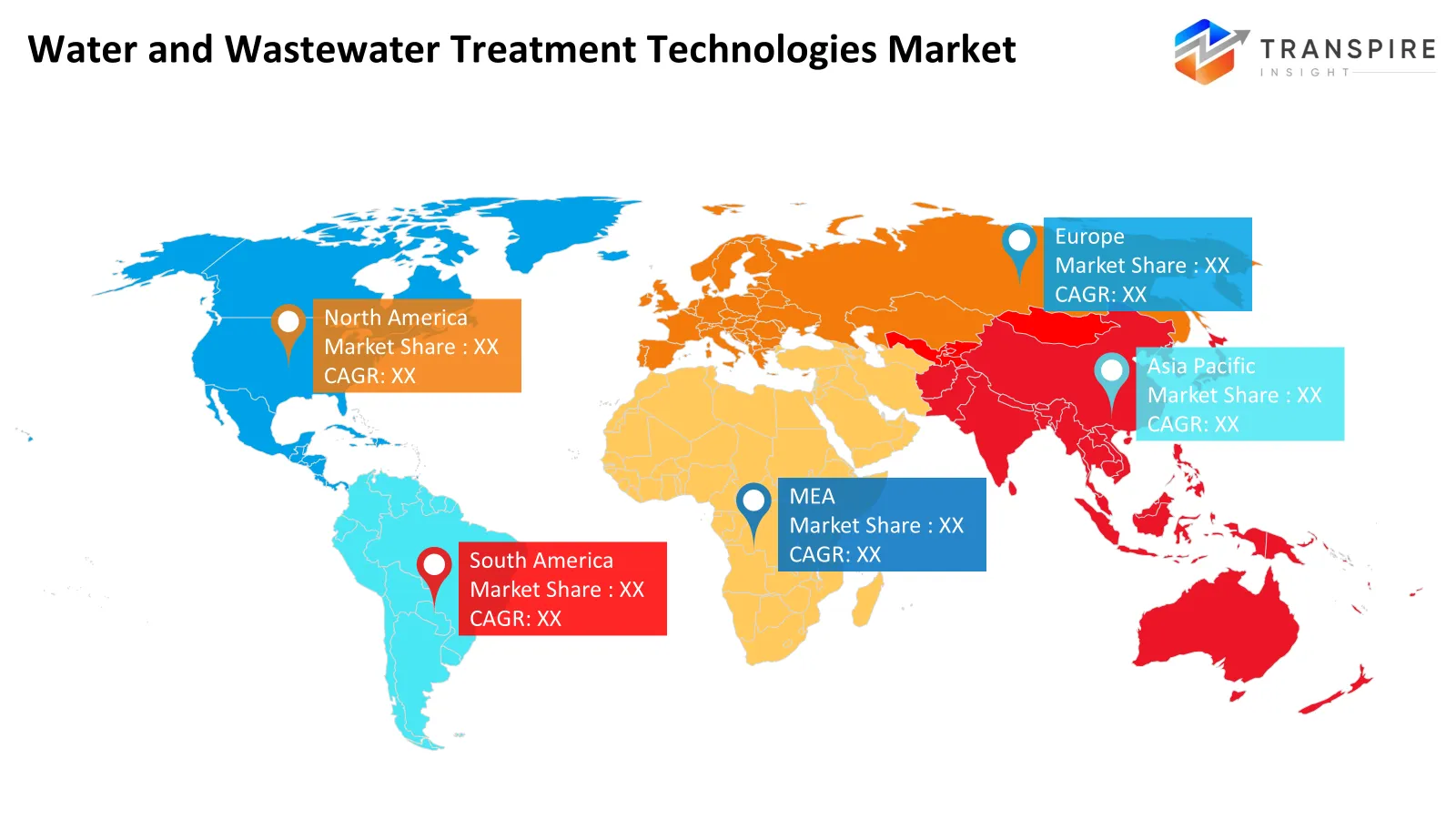
The North American market share is 29.80%, and the infrastructure is mature as compared to many other developing countries' markets. The replacement of aged infrastructure, water quality, and advanced contaminant removal drive demand. The North American region is considered the fastest-growing one, having a 6.90% CAGR, which opens doors for suppliers of advanced technologies for treatment, monitoring, reuse and contaminant removal.
In September 2025, The collaboration between Nexom and SUEZ aimed at launching the Cyclor Turbo wastewater treatment technology, which is an advanced aerobic granular sludge system, in North America.The company started building a full-scale demonstration plant with the East St. Paul wastewater treatment plant in Manitoba, Canada.
https://nexom.com/nexomsuezcyclorturbo/
Europe:
Europe accounts for 22.00% of the worldwide market; the advantage of its established wastewater infrastructure and strict environmental laws drives demand in the region. Latin America contributes 6.65%, and the Middle East & Africa 7.00%. Recent regulatory changes in Europe also increased the demand for water treatment due to higher demands for wastewater treatment and more coverage of urban territories.
In May 2025, Aquafin commissioned the first additional treatment process for micropollutants in its Aartselaar wastewater treatment plant in Belgium. The process involves quaternary treatment to remove pharmaceutical and cosmetic pollutants, facilitating the use of advanced wastewater treatment in Flanders.
Asia Pacific:
Asia Pacific represents the biggest regional market and holds 34.55% of the total market. Urban growth, industry, water quality demands, and infrastructure investments are behind the region's leading role. There is a need for large industrial and municipal treatment facilities, thereby creating many customers for technology providers. In addition, there is great potential for developing more capacity in this region.
In December 2025, the Asian Development Bank (ADB) signed a financing agreement with China Water Affairs Group Limited (CWA) for wastewater improvement in Ningxiang City, China. The project entails construction of a new intelligent wastewater treatment plant and rehabilitation of an existing wastewater treatment plant using enhanced biological treatment technologies.
https://www.adb.org/news/adb-cwa-sign-deal-improve-wastewater-management-system-prc
Who are the Key Players in the Water and Wastewater Treatment Technologies Market and how do they compete?
Market competition in the water and wastewater treatment technologies sector is influenced by technology portfolios, execution, service networks, and customisation capabilities. The companies are competing not just on the basis of their individual treatment technologies but also on engineering, operations, digital surveillance, maintenance, and water management services. Veolia is gaining competitive advantage through technology portfolio development, infrastructure contracts, and greater control over its water technology segment. As part of this move, Veolia signed an agreement to purchase the remaining CDPQ stake in Water Technologies and Solutions. This deal was made in conjunction with its plan to enhance capabilities in water technology and expand into new areas like water scarcity, climate adaptability, semiconductors, the pharma industry, and data centres. Xylem is leveraging acquisitions and alliances to develop its treatment and water infrastructure capability. Acquisitions by Xylem include that of EnviroMix, providing solutions for municipal and industrial customers in terms of mixing and process control, and that of Vacom Systems, specialising in evaporator and crystallizer systems.
Water and Wastewater Treatment Technologies Market companies
- Veolia
- Xylem
- Suez
- DuPont
- Ecolab
- Pentair
- Kurita Water Industries
- AECOM
- Black & Veatch
- Aquatech
- Siemens
- Thermax
- WABAG
- REMONDIS
- Mott MacDonald
Recent Development News
- In June 2026, Xylem has entered into an expanded collaboration with Dow. Xylem will develop, construct, and manage water systems in the industrial complex owned by Dow in Fort Saskatchewan, Alberta, and the project will focus on water treatment and reuse. This is meant to help reduce the need for fresh water at the plant. https://www.xylem.com/en-us/about-xylem/newsroom/press-releases/xylem-expands-long-term-water-partnership-with-dow/
- In September 2025, the acquisition of Sinochem (Ningbo) RO Memtech Co., Ltd. by DuPont took place. The expansion of DuPont’s reverse osmosis manufacturing facility in China and Asia Pacific would enhance DuPont’s capability to deliver the FilmTec membrane products for industrial use. https://www.dupont.com/news/dupont-to-expand-filmtec-manufacturing-into-china-through-reverse-osmosis-acquisition.html
What Strategic Insights Define the Future of the Water and Wastewater Treatment Technologies Market?
The future of water and wastewater treatment technologies market will see a move towards integrated systems that incorporate treatment, reuse, monitoring and recycling aspects. Rather than solely treating wastewater in line with discharge regulations, there is a greater focus now on how wastewater can be used back into production and how valuable materials can be extracted from wastewater. This presents an opportunity for suppliers of integrated technologies instead of treatment technologies alone. Integration of advanced technologies within old treatment plants is a latent threat in the market due to the challenges associated with doing so. The process may be slowed down and made more costly by factors such as old equipment, inadequate digital connectivity, data inconsistency and lack of technical expertise. Therefore, technology suppliers have to consider the integration and life cycle issues rather than treatment efficiency alone. Another area of opportunity is industrial water reuse and contaminant removal, and digitisation of the treatment process. Investment in this market should take into consideration modular systems, automation and predictive monitoring technologies, as well as systems that reduce energy and freshwater use.
By Treatment Type
- Dissolved Solids Removal
- Suspended Solids Removal
- Oil/Water Separation
- Biological Treatment
- Disinfection
- Sludge Treatment
- Nutrient Recovery
- Others
By Technology
- Membrane Filtration
- Reverse Osmosis
- Ultrafiltration
- Activated Sludge
- MBR
- UV Treatment
- Desalination
- Others
By End User
- Municipal
- Food & Beverage
- Oil & Gas
- Pulp & Paper
- Healthcare
- Chemicals
- Power Generation
- Others
By Water Type
- Drinking Water
- Industrial Wastewater
- Municipal Wastewater
- Process Water
- Seawater
- Brackish Water
- Recycled Water
- Others
By Application
- Water Reuse
- Desalination
- Industrial Treatment
- Municipal Treatment
- Resource Recovery
- PFAS Removal
- Nutrient Removal
- Others
By Regional Analysis
North America
- US
- Canada
- Mexico
Europe
- Germany
- UK
- France
- Italy
- Spain
- Russia
- Rest of Europe
Asia Pacific
- China
- Japan
- India
- South Korea
- Australia
- Rest of Asia Pacific
South America
- Brazil
- Argentina
- Rest of South America
Middle East & Africa
- UAE
- Saudi Arabia
- Qatar
- South Africa
- Rest of the Middle East & Africa
Frequently Asked Questions
Find quick answers to common questions.
The water and wastewater treatment technologies market size was valued at USD 374.73 billion in 2025 and is poised to reach USD 856.93 billion by 2033, expanding at a 10.89% CAGR.
Key segments for the water and wastewater treatment technologies market are Treatment Type (Dissolved Solids Removal, Suspended Solids Removal, Oil/Water Separation, Biological Treatment, Disinfection, Sludge Treatment, Nutrient Recovery, Others); Technology (Membrane Filtration, Reverse Osmosis, Ultrafiltration, Activated Sludge, MBR, UV Treatment, Desalination, Others); End User (Municipal, Food & Beverage, Oil & Gas, Pulp & Paper, Healthcare, Chemicals, Power Generation, Others); Water Type (Drinking Water, Industrial Wastewater, Municipal Wastewater, Process Water, Seawater, Brackish Water, Recycled Water, Others); Application (Water Reuse, Desalination, Industrial Treatment, Municipal Treatment, Resource Recovery, PFAS Removal, Nutrient Removal, Others).
Growth is primarily driven by increased urbanisation and industrialisation, increased environmental regulations, high demand for purified water, increased production of wastewater, and increased funding for water treatment facilities and technology.
The market is led by major manufacturers including Veolia, Xylem, Suez, DuPont, Ecolab, Pentair, Kurita Water Industries, AECOM, Black & Veatch, Aquatech, Siemens, Thermax, WABAG, REMONDIS, Mott MacDonald.
The Asia-Pacific region has a huge impact on the market for water treatment technologies and wastewater treatments due to the 34.55% market share it holds. The factors behind this influence are fast industrialisation, urbanisation, high water needs, and increased regulation.
Opportunities in the market of water and wastewater treatment technologies comprise growing requirements for water recycling and reuse systems, rising acceptance of innovative membrane and filtration systems, increasing investments in intelligent and digital water treatment systems, expanding projects of wastewater treatment in industries, and emerging developments in decentralised and energy-efficient treatment systems.
- Veolia
- Xylem
- Suez
- DuPont
- Ecolab
- Pentair
- Kurita Water Industries
- AECOM
- Black & Veatch
- Aquatech
- Siemens
- Thermax
- WABAG
- REMONDIS
- Mott MacDonald
About the Authors

Pankaj Ghogare Patil
I am Pankaj Ghogare Patil, a Senior Research Analyst at Transpire Insight, specializing in the Pharmaceutical, Chemicals & Materials, Healthcare IT, and Biotechnology industry. My expertise lies in conducting comprehensive market research, analyzing industry trends, evaluating competitive landscapes, and translating complex data into actionable insights. At Transpire Insight, I closely follow emerging technologies, regulatory developments, and market innovations to create accurate, well-researched, and informative content that helps businesses and professionals make informed decisions. I am committed to producing credible, evidence-based articles that reflect industry best practices while making technical topics accessible and valuable for a broad audience.

Chakradhar Khansole
Chakradhar serves as the Research Director at Transpire Insight, bringing over 8 years of experience in technology, innovation, and strategic market intelligence. He specializes in transforming complex market data into actionable business insights that enable organizations to make informed, growth-oriented decisions. Recognized for his strategic vision and analytical expertise, Chakradhar leads high-impact research initiatives, delivering comprehensive market assessments, competitive intelligence, and forward-looking industry analysis.
Recently Published Reports
-
May 2026
Healthcare Polymer Packaging Market
Healthcare Polymer Packaging Market Size, Share & Analysis Report By Packaging Type (Syringes, IV Bottles and Pouches, Clamshells, Blisters, Bottles & Jars, Containers, Tubes, IV Parental Packaging, Others), By Type (Regulated, Non-regulated), By Polymer Type (LDPE (Low-Density Polyethylene), HDPE (High-Density Polyethylene), Homo-polymer (Homo), Random Copolymer (Random), Block Copolymer (Block), PET, Polystyrene, Polyvinyl Chloride, Polyamide/EVOH, Others), and Geography (North America, Europe, Asia-Pacific, Middle East and Africa, South and Central America), 2021 - 2031
-
Apr 2026
Hydrophilic Tape (Waterstop) Market
Hydrophilic Tape (Waterstop) Market Size, Share & Analysis Report By Type (Bentonite-Based Hydrophilic Tape, Rubber-Based Hydrophilic Tape), By Application (Residential Buildings, Commercial Buildings, Infrastructure Projects), and Geography (North America, Europe, Asia-Pacific, Middle East and Africa, South and Central America), 2021 - 2031
-
Apr 2026
Metalens Market
Metalens Market Size, Share & Analysis Report By Type (Visible Light Metalens, and Infrared Metalens), By Application (Consumer Electronics, Automotive Electronics, Industrial, Medical, and Others), and Geography (North America, Europe, Asia-Pacific, Middle East and Africa, South and Central America), 2021 - 2031
-
Apr 2026
PBT Resin Market
PBT Resin Market Size, Share & Analysis Report By Type (Reinforced PBT Resin, Unreinforced PBT Resin), By Processing Method (Injection Molding, Extrusion, Blow Molding, Others), By End-User (Automotive, Electrical & Electronics, Consumer Appliances, Industrial Machinery, Medical Devices, Packaging, Others), and Geography (North America, Europe, Asia-Pacific, Middle East and Africa, South and Central America), 2021 - 2031