
France Membrane Filtration Market Size & Forecast:
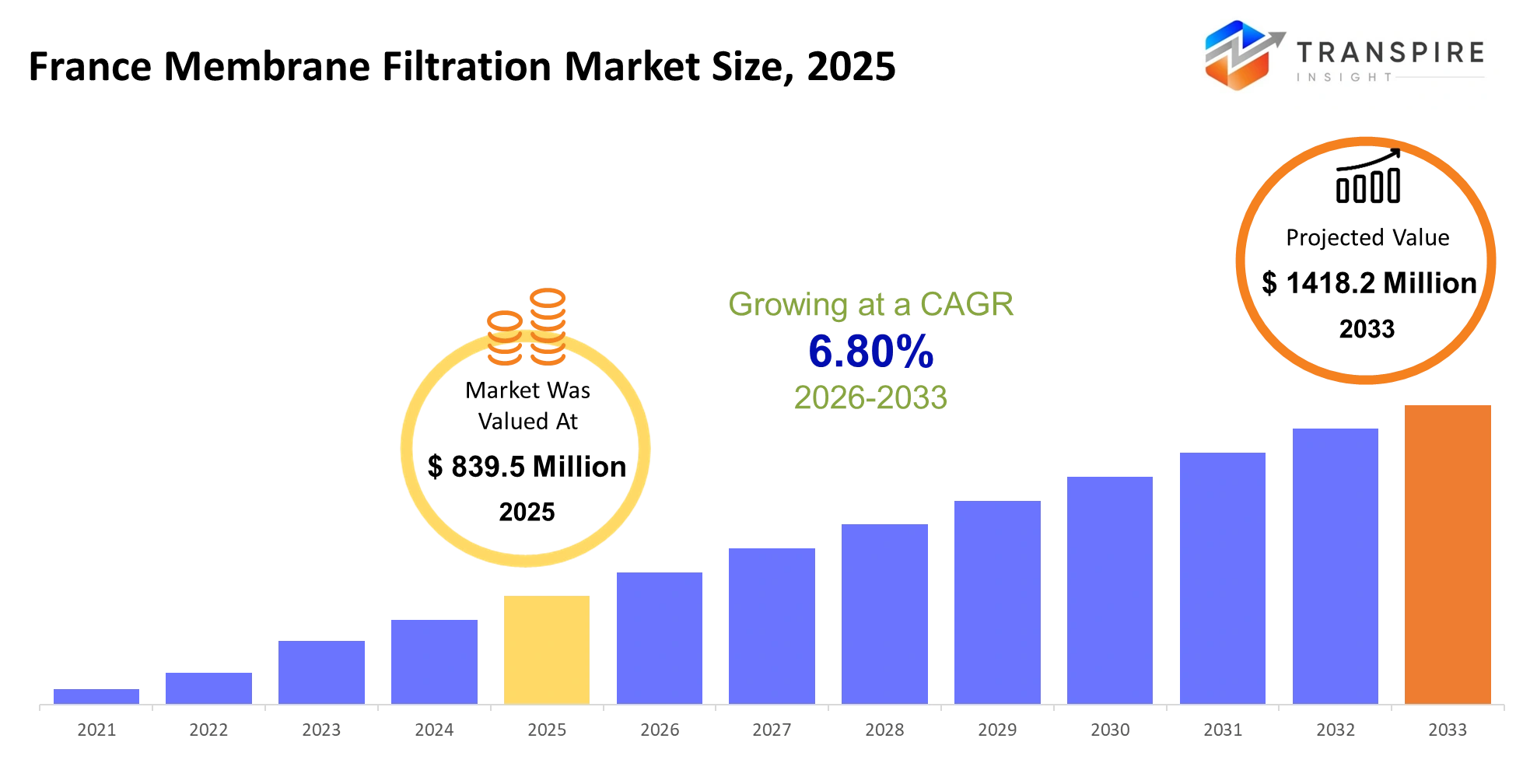
- France Membrane Filtration Market Size 2025: USD 839.5 Million
- France Membrane Filtration Market Size 2033: USD 1418.2 Million
- France Membrane Filtration Market CAGR: 6.80%
- France Membrane Filtration Market Segments: By Type (Microfiltration, Ultrafiltration, Nanofiltration, Reverse Osmosis, Others); By Application (Water Treatment, Food & Beverage Processing, Pharmaceuticals, Chemicals, Others); By End-User (Municipal Sector, Food Industry, Pharma Companies, Industrial Sector, Others); By Material (Polymeric, Ceramic, Others).
To learn more about this report,  Download Free Sample Report
France Membrane Filtration Market Summary
The France Membrane Filtration Market was valued at USD 839.5 Million in 2025. It is forecast to reach USD 1418.2 Million by 2033. That is a CAGR of 6.80% over the period.
The France Membrane Filtration Market enables advanced water purification and food ingredient concentration and pharmaceutical product sterilization through its precise separation technologies. The technology enables industrial facilities to achieve waste water treatment by removing three types of impurities which includes suspended solids and microorganisms and dissolved substances without using energy-consuming thermal methods. This technology now functions as a vital component in wastewater treatment plants and dairy processing facilities and biopharmaceutical production operations throughout France.
The market has experienced a transition during the past three to five years which led to organizations adopting energy-saving hybrid membrane systems that use automated processes and continuous monitoring instead of traditional pressure-based technologies. The tightening of EU water discharge standards required all municipalities and industrial facilities to update their outdated treatment systems. The increased energy prices in Europe which began after the geopolitical events of 2022 created a greater need for energy-efficient filtration solutions. The combination of these elements has transformed purchasing patterns which resulted in organizations selecting membrane systems that decrease their operating expenses while ensuring operational stability and regulatory adherence.
Key Market Insights
- The strong municipal wastewater treatment infrastructure and industrial clusters in Northern France enable the region to maintain a 34% market share.
- The period from 2025 to 2033 will experience its fastest growth in Southern France because of the investments that support food processing and desalination projects.
- The France Membrane Filtration Market identifies Reverse Osmosis as its leading technology which accounts for a 38% market share because of its widespread use in desalination and purification processes.
- The second position in the market belongs to Ultrafiltration which manufacturers use to sterilize food products and beverages and pharmaceutical items.
- The most rapidly expanding market segment until 2033 will develop because it supports applications that require selective ion removal functionality.
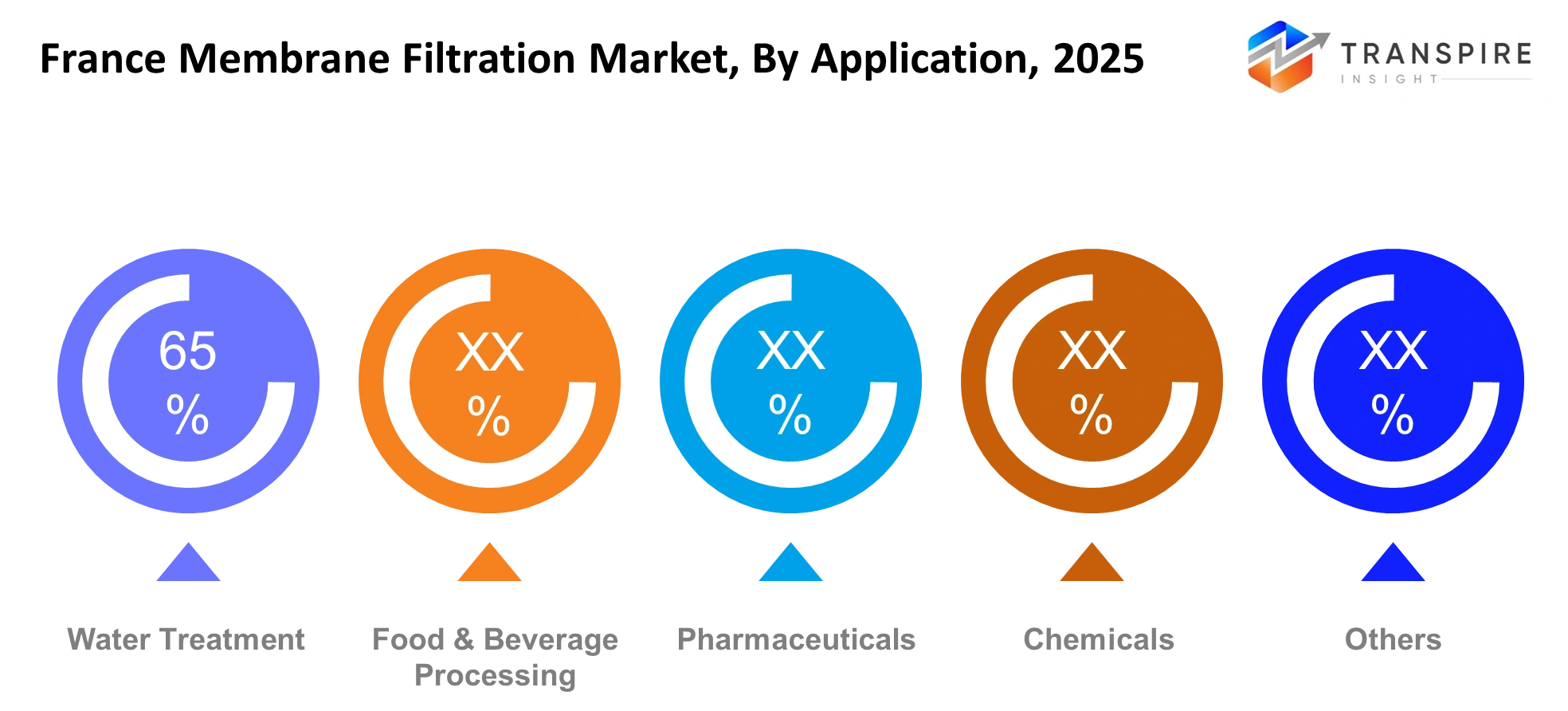
- The water treatment industry maintains its market position with 45% share because EU regulations enforce strict standards for wastewater discharge.
- The application of pharmaceuticals shows the highest growth rate because the demand for biologics and sterile production continues to increase.
- The municipal sector leads the market with approximately 40% share because public water treatment facilities undergo large-scale modernization projects.
- The biologics manufacturing capacity expansion drives pharma companies to become the fastest growing segment of end users.
- Companies direct their research efforts toward membrane development and the creation of energy-efficient filtration solutions and the implementation of digital monitoring systems.
- The European expansion strategy enables businesses to establish more manufacturing sites while developing operational networks that support their local markets.
- The organization establishes partnerships with local government bodies to promote substantial infrastructure improvements and their mandatory compliance requirements.
What are the Key Drivers, Restraints, and Opportunities in the France Membrane Filtration Market?
The strict EU wastewater discharge regulation together with tighter industrial effluent standards, which serve as the main regulatory framework for the France Membrane Filtration Market, have created a market demand for advanced membrane treatment systems that replace traditional wastewater treatment methods. The operational expenses of municipalities and manufacturers increased after they adopted high-efficiency membrane-based solutions to replace their conventional treatment systems. Industrial sectors such as food processing and pharmaceuticals now allocate their capital expenditures toward advanced filtration infrastructure. The technology providers experience better revenue stability because their business operations have established predictable demand patterns, which emerge from the regulatory requirements that control their industry.
The main obstacle prevents small and mid-sized industrial users from using membrane systems because these systems require both significant initial investment and complex system management. The systems need both specialist maintenance and membrane replacement, which should occur at regular intervals, together with energy-efficient system design, which results in higher total operational costs throughout their operational lifetime. The adoption process takes longer in cost-sensitive industrial clusters because these industries face permanent obstacles that restrict their market access to regulated municipal and large enterprise segments.
Decentralized water treatment systems that use compact membrane units present a major opportunity, which businesses can pursue. The growing industrial water reuse plant investments throughout Île-de-France and Rhône-Alpes regions create fresh market opportunities. Companies that combine modular membrane systems with IoT-enabled monitoring, which lets them track system performance, obtain operational cost reductions while achieving business growth through operational expansion. The shift enables organizations to adopt distributed treatment methods, which facilitate their business expansion into areas that traditional centralized infrastructure cannot reach.
What Has the Impact of Artificial Intelligence Been on the France Membrane Filtration Market?
Artificial intelligence is progressively transforming water filtration and industrial filtration systems through membrane technologies in France by enhancing their efficiency and operational dependability. AI-powered control systems in modern treatment plants use real-time pressure and flow rate and fouling indicator data for automatic filtration cycle adjustments. The system achieves stable output quality for large municipal wastewater facilities because it requires fewer manual operations.
Organizations use machine learning models to perform predictive maintenance for their membrane systems. The systems use historical performance data together with sensor data to predict membrane fouling and degradation which occurs before the membranes reach their breaking point. The system allows operators to achieve both decreased unexpected downtime and increased membrane operational lifespan which results in higher overall cost savings. Industrial sectors, including pharmaceuticals and food processing, use AI-based optimization to achieve better process consistency while decreasing water and energy requirements.
The widespread adoption of AI technology remains restricted because organizations must pay substantial costs for AI system implementation with their existing filtration systems. The absence of standardized sensor networks in many older treatment plants leads to two major problems: decreased data accuracy and reduced ability to predict actual system performance during real-world operations. The remote industrial locations experience two problems which include system connectivity issues and incomplete monitoring capabilities. Natural language processing, which operates within these boundaries, enables French authorities to create advanced membrane filtration systems which respond to changing conditions.
Key Market Trends
- The 2024 EU wastewater regulations led to an increase in membrane upgrade projects at French municipal treatment facilities.
- The energy price increase which started after 2022 resulted in more industrial facilities using low-pressure reverse osmosis and ultrafiltration systems.
- In 2025 Veolia deployed AI-powered filtration monitoring systems to all its water treatment plants throughout France.
- SUEZ expanded its funding for modular membrane systems which are used in decentralized wastewater treatment facilities.
- The food industry started using ultrafiltration technology in dairy and beverage processing facilities which has resulted in a sharp increase in adoption rates since 2023.
- The pharmaceutical industry required sterile filtration systems because biologics manufacturing facilities in France experienced rising demand.
- Industrial facilities adopted nanofiltration technology to achieve selective ion removal for their wastewater recycling processes.
- Industrial customers began using hybrid membrane systems which combine reverse osmosis and ultrafiltration because they provide more affordable solutions.
- The implementation of smart sensors enabled facilities to achieve better membrane durability while decreasing maintenance times.
- The municipal utilities adopted advanced membrane technology because they wanted to achieve operational cost savings that would last beyond their initial capital expenses.
France Membrane Filtration Market Segmentation
By Type
French filtration systems depend on five membrane technologies which include microfiltration, ultrafiltration, nanofiltration and reverse osmosis together with additional membrane systems. Reverse osmosis functions as the principal technology for municipal desalination and industrial high-purity water production. The segment maintains strong relevance because it delivers consistent contaminant removal efficiency under strict regulatory thresholds. Water utilities and industrial facilities which require high water usage have made this solution their primary selection.
The segment undergoes growth because EU water quality regulations become stricter and people seek advanced purification technologies which deliver exceptional results. Reverse osmosis functions best under these conditions whereas ultrafiltration use in food and pharmaceutical processing grows because it needs less energy to operate. The industrial reuse market will see an increase in hybrid systems which use multiple membrane technologies according to forecasted market trends. Technology providers will target two main objectives which include decreasing energy usage and increasing fouling resistance to achieve better lifecycle economic performance.
By Application
The water treatment sector dominates the entire application market throughout France because the municipal infrastructure continues to receive enhancements and because strict rules determine waste discharge methods. Public utilities depend on membrane systems for their wastewater recycling and drinking water production needs which makes this segment the top market segment. The system maintains its control over the entire area because of two factors which include strict regulatory enforcement and programs that replace outdated infrastructure.
The most active application sectors belong to pharmaceutical manufacturing and food and beverage production. The sectors depend on membrane filtration systems to achieve sterilization and protein separation while maintaining consistent product quality during their manufacturing operations. Dairy processing and biologics manufacturing growth has driven the increased use of advanced filtration technologies. Companies will implement water recycling systems to decrease their need for freshwater resources which will lead to growth in industrial chemical applications throughout the forecast period.
To learn more about this report, Download Free Sample Report
By End-User
The municipal sector demands the highest volume of resources because it operates extensive wastewater treatment plants and drinking water treatment facilities. The company maintains its leading market position through continuous infrastructure upgrades and its commitment to EU water safety regulations. The French cities that operate centralized treatment facilities will benefit from ongoing advanced membrane technology adoption because of their centralized treatment plant investments.
The pharmaceutical industry and industrial sector users represent the two fastest-growing groups of end users. Pharmaceutical companies need ultra-pure water systems to produce biologics and injectable drugs while industrial plants use water recycling systems to control their increasing operational expenditures. The expansion of these market segments shows the rising need for businesses to achieve resource efficiency improvements and sustainable development objectives. End users will demand systems that provide automatic operation and predictive maintenance through integrated filtration technology.
By Material
Polymeric membranes dominate material usage because they provide cost-efficient and flexible solutions which can be used in both municipal and industrial systems. The manufacturing process of these products and their ability to work with different filtration methods make them easy for users to adopt. The default option for large-scale installations exists because polymeric materials possess these specific attributes.
The fastest expanding material group consists of ceramic membranes because they offer better durability and withstand extreme operational conditions. These materials are increasingly used in high-contamination industrial environments where long service life and chemical resistance are critical. The pharmaceutical and chemical industries which need high-purity filtration will continue to drive market expansion. The material innovation process will create hybrid structures which merge polymer efficiency with ceramic durability to improve system performance while decreasing maintenance expenses throughout the forecast period.
What are the Key Use Cases Driving the France Membrane Filtration Market?
The France Membrane Filtration Market primarily serves municipal wastewater treatment because European Union discharge regulations mandate complete removal of pathogens and suspended solids and micro-contaminants. Urban utilities use membrane systems to achieve reuse requirements while decreasing their need for chemical treatment, which leads to greater system implementation throughout their operations.
Food and beverage processing along with pharmaceutical manufacturing are expanding secondary use cases. Dairy producers use ultrafiltration for protein concentration and whey processing, while pharmaceutical manufacturers rely on sterile membrane filtration to produce contamination-free biological products. Industrial modernization and quality compliance requirements for regulated sectors drive these applications.
Chemical plants establish industrial water recycling processes, while remote industrial areas implement decentralized treatment systems. Companies are adopting these applications because they enable on-site water reuse, which helps reduce costs for their water-intensive operations.
|
Report Metrics |
Details |
|
Market size value in 2025 |
USD 839.5 Million |
|
Market size value in 2026 |
USD 894.9 Million |
|
Revenue forecast in 2033 |
USD 1418.2 Million |
|
Growth rate |
CAGR of 6.80% from 2026 to 2033 |
|
Base year |
2025 |
|
Historical data |
2021 - 2024 |
|
Forecast period |
2026 - 2033 |
|
Report coverage |
Revenue forecast, competitive landscape, growth factors, and trends |
|
Regional scope |
France |
|
Key company profiled |
Merck Millipore, Pall Corporation, Sartorius, Danaher, GE Healthcare, 3M, Koch Membrane Systems, Thermo Fisher, Toray, Pentair, Alfa Laval, Veolia, GEA, Eaton, Asahi Kasei. |
|
Customization scope |
Free report customization (country, regional & segment scope). Avail customized purchase options to meet your exact research needs. |
|
Report Segmentation |
By Type (Microfiltration, Ultrafiltration, Nanofiltration, Reverse Osmosis, Others); By Application (Water Treatment, Food & Beverage Processing, Pharmaceuticals, Chemicals, Others); By End-User (Municipal Sector, Food Industry, Pharma Companies, Industrial Sector, Others); By Material (Polymeric, Ceramic, Others). |
Which Regions are Driving the France Membrane Filtration Market Growth?
The France Membrane Filtration Market sees its main operational base located in Northern France because the region possesses both extensive urban development and strict enforcement of wastewater discharge regulations. The area needs advanced filtration systems because it operates extensive urban treatment networks which serve both Paris and its industrial corridors. Water-intensive manufacturing sectors drive high adoption rates in port-linked industrial zones which establish their operational needs. The established ecosystem of engineering firms and utilities enables ongoing technology upgrades throughout their system operations.
Central France contributes steadily to the market, driven by balanced industrial activity and moderate population density. The region experiences growth through its mid-scale food processing and manufacturing units which operate outside northern regions that depend on large wastewater systems from metropolitan areas. Companies from these industries allocate their resources to membrane systems because they need to meet new environmental regulations which will come into effect. The region generates dependable long-term revenue because its economic landscape remains stable and regulatory changes proceed according to established plans.
Southern France stands as the fastest-growing region because recent investments target its industrial clusters suffering from water shortages and its coastal areas popular with tourists. The introduction of new desalination projects together with recycling initiatives along the Mediterranean coast has driven membrane technology growth since 2023. Industrial parks throughout this area are modernizing their water management systems to decrease their need for freshwater resources during times of drought. The 2026–2033 period provides substantial growth opportunities for market newcomers because this region will experience rapid infrastructure development.
Who are the Key Players in the France Membrane Filtration Market and How Do They Compete?
The France Membrane Filtration Market features a moderately consolidated competitive landscape where a few global leaders dominate high-value municipal and industrial contracts, while specialized technology providers compete in niche applications such as pharmaceuticals and high-purity water systems. The existing market players maintain their position, yet they confront competition from innovative companies that develop energy-efficient products while implementing automatic systems and decreasing product maintenance costs. Companies now compete based on membrane technology performance and system dependability and their ability to connect with digital monitoring systems. Companies now need to use their technological capabilities as their primary method for competing against their rivals.
Veolia strengthens its position through fully integrated water management contracts across French municipalities. The company establishes permanent control over its operations by integrating membrane technology into complete wastewater management solutions instead of selling individual filtration products. SUEZ follows a different approach by focusing on modular and decentralized membrane systems that serve industrial clusters and rapidly deployable treatment needs. The system provides operational flexibility, which enables it to provide services to areas that lack the ability to establish extensive central water treatment facilities.
Danaher, through Pall Corporation, targets high-margin pharmaceutical and biotechnology filtration markets. The company generates its business in regulated industries by using validated sterile membrane systems that meet strict regulatory standards in biologics production. Toray Industries and Asahi Kasei compete through advanced polymer membrane innovation, focusing on higher durability and reduced fouling rates.
Company List
- GE Healthcare
- 3M
- Koch Membrane Systems
- Thermo Fisher Scientific
- Toray Industries
- Pentair plc
- Alfa Laval
- Veolia
- GEA Group
- Eaton Corporation
- Asahi Kasei Corporation
Recent Development News
In January 2026, SUEZ entered a full-scale deployment phase of its PFAS filtration system at the Ternay drinking water facility in France. The pilot demonstrated effective removal of perfluorinated compounds under live operating conditions, supporting compliance with upcoming EU drinking water limits and accelerating municipal adoption of advanced membrane-based treatment solutions.
Source: https://www.latribune.fr/article
In January 2026, Veolia deployed mobile PFAS treatment units in Saint-Louis, France to address localized contamination in drinking water sources. The solution enabled rapid regulatory compliance restoration in high-risk zones and strengthened demand for flexible, membrane-driven emergency water treatment systems across French utilities.
Source: https://www.usinenouvelle.com
What Strategic Insights Define the Future of the France Membrane Filtration Market?
The France Membrane Filtration Market is currently transitioning toward water treatment systems that achieve energy efficiency through digital monitoring and decentralized operation. The EU environmental regulations have become more stringent which together with increasing energy costs has forced companies to make operational improvements that achieve efficiency gains. The next 5 to 7 years will see industries implementing modular membrane systems which use advanced monitoring systems to track their performance in industrial-based water reuse and municipal system improvements.
The supply chain for membrane materials and specialty polymers creates hidden risks because companies need to depend on imported materials. The situation will result in project execution delays while also driving up total operational expenses for all end users.
The southern regions of France offer an opportunity to establish decentralized industrial water recycling systems which use compact hybrid membrane technologies to combat water shortages. A strategic recommendation for market participants is to invest in AI-enabled membrane lifecycle optimization platforms that reduce maintenance costs and improve predictive performance which creates long-term service-based revenue streams.
France Membrane Filtration Market Report Segmentation
By Type
- Microfiltration
- Ultrafiltration
- Nanofiltration
- Reverse Osmosis
- Others
By Application
- Water Treatment
- Food & Beverage Processing
- Pharmaceuticals
- Chemicals
- Others
By End-User
- Municipal Sector
- Food Industry
- Pharma Companies
- Industrial Sector
- Others
By Material
- Polymeric
- Ceramic
- Others
Frequently Asked Questions
Find quick answers to common questions.
The confirmed 2033 market size figure in USD 1418.2 Million.
Key segments for the France Membrane Filtration Market are By Type (Microfiltration, Ultrafiltration, Nanofiltration, Reverse Osmosis, Others); By Application (Water Treatment, Food & Beverage Processing, Pharmaceuticals, Chemicals, Others); By End-User (Municipal Sector, Food Industry, Pharma Companies, Industrial Sector, Others); By Material (Polymeric, Ceramic, Others).
Major France Membrane Filtration Market players are Merck Millipore, Pall Corporation, Sartorius, Danaher, GE Healthcare, 3M, Koch Membrane Systems, Thermo Fisher, Toray, Pentair, Alfa Laval, Veolia, GEA, Eaton, Asahi Kasei.
The France Membrane Filtration Market size is USD 839.5 Million in 2025.
The France Membrane Filtration Market CAGR is 6.80% from 2026 to 2033.
- Merck Millipore
- Pall Corporation
- Sartorius AG
- Danaher Corporation
- GE Healthcare
- 3M
- Koch Membrane Systems
- Thermo Fisher Scientific
- Toray Industries
- Pentair plc
- Alfa Laval
- Veolia
- GEA Group
- Eaton Corporation
- Asahi Kasei Corporation
Recently Published Reports
-
Apr 2026
Healthcare Polymer Packaging Market
Healthcare Polymer Packaging Market Size, Share & Analysis Report By Packaging Type (Syringes, IV Bottles and Pouches, Clamshells, Blisters, Bottles & Jars, Containers, Tubes, IV Parental Packaging, Others), By Type (Regulated, Non-regulated), By Polymer Type (LDPE (Low-Density Polyethylene), HDPE (High-Density Polyethylene), Homo-polymer (Homo), Random Copolymer (Random), Block Copolymer (Block), PET, Polystyrene, Polyvinyl Chloride, Polyamide/EVOH, Others), and Geography (North America, Europe, Asia-Pacific, Middle East and Africa, South and Central America), 2021 - 2031
-
Apr 2026
Hydrophilic Tape (Waterstop) Market
Hydrophilic Tape (Waterstop) Market Size, Share & Analysis Report By Type (Bentonite-Based Hydrophilic Tape, Rubber-Based Hydrophilic Tape), By Application (Residential Buildings, Commercial Buildings, Infrastructure Projects), and Geography (North America, Europe, Asia-Pacific, Middle East and Africa, South and Central America), 2021 - 2031
-
Apr 2026
Metalens Market
Metalens Market Size, Share & Analysis Report By Type (Visible Light Metalens, and Infrared Metalens), By Application (Consumer Electronics, Automotive Electronics, Industrial, Medical, and Others), and Geography (North America, Europe, Asia-Pacific, Middle East and Africa, South and Central America), 2021 - 2031
-
Apr 2026
PBT Resin Market
PBT Resin Market Size, Share & Analysis Report By Type (Reinforced PBT Resin, Unreinforced PBT Resin), By Processing Method (Injection Molding, Extrusion, Blow Molding, Others), By End-User (Automotive, Electrical & Electronics, Consumer Appliances, Industrial Machinery, Medical Devices, Packaging, Others), and Geography (North America, Europe, Asia-Pacific, Middle East and Africa, South and Central America), 2021 - 2031