

UV Printers Market Summary:
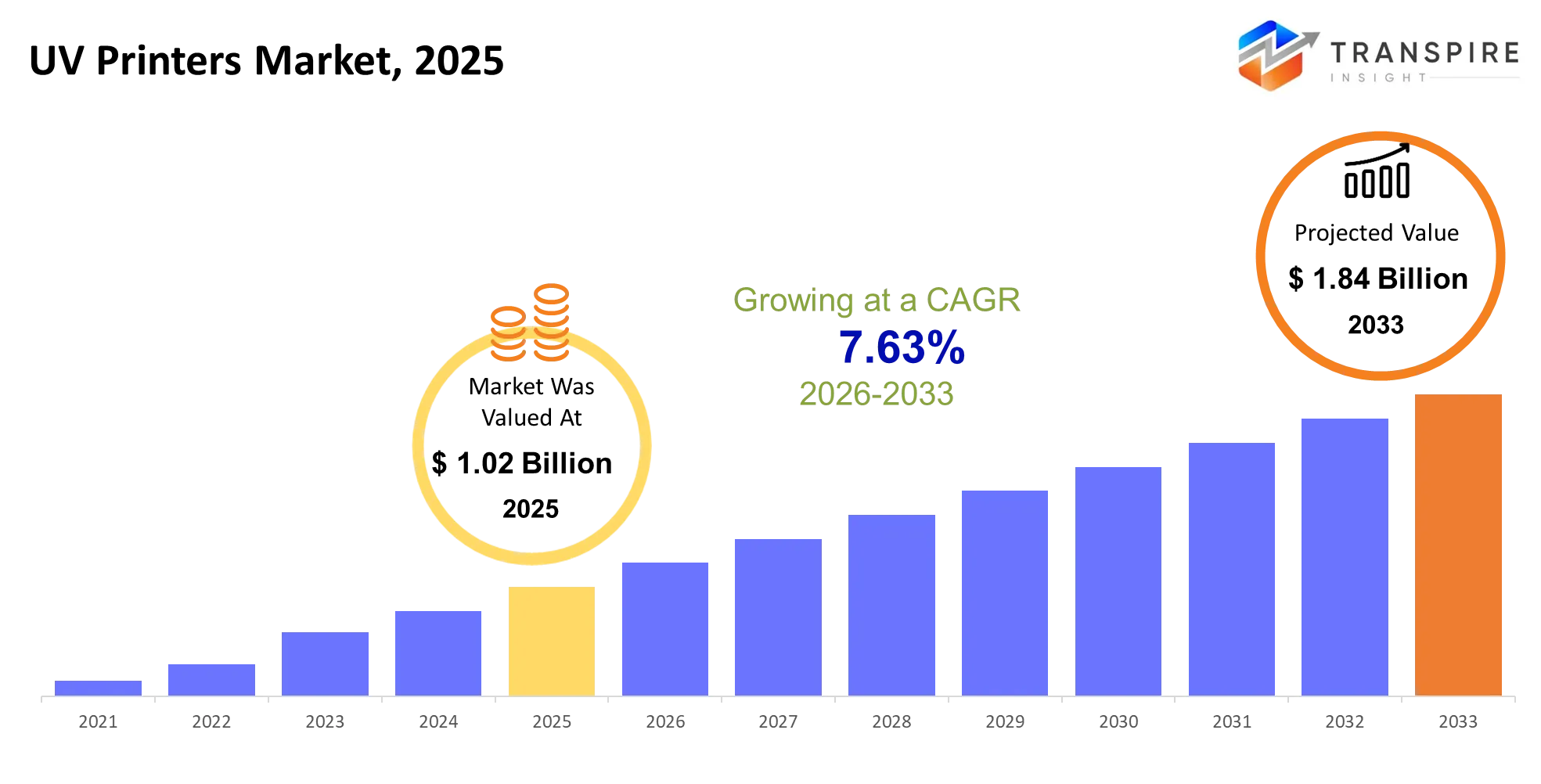
As per the Transpire Insight analysis, The UV Printers Market size is estimated at USD 1.02 billion in 2025 and is anticipated to reach USD 1.84 billion by 2033, growing at a CAGR of 7.63% from 2026 to 2033.
The printing industry is shifting away from traditional signage production and is moving toward on-demand custom manufacturing, direct-to-object printing, and short-run industrial print applications. Printed onto glass, metal, wood, plastics, and acrylic, the ability to print directly onto material substrates using UV printers reduces the need for labels, screens, and other costly setups. Over the past three to five years, new products with UV LED curing, increased printhead resolution, and automated material handling have made digital printing more realistic for smaller production runs. We are observing a structural shift in the industry as providers replace some analogue decoration methods with the more frequently needed workflow, where designs are changed using digitally controlled machinery. The latest LED UV flatbeds from Canon U.S.A. and Digi Tech, the Texas LT3 Series, now incorporate automated unloading and conveyor integration, indicating the direction of higher-throughput production.
UV Printers Market Size & Forecast:
- Market Size 2025: USD 1.02 Billion
- Expected Market Value (2033): USD 1.84 Billion
- Forecast CAGR (2026-2033): 7.63%
- Leading Region in 2025: Asia Pacific
- Fastest Growing Region: Europe
- Key Company Profiles: Canon, HP, Roland DG, Mimaki Engineering, Epson, Ricoh, Fujifilm, Durst Group, Agfa-Gevaert, EFI, Konica Minolta, Mutoh, Brother Industries, Seiko Epson, Dilli.
Key UV Printers Market Insights:
The market is shifting from purely printer specifications to production efficiency, ink performance, and versatility of the substrate. Recent product introductions signal the trend of automated, high-mix manufacturing and speciality direct-to-object applications.
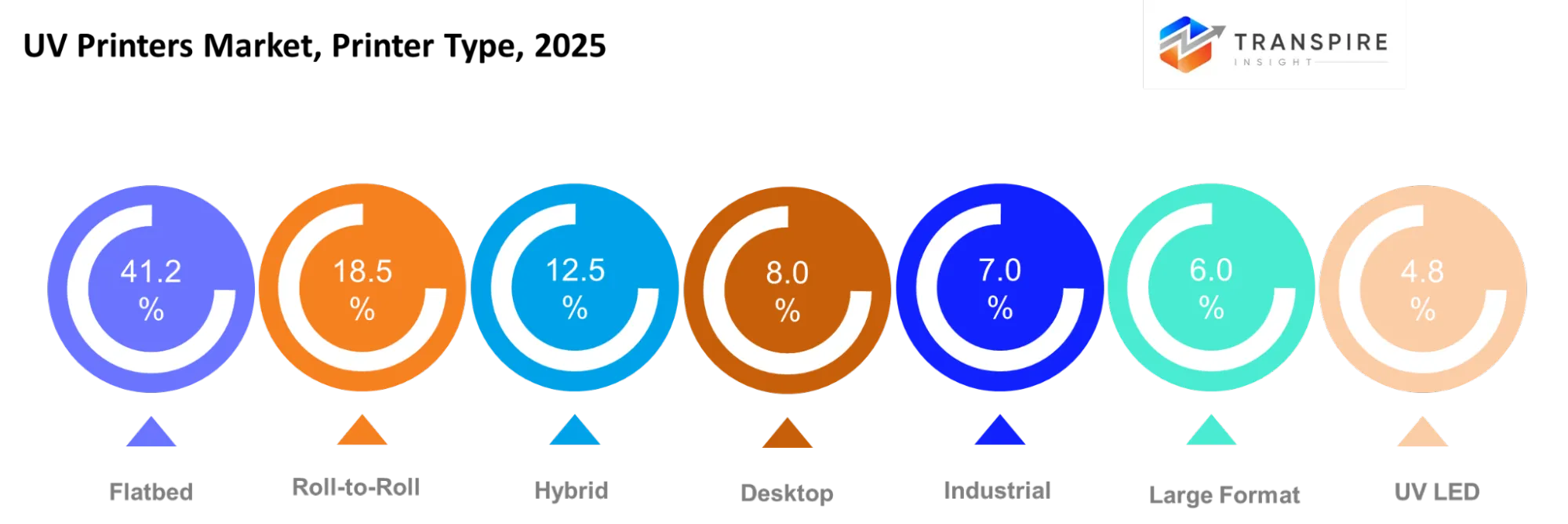
- Flatbed UV printers dominate with 41.2% of the market, while Canon's expansion of its UV inkjet technology into the 2025 packaging arena is aimed at converters looking for short-run, low-waste printing.
- Roll-to-roll systems account for 18.5% of demand, and Mimaki's 2025 collaboration with Durst will see the two companies jointly develop faster UV presses for packaging and signage.
- The hybrid printers represent 12.5% of the market, as customers prefer a platform to work with both rigid boards and flexible media.
- Personalised merchandise, promotional products, and customisation in small batches are key drivers of the growth in Desktop UV systems, accounting for an 8.0% share.
- Industrial printers account for 7.0%, and UV technology is getting into electronics marking, direct-to-shape decoration, and functional coatings.
- Large format systems accounted for 6.0%, with Epson's 2025 SureColor V9000UV launch bolstering the company's outdoor-signage and point-of-purchase business.
- UV LED printers account for 4.8%, and over 45% of new installations are now using LED curing, which reduces power consumption by almost 40%.
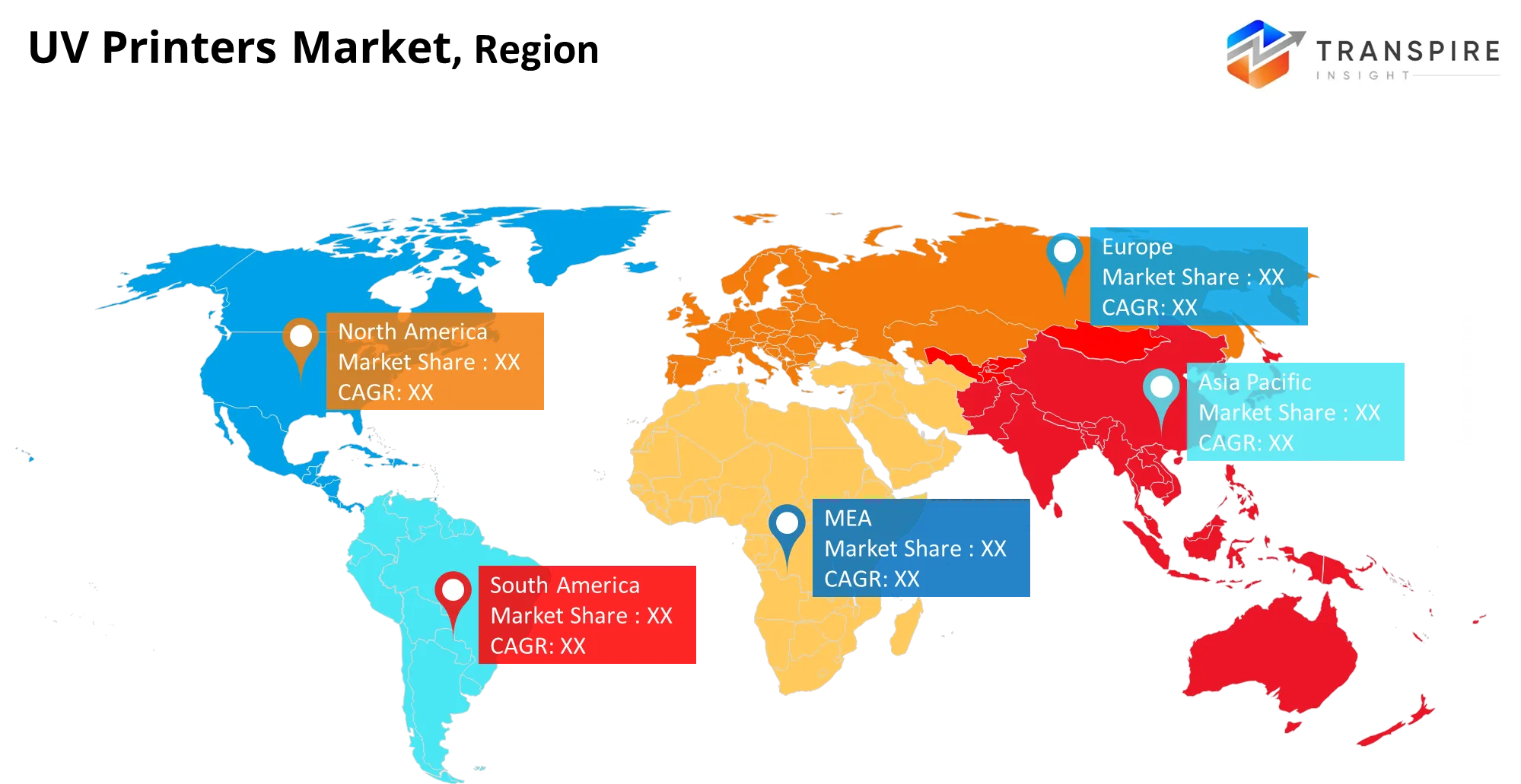
- Asia Pacific is leading with 42.6%, with China's UV LED chip supply chain, Japan's printhead R&D, and India's efforts to eliminate solvent emissions.
- North America has 25.1%, Europe 23.7%, Latin America 5.0%, and the Middle East & Africa 3.6% adoption paths that are distinct.
What are the Key Drivers, Restraints, and Opportunities in the UV Printers Market?
Driver:
Demand is being driven by the economics of short-run customisation and faster production changeovers. E-commerce personalisation, seasonal promotions, and frequent packaging redesigns have made traditional screen-based methods less flexible for smaller orders. UV printers allow businesses to change artwork digitally without manufacturing new screens or plates, helping reduce setup costs and improve order turnaround. Automation-ready flatbed systems also allow commercial printers to increase throughput without proportionately increasing labour requirements.
Restraint:
High initial equipment costs, specialist ink expenses and maintenance requirements continue to limit adoption among small print shops. The challenge persists because profitability depends on machine utilisation, operator skills, substrate compatibility and local technical support. In addition, UV ink chemistry requires careful management. Food-contact packaging applications face migration risks and compliance requirements, while unsuitable ink-substrate combinations can cause adhesion or durability problems. These factors increase qualification costs and can delay investment decisions.
Opportunity:
The strongest opportunity lies in combining UV LED curing with automated feeding, inspection, and direct-to-object printing. For example, packaging converters and promotional-product manufacturers in India and Southeast Asia could use compact flatbed or cylindrical systems to produce limited editions, customised containers and short-run graphics without dedicated tooling. Improved workflow integration can make smaller orders commercially viable while reducing manual handling. Investment in low-migration ink systems, reliable curing, and application-specific printer configurations can also help suppliers access higher-value industrial and packaging applications.
UV Printers Market — Driver Impact Analysis
|
Driver |
Relative Impact on Growth (%) |
Geographic Relevance |
Impact Timeline |
Demand Strength |
Growth Mechanism |
Key Beneficiaries |
Major Constraint |
|
Rapid adoption of UV-LED curing technology |
25% |
Asia-Pacific, Europe, North America |
Short-term (≤2 years) |
High |
Reduces curing energy, heat exposure, and production downtime |
UV printer manufacturers, LED suppliers, print service providers |
High equipment costs and ink compatibility limitations |
|
Growing demand for customized, short-run packaging and labels |
23% |
North America, Europe, Asia-Pacific |
Medium-term (2-4 years) |
High |
Enables economical variable designs and faster product changeovers |
Packaging converters, brand owners, digital printing companies |
Price competition and limited digital-run economies |
|
Expansion of signage, graphics, and direct-to-object printing |
20% |
Asia-Pacific, North America, Europe |
Short-term (≤2 years) |
High |
Supports durable graphics across rigid and curved substrates |
Signage businesses, promotional printers, equipment manufacturers |
Substrate pretreatment and skilled operator requirements |
|
Industrial adoption of high-precision printing and hybrid platforms |
18% |
Asia-Pacific, Europe, North America |
Long-term (≥4 years) |
High |
Integrates printing into electronics and manufacturing workflows |
Industrial OEMs, electronics producers, printhead technology vendors |
Qualification costs and demanding precision requirements |
|
Sustainability priorities and low-VOC printing transitions |
14% |
Europe, North America, Asia-Pacific |
Medium-term (2-4 years) |
Medium |
Encourages lower-emission curing and reduced production waste |
UV-LED suppliers, ink formulators, sustainability-focused printers |
Ink chemistry concerns and application-specific compliance requirements |
|
Total |
100% |
— |
— |
— |
— |
— |
What Has the Impact of Artificial Intelligence Been on the UV Printers Market?
AI makes UV printing a self-learning, digital print-automation workflow that no longer relies on constant human supervision. AI-integrated RIP and job-management software can offer efficient nesting of multiple jobs, media allocation, colour management, and job sequencing to conserve expensive substrates and limit costly changeover downtime. Predictive performance insights are emerging from IoT-powered printheads and sensors by utilising machine-learning algorithms on nozzle temperature and vibration, ink fluid level, and printhead temperature to foresee blocked nozzles, poor-quality curing, or printhead jitter, long before they can cause a rejected batch. Operational workflows can benefit from computer vision inspection that identifies banding, colour shifts, registration errors, or surface markings, thus decreasing the need for costly rework. These enhancements are especially valuable in packaging and industrial printing, where rejected product production represents significant waste of materials and delivery costs. Major hurdles are vendor integration and the required build-up of data, skills, and investment, as many printer systems remain reliant on legacy controls and proprietary software; until that shifts, the take-up by packaging converters and industrial printers is likely to be limited to large businesses.
In February 2026, ColorByte Software launched ImagePrint UV with Pedestal AI, a first-of-its-kind AI-powered 2.5D RIP software platform. This system natively analyses flat, two-dimensional artwork and automatically generates height maps and depth data directly within the RIP workflow.https://worldimagingnews.com/colorbyte-software-introduces-the-industrys-first-ai-powered-2-5d-rip-for-uv-printing/
Key UV Printers Market Trends:
UV printing is expanding beyond signage and into digitally decorated products and workflows for industry. The need for automation, flexibility of substrates, ink performance, and the ability to process smaller orders profitably are becoming more important for competitive advantage.
- Consumers are increasingly concerned about reducing energy consumption, operating temperatures, and the ability to cure heat-sensitive materials and are increasingly turning to UV LED curing systems to replace mercury-lamp systems.
- Increased VOC, REACH, and packaging-recyclability regulations are driving printers to low-migration, low-odour, and mercury-free inks.
- To meet the needs of short runs, variable data, and fast SKU changes, packaging converters are turning to UV flatbed and single-pass systems.
- Hybrid flatbed/roll-to-roll machines are getting a lot of interest because they enable the print provider to use the same machine to print rigid boards and flexible media without having to invest in separate assets.
- The automated media handling, height adjustment and colour calibration are minimising operator dependency and increasing repeat-job accuracy.
- The use of AI and IoT remote monitoring is emerging as a differentiator, allowing for predictive maintenance and reduced unplanned downtime.
- Print platforms are transforming the way their customers buy, customise, and produce items online.
- Today, UV printing is growing into ceramic tiles, glass, electronics coating, and direct-to-shape industrial applications.
- Ink manufacturers are developing plant-based and low-odour inks to make UV printing more palatable for interior and consumer applications.
UV Printers Market Segmentation
Printer Type:
Flatbed printers account for an estimated 41.2% of the market, supported by their ability to print on rigid materials such as acrylic, wood, glass and metal. Roll-to-roll systems are suited to flexible media and continuous graphics production, with a supplied growth estimate of 8.7% CAGR. Hybrid printers combine rigid and flexible media handling, while desktop systems serve small workshops and customised merchandise businesses. Industrial printers prioritise repeatability and durability, large-format models address oversized graphics, and UV LED represents a curing technology category that can overlap with several printer types. The supplied estimates assign 18.5% to roll-to-roll, 12.5% to hybrid, 8.0% to desktop, 7.0% to industrial, 6.0% to large format, 4.8% to UV LED, and 2.0% to others; these figures should be validated for consistent category definitions.
Ink Type:
UV-curable inks provide the broad foundation for the market, while UV LED-compatible formulations are gaining attention for rapid curing, lower heat exposure, and energy-efficient workflows. Flexible UV inks support films and roll media, whereas hard UV inks serve rigid industrial substrates. White, clear, and metallic inks enable premium finishes across packaging, labels, décor, and promotional products. Future adoption will depend on adhesion, durability, curing performance and compliance with application-specific chemical safety requirements.
Technology:
Piezoelectric inkjet technology supports precise droplet control and compatibility with diverse UV ink formulations, making it suitable for commercial and industrial applications. Drop-on-demand systems offer flexibility for customised, short-run jobs, while single-pass configurations support higher throughput in packaging and industrial production. Multi-pass systems remain relevant where detailed graphics and high image quality matter. Thermal inkjet, continuous inkjet and variable-dot technologies serve specialised requirements, with future competition centred on printhead reliability, production speed and ink efficiency.
Application:
Signage remains a foundational application, supported by demand for durable graphics, displays and promotional boards. Packaging is expanding as brands seek customised designs, shorter production runs and faster artwork changes. Textiles, industrial printing, décor, electronics and promotional printing diversify demand across different substrates and production environments. Growth will depend on application-specific ink adhesion, surface durability and process compatibility. In packaging, chemical migration requirements and curing validation can influence equipment selection, particularly for applications involving food contact or sensitive materials.
End User:
Commercial printers and advertising firms remain important buyers because UV equipment supports varied customer orders and rapid design changes. Packaging companies benefit from economical short runs and customised graphics, while manufacturers use UV printing for component identification, product decoration and selected functional applications. Textile producers can serve specialised decorative markets, whereas retailers and interior designers use printed panels, displays and personalised surfaces. Future purchasing decisions will increasingly reflect equipment utilisation, service availability, substrate flexibility and the ability to deliver consistent quality across changing job specifications.
Printer Format:
Large-format and wide-format systems serve signage, exhibition graphics and oversized displays, while medium-format machines accommodate packaging prototypes, decorative panels and general commercial production. Small-format printers support personalised merchandise and compact workshops with limited production space. Super-wide systems address architectural graphics and large installations, whereas roll-format equipment processes flexible media continuously and sheet-format systems handle individual rigid or pre-cut materials. Future demand will favour formats that balance throughput, floor-space constraints, automation compatibility and operating costs with the specific requirements of each printing application.
What are the Key Use Cases Driving the UV Printers Market?
The core use case is direct printing on rigid substrates, supported by flatbed printers' estimated 41.2% market share. Sign manufacturers, commercial printers and retailers use these systems for acrylic displays, wooden panels, glass graphics and customised promotional products. Direct printing removes certain intermediate production steps and makes short-run jobs more economical.
Expanding applications include packaging decoration, interior décor, industrial labels and branded merchandise. Roll-to-roll systems support flexible graphics, while hybrid configurations accommodate varied substrates, helping converters respond to changing order requirements.
Emerging use cases include customised cylindrical packaging, decorated industrial components and limited-edition consumer products. Automated loading and specialised UV inks are widening opportunities for manufacturers seeking faster product changes without dedicated tooling. Adoption will depend on durability, substrate compatibility and production economics.
|
Report Metrics |
Details |
|
Market size value in 2025 |
USD 1.02 Billion |
|
Market size value in 2026 |
USD 1.10 Billion |
|
Revenue forecast in 2033 |
USD 1.84 Billion |
|
Growth rate |
CAGR of 7.63% from 2026 to 2033 |
|
Base year |
2025 |
|
Historical data |
2021 - 2024 |
|
Forecast period |
2026 - 2033 |
|
Report coverage |
Revenue forecast, competitive landscape, growth factors, and trends |
|
Regional scope |
United States; Canada; Mexico; United Kingdom; Germany; France; Italy; Spain; Denmark; Sweden; Norway; China; Japan; India; Australia; South Korea; Thailand; Brazil; Argentina; South Africa; Saudi Arabia; United Arab Emirates |
|
Key companies profiled |
Canon, HP, Roland DG, Mimaki Engineering, Epson, Ricoh, Fujifilm, Durst Group, Agfa-Gevaert, EFI, Konica Minolta, Mutoh, Brother Industries, Seiko Epson, Dilli. |
|
Customization scope |
Free report customization (country, regional & segment scope). Available customized purchase options to meet your exact research needs. |
|
Report Segmentation |
Printer Type (Flatbed, Roll-to-Roll, Hybrid, Desktop, Industrial, Large Format, UV LED, Others)Ink Type (UV-Curable, UV LED, Flexible UV, Hard UV, White UV, Clear UV, Metallic UV, Others)Technology (Piezoelectric, Thermal Inkjet, Continuous Inkjet, Drop-on-Demand, Variable-Dot, Single-Pass, Multi-Pass, Others)Application (Signage, Packaging, Textiles, Industrial Printing, Décor, Electronics, Promotional Printing, Others)End User (Commercial Printers, Advertising, Packaging Companies, Manufacturers, Textile Producers, Retailers, Interior Designers, Others)Printer Format (Small Format, Medium Format, Large Format, Wide Format, Super-Wide Format, Roll Format, Sheet Format, Others). |
Which Regions are Driving the UV Printers Market Growth?
Asia Pacific is the volume driver with a share of 42.6%. Due to the vast manufacturing base, burgeoning packaging industry, and the keen inclination toward digital production technology, APAC remains the largest consumer of UV printers. The efficient supply ecosystem of APAC includes China's expertise in UV LED chip & ink chemistry, Japan's knowledge in intelligent print head & imaging, and India's initiative to minimize solvent emissions. Rising e-commerce and retail customization and industrial decoration demands are driving converters to migrate from analogue to UV LED. Low-cost manufacturing, concentrated supply of local components, and enforcement of compliance standards make Asia Pacific the volume driver of the market.
In September 2026, Hybrid Services Ltd launched the new Mimaki UJF200-6042 UV flatbed printer. The A2-format machine elevates personalisation and custom printing capabilities, allowing small and mid-sized commercial print shops to meet rising market demands for accelerated turnarounds without compromising graphic quality.https://www.texintel.com/press-room/hybdridservices-09-26-cmp-hybrid-services-unveils-new-mimaki-uv-flatbed-printer-at-the-print-show-2026
North America accounts for 25.1% and Europe 23.7% of the market, the entire technology- and compliance-driven demand base. Competition exists between North America and Europe on automation, colour correction, low-migration ink systems and service availability. Demand from North America is stable, led by packaging innovations, retail display manufacturing and large investments into digital workflows; whereas demand from Europe is stable due to regulation on VOC, REACH and recyclability, which helps to accelerate the adoption of LED UV technology. Latin America accounts for 5.0%, and the Middle East and Africa 3.6%; demand here is steady, but held back by capital costs, skills, and service coverage.
In June 2026, INX International established a partnership with press manufacturer Koenig & Bauer to drive advancements in LED-UV, HR-UV, and UV printing technologies. This collaborative initiative enhances production efficiency, colour consistency, and sustainability metrics for packaging converters across international markets.https://www.inxinternational.com/news/inx-inkjet-sustainable-packaging-solutions-printing-united
Europe accounts for 23.7% and is the fastest-growing region with a 7.9% compound annual growth rate, marking a recent shift from compliance-led substitution to active modernisation. New packaging sustainability regulations, the decision to phase out mercury lamps, and rising demand for low-odour indoor graphics all give converters reasons to move to LED UV. High-end, low-migration packaging, décor, and industrial direct-object printing are where the future opportunities lie for European brands to use sustainability and customisation as a premium selling point rather than low price.
In May 2026, Toyo Ink Europe introduced a complete lineup of UV-curable, low-migration, and low-energy inks specifically designed for food-safe packaging. This launch provides European converters with an immediate compliant solution to meet stringent safety and migration limits before they become mandatory under regional regulations.https://www.artiencegroup.com/en/news/2026/26022401.html
Who are the Key Players in the UV Printers Market, and how do they compete?
The competition in the market of UV printers is shifting from a hardware-led to a system-led industry with integrated ecosystems. Today, vendor competition is driven by curing speed, substrate flexibility, software workflow, ink supply, and system lifetime service. Canon, HP, Roland DG, Mimaki Engineering, Epson, Ricoh, Fujifilm, Durst Group, Agfa-Gevaert, EFI, Konica Minolta, Mutoh, Brother Industries, Seiko Epson, and Dilli are the key suppliers in the industry. Canon is pursuing an innovation-and-acquisition strategy, enhancing its UV-curable packaging expertise and expanding its existing commercial-print range; its strength is its worldwide enterprise penetration and complex imaging systems. Epson and Seiko Epson focus on LED UV innovation and commercialisation by 2025 with the Sure Colour V9000UV designed for signage and point-of-purchase. Roland DG and Mimaki Engineering aim to deliver a niche-specialist approach with versatile systems suitable for signage, personalisation, industrial embellishment, and speciality substrates, with Mimaki teaming up with Durst in 2025 for advanced packaging and signage. HP and Mutoh are eyeing partnership-led growth by co-creating UV flatbed systems for signage customers. Durst, EFI, Agfa-Gevaert, Fujifilm, Ricoh, and Konica Minolta are differentiating via industrial automation, workflow, and high-productivity presses for packaging converters and industrial manufacturers, rather than entry-level buyers.
Key Players are:
- Canon
- HP
- Roland DG
- Mimaki Engineering
- Epson
- Ricoh
- Fujifilm
- Durst Group
- Agfa-Gevaert
- EFI
- Konica Minolta
- Mutoh
- Brother Industries
- Seiko Epson
- Dilli
UV Printers Market — Enhanced Competitive Benchmarking
|
Company |
Est. Revenue Share Range |
Key Offerings |
Strategic Positioning |
Geographic Strength |
Technology Focus |
|
Canon |
Estimated 8-12% |
Arizona 1300, Arizona 2300, Arizona 135, UVgel printing systems |
Premium wide-format flatbed and hybrid printing solutions |
North America, Europe, Asia Pacific |
FLXflow media handling, UVgel curing, automated maintenance |
|
Roland DG |
Estimated 7-11% |
VersaOBJECT LO/CO-i, MO Series, TrueVIS LG, VersaSTUDIO BF-16 |
Specialty printing and profitable product personalization |
Asia Pacific, North America, Europe |
UV-LED curing, layered textures, direct-to-object printing |
|
Mimaki Engineering |
Estimated 7-11% |
JFX600, JFX200, UJF-7151, UJF-3042 series |
Broad UV portfolio spanning industrial and small-format applications |
Asia Pacific, Europe, North America |
2.5D texture printing, UV-LED, multi-colour ink configurations |
|
Epson |
Estimated 5-9% |
SureColor V7000, V4000, V1070 |
Image-quality leadership with accessible flatbed configurations |
Asia Pacific, North America, Europe |
PrecisionCore heads, UltraChrome UV inks, white and varnish layers |
|
Electronics For Imaging (EFI) |
Estimated 4-8% |
VUTEk UV platforms, hybrid and flatbed production systems |
High-throughput commercial and industrial graphics production |
North America, Europe, Latin America |
Industrial inkjet, automated workflows, high-speed UV curing |
|
Durst Group |
Estimated 4-7% |
P5 large-format printing systems, industrial UV configurations |
Premium industrial productivity and integrated print workflows |
Europe, North America, Asia Pacific |
Modular print platforms, automation, production workflow integration |
|
Agfa |
Estimated 3-6% |
Jeti Tauro, Anapurna UV systems |
Industrial graphics specialization and production efficiency |
Europe, North America, Asia Pacific |
UV inkjet, automated media handling, ink and workflow optimization |
|
Fujifilm |
Estimated 3-6% |
Acuity flatbed and hybrid UV systems |
Premium graphics quality and specialized print applications |
Europe, North America, Asia Pacific |
UV ink chemistry, printhead engineering, colour consistency |
|
Mutoh |
Estimated 2-5% |
XpertJet UV flatbed systems, ValueJet UV configurations |
Value-oriented wide-format and speciality printing |
Asia Pacific, Europe, North America |
UV-LED curing, multi-layer printing, compact production architectures |
|
Ricoh |
Estimated 2-5% |
Pro TF6250, Pro TF6251 UV flatbed platforms |
Industrial flatbed printing supported by printhead expertise |
Asia Pacific, Europe, North America |
Industrial piezo inkjet heads, LED curing, white ink and primer control |
Recent Development News
- In September 2026, Roland DG launched the VersaObject IO-300 and RC-300 Series industrial UV printing solutions for product decoration and short-run manufacturing. The launch strengthens direct-to-object printing capabilities across flat and cylindrical surfaces, enabling manufacturers and packaging businesses to improve customisation, reduce setup complexity, and respond more efficiently to changing customer requirements.https://corporate.rolanddg.com/en/news/2600901-versaobject-io-300-rc-300.html
- In September 2026, Roland DG Americas entered into a strategic partnership with LogoJET to add selected Roland DG UV flatbed printers to LogoJET’s product portfolio. The partnership broadens equipment availability across desktop, benchtop, and large-format applications, helping expand market access for businesses seeking direct-to-object printing and product personalisation solutions.https://www.prnewswire.com/news-releases/roland-dg-americas-enters-into-strategic-partnership-with-logojet-302883849.html
- In September 2026, Mimaki Engineering announced the UJF200-3042 and UJF200-6042 UV flatbed printer series, featuring newly developed fluorescent UV inks and optional camera and belt units for automated printing. The launch expands direct-to-object printing capabilities for customised promotional goods and industrial products, supporting greater production flexibility and workflow efficiency.https://mimaki.com/news/product/entry-466452.html
What Strategic Insights Define the Future of the UV Printers Market?
The transition to all-in-one UV LED-based production platforms consisting of short-run packaging, object-to-object direct-to-medium printing, and automated quality control is translating into efficiency gains and reduced manual intervention. This enables manufacturers to accelerate workflows and cater to the pace of customer demands. Moreover, for companies that prefer to keep production in-house, it provides a solution for investment in narrow output ranges, which was previously costly in the case of traditional systems. However, an unanticipated concern of this transition is vendor lock-in, where most of the cost of ownership is being driven up owing to proprietary inks, raster image processor (RIP) software, and maintenance contracts, constraining flexibility in operations and preventing smaller printing companies with fewer financial and technical resources from adopting the technology. An emerging opportunity can be seen in low-migration UV LED printing for food-contact and premium packaging applications, where the correlation between compliance regulations and formulation-specific inks could be leveraged as a competitive advantage.
Key Segmentations are:
Printer Type
- Flatbed
- Roll-to-Roll
- Hybrid
- Desktop
- Industrial
- Large Format
- UV LED
- Others
Ink Type
- UV-Curable
- UV LED
- Flexible UV
- Hard UV
- White UV
- Clear UV
- Metallic UV
- Others
Technology
- Piezoelectric
- Thermal Inkjet
- Continuous Inkjet
- Drop-on-Demand
- Variable-Dot
- Single-Pass
- Multi-Pass
- Others
Application
- Signage
- Packaging
- Textiles
- Industrial Printing
- Décor
- Electronics
- Promotional Printing
- Others
End User
- Commercial Printers
- Advertising
- Packaging Companies
- Manufacturers
- Textile Producers
- Retailers
- Interior Designers
- Others
Printer Format
- Small Format
- Medium Format
- Large Format
- Wide Format
- Super-Wide Format
- Roll Format
- Sheet Format
- Others
By Regional Analysis
North America
- US
- Canada
- Mexico
Europe
- Germany
- UK
- France
- Italy
- Spain
- Russia
- Rest of Europe
Asia Pacific
- China
- Japan
- India
- South Korea
- Australia
- Rest of Asia Pacific
South America
- Brazil
- Argentina
- Rest of South America
Middle East & Africa
- UAE
- Saudi Arabia
- Qatar
- South Africa
- Rest of the Middle East & Africa
Frequently Asked Questions
Find quick answers to common questions.
The UV printers market size was valued at USD 1.02 billion in 2025 and is poised to reach USD 1.84 billion by 2033, expanding at a 7.63% CAGR.
Key segments for the UV printers market are Type Printer Type (Flatbed, Roll-to-Roll, Hybrid, Desktop, Industrial, Large Format, UV LED, Others)Ink Type (UV-Curable, UV LED, Flexible UV, Hard UV, White UV, Clear UV, Metallic UV, Others)Technology (Piezoelectric, Thermal Inkjet, Continuous Inkjet, Drop-on-Demand, Variable-Dot, Single-Pass, Multi-Pass, Others)Application (Signage, Packaging, Textiles, Industrial Printing, Décor, Electronics, Promotional Printing, Others)End User (Commercial Printers, Advertising, Packaging Companies, Manufacturers, Textile Producers, Retailers, Interior Designers, Others)Printer Format (Small Format, Medium Format, Large Format, Wide Format, Super-Wide Format, Roll Format, Sheet Format, Others).
Growth is primarily driven by demand for customised printing, adoption of UV LED curing technology, automation of printing workflows, expansion of short-run packaging, and increasing use of direct-to-object printing across industrial and commercial applications
The UV printers market is led by major manufacturers, including Canon, HP, Roland DG, Mimaki Engineering, Epson, Ricoh, Fujifilm, Durst Group, Agfa-Gevaert, EFI, Konica Minolta, Mutoh, Brother Industries, Seiko Epson, Dilli.
Asia-Pacific holds 42.6% of the market, supported by its strong manufacturing ecosystem, established printing-equipment supply chains, industrial production capacity, and growing demand for customised graphics and product decoration.
Key opportunities include UV LED-based printing, low-migration inks for premium packaging, AI-enabled predictive maintenance, automated production workflows, and direct-to-object printing for customised products.
- Canon
- HP
- Roland DG
- Mimaki Engineering
- Epson
- Ricoh
- Fujifilm
- Durst Group
- Agfa-Gevaert
- EFI
- Konica Minolta
- Mutoh
- Brother Industries
- Seiko Epson
- Dilli
About the Authors

Kartik bhong
I am Kartik Bhong, a Senior Research Analyst at Transpire Insight, specializing in the Packaging, Manufacturing, and Construction industry. My work focuses on analyzing market trends, emerging technologies, industry regulations, and competitive landscapes to deliver accurate, data-driven insights. I am passionate about transforming complex industry information into clear, practical content that helps businesses, professionals, and decision-makers stay informed and make confident strategic decisions. Through continuous research and a strong commitment to accuracy, I strive to create reliable, well-researched content that reflects the latest developments across these dynamic industries and supports the vision of Transpire Insight in delivering valuable market intelligence.

Chakradhar Khansole
Chakradhar serves as the Research Director at Transpire Insight, bringing over 8 years of experience in technology, innovation, and strategic market intelligence. He specializes in transforming complex market data into actionable business insights that enable organizations to make informed, growth-oriented decisions. Recognized for his strategic vision and analytical expertise, Chakradhar leads high-impact research initiatives, delivering comprehensive market assessments, competitive intelligence, and forward-looking industry analysis.
Recently Published Reports
-
Apr 2026
Pharmaceutical Cold Chain Packaging Market
Pharmaceutical Cold Chain Packaging Market By Material (Plastic,(Polyethylene (PE), Polypropylene (PP), Polyethylene Terephthalate (PET), Expanded Polystyrene (EPS), Polyurethane (PU),Others), Paper, Metal, Others), By Product (Small Boxes, Pallets, Large Sized Pallet Containers, Others), By End Use (Biopharmaceutical Companies, Clinical Research Organizations, Hospitals, Research Institutes, Logistics and Distribution Companies, Others)”, By Industry Analysis, Size, Share, Growth, Trends, and Forecasts 2026-2033
-
Apr 2026
Active & Intelligent Packaging Market
Active & Intelligent Packaging Market By Type (Active Packaging, Smart Packaging), By Material (Polymer-Based, Paper & Board-Based, Metal-Based, Glass-Based), By Technology (Time-Temperature Indicators, Freshness Indicators, RFID, Antimicrobial Packaging, Modified Atmosphere Packaging), By Application (Food & Beverages, Pharmaceutical, Cosmetics & Personal Care, Electronics & Consumer Goods, Others), By Industry Analysis, Size, Share, Growth, Trends, and Forecasts 2026-2033
-
Apr 2026
Biodegradable Cut Flower Packaging Market
Biodegradable Cut Flower Packaging Market By Material Type (Paper & Paperboard, Biodegradable Plastics, Natural Fibers, Molded Pulp, Others), By Product Type (Sleeves, Wraps, Boxes & Cartons, Bags & Pouches, Inserts & Holders), By Application (Roses, Carnations, Tulips, Chrysanthemums, Mixed Flowers, Others) and By Distribution Channel (Direct Sales, Distributors & Wholesalers, Online Channels), By Industry Analysis, Size, Share, Growth, Trends, and Forecasts 2026-2033
-
May 2026
Pharmaceutical Packaging Market
Pharmaceutical Packaging Market By Material Type (Plastic, Glass, Metal, Paper & Paperboard, Others), By Packaging Type (Bottles, Blister Packs, Vials, Ampoules, Pouches & Sachets, Others) and By End User (Hospitals & Clinics, Retail Pharmacies, Online Pharmacies, Pharmaceutical Manufacturers), By Industry Analysis, Size, Share, Growth, Trends, and Forecasts 2026-2033