
Upstream Oil and Gas Market Summary:
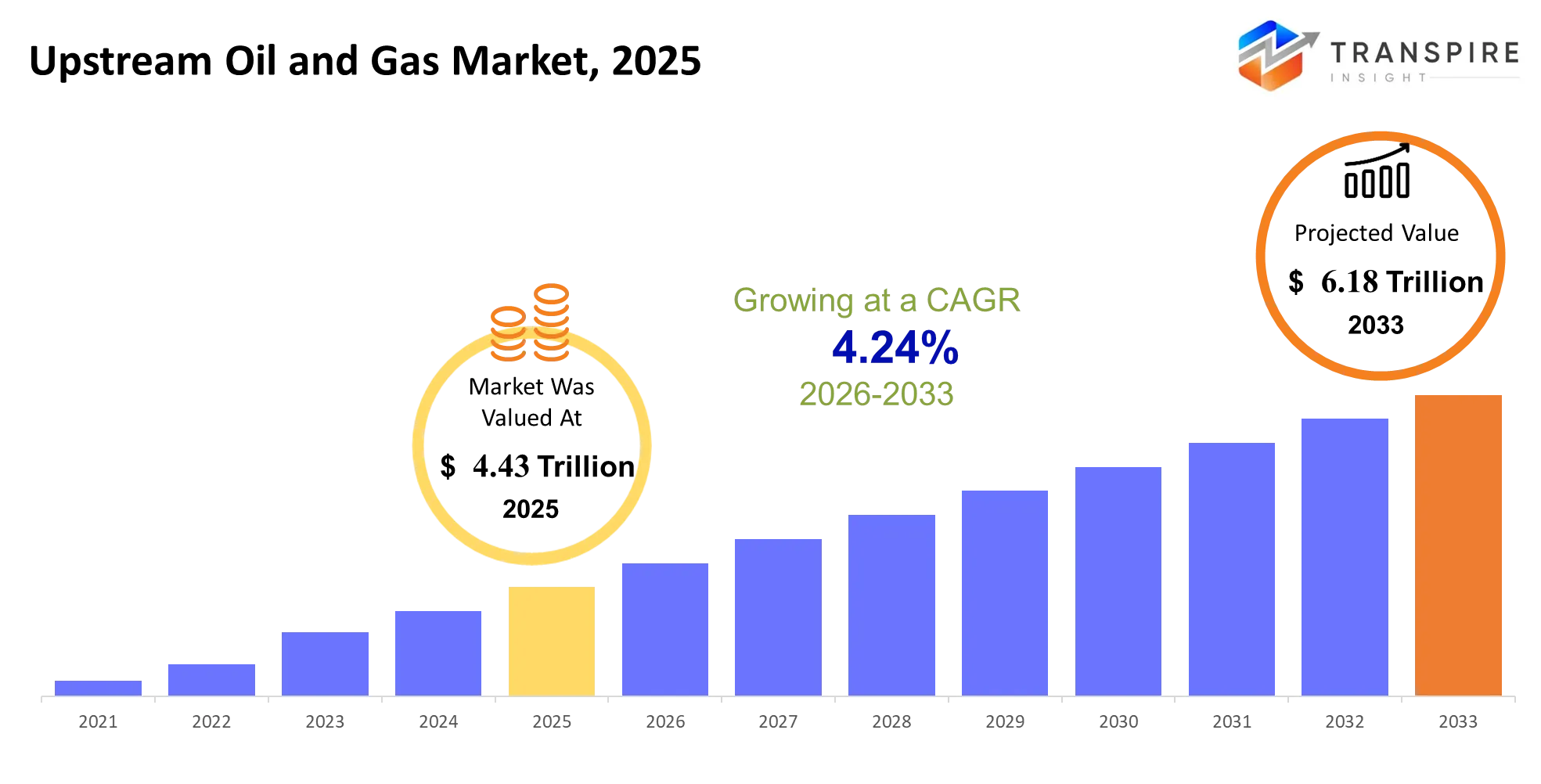
As per the Transpire Insight Analysis, The Upstream Oil and Gas Market size is estimated at USD 4.43 trillion in 2025 and is anticipated to reach USD 6.18 trillion by 2033, growing at a CAGR of 4.24% from 2026 to 2033.
The upstream oil and gas market underpins the exploration, development, and production of crude oil and natural gas, converting geologic formations into commercially viable supplies ready for processing in refineries, power plants, and industrial clients. Over the past three to five years, operators have shifted from being product-volume driven to financially disciplined, payback-focused, and maximally recovered from existing assets. The development of digital oilfields, better seismic imaging, and subsea technology has improved geological illumination and facilitated more precise wellbore placement. A major driver of this change has been geopolitical volatility impacting energy supply chains, demonstrating the need to build resilience through investment in domestic assets and supply diversification. Meanwhile, emissions regulations and methane emissions requirements have created new project economics, compelling operators to combine targeted exploration with brownfield conversion, automation, and enhanced oil recovery. As a result, growth is increasingly based on extracting maximum value from existing facilities and efficiently developing technically advantaged areas.
Upstream Oil and Gas Market Size & Forecast:
- Market Size 2025: USD 4.43 Trillion
- Expected Market Value (2033): USD 6.18 Trillion
- Forecast CAGR (2026-2033): 4.24%
- Leading Region in 2025: Middle East and Africa
- Fastest Growing Region: Asia Pacific
- Key Company Profiles: Saudi Aramco, ExxonMobil, Chevron, Shell, BP, TotalEnergies, Equinor, ConocoPhillips, Eni, Petrobras, ADNOC, QatarEnergy, SLB, Halliburton, Baker Hughes.
Key Upstream Oil and Gas Market Insights:
Instead of maximum output, operators are focusing on capital efficiency, production resilience and enhanced recovery. The success of achieving competitive advantage is increasingly reliant on the ability to integrate subsurface knowledge, technology, and access to infrastructure.
- The largest activity segment is exploration & production, accounting for 31.00% of activity-focused demand.
- Saudi Aramco is expanding industrial AI and digital twins; its use of the technology at North Ghawar increased oil production by 8.44% and reduced Scope 1 and 2 emissions per barrel by 8.21%.
- ADNOC and SLB are rolling out an AI-powered Real-Time Operations Centre (RTOC) in over 120 rigs, which has cut incident response time by 4-12 hours and prevented 1-2 days of rig downtime per incident.
- The drilling segment is the fastest-growing, with 20.00% growth, highlighting the industry's shift towards automated rig operations and real-time performance control.
- Horizontal drilling, stimulation, and unconventional-resource development contribute to well completion, which accounts for 14.00%.
- Equinor identified 27 new oil and gas deposits with the help of AI-assisted exploration, which could help recover up to four billion barrels.
- Baker Hughes is not just a drilling company; its Industrial & Energy Technology orders hit a new high of USD 7.1 billion in Q2 2026, with USD 2.6 billion in power-system orders.
- The growth of subsea technology and digital operations in complex projects is boosting the growth of deepwater and ultra-deepwater resources at a 7.20% CAGR.
- Halliburton is developing a long-term upstream R&D collaboration with KOC via the Ahmadi Innovation Valley, focusing on AI, digital technologies, brownfield, greenfield, and unconventional assets.
What are the Key Drivers, Restraints, and Opportunities in the Upstream Oil and Gas Market?
Driver:
Capital allocation toward gas development, mature-field redevelopment, and strategic offshore projects is supporting upstream investment. Supply disruptions and geopolitical uncertainty have strengthened the focus on reliable production and diversified sourcing. The International Energy Agency's 2026 policy analysis highlights energy security as a central influence on investment decisions. Consequently, operators are prioritising projects that can deliver dependable output, improve recovery rates, and connect gas resources to export infrastructure.
Restraint:
High upfront capital intensity remains the principal constraint. Deepwater, ultra-deepwater, and shale projects require long payback periods, specialised equipment, and substantial environmental compliance spending. This persists because reservoir uncertainty, volatile commodity prices, and stricter emissions rules make investors cautious about approving large, long-cycle upstream projects.
Opportunity:
The next growth opportunity lies in autonomous, data-driven field operations. AI-powered predictive maintenance, digital twins, and remote drilling optimisation can reduce downtime, improve efficiency, and lower operating costs. Rystad Energy estimates that digitalisation and AI could generate nearly USD 500 billion in cumulative value for exploration and production companies between 2026 and 2030. Deepwater projects are particularly promising, as AI-enabled operations could deliver average savings exceeding 15-20%, with further potential in technically complex wells.
Driver Impact Analysis - Upstream Oil and Gas Market
|
Driver |
Relative Impact on Growth (%) |
Geographic Relevance |
Impact Timeline |
Demand Strength |
Growth Mechanism |
Key Beneficiaries |
Major Constraint |
|
1. Rising upstream capital investment and field replacement requirements |
28% |
Middle East, North America, Asia-Pacific |
Short-term (≤2 years) |
High |
Replaces declining output and expands productive capacity. |
National oil companies, drilling contractors, oilfield service providers |
Capital discipline and uncertain crude oil prices. |
|
2. Growing natural gas demand and LNG-linked exploration |
24% |
North America, Middle East, Asia-Pacific |
Medium-term (2-4 years) |
High |
Secures feedstock for LNG exports and power generation. |
Gas producers, offshore drillers, LNG-linked exploration companies |
LNG price volatility and delayed infrastructure development. |
|
3. Deepwater and unconventional resource development |
20% |
Gulf of Mexico, Brazil, Guyana, United States |
Long-term (≥4 years) |
High |
Unlocks complex reserves through advanced drilling and subsea systems. |
Offshore operators, subsea equipment manufacturers, directional drilling firms |
High upfront costs and lengthy project development cycles. |
|
4. Digitalisation, AI and advanced recovery technologies |
16% |
North America, Middle East, Europe |
Medium-term (2-4 years) |
High |
Improves reservoir targeting, recovery rates and drilling efficiency. |
Oilfield technology vendors, automation firms, production operators |
Integration costs and limited legacy-system compatibility. |
|
5. Energy security policies and regulatory-led exploration incentives |
12% |
India, Middle East, North America, Asia-Pacific |
Short-term (≤2 years) |
Medium |
Encourages licensing rounds, domestic exploration and reserve development. |
Exploration companies, national oil companies, seismic survey providers |
Regulatory uncertainty and environmental approval requirements. |
|
Total |
100% |
— |
— |
— |
— |
— |
— |
What Has the Impact of Artificial Intelligence Been on the Upstream Oil and Gas Market?
Artificial Intelligence is shifting upstream work from reactive field management to continuous optimisation: In exploration, machine learning automates seismic interpretation and supports reservoir identification; in drilling, algorithms optimise weight on the drill bit, rotational speed, mud flow and other parameters in real time to prevent non-productive time. Models have become so predictive that Artificial Intelligence is now present in asset management, utilising data from pump, compressor, valve, and rotating equipment sensors to identify signs of impending failure and inform maintenance before production is interrupted, which enhances safety, asset life, and operating expense; leading pilots have achieved double-digit cost reductions through predictive maintenance and remote operations. Automated processes are developing toward supervised autonomy, with systems capable of proactively flagging operational risk and executing perturbations within the scope of authorised automation in drilling, production and maintenance processes. Many operators still rely on legacy supervisory systems and disconnected data environments, which make near-term integration of subsurface, drilling and production data at scale more difficult; the accuracy of models is also dependent on high-quality field data, and the expense of deployment may limit access for smaller producers.
In August 2026, ADNOC (Abu Dhabi National Oil Company) partnered with SLB to deploy an AI-enabled Real-Time Operations Centre (RTOC) platform across its fleet of more than 120 onshore and offshore drilling rigs. This massive implementation bridges the integration gap by consolidating fragmented rig workflows into a single system, providing teams with automated dashboards and AI-powered performance insights.https://www.adnoc.ae/en/news-and-media/press-releases/2026/adnoc-and-slb-deploy-ai-platform-across-over-120-drilling-rigs-to-strengthen-upstream-performance
Key Upstream Oil and Gas Market Trends:
The industry is shifting from volume growth to selective, technologized production, with project economics and supply resilience becoming more and more decisive for investments. Emissions visibility, asset reliability, and digital integration are also becoming an integral part of the operator's business, not only a sustainability initiative.
- Exploration is becoming faster and less speculative as AI-assisted seismic interpretation shortens subsurface analysis cycles.
- Drilling is moving from manual supervision to real-time optimisation, minimising non-productive time and equipment failures.
- Fixed maintenance schedules are being replaced by predictive maintenance to enhance reliability of pumps, compressors and rotating assets.
- Digital twins are becoming more common for pre-operational simulation of reservoir behaviour, well performance, and production scenarios.
- As operators look to address skilled labour shortages and minimise exposure to dangerous offshore conditions, remote operations are growing.
- The deepwater and ultra-deepwater projects are making a comeback as digital tools make complex, high-cost projects more economically viable.
- With the focus on production from existing wells rather than new-frontier exploration, EOR is becoming more important.
- Well design, monitoring of emissions, and investment approvals are being affected, especially in the case of unconventional and offshore resources.
- National oil companies and joint ventures are stepping up collaboration with technology companies to speed up digital oilfield adoption.
Upstream Oil and Gas Market Segmentation
Activity:
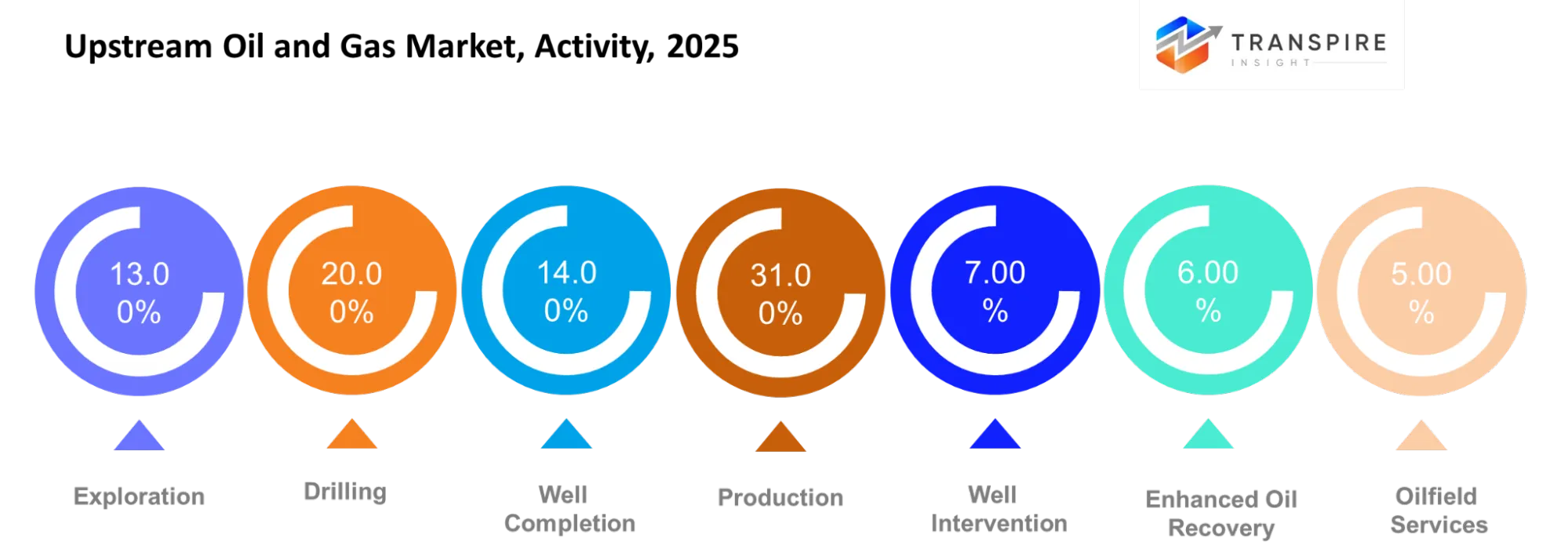
Exploration and production continues to be the largest segment and the basis of all upstream value creation. Exploration is growing at 13.00% as operators are reducing discovery risk through deeper, more complex seismic imaging and AI-led interpretation. Drilling is the fastest-growing segment at 20.00%, driven by directional drilling, automation, and shorter development cycles, while well completion is expanding at 14.00% following the emergence of horizontal wells and hydraulic fracturing. Production is growing at 31.00% as operators focus on churning existing assets for maximum value with current field infrastructure. Well intervention is currently growing at 7.00%, enhanced oil recovery 6.00%, oilfield services 5.00%, and asset management 4.00%, showing a shift towards lifecycle maximisation rather than new field growth.
Resource Type:
Conventional oil and gas benefit from established infrastructure, proven extraction methods, and predictable operating practices. Shale oil, shale gas, tight oil, tight gas, and coalbed methane require specialised technologies to unlock less accessible reserves. Deepwater resources offer significant development potential but involve higher capital expenditure, complex engineering, and longer project timelines. Future investment will depend on reservoir quality, recovery potential, infrastructure access, and the commercial viability of extraction under changing energy security priorities and environmental regulations.
Well Type:
Onshore wells generally offer easier access, lower development complexity, and faster project execution than offshore alternatives. Offshore, deepwater, and ultra-deepwater wells require advanced subsea equipment, specialised drilling systems, and stronger safety controls. Horizontal wells improve reservoir contact, while multilateral designs access multiple production zones from a single wellbore. Vertical wells remain suitable for specific geological formations. Future development will increasingly favour well designs that improve recovery, reduce surface footprints, and optimise drilling expenditure across diverse reservoirs.
Technology:
Seismic imaging helps identify promising geological formations, while directional drilling improves well placement and hydraulic fracturing enables production from suitable unconventional reservoirs. Digital oilfields, artificial lift, automation, subsea technology, and enhanced oil recovery improve operational visibility and asset productivity. AI-assisted analytics increasingly support drilling decisions, equipment monitoring, and reservoir optimisation. As operators seek stronger returns from existing assets, integrated technologies will become increasingly important for reducing downtime, improving recovery rates, and managing complex exploration and production activities.
Service:
Drilling, completion, well testing, logging, cementing, stimulation, production support, and maintenance underpin efficient upstream operations. These services help operators evaluate formations, construct reliable wells, manage production, and address equipment failures. Integrated service delivery can improve coordination between contractors, shorten project schedules, and reduce nonproductive time. Growing technical complexity is increasing the importance of specialised engineering, real-time monitoring, and digital service platforms. Providers that combine operational expertise with advanced technologies can strengthen customer relationships and capture opportunities across conventional and offshore developments.
Operator Type:
National oil companies and international oil companies lead many large-scale developments through substantial capital investment, established infrastructure, and long-term resource strategies. Independent producers focus on selected basins, cost efficiency, and specialised opportunities, while private operators and government entities contribute financing, oversight, and operational capabilities. Joint ventures distribute investment requirements and geological risks, while oilfield service companies supply essential technical expertise. Deepwater and ultra-deepwater activities are projected to grow at a 7.20% CAGR, creating opportunities for collaborative development and advanced offshore engineering.
What are the Key Use Cases Driving the Upstream Oil and Gas Market?
The core use case is commercial oil and gas extraction, led by Exploration & Production. Operators use seismic imaging, drilling, well completion, and production systems to convert discovered reserves into marketable hydrocarbons while controlling development costs and maintaining well integrity.
Expanding applications include mature-field rehabilitation, horizontal drilling, artificial lift, and enhanced oil recovery. These techniques help producers sustain output from ageing reservoirs, improve recovery, and extend asset life without relying entirely on discoveries. Gas-field development also supports LNG supply chains and industrial fuel requirements.
Emerging use cases centre on AI-assisted exploration, autonomous drilling, digital reservoir twins, and methane-leak detection. Deepwater and ultra-deepwater projects, growing at a projected 7.20% CAGR, are creating opportunities for subsea automation, remote monitoring, and advanced offshore engineering.
|
Report Metrics |
Details |
|
Market size value in 2025 |
USD 4.43 Trillion |
|
Market size value in 2026 |
USD 4.62 Trillion |
|
Revenue forecast in 2033 |
USD 6.18 Trillion |
|
Growth rate |
CAGR of 4.24% from 2026 to 2033 |
|
Base year |
2025 |
|
Historical data |
2021 - 2024 |
|
Forecast period |
2026 - 2033 |
|
Report coverage |
Revenue forecast, competitive landscape, growth factors, and trends |
|
Regional scope |
United States; Canada; Mexico; United Kingdom; Germany; France; Italy; Spain; Denmark; Sweden; Norway; China; Japan; India; Australia; South Korea; Thailand; Brazil; Argentina; South Africa; Saudi Arabia; United Arab Emirates |
|
Key companies profiled |
Saudi Aramco, ExxonMobil, Chevron, Shell, BP, TotalEnergies, Equinor, ConocoPhillips, Eni, Petrobras, ADNOC, QatarEnergy, SLB, Halliburton, Baker Hughes. |
|
Customization scope |
Free report customization (country, regional & segment scope). Avail customized purchase options to meet your exact research needs. |
|
Report Segmentation |
Activity (Exploration, Drilling, Well Completion, Production, Well Intervention, Enhanced Oil Recovery, Oilfield Services, Asset Management); Resource Type (Conventional Oil, Conventional Gas, Shale Oil, Shale Gas, Tight Oil, Tight Gas, Coalbed Methane, Deepwater Resources); Well Type (Onshore Wells, Offshore Wells, Deepwater Wells, Ultra-Deepwater Wells, Horizontal Wells, Vertical Wells, Multilateral Wells); Technology (Seismic Imaging, Directional Drilling, Hydraulic Fracturing, Digital Oilfield, Artificial Lift, Enhanced Oil Recovery, Subsea Technology, Well Automation); Service (Drilling Services, Completion Services, Production Services, Well Testing, Logging & Measurement, Cementing, Stimulation, Well Maintenance); Operator Type (National Oil Companies, International Oil Companies, Independent Producers, Private Operators, Oilfield Service Companies, Government Operators, Joint Ventures). |
Which Regions are Driving the Upstream Oil and Gas Market Growth?
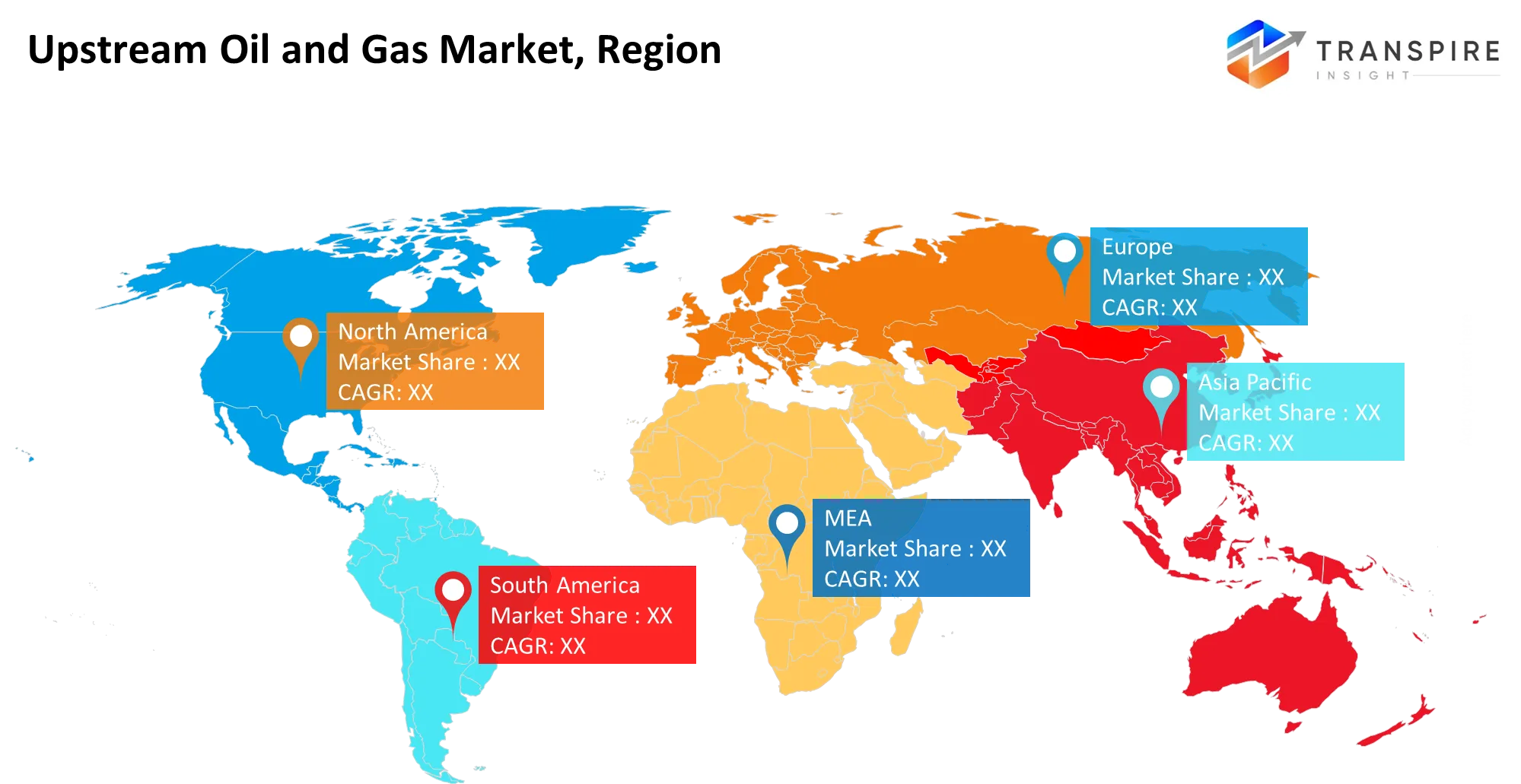
Middle East and Africa lead the upstream oil and gas market due to the presence of very economical conventional resources, significant investment plans by NOCs, and matured export infrastructure available in the region. Middle East and Africa hold the major share of 34.20% owing to the ability to produce the highest volumes at the lowest unit operating costs, increasing gas and LNG capacity, favourable policies for resource monetisation, long-term supply arrangements, and mature port, pipeline, and processing infrastructure. Additionally, deploying artificial intelligence in drilling fleets resulted in more reliable and cost-efficient units to operate.
In July 2026, the Abu Dhabi National Oil Company (ADNOC) announced a final investment decision (FID) of $6.2 billion to develop the Umm Shaif Gas Cap alongside partners TotalEnergies, Eni, and China National Petroleum Corporation.https://www.adnoc.ae/en/news-and-media/press-releases/2026/adnoc-accelerates-gas-growth-strategy-with-62-billion-fid-for-umm-shaif-gas-cap
North America 28.00% due to shorter-cycle shale and tight-resource business model South America 7.80% due to greater demand diversity and alternative supply sources Low-cost labour means long-term non-operated capital can be used to fund short-term fluctuating activity levels Asia Pacific 20.00% only economic in a high-price environment High diversity of energy and demand sources Energy security remains a key issue Europe 10.00% Low-cost labour enables non-operated capital to fund fluctuations through the cycle but at lower rate than North America.
In October 2026, Crescent Energy entered into a definitive agreement to acquire Devon Energy's Eagle Ford assets for $3.85 billion. This action expands Crescent's position in South Texas by adding approximately 68,000 barrels of oil equivalent per day of production and more than 600 Tier 1 net drilling locations adjacent to its existing operations.https://www.worldoil.com/news/2026/10/8/crescent-energy-strikes-4-2-billion-deal-for-devon-s-eagle-ford-assets/
Asia Pacific accounts for 20.00% of the market and is the fastest-growing region at a 6.30% CAGR, driven by energy-security concerns, rising industrial power demand, and greater investment in domestic gas and offshore resources. The region’s heavy reliance on imported Middle Eastern oil and gas has increased the strategic value of local upstream development. Future opportunities lie in offshore exploration, LNG-linked gas projects, and digital field modernisation, particularly where governments are encouraging investment to reduce import dependence.
In October 2026, Air Products partnered with PG Cold Energy 1 Sdn. Bhd. (a joint venture led by PETRONAS Gas Berhad and DIALOG Group Berhad) to design, build, and operate a new LNG-based air separation unit at the Pengerang LNG regasification terminal in Johor.https://www.lngindustry.com/regasification/13102026/air-products-to-supply-lng-based-air-separation-unit-for-petronas-gas-berhad-led-jv/
Who are the Key Players in the Upstream Oil and Gas Market, and how do they compete?
The key areas of competition for the oil and gas industry are based on reserves quality, production costs, project delivery, technological capabilities, and capital access. Based on the resource endowment and integrated system, Saudi Aramco, ADNOC and Qatar Energy have been given the priority of increasing their capacity; Exxon Mobil and Chevron seek high return assets, disciplined capital expenditure, and large-scale resource development; Conoco Phillips focuses on portfolio optimization and resource-driven growth; Shell and Total Energies combine offshore operating expertise with selective portfolio management; BP is conducting strategic review; Equinor has competitive offshore engineering as well as efficiency; Petrobras builds strength through its latest pre-salt and deepwater experience, while Eni expands ly through strategic partnerships and selective acquisitions including its participation in Vaca Muerta in Argentina; SLB, Halliburton and Baker Hughes focus on advanced technologies rather than reserve assets, with digital drilling service agreement by Total Energies in 2026, AI and field execution made one, BHR' s new wireline and production proposals made two. This reveals that within the industry, scale growth is increasingly driven by partnerships, acquisitions, and digital optimization, or technically differentiated assets with high recovery factor and controlled capital exposure.
Key Players are:
- Saudi Aramco
- ExxonMobil
- Chevron
- Shell
- BP
- TotalEnergies
- Equinor
- ConocoPhillips
- Eni
- Petrobras
- ADNOC
- QatarEnergy
- SLB
- Halliburton
- Baker Hughes
Upstream Oil and Gas Market — Enhanced Competitive Benchmarking
|
Company |
Est. Revenue Share Range |
Key Offerings |
Strategic Positioning |
Geographic Strength |
Technology Focus |
|
Saudi Aramco |
Estimated 8-12% |
Crude oil production, natural gas, offshore development, unconventional gas |
Low-cost production at exceptional scale |
Middle East, Asia Pacific |
Reservoir optimisation and intelligent field automation |
|
China National Petroleum Corporation (CNPC) |
Estimated 4-8% |
Conventional oil, natural gas, shale resources, overseas exploration |
State-backed scale with integrated upstream capabilities |
Asia Pacific, Central Asia, Middle East |
Seismic imaging and digital reservoir management |
|
ExxonMobil |
Estimated 3-5% |
Deepwater production, Permian shale, LNG-linked gas production, offshore developments |
Capital-efficient growth through advantaged assets |
North America, South America, Asia Pacific |
Advanced drilling and integrated reservoir modelling |
|
Chevron |
Estimated 2-4% |
Shale production, deepwater oil, natural gas, offshore field development |
High-return assets and disciplined project execution |
North America, South America, Asia Pacific |
Advanced completions and digital production optimisation |
|
Shell |
Estimated 2-4% |
Offshore oil and gas, deepwater projects, conventional production, gas resources |
Selective investment in competitive, higher-margin basins |
Europe, Africa, South America |
Subsea systems and data-driven asset optimisation |
|
ADNOC |
Estimated 2-4% |
Onshore oil, offshore production, natural gas, unconventional resources |
National resource development with capacity expansion |
Middle East, Asia Pacific |
AI-enabled operations and intelligent drilling |
|
QatarEnergy |
Estimated 2-4% |
Natural gas production, condensate, offshore exploration, North Field development |
Large-scale gas resource development and export integration |
Middle East, Asia Pacific |
Reservoir modelling and offshore gas development |
|
TotalEnergies |
Estimated 1.5-3% |
Deepwater production, conventional oil, natural gas, offshore developments |
Diversified international portfolio with selective upstream investment |
Africa, Europe, Middle East |
Subsea engineering and predictive asset maintenance |
|
Petrobras |
Estimated 1.5-3% |
Pre-salt oil, deepwater production, FPSO-based developments, associated gas |
Deepwater specialisation and high-productivity offshore assets |
South America, Africa |
Ultra-deepwater engineering and high-pressure production |
|
CNOOC |
Estimated 1-2.5% |
Offshore crude oil, offshore natural gas, deepwater exploration, subsea developments |
Offshore-focused growth supported by domestic resource development |
Asia Pacific, Africa, South America |
Deepwater drilling and subsea production systems |
Recent Development News
- In September 2026, Vedanta Oil & Gas partnered with Beicip-Franlab India to accelerate exploration, subsurface evaluation, and production development across its Northeast India portfolio. The collaboration covers nine OALP blocks and one DSF block, aiming to identify new drilling prospects and unlock up to 300 million barrels of oil equivalent in resources and reserves.https://www.vedantaoilandgas.com/pressrelease/vedanta-oil-gas-partners-with-beicip-franlab-to-accelerate-exploration-and-production-growth-in-the-northeast/
- In September 2026, Comstock Resources announced a proposed $1.65 billion strategic partnership with SOCAR involving non-operated interests in its Haynesville upstream assets and related gas infrastructure. The proposed transaction is intended to strengthen Comstock's balance sheet, support further natural gas development, and improve access to international gas marketing opportunities.https://investors.comstockresources.com/news-releases/news-release-details/comstock-announces-165-billion-strategic-partnership-socar-and
- In October 2026, Cenovus Energy agreed to acquire Athabasca Oil in a C$5.7 billion cash-and-stock transaction. The acquisition is expected to add approximately 45,000 barrels of oil equivalent per day to Cenovus's thermal oil sands production, expand its upstream resource base, and create opportunities to accelerate future development projects.https://www.reuters.com/business/energy/cenovus-buy-athabasca-oil-57-billion-cash-and-stock-deal-2026-10-05/
What Strategic Insights Define the Future of the Upstream Oil and Gas Market?
The industry is on the path towards selective resource development, digitally-enabled operations, and better control of project economics. Operators that can deliver the most attractive wells, optimally resourced, and in the best locations, are better prepared to weather swings in commodity prices. Hidden herein is the risk posed by the growing correlation of production systems, digital platforms, and key export routes; a cyberattack or geopolitical event could severely impair these otherwise profitable assets. At the same time, seismic computing, automated drilling, and deepwater gas developments are uncovering techniques to improve recovery and commercialise what are now unaffordable/unprofitable reserves. Aramco's 2026 supercomputing rollout and SLB's digital drilling pact with TotalEnergies underscore how digital is becoming central to core upstream decisions.
From a strategic perspective, portfolio value is driven by resilient project breakevens, methane detection during operations, and the use of strategic alliances to share technical and financial risk. Investment must be weighed carefully for near-term cash flow and long-term resource replacement/infrastructure survivability.
Key Segmentations are:
Activity
- Exploration
- Drilling
- Well Completion
- Production
- Well Intervention
- Enhanced Oil Recovery
- Oilfield Services
- Asset Management
Resource Type
- Conventional Oil
- Conventional Gas
- Shale Oil
- Shale Gas
- Tight Oil
- Tight Gas
- Coalbed Methane
- Deepwater Resources
Well Type
- Onshore Wells
- Offshore Wells
- Deepwater Wells
- Ultra-Deepwater Wells
- Horizontal Wells
- Vertical Wells
- Multilateral Wells
Technology
- Seismic Imaging
- Directional Drilling
- Hydraulic Fracturing
- Digital Oilfield
- Artificial Lift
- Enhanced Oil Recovery
- Subsea Technology
- Well Automation
Service
- Drilling Services
- Completion Services
- Production Services
- Well Testing
- Logging & Measurement
- Cementing
- Stimulation
- Well Maintenance
Operator Type
- National Oil Companies
- International Oil Companies
- Independent Producers
- Private Operators
- Oilfield Service Companies
- Government Operators
- Joint Ventures
By Regional Analysis
North America
- US
- Canada
- Mexico
Europe
- Germany
- UK
- France
- Italy
- Spain
- Russia
- Rest of Europe
Asia Pacific
- China
- Japan
- India
- South Korea
- Australia
- Rest of Asia Pacific
South America
- Brazil
- Argentina
- Rest of South America
Middle East & Africa
- UAE
- Saudi Arabia
- Qatar
- South Africa
- Rest of the Middle East & Africa
Frequently Asked Questions
Find quick answers to common questions.
The upstream oil and gas market size was valued at USD 4.43 trillion in 2025 and is poised to reach USD 6.18 trillion by 2033, expanding at a 4.24% CAGR.
Key segments for the upstream oil and gas market are Activity (Exploration, Drilling, Well Completion, Production, Well Intervention, Enhanced Oil Recovery, Oilfield Services, Asset Management); Resource Type (Conventional Oil, Conventional Gas, Shale Oil, Shale Gas, Tight Oil, Tight Gas, Coalbed Methane, Deepwater Resources); Well Type (Onshore Wells, Offshore Wells, Deepwater Wells, Ultra-Deepwater Wells, Horizontal Wells, Vertical Wells, Multilateral Wells); Technology (Seismic Imaging, Directional Drilling, Hydraulic Fracturing, Digital Oilfield, Artificial Lift, Enhanced Oil Recovery, Subsea Technology, Well Automation); Service (Drilling Services, Completion Services, Production Services, Well Testing, Logging & Measurement, Cementing, Stimulation, Well Maintenance); Operator Type (National Oil Companies, International Oil Companies, Independent Producers, Private Operators, Oilfield Service Companies, Government Operators, Joint Ventures).
Growth is primarily driven by energy security priorities, offshore exploration investments, mature-field redevelopment, advanced drilling technologies, digital oilfield adoption, and rising investment in domestic hydrocarbon production.
The upstream oil and gas market is led by major manufacturers, including Saudi Aramco, ExxonMobil, Chevron, Shell, BP, TotalEnergies, Equinor, ConocoPhillips, Eni, Petrobras, ADNOC, QatarEnergy, SLB, Halliburton, and Baker Hughes.
The Middle East & Africa holds a 34.20% market share, supported by abundant hydrocarbon reserves, established export infrastructure, national energy investment programmes, and large-scale production capabilities.
Key opportunities include AI-enabled drilling optimisation, deepwater exploration, enhanced oil recovery, methane monitoring, and digital solutions that improve production efficiency and reduce operating costs.
- Saudi Aramco
- ExxonMobil
- Chevron
- Shell
- BP
- TotalEnergies
- Equinor
- ConocoPhillips
- Eni
- Petrobras
- ADNOC
- QatarEnergy
- SLB
- Halliburton
- Baker Hughes
About the Authors

Avinash Kumar
I’m Avinash Kumar, a Senior Research Analyst at Transpire Insight, with expertise in the Electronics and Semiconductor and Energy & Power industry. My work focuses on analyzing emerging technologies, market trends, industry developments, and innovation across these sectors. I specialize in transforming complex technical and market insights into clear, research-backed content that helps professionals, businesses, and decision-makers stay informed. Through continuous industry research and data-driven analysis, I strive to deliver accurate, reliable, and practical perspectives on the latest advancements shaping the semiconductor and energy landscape.

Chakradhar Khansole
Chakradhar serves as the Research Director at Transpire Insight, bringing over 8 years of experience in technology, innovation, and strategic market intelligence. He specializes in transforming complex market data into actionable business insights that enable organizations to make informed, growth-oriented decisions. Recognized for his strategic vision and analytical expertise, Chakradhar leads high-impact research initiatives, delivering comprehensive market assessments, competitive intelligence, and forward-looking industry analysis.
Recently Published Reports
-
Apr 2026
Active Power Filter Market
Active Power Filter Market Size, Share & Analysis Report By Type (Shunt Active Power Filters, Series Active Power Filter, Hybrid Active Power Filter), By Application (Harmonics Mitigation, Reactive Power Compensation, Voltage Regulation, Power Factor Correction), By Phase (Single Phase, Three Phase), By End-User Industry (Manufacturing, Healthcare, Commercial, Automotive, Oil and Gas, Others), and Geography (North America, Europe, Asia-Pacific, Middle East and Africa, South and Central America), 2021 - 2031
-
Apr 2026
Electrical Transformer Market
Electrical Transformer Market Size, Share & Analysis Report By Core (Closed, Shell, and Berry), By Insulation (Gas, Oil, Solid, Air, and Other), By Phase (Single, and Three), By Rating (100 MVA to 500 MVA, 501 MVA to 800 MVA, and 801 MVA to 1200 MVA), and Geography (North America, Europe, Asia-Pacific, Middle East and Africa, South and Central America), 2021 – 2031
-
Apr 2026
Hydraulic Piston Pumps Market
Hydraulic Piston Pumps Market Size, Share & Analysis Report By Type (Axial Piston Pumps, Radial Piston Pumps), By Operating Pressure (Low Pressure, Medium Pressure, High Pressure), By Application (Construction, Mining, Agriculture, Automotive, Oil & Gas, Industrial Machinery, Others), By End-User (OEMs, Aftermarket), and Geography (North America, Europe, Asia-Pacific, Middle East and Africa, South and Central America), 2021 – 2031
-
Apr 2026
Laboratory Gas Generators Market
Laboratory Gas Generators Market Size, Share & Analysis Report By Product (Nitrogen Gas Generator, Hydrogen Gas Generator, Zero Air Gas Generator, Purge Gas Generator, TOC Gas Generators, Others), By Application (Gas Chromatography, Liquid Chromatography-mass Spectrometry (LC-MS), Gas Analyzers, Others), By End-user (Life Science, Chemical & Petrochemical, Food & Beverage, Others), and Geography (North America, Europe, Asia-Pacific, Middle East and Africa, South and Central America), 2021 – 2031