
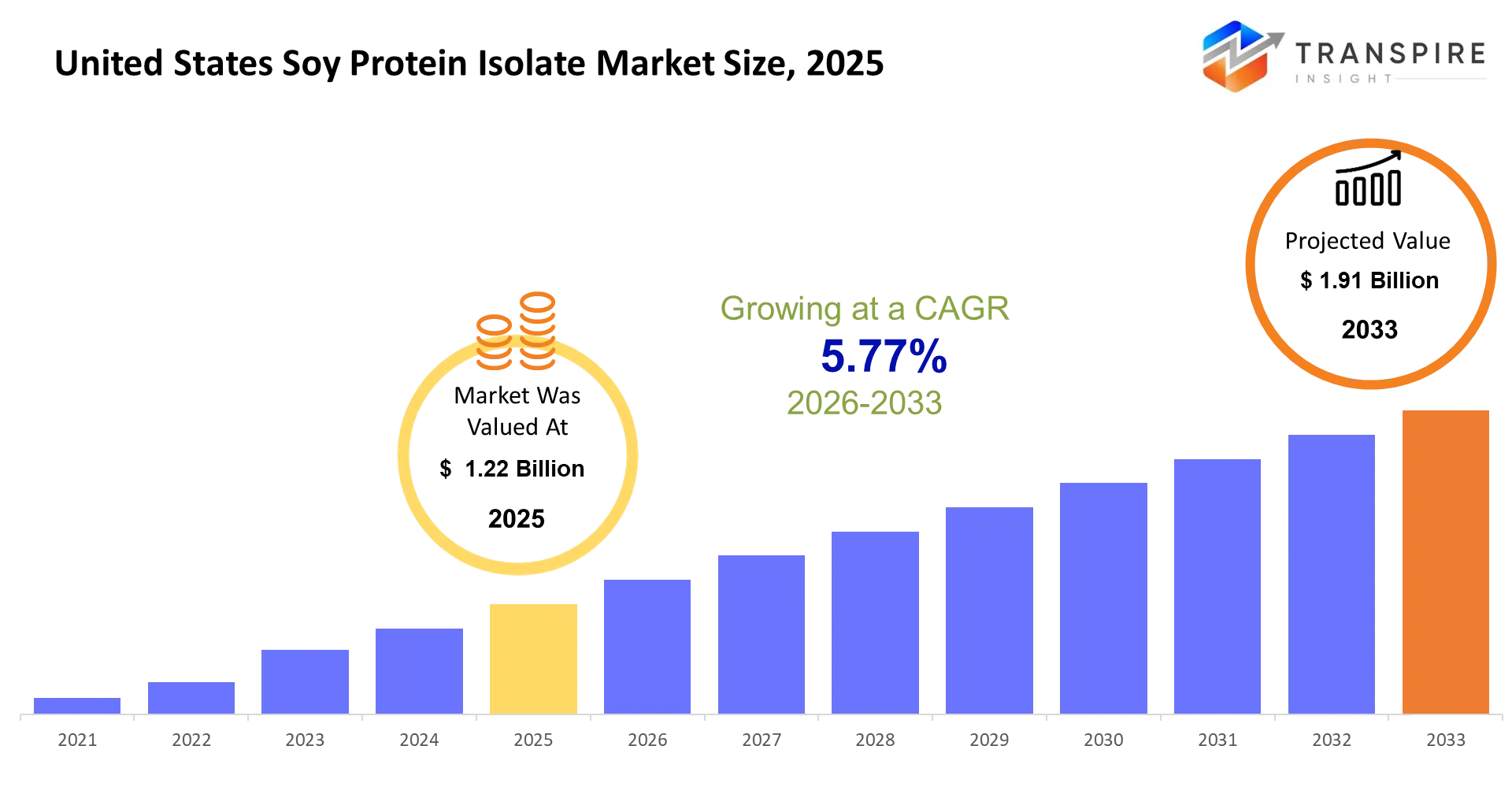
United States Soy Protein Isolate Market Size & Forecast:
- United States Soy Protein Isolate Market Size 2025: USD 1.22 Billion
- United States Soy Protein Isolate Market Size 2033: USD 1.91 Billion
- United States Soy Protein Isolate Market CAGR: 5.77%
- United States Soy Protein Isolate Market Segments: By Type (Organic SPI, Conventional SPI, Textured SPI, Hydrolyzed SPI, Non-GMO SPI, Others); By Application (Food & Beverages, Sports Nutrition, Animal Feed, Pharmaceuticals, Cosmetics, Others); By End-User (Food Industry, Pharma, Fitness Industry, Retail, Industrial, Others); By Form (Powder, Liquid, Granules, Blends, Capsules, Others)
To learn more about this report,  Download Free Sample Report
United States Soy Protein Isolate Market Summary
The United States Soy Protein Isolate Market was valued at USD 1.22 Billion in 2025. It is forecast to reach USD 1.91 Billion by 2033. That is a CAGR of 5.77% over the period.
In the United States, the Soy Protein Isolate market works like a critical “input” for food manufacturers, kind of a baseline necessity, that have to lift protein levels while still keeping cost and texture under control in things such as meat alternatives, dairy substitutes, ready-to-drink nutrition beverages, and packaged baked goods. It lets processors swap out more expensive animal proteins, without losing binding, emulsification, or that specific mouthfeel consumers expect. This, in turn, keeps large-scale product rework moving in the food industry, because reformulation becomes less risky and more manageable.
Over the past 3–5 years, the market has been shifting in a more structural way toward plant-based formulation systems, backed by better aqueous extraction plus membrane filtration methods that bring out higher purity protein fractions. A big trigger was the COVID-19 supply chain disruption, which showed how shaky dairy and egg protein availability could get, including pricing swings. That pressure then encouraged manufacturers to secure more stable, soy-derived feedstocks for their lines. Adoption has really picked up since then , because SPI offers dependable sourcing, fits clean-label positioning efforts, and lowers reliance on animal-protein markets. So it keeps strengthening its position inside industrial food manufacturing strategies, even when demand conditions change.
Key Market Insights
- The United States Soy Protein Isolate Market looks like it has really strong industrial adoption, and this is pulled along by plant-based food innovation. Also, protein fortification keeps showing up across most packaged food systems, kind of steadily, not stopping.
- Market growth is also backed up by 2025 forecast demand expansion, especially in meat alternatives and dairy substitutes, plus sports nutrition use, nationwide.
- The Midwest ends up dominating the United States Soy Protein Isolate Market, with about 38% share in 2025 because the soybean processing infrastructure there is solid, and not just a little, it’s broad.
- Meanwhile the West Coast is emerging as the fastest-growing region through 2032, driven by plant-based food startups. Along with that, vegan consumer clusters in the area add extra momentum too.
- Powdered soy protein isolate takes the lead with a 52% share, mainly because it stays stable and is used a lot in industrial food formulation, regularly.
- Functional food-grade isolate ranks second, and it’s widely used in nutrition beverages and in bakery protein enrichment systems as well.
- Textured isolate seems like the fastest-growing segment into 2030, powered by meat analogs and a hybrid protein innovation trend, that is kind of everywhere.
- Meat alternatives still take the lead with a 44% share in the United States Soy Protein Isolate Market, largely because protein substitution is being asked for, pretty quickly.
- Sports nutrition is showing the quickest rise too, backed by an upturn in fitness culture, and the steady push for high-protein dietary consumption.
- Meanwhile the food processing industry holds the biggest part at 57% , using soy protein isolate in big scale product reformulation, basically to keep output consistent.
What are the Key Drivers, Restraints, and Opportunities in the United States Soy Protein Isolate Market?
The main driver is this fast, kinda messy reformulation of packaged food and beverage products into high-protein, plant-based alternatives. It started because animal proteins saw a lot of price volatility that just kept going ,and then got worse after 2020 when supply chains were disrupted. That disruption sort of exposed dependency risks in dairy and egg protein sourcing. As manufacturers started leaning on cost-stable plant inputs, soy protein isolate got a lot more traction, not just because it works but because it delivers steady amino acid profiles and solid functional performance for emulsification and texture binding. So yeah, this directly raises procurement volumes from big food processors, which supports steady industrial demand ,and that in turn helps ingredient suppliers keep more stable revenue.
The key restraint is more about how people perceive soy as an allergen, plus how sensitive labeling becomes. It feels like a structural barrier since it links back to regulatory labeling frameworks and also long-term consumer dietary restrictions, not really to short-term market cycles. Because of that, a bunch of product developers avoid full substitution with soy protein isolate. They usually do partial changes and they stay away from it in certain clean-label and allergen-free product lines. This ends up suppressing revenue expansion, especially in premium health-focused segments where expectations are stricter.
One major opportunity is showing up in precision fermentation and hybrid protein systems, where soy protein isolate is blended with microbial sources or pea protein bases. The idea is to improve texture, and also balance amino profiles in a more controlled way. Early adoption is already visible in U.S. alternative protein startups, especially around California ,where pilot-scale facilities are scaling hybrid meat analog formulations aimed at retail expansion.
What Has the Impact of Artificial Intelligence Been on the United States Soy Protein Isolate Market?
Artificial intelligence, and advanced digital technologies are kind of reshaping how operational efficiency works, and how quality control behaves within the United States Soy Protein Isolate Market, especially across processing, formulation, and the supply chain management side. In today’s soy protein isolate production plants, AI driven automation is used more and more to tune extraction variables like temperature, pH balance, and membrane filtration cycle timing. The goal is less manual forcing inside scrubber-like process control loops, and in turn, better consistency in protein purity, along with steadier functional performance from batch to batch, for products that end up in food and beverage manufacturing.
Also, machine learning models are now commonly deployed for preventative maintenance of high pressure filtration equipment, as well as centrifugation systems. They read vibration signals, throughput patterns, and energy consumption trends, then forecast how equipment will slowly degrade. This reduces the chance of surprise stoppages, and in advanced facilities it can push operational uptime up by roughly 10–15% . On top of that, AI based demand forecasting tools help coordinate raw soybean sourcing and inventory timing, which cuts holding expenses while still improving supply dependability for bigger processors.
From an operational angle, these digital tools improve energy efficiency within protein extraction lines, and they also support tighter compliance with food safety and quality requirements through real time anomaly detection. Still, adoption is not as wide as you’d expect because integration can be expensive, and many mid-sized plants run on fragmented legacy infrastructure. Plus, some sites struggle with data standardization, so model performance suffers, and deployment becomes slower across the United States Soy Protein Isolate Market. There’s also a knock on effect for related marine emission control style process monitoring systems used in industrial food production, where consistency of data is basically everything.
Key Market Trends
- After 2021, many manufacturers kinda shifted from the usual soy concentrates to high-purity isolates, and that helped a lot with texture control in plant based meat systems.
- From 2022 to 2025, food processors started leaning more on automated membrane filtration, and overall batch variability went down by almost 12 percent , which is pretty notable I guess.
- In 2023, demand patterns moved toward hybrid protein formulations , and companies combined soy with pea plus fermentation based proteins.
- Then in 2024, big buyers cut animal protein procurement by double digits, so the swap toward soy protein isolate in packaged foods really accelerated.
- Also, the supply chain volatility after 2020 basically pushed processors to lock in long term soybean contracts, so input pricing stayed more stable across the United States Soy Protein Isolate Market.
- By 2025, Archer Daniels Midland and Cargill expanded enzyme assisted extraction capacity , aiming to boost protein yield efficiency and at the same time reduce energy consumption.
- On top of that, regulatory emphasis on clean-label transparency in 2023 forced reformulation of more than 18 percent of U.S. protein beverage products using soy isolates.
- Since 2024, AI enabled predictive maintenance systems have been adopted in multiple places, and they reduced unplanned processing downtime by something like 10 to 15 percent within advanced soy processing facilities.
- Lastly, competitive strategy shifted into regional expansion across North America, with firms giving extra priority to Midwest processing hubs for soybean sourcing efficiency , and that seems to be the play they kept returning to.
United States Soy Protein Isolate Market Segmentation
By Type :
Organic soy protein isolate is going to keep growing, kind of, because demand is going up for clean-label and chemical-free protein sources in food and nutrition products. Traditional SPI will probably still keep a big share too, mainly due to broad availability, and a cost advantage. Textured SPI will be pulled into meat alternatives, while hydrolyzed SPI will support faster uptake in nutrition and health oriented products.
Non-GMO soy protein isolate will see consistent demand as people lean toward ingredients that feel natural and traceable in everyday meals. Other forms will cover blended or customized protein setups used for specific industrial needs. In general, each type ends up backing different usage habits across food, sports nutrition and processed product segments, depending on texture, digestibility, and how the formula is built
By Application :
Food and beverages should stay as the leading application, largely because soy protein isolate is being used more in bakery, dairy alternatives, and processed foods. Sports nutrition will likely grow strongly, since protein supplements and performance products keep expanding among fitness focused consumers. Animal feed should also stay steady, because it’s a cost-effective way to add protein enrichment.
Pharmaceutical uses will rely on soy protein isolate for nutritional supplements and functional health products. Cosmetics will start adopting soy based ingredients for skin, and hair care formulations, given the protein benefits there. Other areas will include special industrial and nutritional uses where plant-based protein support is needed, which helps the market reach stretch across multiple end-use industries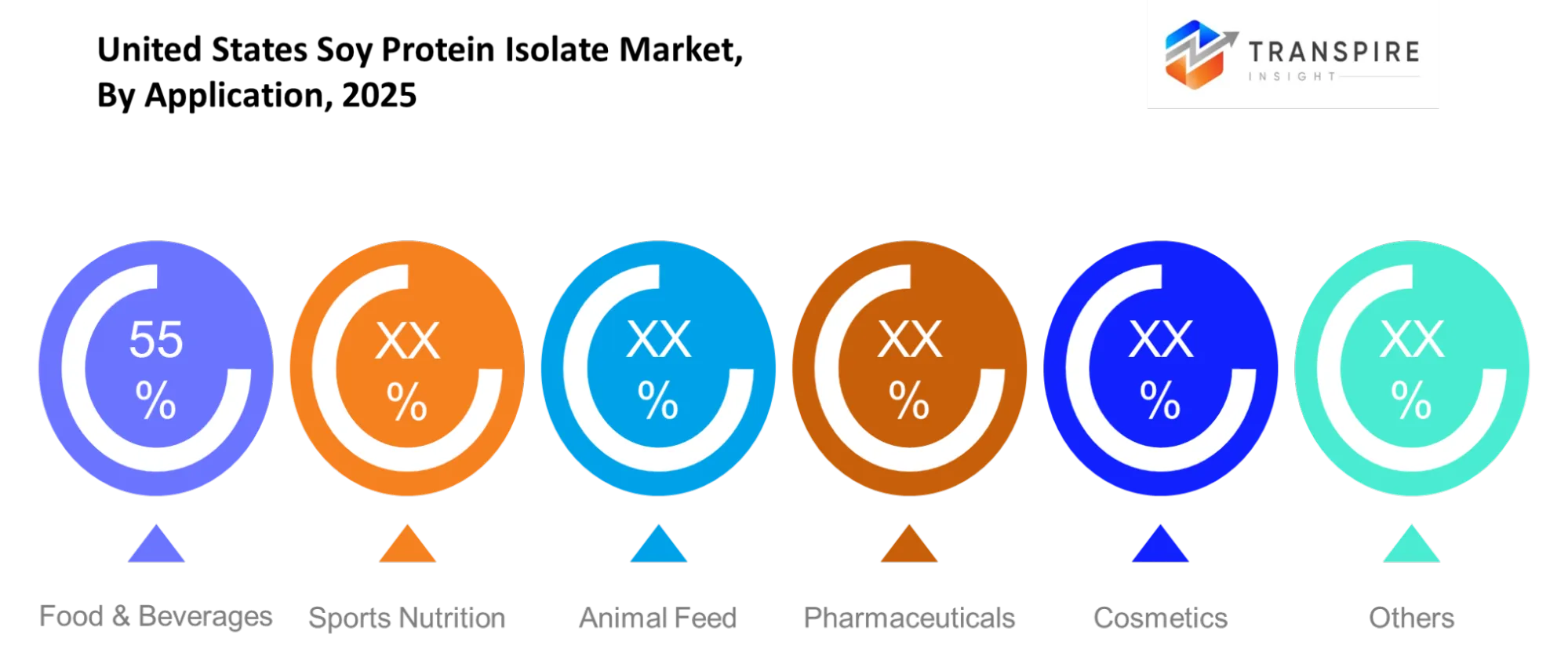
To learn more about this report, Download Free Sample Report
By End-User :
The food industry will basically dominate the usage of soy protein isolate because of a strong demand for plant based inputs in processed foods and ready to eat products. The Pharma segment will also lean on it for supplement formulation and medical nutrition. Meanwhile the fitness world should keep expanding, since the protein intake habit is rising among athletes and more active consumers .
Retail will chip in via packaged protein goods and health supplements , moving through supermarkets and online marketplaces. Industrial buyers will cover big scale food manufacturers and ingredient processors. The other end users, meaning institutional catering outfits and specialty nutrition businesses, also need a reliable protein source for different product development goals, not just one type.
By Form :
In terms of form, powder will stay the most commonly selected, mostly because it mixes easy, keeps a long shelf life and works well across foods, drinks, and supplement categories. Liquid soy protein isolate will show up in ready to drink mixtures and in processed food cases where quick blending is required. Granules on the other hand will back up certain food processing needs.
Blends will take soy protein isolate together with other plant proteins, this is done to lift nutrition quality and improve texture in food items. Capsules will be used within dietary supplements for measured dosing and everyday convenience. Basically each format serves slightly different manufacturing realities and consumer habits, based on product type, processing approach, and how people actually prefer to consume it.
What are the Key Use Cases Driving the United States Soy Protein Isolate Market?
In the United States Soy Protein Isolate Market the dominant use case sort of stays on the meat alternative side, especially when it comes to large scale food processing. Manufacturers end up using soy protein isolate in meat analog formulations, because it helps mimic binding, juiciness and texture in plant-based burgers, sausages, and also ready meals. That kind of performance is what keeps the industrial demand steady, and yes it stays pretty consistent.
At the same time, expanding applications run into protein fortified beverages and bakery enrichment formats. Nutraceutical companies and functional food producers take these products up, mainly to elevate the protein content without wrecking shelf stability or making the flavor drift. It shows up a lot across high-protein sports nutrition and meal replacement categories, where taste consistency matters as much as the macro value.
For what is emerging, there are hybrid protein systems and personalized nutrition offerings. In these, soy protein isolate is often blended with fermentation-derived proteins or precision fermented ingredients. A few early-stage food tech firms, and some clinical nutrition developers, are actively testing these blends, aiming for metabolic health, and more tailored dietary solutions, during the forecast period.
|
Report Metrics |
Details |
|
Market size value in 2025 |
USD 1.22 Billion |
|
Market size value in 2026 |
USD 1.29 Billion |
|
Revenue forecast in 2033 |
USD 1.91 Billion |
|
Growth rate |
CAGR of 5.77% from 2026 to 2033 |
|
Base year |
2025 |
|
Historical data |
2021 - 2024 |
|
Forecast period |
2026 - 2033 |
|
Report coverage |
Revenue forecast, competitive landscape, growth factors, and trends |
|
Geographic scope |
United States of America |
|
Key company profiled |
ADM, Cargill, DuPont, Kerry Group, Wilmar, Fuji Oil, CHS, Burcon NutraScience, Shandong Yuwang, Crown Soya Protein, Sonic Biochem, NOW Foods, Gushen Biotechnology, Scoular, Bunge |
|
Customization scope |
Free report customization (country, regional & segment scope). Avail customized purchase options to meet your exact research needs. |
|
Report Segmentation |
By Type (Organic SPI, Conventional SPI, Textured SPI, Hydrolyzed SPI, Non-GMO SPI, Others); By Application (Food & Beverages, Sports Nutrition, Animal Feed, Pharmaceuticals, Cosmetics, Others); By End-User (Food Industry, Pharma, Fitness Industry, Retail, Industrial, Others); By Form (Powder, Liquid, Granules, Blends, Capsules, Others) |
Which Regions are Driving the United States Soy Protein Isolate Market Growth?
The Midwest is basically leading the United States Soy Protein Isolate Market , mostly because it has a dense soybean processing setup, plus it is close to the zones where raw materials are grown. In practice, strong farm infrastructure across states like Iowa and Illinois keeps a steady flow of soybeans going for big extraction facilities. There are also established processing pockets that help with integrated crushing , refining, and protein isolation workflows , and this tends to cut down shipping frictions, while boosting overall output efficiency. With that kind of ecosystem in place, companies can keep production volumes more stable, for food and beverage uses , without too many swings.
The West Coast is usually seen as the second major region, but the logic there is different. It is not really raw-material nearness that drives the momentum so much as demand-side innovation, and product experimentation in the food world. California and Washington back a fairly mature plant based food industry, helped along by venture capital, and by advanced food technology firms that keep pushing upgrades. Compared with the Midwest’s supply-first approach, this area leans on quick product iteration cycles and a more premium consumer slice. It also benefits from firm regulatory oversight around clean-label language, and nutrition transparency, which makes adoption smoother across many packaged food and beverage categories.
Meanwhile the Northeast is the fastest-growing corner, largely tied to a rapid uptick in health oriented retail buying and institutional nutrition programs. More recently, investments in cold chain logistics, and urban food innovation hubs have improved distribution speed for protein enriched offerings. Since 2023, hospitals, universities, and corporate wellness efforts have ramped up procurement of soy based protein solutions . Overall, this trajectory points to solid opportunities for new entrants aiming at high-density cities, with premium nutrition focused applications through 2033.
Who are the Key Players in the United States Soy Protein Isolate Market and How Do They Compete?
The United States Soy Protein Isolate Market feels kinda moderately consolidated, not total chaos , but also not fully locked up. There’s this small cluster of multinational ingredient processors that grabs a big chunk of the pie through vertically integrated supply chains and those long term arrangements with food manufacturers. What really moves the competition is mostly production efficiency, keeping protein purity consistent, and formulation functionality, not price alone maybe. Big incumbents are staying put, even pushing ahead, by scaling capacity and tightening up relationships with major packaged food and nutrition brands, while smaller innovators seem to aim at niche plant-based use cases and specialty nutrition applications… kind of more specific.
Archer Daniels Midland uses a cost leadership approach, basically it leans on its Midwest crushing and refining network to pull raw soybean supply at lower input volatility. Because it’s integrated from grain sourcing through isolated production, it can keep its pricing steadier, and it signs those large-volume contracts for global food processors. Cargill tends to emphasize supply chain resilience and broad global procurement strength, with diversified sourcing and joint ventures alongside plant-based food manufacturers, which helps smooth out demand cycles. That, in turn, supports its position in large institutional and multinational buyer agreements.
DuPont differentiates by enzyme-assisted processing technologies, which help improve protein functionality especially for emulsification and texture-sensitive applications. Kerry Group sort of grows by formulation led innovation, and it also leans on acquisitions linked with nutrition science, so they can set up bespoke protein systems for beverage brands and health food producers. Roquette , for its part, doubles down by putting money into hybrid plant protein portfolios and pushing out production capacity for alternative protein mixes, all to reach the next generation of meat analog products.
Company List
- ADM
- Cargill
- DuPont
- Kerry Group
- Wilmar
- Fuji Oil
- CHS
- Burcon NutraScience
- Shandong Yuwang
- Crown Soya Protein
- Sonic Biochem
- NOW Foods
- Gushen Biotechnology
- Scoular
- Bunge
Recent Development News
In March 2026, Bunge Global SA announced the completion of its acquisition of International Flavors & Fragrances (IFF)’s soy protein concentrate, lecithin, and soy crush businesses. The transaction strengthens Bunge’s U.S. and global plant-protein portfolio by expanding its capacity in textured and functional soy protein ingredients used across bakery, meat alternatives, and nutrition applications. Source https://www.nasdaq.com/
In May 2026, Bunge Global SA inaugurated a new soy protein concentrate facility in Morristown, Indiana, marking the first food-grade plant of its kind built in the United States in over 40 years. The plant expands domestic production capacity for high-purity soy protein concentrates, improving supply security for U.S. food and alternative protein manufacturers.
Source https://www.feedandgrain.com/
What Strategic Insights Define the Future of the United States Soy Protein Isolate Market?
The United States Soy Protein Isolate market is kind of moving, structurally speaking, toward more functional specialization rather than just volume-led expansion, because food manufacturers keep reformulating and plant-based proteins are getting more and more folded into mainstream packaged goods. Over the next 5–7 years, growth should be shaped by a shift away from plain single-ingredient substitution, toward engineered protein systems that blend soy isolates with supporting plant sources and fermentation-derived inputs. The goal is to get taste and texture parity with animal proteins , not only “enough” performance.
There’s also a quieter risk that’s easy to miss: protein substitution pressure from newer alternatives like precision-fermented whey and mycoprotein. These could slowly take away soy isolate’s edge in premium nutrition categories. And the pressure might get stronger because large processors are concentrating more and more of the supply chain, so supply decisions are becoming centralized which, then, can expose the market to tighter procurement leverage and pricing constraints.
On the opportunity side, an emerging opening is integrating soy protein isolate into climate-labeled and carbon-tracked supply chains, especially in institutional procurement programs across the United States. This is getting supported by early-stage sustainability reporting frameworks inside big foodservice contracts. Market participants should invest in hybrid protein R&D along with digital traceability systems, so they can maintain differentiation as procurement standards start prioritizing verified environmental performance, more than before.
United States Soy Protein Isolate Market Report Segmentation
By Type
- Organic SPI
- Conventional SPI
- Textured SPI
- Hydrolyzed SPI
- Non-GMO SPI
By Application
- Food & Beverages
- Sports Nutrition
- Animal Feed
- Pharmaceuticals
- Cosmetics
By End-User
- Food Industry
- Pharma
- Fitness Industry
- Retail
- Industrial
By Form
- Powder
- Liquid
- Granules
- Blends
- Capsules
Frequently Asked Questions
Find quick answers to common questions.
The United States Soy Protein Isolate Market size is USD 1.91 Billion in 2033.
Key Segments for the United States Soy Protein Isolate Market are By Type (Organic SPI, Conventional SPI, Textured SPI, Hydrolyzed SPI, Non-GMO SPI, Others); By Application (Food & Beverages, Sports Nutrition, Animal Feed, Pharmaceuticals, Cosmetics, Others); By End-User (Food Industry, Pharma, Fitness Industry, Retail, Industrial, Others); By Form (Powder, Liquid, Granules, Blends, Capsules, Others).
Major United States Soy Protein Isolate Market players are ADM, Cargill, DuPont, Kerry Group, Wilmar, Fuji Oil, CHS, Burcon NutraScience, Shandong Yuwang, Crown Soya Protein, Sonic Biochem, NOW Foods, Gushen Biotechnology, Scoular, Bunge.
The Current United States Soy Protein Isolate Market size is USD 1.22 Billion in 2025.
The United States Soy Protein Isolate Market CAGR is 5.77% from 2026 to 2033.
- ADM
- Cargill
- DuPont
- Kerry Group
- Wilmar
- Fuji Oil
- CHS
- Burcon NutraScience
- Shandong Yuwang
- Crown Soya Protein
- Sonic Biochem
- NOW Foods
- Gushen Biotechnology
- Scoular
- Bunge
Recently Published Reports
-
Apr 2026
Baby Infant Formula Market
Baby Infant Formula Market Size, Share & Analysis Report By ype (Infant Milk, Follow On Milk, Specialty Baby Milk, Growing-Up Milk), By Ingredient (Carbohydrate, Fat, Protein, Minerals, Vitamins, and Others), By Product Form (Powder, Liquid, and Ready-to-feed), By Distribution Channels (Supermarket/Hypermarket, Specialty Store, Pharmacies, Online Retail, and Others), and Geography (North America, Europe, Asia-Pacific, Middle East and Africa, South and Central America), 2021 - 2031
-
Apr 2026
Edible Insects for Animal Feed Market
Edible Insects for Animal Feed Market Size, Share & Analysis Report By Type (Insect Powder, Insect Meal, Insect Bar, Insect Paste, Insect Oil, and Others), By Insect Type (Beetles, Cricket, Caterpillar, Hymenoptera, Orthoptera, Tree Bugs, and Others), By Application (Livestock, Pet Food, and Aquaculture), By Livestock Type (Poultry, Swine, and Others), and Geography (North America, Europe, Asia-Pacific, Middle East and Africa, South and Central America), 2021 - 2031
-
Apr 2026
Food Industry Disinfection and Bacterial Control Market
Food Industry Disinfection and Bacterial Control Market Size, Share & Analysis Report By Type (Chemical Disinfectants, Physical Disinfectants, and Biocides and Antimicrobials), By Application (Food Processing Equipment Surface Disinfection, Food Preparation Areas Surface Disinfection, Storage Areas Surface Disinfection, Anti-microbial Coatings Food Preservation, and Preservative Solutions Food Preservation), By End User (Meat and Poultry Processing, Dairy Processing, Seafood Processing, Bakery and Confectionery, Restaurants and Commercial Kitchens, and Food Service Providers), By Sales Channel (Online, Offline), and Geography (North America, Europe, Asia-Pacific, Middle East and Africa, South and Central America), 2021 - 2031
-
Apr 2026
Freeze Dried Food Market
Freeze Dried Food Market Size, Share & Analysis Report By Product Type (Fruits, Vegetables, Freeze-Dried Dairy Products, Freeze-Dried Meat and Seafood, Freeze-Dried Pet Food, and Prepared Meal), By Nature (Organic, and Conventional), By Form (Powdered, Granules, and Diced), By End Use (Breakfast Cereals, Dairy Products, Bakery & Confectionery, Nutritional Bars & Supplements, Powdered Beverages, Snacks, and Retail (Household)), and Geography (North America, Europe, Asia-Pacific, Middle East and Africa, South and Central America), 2021 - 2031