
United States Functional Cosmetics Market Size & Forecast:
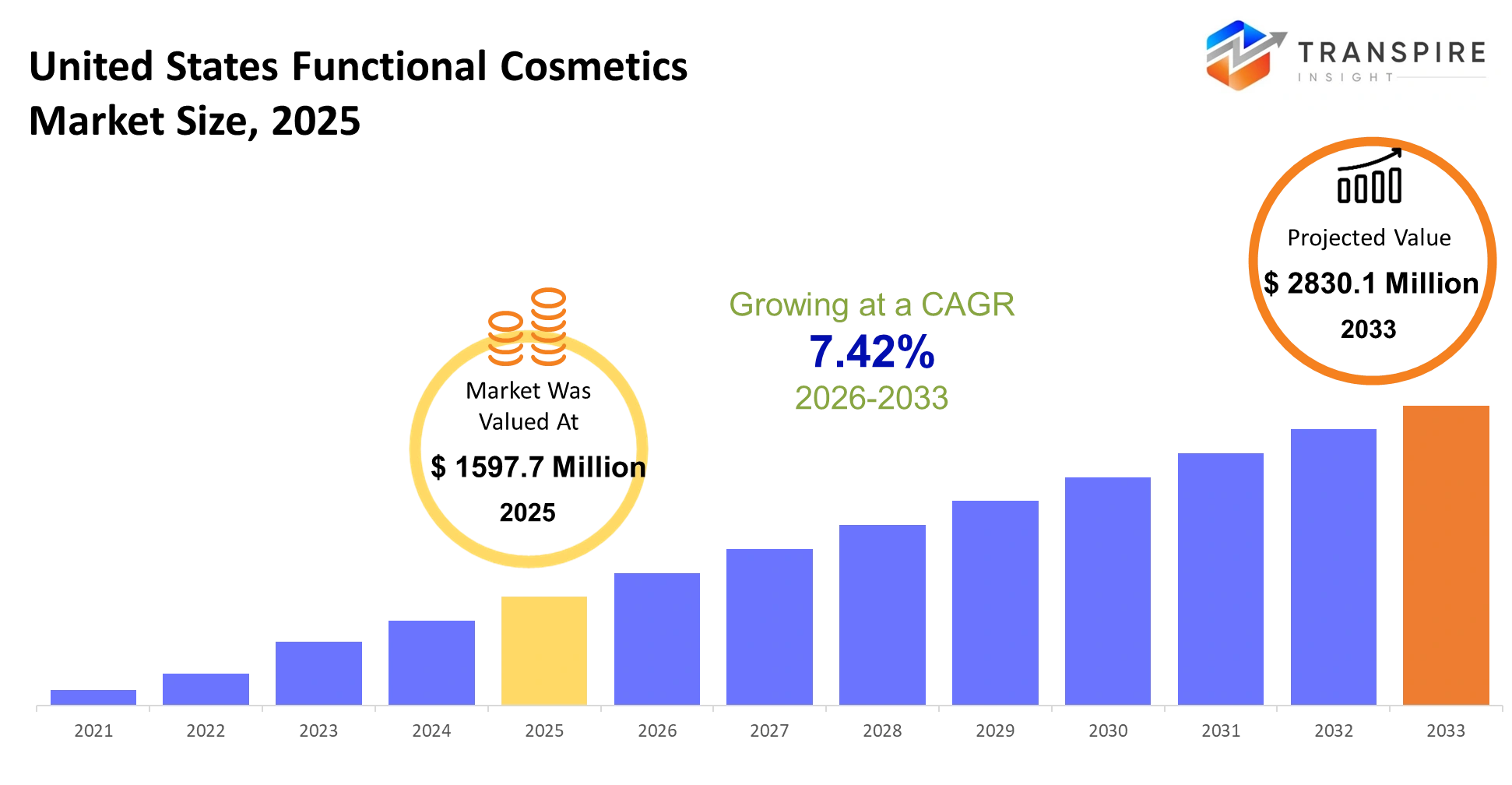
- United States Functional Cosmetics Market Size 2025: USD 1597.7 Million
- United States Functional Cosmetics Market Size 2033: USD 2830.1 Million
- United States Functional Cosmetics Market CAGR: 7.42%
- United States Functional Cosmetics Market Segments: By Product Type (Anti-aging Cosmetics, Skin Whitening Products, Sun Protection Products, Acne Treatment Products, Hair Care Products, Moisturizers, Multifunctional Cosmetics), By Ingredient Type (Peptides, Vitamins, Hyaluronic Acid, Retinol, Herbal Extracts, Collagen, Ceramides), By Distribution Channel (Online Stores, Specialty Beauty Stores, Pharmacies, Supermarkets, Department Stores, Brand Stores).
To learn more about this report,  Download Free Sample Report
United States Functional Cosmetics Market Summary:
The United States Functional Cosmetics Market size is estimated at USD 1597.7 Million in 2025 and is anticipated to reach USD 2830.1 Million by 2033, growing at a CAGR of 7.42% from 2026 to 2033. The United States Functional Cosmetics Market has kind of moved past just doing basic beauty enhancement , and now it’s a performance type segment, where people are trying to solve real skin and hair problems. Stuff like UV harm, pollution exposure, early aging, acne, sensitivity, even scalp health. And more and more products are mixing cosmetic charm with dermatological function, so consumers can cut down the usual multi step routine and instead use hybrid formulations that look good and also do something noticeable in daily care.
In the last five years, the market kind of shifted toward science-backed products, clinically positioned, with research coming through the ingredients and not just the claims. Biotechnology inputs—more like small but, crucial supporting bits—microbiome studies, and messages led by dermatologists have all played a role in it, honestly. This change got faster after the COVID-19 period, when consumer focus turned more toward wellness, skin well being, and clear ingredient details. Meanwhile, supply chain problems made it painfully clear that relying on imported active ingredients isn’t always safe, so many manufacturers started diversifying where they source from , and they invested more in domestic formulation know how.
Today’s growth feels like a bigger overlap between beauty, healthcare, and preventive self-care habits. As customers start treating cosmetics more like a longer-term health investment, not just an extra purchase, brands that can back their claims with clinical validation and offer multiple benefits in one routine are pulling ahead. They’re also seeing better margins and stronger repeat buying , which is kind of the whole point.
Key Market Insights
- The Western United States basically dominated the United States Functional Cosmetics Market with almost 34% market share in 2025, largely because premium skincare adoption was going up and yes, it just kept going.
- Meanwhile the Southern region is likely the fastest mover through 2032, driven by expanding urban populations and that rising beauty retail penetration, that people talk about a lot.
- California keeps on leading in industry revenue generation because it has strong clean beauty startups plus advanced cosmetic research infrastructure, which really matters for product credibility.
- In the Northeast, the metropolitan markets show noticeable share growth from luxury dermocosmetic demand and high consumer spending on anti-aging solutions , too.
- Skincare products still led the United States Functional Cosmetics Market with over 46% share in 2025. This was mainly tied to anti-aging and hydration-focused formulations , which feels kind of obvious but it’s still true.
- Haircare functional cosmetics came in as the second-largest segment. This is supported by scalp treatment products and damage-repair ingredient innovations, with brands pushing newer actives.
- Hybrid beauty products—mixing SPF, hydration and active skincare ingredient systems—are the fastest-growing category during the 2026–2032 forecast window.
- Biotechnology-based cosmetic ingredients also recorded strong industry growth as brands leaned into clinically validated and science-driven product positioning, like they’re trying to prove everything.
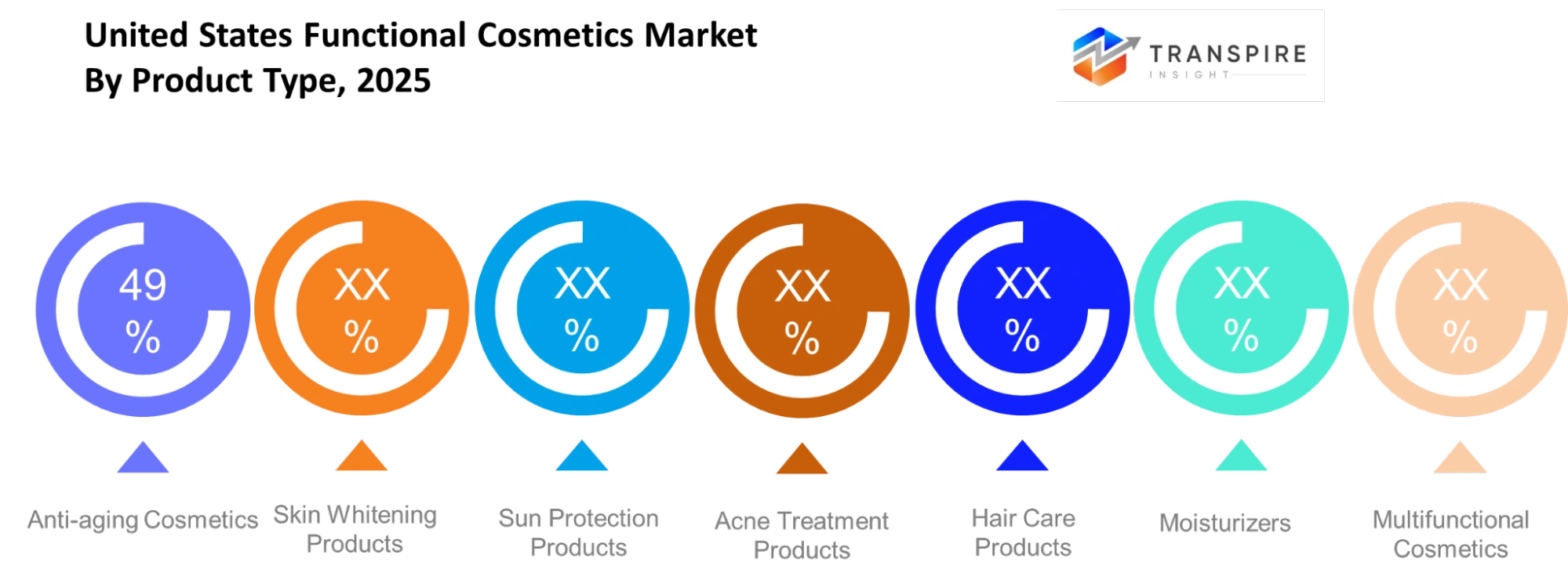
- Anti-aging applications accounted for nearly 38% of total market revenue in 2025 because consumers increasingly prefer preventive skincare routines, rather than waiting.
- Sun protection and pollution-defense cosmetics are seeing emerging demand due to environmental stress concerns , and also prolonged digital screen exposure.
- Finally acne-control and sensitive-skin applications gained solid market share among younger consumers who want dermatologist-approved functional beauty solutions, and they do not compromise.
What are the Key Drivers, Restraints, and Opportunities in the United States Functional Cosmetics Market?
The strongest force pushing the United States Functional Cosmetics Market forward is kinda the overlap of biotechnology, with clinical skincare “proof” that actually holds up.In the last five years, ingredient manufacturers kinda lowered the go to market expenses around peptides, probiotics, ceramides, and fermentation derived actives. This made it a bit easier for cosmetic brands to fold in pharmaceutical style performance claims into mass premium lines , not just boutique stuff. And the momentum really got reinforced after the pandemic, when people started caring more about skin barrier repair, scalp health, and these longer horizon preventive routines. So brands that use clinically tested formulations were able to get more repeat purchases , and also you know, charge higher prices.So, brands that use clinically tested formulations were able to get more repeat purchases and, yeah, charge higher prices. Which then boosts per-customer revenue and also helps widen adoption across prestige retail and direct-to-consumer channels.
Meanwhile, the market’s biggest structural friction is the regulatory gray zone between what counts as cosmetics versus what looks like therapeutic claims. Functional cosmetic companies have to sell efficacy-driven products, without stepping into drug classification under U.S. regulatory standards. This boundary tends to slow down innovation cycles, because companies put a lot of money into testing, legal review, and reworking formulas before they can launch. Smaller brands, in particular, often don’t have enough capital for longer clinical validation tracks, so their market entry gets suppressed and advanced formulations end up taking longer to reach consumers.
Personalized functional skin care kind of represents the next big growth chance, or at least thats how it feels. AI driven skin diagnostics plus microbiome analysis platforms are helping brands put together tailored formulations, based on hydration levels sensitivity pigmentation and whatever the environment is doing at the moment. And it’s not just skin traits either, because these systems also try to read the microflora, so recommendations are more “specific” instead of one-size fits all, you know.
Also, the firms putting money into subscription like personalized skin care ecosystems are seeing better customer retention and they’re tapping into steady recurring revenue streams, especially among digitally active urban consumers. It’s like an ongoing loop, not a one time transaction, even when people switch products a bit.
What Has the Impact of Artificial Intelligence Been on the United States Functional Cosmetics Market?
Artificial intelligence along with advanced digital technologies are kind of remaking the United States Functional Cosmetics Market, not just in a straight line, but more like across the whole lifecycle of a product—formulation, testing, promotion, and even personalization. Right now, beauty manufacturers are leaning on AI based formulation platforms to look at how ingredients play together, to anticipate skin reactions, and to speed up the entire development process. At the same time, a lot of firms are rolling out automated digital monitoring systems through their manufacturing sites, to keep batches more consistent, manage ingredient dosing more tightly, and strengthen quality assurance. That approach is cutting production waste, and in turn lowering operating expenses.
On the predictive side, machine learning models are getting used for skincare analysis in a broader way than before. Brands are combining consumer skin imaging, microbiome mapping, and environmental exposure signals to guess things like hydration fade, pigmentation risk, or sensitivity behaviors before the issue shows up in an obvious, visible way. Because of that, their “future aware” insights help guide personalized product suggestions, and they also boost customer loyalty, especially with subscription style skincare programs. Even diagnostics powered by AI are playing a role in inventory management and demand forecasting, which helps premium cosmetic brands avoid stock gaps or overages, and improves order fulfillment efficiency on e commerce channels.
From an operations standpoint, digital skin analysis tools plus automated formulation systems are pushing faster product launches, encouraging repeat purchases, and supporting that higher margin premium image. Still, there’s a big hitch that keeps showing up: the integration cost for AI infrastructure, plus the need for clinical-grade consumer data collection. Smaller cosmetic companies often cannot obtain large medically validated datasets, so the algorithm reliability can drop and the wider adoption of advanced personalization slows down, kind of like running with one hand tied behind your back.
Key Market Trends
- Since 2021, peptide and ceramide- based skincare launches went up, more or less sharply, as people start to lean harder into barrier repair, and also more preventive anti aging kinds of formulations.
- Brands like L'Oréal and Estée Lauder Companies expanded their microbiome oriented product pipelines, after clinical skincare got stronger post pandemic traction, kind of like a second wave of interest.
- Direct-to-consumer functional beauty sales accelerated from 2020 to 2025. This reduced retailer dependence , and helped brands keep customers longer through subscription skincare programs that feel more “sticky” over time.
- U.S. manufacturers increasingly started sourcing active ingredients domestically, after global supply disruptions delayed cosmetic formulation cycles during 2021 and 2022.
- Hybrid cosmetics that combine SPF, hydration, antioxidants and anti aging functions, replaced single purpose products across many premium skincare portfolios after 2023.
- AI driven skin diagnostics also moved into commercial adoption, as brands used smartphone imaging tools to tailor formulations, and to drive repeat purchase rates , more reliably.
- Male functional skincare captured more shelf space after grooming focused consumers increased spending on scalp care and anti fatigue formulations since 2022.
- Regulatory scrutiny around efficacy claims tightened, after a few brands marketed therapeutic style benefits with not enough dermatological validation, or clinical testing transparency, depending on the case.
- Clean label and fragrance free formulations gained better market penetration, as younger consumers rejected alcohol-heavy products, tied to skin sensitivity concerns .
- Biotechnology partnerships between cosmetic companies and dermatology research labs expanded significantly, after investors leaned toward science backed premium skincare platforms rather than the more mass market beauty categories.
United States Functional Cosmetics Market Segmentation
By Product Type
In terms of by product type, anti-aging cosmetics hold the most solid market place , since premium customers keep putting wrinkle reduction first. They also lean toward skin repair and long-term prevention care, kind of like a steady routine over time. Meanwhile moisturizers and multifunctional cosmetics still hold a big chunk, because a lot of buyers are drifting away from multi-step routines into things that quietly do more, without much fuss.Hydration along with SPF protection, and also antioxidant support in one go, it just feels less fussy and smoother , kind of effortless. Sun protection products got extra momentum once dermatologists and skincare brands started highlighting daily UV defense as a standard part of preventive wellness.
Acne treatment products also expanded, mainly among younger groups, especially those hunting for clinically tested and fragrance-free formulations. Hair care products meanwhile benefited from growing interest in scalp health, along with damage repair that actually feels targeted.
Right now, product innovation seems to revolve around hybrid functionality rather than just one purpose beauty enhancement. Manufacturers are putting more money into biotech ingredients, personalized formulations, and subscription-based skincare ecosystems , mainly to secure repeat purchases and a stronger premium vibe. Looking ahead, the next wave of competition will probably rest on clinical validation, ingredient transparency, and digital personalization features. Not so much on old-school brand recognition by itself.
To learn more about this report, Download Free Sample Report
By Ingredient Type
Ingredient-wise, peptides pretty much dominate premium skincare formulations, since ongoing clinical studies keep linking peptide complexes to collagen stimulation , elasticity gain, and a clear anti-aging look in practice. Hyaluronic acid alongside ceramides still get big adoption too, mostly because shoppers seem more into hydration first and barrier-repair kind of solutions, not just something nice to try. Retinol also stays influential in dermatologist-backed product lines, but there are irritation worries plus regulatory attention on concentration levels , which together curb wider mass-market reach.
Vitamins like Vitamin C and Vitamin E keep a steady sort of demand, because the antioxidant framing sort of fits pollution defense messaging, together with skin brightening goals, you know. Herbal extracts plus collagen derived ingredients grew at a regular pace, since the clean label position started looking more obvious and louder, especially among younger consumers who tend to prefer plant-based or wellness tilted cosmetic ideas.. Even ingredient sourcing and formulation science now steer competitive differentiation more directly than packaging does, or the whole celebrity marketing angle .
Looking ahead, investment will likely lean toward fermentation-derived actives, microbiome-supportive materials, and biotechnology platforms that can strengthen formulation stability while also making efficacy validation easier to prove.
By Distribution Channel
By distribution channel, online stores now represent the fastest-changing part, because digital commerce platforms are reshaping how skincare brands connect with consumers, and they also gather behavioral signals. Specialty beauty stores still hold solid market pull. The reason is that premium buyers often want in-person guidance, like consultations , plus ingredient education and dermatologist-supported product advice before they buy those higher-value formulations. Pharmacies keep a meaningful share, especially in acne treatment, sensitive skin, and clinically positioned skincare lines, largely due to the stronger sense of trust in medically linked retail spaces.
Meanwhile, supermarkets and department stores have seen slower expansion in premium categories, since functional cosmetics increasingly depend on teachable product selling and individualized recommendations , things that mass retail environments just don’t deliver as well. Brand- owned shops are also getting more strategic as cosmetics firms pushed harder into direct-to-consumer tactics, and built loyalty ecosystems kinda everywhere. Moving forward, distribution growth will probably spin around AI based skin diagnostics, subscription driven replenishment, and omnichannel retail blending so manufacturers can increase customer stickiness, while also trimming dependence on third party retail margins.
What are the Key Use Cases Driving the United States Functional Cosmetics Market?
Anti-aging skincare still gets the most attention, kind of as the main reason people actually adopt the category because premium shoppers now think of cosmetics like preventative wellness care not just something that’s about looks. Clinically validated moisturizers, peptide serums, and SPF built into the formula are pulling in the biggest demand, largely from daily use cadence, and the fact that customers tend to repurchase pretty often—again and again.
At the same time acne-control products and scalp-health routines are growing fast, especially with younger buyers and in male grooming segments. Pharmacies and niche beauty shops are saying they’re noticing a bit more momentum with sensitive-skin offerings, microbiome friendly formulations, and dermatologist backed hair repair products meant to handle pollution exposure and that longer screen connected skin strain. It’s kind of like the market is looking for stuff that doesn’t fuss too much with the barrier.
Looking ahead, the newer angles are getting weirder in a good way, like AI-personalized skincare systems, plus cosmetic formulas that aim at the microbiome in a more deliberate manner. Beauty tech companies are also testing diagnostic tools that can point toward tailored ingredient blends based on hydration pigmentation and local environmental conditions, and that could open up long term options for subscription driven skincare frameworks and digitally managed treatment routines even when life stays busy.
|
Report Metrics |
Details |
|
Market size value in 2025 |
USD 1597.7 Million |
|
Market size value in 2026 |
USD 1715.3 Million |
|
Revenue forecast in 2033 |
USD 2830.1 Million |
|
Growth rate |
CAGR of 7.42% from 2026 to 2033 |
|
Base year |
2025 |
|
Historical data |
2021 - 2024 |
|
Forecast period |
2026 - 2033 |
|
Report coverage |
Revenue forecast, competitive landscape, growth factors, and trends |
|
Geographic scope |
United States of America |
|
Key company profiled |
Estée Lauder, L'Oréal, Shiseido, Procter & Gamble, Johnson & Johnson, Unilever, Amorepacific |
|
Customization scope |
Free report customization (country, regional & segment scope). Avail customized purchase options to meet your exact research needs. |
|
Report Segmentation |
By Product Type (Anti-aging Cosmetics, Skin Whitening Products, Sun Protection Products, Acne Treatment Products, Hair Care Products, Moisturizers, Multifunctional Cosmetics), By Ingredient Type (Peptides, Vitamins, Hyaluronic Acid, Retinol, Herbal Extracts, Collagen, Ceramides), By Distribution Channel (Online Stores, Specialty Beauty Stores, Pharmacies, Supermarkets, Department Stores, Brand Stores) |
Which Regions are Driving the United States Functional Cosmetics Market Growth?
The Western United States kind of leads the functional cosmetics market, mostly because California along with nearby states blend advanced beauty innovation ecosystems with strong consumer spending for premium skincare. There has also been regulatory attention—toward ingredient transparency and clean-label formulations—which sort of pushed brands to invest sooner in clinically validated and biotechnology based cosmetic products. Plus, the region has this dense web of dermatology clinics, cosmetic labs, contract manufacturers, and digital beauty startups, that overall make product commercialization faster and easier. Big metro areas like Los Angeles and San Francisco keep that edge going, mainly via deep e-commerce penetration, influencer-led take up of products and very high demand for multifunctional skincare solutions.
The Northeastern United States adds steady market revenue via a different sort of growth structure, one that leans heavily on medical credibility and the concentration of luxury retail. People in places like New York and Boston often prefer dermatologist-backed anti-aging options, premium serums, and even pharmacy-distributed treatment cosmetics rather than chasing trendier beauty categories. Department stores, specialty beauty retailers, and clinical skincare providers keep strong brand visibility and they support repeat purchasing in high-income consumer groups. Compared with the Western market, the Northeast seems to do less rapid product experimentation and more leaning on established premium brands with long standing consumer trust.
The Southern United States shows the fastest-growing regional market , mostly because urban populations are swelling, disposable income keeps rising ,and beauty retail is expanding quickly across Texas, Florida, and Georgia. It really sped up after 2022 since direct-to-consumer cosmetic companies started pushing deeper distribution investments in the region, and online beauty marketplaces made products easier to reach outside the biggest metro areas. At the same time, the warmer climate does a lot , it boosts interest in sun protection items, hydration driven skincare, plus pollution-defense formulas meant for everyday wear. This kind of regional momentum is creating solid openings for producers and investors between 2026 and 2033, especially around customized skincare platforms, pharmacy collaborations, and affordable-premium cosmetic ranges.
Who are the Key Players in the United States Functional Cosmetics Market and How Do They Compete?
The United States Functional Cosmetics Market stays somewhat moderately fragmented, because multinational beauty corporations jostle with biotechnology-centered skincare brands, dermatologist-led labels and digitally native cosmetic startups. The rivalry seems to be moving, or sort of shifting , toward formulation science, clinical validation, and personalization tools more than just price based positioning, alone. Bigger incumbents keep trying to protect their footing via ongoing research spending and strong retail distribution, while newer entrants are shaking up the premium skincare lanes using microbiome technology, clean label formulations, and direct-to-consumer subscription models. Also the speed of innovation has turned into a major edge since shoppers more and more expect multifunctional products paired with trackable performance claims , backed by something measurable.
L'Oréal stands apart mostly through biotechnology fueled formulation work and AI driven beauty diagnostics that plug into personalized skincare suggestions. It pushed forward digital skin analysis functions and reinforced its premium skincare position by partnering with beauty technology platforms as well as dermatological research networks. Estée Lauder Companies tends to concentrate on prestige skincare supported by higher margin anti aging formulations, plus more advanced ingredient technologies. Its strong department store relationships and luxury retail reach give it a steady cushion with affluent urban consumers, especially those chasing beauty products that feel clinically grounded.
Procter & Gamble moves ahead mostly by scale efficiency and by keeping a kind of mass-premium accessibility, basically using a wide retail footprint to roll out functional skincare items with very competitive price points. It keeps putting money into science backed ingredient platforms and data driven consumer signals, so they can raise repeat purchases in skincare and haircare, you know, across the board. Shiseido holds on to its distinctness with advanced anti-aging study and a deep Asian skincare know-how, especially for hydration and skin barrier repair approaches. Johnson & Johnson meanwhile taps into pharmaceutical credibility and dermatological trust, then uses that to broaden clinically focused skincare lines, aimed at sensitive skin, and also leaning into therapeutic style cosmetic uses.
Company List
- Estée Lauder
- L'Oréal
- Shiseido
- Procter & Gamble
- Johnson & Johnson
- Unilever
- Amorepacific
Recent Development News
In April 2026, Estée Lauder Expands Restructuring With 3,000 Additional Job Cuts : U.S. beauty giant Estée Lauder announced plans to eliminate up to 3,000 more jobs globally while raising its annual profit outlook. The move is part of the company’s broader turnaround strategy focused on improving profitability and strengthening premium skincare and fragrance operations in the United States market.
Source: https://www.reuters.com
In April 2026, Estée Lauder Advances Takeover Discussions With Puig: Reuters reported that Estée Lauder was advancing talks for a potential stock-based combination with Spanish beauty company Puig. The proposed deal reflects aggressive consolidation efforts by U.S. cosmetics companies seeking stronger positions in prestige skincare and functional beauty categories.
Source: https://www.reuters.com
What Strategic Insights Define the Future of the United States Functional Cosmetics Market?
The United States Functional Cosmetics Market is, kinda, moving structurally toward clinically integrated beauty solutions that blend biotechnology, dermatology, and AI led personalization into long term consumer wellness platforms . In the next five to seven years, the competitive edge is expected to drift away from old style brand marketing and toward proprietary ingredient systems, diagnostic technologies, and consumer data ecosystems. This shift is pushed by consumers who are now treating skincare like preventive health management, not really like discretionary beauty spending, which is a difference that matters.
One underrecognized risk has to do with how the market may be clustering around a smaller set of biotechnology ingredient suppliers and contract formulation partners . As premium brands lean more on specialized peptides, microbiome actives, and fermentation derived compounds, any supply disruption or intellectual property limitation could squeeze margins, and slow product innovation cycles in a way that’s harder to recover from.
Still, there’s a meaningful emerging opportunity too. It’s the AI enabled personalized skincare subscriptions that are tied to tele-dermatology platforms, especially in fast growing Southern metro areas where digital beauty adoption keeps picking up speed. Firms trying to enter this space should really focus on funding clinically validated consumer data infrastructure and domestic ingredient sourcing capabilities, because regulatory scrutiny around efficacy statements and supply chain transparency will probably intensify before 2033, even if timelines feel uncertain right now .
United States Functional Cosmetics Market Report Segmentation
By Product Type
- Anti-aging Cosmetics
- Skin Whitening Products
- Sun Protection Products
- Acne Treatment Products
- Hair Care Products
- Moisturizers
- Multifunctional Cosmetics
By Ingredient Type
- Peptides
- Vitamins
- Hyaluronic Acid
- Retinol
- Herbal Extracts
- Collagen
- Ceramides
By Distribution Channel
- Online Stores
- Specialty Beauty Stores
- Pharmacies
- Supermarkets
- Department Stores
- Brand Stores
Frequently Asked Questions
Find quick answers to common questions.
The approximate United States Functional Cosmetics Market size for the market will be USD 2830.1 Million in 2033.
The key segments of the United States Functional Cosmetics Market are By Product Type (Anti-aging Cosmetics, Skin Whitening Products, Sun Protection Products, Acne Treatment Products, Hair Care Products, Moisturizers, Multifunctional Cosmetics), By Ingredient Type (Peptides, Vitamins, Hyaluronic Acid, Retinol, Herbal Extracts, Collagen, Ceramides), By Distribution Channel (Online Stores, Specialty Beauty Stores, Pharmacies, Supermarkets, Department Stores, Brand Stores).
Major players in the United States Functional Cosmetics Market are Estée Lauder, L'Oréal, Shiseido, Procter & Gamble, Johnson & Johnson, Unilever, Amorepacific.
The current market size of the United States Functional Cosmetics Market is USD 1597.7 Million in 2025.
The United States Functional Cosmetics Market CAGR is 7.42%.
- Estée Lauder
- L'Oréal
- Shiseido
- Procter & Gamble
- Johnson & Johnson
- Unilever
- Amorepacific
Recently Published Reports
-
Apr 2026
Bottled Water Market
Bottled Water Market Size, Share & Analysis Report By Product Type (Still Bottled Water, Carbonated Bottled Water, Functional Bottled Water, and Others), By Packaging (PET, Cans, and Others), By Sales Channel (Supermarkets/Hypermarkets, Convenience Stores/Drug Stores, Grocery Stores/Club Stores, Foodservice, and Others) and Geography (North America, Europe, Asia-Pacific, Middle East and Africa, South and Central America), 2021 - 2032
-
Apr 2026
Color Cosmetic Packaging Market
Color Cosmetic Packaging Market Size, Share & Analysis Report By Application (Mascara Packaging, Liquid Packaging, and Liquid Face), By Type (Tubes & Bottles, Pens & Markers, Compacts & Containers, and Droppers & Pumps), and Geography (North America, Europe, Asia-Pacific, Middle East and Africa, South and Central America), 2021 - 2031
-
Apr 2026
External Microphone For Camera Market
External Microphone For Camera Market Size, Share & Analysis Report By Type (Shotgun Microphone, Lavalier Microphone, and Others), By Application (Digital Camera, Professional Video Camera, and Others), and Geography (North America, Europe, Asia-Pacific, Middle East and Africa, South and Central America), 2021 - 2031
-
Apr 2026
Foot Orthotic Insoles Market
Foot Orthotic Insoles Market Size, Share & Analysis Report By Type (Pre-fabricated, and Custom-made), By Material (Thermoplastic, Composite Carbon Fiber, and Others), By Distribution Channel (Drug Stores, Hospitals & Clinics, and Others), and Geography (North America, Europe, Asia-Pacific, Middle East and Africa, South and Central America), 2021 - 2031