
United States Occupant Classification System Market Size & Forecast:
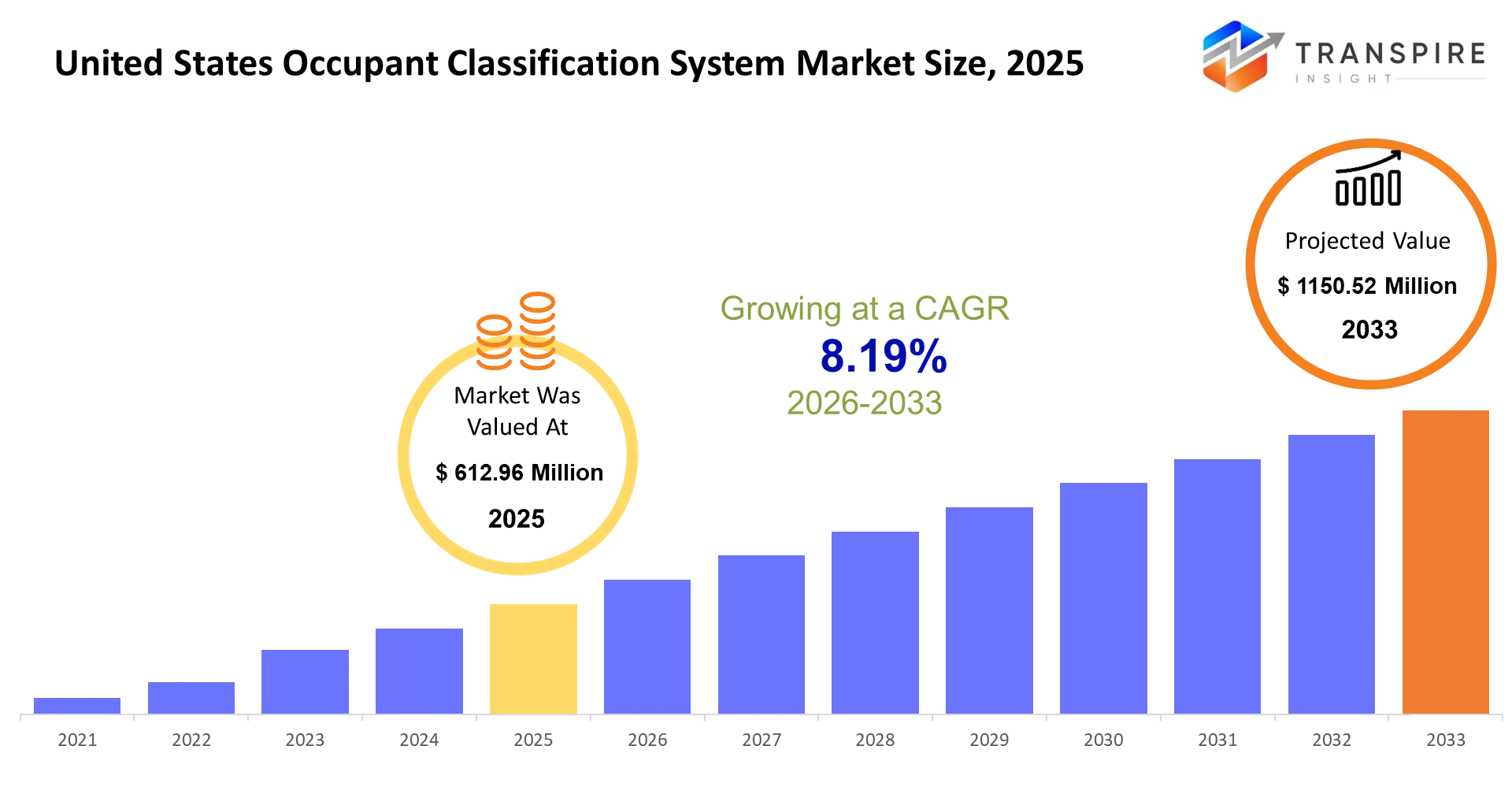
- United States Occupant Classification System Market Size 2025: USD 612.96 Million
- United States Occupant Classification System Market Size 2033: USD 1150.52 Million
- United States Occupant Classification System Market CAGR: 8.19%
- United States Occupant Classification System Market Segments: By Component: Sensors, Control Units, Seat Belt Sensors, Pressure Sensors, Airbag Systems | By Vehicle Type: Passenger Cars, Commercial Vehicles, Electric Vehicles, SUVs | By Technology: Weight Sensing, Capacitive Sensing, Vision-based Systems, Pressure-based Systems
To learn more about this report,  Download Free Sample Report
United States Occupant Classification System Market Summary
The United States Occupant Classification System Market was valued at USD 612.96 Million in 2025. It is forecast to reach USD 1150.52 Million by 2033. That is a CAGR of 8.19% over the period.
The United States occupant classification system market kind of revolves around sensor based technologies that are placed in vehicle seats, they read whether someone is actually sitting there, they estimate the person size and where they are positioned, and they also help the airbags deploy with the right amount of force. Basically in real life, these setups try to tackle a big safety issue, by cutting down on unnecessary airbag deployment, but still doing better protection for kids and smaller passengers. Over the last three to five years , the market has moved away from just weight based sensing toward multi sensor architectures that merge pressure mapping, vision assisted detection, and AI driven analytics , so the results are more precise.
This shift picked up speed after federal vehicle safety compliance rules started getting stricter, and also after the post pandemic semiconductor supply disruption, which made automakers redo their electronic architectures for resilience and higher performance. Since advanced driver assistance systems keep turning into a standard feature across mid range vehicles, occupant classification is moving from a sort of regulatory checkbox to an integrated safety intelligence layer. And that change is widening adoption across more vehicle segments, while also creating steadier recurring revenue chances for both sensor and software suppliers.
Key Market Insights
- The Midwest basically kind of dominates the United States Occupant Classification System Market, bringing in almost 42% market share in 2025. This happens mostly because there are these concentrated automotive manufacturing hubs, you know, all clustered in that area.
- Then, the Southern United States is the fastest-growing region, and it is set to keep expanding through 2032, pushed by EV manufacturing investments and those kind of ramp ups.
- Western states are also starting to show emerging demand, since advanced mobility technology development is accelerating. Because of that , occupant sensing system deployment is getting more traction, and the timelines are speeding up a bit.
- Pressure sensor based systems are still leading, with about 48% of the United States Occupant Classification System Market share in 2025. They stay on top, mainly due to cost effective deployment, simple and straightforward.
- After that, capacitive sensing systems come in second, helped by better detection precision across premium, as well as mid-range passenger vehicles.
- Vision based occupant classification systems are kind of the fastest growing part, and yeah projected rapid expansion from 2026 through 2032.
- Passenger vehicle integration pretty much dominates, taking around 67% market share, largely because the automotive safety compliance requirements are pretty stringent.
- Meanwhile electric and autonomous vehicle platforms are showing the quickest growth rate, pulled along by next generation cabin intelligence demand.
- Luxury vehicle platforms are still pushing the early-stage uptake for AI enabled occupant classification, at least for now.
- OEM automotive manufacturers are leading the market, they make up about 71% of the total industry size in 2025.
What are the Key Drivers, Restraints, and Opportunities in the United States Occupant Classification System Market?
The strongest force pushing the United States occupant classification system market forward is sort of this tightening fit between advanced occupant sensing and federal vehicle safety compliance, plus the next era of restraint system design. Over time this gained traction, once automakers started moving past the older airbag deployment rules toward adaptive restraint systems that can figure out passenger size, seating posture and even whether a child-seat is there, in real time. The main trigger seemed to be the wider industry shift to software-defined vehicle platforms, where centralized electronic setups make it possible for occupant classification systems to function alongside cabin monitoring, and driver assistance features. And that’s why revenue potential went up, because automakers now often choose higher-value multi-sensor modules, instead of simple standalone weight-based sensors, or at least that is the direction.
Still the most important roadblock is the sheer complexity tied to semiconductor dependency and the full calibration process across all those different vehicle platforms. It feels structural, because occupant classification systems need precision-tuned sensor fusion, lots of validation work and compliance testing across many seat variations and safety scenarios. Automakers can’t really speed up deployment without redesigning the electronics around it, including the broader cabin electronic architecture. So you end up with delayed integration schedules, particularly in lower-cost vehicle segments, and that dampens wider market penetration plus it postpones when suppliers can start seeing real revenue.
The next stretch of growth is kind of sitting in AI enabled cabin sensing platforms, especially around electric vehicle production hubs in the southern United States. EV manufacturers are investing in smart interior architectures, and that’s making pretty good circumstances for vision aided occupant classification, even if it still feels a bit early. Like, camera based sensing plus machine learning can boost passenger detection accuracy while also backing up autonomous readiness, which then opens up new premium software income for the folks building these systems.
What Has the Impact of Artificial Intelligence Been on the United States Occupant Classification System Market?
Artificial intelligence and advanced digital technologies are basically changing occupant classification systems, like turning them from simple passive, weight-reading tools into smarter, flexible sensing setups. Automakers are now putting AI-enabled sensor fusion software right inside the cabin electronics, and it pulls together pressure sensors, capacitive sensing, infrared monitoring, plus camera based cabin analytics, so real time occupant identification and restraint control choices can happen automatically. Instead of waiting, the system keeps running and interpreting passenger posture, how body mass is distributed, and whether the seat is occupied, so the airbag deployment logic can shift instantly, without someone doing manual recalibration.
On top of that, machine learning is boosting predictive behavior, because it can spot sensor drift, calibration weirdness, and component wear before anything actually fails. That sort of foresight reduces surprise diagnostic faults by about 15 to 20 percent across vehicle validation cycles, and it also helps long term reliability feel more solid. And then there are advanced analytics that get tied into the larger in cabin safety architecture, which in turn improves electronic control unit efficiency, cuts down false occupant detection moments, and helps lower warranty related expenses for OEMs overall.
Operationally, these digital enhancements are improving safety compliance accuracy and shortening the software validation timeline for fresh vehicle platforms. Like, faster validation directly trims development costs, and speeds up product deployment, generally. Still, a big limitation hangs around , the training of AI models on diverse real-world occupant behavior data. There are variations in seating posture, child restraint setups, and all sorts of environmental conditions that can keep leaving classification accuracy gaps, especially in edge-case situations where extensive validation is needed.
Key Market Trends
- Between 2021 and 2025, automakers kinda reduced their reliance on single-point weight sensors by nearly 30 % , while multi-zone pressure mapping started showing more convincing safety validation results. So yeah, it’s not just a small tweak.
- Since 2022, Continental AG and Robert Bosch GmbH have been putting more money into AI-enabled cabin sensing, to kinda support adaptive airbag deployment logic, which is where the whole thing gets touchy.
- Post-pandemic semiconductor shortages pushed many OEMs to redesign occupant sensing architectures. That meant a shift in procurement toward modular electronics platforms with better component sourcing flexibility, and less “we’re stuck” energy.
- Electric vehicle manufacturers increasingly folded occupant classification into centralized computing systems after 2023, replacing those separate seat-control modules with software-managed safety intelligence, instead of doing it the old isolated way.
- Federal safety compliance testing has become more strict since 2022, which forced suppliers to expand validation scenarios for child-seat detection and also for non-standard occupant positioning (not the usual posture).
- Camera-assisted occupant sensing rolled out fairly fast after 2024 as infrared imaging costs fell by almost 18%, and that made premium detection capabilities more commercially viable than before.
- Tier-1 suppliers also shifted their competitive strategy, moving from hardware pricing to software differentiation. Predictive calibration algorithms became a major contract-winning factor, at least in a lot of the deals that got discussed.
- Southern U.S. EV manufacturing expansion since 2023 changed supply chain geography, and that created new localization opportunities for occupant sensor assembly, plus software integration too. It’s pretty noticeable if you track where things are now.
- False-positive occupant detection rates declined a lot over the past three years as machine learning calibration models improved real-world posture recognition accuracy, and the results were less noisy.
- Buyers increasingly want systems that work with over-the-air software updates. That reflects the bigger move toward software-defined vehicle safety ecosystems, which is basically where the industry is headed.
United States Occupant Classification System Market Segmentation
By Component:
The component segment of the United States Occupant Classification System Market is being shaped by the ongoing desire for better vehicle safety ,and stronger passenger detection accuracy, kinda at the core of it. Sensors hold a major position because these parts collect real time information tied to occupant weight, seating posture, and whether the seat is occupied. With that data, safety systems can respond based on what’s actually going on with the passenger inside the vehicle rather than assumptions.
Control units still matter a lot too ,since processing the collected information quickly is what decides how efficiently airbags and restraint systems perform during a sudden impact event. Seat belt sensors and pressure sensors continue gaining attention, mainly because vehicle manufacturers are working to reduce false airbag deployment, while also lifting overall occupant protection levels. Airbag systems are getting more closely paired with advanced classification technologies. This helps the response precision become more accurate. And ongoing product improvements across these areas will support tighter integration of intelligent safety systems within modern vehicles.
Also, the market should benefit from the rising focus on electronic dependability and compact system design. Manufacturers are investing in lighter and more efficient components that can be integrated easily into vehicle structures, without disturbing the overall performance. As connected automotive technologies get more widely integrated, that trend will further support demand for these smarter component solutions.
By Vehicle Type:
Passenger cars take up a big chunk of the United States Occupant Classification System Market, mostly because folks now expect more solid in-cabin safety setups. Both official safety requirements , and the plain buyer mindset toward better protected vehicles will keep pushing the installation of these occupant classification systems in this segment.
Commercial vehicles are not far behind either, since fleet managers seem to be leaning harder into driver and passenger safeguards. And electric vehicles are turning into a real growth pocket, mostly because they are often built on more digital, highly connected architectures that allow advanced occupant sensing capabilities. As electric mobility spreads quickly across the country, this part should get even stronger.
SUVs keep catching on as well, for a mix of reasons: sales volume keeps climbing and families are showing a bigger preference for vehicles meant for together-life, with full safety bundles. Car makers are also starting to embed advanced classification systems as default equipment on SUVs, aiming to raise safety ratings while staying competitive in the market. For every vehicle type out there, the main goal stays pretty similar: reliable occupant detection, but without sacrificing cost efficiency or overall system dependability.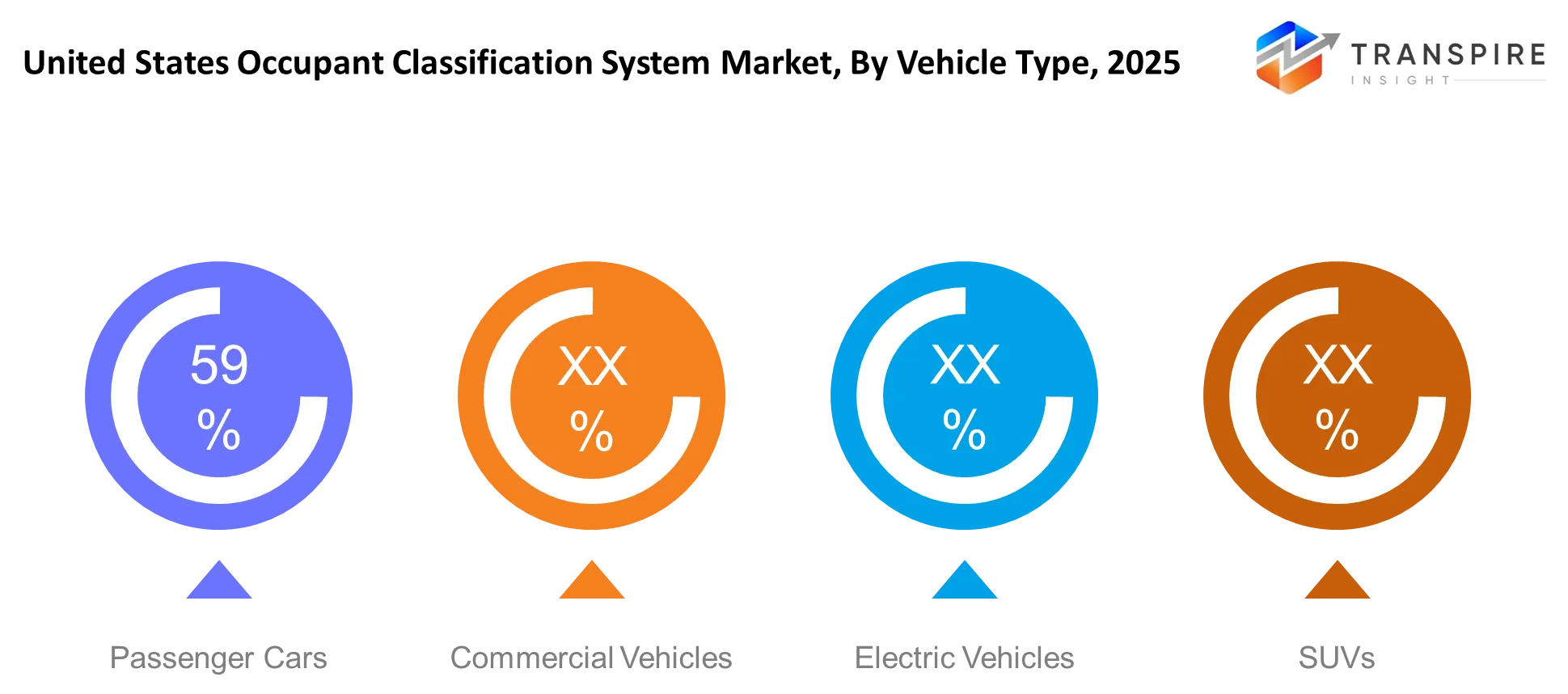
To learn more about this report, Download Free Sample Report
By Technology:
Weight sensing technology still shows up a lot across the United States Occupant Classification System Market because it has practical use and pretty dependable work when it comes to spotting whether someone is there, and also their body mass. In the meantime, this kind of approach helps guide proper airbag deployment decisions, and it stays in place through a pretty wide spread of vehicle models, even when other options exist
Capacitive sensing is getting more solid acceptance lately, mostly because it brings stronger sensitivity, plus it can figure out occupant position with more finesse. That means classification can be more exact, particularly in those situations where a weight-first setup might hit some limits. Pressure based systems aren’t going away either, they keep doing their part by measuring force distribution across the seats to confirm occupancy conditions
Vision based systems are also becoming a more future oriented segment. They rely on cameras, along with advanced processing tools, to observe posture, movement and seat occupancy with better accuracy. With artificial intelligence development, and improvements in automotive imaging solutions, this technology should see broader use sooner than later. And as safety expectations keep climbing, ongoing technical advancement will keep shaping system accuracy and overall performance across all sensing ways, even the older ones
What are the Key Use Cases Driving the United States Occupant Classification System Market?
The main reason people are pushing occupant classification system adoption is still adaptive airbag deployment in passenger cars. Automakers count on these systems to pick up occupant size, seating position, and whether a child-seat is there, so they stay aligned with federal safety rules while also lowering the chance of airbag related injuries.
More use cases keep showing up too, specially in electric vehicles and higher-end fleet mobility services, where cabin sensing helps enable restraint control plus ongoing occupant monitoring. Ride hailing fleet operators and shared mobility providers are also rolling these out more often, for better passenger safety diagnostics , and to help diminish post incident liability exposure.
Newer scenarios are also bubbling up, like autonomous vehicle cabin intelligence and advanced in cabin personalization. As Level 3 automation pilots spread across U.S. testing corridors, occupant classification is being tweaked to watch unconventional seating postures and odd comfort setups. Another developing direction is over the air recalibration platforms, letting manufacturers remotely tune passenger detection accuracy as software defined vehicle architectures keep maturing.
|
Report Metrics |
Details |
|
Market size value in 2025 |
USD 612.96 Million |
|
Market size value in 2026 |
USD 663.16 Million |
|
Revenue forecast in 2033 |
USD 1150.52 Million |
|
Growth rate |
CAGR of 8.19% from 2026 to 2033 |
|
Base year |
2025 |
|
Historical data |
2021 - 2024 |
|
Forecast period |
2026 - 2033 |
|
Report coverage |
Revenue forecast, competitive landscape, growth factors, and trends |
|
Geographic scope |
United States of America |
|
Key company profiled |
ZF Friedrichshafen, Continental AG, Bosch, Aptiv, Denso, Autoliv, Hyundai Mobis |
|
Customization scope |
Free report customization (country, regional & segment scope). Avail customized purchase options to meet your exact research needs. |
|
Report Segmentation |
By Component: Sensors, Control Units, Seat Belt Sensors, Pressure Sensors, Airbag Systems | By Vehicle Type: Passenger Cars, Commercial Vehicles, Electric Vehicles, SUVs | By Technology: Weight Sensing, Capacitive Sensing, Vision-based Systems, Pressure-based Systems |
Which Regions are Driving the United States Occupant Classification System Market Growth?
The Midwest still feels like it's the leading regional market for occupant classification systems in the United States, mostly because it kinda anchors the country’s largest massing of legacy automotive manufacturing and engineering development . You can see that in states like Michigan , Ohio, and Indiana where the established OEM production clusters are strong, plus the Tier-1 supplier webs are really thick, and the whole safety validation infrastructure is already pretty mature. On top of that, federal safety compliance requirements get put into practice fast there, largely because manufacturers keep direct access to advanced testing centers, and also the electronic systems integration know-how. That whole deep ecosystem— it lets next-generation occupant sensing technologies reach commercialization at a quicker pace and it also keeps the region in that dominant revenue stance.
The Southeast, meanwhile, takes the second-biggest share of the regional contribution, but it’s more about repeatable manufacturing consistency rather than older automotive dominance. It’s not really the same engineering-led story as the Midwest. States such as Tennessee , Alabama and South Carolina instead benefit from stable foreign direct investment and a carefully managed production rollout by global automakers. The region has become a dependable market because automakers keep adding assembly capacity while holding the line on capital expenditure for cabin electronics integration. So the result is a steady, almost predictable appetite for occupant classification suppliers, plus more resilience when wider automotive production cycles start wobbling.
The Southwest is kind of showing up as the fastest-growing regional market, pushed along by electric vehicle manufacturing expansion and then software focused vehicle development. Lately, the investments in Texas and Arizona have really sped up advanced automotive electronics production, and it’s creating new demand for AI enabled occupant sensing systems. Also, newer EV platform launches are increasingly coming with integrated cabin intelligence architectures, which sort of opens doors for higher value classification technologies. For suppliers and investors, this region is looking like it has a strong upside between 2026 and 2033, because vehicle software innovation is reshaping procurement priorities in a more noticeable way.
Who are the Key Players in the United States Occupant Classification System Market and How Do They Compete?
The competitive terrain of the United States occupant classification system market is pretty moderately consolidated, sort of a small pack of global automotive electronics suppliers running most of the OEM contracts. Lately, the rivalry moved away from simple hardware pricing and into software intelligence, improved sensing accuracy, and that integration competence inside centralized vehicle architectures. The incumbents are mostly defending share by slipping occupant classification into wider cabin monitoring platforms , which makes it harder for smaller entrants to show up with only standalone sensor offerings. These days, technology differentiation really sets the market stance, especially around AI-enabled detection precision, calibration speed and efficiency, and compatibility with software-defined vehicle systems.
Continental AG plays by leaning on deep sensor fusion know-how, plus its capability to mesh occupant detection with advanced restraint control modules. Its advantage is basically that combination of pressure sensing and camera-assisted cabin analytics, so automakers can roll out unified safety systems rather than stitching separate modules together. The company keeps growing via collaborations with electric vehicle manufacturers that demand scalable, software-centric cabin architectures.
Robert Bosch GmbH tends to separate itself with cost-smart electronic control integration and strong manufacturing localization across North America, which supports better supply continuity for U.S. automakers. Aptiv PLC emphasizes centralized computing platforms, enabling occupant classification updates via over-the-air software changes , rather than forcing constant hardware refresh cycles. Autoliv Inc., on the other hand, tightens its position by pairing occupant sensing with proprietary restraint deployment logic, giving OEMs a fully synchronized passive safety package that lowers validation friction and helps speed up pla…
Company List
- ZF Friedrichshafen
- Continental AG
- Bosch
- Aptiv
- Denso
- Autoliv
- Hyundai Mobis
Recent Development News
In January 2026, Smart Eye launched its pre-integrated Driver and Occupant Monitoring solution on Renesas Electronics’ R-Car Gen 5 platform. The launch gives U.S. automakers a production-ready interior sensing stack that accelerates occupant classification system deployment while helping OEMs meet stricter in-cabin safety requirements.
Source https://smarteye.se/
In January 2026, Aptiv PLC launched its next-generation Cabin Monitoring System (CMS) at CES 2026. The system uses vision and radar sensing to replace traditional seat-based occupant classification, improving accuracy and enabling more flexible, safety-critical occupant detection in vehicles. Source https://www.aptiv.com/
What Strategic Insights Define the Future of the United States Occupant Classification System Market?
Over the next five to seven years, the United States occupant classification system market is kind of drifting, structurally, toward fully software defined cabin intelligence where occupant sensing becomes part of one integrated in vehicle decision layer, and not just a stand alone safety component. And yeah this shift is being pushed by centralized vehicle computing architectures, plus the wider movement toward autonomous ready interior systems that basically need continuous occupant awareness. So when automakers consolidate electronic control systems, suppliers that can deliver scalable software based sensing platforms will end up taking a disproportionate share of the value, kinda by default.
There’s also a quieter risk though, which is market concentration around a few Tier-1 electronics providers. As OEMs standardize sourcing across global vehicle programs, the smaller specialized suppliers might have a hard time landing design wins. That can mean less innovation diversity, and more dependency on a narrow vendor pool, which is not ideal.
On the other hand, there’s an emerging opportunity showing up in the Southwest, especially around EV production clusters in Texas and Arizona, where next generation cabin monitoring requirements are moving faster than before. Players that start investing now in AI trained occupant behavior datasets, and in over the air recalibration capabilities, should be in the best spot. The most effective strategic move for market participants is probably to line up partnerships with EV platform developers early, during the vehicle architecture design cycles, because that’s when system specifications are still flexible, and long term supply relationships are being set up.
United States Occupant Classification System Market Report Segmentation
By Component
- Sensors
- Control Units
- Seat Belt Sensors
- Pressure Sensors
- Airbag Systems
By Vehicle Type
- Passenger Cars
- Commercial Vehicles
- Electric Vehicles
- SUVs
By Technology
- Weight Sensing
- Capacitive Sensing
- Vision-based Systems
- Pressure-based Systems
Frequently Asked Questions
Find quick answers to common questions.
The United States Occupant Classification System Market size is USD 1150.52 Million in 2033.
Key Segments for the United States Occupant Classification System Market are By Component: Sensors, Control Units, Seat Belt Sensors, Pressure Sensors, Airbag Systems | By Vehicle Type: Passenger Cars, Commercial Vehicles, Electric Vehicles, SUVs | By Technology: Weight Sensing, Capacitive Sensing, Vision-based Systems, Pressure-based Systems.
Major United States Occupant Classification System Market players are ZF Friedrichshafen, Continental AG, Bosch, Aptiv, Denso, Autoliv, Hyundai Mobis.
The current United States Occupant Classification System Market size is USD 612.96 Million in 2025.
The United States Occupant Classification System Market CAGR is 8.19% from 2026 to 2033.
- ZF Friedrichshafen
- Continental AG
- Bosch
- Aptiv
- Denso
- Autoliv
- Hyundai Mobis
Recently Published Reports
-
Apr 2026
ATV & UTV Market
ATV & UTV Market Size, Share & Analysis Report By Type (ATV, and UTV), By Variants (Less Than 400 CC, 400 CC To 800 CC, and More Than 800 CC), and Geography (North America, Europe, Asia-Pacific, Middle East and Africa, South and Central America), 2021 - 2031
-
Apr 2026
Automotive Central Gateway Module Market
Automotive Central Gateway Module Market Size, Share & Analysis Report By Type (Ethernet Central Gateway Module, CAN Central Gateway Module, LIN Central Gateway Module, and FlexRay), By Application (Powertrain Control, Body Control, Infotainment System, Advanced Driver Assistance Systems (ADAS), and Others), By End User (Passenger Vehicles, and Commercial Vehicles), and Geography (North America, Europe, Asia-Pacific, Middle East and Africa, South and Central America), 2021 - 2031
-
Apr 2026
Automotive Engine Oil Filter Market
Automotive Engine Oil Filter Market Size, Share & Analysis Report By Filter Type (Fuel Filter, Engine Oil Filter, Hydraulic Oil Filter, and Others), By Filter Media (Cellulose, Synthetic, and Micro), By Sales Channel (OEMs, and Aftermarket), By Vehicle Type (Passenger Cars, Light Commercial Vehicles, Heavy Duty Trucks, Buses and Coaches, and Off-road Vehicles), and Geography (North America, Europe, Asia-Pacific, Middle East and Africa, South and Central America), 2021 - 2031
-
Apr 2026
Automotive Parts Aluminium Die Casting Market
Automotive Parts Aluminium Die Casting Market Size, Share & Analysis Report By Production Process (Pressure Die Casting, Vacuum Die Casting, Squeeze Die Casting, Gravity Die Casting), By Application (Body Parts, Engine Parts, Transmission Parts, Battery And Related Components, Other Application Types), and Geography (North America, Europe, Asia-Pacific, Middle East and Africa, South and Central America), 2021 - 2031
Our Clients