United States Nucleic Acid Amplification Testing Market Size & Forecast:
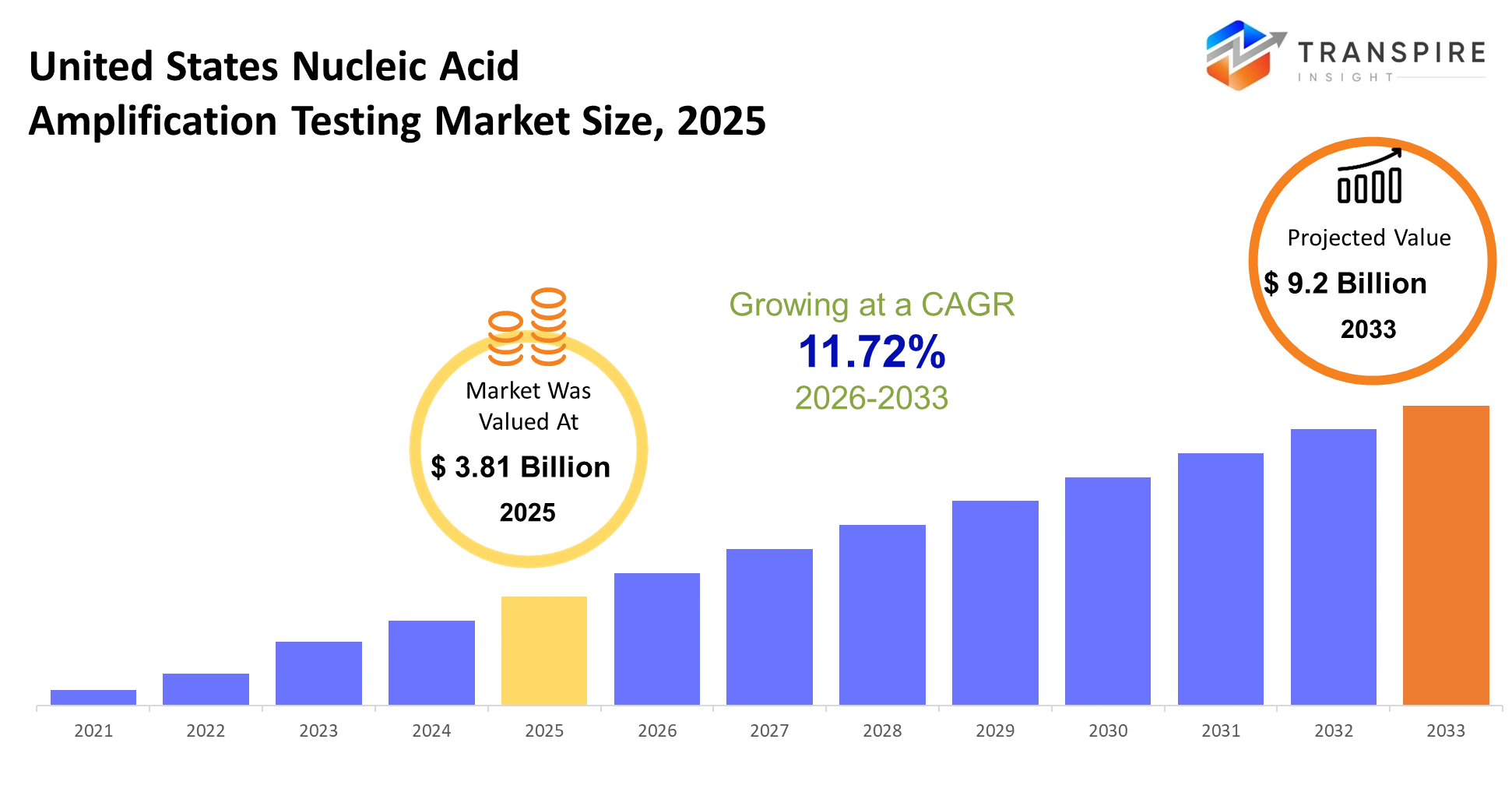
- United States Nucleic Acid Amplification Testing Market Size 2025: USD 3.81 Billion
- United States Nucleic Acid Amplification Testing Market Size 2033: USD 9.2 Billion
- United States Nucleic Acid Amplification Testing Market CAGR: 11.72%
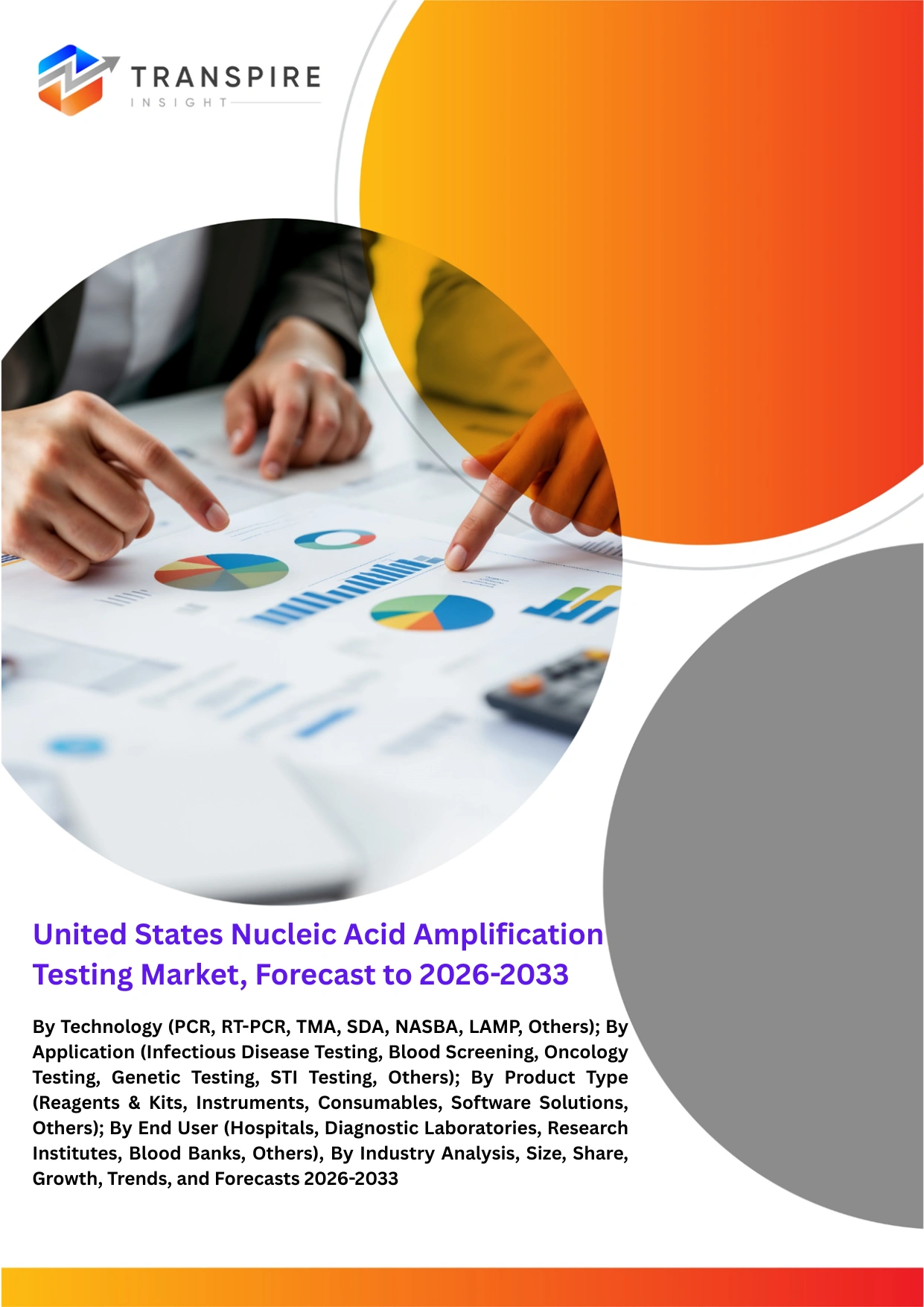
- United States Nucleic Acid Amplification Testing Market Segments: By Technology (PCR, RT-PCR, TMA, SDA, NASBA, LAMP, Others); By Application (Infectious Disease Testing, Blood Screening, Oncology Testing, Genetic Testing, STI Testing, Others); By Product Type (Reagents & Kits, Instruments, Consumables, Software Solutions, Others); By End User (Hospitals, Diagnostic Laboratories, Research Institutes, Blood Banks, Others)
To learn more about this report,  Download Free Sample Report
United States Nucleic Acid Amplification Testing Market Summary
The United States Nucleic Acid Amplification Testing Market was valued at USD 3.81 Billion in 2025. It is forecast to reach USD 9.2 Billion by 2033. That is a CAGR of 11.72% over the period.
Across the United States, nucleic acid amplification testing NAAT is used by hospitals , reference laboratories , and urgent care networks to quickly detect genetic material from viruses and bacteria in patient samples. this helps clinicians verify infections and decide on treatment or isolation , within hours rather than days , and it gets done a lot faster than older methods. Over the last 3 to 5 years, the market has shifted in a more structural way, moving away from centralized lab PCR testing. Instead, people are leaning toward decentralized, cartridge based and multiplex molecular platforms that can run at or very close to the point of care, pretty much on site.
The COVID-19 pandemic sort of acted as a big catalyst, with FDA emergency use authorizations pushing the deployment of instruments, and also forcing healthcare systems to build lasting molecular testing capacity. Because of that, quicker turnaround times improved bed management and infection containment, while stronger reimbursement support kept adoption moving in places that are not strictly hospitals, which expanded the recurring test volumes and stabilized the revenue streams for manufacturers.
Key Market Insights
- The Northeastern United States, holds about 32% share in the United States Nucleic Acid Amplification Testing Market because of dense hospital networks and advanced lab infrastructure, sort of a dense web for testing.
- Meanwhile the western region is the fastest-growing area through 2026, and it’s largely fueled by biotech expansion, plus really high adoption of automated molecular platforms.
- For the Midwest, the uptake looks more steady, supported by integrated hospital systems and also those diagnostic consolidation tendencies that keep showing up.
- When it comes to what’s being sold, consumables and reagents dominate with ~45% share, mainly because recurring testing demand keeps cycling through clinical diagnostics workflows, day after day, workflow after workflow.
- And instrument platforms still land as the second-largest segment, because of the installed PCR and isothermal amplification systems already present across a lot of labs.
- Cartridge based NAAT systems are basically the fastest growing segment through 2026, helping rapid decentralized testing adoption sort of happen.
- Infectious disease diagnostics is leading with about ~60% share, which keeps reinforcing its main role in respiratory and sexually transmitted infection testing.
- Molecular testing tied to oncology is showing up as a fast-growing use case in precision medicine programs.
- Hospital laboratories dominate with roughly ~48% share in the United States Nucleic Acid Amplification Testing Market , mainly because inpatient diagnostic volume stays high.
- Diagnostic laboratories are the fastest-growing end user group , with outsourcing and high throughput testing models backing it up.
What are the Key Drivers, Restraints, and Opportunities in the United States Nucleic Acid Amplification Testing Market?
The main growth engine is kind of the widespread roll out of rapid PCR plus isothermal amplification platforms after the COVID-19 era testing overhaul, and it’s not just a small change. Emergency use authorizations from regulators really helped speed up deployment across hospitals , and also outpatient clinics, so molecular testing got basically treated as a first line diagnostic routine. That larger structural shift has pushed test volumes higher , and in turn made reagent consumption cycles more predictable, which directly supports recurring revenue for manufacturers across the United States Nucleic Acid Amplification Testing Market.
Still even with solid adoption there’s this stubborn downside that doesn’t go away: high capital spending and per test costs stay a structural barrier, most notably for smaller clinics and rural healthcare providers. Those platforms often still require specialized infrastructure, trained personnel , plus reliable reagent supply chains that do not wobble, and because of that scaling beyond big hospital networks can get a bit tricky. So adoption ends up uneven, and part of diagnostic demand is still leaning on slower, lower-cost conventional testing, which ends up suppressing full market penetration.
The next growth stretch is showing up with fully decentralized, AI-enhanced cartridge-based NAAT platforms. Investment is speeding up in high-throughput point of care systems, especially across retail clinics and emergency departments in places like California and Texas. Firms such as Abbott are pushing compact molecular systems that reduce the turnaround time to under 30 minutes, and that opens the door for wider outpatient use. In turn, it expands the United States Nucleic Acid Amplification Testing Market beyond the classic laboratory footprint.
What Has the Impact of Artificial Intelligence Been on the United States Nucleic Acid Amplification Testing Market?
Artificial intelligence is getting used (in kind of a routine way) to automate continuous monitoring of exhaust gas cleaning systems by looking at sensor signals like SOx concentration , pressure differentials and washwater quality. With these automated control systems, the amount of manual inspection work drops, and vessels can keep compliance with IMO emission rules in near real time, more or less. Machine learning models further help with predictive maintenance too, because they can pick up early indicators of fouling , corrosion or pump inefficiencies , so operators can line up maintenance actions before a system failure shows up.
From an operational angle, shipping operators say they see better uptime and a steadier fuel consumption profile, since AI-driven optimization tweaks scrubber settings depending on engine load and what kind of sailing conditions are happening. That adjustment tends to mean more efficient fuel usage, along with less exposure to compliance penalties. Still, there is a major catch: connectivity at sea stays inconsistent, so real-time data transmission to shore-based analytics platforms is often limited, or delayed. On top of that, the models can’t always learn everything well, because they’re constrained by not enough high-quality labeled operational data coming from a wide range of maritime environments , which then lowers predictive accuracy in those annoying edge cases.
Key Market Trends
- From 2020 through 2025, hospital reliance started to move away from centralized PCR labs and more toward near-patient molecular testing, kinda across emergency care networks.
- After the whole Post-COVID funding push , a lot of the rapid NAAT rollouts sped up, and that meant installed base growth jumped notably in U.S. outpatient and urgent care settings.
- Since 2022, multiplex PCR has been going up fast, because clinicians leaned into single-panel approaches for respiratory and STI testing, so diagnostics came back faster, you know.
- Thermo Fisher Scientific, along with other firms, redirected R&D to cartridge-based setups, that reduced assay complexity and helped turnaround times stay under 60 minutes more often than before.
- Diagnostic labs also increased automation investment after 2021, plugging in high-throughput NAAT platforms to keep up with the rising infectious disease testing loads.
- During emergency use authorization windows, regulatory steps basically got faster, and they kept that momentum so FDA clearances moved quicker too, which shortened product commercialization cycles quite a bit by 2024.
- Reagent supply chains changed after pandemic disruptions, with manufacturers localizing production to cut down dependency on global logistics volatility, even if demand still kept swinging around.
- By 2025, retail clinics were expanding NAAT adoption, since decentralized care models gained traction, and testing shifted away from strictly hospital-centric workflows.
- Meanwhile competitive strategies also evolved toward instrument-plus-reagent ecosystems, kind of locking in long-term consumable-driven revenue streams across most of the U.S. market.
United States Nucleic Acid Amplification Testing Market Segmentation
By Technology :
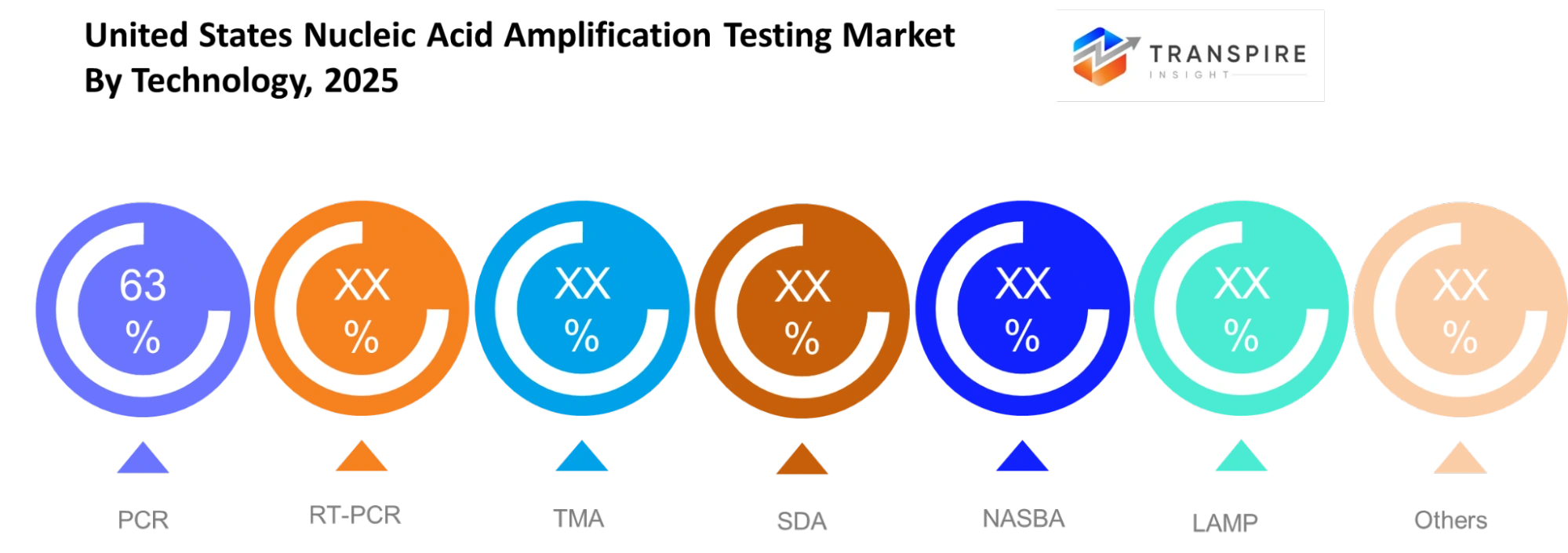
Polymerase chain reaction (PCR) and real-time PCR (RT-PCR) will keep getting used because they’re quite accurate in spotting genetic material, or so it seems in most real settings. These approaches will help with quick pathogen find ups and also with spotting genetic changes that otherwise would go unnoticed. TMA, SDA, NASBA, and LAMP should get wider adoption too, for diagnostic workflows that are faster and simpler, across many laboratories, with fewer steps here and there.
Overall tech adoption is likely to keep shifting toward options that give quicker turnaround times and stronger sensitivity, even when the sample handling is limited. RT-PCR will still matter a lot for infectious disease detection, while LAMP will fit well for low cost and rapid testing needs. Ongoing improvements in amplification systems will make results more steady and trustworthy across both clinical and research diagnostic settings .
To learn more about this report, Download Free Sample Report
By Application :
Infectious disease testing will drive demand due to the rising need for fast pathogen detection. Blood screening will back safer transfusion practices. Oncology testing will likely expand as early cancer detection gets more attention. Genetic testing will help with identifying inherited disorders, and STI testing will respond to the growing need for routine screening.
Growth in applications will also be pushed by people realizing preventive healthcare matters, plus earlier diagnosis being emphasized more often. Laboratories should use nucleic acid amplification methods more, especially when the conditions are complex and the results need to stay accurate. Expanding healthcare access will also translate into higher testing volumes, not just in hospitals and diagnostic labs but in specialized testing centers as well.
By Product Type :
Reagents and kits will probably take up a major share , since they get used again and again during each test cycle. Instruments will back automated and high-throughput testing setups and well you know, they kind of make the whole process run quicker. Consumables will stay needed for the routine lab stuff. Software solutions will help with result analysis, data tracking, and managing workflows across diagnostic facilities, kinda end to end.
Product demand will keep climbing as laboratories expand their testing capacity, plus automation levels. Reagents and kits should keep seeing steady consumption because there is continuous testing demand, no big pause really. Instruments will move toward upgrades aimed at faster processing systems. Software adoption will likely improve efficiency, cut down on errors, and enable more structured reporting in clinical diagnostics environments.
By End User :
Hospitals will use nucleic acid amplification testing for rapid diagnosis, and to guide treatment decisions right away. Diagnostic laboratories will dominate because they handle high test volumes and specialized equipment. Research institutes will use these same approaches for molecular studies and deeper investigations. Blood banks will apply testing to keep the blood supply safer , while also supporting screening accuracy.
End user demand should rise as healthcare systems put more focus on faster , more dependable diagnostics overall. Diagnostic laboratories will keep leading adoption thanks to scale and efficiency. Hospitals will expand testing capabilities for both emergency scenarios and routine care. Research groups and blood banks will support more specialized, safety-oriented applications within testing workflows.
What are the Key Use Cases Driving the United States Nucleic Acid Amplification Testing Market?
In the United States Nucleic Acid Amplification Testing Market the main use case is kind of infectious disease detection inside hospital labs , where rapid identification of respiratory viruses, influenza, and sexually transmitted infections is what pushes very high daily test counts. Hospitals lean on these diagnostics to support quick treatment decisions, plus tighter infection-control protocols, so they end up being the largest and also the most dependable demand source.
At the same time, the scope is widening into oncology focused molecular profiling, and screening for hospital acquired infections, particularly within diagnostic laboratories and across integrated health systems. These angles are picking up steam, because clinicians are leaning more often toward precision guided therapies , and stricter infection prevention benchmarks for inpatient care environments.
More recently, you can also notice new scenarios like at-home molecular testing kits, plus decentralized testing that is offered through retail clinics and emergency departments . These are enabled by cartridge based NAAT platforms and quicker regulatory approvals, and that whole combination hints at a shift toward patient-centered diagnostics outside the usual lab routine.
|
Report Metrics |
Details |
|
Market size value in 2025 |
USD 3.81 Billion |
|
Market size value in 2026 |
USD 4.23 Billion |
|
Revenue forecast in 2033 |
USD 9.2 Billion |
|
Growth rate |
CAGR of 11.72% from 2026 to 2033 |
|
Base year |
2025 |
|
Historical data |
2021 - 2024 |
|
Forecast period |
2026 - 2033 |
|
Report coverage |
Revenue forecast, competitive landscape, growth factors, and trends |
|
Geographic scope |
United States of America |
|
Key company profiled |
Roche Diagnostics, Abbott Laboratories, Hologic, Qiagen, Danaher Corporation, Thermo Fisher Scientific, Bio-Rad Laboratories, BD, Siemens Healthineers, Cepheid, Grifols, Meridian Bioscience, PerkinElmer, Agilent Technologies, Seegene |
|
Customization scope |
Free report customization (country, regional & segment scope). Avail customized purchase options to meet your exact research needs. |
|
Report Segmentation |
By Technology (PCR, RT-PCR, TMA, SDA, NASBA, LAMP, Others); By Application (Infectious Disease Testing, Blood Screening, Oncology Testing, Genetic Testing, STI Testing, Others); By Product Type (Reagents & Kits, Instruments, Consumables, Software Solutions, Others); By End User (Hospitals, Diagnostic Laboratories, Research Institutes, Blood Banks, Others) |
Which Regions are Driving the United States Nucleic Acid Amplification Testing Market Growth?
The United States kind of dominates the nucleic acid amplification testing market , mainly because the healthcare infrastructure is more advanced and the regulatory enforcement for infectious disease control is really strong. Big hospital networks plus connected diagnostic laboratories make this high-throughput testing system that keeps up continuous demand. Federal agencies, and also public health programs at the state level, actively back the shift toward rapid molecular diagnostics through reimbursement structures. So in the end this mix of policy support and a solid clinical setup makes sure the testing gets used pretty steadily, in both inpatient and outpatient care.
Meanwhile the Midwest region brings in steady revenue, pushed by its sizable base of integrated health systems and consolidated lab networks. It’s a bit different from the coastal regions, because it does not depend on quick innovation cycles , instead it leans on operational calmness and cost-efficient diagnostic processes. In many cases, long term agreements between hospital groups and diagnostic service providers keep testing volumes predictable. The region’s staying power comes more from structured procurement channels and ongoing investment in standardized laboratory automation , not from any very aggressive take up of new technologies.
The Western United States shows the fastest growth , kind of backed by expanding biotech clusters and a pretty strong push in outpatient diagnostic infrastructure . At the same time, recent state-level initiatives aimed at pandemic preparedness have helped speed up the rollout of decentralized molecular testing systems in California, and also Washington . With more people using retail clinics and urgent care facilities , access to rapid diagnostics has gotten even broader, not just in theory . For investors and market entrants it looks like a clear signal of major expansion potential through 2026–2033, and especially so for portable , cartridge-based NAAT platforms that match decentralized care models .
Who are the Key Players in the United States Nucleic Acid Amplification Testing Market and How Do They Compete?
The United States Nucleic Acid Amplification Testing Market feels moderately consolidated, not fully, but you can see a small set of global diagnostics leaders taking most of the high-volume hospital and lab contracts. What actually drives competition day to day is mostly technology performance, especially turnaround time , assay sensitivity, and platform automation , rather than just price. The incumbents kind of hold their ground with installed instrument bases and long term reagent supply arrangements, but things get more intense as decentralized models grow, and also in point-of-care environments where faster cartridge-based systems are changing how traditional lab workflows run, a bit fast, sometimes.
Abbott leans hard into decentralized molecular testing using quick point-of-care platforms like ID NOW. It’s aimed at urgent care and outpatient clinics, where people expect results within minutes. The whole approach depends on portability and workflow simplicity, so it can move more easily into settings that are not hospitals. Danaher, via Cepheid, plays from a stronger position with the GeneXpert system. It combines sample processing and PCR amplification in closed cartridges. That closed design helps reduce contamination exposure and it supports wider adoption in hospitals and in government-funded testing programs across the United States.
Thermo Fisher Scientific competes by offering high-throughput laboratory PCR instruments along with a wide reagent ecosystem that encourages repeat consumable pull. Roche, on the other hand, keeps momentum in centralized diagnostic laboratories using its cobas PCR platform, focusing on standardized large-scale testing efficiency. Hologic differentiates through high-precision molecular assays for women’s health and sexually transmitted infections, and it keeps expanding its presence in specialty diagnostic segments through hospital partnerships as well as more targeted assay development.
Company List
- Roche Diagnostic
- Abbott Laboratories
- Hologic
- Qiagen
- Danaher Corporation
- Thermo Fisher Scientific
- Bio-Rad Laboratories
- BD
- Siemens Healthineers
- Cepheid
- Grifols
- Meridian Bioscience
- PerkinElmer
- Agilent Technologies
- Seegene
Recent Development News
In April 2025, GeneDx announced the acquisition of Fabric Genomics. The acquisition strengthened GeneDx’s AI-powered genomic interpretation capabilities, enhancing its nucleic acid sequencing and diagnostic testing workflow for rare disease applications in the U.S. clinical diagnostics market.Source https://www.genedx.com/
In December 2025, GSK plc entered a strategic partnership with CAMP4 Therapeutics valued at up to $458 million to advance antisense oligonucleotide (ASO)-based nucleic acid therapeutic programs targeting regulatory RNAs. While primarily therapeutic in scope, the collaboration strengthens the broader nucleic acid technology ecosystem in the U.S., supporting downstream demand for NAAT platforms used in biomarker validation and molecular diagnostics. Source https://www.insights.bio/
What Strategic Insights Define the Future of the United States Nucleic Acid Amplification Testing Market?
The United States Nucleic Acid Amplification Testing Market is kind of structurally moving toward decentralized , high-speed molecular diagnostics that get integrated right inside outpatient and near-patient care environments. This change is mostly pushed by healthcare systems that are focusing on quicker clinical decision-making and on reducing how much they depend on centralized laboratory infrastructure. As cartridge-based platforms and multiplex assays keep getting better, value creation is getting concentrated less on the test performance by itself and more on workflow integration, so diagnostic providers are basically reshaping the way they win and keep long-term contracts.
There is also a risk that is a bit harder to see, market concentration is increasing among a small set of vertically integrated diagnostics firms, and over time this could bring pricing rigidity, plus less variety in innovation . At the same time, when providers rely on proprietary consumable ecosystems , they may end up exposed to supply chain disruptions for critical reagents, which can mess with testing continuity exactly when demand spikes.
An emerging opportunity is to plug NAAT platforms into retail healthcare networks and digital-first primary care models, especially in underserved suburban and semi-urban areas across the United States. Expansion of clinician led at home testing programs, plus new rapid regulatory clearances for self collection kits could open up even more demand too, kind of like extra momentum. Market players should put the focus on interoperable platform design that helps multi assay flexibility, so they can snag those repeat test volumes across both hospital routes and decentralized care settings, at the same time.
United States Nucleic Acid Amplification Testing Market Report Segmentation
By Technology
- PCR
- RT-PCR
- TMA
- SDA
- NASBA
- LAMP
By Application
- Infectious Disease Testing
- Blood Screening
- Oncology Testing
- Genetic Testing
- STI Testing
By Product Type
- Reagents & Kits
- Instruments
- Consumables
- Software Solutions
By End User
- Hospitals
- Diagnostic Laboratories
- Research Institutes
- Blood Banks
Frequently Asked Questions
Find quick answers to common questions.
The United States Nucleic Acid Amplification Testing Market size is USD 9.2 Billion in 2033.
Key segments for the United States Nucleic Acid Amplification Testing Market are By Technology (PCR, RT-PCR, TMA, SDA, NASBA, LAMP, Others); By Application (Infectious Disease Testing, Blood Screening, Oncology Testing, Genetic Testing, STI Testing, Others); By Product Type (Reagents & Kits, Instruments, Consumables, Software Solutions, Others); By End User (Hospitals, Diagnostic Laboratories, Research Institutes, Blood Banks, Others)
Major United States Nucleic Acid Amplification Testing Market players are Roche Diagnostics, Abbott Laboratories, Hologic, Qiagen, Danaher Corporation, Thermo Fisher Scientific, Bio-Rad Laboratories, BD, Siemens Healthineers, Cepheid, Grifols, Meridian Bioscience, PerkinElmer, Agilent Technologies, Seegene.
The United States Nucleic Acid Amplification Testing Market size is USD 3.81 Billion in 2025.
The United States Nucleic Acid Amplification Testing Market CAGR is 11.72% from 2026 to 2033.
- Roche Diagnostic
- Abbott Laboratories
- Hologic
- Qiagen
- Danaher Corporation
- Thermo Fisher Scientific
- Bio-Rad Laboratories
- BD
- Siemens Healthineers
- Cepheid
- Grifols
- Meridian Bioscience
- PerkinElmer
- Agilent Technologies
- Seegene
Recently Published Reports
-
Apr 2026
AI in Diabetic Retinopathy Market
AI in Diabetic Retinopathy Market Size, Share & Analysis Report By Type (Screening AI Systems, Diagnostic AI Systems, and Predictive AI Models), By Application Segment (Hospitals, Ophthalmology Clinics, Diagnostic Centers, and Research and Development), and Geography (North America, Europe, Asia-Pacific, Middle East and Africa, South and Central America), 2021 - 2031
-
Apr 2026
Psychometric Tests Market
Psychometric Tests Market Size, Share & Analysis Report By Type (Personality Tests, Ability/Aptitude Tests, Skill/Knowledge Tests, and Others), By Application (Talent Acquisition and Talent Management), and Geography (North America, Europe, Asia-Pacific, Middle East and Africa, South and Central America), 2021 – 2031
-
Apr 2026
Rare Biological Sample Collection Market
Rare Biological Sample Collection Market Size, Share & Analysis Report By Type (Isolation Kits & Reagent, Blood Collection Tubes, and Others), By Application (Oncology, Transcriptomics, Pharmacogenomics, and Others), and Geography (North America, Europe, Asia-Pacific, Middle East and Africa, South and Central America), 2021 – 2031
-
May 2026
Patient Lift Pendant Market
Patient Lift Pendant Market By Product Type (Wired Pendants, Wireless, Programmable), By Operation Type(Manual, Electric), By End-Users (Healthcare Professionals, Patients), By Application (Hospitals, Homecare, Rehabilitation Centers, Others), By Industry Analysis, Size, Share, Growth, Trends, and Forecasts 2021-2033
Our Clients
.jpg)