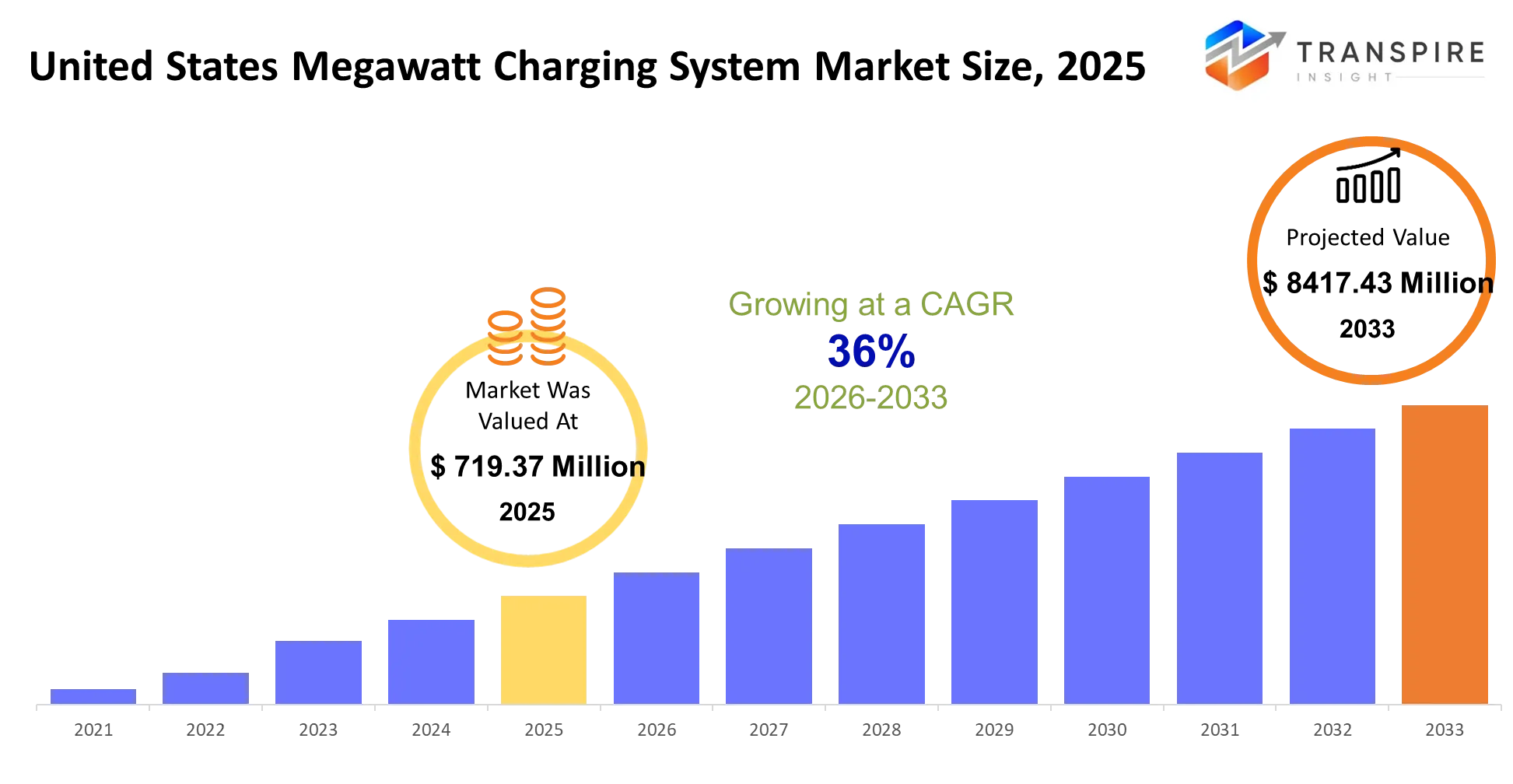
United States Megawatt Charging System Market Size & Forecast:
- United States Megawatt Charging System Market Size 2025: USD 719.37 Million
- United States Megawatt Charging System Market Size 2033: USD 8417.43 Million
- United States Megawatt Charging System Market CAGR: 36%
- United States Megawatt Charging System Market Segments: By Component (Charging Stations, Power Modules, Connectors, Cooling Systems, Software Platforms, Others); By Vehicle Type (Electric Trucks, Electric Buses, Heavy-duty Vehicles, Construction Vehicles, Others); By Charging Type (Ultra-fast Charging, Smart Charging, Bidirectional Charging, Wireless Charging, Others); By End User (Logistics Companies, Public Transport Operators, Fleet Operators, Others)
To learn more about this report,  Download Free Sample Report
United States Megawatt Charging System Market Summary
The United States Megawatt Charging System Market was valued at USD 719.37 Million in 2025. It is forecast to reach USD 8417.43 Million by 2033. That is a CAGR of 36% over the period.
The United States megawatt charging system market is, kinda building the high power charging backbone it needs to keep heavy duty electric trucks, buses, and industrial transport fleets moving without too much long operational downtime. In practice these systems solve one of electrification’s biggest pinch points: getting enough electricity to recharge large battery packs fast enough to stay aligned with commercial logistics schedules. Over the last five years the market kind of moved from pilot scale depot charging, to utility integrated corridor infrastructure built for interstate freight travel. That shift really picked up speed after federal clean transportation funding via the U.S. Department of Energy, plus stricter state level zero emission vehicle requirements made fleet operators rethink how soon they can do long haul electrification.
On top of that, supply chain disruptions during the semiconductor shortage made the diesel tied freight networks look especially fragile, so companies accelerated investment in domestic charging resilience. Now as truck manufacturers roll out higher capacity electric platforms, charging providers are scaling up megawatt capable networks to match that pace. And there’s a pretty direct revenue effect here: quicker charging tends to raise vehicle utilization, which makes fleet electrification more financially grounded, and it also pulls in bigger infrastructure contracts across logistics hubs and industrial corridors.
Key Market Insights
- The Western United States is kind of dominating the United States Megawatt Charging System Market, holding close to 38% market share in 2025, pushed by California’s zero-emission freight mandates.
- Charging hardware systems are leading the market, with roughly 46% share in 2025, and it’s mostly because high-power dispenser installations are speeding up across the country.
- Grid integration and energy management software come in as the second-largest segment, backed by the need for load balancing as well as peak-power optimization, not just one thing but both.
- Megawatt depot charging services are expected to grow the fastest through 2030, driven by private fleet electrification and the shifting shape of long-haul logistics.
- Heavy-duty electric trucks take the top spot, nearly 42% market share, showing how much freight operators are investing as they transition away from diesel fleets.
- Electric port operations ,and maritime logistics charging is kinda the fastest-growing use case as U.S. ports modernize clean transport infrastructure and stuff.
- Industrial distribution centers are popping up as a main deployment zone, mostly because warehouse fleets are getting electrified pretty quickly.
- Logistics and transportation operators still hold nearly 49% of the total demand in 2025 , fueled by commercial fleet decarbonization needs and related compliance pressure.
- Public infrastructure developers are moving the fastest among end users, it’s supported by federal funding and the whole interstate charging corridor programs.
- And then utility backed charging network operators are pushing hard , trying to lock in long term infrastructure contracts.
What are the Key Drivers, Restraints, and Opportunities in the United States Megawatt Charging System Market?
The most powerful force pushing the United States Megawatt Charging System market is the fast electrification of heavy freight haulage, kind of kicked off by federal infrastructure dollars and the zero-emission trucking rules at the state level, often guided by regions like California. Then there’s the rollout of next generation Class 8 electric trucks, with battery volumes above 800 kWh, and yeah at that point “regular” quick charging just doesn’t cut it for real commercial usage. So that tech change is basically opening up fresh money paths for charging hardware manufacturers, people who handle grid connection and integration, and also the builders of public and private charging sites. Fleet operators now want ultra high power charging setups, so they can refill a meaningful portion of battery capacity during the mandated driver rest windows. With swifter charging, fleet utilization rates go up, and that makes electric freight hauling more financially workable for long-route logistics teams.
The market's biggest structural obstacle is, honestly, grid readiness. Megawatt charging sites need big electrical horsepower, which usually means power upgrades, substation changes, close utility coordination and then lengthy permitting. Those issues are not cheap, they’re capex heavy, and they can’t be ironed out on a short clock, because they rely on utility investment schedules and local transmission headroom. As a result deployment timelines get stretched by months, or sometimes years, and that holds back near-term charging station installations. In turn, it slows the timing of revenue realization across the broader equipment supply chain and its related service providers.
A pretty forward-looking opportunity sits in dedicated freight corridor electrification, across the Midwest and the Southern logistics belt, yes kind of. Utility-backed charging hubs , paired with battery energy storage systems are showing up as a pragmatic solution that does not feel too theoretical. On top of that, investments in smart load management tech, especially depot based microgrid charging setups, could enable wide scale uptake. The key idea is cutting grid strain while still allowing uninterrupted, high-power fleet charging, even when schedules get messy.
What Has the Impact of Artificial Intelligence Been on the United States Megawatt Charging System Market?
Artificial intelligence and advanced digital control platforms are getting, kind of central to how megawatt-scale charging infrastructure runs across the United States. Charging network operators are rolling out AI driven energy management systems, to automate power distribution, keep an eye on charger health, and then dynamically balance loads across a bunch of high-capacity charging points. Basically these setups keep scanning vehicle arrival patterns, battery state-of-charge signals, plus what the grid is doing in real time. The goal is to shape charging plans in a way that won’t over stress nearby distribution assets . For big commercial fleet depots, this whole level of automation tends to bump charger utilization up, and cuts down on idle infrastructure time.
Machine learning models are also giving predictive maintenance a real boost. They look at temperature swings, connector wear behavior, power conversion irregularities and they even cross reference historical fault logs. With all that, they can spot equipment decline before it becomes an actual failure. Operators who use predictive diagnostics, have mentioned improved uptime in the 15% to 25% range, while intelligent load forecasting can help reduce peak demand charges and makes operations more cost efficient overall. There are also AI enabled route and charging synchronization tools that support compliance with federal hours-of-service rules, by lining up charging cycles with the required driver rest periods.
One big snag is the high price of weaving these digital layers into older utility systems, and honestly it’s not a small thing. A lot of charging sites still run on patchwork data environments, so model accuracy gets hit, and real-time optimization becomes less effective, kind of, even when the controls look good on paper. On top of that there’s limited historical performance data for megawatt-scale setups which keeps algorithm training more or less stuck, which then slows down the wider roll-out of more fully autonomous charging management solutions.
Key Market Trends
- Since 2023, freight operators have moved away from depot-only charge plans into corridor based megawatt style networks, to back up interstate electric truck lanes over 500 miles , or so. Tesla Inc. and ChargePoint Holdings Inc. also seemed to push liquid-cooled connectors to work harder once battery pack capacities crossed 800 kWh in 2024.
- Meanwhile, the approval timelines for utility interconnection went from about six months in 2021 to almost 18 months in a few states , so charging developers had to plan sites earlier than before.
- After 2022, federal infrastructure funding that actually landed in allocations pushed more than 35 states to rework their commercial EV corridor electrification plans and lean into high-capacity charging nodes.
- Fleet buyers have been showing more interest in modular charging systems, with setup-able power cabinets getting something like 40% higher procurement preference compared with fixed-output setups since 2023.
- Since 2024, regulators have basically shifted attention away from “how many chargers” targets, and more toward uptime standards, which made operators put money into predictive maintenance software.
- Partnerships between ABB Ltd utilities, and regional logistics hubs got much stronger, because operators wanted an integrated grid plus charging deployment model.
- Battery energy storage integration became a standout theme after peak-demand costs rose nearly 20% across major freight corridors between 2022 and 2025.
- On the hardware side, manufacturers reduced average charging cable weight by around 25% since 2021, and that made day to day usability better, which helped driver acceptance for commercial fleets.
- And more and more, OEMs bundle charging infrastructure agreements alongside truck sales, so competition shifts from standalone hardware sales, into full-service ecosystem offerings.
United States Megawatt Charging System Market Segmentation
By Component :
Charging stations form the physical backbone that lets high capacity energy actually move for heavy duty electric mobility. Power modules make sure electricity is converted in a stable and efficient way , so performance stays consistent even when operations are demanding. Connectors keep the energy flowing safely while cooling systems handle the heat that builds up during megawatt level charging, which is kinda a big deal.
On the software side, platforms will enable monitoring, scheduling, and more or less optimization of charging cycles across vehicle fleets. Integration of digital tools should also help with predictive maintenance and energy efficiency, not just “watching” things. Besides that there are supporting elements like control units and safety systems, they will strengthen overall reliability, so operations remain uninterrupted across logistics and transport networks.
By Vehicle Type :
Electric trucks will stay central due to rising demand for long haul freight electrification, you can basically feel that trend. Electric buses will support urban transport systems, benefiting from predictable routes and centralized charging infrastructure. Heavy duty vehicles will still need robust charging solutions to maintain operational continuity across industrial activities, even when usage is intense.
Construction vehicles will gradually move toward electrification, propelled by emission regulations and operational efficiency. Other categories too, including specialized industrial transport units, will expand adoption as charging infrastructure gets better. Each vehicle type will influence demand patterns depending on usage intensity and operational schedules.
By Charging Type :
Ultra-fast charging is likely to end up dominating , mostly because commercial operations really care about fewer minutes of downtime between runs. Smart charging will also show up as a kind of energy manager, optimizing how and when vehicles get charged so it matches grid capacity and those cost related signals that matter. Then there is bidirectional charging which gets described as two-way energy flow, enabling vehicles to trade power with grid systems , so overall energy balancing becomes easier, or at least more steady.
Wireless charging probably won’t arrive all at once , it will roll out gradually, with convenience in mind and less manual handling required. Meanwhile, other charging methods will surface as the tech moves forward , adding more flexibility for different scenarios and daily needs. Taken together, each charging approach should help improve efficiency, reliability, and even the scalability of the supporting infrastructure.

To learn more about this report, Download Free Sample Report
By End User :
On the adoption side, logistics companies will tend to move first, because they want faster turnaround times and they also want reduced fuel expenses. Public transport operators will concentrate on stable, scheduled charging setups so service reliability stays intact along urban routes. Fleet operators meanwhile will push for solutions that scale well and still feel cost-efficient across bigger groups of vehicles, especially when requirements start stacking up.
Operational efficiency will remain the headline priority for most end users. Infrastructure planning will follow route density, vehicle size, and the real energy demand , not just theoretical numbers. Investment behavior should reflect long-term savings, regulatory compliance requirements, and sustainability ambitions across the whole transport and mobility space.
What are the Key Use Cases Driving the United States Megawatt Charging System Market?
The main thing pushing adoption is long distance electric freight trucking, especially on interstate logistics corridors that tie together big distribution hubs across places like California, Texas and Illinois. Fleet operators basically need megawatt level charging, so they can refill those large battery packs while drivers are taking their federally mandated rest periods. So yeah, this ends up being the biggest reason so much infrastructure money is getting poured in.
A secondary wave is also showing up in port drayage fleets and the larger warehouse distribution networks. Port folks, under tighter emissions compliance requirements, are putting in ultra fast charging for electric container transport vehicles. At the same time, major retail outfits and third party logistics companies are bringing in high-capacity depot charging, to enable more regional delivery to go electric.
Some emerging use cases are electrified mining haul trucks and airport ground support fleets, where the work is heavy and the duty cycle stays high, and they need quick turnaround. There is also a pretty interesting angle with military and emergency response vehicle electrification, where dependable, high output charging systems could help keep mission critical fleets ready, especially as federal energy resilience standards keep evolving.
|
Report Metrics |
Details |
|
Market size value in 2025 |
USD 719.37 Million |
|
Market size value in 2026 |
USD 978.36 Million |
|
Revenue forecast in 2033 |
USD 8417.43 Million |
|
Growth rate |
CAGR of 36% from 2026 to 2033 |
|
Base year |
2025 |
|
Historical data |
2021 - 2024 |
|
Forecast period |
2026 - 2033 |
|
Report coverage |
Revenue forecast, competitive landscape, growth factors, and trends |
|
Geographic scope |
United States of America |
|
Key company profiled |
ABB, Siemens, Tesla, ChargePoint, Tritium, Delta Electronics, Schneider Electric, Eaton, Heliox, EVBox, Kempower, Blink Charging, Alpitronic, BorgWarner, Leviton |
|
Customization scope |
Free report customization (country, regional & segment scope). Avail customized purchase options to meet your exact research needs. |
|
Report Segmentation |
By Component (Charging Stations, Power Modules, Connectors, Cooling Systems, Software Platforms, Others); By Vehicle Type (Electric Trucks, Electric Buses, Heavy-duty Vehicles, Construction Vehicles, Others); By Charging Type (Ultra-fast Charging, Smart Charging, Bidirectional Charging, Wireless Charging, Others); By End User (Logistics Companies, Public Transport Operators, Fleet Operators, Others) |
Which Regions are Driving the United States Megawatt Charging System Market Growth?
The Western United States kind of leads the megawatt charging system market, with California acting as the main anchor point for deployment activity. People often point to its dominance because of very assertive zero-emission trucking mandates, plus the dense freight flow that funnels through ports like the Port of Los Angeles . On top of that, early utility investment has helped push high-capacity grid upgrades. Big logistics players across the region have ramped up electric fleet purchases to stay aligned with tightening emissions standards, and also to lock in longer-term operational savings. You can also see this leadership sticking around because there’s a fairly mature ecosystem—charger manufacturers, grid services providers, software developers, and public funding programs that collectively lower deployment risk, sort of makes everything less wobbly.
The Midwest takes the second-largest spot though, but its strength feels more rooted in economic stability than in regulatory urgency. Unlike the West where policy seems to drive everything forward, Midwestern growth is tied to long-established freight density, manufacturing output, and steady private capital from fleet operators. States like Illinois and Ohio benefit from warehouse clusters that are widespread, and interstate distribution corridors that keep utilization looking predictable. So, charging providers get a more dependable revenue base, and the region keeps more long-term resilience even when policy frameworks shift at a slower pace.
The Southern United States seems to be coming up as the fastest growing region after those recent federal infrastructure awards, and then utility backed freight electrification programs basically sped up project development. Texas, Georgia, and Tennessee have expanded grid modernization efforts, to help handle high output charging being deployed close to logistics and manufacturing hubs. Meanwhile, rising investment from electric truck OEM assembly plants in the region is also driving local demand for supporting charging ecosystems. For investors and new entrants, this kind of momentum points to a big window between 2026 and 2033, because lower deployment costs and wider industrial electrification are making the ground more favorable for quick market penetration.
Who are the Key Players in the United States Megawatt Charging System Market and How Do They Compete?
The competitive landscape of the United States megawatt charging system market is still moderately concentrated, yet competition is getting sharper because utility backed infrastructure developers EV charging specialists and truck manufacturers seem to converge around heavy duty electrification . Most established charging infrastructure providers are trying to hold their ground via integrated software ecosystems and grid services know-how, while newer players are starting to nudge the market using modular architectures and fleet specific rollout models . Tech performance now feels like the main battleground, especially on charging speeds, liquid cooled connector durability, load management intelligence, and uptime assurances . And then there is geographic reach too , because companies that land utility partnerships across the freight corridors can get a real deployment edge.
ABB Ltd. is pushing forward with power electronics innovation and deep grid integration. Its real differentiator is utility scale energy management systems, which help operators squeeze more value out of megawatt charging loads without constantly overbuilding local infrastructure. The company keeps growing by leaning on strategic partnerships with freight corridor developers, as well as utility operators . Tesla, Inc. goes with a vertically integrated playbook, mixing truck platform development with a proprietary charging architecture. That combination helps tighten battery to charger optimization, and it also tends to shorten deployment cycles .
ChargePoint Holdings, Inc. tends to emphasize software-led fleet charging orchestration , basically helping commercial depot operators get better scheduling and also predictive upkeep. The real edge is more about service-layer flexibility mixed with integration across mixed fleet operations, not just one single feature. Siemens AG then stands out via large-scale grid modernization know-how, they usually aim at industrial charging hubs where electrical infrastructure complexity becomes a real wall for smaller rivals. And on the other side, Blink Charging Co. is pushing ahead through regional fleet partnerships, targeting logistics corridors that are still kind of underserved, where quicker site deployment becomes that first mover advantage . Overall, it reads like each player is leaning into a different angle, even if the end goal overlaps.
Company List
- ABB
- Siemens
- Tesla
- ChargePoint
- Tritium
- Delta Electronics
- Schneider Electric
- Eaton
- Heliox
- EVBox
- Kempower
- Blink Charging
- Alpitronic
- BorgWarner
- Leviton
Recent Development News
In October 2025, WattEV launched a solid-state transformer for megawatt charging deployment. The company introduced a modular medium-voltage power conversion system designed to accelerate rollout of Megawatt Charging System (MCS) infrastructure across U.S. heavy-duty truck depots, reducing installation costs and improving charging scalability for freight electrification.Source https://wattev.com/
In January 2025, the U.S. Department of Energy committed $68 million in funding for heavy-duty electric vehicle charging projects. Several awarded projects included deployment of MCS-compatible charging infrastructure for Class 8 truck corridors in the United States, strengthening domestic high-power charging buildout and accelerating commercialization of megawatt-scale freight charging.Source https://www.energy.gov/
What Strategic Insights Define the Future of the United States Megawatt Charging System Market?
Over the next five to seven years, the United States megawatt charging system market is quietly moving toward a more utility-integrated infrastructure model, where charging assets are basically distributed energy nodes, not just stand alone refueling points. And this direction is getting pulled by a few things that line up at once: heavy-duty fleet electrification mandates, grid digitization, plus the practical need to synchronize charging cycles with freight logistics efficiency. So, the market’s path seems to lean into deeper integration between charging operators, utilities, and the fleet management software platforms, like all of it has to talk to each other.
There’s also a less visible risk, more like a background thing that can still matter a lot. The market could become concentrated around a limited number of grid-connected freight corridors. If deployment capital keeps flowing only into the high-volume routes, then secondary freight regions might end up with infrastructure gaps. In other words, adoption of electric trucks nationwide could slow down, even if interest is there. That sort of imbalance could also flatten utilization rates and, over time, make returns weaker for providers that are too exposed to markets that are already overserved.
On the opportunity side, a significant emerging angle is battery-buffered megawatt charging hubs across the Southern manufacturing belt. There, grid modernization programs are accelerating, which helps the case for faster buildouts. For participants, one of the most effective strategies is to lock in early utility partnerships and put money into modular, software-optimized charging architectures. In the end, companies that can build flexible systems that scale with regional grid constraints will be in a better spot to win long-term infrastructure contracts, as commercial fleet electrification keeps expanding.
United States Megawatt Charging System Market Report Segmentation
By Component
- Charging Stations
- Power Modules
- Connectors
- Cooling Systems
- Software Platforms
By Vehicle Type
- Electric Trucks
- Electric Buses
- Heavy-duty Vehicles
- Construction Vehicles
By Charging Type
- Ultra-fast Charging
- Smart Charging
- Bidirectional Charging
- Wireless Charging
By End User
- Logistics Companies
- Public Transport Operators
- Fleet Operators
Frequently Asked Questions
Find quick answers to common questions.
The United States Megawatt Charging System Market size is USD 8417.43 Million in 2033.
Key segments for the United States Megawatt Charging System Market are By Component (Charging Stations, Power Modules, Connectors, Cooling Systems, Software Platforms, Others); By Vehicle Type (Electric Trucks, Electric Buses, Heavy-duty Vehicles, Construction Vehicles, Others); By Charging Type (Ultra-fast Charging, Smart Charging, Bidirectional Charging, Wireless Charging, Others); By End User (Logistics Companies, Public Transport Operators, Fleet Operators, Others).
Major United States Megawatt Charging System Market players are ABB, Siemens, Tesla, ChargePoint, Tritium, Delta Electronics, Schneider Electric, Eaton, Heliox, EVBox, Kempower, Blink Charging, Alpitronic, BorgWarner, Leviton.
The United States Megawatt Charging System Market size is USD 719.37 Million in 2025.
The United States Megawatt Charging System Market CAGR is 36% from 2026 to 2033.
- ABB
- Siemens
- Tesla
- ChargePoint
- Tritium
- Delta Electronics
- Schneider Electric
- Eaton
- Heliox
- EVBox
- Kempower
- Blink Charging
- Alpitronic
- BorgWarner
- Leviton
Recently Published Reports
-
Apr 2026
ATV & UTV Market
ATV & UTV Market Size, Share & Analysis Report By Type (ATV, and UTV), By Variants (Less Than 400 CC, 400 CC To 800 CC, and More Than 800 CC), and Geography (North America, Europe, Asia-Pacific, Middle East and Africa, South and Central America), 2021 - 2031
-
Apr 2026
Automotive Central Gateway Module Market
Automotive Central Gateway Module Market Size, Share & Analysis Report By Type (Ethernet Central Gateway Module, CAN Central Gateway Module, LIN Central Gateway Module, and FlexRay), By Application (Powertrain Control, Body Control, Infotainment System, Advanced Driver Assistance Systems (ADAS), and Others), By End User (Passenger Vehicles, and Commercial Vehicles), and Geography (North America, Europe, Asia-Pacific, Middle East and Africa, South and Central America), 2021 - 2031
-
Apr 2026
Automotive Engine Oil Filter Market
Automotive Engine Oil Filter Market Size, Share & Analysis Report By Filter Type (Fuel Filter, Engine Oil Filter, Hydraulic Oil Filter, and Others), By Filter Media (Cellulose, Synthetic, and Micro), By Sales Channel (OEMs, and Aftermarket), By Vehicle Type (Passenger Cars, Light Commercial Vehicles, Heavy Duty Trucks, Buses and Coaches, and Off-road Vehicles), and Geography (North America, Europe, Asia-Pacific, Middle East and Africa, South and Central America), 2021 - 2031
-
Apr 2026
Automotive Parts Aluminium Die Casting Market
Automotive Parts Aluminium Die Casting Market Size, Share & Analysis Report By Production Process (Pressure Die Casting, Vacuum Die Casting, Squeeze Die Casting, Gravity Die Casting), By Application (Body Parts, Engine Parts, Transmission Parts, Battery And Related Components, Other Application Types), and Geography (North America, Europe, Asia-Pacific, Middle East and Africa, South and Central America), 2021 - 2031
Our Clients