

United States Medicinal Mushroom Market Summary
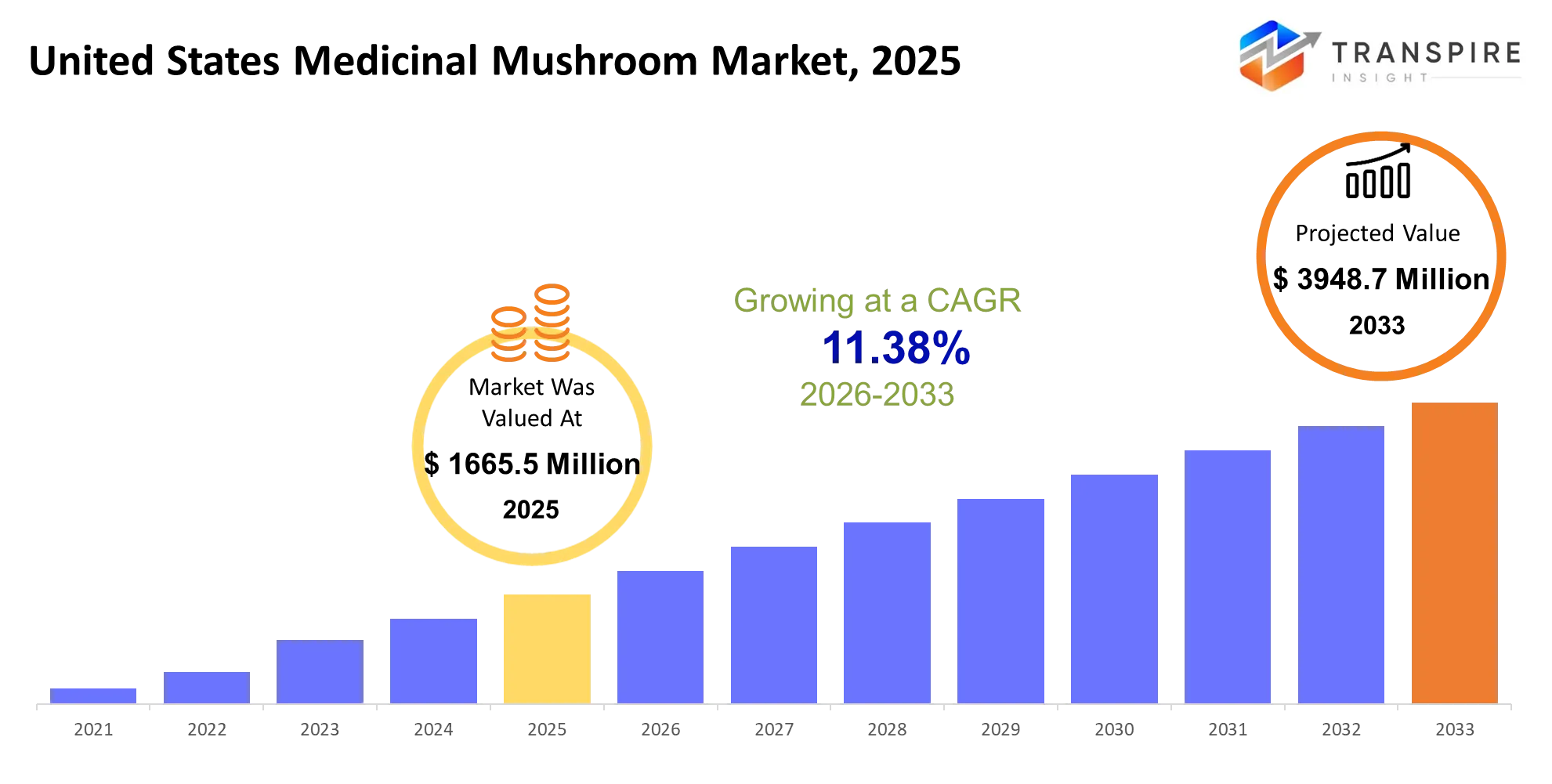
As per Transpire Insight, the United States Medicinal Mushroom Market size is estimated at USD 1665.5 Million in 2025 and is anticipated to reach USD 3948.7 Million by 2033, growing at a CAGR of 11.38% from 2026 to 2033.
The United States medicinal mushroom market provides concentrated mushroom ingredients plus final products that get used in dietary supplements, functional foods, beverages, and general wellness formulas. In the last 3–5 years, things have kind of moved away from “just niche capsules” and into more handy powders , gummies , coffees and blended functional products. During this shift, lion’s mane and reishi have been getting a lot more commercial attention, and you can see that in the way new items keep appearing on shelves.
It’s also being reported that U.S. sales of functional mushrooms jumped about 450% between 2021 and 2025, which is kind of helping retail adoption and driving more product launches along the way. There’s also a major kind of structural shift, in particular the move toward standardized extracts plus branded formulations, not just whole dried mushroom pieces. Online retail meanwhile has shortened the gap from smaller specialty producers to actual consumers, so the uptake feels faster. Still, at the same time, FDA rules around structure/function claims have sort of nudged manufacturers toward substantiated, carefully worded positioning, instead of looser wording.So instead of broad promises, companies are leaning into wording that’s supported and more controlled. Market revenue is forecast to increase from USD 1,665.5 million in 2025 up to USD 3,948.7 million by 2033, as manufacturers broaden higher-value extracts , ready-to-use formats, and formulations that are more clinically framed.
United States Medicinal Mushroom Market Size & Forecast:
- United States Medicinal Mushroom Market Size 2025: USD 1665.5 Million
- Expected Market Value 2033: USD 3948.7 Million
- Forecast CAGR: 11.38%
- Key Profile: Host Defense, Real Mushrooms, Four Sigmatic, Om Mushroom Superfood, Gaia Herbs, Mushroom Wisdom, Oriveda, Nammex, FreshCap Mushrooms, Swanson Health, Nature's Way, Solaray, Bio-Botanica, Aloha Medicinals, New Chapter
Key Market Insights
- In 2025 the West kind of dominated the market, backed by long-standing wellness brands, specialty retailers and pretty strong functional food adoption… you know, the usual momentum. Meanwhile, the South is forecasted to be the fastest growing region through 2033, partly because online distribution is expanding and specialty wellness retail is getting more shelf, or at least more attention, in general.
- Reishi was in a leading product spot, while Lion’s Mane showed better momentum over time, especially within cognitive health and focus oriented formulations. Capsules stayed the big format, but powders, gummies and functional beverages quietly started taking more shelf space between 2022–2026.
- For application, dietary supplements still were the dominant chunk, kind of helped by retail distribution already in place and solid supplement manufacturing knowhow, yes. Functional beverages also moved quick, with some brands mixing mushroom extracts into coffee , energy drinks, and these ready to consume wellness options, that people grab on the go.
- After 2020, online retail got stronger , which made it easier for specialist brands to reach consumers without leaning on so much broad physical store distribution. At the same time, manufacturers began pointing out extraction methods , beta-glucan content, sourcing and third party testing, trying to stand out with what they describe as premium formulations. It just feels more disciplined, like somehow everyone has to show receipts now.
- Even FDA labeling requirements nudged more structured structure/function claims, so the whole “unsupported disease treatment” angle gets more constrained. Companies like Host Defense, Real Mushrooms, Four Sigmatic, Om Mushroom Superfood, Gaia Herbs, and FreshCap Mushrooms keep moving forward and competing through product innovation and channel expansion, even if their routes are a bit different.
What are the Key Drivers, Restraints, and Opportunities in the United States Medicinal Mushroom Market?
Driver: Product diversification has turned into the most powerful commercial driver . Starting around 2021, mushroom ingredients have basically shifted past the classic capsule format into coffees powders gummies beverages, and even combo supplements , which means more “buy moments” and manufacturers can often request higher prices for more distinctive formulations. In the U.S., functional mushroom sales were reported to have climbed roughly 450% from 2021 through 2025, suggesting how fast product forms can scale up market revenue.
Restraint: Still, solid scientific substantiation and the way regulatory claim rules work act like a structural limitation. The FDA allows structure / function claims but only under specific conditions , whereas anything marketed to diagnose treat cure or prevent disease gets handled as drug territory. On top of that, the clinical proof base for a number of widely discussed mushroom advantages is limited, so trying to market in an aggressive health-claims style becomes harder, which slows down “pharmaceutical-like” adoption.
Opportunity: Standardized extracts, traceable sourcing, and data-supported formulations really point to a credible expansion route. Digital quality systems and computer vision cultivation can raise consistency levels, while mushroom-focused datasets are already being used to back automated growth monitoring and quality checks. A 2024 dataset with more than 18,000 individual mushroom instances shows the tech groundwork is growing for more automated mushroom production.
What Has the Impact of Artificial Intelligence Been on the United States Medicinal Mushroom Market?
Artificial intelligence is starting to creep into medicinal mushroom production via more controlled-environment monitoring, computer vision, and those predictive cultivation models people keep talking about. With sensors it becomes possible to continuously track temperature, humidity, airflow, carbon dioxide, plus substrate conditions too, and then machine-learning systems can flag odd growing conditions before quality losses get really noticeable. There’s research showing neural network style prediction of a mushroom-growing-room temperature, and one study even reported a correlation coefficient around 0.966 for system behavior prediction (basically it follows along closely). At the same time computer vision is also trending toward automated growth monitoring, size classification , quality inspection , and harvesting, and it’s getting help from mushroom specific datasets like the M18K benchmark, which includes more than 18,000 annotated instances. All of this can cut down on manual checking , make batches a lot more consistent, and support a tighter environmental control loop, which may then turn into higher yield while also lowering operational waste. Still, AI adoption stays somewhat limited because integration costs are high, cultivation data is scattered across places, and model accuracy can wobble when you switch between mushroom varieties or different growing environments. Newer synthetic-data approaches are easing parts of the training data gap, but the real-world validation step is still required, every single time, in practice.
Key Market Trends
- Since 2021, functional mushroom sales have supposedly climbed around 450% ,and it’s been pushing product launches faster across drinks, foods, and supplements kind of all at once.
- From 2022 onward, Lion’s Mane offerings have gotten a stronger place in the market tied to cognition, focus, and that productivity centered wellness idea.
- Starting around 2020, online channels apparently helped specialist mushroom brands grow by lowering the reliance on physical specialty-store distribution.
- Across 2023–2026 , mushroom coffee and ready to drink items broadened who they can reach, beyond the usual supplement buyer crowd.
- Manufacturers have been leaning more into standardized extracts, beta-glucan specifications, and third-party testing, mostly so they can sell a more premium narrative.
- Since 2024, computer vision research advanced automated mushroom detection, quality checks, growth monitoring, and harvesting applications, not just lab experiments.
- FDA compliant structure/function positioning has become extra important too, as companies try to use commercially useful claims while staying clear of drug-claim lines.
- From 2024 forward, mushroom specific datasets have supported more advanced AI models for automated cultivation and quality control systems.
- Premium brands are also trying to stand out using extraction methods, fruiting body sourcing, traceability, and quantified active compounds, rather than only naming the species.
- Competition has sort of moved toward multi format portfolios, where big players keep expanding capsules powders beverages gummies tinctures and combination formulas all together, instead of sticking to one lane.
United States Medicinal Mushroom Market Segmentation
By Mushroom Type:
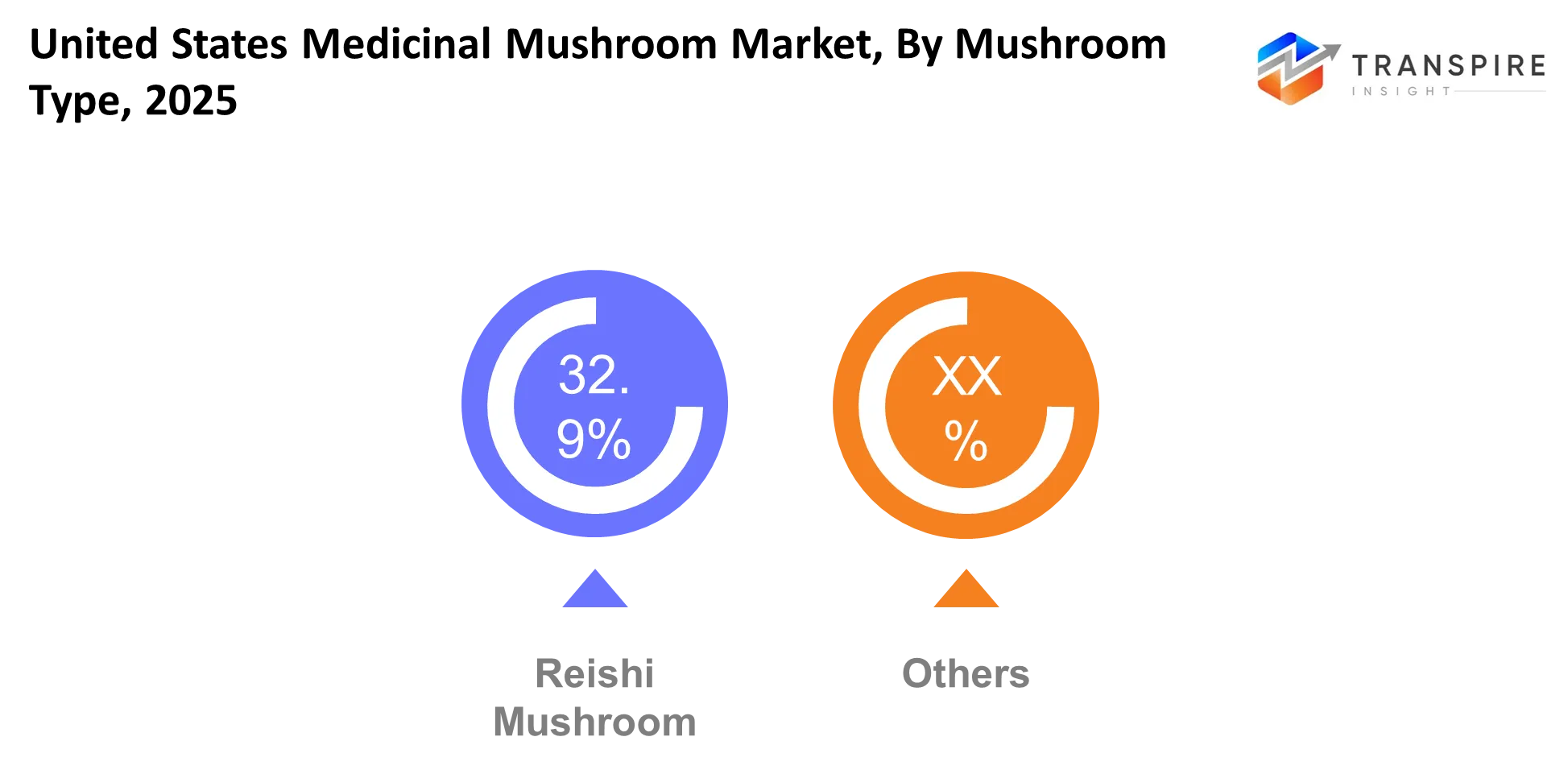
Reishi really has a pretty strong commercial footing, mostly since established supplement brands keep putting Reishi into capsules, powders, extracts and wellness blends. Lion’s Mane has picked up solid momentum, not just from general use but from that cognitive- health angle, yknow, and Cordyceps rides along with sports nutrition and energy centered formulations. Chaga plus Turkey Tail still hold onto that niche, immune support type of demand.
Meanwhile, Shiitake and Maitake sort of bridge two worlds, food and wellness, and that also helps everyday consumers feel more familiar with them. Tremella trends more beauty oriented in the way it gets formulated , and Agaricus Blazei , plus other similar varieties, stay kinda more specialized overall. Going forward, product innovation will likely keep shifting commercial attention toward varieties that use standardized extracts and also offer straightforward formulation benefits.
By Form:
Capsules are a big commercial thing, mostly because they give standardized dosing , plus they’re easy to stash and they also match the usual supplement-channel habits. Powders meanwhile feel more adaptable because you can fold them into smoothies , brew them into coffee, or mix them into foods and pretty much anything. Tablets also stay in the mix as another well known format for supplements. Then liquid extracts and tinctures come in with concentrated formulations , good for people who want more flexibility in how much they take per serving.
Gummies and functional beverages have also picked up a lot of momentum, really by making the taste better and the whole process convenient . Softgels, dried mushrooms , and a few other niche formats keep pulling in specialist demand, while manufacturers increasingly lean on formulation technology to make improvements in flavor, stability, absorption and shelf life too. Premium brands will keep pushing and expanding these convenient forms across online stores and specialty retail spots .
By Application:
Dietary Supplements represent the top application, mainly because mushroom extracts slot well into well established supplement manufacturing, retail distribution, and how people actually buy things. Pharmaceuticals still count as a more specialized application, they do need firmer clinical validation and regulatory backing. Functional foods and functional beverages then open up wider commercial chances, since they can be worked into everyday consumption moments
Cosmetics, immune-support products, cognitive-health formulations and sports nutrition keep adding more routes to market. Traditional medicine also stays relevant, supported by known mushroom varieties plus familiar extract formats. Going forward, manufacturers will go after specific wellness outcomes with more differentiated formulations, not just lean on a broad mushroom based story.
By Distribution Channel:
Online retail has gained a lot more importance, mostly because digital channels let specialist mushroom brands push through directly to consumers, while also sharing a lot more detailed ingredient information. Pharmacies and health and wellness stores add credibility, plus they come with familiar, established routines for buying supplements . Supermarkets and specialty stores, on the other hand , help broaden product visibility through more physical distribution.
Direct sales and e-commerce platforms also help smaller brands, because the distribution barriers stay lower and the brand can keep a closer relationship with customers. Hospital pharmacies stay a more specialized channel , and they matter most when the product is clinically positioned. Distribution strategies will likely keep mixing the digital reach with a carefully chosen handful of physical retail partners, kind of like a hybrid approach .
By End User:
Adults are still the biggest consumer group , mostly because mushroom products slip into general wellness, dietary supplementation and those functional food routines that people already do. Health-aware buyers and fitness enthusiasts are also driving demand, especially for blends focused on cognitive wellness, immune support , more energy, and sports nutrition kinds of needs. Athletes then form a key niche too, with Cordyceps being a common example for performance oriented products.
Elderly consumers in particular show a major opening for items framed around healthy aging, along with cognitive assistance , as long as the evidence is solid and the claims stay compliant. There are also more focused audiences , like patients, women , and men. In the meantime, product manufacturers will keep dividing their formulations by the specific wellness goal and even by the consumption occasion , so the usage fits the moment rather than just the ingredient.
What are the Key Use Cases Driving the United States Medicinal Mushroom Market?
Dietary supplements still stay at the center of it because capsules, powders, extracts, and tablets give standardized intake and they fit with the usual U.S. supplement buying behavior. Things like Reishi, Lion’s Mane, Cordyceps, and Chaga help people build more distinct formulas, you know, for immune, brain performance, calmness, and sports nutrition angles.
Then you have functional beverages and functional foods as a kind of secondary expansion. Mushroom coffee, ready to drink options, snack items, and wellness blends let manufacturers tap adults, gym minded folks, and health centered buyers using those normal “grab and go” moments.
Some newer use cases are mushroom based cosmetics, cognitive health mixes, and more advanced standardized extracts too. AI assisted cultivation and quality control tech can help keep things consistent, plus make traceability way clearer, so premium products have an easier time standing out, especially when manufacturers want stronger differentiation.
|
Report Metrics |
Details |
|
Market size value in 2025 |
USD 1665.5 Million |
|
Market size value in 2026 |
USD 1857.1 Million |
|
Revenue forecast in 2033 |
USD 3948.7 Million |
|
Growth rate |
CAGR of 11.38% from 2026 to 2033 |
|
Base year |
2025 |
|
Historical data |
2021 - 2024 |
|
Forecast period |
2026 - 2033 |
|
Report coverage |
Revenue forecast, competitive landscape, growth factors, and trends |
|
Regional scope |
United States; Canada; Mexico; United Kingdom; Germany; France; Italy; Spain; Denmark; Sweden; Norway; China; Japan; India; Australia; South Korea; Thailand; Brazil; Argentina; South Africa; Saudi Arabia; United Arab Emirates |
|
Key company profiled |
Host Defense, Real Mushrooms, Four Sigmatic, Om Mushroom Superfood, Gaia Herbs, Mushroom Wisdom, Oriveda, Nammex, FreshCap Mushrooms, Swanson Health, Nature's Way, Solaray, Bio-Botanica, Aloha Medicinals, New Chapter |
|
Customization scope |
Free report customization (country, regional & segment scope). Avail customized purchase options to meet your exact research needs. |
|
Report Segmentation |
By Mushroom Type (Reishi, Lion's Mane, Chaga, Cordyceps, Turkey Tail, Shiitake, Maitake, Tremella, Agaricus Blazei, Others); By Form (Capsules, Powders, Tablets, Liquid Extracts, Gummies, Softgels, Functional Beverages, Tinctures, Dried Mushrooms, Others); By Application (Dietary Supplements, Pharmaceuticals, Functional Foods, Functional Beverages, Cosmetics, Immune Support, Cognitive Health, Sports Nutrition, Traditional Medicine, Others); By Distribution Channel (Online Retail, Pharmacies, Health & Wellness Stores, Supermarkets, Specialty Stores, Direct Sales, E-commerce Platforms, Hospital Pharmacies, Others); By End User (Adults, Elderly, Athletes, Health-Conscious Consumers, Patients, Fitness Enthusiasts, Women, Men, Others) |
Which Regions are Driving the United States Medicinal Mushroom Market Growth?
The Western United States kind of leads the market, backed by a pretty mature natural products ecosystem , plus solid specialty wellness retail, and then a heavy presence of mushroom cultivation paired with supplement operations. Washington, Oregon and California give you those established pathways that run from growing, extraction, and formulation, over to branding, and then finally direct-to-consumer delivery. Host Defense , sitting near Washington’s Olympic Rainforest, shows how regionally specialized the industry is and how long those mushroom supplement capabilities have been around. Put together, you get reliable suppliers, wellness-minded shoppers, and a more sophisticated e-commerce setup, so the West ends up with a strong footing for premium mushroom offerings.
The Northeast looks more like a different engine for growth. Here, the momentum is supported by dense healthcare, pharmaceutical, research , and specialty retail networks. The big metropolitan hubs provide manufacturers with access to higher-income consumers and established distribution ties, across pharmacies, wellness shops, and also online storefronts. This area also tends to connect nutritional products more closely with clinical research and evidence-focused wellness storytelling than the cultivation-first style you see in parts of the West. As a result, it can create steadier revenue chances , even if discretionary wellness spending slows down a bit or gets shaky.
Then the Southern United States shows the most noticeable growth push. Population growth, more retail build-out, and wider uptake of functional wellness products are basically opening up new channels. Texas, Florida, and nearby markets bring large customer pools, and their supermarket shelves, specialty-store aisles, and e-commerce networks are expanding.
Who are the Key Players in the United States Medicinal Mushroom Market and How Do They Compete?
Competition is still kind of fragmented, because the market has specialist extract suppliers, supplement makers, functional beverage brands, and also these big wellness distributors all in the mix. So, really companies tend to go after differentiation using ingredient quality, extraction methodology, what the product actually looks like in practice (like powder , capsules, drinks, gummies etc.) , testing transparency, brand credibility, and retail reach , not only price. Host Defense kind of leans into mushroom mycelium know-how and science-led formulation, while Four Sigmatic goes for a more familiar angle, putting functional mushrooms into everyday categories like coffee, tea, and even protein.
Real Mushrooms along with Nammex usually wrestle over fruiting-body versus extract quality, and they market that clarity to consumers, and brands that want cleaner ingredient specifications. Nammex also added more technical lift with ErinaPrime, which is described as a pure freeze-dried Lion’s Mane mycelium ingredient without grain fillers, and it comes with verified Erinacine A levels. Meanwhile Host Defense keeps widening the brand map through targeted formulas and new formats, including supplements aimed at women, plus that Grateful Dead gummy collaboration that rolled out in 2026. Four Sigmatic continues to stand out by slotting mushroom ingredients into the kinds of daily-use products people already buy, rather than leaning only on the typical supplement format.
Company List
- Host Defense
- Real Mushrooms
- Four Sigmatic
- Om Mushroom Superfood
- Gaia Herbs
- Mushroom Wisdom
- Oriveda
- Nammex
- FreshCap Mushrooms
- Swanson Health
- Nature's Way
- Solaray
- Bio-Botanica
- Aloha Medicinals
- New Chapter
Recent Development News
- "In February 2026, Host Defense launched Grateful Dead Gummies in collaboration with the Grateful Dead. The mushroom mycelium gummies introduced a mainstream lifestyle collaboration and expanded the brand’s presence in the convenient gummy format.https://hostdefense.com/blogs/press-releases/host-defense-mushrooms-launches-grateful-dead-gummies-in-first-ever-wellness-supplement-collaboration-with-the-grateful-dead (Host Defense)."
- "In April 2026, Hypha Labs entered a partnership with Mycology Resources, LLC. The agreement combines Mushroom Accelerator technology and MicroPearls delivery technology with cultivation, extraction, and distribution capabilities to develop scalable mushroom ingredients and technologies.https://www.accessnewswire.com/newsroom/en/healthcare-and-pharmaceutical/hypha-labs-inc.-otcqb-funi-announces-partnership-with-mycology-resour-1156016 (ACCESS Newswire)."
- "In December 2025, FBC Holding acquired Mushroom Madness through a stock-based transaction. The acquisition expanded FBC Holding’s functional wellness portfolio with vegan, adaptogen-infused mushroom formulations and strengthened its entry into the mushroom wellness sector.https://www.nasdaq.com/press-release/fbc-holding-inc-fbcd-acquires-mushroom-madness-accelerate-entry-explosive-mushroom (Nasdaq)."
What Strategic Insights Define the Future of the United States Medicinal Mushroom Market?
It feels like the market is structurally moving away from generic mushroom supplements, toward standardized, targeted, and convenient formulations, mostly pulled by stronger segmentation and the fact that mushroom ingredients are sneaking into everyday foods and drinks. At the same time, there is a less obvious risk, basically ingredient-quality fragmentation, where extraction methods vary, raw material specs change, and even labeling practices end up drifting around a bit . That kind of inconsistency can quietly erode consumer confidence, and then premium products get harder to tell apart from low-cost options.
The bigger emerging win seems to be standardized mushroom ingredients, but backed by measurable bioactive compounds, plus digital batch traceability , and AI supported cultivation. Together, those things can boost consistency while also helping B2B partners feel more confident in formulation claims. Nammex’s recent pure Lion’s Mane mycelium launch, with verified Erinacine A, is a pretty clear example of where this is going.
So market players should really focus on controlled sourcing, third party testing, quantified active compounds, and targeted product formats rather than just adding more SKU s without a real, clear differentiation.
United States Medicinal Mushroom Market Report Segmentation
By Mushroom Type
- Reishi
- Lion's Mane
- Chaga
- Cordyceps
- Turkey Tail
- Shiitake
- Maitake
- Tremella
- Agaricus Blazei
- Others
By Form
- Capsules
- Powders
- Tablets
- Liquid Extracts
- Gummies
- Softgels
- Functional Beverages
- Tinctures
- Dried Mushrooms
- Others
By Application
- Dietary Supplements
- Pharmaceuticals
- Functional Foods
- Functional Beverages
- Cosmetics
- Immune Support
- Cognitive Health
- Sports Nutrition
- Traditional Medicine
- Others
By Distribution Channel
- Online Retail
- Pharmacies
- Health & Wellness Stores
- Supermarkets
- Specialty Stores
- Direct Sales
- E-commerce Platforms
- Hospital Pharmacies
- Others
By End User
- Adults
- Elderly
- Athletes
- Health-Conscious Consumers
- Patients
- Fitness Enthusiasts
- Women
- Men
- Others
Frequently Asked Questions
Find quick answers to common questions.
The expected United States Medicinal Mushroom Market size for the market will be USD 3948.7 Million in 2033.
Key segments for the United States Medicinal Mushroom Market are By Mushroom Type (Reishi, Lion's Mane, Chaga, Cordyceps, Turkey Tail, Shiitake, Maitake, Tremella, Agaricus Blazei, Others); By Form (Capsules, Powders, Tablets, Liquid Extracts, Gummies, Softgels, Functional Beverages, Tinctures, Dried Mushrooms, Others); By Application (Dietary Supplements, Pharmaceuticals, Functional Foods, Functional Beverages, Cosmetics, Immune Support, Cognitive Health, Sports Nutrition, Traditional Medicine, Others); By Distribution Channel (Online Retail, Pharmacies, Health & Wellness Stores, Supermarkets, Specialty Stores, Direct Sales, E-commerce Platforms, Hospital Pharmacies, Others); By End User (Adults, Elderly, Athletes, Health-Conscious Consumers, Patients, Fitness Enthusiasts, Women, Men, Others).
Major United States Medicinal Mushroom Market players are Host Defense, Real Mushrooms, Four Sigmatic, Om Mushroom Superfood, Gaia Herbs, Mushroom Wisdom, Oriveda, Nammex, FreshCap Mushrooms, Swanson Health, Nature's Way, Solaray, Bio-Botanica, Aloha Medicinals, New Chapter.
The United States Medicinal Mushroom Market size is USD 1665.5 Million in 2025.
The United States Medicinal Mushroom Market CAGR is 11.38%from 2026 to 2033.
- Host Defense
- Real Mushrooms
- Four Sigmatic
- Om Mushroom Superfood
- Gaia Herbs
- Mushroom Wisdom
- Oriveda
- Nammex
- FreshCap Mushrooms
- Swanson Health
- Nature's Way
- Solaray
- Bio-Botanica
- Aloha Medicinals
- New Chapter
About the Authors

Pankaj Ghogare Patil
I am Pankaj Ghogare Patil, a Senior Research Analyst at Transpire Insight, specializing in the Pharmaceutical, Chemicals & Materials, Healthcare IT, and Biotechnology industry. My expertise lies in conducting comprehensive market research, analyzing industry trends, evaluating competitive landscapes, and translating complex data into actionable insights. At Transpire Insight, I closely follow emerging technologies, regulatory developments, and market innovations to create accurate, well-researched, and informative content that helps businesses and professionals make informed decisions. I am committed to producing credible, evidence-based articles that reflect industry best practices while making technical topics accessible and valuable for a broad audience.

Chakradhar Khansole
Chakradhar serves as the Research Director at Transpire Insight, bringing over 8 years of experience in technology, innovation, and strategic market intelligence. He specializes in transforming complex market data into actionable business insights that enable organizations to make informed, growth-oriented decisions. Recognized for his strategic vision and analytical expertise, Chakradhar leads high-impact research initiatives, delivering comprehensive market assessments, competitive intelligence, and forward-looking industry analysis.
Recently Published Reports
-
Jul 2026
Alopecia Treatment Market
Alopecia Treatment Market Size, Share & Analysis Report By Disease Type (Alopecia Areata, Cicatricial Alopecia, Traction Alopecia, Alopecia Totalis, Androgenetic Alopecia, Alopecia Universalis, and Other Disease Types), By Treatment Type (Topical Treatments, Oral Medications, Injectable Therapies, and Hair Transplantation), By Gender (Male, and Female), By Distribution Channel (Hospitals and Clinics, Retail Pharmacies, and Online Retailers), and Geography (North America, Europe, Asia-Pacific, Middle East and Africa, South and Central America), 2021 - 2031
-
Jul 2026
Medical Ultrasound Probe Market
Medical Ultrasound Probe Market Size, Share & Analysis Report By Type (Linear Type, Convex Type, Endocavitary Probe, Phased Array/Cardiac Probe, Transesophageal (TEE) Probe, and Others), By Application (Ophthalmology, Cardiology, Musculoskeletal, Oncology, Obstetrics & Gynecology, General Imaging, and Others), By End User (Hospitals & Clinics, Diagnostic Centers, Ambulatory Surgical Centers, and Others), and Geography (North America, Europe, Asia-Pacific, Middle East and Africa, South and Central America), 2021 – 2031
-
May 2026
Biosimilars Market
Biosimilars Market By Product Type (Monoclonal Antibodies, Recombinant Hormones, Erythropoietin, G-CSF, Others), By Indication (Oncology, Autoimmune Diseases, Blood Disorders, Diabetes, Others), By Manufacturing Type (In-House Manufacturing, Contract Manufacturing), By Distribution Channel (Hospital Pharmacies, Retail Pharmacies, Online Pharmacies), By Industry Analysis, Size, Share, Growth, Trends, and Forecasts 2021-2033
-
Apr 2026
Gastrointestinal Endoscopy Market
Gastrointestinal Endoscopy Market By Type (Rigid Gastrointestinal Endoscope, Flexible Gastrointestinal Endoscopes, Disposable Gastrointestinal Endoscope), By Procedure Type (Colonoscopy, Gastroscopy, Duodenoscopy, Enteroscopy, Flexible Sigmoidoscopy, Others), By Application (Diagnosis, Treatment), By End-Users (Hospitals, Ambulatory Surgical Centers, Specialty Clinics, Laboratories, Others), By Industry Analysis, Size, Share, Growth, Trends, and Forecasts 2021-2033