

United States Interactive Whiteboard Market Size & Forecast:
- United States Interactive Whiteboard Market Size 2025: USD 980.2 Million
- United States Interactive Whiteboard Market Size 2033: USD 1605.8 Million
- United States Interactive Whiteboard Market CAGR: 6.42%
- United States Interactive Whiteboard Market Segments: By Technology (Infrared Technology, Resistive Technology, Capacitive Technology, Electromagnetic Technology, Others); By Screen Size (Below 50 Inches, 50–70 Inches, Above 70 Inches, Others); By Application (Education, Corporate Training, Healthcare, Government, Retail, Others); By End User (Schools & Universities, Enterprises, Training Centers, Government Institutions, Others)

To learn more about this report,  Download Free Sample Report
United States Interactive Whiteboard Market Summary
The United States Interactive Whiteboard Market was valued at USD 980.2 Million in 2025. It is forecast to reach USD 1605.8 Million by 2033. That is a CAGR of 6.42% over the period.
The United States Interactive Whiteboard market is basically built around digital collaboration setups that show up in classrooms, training spaces, and corporate meeting rooms, to swap those still mostly static whiteboards for touch-enabled screens. These new displays link the people, the content and even the remote users in something like real time, not just a local experience. In the last five years, the whole thing has also shifted away from standalone hardware installs, and toward integrated software driven ecosystems that plug into cloud platforms like video conferencing services and learning management systems.
A major structural change was when buyers stopped treating these tools as a one time display purchase. Now it is more like connected devices that quietly require ongoing software updates, plus content management capabilities, and that kind of continual maintenance. The COVID-19 pandemic, honestly, became the big trigger, it forced schools and enterprises to adopt hybrid learning and remote collaboration almost overnight, with little time to plan. That shift sped up procurement cycles too, and pushed organizations to value interactive infrastructure that supports distributed engagement, even when teams are not in the same room.
So, the revenue story ends up being driven less by simply selling more units, and more by ecosystem adoption plus upgrade cycles across education and enterprise users, which is where most of the sustained spending seems to land.
Key Market Insights
- Northeastern U.S. holds almost 32–35% share, more or less because of dense educational infrastructure and fairly early smart classroom rollouts in the United States Interactive Whiteboard Market maybe.
- Western U.S. is the fastest-growing region from 2024 to 2030, pushed by EdTech funding, and also that strong demand for SaaS classroom integration, really.
- Display-based interactive whiteboards take the lead at about 45% share, mostly due to broad institutional replacement cycles, so they get swapped sooner.
- Software integrated boards make up the second-largest segment, allowing cloud teamwork and content management features to work together, quietly.
- Portable and wireless interactive systems are the fastest-growing segment up to 2030, driven by more flexible learning environments and that kind of classroom mobility.
- Education still kinda dominates the whole scene with almost 60% share, kept going by smart classroom modernization programs and stuff.
- Corporate training alongside virtual teamwork tools is the fastest moving application chunk in the United States Interactive Whiteboard Market, in a real noticeable way.
- In schools and higher education spaces, around 55–60% market share shows up, mainly because digital learning investment keeps getting sustained and renewed year after year.
- For end users, corporate enterprises are the quickest growing group, especially as hybrid work models widen across U.S. companies.
- Finally, strategic alliances with education boards and enterprise SaaS providers are pushing broader platform integration, and adoption too.
What are the Key Drivers, Restraints, and Opportunities in the United States Interactive Whiteboard Market?
The main engine behind this momentum is the fast kind of normalization of hybrid learning and remote teamwork models after the COVID-19 disruption, and yes it sort of “reset” how people think about learning time. Schools and corporations then reworked their communication processes around cloud based platforms which, in turn, led to consistent spending on interactive whiteboards that enable real-time marking, screen sharing, and participation from multiple places. In practice this shift has pushed up procurement budgets for digital classroom infrastructure and sped up the replacement schedules for older projection setups, and that’s helping vendors in the United States Interactive Whiteboard Market benefit from steadier recurring income streams.
Now the big limiting factor is the high total cost of ownership, meaning, hardware buying plus software licensing, then integration work with existing IT environments, plus the ongoing upkeep. That kind of cost load is hard to squeeze down, because it is basically tied to proprietary ecosystems and specific compatibility needs across both educational districts and corporate IT networks. So smaller school districts and mid sized companies often postpone upgrades which, even with strong long term interest, still dampens near term penetration.
One notable opportunity is showing up through AI-enabled and cloud native interactive platforms. Some players are testing AI assisted lesson delivery and automated content reshaping in places like California and Texas, where broader digital education funding initiatives already exist. These improvements are expected to open the next adoption phase by turning interactive whiteboards into more intelligent collaboration systems, rather than just static display tools.
What Has the Impact of Artificial Intelligence Been on the United States Interactive Whiteboard Market?
AI based automation is now used in a bit of an in-between way to turn handwritten notes on digital boards into editable text , then summarize what was taught, and later sync session materials with cloud learning management systems. In the United States Interactive Whiteboard Market , this stuff noticeably cuts down on manual capture work for educators and helps speed up real time knowledge exchange in hybrid classes. A few platforms also run device diagnostics in the background, kind of checking touch response precision and calibration status, so deployments run longer with less surprise downtime in busy institutional settings.
Lately, predictive capabilities are getting more common through machine learning models that look at usage patterns , to estimate hardware wear, plan maintenance ahead of time, and even tune energy consumption across big district networks. The result is better availability and a longer usable device life, with vendors saying they see fewer unplanned disruptions in high usage environments.
Day to day operations are also changing, institutions report quicker lesson rollout cycles, better visibility into classroom engagement signals, and lower IT overhead thanks to centralized management dashboards. That said, the main obstacle still feels like integration complexity, especially when trying to match AI enabled interactive whiteboards with older school IT infrastructure , plus strict student data privacy rules. This combination slows down large scale deployment across the United States Interactive Whiteboard Market.
Key Market Trends
- Schools moved away from projector setups and into interactive panels after 2020 , which kind of sped up the whole digital classroom replacement cycle across a lot of U.S. districts.
- By 2025 education institutions had shifted procurement from one-time hardware buys in 2019, to subscription tied software ecosystems or similar arrangements.
- Vendors like SMART Technologies added more cloud integration features between 2022 and 2026, so hybrid classroom continuity actually stayed on track.
- After 2023 corporate adoption climbed too, since enterprises gradually ditched physical meeting boards for collaborative platforms that plug into Microsoft Teams environments.
- AI powered transcription plus lesson summarization tools showed up around 2024 , cutting down the manual note keeping burden for teachers trainers in a pretty noticeable way.
- Budget patterns changed after 2021, with U.S. school districts choosing digital infrastructure funding over the usual classroom equipment upgrades.
- Touch enabled displays basically took over from old whiteboard systems in big districts by 2023 , mainly because the multi user interaction capability got better.
- Promethean and other manufacturers also expanded software partnerships starting in 2022 , aiming to lock in stronger recurring revenue models.
- In 2023 new cybersecurity compliance requirements came in, and that pushed vendors to redesign cloud storage architecture for student data protection standards.
- Even so, integration complexity with legacy IT systems still lingers as a recurring obstacle, it slows full scale rollout in smaller districts through 2026
United States Interactive Whiteboard Market Segmentation
By Technology :
Infrared Technology is used a lot in interactive whiteboards, mainly because it has strong touch precision and long lasting durability. Infrared sensors find where you touched by breaking or interrupting the light grids , and that helps with multi-touch behavior in day to day use. Resistive Technology, on the other hand, works by pressure contact between layered surfaces, so it is a pretty cost effective choice, but the touch sensitivity is usually a bit lower.
Capacitive Technology gives a smoother touch feel and better overall endurance, so it fits modern classrooms and offices better. Electromagnetic Technology is built for accurate writing, especially when you use a stylus, and many people choose it for professional training, workshops, and design oriented work. There are also other approaches like optical and hybrid systems, which mix several sensing methods, so performance goes up, and flexibility tends to improve too.
By Screen Size :
For interactive whiteboards below 50 Inches , they are most often put in compact spaces such as small training rooms and meeting areas. Those screens support the usual collaboration functions, but the audience reach is limited , still they stay cost efficient for institutions that are careful with budgets.
50–70 Inches models are widely adopted across classrooms and corporate environments, since they give a good balance between visibility and space usage. Anything above 70 Inches is usually chosen for large lecture halls and conferences, where people need wider visibility, from farther away. Other screen sizes can be customized for specific institutional layouts, and some advanced digital setups are built with particular requirements in mind.
By Application :
Education still seems to be the main application, where interactive whiteboards help with digital learning, showing ideas during class, and keeping student involvement up. In schools and universities they are used for interactive instruction styles, plus visual content delivery, which usually leads to better classroom participation, and a clearer sense of understanding.
In corporate training the same interactive whiteboards show up for presentations and hand on collaboration, plus remote meetings where teams stay aligned. Healthcare teams lean on them for patient education and for medical training visualizations. In government settings the emphasis is mostly on communication, and public service presentations, while in retail spaces they get used for product showcasing, and customer attention. Beyond that, research centers and specialized professional environments also put them to work, in day to day tasks.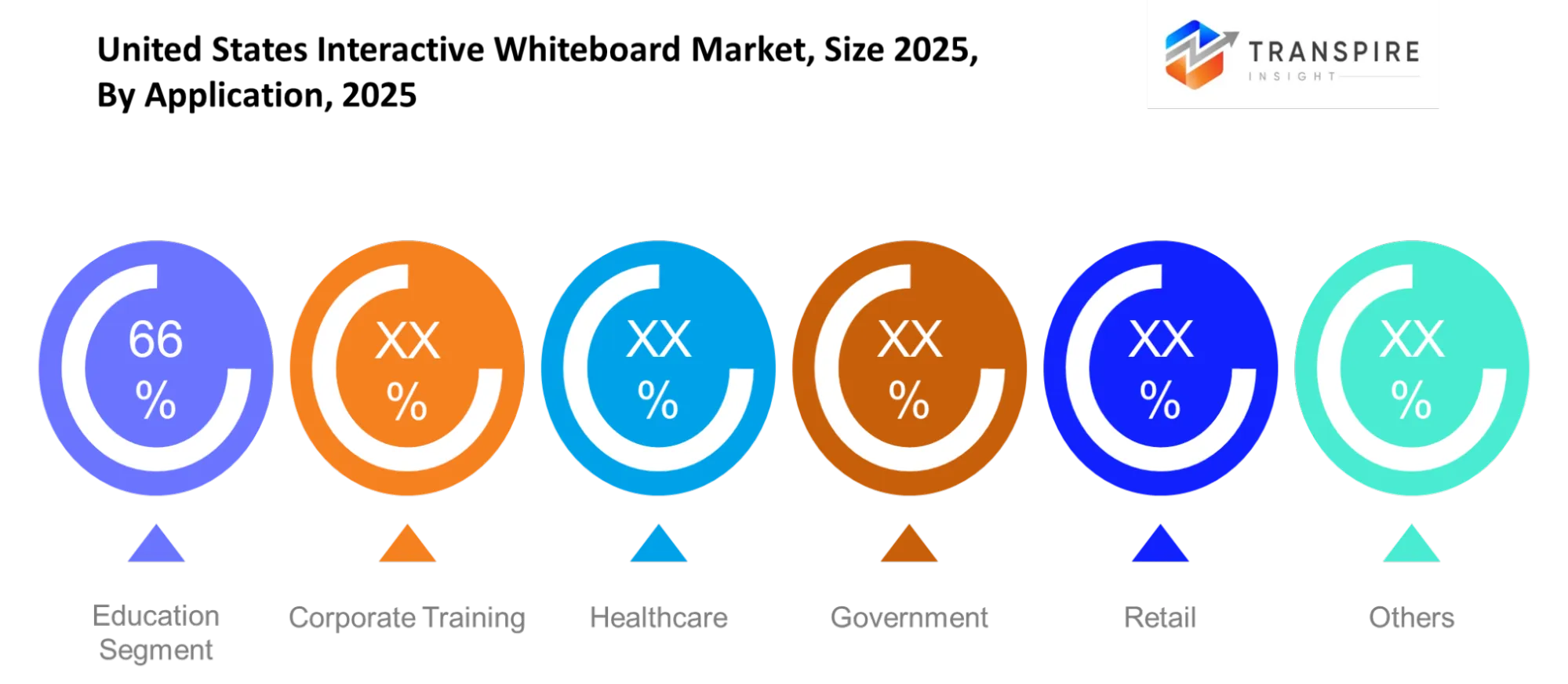
To learn more about this report, Download Free Sample Report
By End User :
Schools and universities commonly adopt interactive whiteboards to modernize teaching methods and boost student interaction. Such systems enable digital lessons, group activities, and visual explanations , which helps learning flow more smoothly across a wider set of subjects.
Enterprises use interactive whiteboards for meetings, planning sessions, and remote teamwork. Training centers rely on them for organized skill development tracks and workshops. Government institutions put them into administrative presentations, communication work, and policy discussions, so information lands more clearly, and engagement improves overall.
What are the Key Use Cases Driving the United States Interactive Whiteboard Market?
Core demand in the United States Interactive Whiteboard Market kind of comes mostly from K-12 classrooms and higher education institutions, where they use those interactive panels for real-time teaching, teamwork style problem solving, and hybrid instruction. It boosts learner participation a bit, and also reduces the dependence on older projection based systems, which is kind of the big thing.
Then secondary adoption, it is also climbing, especially in corporate training centers and healthcare education programs. In those places, organizations roll out interactive displays for workforce upskilling, remote style meetings, and clinical simulation training. They also tie it in with cloud based collaboration platforms so things stay synced, even when teams are scattered around.
For emerging use, you can see AI assisted tutoring systems that personalize lesson delivery, plus AR enabled remote collaboration tools for classrooms that are distributed. There is a strong potential here, since schools and companies keep putting money into adaptive learning and immersive digital training settings during the forecast period, not just for novelty but for actual outcomes.
|
Report Metrics |
Details |
|
Market size value in 2025 |
USD 980.2 Million |
|
Market size value in 2026 |
USD 1038.5 Million |
|
Revenue forecast in 2033 |
USD 1605.8 Million |
|
Growth rate |
CAGR of 6.42% from 2026 to 2033 |
|
Base year |
2025 |
|
Historical data |
2021 - 2024 |
|
Forecast period |
2026 - 2033 |
|
Report coverage |
Revenue forecast, competitive landscape, growth factors, and trends |
|
Geographic scope |
United States of America |
|
Key company profiled |
SMART Technologies, Promethean, Samsung Electronics, LG Electronics, Panasonic, ViewSonic, BenQ, Epson, Microsoft, Hitachi, Ricoh, Cisco Systems, Boxlight, Sharp NEC Display Solutions, Dell Technologies |
|
Customization scope |
Free report customization (country, regional & segment scope). Avail customized purchase options to meet your exact research needs. |
|
Report Segmentation |
By Technology (Infrared Technology, Resistive Technology, Capacitive Technology, Electromagnetic Technology, Others); By Screen Size (Below 50 Inches, 50–70 Inches, Above 70 Inches, Others); By Application (Education, Corporate Training, Healthcare, Government, Retail, Others); By End User (Schools & Universities, Enterprises, Training Centers, Government Institutions, Others) |
Which Regions are Driving the United States Interactive Whiteboard Market Growth?
The Northeastern United States kind of leads the Interactive Whiteboard Market , mainly because it has dense educational infrastructure and pretty strong public-sector digital learning mandates, across states like New York and Massachusetts. Big city school districts keep upgrading classroom technology , so hybrid instruction can run smoother, and standardized digital curricula get rolled out more often. Universities and research institutions in the same region also bring interactive whiteboards into lecture halls and group collaboration labs . Altogether it builds a mature procurement ecosystem, backed by steadier education funding and longer edtech vendor contracts that tend to last.
The Midwest feels a bit more stability driven , where adoption is tied to consistent school district spending and a slow modernization of older classrooms in places like Illinois, Ohio, and Michigan. And unlike the Northeast , the growth there is less policy heavy, more dependent on the ups and downs of public education budgets and district level technology refresh programs. Community colleges plus workforce training centers add steady demand too , by folding interactive displays into vocational instruction. So the region ends up with predictable revenue contribution, mostly because procurement cycles are disciplined rather than because there are sudden fast digital transformation shifts.
The Southern and Western United States, show what feels like the fastest growth, driven by population expansion and big-scale investments in digital first schooling across Texas, Florida and California. Lately, state-level funding programs—aimed at classroom modernization, and STEM led learning environments—have sped up the push for interactive whiteboard deployment ,kind of quickly too. Rapid school construction and district expansion, have opened new installation opportunities instead of usual replacement cycles. For people coming in as market entrants or investors, this area reads as the strongest upside bet through 2033, mainly because infrastructure is still scalable, and technology adoption is accelerating.
Who are the Key Players in the United States Interactive Whiteboard Market and How Do They Compete?
The United States Interactive Whiteboard Market looks like it has moderate consolidation, so a handful of established manufacturers still hold ground, while a few newer software driven entrants keep pushing in. Honestly, competition isn’t only about display hardware anymore, it’s more like an ecosystem fit across cloud platforms, classroom tools, and those hybrid collaboration workflows. In practice, vendors now try to win on interoperability with learning management systems, AI enabled add ons, and total cost of ownership, not just raw display resolution. Even more, new players coming from the broader EdTech and SaaS world are pressuring incumbents, they do it by pitching platform first solutions that lower reliance on proprietary devices.
SMART Technologies leans hard into classroom integration, and it stands out with interactive software suites that line up lesson material with cloud storage and student devices. It keeps its edge by building partnerships with school districts and LMS providers so curriculum alignment feels seamless, at least from the rollout side. Promethean takes a curriculum centric stance, and it focuses on improving teacher workflow efficiency, then it expands adoption via longer term contracts with public education organizations and regional distribution alliances. ViewSonic plays more on cost efficiency and modular deployment approaches, which helps it reach mid-sized districts and private education networks quicker, without so much friction.
Samsung does use top tier display manufacturing know-how plus hardware sturdiness stuff, and it tends to mesh its panels into enterprise collaboration environments, so it kinda moves past only education and into corporate offices too. Microsoft keeps pushing its advantage by leaning on native fitting with Teams together with Office 365, and it brings interactive whiteboard features right into the day-to-day work stream. Google meanwhile goes for a cloud-first approach using classroom tools, and pairs that with Android based interactive display compatibility, which helps it spread through digitally native school setups more easily.
Company List
- SMART Technologies
- Promethean
- Samsung Electronics
- LG Electronics
- Panasonic
- ViewSonic
- BenQ
- Epson
- Microsoft
- Hitachi
- Ricoh
- Cisco Systems
- Boxlight
- Sharp NEC Display Solutions
- Dell Technologies
Recent Development News
In January 2026, SMART Technologies introduced upgraded higher-education and enterprise interactive display solutions under its GX Plus series portfolio. The updated lineup focuses on improved touch responsiveness and cloud-connected collaboration tools designed to support hybrid classrooms and corporate meeting environments across North America. Source https://www.smarttech.com/
In January 2026, ViewSonic expanded its interactive display lineup with the launch of the ViewBoard IFP35-1 and IFP 41-1 series. These new EDLA-certified education displays feature Android 16 integration, 64-point multi-touch capability, and enhanced myViewBoard software for classroom collaboration, strengthening ViewSonic’s position in the U.S. K–12 digital learning segment. Source https://en.wikipedia.org/
What Strategic Insights Define the Future of the United States Interactive Whiteboard Market?
The United States Interactive Whiteboard Market is sort of steadily moving toward software-defined collaboration ecosystems where the hardware is basically just the delivery layer for cloud based education and enterprise platforms. It is being pushed by hybrid learning staying power , plus the classroom workflows getting more tightly tied into SaaS learning management systems. So value creation is shifting away from the devices and more toward recurring digital services and content ecosystems, which sounds obvious but it still feels like a big pivot in practice.
There is also a quieter risk, like platform concentration. When you are depending on only a few operating systems and collaboration suites , for example Microsoft and Google, it increases exposure to pricing changes or sudden ecosystem policy shifts. Over time this can squeeze the margins for hardware vendors and make it harder to stand out in mid-tier product categories , especially when the feature baseline starts to converge.
On the opportunity side, there is a growing opening to integrate generative AI into classroom interaction layers. This is showing up in state funded digital learning programs where pilots are starting , including in Texas and California. In that setup, interactive whiteboards can act more like adaptive instruction platforms, not only passive display tools that sit there and wait.
Market participants should focus on open architecture systems with solid API compatibility, so dependency risk stays lower. At the same time they can capture AI driven service monetization opportunities across education networks, rather than relying on hardware margins alone.
United States Interactive Whiteboard Market Report Segmentation
By Technology
- Infrared Technology
- Resistive Technology
- Capacitive Technology
- Electromagnetic Technology
By Screen Size
- Below 50 Inches
- 50–70 Inches
- Above 70 Inches
By Application
- Education
- Corporate Training
- Healthcare
- Government
- Retail
By End User
- Schools & Universities
- Enterprises
- Training Centers
- Government Institutions
Frequently Asked Questions
Find quick answers to common questions.
The United States Interactive Whiteboard Market size is USD 1605.8 Million in 2033.
Key Segments for the United States Interactive Whiteboard Market are By Technology (Infrared Technology, Resistive Technology, Capacitive Technology, Electromagnetic Technology, Others); By Screen Size (Below 50 Inches, 50–70 Inches, Above 70 Inches, Others); By Application (Education, Corporate Training, Healthcare, Government, Retail, Others); By End User (Schools & Universities, Enterprises, Training Centers, Government Institutions, Others).
Major United States Interactive Whiteboard Market Players are SMART Technologies, Promethean, Samsung Electronics, LG Electronics, Panasonic, ViewSonic, BenQ, Epson, Microsoft, Hitachi, Ricoh, Cisco Systems, Boxlight, Sharp NEC Display Solutions, Dell Technologies.
The Current United States Interactive Whiteboard Market size is USD 980.2 Million in 2025.
The United States Interactive Whiteboard Market CAGR is 6.42% from 2026 to 2033.
- SMART Technologies
- Promethean
- Samsung Electronics
- LG Electronics
- Panasonic
- ViewSonic
- BenQ
- Epson
- Microsoft
- Hitachi
- Ricoh
- Cisco Systems
- Boxlight
- Sharp NEC Display Solutions
- Dell Technologies
Recently Published Reports
-
Apr 2026
3D Optical Profiler Market
3D Optical Profiler Market Size, Share & Analysis Report By Type (Desktop 3D Optical Profiler, and Portable 3D Optical Profiler), By Technology (Confocal Technology, and White Light Interference), By End-Use Industry (Manufacturing, Research Institutions, Automotive, Aerospace and Defense, Medical Devices, and Other), and Geography (North America, Europe, Asia-Pacific, Middle East and Africa, South and Central America), 2021 - 2031
-
Apr 2026
Depth Sensor Market
Depth Sensor Market Size, Share & Analysis Report By Type (Infrared Depth Sensors, Time-of-Flight (ToF) Sensors, Stereo Vision Sensors, Structured Light Sensors, Ultrasonic Depth Sensors), By Application (Automotive, Robotics, Gaming, Consumer Electronics, Industrial Automation, Healthcare, Security & Surveillance, Others), By End Users (Automotive Manufacturers, Consumer Electronics Companies, Healthcare Providers, Industrial Companies, Security Agencies, Gaming Companies, Robotics Companies, Others), and Geography (North America, Europe, Asia-Pacific, Middle East and Africa, South and Central America), 2021 – 2031
-
Apr 2026
Digital Manufacturing Market
Digital Manufacturing Market Size, Share & Analysis Report By Component (Hardware, Software, and Services), By Technology (Robotics, 3D Printing, Internet of Things (IoT), and Others), By Application (Automotive and Transportation, Aerospace and Defense, Consumer Electronics, Industrial Machinery, and Others), By Process Type (Computer-Based Designing, Computer-Based Simulation, Computer 3D Visualization, Analytics, and Others), and Geography (North America, Europe, Asia-Pacific, Middle East and Africa, South and Central America), 2021 – 2031
-
Apr 2026
Digital Visa Services Market
Digital Visa Services Market Size, Share & Analysis Report By Type (Individual Travelers, Group Travelers), By Application (Tourism, Business Travel, Others), and Geography (North America, Europe, Asia-Pacific, Middle East and Africa, South and Central America), 2021 – 2031