United States Head Up Display (HUD) Vehicle Infotainment Market Size & Forecast:
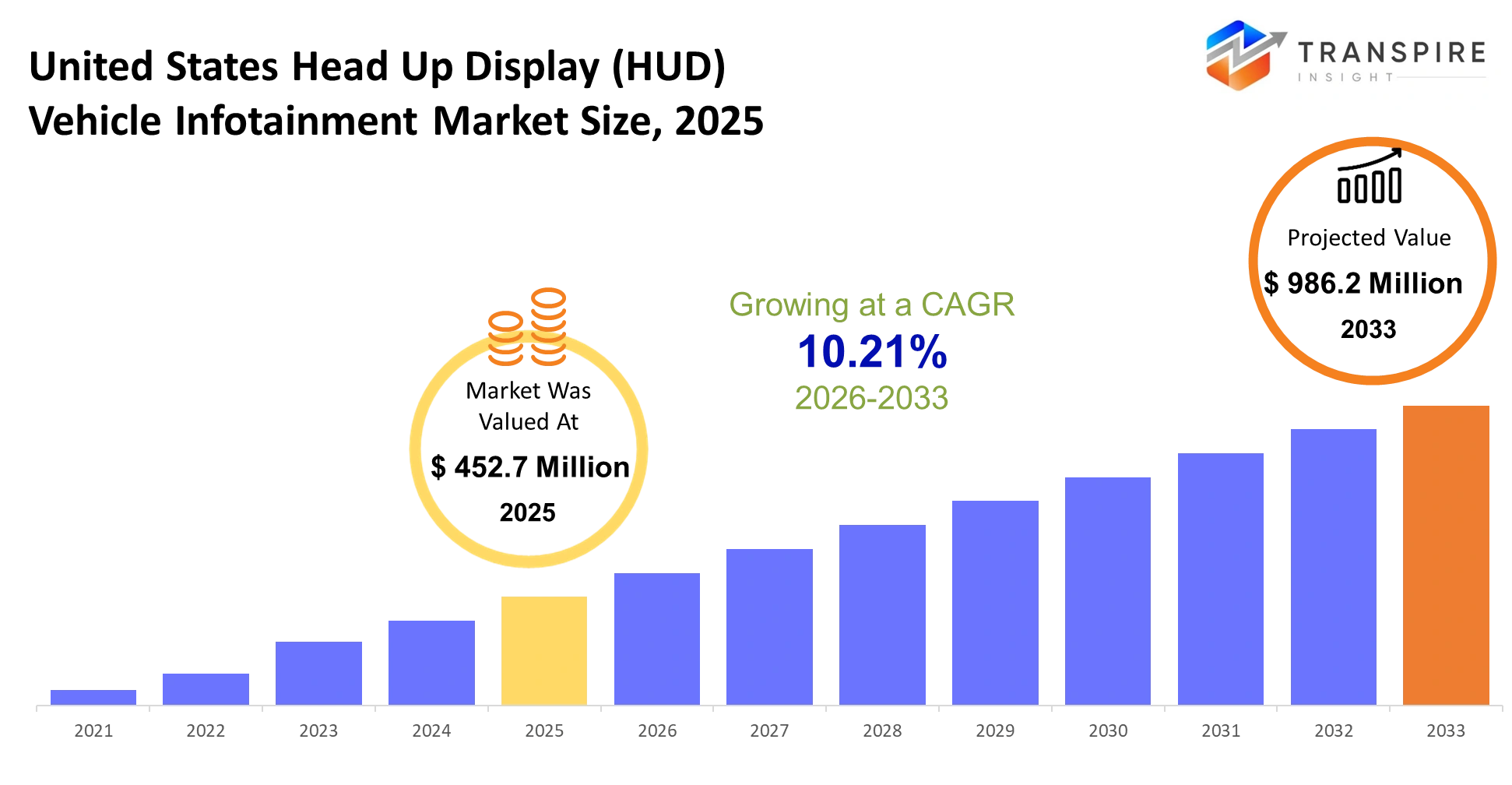
- United States Head Up Display (HUD) Vehicle Infotainment Market Size 2025: USD 452.7 Million
- United States Head Up Display (HUD) Vehicle Infotainment Market Size 2033: USD 986.2 Million
- United States Head Up Display (HUD) Vehicle Infotainment Market CAGR: 10.21%
- United States Head Up Display (HUD) Vehicle Infotainment Market Segments: By HUD Type (Windshield HUD, Combiner HUD, Augmented Reality HUD, Holographic HUD, Others); By Component (Projectors, Display Panels, Sensors, Control Units, Software Systems, Others); By Vehicle Type (Passenger Cars, SUVs, Commercial Vehicles, Electric Vehicles, Others); By Application (Navigation Display, Safety Alerts, Driver Assistance, Entertainment Systems, Others)
To learn more about this report,  Download Free Sample Report
United States Head Up Display (HUD) Vehicle Infotainment Market Summary
The United States Head Up Display (HUD) Vehicle Infotainment Market was valued at USD 452.7 Million in 2025. It is forecast to reach USD 986.2 Million by 2033. That is a CAGR of 10.21% over the period.
Head-up display, HUD vehicle infotainment systems project important driving data onto the windshield while letting drivers keep most attention on the road and still interact with in vehicle digital functions. In the United States, these things are now more and more tangled up inside wider digital cockpit architectures, not really sold as stand-alone high end add-ons. Over the past five years, the market looks like it changed in a structural way, moving from luxury only access toward mid-range acceptance.
That shift is being pushed by software-defined vehicle platforms plus augmented reality HUD integration, and if you think about it, those two almost ride together. One big trigger was the semiconductor supply chain disruption during 2020–2022, which made automakers lean on high value digital safety and infotainment modules when deciding production allocation. At the same time, electric vehicle momentum kept climbing, so demand for more instinctive in-cabin interfaces grew quickly, because EV manufacturers reshaped dashboards around screen based layouts and projected interfaces. Put together, this has pushed OEMs to bring HUDs into earlier design stages, which helps adoption, and also tends to reinforce aftermarket ecosystem revenues.
Key Market Insights
- In the West region, the United States Head Up Display (HUD) Vehicle Infotainment Market sort of dominates with about 38% market share in 2025, and it’s pushed by EV manufacturing clusters, plus faster technology take up.
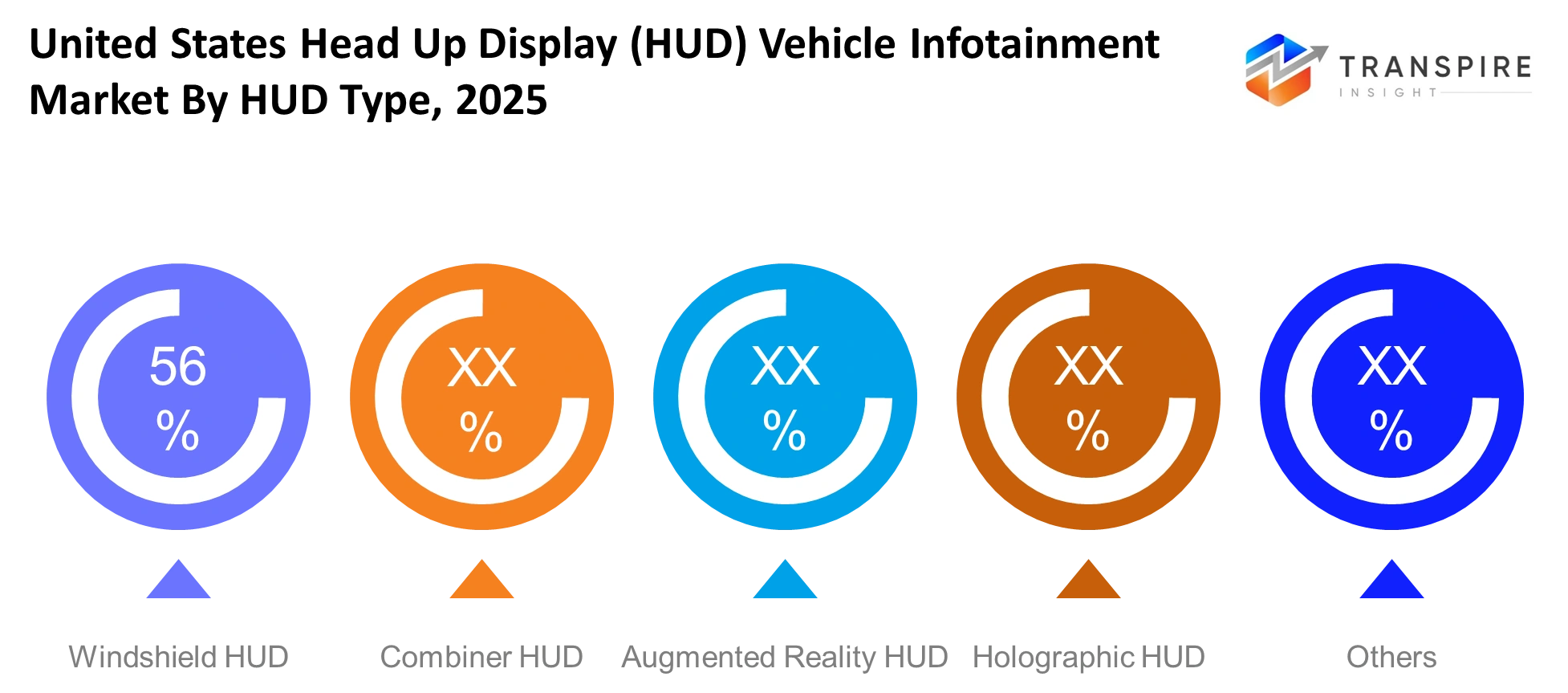
- For windshield HUD systems, they will grab over 52% of the industry share in 2025, mainly because the visibility is better, the navigation display feels more pronounced, and there’s a growing trend of premium vehicle integration, too.
- When it comes to usage, passenger vehicles are the big piece, holding nearly 68% market share in 2025. This happens because consumers keep leaning toward advanced infotainment, and digital cockpit related tech.
- The electric vehicles segment is actually the quickest moving application group. EV makers are steadily rolling in AI powered HUD infotainment experiences, along with real time driver assistance tools.
- And luxury vehicle manufacturers are still out front with HUD infotainment adoption, so they contribute more than 45% of end user revenue share in 2025, thanks to premium smart cockpit installations that keep expanding.
- Growing interest from consumers in connected mobility options plus real-time navigation screen experiences is kind of pushing the United States Head Up Display (HUD) Vehicle Infotainment Market to keep expanding overall.
- At the same time the automotive infotainment scene is seeing more funding going into augmented reality visualizations, voice activated controls, and cloud based connectivity platforms. It’s like everything is getting more intertwined.
- Also 5G enabled communication systems for vehicles are speeding up the rollout of new HUD infotainment setups across smart mobility ,and autonomous driving related ecosystems too.
- On top of that over the air software updates ,and AI driven personalization functions are turning into major differentiators within the automotive display technology landscape that keeps evolving.
- And since more people are adopting autonomous or semi autonomous vehicles ,the appetite for smarter HUD interfaces—ones that show live road and traffic visuals— is staying pretty strong.
What are the Key Drivers, Restraints, and Opportunities in the United States Head Up Display (HUD) Vehicle Infotainment Market?
The main thing speeding up the United States Head Up Display (HUD) Vehicle Infotainment Market is the quick rollout of advanced driver assistance systems in regular passenger cars. Automakers started pushing HUDs more widely after federal safety bodies and also insurance organizations started putting extra focus on distracted driving, and collision prevention technologies. That basically made manufacturers fold windshield-projected navigation , speed tracking, and lane guidance right into the driver’s view, like in front of their eyes, not off to the side. And when electric vehicle brands plus premium automotive names scaled up connected vehicles from 2023 to 2025, HUD infotainment systems sort of slid out of pure luxury, and into larger volume vehicle categories. This has been lifting revenue and also increasing installation rates.
The biggest restraint is still the pricey integration , tied to advanced HUD gear, augmented reality software ,and semiconductor-heavy display modules. The issue feels kind of built-in because the supply chain relies on specialized optics, microdisplay components, and automotive-grade chips. Those don’t just appear fast , they need long qualification timelines and tight safety validation. Smaller automakers and mid-priced manufacturers keep postponing adoption, since turning on HUD functionality meaningfully increases dashboard architecture costs, and even software calibration time, almost like a hidden project inside the project.
A notable chance is also coming from augmented reality HUD platforms meant for autonomous, and software-defined vehicles. Firms working on AI-enabled smart cockpits and 5G-linked infotainment environments are building room to grow at scale. This matters especially across the United States electric vehicle manufacturing corridors in California and Texas, where higher production volume can make these systems spread faster.
What Has the Impact of Artificial Intelligence Been on the United States Head Up Display (HUD) Vehicle Infotainment Market?
Artificial intelligence along with newer digital tools are quietly reshaping the United States Head Up Display (HUD) Vehicle Infotainment Market, mostly because they make it easier for drivers to interact in real time. At the same time, predictive diagnostics and vehicle system automation are getting a lot more capable. As a result, automotive makers keep adding AI driven driver monitoring systems that sit right alongside HUD displays. In practice this means the vehicle can handle navigation prompts, collision warnings, lane departure alerts, and even adaptive cruise control visualization, with less fuss. The general idea is that contextual info gets projected straight onto the windshield so distractions drop and the driver can decide faster, especially when highway speeds are involved and everything feels urgent.
Also, machine learning models are strengthening predictive maintenance inside connected vehicle infotainment environments. Automakers, and also some automotive software providers, look at sensor signals coming from display units, processors, plus electronic control modules. From that, they try to foresee component failures before the system downtime shows up. That strategy cuts down on surprise repair events, boosts infotainment uptime, and helps lower long term service costs for fleet operators and passenger vehicle manufacturers. On top of that, AI enabled cockpit systems can tune display brightness, adjust navigation timing and improve voice command responsiveness depending on how the driver behaves and what the surroundings look like. It’s a small shift, but it tends to raise overall operational efficiency and makes the user experience feel smoother.
Advanced digital cockpit platforms are enabling measurable gains with respect to vehicle safety compliance and faster software update efficiency, mainly via over-the-air diagnostics plus cloud- based performance monitoring. Still, the integration costs, they stay a big limitation, even if everything else looks good. Advanced augmented reality HUD systems also need costly sensors , high-performance semiconductors and an involved calibration software stack, so the rollout is kinda restricted for mass adoption across the mid-priced vehicle segments.
Key Market Trends
- Between 2022 and 2025, automakers kind of shifted HUD integration from luxury sedans into mid range SUVs and electric crossovers, to boost differentiation maybe.
- Tesla, General Motors, and BMW also upped investment in AI powered digital cockpit platforms after consumer desire for connected driving stuff sped up post 2023 and people wanted more.
- Windshield projected augmented reality navigation got more momentum once U.S. safety agencies tightened attention on cutting distracted driving collision risks, which sounds kind of obvious but it happened anyway.
- Automotive suppliers like Continental AG and Visteon Corporation, expanded software defined cockpit collaborations between 2024 and 2026 to support steadier recurring software revenue models, more like subscription vibes.
- HUD makers increasingly swapped standalone infotainment displays for integrated multi screen cockpit ecosystems linked through cloud based vehicle operating systems.
- And the semiconductor shortages during 2021 and 2022, forced automakers to redo their infotainment sourcing plans, plus diversify the display component supplier web across North America.
- By 2025, electric vehicle manufacturers leaned into larger projection displays, and also real time battery visualization tools to make driver interaction smoother and energy monitoring more efficient.
- Voice enabled infotainment interfaces evolved fast once generative AI integration improved natural language command precision and reduced how much drivers had to stare at screens while navigating.
- Finally, automotive OEMs pushed over the air update deployment harder after software defined vehicle platforms lowered the need for dealership servicing, and made infotainment features land sooner, without as much waiting around.
United States Head Up Display (HUD) Vehicle Infotainment Market Segmentation
By HUD Type:
The United States Head Up Display (HUD) Vehicle Infotainment market is seeing solid growth, and it kind of keeps going across different HUD technologies as vehicle makers work on driving comfort, plus safety, a bit more each year. Windshield HUD systems still get used a lot, mostly because these setups throw the driving info right onto the windshield. That way drivers can keep eyes forward, and not get pulled into distractions that feel unnecessary. Passenger vehicle manufacturers are also leaning harder into windshield HUD systems in both premium and mid-range cars. This shift comes as customer demand for connected driving experiences rises, kind of consistently, over time.
At the same time, combiner HUD systems keep finding buyers in the more cost-sensitive vehicle segments, mainly due to easier installation and reduced production spend. Augmented Reality HUD solutions are getting more attention too, because they deliver real time navigation support, lane positioning cues, and hazard notifications, with sharper visual clarity than before. Holographic HUD technology is continuing to mature as well, especially in luxury, and also in advanced electric vehicles, where advanced visualization features help build a more futuristic cockpit atmosphere. Beyond that, other HUD formats keep covering smaller niches, with specialized infotainment needs across the broader market.
To learn more about this report, Download Free Sample Report
By Component:
Component demand across the United States Head Up Display (HUD) Vehicle Infotainment Market is still growing, though not in a perfectly steady way, as makers keep pushing for better display quality , faster response time, and smoother software integration. Projectors stay a key piece in most HUD systems, because the clarity of what gets projected really changes how well the driver can see, and how good the whole experience feels in daily driving. At the same time, display panels are moving forward too, with brighter outputs and sharper contrast, which helps readability in daylight or after dark when conditions get harsher and you want the image to remain steady and easy to track.
Sensors, plus the control units, also matter a lot for keeping data accurate inside a HUD setup. Newer sensors enable near real-time vehicle monitoring, while control units manage the display functions and keep infotainment activities aligned without too much lag, or at least, without noticeable mismatch. Software systems are getting even more central as connected vehicle technology expands through the automotive ecosystem. Better software platforms allow navigation updates more smoothly, improve driver assistance features, and enable personalized infotainment settings that feel less generic. Beyond that, other supporting components still help strengthen overall HUD performance, and they also support longer term system reliability.
By Vehicle Type:
Passenger cars are still holding a big slice of the United States Head Up Display (HUD) Vehicle Infotainment Market, even as people keep wanting more advanced infotainment plus safety tools for everyday trips. Because of that, automakers keep slipping HUD systems into sedans and hatchbacks , to make driving feel easier and sort of more premium inside the cabin. At the same time, growing consumer awareness about driver safety along with connected-vehicle features, still is helping push broader usage across basically all passenger car groups.
And SUVs, well the push for HUD infotainment keeps climbing too , since bigger vehicles often come with extra comfort items and driver-assistance functions. On the commercial side, trucks and related vehicles are slowly but surely starting to adopt HUD tech, mainly for better route visibility and to cut down distraction when drivers are doing long-distance work. Also electric vehicles are creating solid new chances for HUD integration , because companies are investing heavily in digital cockpits and those forward looking driving interfaces.Besides those main groups, other vehicle types keep nudging market growth forward, as infotainment tech adoption continues growing steadily throughout the whole automotive industry.
By Application:
Navigation display applications keep pushing solid demand in the United States Head Up Display (HUD) Vehicle Infotainment Market because many drivers now want real-time route guidance, without moving their eyes away from the roadway. With HUD navigation, directional cues show up right in the driver’s line of sight. That makes a noticeable difference both for city maneuvers and long highway trips, simply because the info feels more immediate. At the same time, automakers are still tuning navigation graphics, plus positioning accuracy, so the overall driving experience feels smoother and more reliable.
On top of that, safety alerts and driver assistance applications are also growing fast, mainly tied to the stronger emphasis on accident prevention and general road awareness. Today’s HUD units can surface warnings for speed limits, collision risks, blind zones and lane departures, and they do it in a format that is harder to miss, or too easy to ignore. Entertainment system integration is getting more widespread too since connected vehicles keep evolving into richer infotainment ecosystems. Vehicle makers are enhancing multimedia access while trying to keep attention anchored, and to lower distraction during operation.
What are the Key Use Cases Driving the United States Head Up Display (HUD) Vehicle Infotainment Market?
Passenger vehicles are still like the main thing for HUD vehicle infotainment systems, mostly in premium sedans, SUVs, and electric vehicles. Automakers are leaning on windshield-projected navigation, speed warnings, and lane assistance visuals to help with driver safety, while at the same time cutting down dashboard distraction during city streets and also on highways
More uses are showing up in commercial fleet vehicles and shared mobility services, where operators are putting connected HUD setups into the workflow for route optimization , driver monitoring, and fuel-efficiency tracking. Electric vehicle brands are also folding in advanced infotainment displays so they can show battery status in a clearer way, plus real-time charging updates for people doing longer trips
Some emerging use cases are augmented reality windshield displays for semi-autonomous driving, and AI-enabled smart cockpit systems that can handle personalized driver interaction. Automotive tech firms are also running tests with holographic projection interfaces and even gesture-controlled infotainment features, which could become more common once software-defined vehicles spread more widely across the United States automotive market
|
Report Metrics |
Details |
|
Market size value in 2025 |
USD 452.7 Million |
|
Market size value in 2026 |
USD 499.5 Billion |
|
Revenue forecast in 2033 |
USD 986.2 Million |
|
Growth rate |
CAGR of 10.21% from 2026 to 2033 |
|
Base year |
2025 |
|
Historical data |
2021 - 2024 |
|
Forecast period |
2026 - 2033 |
|
Report coverage |
Revenue forecast, competitive landscape, growth factors, and trends |
|
Geographic scope |
United States of America |
|
Key company profiled |
Continental AG, Denso, Bosch, Panasonic Automotive, Nippon Seiki, Visteon, Valeo, Garmin, Hyundai Mobis, Pioneer Corporation, Harman International, Texas Instruments, Yazaki Corporation, LG Electronics, Envisics |
|
Customization scope |
Free report customization (country, regional & segment scope). Avail customized purchase options to meet your exact research needs. |
|
Report Segmentation |
By HUD Type (Windshield HUD, Combiner HUD, Augmented Reality HUD, Holographic HUD, Others); By Component (Projectors, Display Panels, Sensors, Control Units, Software Systems, Others); By Vehicle Type (Passenger Cars, SUVs, Commercial Vehicles, Electric Vehicles, Others); By Application (Navigation Display, Safety Alerts, Driver Assistance, Entertainment Systems, Others) |
Which Regions are Driving the United States Head Up Display (HUD) Vehicle Infotainment Market Growth?
The Western United States kinda leads the Head Up Display (HUD) Vehicle Infotainment Market, not just because it has tech, but because the region blends advanced automotive tech development with a lot of electric vehicle making. California still sits at the center of this dominance too, partly because of tough zero-emission vehicle rules, widespread interest in luxury cars, and the heavy presence of autonomous driving research locations. Lots of major automotive software builders, semiconductor firms, and EV manufacturers are basically running intertwined innovation ecosystems across Silicon Valley and Southern California. That local network helps automakers roll out augmented reality HUD features, run AI enabled cockpit testing, and stitch together connected-vehicle software much quicker than in other regions.
Then the Midwest shows up as the second-largest regional contributor, though it’s more about manufacturing staying steady rather than rapid tech disruption. Places like Michigan and Ohio do well thanks to dependable automotive supply chains, longer-term OEM commitment, and ongoing output of both passenger vehicles and commercial fleets. Unlike the West, where software novelty tends to push adoption, the Midwest leans toward large-scale integration of HUD systems into high volume vehicle production setups. Continued close ties between suppliers, assembly plants, and electronics manufacturers help keep consistent demand for infotainment display technologies, supporting domestic growth and also vehicle production aimed at export markets.
The Southern United States looks like it’s becoming the fastest-growing region mainly because of aggressive electric vehicle investment, and not just that either, also expanding auto production capacity. Starting around 2023, states like Texas Tennessee, and Georgia have pulled in big EV assembly plants, battery manufacturing facilities and a wave of connected mobility investments, partly from tax incentives and continued infrastructure expansion programs. Automakers moving into these areas are building newer vehicle platforms that include integrated digital cockpit architectures , and that’s creating pretty clear new openings for HUD infotainment suppliers. Over the 2026 to 2033 window this whole momentum should keep drawing more software developers, semiconductor providers and automotive technology investors as regional electrification of vehicles picks up again.
Who are the Key Players in the United States Head Up Display (HUD) Vehicle Infotainment Market and How Do They Compete?
The United States Head Up Display (HUD) Vehicle Infotainment Market is still kind of moderately consolidated, and honestly the battle is mostly about software tie-ins, augmented reality features, and those long-term automotive OEM friendships. Incumbent automotive electronics suppliers keep trying to hold their share, using proprietary cockpit frameworks plus big production scale, while newer tech-forward players are nudging things around with AI enabled visualization and cloud linked infotainment setups. Basically the main reason companies win or lose has moved away from hardware cost, and more toward what the software can do, how good the display looks, how strong the cybersecurity is , and whether it works nicely with software-defined vehicle platforms. Firms that can bundle navigation, driver assistance visualization, and over the air update ecosystems into one unified cockpit, are starting to bargain much harder with automakers.
Continental AG stands out by offering augmented reality HUD systems that layer real-time navigation overlays together with more advanced driver assistance visualization. The company has been leaning into partnerships with electric vehicle manufacturers as well as premium automotive brands, so that larger windshield projection systems can fit into next-generation digital cockpits. Visteon Corporation is putting a lot of focus on software-defined cockpit design, and also on multi display integration, which lets automakers combine infotainment, instrumentation, and HUD functionality into one centralized processing platform. Its edge largely comes from scalable cockpit electronics that help reduce wiring confusion and improve how efficiently software updates roll out.
Denso Corporation competes by pushing compact HUD designs that are tuned for fuel-efficient and hybrid vehicles , especially across Asian and North American automotive production chains. The company keeps expanding via collaborative development deals with automakers who want lower-power infotainment systems for EV platforms , that part really matters. Meanwhile Robert Bosch GmbH leans hard into AI-driven driver interaction, and sensor integrated cockpit systems that can handle semi-autonomous driving settings, and that sort of thing. Bosch also boosts its stance by putting money into connected mobility software, high resolution display technologies, as well as predictive driver assistance platforms aimed at future autonomous vehicle rollouts.
Company List
- Continental AG
- Denso
- Bosch
- Panasonic Automotive
- Nippon Seiki
- Visteon
- Valeo
- Garmin
- Hyundai Mobis
- Pioneer Corporation
- Harman International
- Texas Instruments
- Yazaki Corporation
- LG Electronics
- Envisics
Recent Development News
In April 2026, Hyundai Motor Group launched its next-generation “Pleos Connect” infotainment system. The AI-powered in-vehicle platform is designed for software-defined vehicles and supports integrated display and HUD-style visualization features, strengthening the competitive landscape for advanced vehicle infotainment systems in the United States market.
Sourcer https://www.prnewswire.com/
In February 2026, Hyundai Mobis formed a strategic partnership with ZEISS, tesa, and Saint-Gobain Sekurit to commercialize holographic windshield display technology. The alliance aims to accelerate mass production of next-generation holographic head-up displays, supporting future growth in connected and infotainment-focused vehicles across global markets including the United States. Source https://www.prnewswire.com/
What Strategic Insights Define the Future of the United States Head Up Display (HUD) Vehicle Infotainment Market?
The United States Head Up Display (HUD) Vehicle Infotainment Market is heading toward these more fully integrated software-defined cockpit ecosystems, where augmented reality visualization , AI-assisted navigation, and real time driver analytics all seem to run through centralized computing platforms. Over the next five to seven years the whole space will keep drifting away from hardware centric competition and toward recurring software and connectivity revenue streams , pushed along by autonomous driving work and the steady adoption of electric vehicles.
There’s also a risk that feels under-recognized, it’s this growing dependence on advanced semiconductor supply chains that are basically concentrated among a small group of chipmakers and optical component suppliers. If there’s a prolonged disruption in automotive-grade semiconductor availability it could slow down vehicle production timelines and, in turn, limit HUD deployment across mid-priced vehicle segments. Meanwhile at the same time, holographic windshield projection systems, plus adaptive AI driven cockpit personalization, look like a major emerging opportunity, especially as premium EV manufacturers want differentiation that goes beyond battery performance or driving range.
For market participants, the smart move is probably to lean into strategic partnerships with automotive software developers and semiconductor providers, instead of only expanding display hardware. Firms that manage to lock in long term software integration capabilities and build scalable over the air update infrastructure may end up capturing stronger margins and more OEM loyalty by 2033.
United States Head Up Display (HUD) Vehicle Infotainment Market Report Segmentation
By HUD Type
- Windshield HUD
- Combiner HUD
- Augmented Reality HUD
- Holographic HUD
By Component
- Projectors
- Display Panels
- Sensors
- Control Units
- Software Systems
By Vehicle Type
- Passenger Cars
- SUVs
- Commercial Vehicles
- Electric Vehicles
By Application
- Navigation Display
- Safety Alerts
- Driver Assistance
- Entertainment Systems
Frequently Asked Questions
Find quick answers to common questions.
The United States Head Up Display (HUD) Vehicle Infotainment Market size is USD 986.2 Million in 2033.
Key segments for the United States Head Up Display (HUD) Vehicle Infotainment Market are By HUD Type (Windshield HUD, Combiner HUD, Augmented Reality HUD, Holographic HUD, Others); By Component (Projectors, Display Panels, Sensors, Control Units, Software Systems, Others); By Vehicle Type (Passenger Cars, SUVs, Commercial Vehicles, Electric Vehicles, Others); By Application (Navigation Display, Safety Alerts, Driver Assistance, Entertainment Systems, Others).
Major United States Head Up Display (HUD) Vehicle Infotainment Market players are Continental AG, Denso, Bosch, Panasonic Automotive, Nippon Seiki, Visteon, Valeo, Garmin, Hyundai Mobis, Pioneer Corporation, Harman International, Texas Instruments, Yazaki Corporation, LG Electronics, Envisics.
The United States Head Up Display (HUD) Vehicle Infotainment Market size is USD 452.7 Million in 2025.
The United States Head Up Display (HUD) Vehicle Infotainment Market CAGR is 10.21% from 2026 to 2033.
- Continental AG
- Denso
- Bosch
- Panasonic Automotive
- Nippon Seiki
- Visteon
- Valeo
- Garmin
- Hyundai Mobis
- Pioneer Corporation
- Harman International
- Texas Instruments
- Yazaki Corporation
- LG Electronics
- Envisics
Recently Published Reports
-
Apr 2026
ATV & UTV Market
ATV & UTV Market Size, Share & Analysis Report By Type (ATV, and UTV), By Variants (Less Than 400 CC, 400 CC To 800 CC, and More Than 800 CC), and Geography (North America, Europe, Asia-Pacific, Middle East and Africa, South and Central America), 2021 - 2031
-
Apr 2026
Automotive Central Gateway Module Market
Automotive Central Gateway Module Market Size, Share & Analysis Report By Type (Ethernet Central Gateway Module, CAN Central Gateway Module, LIN Central Gateway Module, and FlexRay), By Application (Powertrain Control, Body Control, Infotainment System, Advanced Driver Assistance Systems (ADAS), and Others), By End User (Passenger Vehicles, and Commercial Vehicles), and Geography (North America, Europe, Asia-Pacific, Middle East and Africa, South and Central America), 2021 - 2031
-
Apr 2026
Automotive Engine Oil Filter Market
Automotive Engine Oil Filter Market Size, Share & Analysis Report By Filter Type (Fuel Filter, Engine Oil Filter, Hydraulic Oil Filter, and Others), By Filter Media (Cellulose, Synthetic, and Micro), By Sales Channel (OEMs, and Aftermarket), By Vehicle Type (Passenger Cars, Light Commercial Vehicles, Heavy Duty Trucks, Buses and Coaches, and Off-road Vehicles), and Geography (North America, Europe, Asia-Pacific, Middle East and Africa, South and Central America), 2021 - 2031
-
Apr 2026
Automotive Parts Aluminium Die Casting Market
Automotive Parts Aluminium Die Casting Market Size, Share & Analysis Report By Production Process (Pressure Die Casting, Vacuum Die Casting, Squeeze Die Casting, Gravity Die Casting), By Application (Body Parts, Engine Parts, Transmission Parts, Battery And Related Components, Other Application Types), and Geography (North America, Europe, Asia-Pacific, Middle East and Africa, South and Central America), 2021 - 2031
Our Clients