
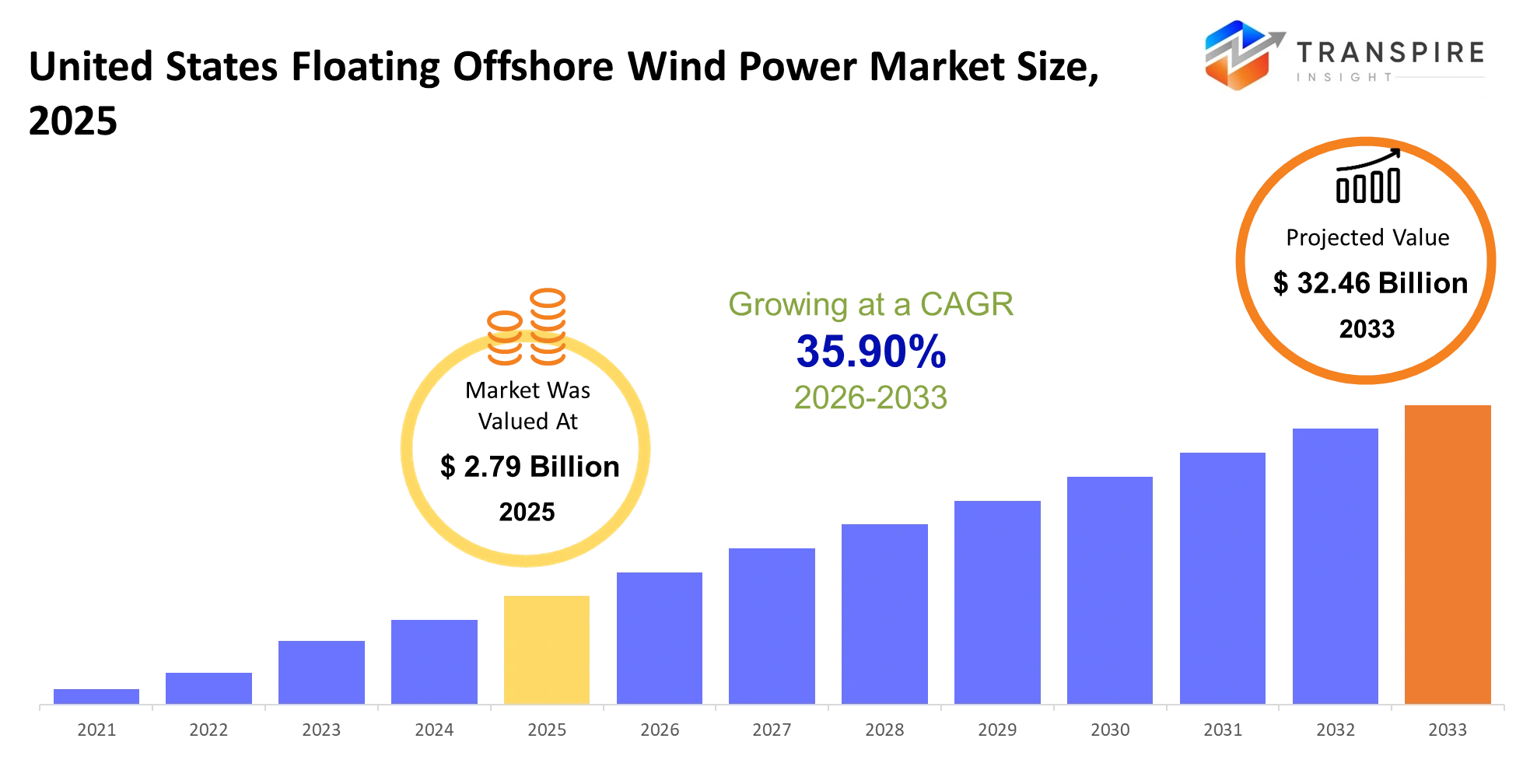
United States Floating Offshore Wind Power Market Size & Forecast:
- United States Floating Offshore Wind Power Market Size 2025:USD 2.79 Billion
- United States Floating Offshore Wind Power Market Size 2033: USD 32.46 Billion
- United States Floating Offshore Wind Power Market CAGR: 35.90%
- United States Floating Offshore Wind Power Market Segments: By Platform Type (Spar-buoy, Semi-submersible, Tension-leg Platform, Barge-type Platforms, Others); By Component (Turbines, Floating Foundations, Mooring Systems, Cables, Substations, Others); By Water Depth (Shallow Water, Deep Water, Ultra-deep Water, Others); By Application (Utility Power Generation, Commercial Power Supply, Industrial Energy Supply, Others).
To learn more about this report,  Download Free Sample Report
United States Floating Offshore Wind Power Market Summary
The United States Floating Offshore Wind Power Market was valued atUSD 2.79 Billion in 2025. It is forecast to reach USD 32.46 Billion by 2033. That is a CAGR of 35.90% over the period.
The United States offshore floating wind power market kind of lets large turbines make electricity out at sea, deep ocean areas where regular fixed foundations aren’t really workable, mostly along the Pacific Coast. In a sense, it turns a strong offshore wind condition into grid electricity for coastal demand places that get squeezed by land limits and, you know, not many straightforward options for more onshore buildout. Over the last 3 to 5 years, things have moved from early pilot demonstrations toward more organized commercial leasing efforts, so there is this bigger shift in how the industry is structurally heading to utility-scale deployment.
One big trigger has been federal backing tied to the Inflation Reduction Act, it boosted the project economics via tax credits and also lowered financing uncertainty, which is honestly a rare win. At the same time, West Coast deep-water geography has basically compelled developers to use floating platforms rather than fixed-bottom designs, even when it’s more complicated. That whole combo is speeding up port redevelopment, supporting local supply chain choices, and encouraging long-term power purchase planning, so utilities and developers are being pushed toward earlier-stage commitments and, generally, a bigger lineup of projects in the pipeline.
Key Market Insights
- California kind of dominates the United States Floating Offshore Wind Power Market, with over 45% share in 2025, pushed by Pacific deep-water wind zones.
- Meanwhile the U.S. East Coast—particularly Massachusetts and New York—is showing the quickest growth, with offshore leasing activity getting more expanded across 2025 to 2030.
- Also the Gulf of Maine is emerging as a more strategic deep-water cluster, helping the long term floating offshore wind pipeline diversify, in a steadier way.
- For platform systems, they basically lead the market in the United States Floating Offshore Wind Power Market, because floating setups are needed for deep-water turbine steadiness and stability solutions.
- Then turbine systems take the second-largest slice, backed by scaling high-capacity offshore wind technology upgrades.
- As for mooring and anchoring systems they are the fastest-growing segment from 2025 to 2030, mostly because seabed deployment becomes complex and more demanding.
- Utility scale electricity generation keeps over 65% share, so it is kinda the dominant application in the United States Floating Offshore Wind Power Market.
- Green hydrogen production is coming up as the fastest growing application, basically tying offshore wind to industrial decarbonization aims, and that mix seems to be accelerating.
- Utility companies led the way with over 50% share, and that positions them to push procurement as well as sign long term offshore power purchase agreements.
- Industrial energy buyers are the fastest-growing end-user group, mainly because of decarbonization commitments and the need for cleaner energy sourcing.
What are the Key Drivers, Restraints, and Opportunities in the United States Floating Offshore Wind Power Market?
The United States Floating Offshore Wind Power Market is mostly pushed by federal and state level decarbonization mandates , kind of together with big incentive frameworks like the Inflation Reduction Act. These policy moments have fairly improved project economics , by trimming tax burdens and also by making long gestation offshore investments feel less risky. Because of that, utilities plus developers are starting sooner with multi gigawatt leasing zones, especially along the Pacific Coast, where deep water conditions basically force floating technology. This movement then speeds up revenue visibility through longer term power purchase agreements, and a more structured offshore leasing pipeline, even if the sequencing can look messy on paper.
At the same time, though, the market is held back by a structural brake tied to installation difficulty and infrastructure complexity. Floating offshore wind needs specialized vessels, deep water mooring systems, and upgraded port facilities , and most of those elements are still not fully built out in the United States. So you get bottlenecks in project execution timelines and you also see more uncertainty in capital expenditure. It is not something you can fix quickly either , because it relies on multi year infrastructure buildout, plus there is limited domestic manufacturing capacity. All of that stretches commercialization, and it tends to calm down revenue acceleration in the near term.
An emerging opportunity sits in hybrid offshore energy hubs, where floating wind farms get mixed with green hydrogen production, plus coastal grid storage systems. California’s planned Humboldt Bay offshore wind zone kinda shows the path, because developers are lining up floating turbine deployment with hydrogen pilot infrastructure. This meeting of things could unlock fresh revenue streams beyond selling electricity, and it could also position the United States Floating Offshore Wind Power Market as a multi output offshore energy ecosystem that is more layered than before.
What Has the Impact of Artificial Intelligence Been on the United States Floating Offshore Wind Power Market?
Artificial intelligence and advanced digital technologies are being used more and more to reshape how operations run in the United States Floating Offshore Wind Power Market, in a sort of yes-and way, like they help track, guide, and maintain offshore assets across deep-water conditions. Today operators often rely on AI-enabled supervisory control and data acquisition systems, to automate turbine performance observations, tweak blade pitch in real time, and squeeze out better energy production as wind and wave conditions shift. At the same time digital twin models copy floating turbine behavior, so engineers can replay stress loads and boost design precision before any deployment, which also trims the expensive “try again” phase that happens during offshore trials.
On top of that, machine learning models are pretty common in predictive maintenance, where signals from turbines, mooring lines, and subsea cables are interpreted to anticipate equipment fatigue, and stop the kind of unplanned shutdown that nobody wants. Alongside those efforts, AI-based vessel routing systems help plan installation and servicing in a smarter sequence , cutting down on vessel idle time and improving coordination across offshore wind farms. Collectively these things raise uptime reliability and they have led to measurable decreases in maintenance costs and operational delays.
Still, the take-up isn’t fully smooth because there’s limited high-quality offshore training data , plus connectivity can be inconsistent in deep-water zones. Also harsh maritime weather can lower sensor clarity, leaving certain model outputs less steady, and that slows the broader, full-scale integration of AI across the United States Floating Offshore Wind Power Market.
Key Market Trends
- Floating offshore wind kind of moved from that under 1 GW demonstration capacity in 2022, into multi-gigawatt planned pipelines by 2026, like a quick jump.
- Federal lease auctions expanded offshore development zones in 2024 , which made developers pivot away from pure feasibility studies and toward execution planning.
- California accelerated permitting timelines in 2025, and that reduced average project approval cycles by about 18–22 months, pretty noticeably.
- Equinor and Shell also increased early-stage U.S. investment allocations between 2023 and 2025, showing a sort of strategic offshore portfolio rebalancing without too much surprise.
- On the hardware side, turbine technology shifted from 12 MW-class machines to 15+ MW offshore units, boosting energy yield per floating platform deployment in the process.
- Meanwhile, port infrastructure upgrades in Oregon and California shifted from the planning phase into the construction phase during 2024–2026 period, it felt like.
- Utilities moved from short-term procurement to longer 20–30 year offshore power purchase agreements after 2024 brought clearer regulatory guidance.
- Floating platform designs meanwhile evolved from semi-submersible prototypes into standardized commercial scale models with major OEMs by 2025.
- Supply chain localization increased too, as U.S. fabrication yards expanded capacity, meaning less reliance on European offshore component imports.
- And for grid integration, strategies started leaning toward hybrid offshore hubs, combining wind storage and hydrogen pilots from 2025 onwards.
United States Floating Offshore Wind Power Market Segmentation
By Platform Type :
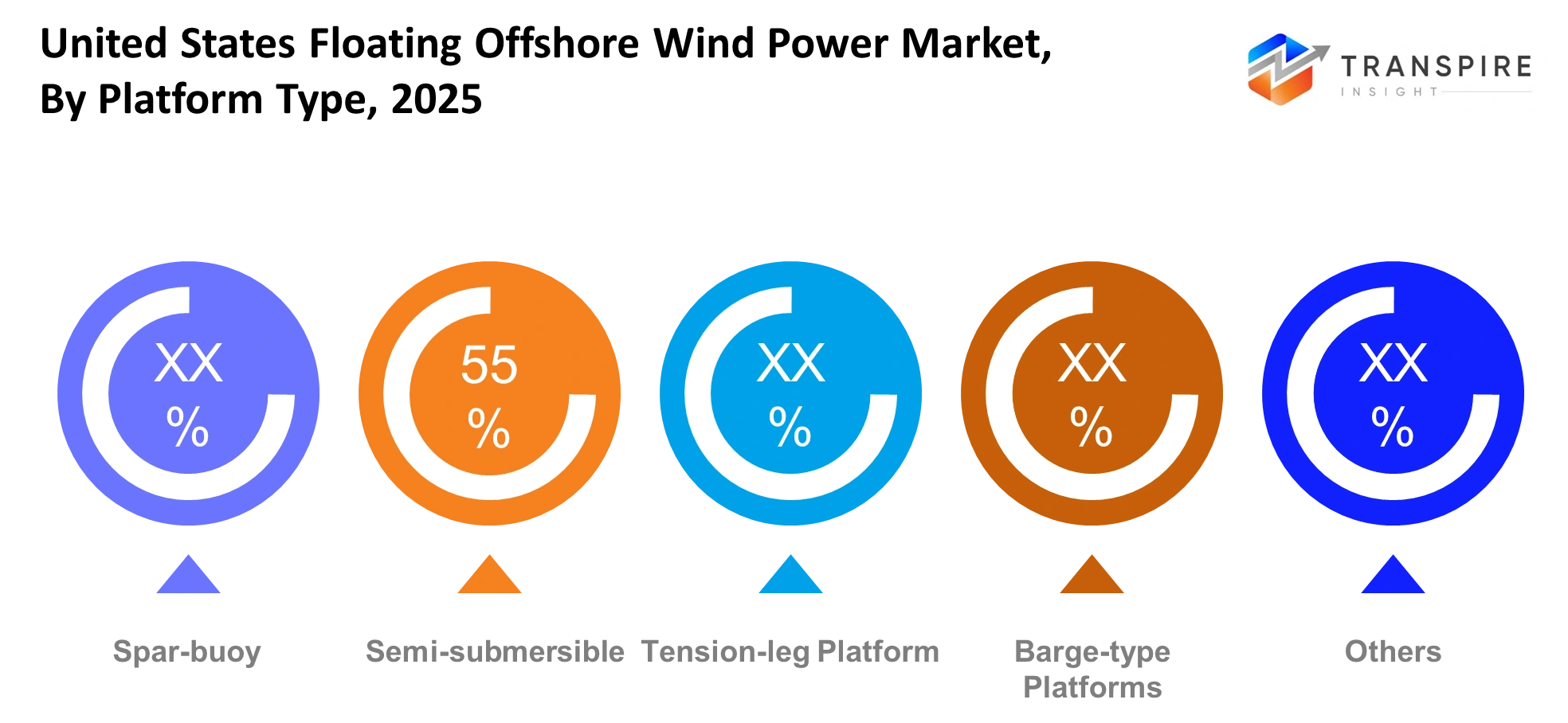
Spar-buoy systems help with deep water stability by using a long vertical ballast structure, which drops the center of gravity, kinda like it gives the whole setup more “weight down” so it settles better. Semi-submersible platforms use several pontoons to build buoyancy and keep things steady during moderate sea conditions. Tension-leg platforms lean on vertical mooring tension, so the motion stays reduced in a controlled way, and the turbine can work more steadily.
Barge-type platforms use a broad floating base, which works best in calmer waters, and the installation steps are usually simpler too. Other platform types include hybrid floating designs, those get tailored for the specific wind and wave conditions at the site. Picking a platform depends on water depth , seabed profile, installation cost, and the expected energy yield across offshore wind development zones.
To learn more about this report, Download Free Sample Report
By Component :
Turbines basically are the main energy conversion units, built to capture offshore wind at high capacity especially when wind speeds are strong. Floating foundations provide structural support and keep the turbine stable on the water surface, using engineered buoyancy plus carefully matched weight balance across the operating conditions.
Mooring systems anchor the floating units to the seabed. That reduces drift and keeps position accuracy where it needs to be. Subsea cables carry the generated electricity to onshore grids, while offshore substations manage voltage and power flow. There are also monitoring systems, control units, and safety mechanisms. Together they support continuous offshore wind energy operations, with less trouble in day to day functioning.
By Water Depth :
Shallow water installations can use fixed or almost fixed arrangements, with less building complication and kind of easier maintenance access. Deep water areas tend to need floating platforms because the seabed will not cooperate, so wind energy extraction in high wind offshore regions becomes feasible and performance can stay steady.
Ultra-deep water use cases lean on advanced floating systems, built for really extreme depth conditions and more intense wave action. Then there are also transitional depth zones, where mixed installation approaches are sometimes used, sort of bridging the gap. Picking the water depth really affects the foundation selection, the overall cost structure, engineering design choices, and the long term operational efficiency of offshore wind projects.
By Application :
Utility power generation is basically large-scale offshore wind farms, pushing electricity into regional grids, aiming for strong output capacity and ongoing energy delivery that is consistent. Commercial power supply is more about direct electricity distribution into business districts and nearby coastal commercial zones, where a stable renewable energy input is critical. Industrial energy supply backs manufacturing plants and heavy industries, where they need high and continuous power availability.
Offshore floating wind systems also help diversify energy supply, and reduce reliance on older fossil based sources. In the end, application choice depends on the demand magnitude, grid connectivity constraints, and regional energy transition objectives, especially when you’re looking at coastal infrastructure development.
What are the Key Use Cases Driving the United States Floating Offshore Wind Power Market?
In the United States Floating Offshore Wind Power Market, utility-scale electricity generation is pretty much the lead role , as coastal utilities look for big clean power without being boxed in by land constraints. It lines up well with long-term power purchase agreements and, in practice, it also helps grid reliability for those higher-demand urban corridors.
After that , there’s this broader push from industrial decarbonization and offshore energy integration , which is slowly picking up speed with both utility companies and heavy energy users. Floating wind output is getting matched more often with coastal hydrogen production trials and desalination undertakings, especially in California and Massachusetts , where grid strain and water scarcity seem to meet at the same time.
Some newer directions are starting to show up too, like hybrid offshore energy hubs that blend floating wind, battery storage, and subsea transmission nodes for grid balancing. There’s also offshore electrification of oil and gas platforms that people are testing in the Gulf of Mexico, which kind of points to early diversification beyond the old, conventional generation focus.
|
Report Metrics |
Details |
|
Market size value in 2025 |
USD 2.79 Billion |
|
Market size value in 2026 |
USD 3.792 Billion |
|
Revenue forecast in 2033 |
USD 32.46 Billion |
|
Growth rate |
CAGR of 35.90% from 2026 to 2033 |
|
Base year |
2025 |
|
Historical data |
2021 - 2024 |
|
Forecast period |
2026 - 2033 |
|
Report coverage |
Revenue forecast, competitive landscape, growth factors, and trends |
|
Geographic scope |
United States of America |
|
Key company profiled |
Equinor, Ørsted, Siemens Gamesa, GE Vernova, Vestas, Principle Power, Hexicon, BW Ideol, RWE, Shell, TotalEnergies, EDF Renewables, Iberdrola, Copenhagen Infrastructure Partners, Hitachi Energy. |
|
Customization scope |
Free report customization (country, regional & segment scope). Avail customized purchase options to meet your exact research needs. |
|
Report Segmentation |
By Platform Type (Spar-buoy, Semi-submersible, Tension-leg Platform, Barge-type Platforms, Others); By Component (Turbines, Floating Foundations, Mooring Systems, Cables, Substations, Others); By Water Depth (Shallow Water, Deep Water, Ultra-deep Water, Others); By Application (Utility Power Generation, Commercial Power Supply, Industrial Energy Supply, Others). |
Which Regions are Driving the United States Floating Offshore Wind Power Market Growth?
The West Coast basically takes the lead in the United States Floating Offshore Wind Power Market, with California acting like the main hub. It is mostly because the coastline has deeper waters, so you end up needing floating technology over fixed-bottom structures, not the other way around. At the state level there are climate mandates and some pretty aggressive offshore leasing programs, and they have kind of built a more organized development pipeline . Also, the area gets extra lift from port redevelopment work in places like Humboldt and Long Beach, which helps with assembly staging,and turbine deployment operations , so the logistics feel less messy. On top of that, you have a rising ecosystem of developers, utilities, and transmission planners, they help lock in long term project visibility and they speed up commercialization readiness in a way that looks pretty predictable.
Meanwhile the East Coast is more steady, and a bit more mature. Massachusetts, New York, and New Jersey are the key states, since offshore wind work there already established strong fixed-bottom foundations. Compared with the West Coast, this region does not face the same deep-water push, so it leans toward incremental capacity expansion, rather than “floating because we have to” situations. That approach is supported by dense population centers, plus stable electricity demand that keeps showing up . Long term regulatory consistency, for example through state renewable portfolio standards, has encouraged sustained utility investment. So even while the East Coast shifts selectively toward floating pilot projects in deeper offshore zones, it still functions like a dependable revenue contributor.
The Gulf Coast is kind of emerging as the fastest-growing region, supported by a lot of recent federal port modernization funding and offshore energy diversification policies that got introduced after 2024. Texas and Louisiana have started looking at floating offshore wind integration with the existing oil and gas maritime infrastructure, maybe not all at once but steadily. This shift shows a wider industrial transition where older offshore service vessels and fabrication yards are being repurposed for wind deployment and related tasks. For investors, that means a real first-mover opportunity between 2026 and 2033 as readiness for infrastructure improves and bigger, large-scale project awards begin to show up and materialize.
Who are the Key Players in the United States Floating Offshore Wind Power Market and How Do They Compete?
Competition in the United States floating offshore wind power market is still fairly moderately concentrated, not totally fragmented, more like a mix of global offshore energy incumbents and newer U.S.-centered developers all trying to win early-stage leases and lock in long-term offtake arrangements. The European offshore leaders continue to be ahead when it comes to technology handover and how they structure projects, while domestic utilities and energy majors keep tightening their grip via state-backed procurement channels. Right now, the competitive pressure is mostly about technical know-how in deep-water settings, practical access to port infrastructure, and whether a player can secure long-duration power purchase agreements… not just chasing the lowest levelized cost in the abstract.
Ørsted leans into an integrated delivery approach, basically pairing turbine sourcing, installation planning, and long-term operations under one lifecycle framework, even if it sounds a bit simplified. Its edge comes from early-mover know-how from offshore wind auctions, and it uses that experience by working alongside U.S. utilities for East Coast project execution. Equinor, on the other hand, differentiates through deep-water engineering depth, especially with floating platform design knowledge it already built up in North Sea work. It is also pushing further into the U.S. by scaling pilot floating projects, then trying to line up those efforts with federal lease zones along the Pacific Coast.
Shell applies a capital heavy diversification play, using offshore wind to smooth out its traditional hydrocarbon set while also putting money into floating wind joint ventures, kind of like hedging. BP leans toward utility scale partnerships and the ability to integrate with grids, so it places itself inside multi gigawatt offshore clusters via co-development agreements. Avangrid strengthens the edge through regulated utility ties and long term transmission planning, which gives it a structural advantage when it comes to winning U.S. state backed offshore procurement contracts.
Company List
- Equinor
- Ørsted
- Siemens Gamesa
- GE Vernova
- Vestas
- Principle Power
- Hexicon
- BW Ideol
- RWE
- Shell
- TotalEnergies
- EDF Renewables
- Iberdrola
- Copenhagen Infrastructure Partners
- Hitachi Energy
Recent Development News
In March 2026, the U.S. Department of the Interior (via the Bureau of Ocean Energy Management) announced continued advancement of offshore wind leasing activity that includes floating offshore wind planning areas along the Pacific Coast. The action supports early-stage commercialization pathways for deep-water floating wind projects and strengthens developer visibility for upcoming lease auctions in California and Oregon waters, where floating technology is essential due to water depth constraints.
Source: https://eelp.law.harvard.edu/
In April 2026, the Trump administration terminated two additional offshore wind lease agreements, including one in the Pacific region, in exchange for redirected private investment commitments into fossil fuel infrastructure. The decision affects planned offshore wind development pipelines that also include floating offshore wind projects on the U.S. West Coast, reducing near-term lease availability and increasing regulatory uncertainty for developers.
Source: https://www.reuters.com/
What Strategic Insights Define the Future of the United States Floating Offshore Wind Power Market?
The United States Floating Offshore Wind Power Market is kinda moving, structurally, toward full-on utility scale commercialization, anchored in deep water coastal zones—especially along the Pacific Coast. This general direction is pulled along by long term federal procurement visibility and, also, the need to decarbonize coastal grids that are already constrained and really cannot stretch much more with onshore generation capacity. In the next 5–7 years, growth will depend less on the sheer number of projects being announced and more on execution capability, so the real competitive edge shifts toward the firms that can tie port infrastructure together, land transmission access and manage offshore engineering at scale… yeah, all of it, not just one part.
There’s also a less obvious hazard, more quiet risk, around supply chain concentration for specialized floating foundation components. Basically, if the limited global fabrication capacity doesn’t keep up, it can turn into bottlenecks, and that, in turn, inflates project timelines. This issue may get stronger if several large scale leases move into construction at the same time, because then the whole effort starts depending on a small group of European-heavy engineering suppliers, which sounds fine until it doesn’t.
An opportunity that’s starting to show up is co-located offshore hydrogen production, connected to floating wind farms. You can see this most in California’s Humboldt development zone where policy support is lining up with industrial decarbonization objectives. Market participants should really put early money into integrated offshore energy systems, and lock in long term port partnerships, because in practice, infrastructure control is going to decide whether these projects actually work and whether they keep the revenue they’re aiming for.
United States Floating Offshore Wind Power Market Report Segmentation
By Platform Type
- Spar-buoy
- Semi-submersible
- Tension-leg Platform
- Barge-type Platforms
By Component
- Turbines
- Floating Foundations
- Mooring Systems
- Cables
- Substations
By Water Depth
- Shallow Water
- Deep Water
- Ultra-deep Water
By Application
- Utility Power Generation
- Commercial Power Supply
- Industrial Energy Supply
Frequently Asked Questions
Find quick answers to common questions.
The United States Floating Offshore Wind Power Market size is USD 32.46 Billion in 2033.
Key segments for the United States Floating Offshore Wind Power Market are By Platform Type (Spar-buoy, Semi-submersible, Tension-leg Platform, Barge-type Platforms, Others); By Component (Turbines, Floating Foundations, Mooring Systems, Cables, Substations, Others); By Water Depth (Shallow Water, Deep Water, Ultra-deep Water, Others); By Application (Utility Power Generation, Commercial Power Supply, Industrial Energy Supply, Others).
Major United States Floating Offshore Wind Power Market players are Equinor, Ørsted, Siemens Gamesa, GE Vernova, Vestas, Principle Power, Hexicon, BW Ideol, RWE, Shell, TotalEnergies, EDF Renewables, Iberdrola, Copenhagen Infrastructure Partners, Hitachi Energy.
The United States Floating Offshore Wind Power Market size isUSD 2.79 Billion in 2025.
The United States Floating Offshore Wind Power Market CAGR is 35.90% from 2026 to 2033.
- Equinor
- Ørsted
- Siemens Gamesa
- GE Vernova
- Vestas
- Principle Power
- Hexicon
- BW Ideol
- RWE
- Shell
- TotalEnergies
- EDF Renewables
- Iberdrola
- Copenhagen Infrastructure Partners
- Hitachi Energy
Recently Published Reports
-
Apr 2026
Active Power Filter Market
Active Power Filter Market Size, Share & Analysis Report By Type (Shunt Active Power Filters, Series Active Power Filter, Hybrid Active Power Filter), By Application (Harmonics Mitigation, Reactive Power Compensation, Voltage Regulation, Power Factor Correction), By Phase (Single Phase, Three Phase), By End-User Industry (Manufacturing, Healthcare, Commercial, Automotive, Oil and Gas, Others), and Geography (North America, Europe, Asia-Pacific, Middle East and Africa, South and Central America), 2021 - 2031
-
Apr 2026
Electrical Transformer Market
Electrical Transformer Market Size, Share & Analysis Report By Core (Closed, Shell, and Berry), By Insulation (Gas, Oil, Solid, Air, and Other), By Phase (Single, and Three), By Rating (100 MVA to 500 MVA, 501 MVA to 800 MVA, and 801 MVA to 1200 MVA), and Geography (North America, Europe, Asia-Pacific, Middle East and Africa, South and Central America), 2021 – 2031
-
Apr 2026
Hydraulic Piston Pumps Market
Hydraulic Piston Pumps Market Size, Share & Analysis Report By Type (Axial Piston Pumps, Radial Piston Pumps), By Operating Pressure (Low Pressure, Medium Pressure, High Pressure), By Application (Construction, Mining, Agriculture, Automotive, Oil & Gas, Industrial Machinery, Others), By End-User (OEMs, Aftermarket), and Geography (North America, Europe, Asia-Pacific, Middle East and Africa, South and Central America), 2021 – 2031
-
Apr 2026
Laboratory Gas Generators Market
Laboratory Gas Generators Market Size, Share & Analysis Report By Product (Nitrogen Gas Generator, Hydrogen Gas Generator, Zero Air Gas Generator, Purge Gas Generator, TOC Gas Generators, Others), By Application (Gas Chromatography, Liquid Chromatography-mass Spectrometry (LC-MS), Gas Analyzers, Others), By End-user (Life Science, Chemical & Petrochemical, Food & Beverage, Others), and Geography (North America, Europe, Asia-Pacific, Middle East and Africa, South and Central America), 2021 – 2031