
Middle East and Africa Shore to Ship Power Supply Market Size & Forecast:
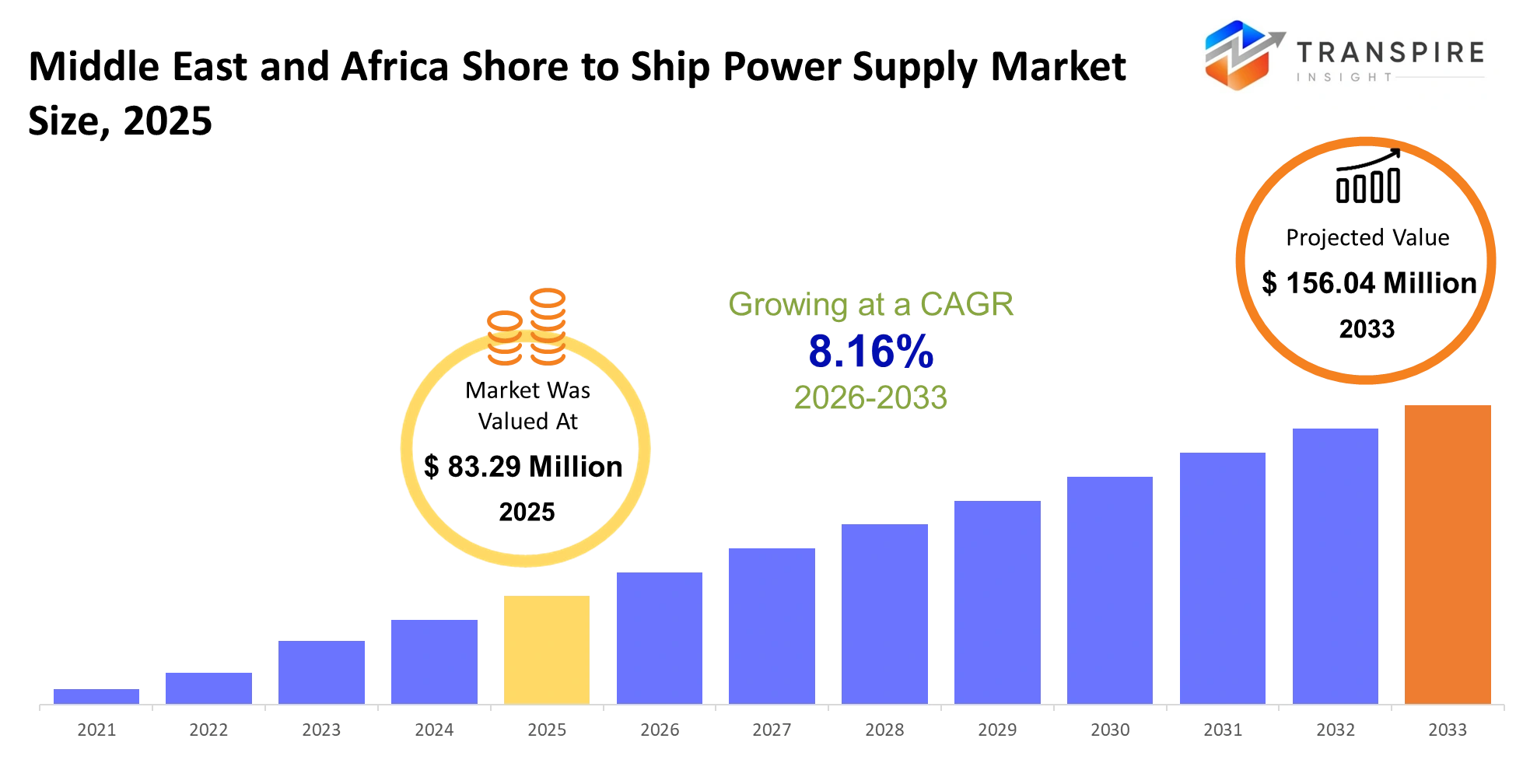
- Middle East and Africa Shore to Ship Power Supply Market Size 2025: USD 83.29 Million
- Middle East and Africa Shore to Ship Power Supply Market Size 2033: USD 156.04 Million
- Middle East and Africa Shore to Ship Power Supply Market CAGR: 8.16%
- Middle East and Africa Shore to Ship Power Supply Market Segments: By Type (Low Voltage Systems, Medium Voltage Systems, High Voltage Systems, Others); By Application (Container Ships, Cruise Ships, Ferries, Ports, Offshore Vessels, Others); By End-User (Port Authorities, Shipping Companies, Government, Energy Providers, Others); By Component (Transformers, Switchgear, Cables, Connectors, Others).
To learn more about this report,  Download Free Sample Report
Middle East and Africa Shore to Ship Power Supply Market Summary
The Middle East and Africa Shore to Ship Power Supply Market was valued at USD 83.29 Million in 2025. It is forecast to reach USD 156.04 Million by 2033. That is a CAGR of 8.16% over the period.
The Middle East and Africa Shore to Ship Power Supply Market, kind of enables vessels to plug into electricity that is based at the port while they are berthed. In practice, it replaces those onboard diesel generators that usually keep running during loading and unloading , so you get less noise and less smoke right at the dock area. That should lower port emissions, make air quality better in crowded coastal zones, and also helps smooth out energy use across terminal operations, since ships would otherwise sit there idling with auxiliary engines on.
Over the last 3–5 years, this market has moved away from small pilot scale placements and toward more organized electrification efforts, notably across GCC mega ports. One important change is the move from simple diesel-dependent port power layouts to grid integrated plus hybrid shore connection systems. Those setups are more capable, especially for high voltage container vessels. This shift was also pushed along by tighter IMO sulfur rules , along with national decarbonization goals, so ports started redesigning energy infrastructure instead of only adding a quick retrofit to isolated terminals.
A big driver that sped things up was rerouting in global shipping lanes and then, more congestion around the Red Sea and several African trade gateways. That situation raised pressure on ports to improve turnaround speed while still staying in line with emission requirements. Because of that ports are now putting more money into shore power infrastructure, to cut vessel idle emissions and to avoid compliance penalties. In turn, this directly supports more revenue from equipment purchases and the system integration side, even when the projects are complex or staged.
Key Market Insights
- GCC countries hold nearly 45% share in the Middle East and Africa Shore to Ship Power Supply Market in 2025, sort of led by advanced port electrification programs in UAE and Saudi Arabia .
- Africa looks like it is becoming the quickest-growing region through 2025–2030 , because ports in South Africa and Kenya are expanding grid-connected berthing infrastructure, bit by bit .
- Meanwhile West African trade gateways are slowly raising adoption, mostly due to rerouted shipping lanes and the rising need for port congestion management .
- High-voltage shore connection systems are the ones that dominate the Middle East and Africa Shore to Ship Power Supply Market, almost 50% share, mainly because container vessel compatibility requirements matter a lot .
- Low-voltage shore power units stay as the second-biggest segment, and they’re mainly used in ferry operations and small cargo terminal setups.
- Containerized and modular shore power solutions are the fastest-growing segment from 2024 to 2030, since they provide flexible deployment benefits, without much delay .
- Container terminals account for over 40% share in the Middle East and Africa Shore to Ship Power Supply Market, largely due to the high vessel turnaround frequency .
- For applications, LNG and oil terminals are moving the fastest, as energy export infrastructure keeps expanding across GCC economies .
- Commercial port operators are leading overall with more than 55% share, backed by large-scale government-backed electrification projects .
- Private terminal operators are the fastest-growing end-user group too, driven by ESG compliance obligations , and also by international shipping contracts .
What are the Key Drivers, Restraints, and Opportunities in the Middle East and Africa Shore to Ship Power Supply Market?
The main thing, sort of, shaping the Middle East and Africa shore-to-ship power supply situation is tightening maritime emission regulation, plus port decarbonization requirements, in those important trading hubs like the UAE and Saudi Arabia. The International Maritime Organization’s sulfur cap push and the national net-zero port plans have basically pushed operators to fit shore connection systems so a vessel can shut down auxiliary diesel engines while it is berthed. That change, right there, tends to lift capital spending on electrification infrastructure at ports, and it also forms steady income for electrical system integrators and for grid operators, mostly in container and LNG terminals where vessel turnaround times are higher.
One big restraint is the structural limit of what the port-side electrical setup can handle, especially across African coastal economies where grid stability is fragile and there is not enough high-voltage room for reliable shore power delivery. This isn’t a quick, short-term problem, because transmission network upgrades need long horizons for investment , plus sovereign funding alignment and multi-year construction schedules. So ports across parts of East and West Africa often postpone full adoption, or they go with only partial systems, which in turn dampens near-term equipment sales and lowers the utilization levels for already installed shore power assets.
An emerging chance is in modular, containerized shore power units, together with renewable microgrids. These do help lessen reliance on centralized grid upgrades. Some work around South Africa’s Durban port expansion shows this movement, where hybrid solar-backed shore supply trials are being tested to support moored vessels, while also helping steady the local energy constraints.
What Has the Impact of Artificial Intelligence Been on the Middle East and Africa Shore to Ship Power Supply Market?
Artificial intelligence and cutting edge digital systems are getting more and more woven into scrubber performance routines and shore power coordination along Middle East and Africa ports, particularly when operators clamp down on emission compliance and push for energy efficiency targets. Ports, and shipping operators, are now rolling out AI enabled control platforms to automatically watch over exhaust gas cleaning technology, tuning scrubber flow rates and water treatment parameters in real time so they can stay on IMO sulfur limits, while also cutting down on how much human attention is needed.
At the same time, machine learning models are used for predictive care, sifting through vibration, temperature, and corrosion signals coming from shore connection equipment and onboard power interfaces, so failures can be expected before they interrupt berthing activities. In multiple GCC ports, digital twin style simulations compare vessel energy needs with available grid capacity, which helps with scheduling and also lessens peak load pressure on port infrastructure. According to operators, these setups have improved equipment availability and reduced surprise maintenance events by roughly 10–20 percent, and that usually comes with lower auxiliary fuel burn during port stays too.
AI driven emissions forecasting tools also help to fine tune vessel port timing, which supports planning shore connection moments and reduces the stop and go idle of auxiliary engines. Still, take up is not uniform, because there is limited high quality maritime training data, plus connectivity can be uneven across some African coastal terminals. That combination makes models less accurate in practice, and it can slow the real time optimization, especially in locations where data flow is patchy.
Key Market Trends
- Ports around the region, sort of quietly, shifted gears from small pilot shore power schemes before 2020 to much bigger electrification plans after 2023, mainly because IMO aligned emission rules started to bite and cities got more vocal about air quality pressures , honestly.
- Governments also moved away from these voluntary sustainability carrots, and toward tougher compliance structures. So shipping operators ended up installing shore power interfaces instead of just leaning on auxiliary diesel engines, like it was the “default” option.
- Investment behavior changed too. It wasn’t only about a few isolated commercial ports in the GCC hubs anymore. It expanded across African trade gateways, especially in West and Southern Africa, as shipping routes got rerouted and the traffic patterns followed.
- On the infrastructure side, the development path went from low voltage, ship specific arrangements to higher capacity smart grid integration. This happened as container vessel energy demand rose with the whole mega ship expansion wave , you know.
- Retrofit work increased a lot. Older fleets had to adapt to shore connection needs, and that reduced the appetite for full fleet replacement , partly because of cost and downtime constraints that are hard to ignore.
- Private port operators, more and more, changed from stand alone diesel based port power setups toward hybrid renewable supported shore power solutions, since the decarbonization targets are not really optional.
- Technology adoption also evolved. It went beyond basic connection systems into digitally managed power distribution, with real time load balancing and predictive energy management tools doing the heavy lifting.
- Meanwhile African ports started feeling more strategically relevant. Rerouted Red Sea shipping brought more activity, which then sped up electrification urgency in terminals that used to be underinvested for longer than they should have been.
- And competitively, the whole dynamic moved. Global electrical equipment suppliers broadened partnerships locally, sort of replacing the earlier dominance of localized EPC contractors in these port infrastructure buildouts.
- Energy reliability concerns in parts of the Middle East pushed hybrid backup systems, into shore power designs i guess, which also raised the integration of storage together with renewable co-location.
Middle East and Africa Shore to Ship Power Supply Market Segmentation
By Type
Low voltage systems tend to stick around with a strong installed base , mostly because earlier shore power rollouts went after small to mid sized ports where the grid was kind of tight on capacity. They usually show up most in retrofit work, because the initial capital investment is lower and the grid integration is less complicated. You can also see the demand getting nudged by ferry terminals and smaller container ports , these operators often prefer cost control rather than jumping straight into ultra high capacity electrification.
Medium voltage systems seem to gain traction quicker, since bigger trade hubs ramp up day to day throughput and they need a higher energy transfer level for both container vessels and cruise ships. A lot of the growth is tied to port modernization programs, with the idea to cut turnaround related vessel emissions without doing heavy berth redesign. There’s also support from standardized vessel compatibility , meaning ships can match infrastructure across multiple international shipping lanes with fewer headaches.
High voltage systems stay smaller but they are still strategically meaningful, especially where large container terminals and cruise hubs are involved. Their adoption is slowed by the fact that infrastructure costs can be high and the grid reinforcement work is not optional. Still, in the long run, expansion should tilt toward high voltage systems as major ports move toward full electrification, so it opens doors for advanced power electronics providers.
By Application
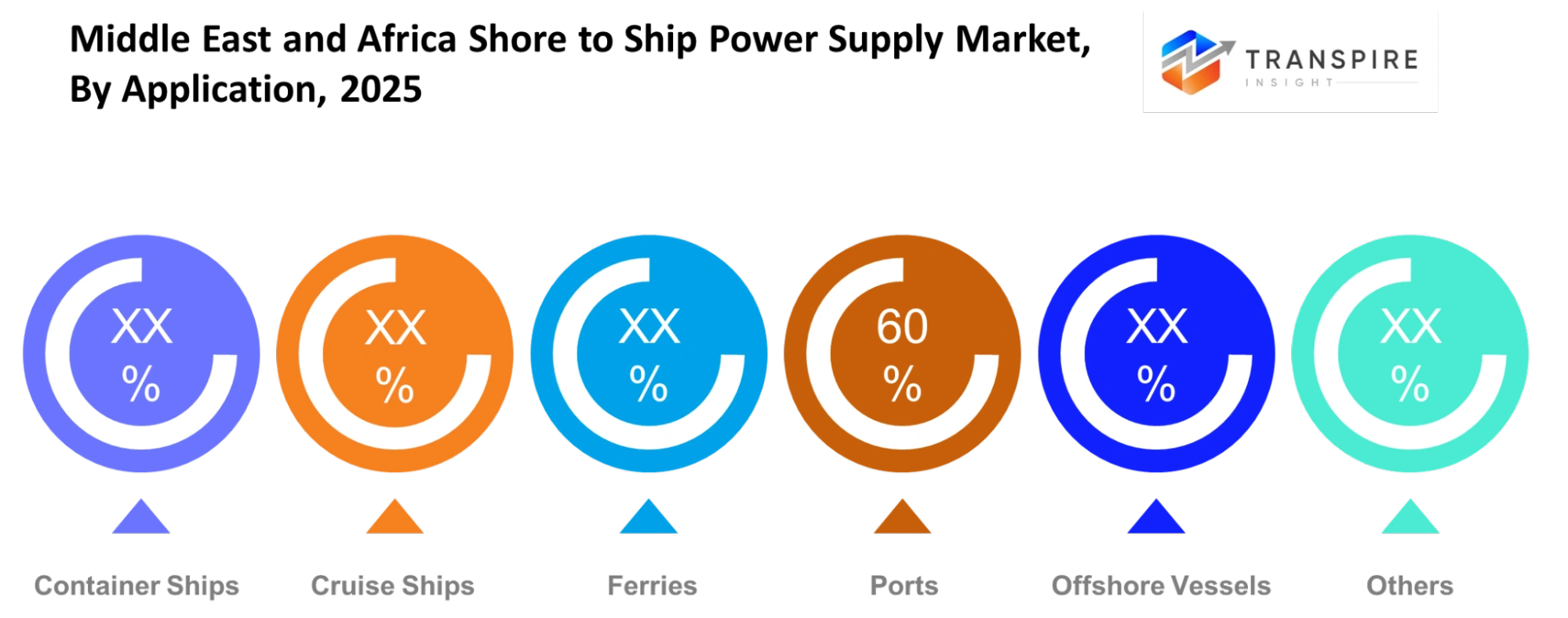
Container ships are the leading application, mainly because global traffic remains huge and these ships make a lot of port calls along major trade corridors. Demand is pushed by tight emissions reduction mandates at the berth, plus pressure from global shipping alliances that want to decarbonize day to day operations. This part also tends to set the tone for long term procurement contracts .
Cruise ships and ferries are becoming a steadily growing secondary application group, most notably in tourism oriented coastal towns and island routes. There is strong public pressure, well, to cut visible emissions near the urban waterfronts, and everyone notices when something changes. At the same time offshore vessels also create a niche demand, especially during maintenance windows in oil and gas support ports.
Looking ahead, the next phase of growth is likely to come from cruise terminals and specialized ferry corridors as environmental compliance tightens along coastal tourism areas. Some expansion will also show up through offshore support infrastructure tied to energy transition projects. Product developers will have to build flexible systems that can handle mixed vessel categories inside one port setting, kinda same footprint, different needs.
To learn more about this report, Download Free Sample Report
By End-User
Port authorities hold the largest share, largely because they have direct responsibility for port infrastructure development and regulatory compliance. They decide how capital is allocated for berth electrification and, together with utilities, they coordinate grid upgrades. In practice their procurement choices end up setting system standards across multiple terminals.
Shipping companies drive demand too, mostly through fleet modernization plans and their emissions commitments. Bigger operators often design new vessels with shore power compatibility built in, so they can satisfy international decarbonization goals. Government agencies act as support here, enforcing environmental rules and also funding early stage infrastructure, when it needs a first push.
Energy providers are getting more involved, because shore power systems now need deeper grid integration, and load balancing that is more constant. Their push comes from increasing electricity demand at electrified ports, plus the wider aim to integrate renewables. In the long run , it is this kind of back-and-forth between utilities and port operators that will shape scalability and whether the system stays dependable over time, not just today.
By Component
Transformers are in a key spot, since the voltage conversion step basically decides how well national grids fit with vessel systems. These units are usually the backbone in high-capacity setups where stability and safety rules are strict. Demand tends to be strongest in big ports, especially those running multi terminal electrification programs.
Switchgear together with cables makes up the operational core of shore power systems, and they also drive frequent replacement and upgrade routines. The momentum is tied to the push for gentler load management, and better transmission efficiency as port networks keep expanding. Connectors are getting more attention too, largely because vessel interface standardization has become a more formal requirement.
Looking ahead, future demand should tilt toward intelligent parts, where monitoring and automation features are built right into switchgear and connectors. Modular cable systems may see more adoption in terminals that do a lot of retrofitting. Suppliers that embed digital diagnostics into the equipment will often land higher value contracts, as ports shift toward predictive maintenance approaches, rather than waiting until something fails.
What are the Key Use Cases Driving the Middle East and Africa Shore to Ship Power Supply Market?
The core use case pushing adoption in the Middle East and Africa, for shore-to-ship power, is basically container plus bulk cargo vessel electrification while at berth . Ports on high frequency international lanes keep running auxiliary engines nonstop, which means continual exhaust, so shore power gets used to cut fuel burn, align with new port environmental rules and also reduce the congestion type penalties during turnaround
More and more it is showing up in cruise terminals and ferry operations, particularly in coastal towns where tourism matters, and on cross border passenger corridors . Those groups choose shore power to handle tougher air quality expectations along urban waterfronts, while also improving the trip itself via quieter operations, less vibration for passengers, and smoother docking . In parallel offshore support vessels that service oil and gas platforms are starting to include shore power too, mainly during maintenance windows when they visit regional ports
There are also newer angles, like electrifying inland river ports, and logistics hubs linked to special economic zones. Cold ironing for liquefied natural gas carriers during loading is starting to draw attention early as gas export infrastructure expands .
|
Report Metrics |
Details |
|
Market size value in 2025 |
USD 83.29 Million |
|
Market size value in 2026 |
USD 90.09 Million |
|
Revenue forecast in 2033 |
USD 156.04 Million |
|
Growth rate |
CAGR of 8.16% from 2026 to 2033 |
|
Base year |
2025 |
|
Historical data |
2021 - 2024 |
|
Forecast period |
2026 - 2033 |
|
Report coverage |
Revenue forecast, competitive landscape, growth factors, and trends |
|
Regional scope |
Middle East and Africa (Saudi Arabia, United Arab Emirates, South Africa, Rest of Middle East and Africa) |
|
Key company profiled |
ABB, Siemens, Schneider Electric, Wärtsilä, Cavotec, GE, Hitachi Energy, Eaton, Legrand, Toshiba, Hyundai Electric, Mitsubishi Electric, Fuji Electric, Nexans, Prysmian. |
|
Customization scope |
Free report customization (country, regional & segment scope). Avail customized purchase options to meet your exact research needs. |
|
Report Segmentation |
By Type (Low Voltage Systems, Medium Voltage Systems, High Voltage Systems, Others); By Application (Container Ships, Cruise Ships, Ferries, Ports, Offshore Vessels, Others); By End-User (Port Authorities, Shipping Companies, Government, Energy Providers, Others); By Component (Transformers, Switchgear, Cables, Connectors, Others). |
Which Regions are Driving the Middle East and Africa Shore to Ship Power Supply Market Growth?
Europe is basically ahead, in this shore-to-ship power supply adoption thing , and the ripple effect goes pretty far into nearby Mediterranean-linked operations that touch Middle East and Africa trade routes. The stricter emissions rules—those EU port directives—have pushed ports to install shore power fast at big container and cruise sites. So you get this sort of mature demand ecosystem already, not some random early experiments. And there’s more, the funding side is coordinated too , which helps port authorities lower the upfront capital risk and makes grid integration happen quicker. Because of that, equipment vendors sit in a pretty predictable procurement climate where compliance deadlines and standardized technical requirements keep showing up again and again, so deployments tend to be repeatable rather than standing alone as pilot efforts.
East Asia is a different story, more commercial in spirit, but still very stable as a second tier. It’s shaped by long-term shipbuilding integration and those consistent cycles of port modernization. Instead of Europe’s “regulation-first” posture, this area moves through aligned investments from shipping lines and port operators who want operational efficiency and, yes, fuel flexibility. Big hubs like Singapore and several major Chinese coastal ports care a lot about uptime reliability and fast vessel turnarounds, so shore power becomes part of broader port automation playbooks. That, in turn, produces steady demand patterns for suppliers—especially ones delivering high-capacity systems that can handle different vessel types, even when traffic intensity stays high.
The Middle East is moving fastest overall , powered by aggressive port expansion programs in the United Arab Emirates, Saudi Arabia, and Egypt. These efforts sit under broader economic diversification agendas too.New investments in giant ports and logistics passages have opened greenfield chances where shore power can be built in from the start, not later retrofitted. Governments are also lining up port builds with hydrogen preparedness and low carbon shipping routes, so procurement timelines move faster. For newcomers and investors, this change feels like a 2026 to 2033 window, where early presence in standards, cooperative arrangements, and utility coordination will meaningfully shape long term contract access , for years.
Who are the Key Players in the Middle East and Africa Shore to Ship Power Supply Market and How Do They Compete?
The Middle East and Africa shore-to-ship power supply market still looks moderately fragmented, and you can feel the rivalry is more about who lands each project than any kind of long-held dominance. Bigger electrical and marine electrification vendors are in the mix, but also port engineering specialists, kind of side by side. Then, local EPC contractors end up steering some of the last deployment choices, even when the main technology comes from elsewhere. Incumbents try to protect their position using integrated turnkey programs that bundle grid interface systems, vessel connection equipment, and digital load management. At the same time though, the whole area is being pushed forward—kind of gradually—by modular system providers. They reduce installation friction and trim down deployment schedules, so now competition leans toward adaptability and lifecycle service readiness, not just raw hardware supply.
ABB leans into high-voltage shore connection systems that are paired with grid automation. That lets it stand out by focusing on deep power systems know-how, plus strong alignment with tight maritime electrification requirements. Its approach is basically to slot shore power into wider port electrification ecosystems, usually alongside utilities and port authorities, and not as a standalone item. Cavotec goes another direction, with niche specialization in vessel connection systems—especially retractable cable management and modular shore power units. That fits terminals where retrofits dominate, or where the site constraints make full-scale redesign unrealistic. So they can still win when the infrastructure can’t really support the bigger, more invasive upgrade paths.
Siemens Energy and Hitachi Energy kind of emphasize how solid their grid integration is, using their know how from large scale electrical infrastructure so they can win contracts that are tied to port decarbonization programs. Siemens is expanding by leaning into more digitalized energy management platforms, in a way that optimizes load distribution at the berth level, and yeah it’s not just hardware. Hitachi Energy meanwhile builds its advantage by leaning on high voltage reliability systems that get deployed across big container ports and also ferry terminals. And instead of acting like it’s only standalone equipment sales, both firms are going further through joint infrastructure partnerships with port authorities plus regional energy utilities, where they sort of co design the approach.
Company List
- ABB
- Siemens
- Schneider Electric
- Wärtsilä
- Cavotec
- GE
- Hitachi Energy
- Eaton
- Legrand
- Toshiba
- Hyundai Electric
- Mitsubishi Electric
- Fuji Electric
- Nexans
- Prysmian
Recent Development News
“In June 2025, ABB-led consortium completed a major shore power installation at the Port of Toulon in France. The system enables simultaneous electrification of multiple vessels, including ferries and cruise ships, significantly reducing berth emissions and demonstrating scalable smart-grid shore power integration in a high-traffic European port environment.
Source: https://new.abb.com
“In June 2025, Cavotec launched its PowerAlign modular shore power system designed for container terminals, improving flexibility and reducing infrastructure constraints in retrofit-heavy port environments. The solution supports faster deployment of electrification infrastructure without full quay reconstruction, addressing a key bottleneck in port decarbonization programs.
Source: https://press.cavotec.com
What Strategic Insights Define the Future of the Middle East and Africa Shore to Ship Power Supply Market?
Over the next five to seven years, the Middle East and Africa shore-to-ship power supply market is likely to wobble a bit, moving from pilot-scale deployments toward infrastructure integrated port modernization, mostly kicked along by decarbonization mandates at big trade hubs and the mounting pressure to cut emissions from auxiliary ship engines while ships are at berth. The shift will not be even though, Gulf ports seeming to roll ahead faster than smaller African terminals, mainly because of capital availability, plus a more rigid grid stability situation.
There is also a quieter sort of risk, sort of technology lock-in around LNG-compatible setups, which could get thrown off if onboard alternative fuel systems get adopted sooner than expected, and then shore power utilization drops, almost like an unwanted domino effect.
At the same time, an opportunity is starting to show up more clearly: modular containerized shore power units, powered by hybrid renewables. These are particularly appealing for secondary ports where grid upgrades are slow or simply too expensive to wait on.
Market participants should therefore focus on flexible, interoperable systems, designed so they can work with multiple vessel standards, to hedge against the unclear propulsion pathways and the regulatory differences that keep appearing across regions.
Middle East and Africa Shore to Ship Power Supply Market Report Segmentation
By Type
- Low Voltage Systems
- Medium Voltage Systems
- High Voltage Systems
- Others
By Application
- Container Ships
- Cruise Ships
- Ferries
- Ports
- Offshore Vessels
- Others
By End-User
- Port Authorities
- Shipping Companies
- Government
- Energy Providers
- Others
By Component
- Transformers
- Switchgear
- Cables
- Connectors
- Others
Frequently Asked Questions
Find quick answers to common questions.
The Middle East and Africa Shore to Ship Power Supply Market size is USD 156.04 Million in 2033.
Key segments for the Middle East and Africa Shore to Ship Power Supply Market are By Type (Low Voltage Systems, Medium Voltage Systems, High Voltage Systems, Others); By Application (Container Ships, Cruise Ships, Ferries, Ports, Offshore Vessels, Others); By End-User (Port Authorities, Shipping Companies, Government, Energy Providers, Others); By Component (Transformers, Switchgear, Cables, Connectors, Others).
Major Middle East and Africa Shore to Ship Power Supply Market players are ABB, Siemens, Schneider Electric, Wärtsilä, Cavotec, GE, Hitachi Energy, Eaton, Legrand, Toshiba, Hyundai Electric, Mitsubishi Electric, Fuji Electric, Nexans, Prysmian.
The Middle East and Africa Shore to Ship Power Supply Market size is USD 83.29 Million in 2025.
The Middle East and Africa Shore to Ship Power Supply Market CAGR is 8.16% from 2026 to 2033.
- ABB
- Siemens
- Schneider Electric
- Wärtsilä
- Cavotec
- GE
- Hitachi Energy
- Eaton
- Legrand
- Toshiba
- Hyundai Electric
- Mitsubishi Electric
- Fuji Electric
- Nexans
- Prysmian
Recently Published Reports
-
Apr 2026
Active Power Filter Market
Active Power Filter Market Size, Share & Analysis Report By Type (Shunt Active Power Filters, Series Active Power Filter, Hybrid Active Power Filter), By Application (Harmonics Mitigation, Reactive Power Compensation, Voltage Regulation, Power Factor Correction), By Phase (Single Phase, Three Phase), By End-User Industry (Manufacturing, Healthcare, Commercial, Automotive, Oil and Gas, Others), and Geography (North America, Europe, Asia-Pacific, Middle East and Africa, South and Central America), 2021 - 2031
-
Apr 2026
Electrical Transformer Market
Electrical Transformer Market Size, Share & Analysis Report By Core (Closed, Shell, and Berry), By Insulation (Gas, Oil, Solid, Air, and Other), By Phase (Single, and Three), By Rating (100 MVA to 500 MVA, 501 MVA to 800 MVA, and 801 MVA to 1200 MVA), and Geography (North America, Europe, Asia-Pacific, Middle East and Africa, South and Central America), 2021 – 2031
-
Apr 2026
Hydraulic Piston Pumps Market
Hydraulic Piston Pumps Market Size, Share & Analysis Report By Type (Axial Piston Pumps, Radial Piston Pumps), By Operating Pressure (Low Pressure, Medium Pressure, High Pressure), By Application (Construction, Mining, Agriculture, Automotive, Oil & Gas, Industrial Machinery, Others), By End-User (OEMs, Aftermarket), and Geography (North America, Europe, Asia-Pacific, Middle East and Africa, South and Central America), 2021 – 2031
-
Apr 2026
Laboratory Gas Generators Market
Laboratory Gas Generators Market Size, Share & Analysis Report By Product (Nitrogen Gas Generator, Hydrogen Gas Generator, Zero Air Gas Generator, Purge Gas Generator, TOC Gas Generators, Others), By Application (Gas Chromatography, Liquid Chromatography-mass Spectrometry (LC-MS), Gas Analyzers, Others), By End-user (Life Science, Chemical & Petrochemical, Food & Beverage, Others), and Geography (North America, Europe, Asia-Pacific, Middle East and Africa, South and Central America), 2021 – 2031