

United States Flexible Printed Circuit (FPC) Market Size & Forecast:
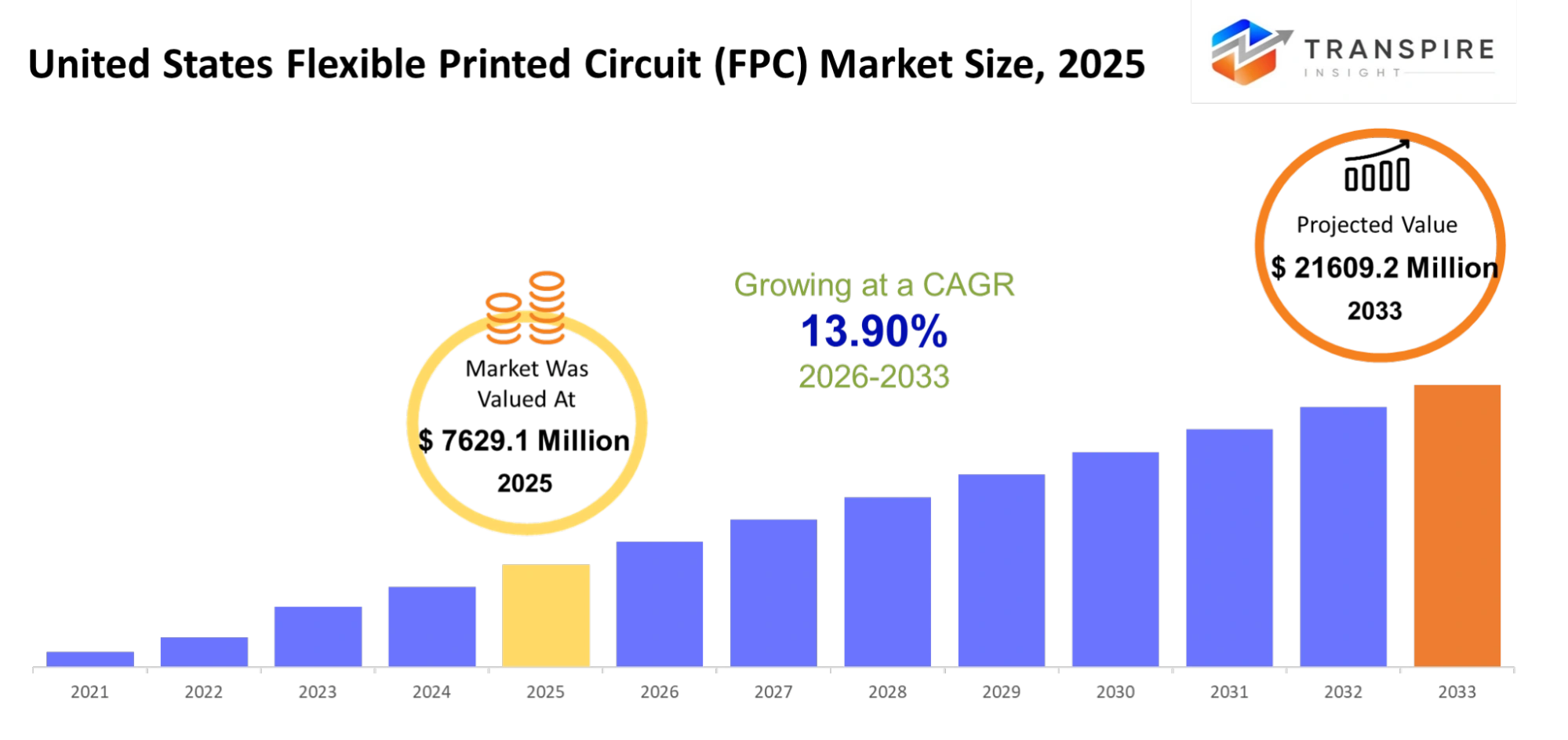
- United States Flexible Printed Circuit (FPC) Market Size 2025: USD 7629.1 Million
- United States Flexible Printed Circuit (FPC) Market Size 2033: USD 21609.2 Million
- United States Flexible Printed Circuit (FPC) Market CAGR: 13.90%
- United States Flexible Printed Circuit (FPC) Market Segments:By Type (Single, Double, Multi-layer, Rigid-flex, HDI, Hybrid, Stretchable), By Application (Electronics, Automotive, Healthcare, Aerospace, Industrial, Wearables, Telecom), By Material (Polyimide, Polyester, Copper, Adhesives, Coverlay, Laminates, Ink), By End-User (OEMs, Electronics, Automotive, Industrial, Healthcare, Defense, Telecom), By Tech (Etching, Printing, Laser, SMT, Additive, Roll-to-roll, Advanced).
To learn more about this report,  Download Free Sample Report
United States Flexible Printed Circuit (FPC) Market Summary:
The United States Flexible Printed Circuit (FPC) market size is estimated at USD 7629.1 Million in 2025 and is anticipated to reach USD 21609.2 Million by 2033, growing at a CAGR of 13.90% from 2026 to 2033. The United States Flexible Printed Circuit (FPC) market is experiencing steady growth because there is increasing demand for electronic components that are both compact and light in weight and capable of delivering high performance. The consumer electronics and automotive and healthcare and aerospace industries are adopting FPC technology which drives both innovation and production processes. The companies are developing new materials and design methods to create products that match current technological requirements of the industry. The increasing demand for smaller electronic devices and intelligent devices is driving market expansion because FPCs serve as essential elements for upcoming electronic products which will be used throughout the United States.
Key Market Trends & Insights:
- The current technology trend leads to smaller device designs which create demand for flexible circuits that can operate in restricted areas. FPCs enable designers to create efficient systems which maintain their operational abilities, thus becoming vital components of contemporary electronic products.
- The main factors driving FPC usage in the market include smartphones, wearables, and tablets. Manufacturers are increasingly using flexible circuits to enhance their products through improved performance and longer-lasting and lighter-weight designs.
- The rising popularity of electric vehicles together with advanced driver-assistance systems (ADAS) has resulted in increased FPC adoption. These circuits enable the construction of complicated wiring networks while they decrease vehicle weight and improve system reliability.
- FPCs are being used in medical devices which include wearable monitors and diagnostic tools because they provide both flexible design and accurate measurement capabilities. The trend originates from the rising demand for remote patient monitoring systems and compact medical devices.
- Companies are putting their resources into developing new materials which provide superior temperature resistance and material strength. The advanced design capabilities now enable the creation of more intricate and efficient circuit layouts.
- Aerospace and defence industries have started to adopt FPC technology because of its lightweight attributes and superior operational capabilities. The system works best for situations which require maximum use of available space while minimising total system weight.
- The demand for high-speed and high-performance electronic devices drives the market for HDI flexible circuits. The technology enables higher connectivity densities, which results in improved device performance through smaller space requirements.
United States Flexible Printed Circuit (FPC) Market Segmentation
By Type
- Single: Simple applications that need affordable solutions depend on single-layer FPCs which serve as their most common solution. Basic electronic devices benefit from their lightweight design, which enables flexible operation. The system provides reliable performance for basic designs which need extended functionality in areas with restricted space.
- Double: Double-layer FPCs provide enhanced circuit density and improved functionality compared to single-layer designs. The system enables better routing through its enhanced capabilities which match the requirements of devices with moderate complexity. The circuits deliver balanced performance yet maintain affordable pricing which drives their usage in both consumer electronics and automotive components.
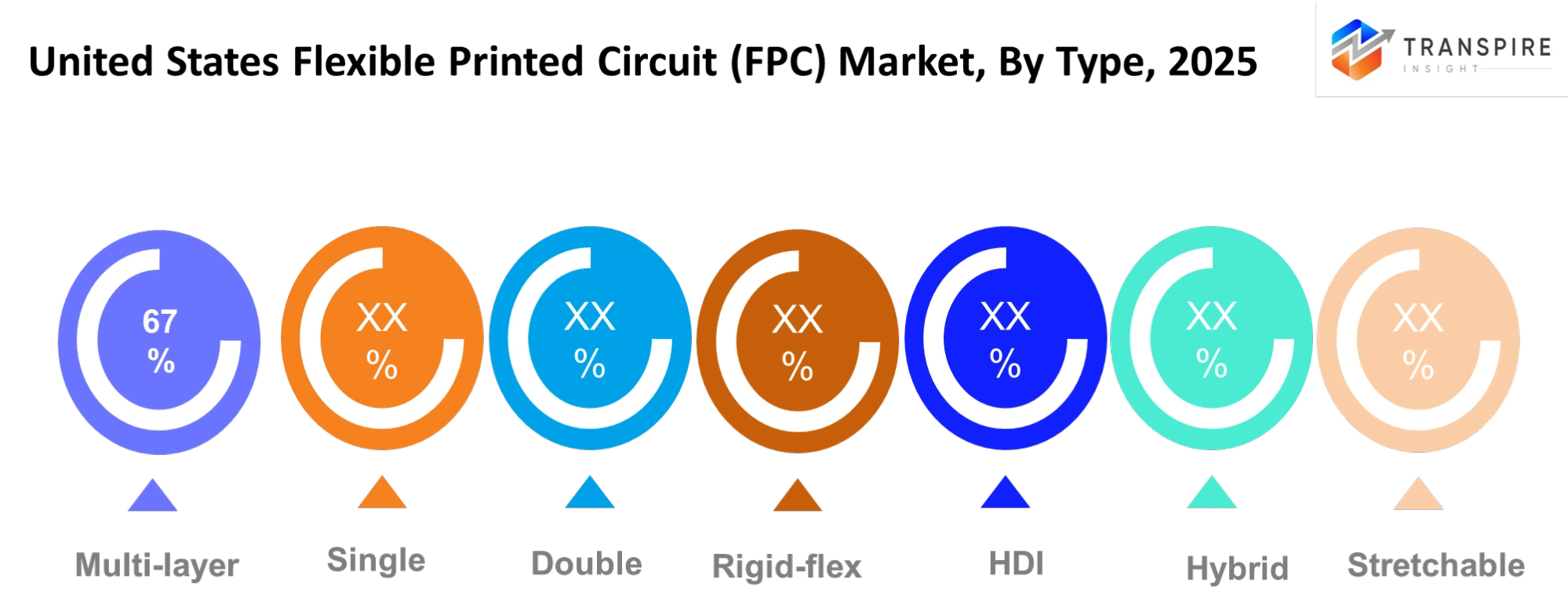
- Multi-layer FPCs support high-density circuits and complex designs. The technology finds increasing application in advanced electronics because performance and compactness are essential requirements. The system enables multiple functionalities to operate within a limited area which makes it crucial for high-end applications.
- Rigid-flex: Rigid-flex circuits provide the combined benefits of rigid boards together with flexible circuit technology. The solution eliminates complex assembly tasks while it enhances the durability of systems. The solution finds extensive application in aerospace and medical devices to deliver dependable performance under conditions that demand both strength and flexibility.
- HDI: High-Density Interconnect (HDI) FPCs enable more connections in limited space. The devices function as vital components within electronic systems which require both high-speed processing and compact design. The market demand for smaller devices drives the rapid adoption of HDI technology across cutting-edge applications.
- Hybrid: Hybrid FPCs use multiple technologies together with various materials to create performance solutions that match specific needs. The system serves specialized fields that demand specific electrical and mechanical characteristics. The system provides manufacturers with the ability to deliver customized solutions which meet different industry requirements.
- Stretchable: Stretchable FPCs demonstrate an emerging technology which allows for their continuous operation during both their expansion and contraction periods. The technology proves suitable for use in both wearable devices and biomedical research applications. Their adaptable design capabilities create new opportunities for development in both flexible electronic devices and smart electronic devices.
To learn more about this report, Download Free Sample Report
By Application
- Electronics: FPCs find their primary use in consumer electronics, which represents the most significant market share. Flexible circuits enable smartphones and tablets to achieve their required design and operational needs. The continuous development of new technologies creates increased market need for this product category.
- Automotive: The automotive sector now uses flexible printed circuits to support advanced safety and infotainment systems. The lightweight design of this product enables vehicles to achieve better fuel efficiency. The electric vehicle market expansion creates new business opportunities.
- Healthcare: The healthcare sector experiences rapid growth with FPCs used in both diagnostic and wearable medical devices. The technology provides flexible yet precise measurement capabilities for compact and dependable systems. The existing trend continues to rise because of increasing requirements for remote monitoring systems.
- Aerospace: FPCs deliver lightweight yet high-performance capabilities which the aerospace industry highly values. The products enable weight reduction while maintaining system performance. The circuits function as essential components in systems that need to endure severe operational environments.
- Industrial: FPCs serve industrial purposes through their application in both automation systems and machinery operations. The product's flexible nature allows for effective connections between different components of intricate systems. Automated processes together with intelligent manufacturing methods drive their increased usage.
- Wearables: FPCs experience rapid market growth within the wearable technology sector. The circuits create stylish and adaptive product designs which fitness trackers and smartwatches use. The material's capacity to endure both physical movement and flexible bending makes it suitable for personal electronics use.
- Telecom: FPCs serve as essential components in both communication devices and network infrastructure throughout the telecom sector. The technology provides essential support for both quick data transfer capabilities and compact system design. The demand for 5G networks continues to grow, which drives further market expansion.
By Material
- Polyimide: The material most commonly used for applications requires polyimide because it provides exceptional thermal stability and flexible properties. The material functions effectively in extreme conditions which makes it suitable for use in high-tech electronic systems. The material maintains its strength throughout extended usage.
- Polyester: Polyester is a cost-effective alternative used in less demanding applications. The material provides users with both flexible attributes and electrical performance capabilities. This material is commonly used in consumer electronics where cost efficiency is important.
- Copper: Copper functions as a necessary component which enables electrical flow through FPCs. The material delivers reliable electrical performance through its complete conductivity. The integrity of complex circuits depends on high-quality copper layers which handle signal transmission.
- Adhesives: Adhesives attach various components together which make up FPCs. The materials help maintain structural strength while providing long-lasting power. New adhesive technologies enable better heat resistance which enhances the entire circuit operation.
- Coverlay: Coverlay functions as a protective shield that defends flexible circuits from damage. The material increases strength while offering protection against environmental hazards. This material ensures extended operational life through its use in challenging operational environments.
- Laminates: Laminates create the foundational framework of FPCs because they combine flexible properties with strong structural support. The materials enable the support of numerous layers while they enhance the strength of the system. The circuit reliability and lifespan depend on the quality of the components used in its construction.
- Ink: Printed electronics and flexible circuits use conductive inks for their operations. The material enables the development of new manufacturing processes through its printing capability. The material is becoming popular for use in new electronic devices which are designed for budget-friendly price points.
By End-User
- OEMs: The primary users of FPCs in the market are Original Equipment Manufacturers which use FPCs to create their final products in all industrial sectors. The market demand from these companies leads to technological advancements and large production operations.
- Electronics: FPCs serve as essential components for electronics companies who develop new products. The industry continues to expand its demand for compact yet effective design solutions. This segment remains a major contributor to market revenue.
- Automotive: Modern vehicle systems use FPCs as an essential component in contemporary automotive manufacturing. The adoption rate of these systems has increased because of the growing popularity of electric vehicles and smart vehicles. The circuits enable better system performance while decreasing overall system weight.
- Industrial: FPCs are used by industrial users to build their automation and control systems. The system provides designers with the ability to create intricate machinery systems. The demand for this sector is increasing because smart factories are expanding their operations.
- Healthcare: Healthcare organisations use FPCs in medical devices and equipment. The technology provides reliable operation and accurate measurement, which medical professionals need to protect patient health. The healthcare sector is expanding because more people are adopting technology in their healthcare practices.
- Defense: The defense sector needs FPCs that provide both advanced reliability and extended durability for its operational requirements. The advanced military equipment uses these specialised circuits. The sector depends on these materials because they function effectively under extreme environmental conditions.
- Telecom: Telecom companies require FPCs for their essential communication systems and infrastructure projects. The systems depend on their ability to provide fast internet access for operational efficiency. The need for FPCs has increased because digital networks continue to expand their reach.
By Tech
- Etching: Etching functions as a traditional method which engineers use to produce circuit patterns. The method delivers accurate and dependable results for intricate design work. FPC manufacturers continue to employ this method throughout their production process.
- Printing: Printing technology enables manufacturers to produce circuits at low costs while maintaining production flexibility. The system works best for industrial production processes and innovative development work. The method has become popular because it provides effective results.
- Laser: Laser technology serves as a precise cutting and drilling method which manufacturers use to produce flexible printed circuits. The system improves precision while decreasing material consumption. The advanced method enables manufacturers to create products which meet high standards of excellence.
- SMT: Surface Mount Technology (SMT) allows efficient component placement on FPCs. The system helps to assemble products at a faster pace while also increasing their assembly accuracy. SMT has become a fundamental requirement for current electronic production processes.
- Additive: Additive manufacturing builds circuits layer by layer. The process minimises material waste while allowing engineers to build intricate circuit designs. The new design method has attracted interest from researchers who study cutting-edge technology.
- Roll-to-roll: The roll-to-roll processing method enables manufacturers to produce products continuously while maintaining their high production output. The system operates with both high efficiency and low operational costs. The method works best for industrial production of flexible electronic devices.
- Advanced: Advanced technologies combine multiple innovative processes for superior performance. The systems allow users to create personalised products with exceptional accuracy. The emerging technologies are defining how FPC products will evolve in the forthcoming time.
Country Insights
The United States Flexible Printed Circuit (FPC) market operates through two competing forces which create multiple technological advancements together with strong industrial requirements. The established electronics ecosystem of the country, which benefits from ongoing innovation, serves as the main factor driving FPC implementation across various industries, including consumer electronics and automotive, healthcare and aerospace sectors. Manufacturers dedicate resources to developing sophisticated circuit solutions and innovative materials because they need to create smaller and better-performing products.
The rising interest in electric vehicles together with smart medical devices and advanced communication systems presents new chances for business expansion. The combination of domestic manufacturing capabilities with strategic partnerships and research and development (R&D) expenditures creates a stronger market environment. The United States maintains its status as an innovative leader despite ongoing supply chain difficulties and financial constraints because it serves as a vital centre for developing and implementing flexible printed circuit technologies.
Recent Development News
In January 2026, AI Integration Speeds Up Flexible Circuit Design Processes: Artificial intelligence tools are reducing prototyping time and costs in flexible electronics. U.S. manufacturers are adopting AI-driven design to stay competitive.
In January 2026, Wearable Technology Expansion Accelerates Flexible Circuit Innovation: Growing demand for fitness trackers and medical wearables is pushing innovation in stretchable and flexible circuits. U.S. companies are investing heavily in this segment.
|
Report Metrics |
Details |
|
Market size value in 2025 |
USD 7629.1 Million |
|
Market size value in 2026 |
USD 8689.9 Million |
|
Revenue forecast in 2033 |
USD 21609.2 Million |
|
Growth rate |
CAGR of 13.90% from 2026 to 2033 |
|
Base year |
2025 |
|
Historical data |
2021 – 2024 |
|
Forecast period |
2026 – 2033 |
|
Report coverage |
Revenue forecast, competitive landscape, growth factors, and trends |
|
Country scope |
United States |
|
Key company profiled |
Nippon Mektron, Sumitomo, Fujikura, Samsung EM, LG Innotek, Flexium, Zhen Ding, Interflex, Career Tech, Unimicron, TTM, AT&S, Jabil, Molex, Foxconn |
|
Customization scope |
Free report customization (country, regional & segment scope). Avail customized purchase options to meet your exact research needs. |
|
Report Segmentation |
By Type (Single, Double, Multi-layer, Rigid-flex, HDI, Hybrid, Stretchable), By Application (Electronics, Automotive, Healthcare, Aerospace, Industrial, Wearables, Telecom), By Material (Polyimide, Polyester, Copper, Adhesives, Coverlay, Laminates, Ink), By End-User (OEMs, Electronics, Automotive, Industrial, Healthcare, Defense, Telecom), By Tech (Etching, Printing, Laser, SMT, Additive, Roll-to-roll, Advanced). |
Key United States Industrial Coating Company Insights
The United States Flexible Printed Circuit (FPC) market is shaped by a mix of established manufacturers and innovative technology firms that specialise in producing accurate products with high operational efficiency. Companies are investing in advanced materials and automation technologies and high-density circuit designs to fulfil their current industry requirements. The companies maintain their competitive edge through both strategic partnerships and their ongoing research activities which support their business needs. The market players strengthen their market position through their focus on customised solutions and high-quality products, which they develop for multiple industries, including healthcare and automotive and aerospace sectors in the innovation-driven market.
Company List
- Nippon Mektron
- Sumitomo
- Fujikura
- Samsung EM
- LG Innotek
- Flexium
- Zhen Ding
- Interflex
- Career Tech
- Unimicron
- TTM
- AT&S
- Jabil
- Molex
- Foxconn
United States Flexible Printed Circuit (FPC) Market Report Segmentation
By Type
- Single
- Double
- Multi-layer
- Rigid-flex
- HDI
- Hybrid
- Stretchable
By Application
- Electronics
- Automotive
- Healthcare
- Aerospace
- Industrial
- Wearables
- Telecom
By Material
- Polyimide
- Polyester
- Copper
- Adhesives
- Coverlay
- Laminates
- Ink
By End-User
- OEMs
- Electronics
- Automotive
- Industrial
- Healthcare
- Defense
- Telecom
By Tech
- Etching
- Printing
- Laser
- SMT
- Additive
- Roll-to-roll
- Advanced
Frequently Asked Questions
Find quick answers to common questions.
The approximate United States Flexible Printed Circuit (FPC) Market size for the market will be USD 21609.2 Million in 2033.
The key segments of the United States Flexible Printed Circuit (FPC) Market are By Type (Single, Double, Multi-layer, Rigid-flex, HDI, Hybrid, Stretchable), By Application (Electronics, Automotive, Healthcare, Aerospace, Industrial, Wearables, Telecom), By Material (Polyimide, Polyester, Copper, Adhesives, Coverlay, Laminates, Ink), By End-User (OEMs, Electronics, Automotive, Industrial, Healthcare, Defense, Telecom), By Tech (Etching, Printing, Laser, SMT, Additive, Roll-to-roll, Advanced).
Major players in the United States Flexible Printed Circuit (FPC) Market are Nippon Mektron, Sumitomo, Fujikura, Samsung EM, LG Innotek, Flexium, Zhen Ding, Interflex, Career Tech, Unimicron, TTM, AT&S, Jabil, Molex, Foxconn.
The current market size of the United States Flexible Printed Circuit (FPC) Market is USD 7629.1 Million in 2025.
The United States Flexible Printed Circuit (FPC) Market CAGR is 13.90%.
- Nippon Mektron
- Sumitomo
- Fujikura
- Samsung EM
- LG Innotek
- Flexium
- Zhen Ding
- Interflex
- Career Tech
- Unimicron
- TTM
- AT&S
- Jabil
- Molex
- Foxconn
Recently Published Reports
-
Apr 2026
Fiber Optic Faceplates Market
Fiber Optic Faceplates Market Size, Share & Analysis Report By Type (< 300 mm2, 300-350 mm2, and > 350 mm2, By Application (Night Vision, Holographic Imaging, Medical, and Others), and Geography (North America, Europe, Asia-Pacific, Middle East and Africa, South and Central America), 2021 - 2031
-
Apr 2026
High Temperature Superconductors Market
High Temperature Superconductors Market Size, Share & Analysis Report By Type (1G HTS, and 2G HTS), By Application (Power Cable, Fault Current Limiter, and Transformer), and Geography (North America, Europe, Asia-Pacific, Middle East and Africa, South and Central America), 2021 - 2031
-
Apr 2026
Industrial Plugs and Socket Market
Industrial Plugs and Socket Market Size, Share & Analysis Report By Type (Industrial Plugs, Industrial Sockets), By Current (Up to 32 A, 32 to 125 A, Above 125 A), By Protection (Dustproof and Splash Proof, Waterproof, Explosion Proof), By End User (Heavy Industries, Oil and Gas, Chemicals and Pharmaceuticals, Power Generation, Others), and Geography (North America, Europe, Asia-Pacific, Middle East and Africa, South and Central America), 2021 - 2031
-
Apr 2026
InGaAs Avalanche Photodiodes Market
InGaAs Avalanche Photodiodes Market Size, Share & Analysis Report By Type (1100 - 1700 nm, and 1000 - 1600 nm), By Application (Missile Warning System, Muzzle Flash Detection, Wafer Defect Inspection, Laser Rangefinders, and Others), and Geography (North America, Europe, Asia-Pacific, Middle East and Africa, South and Central America), 2021 - 2031