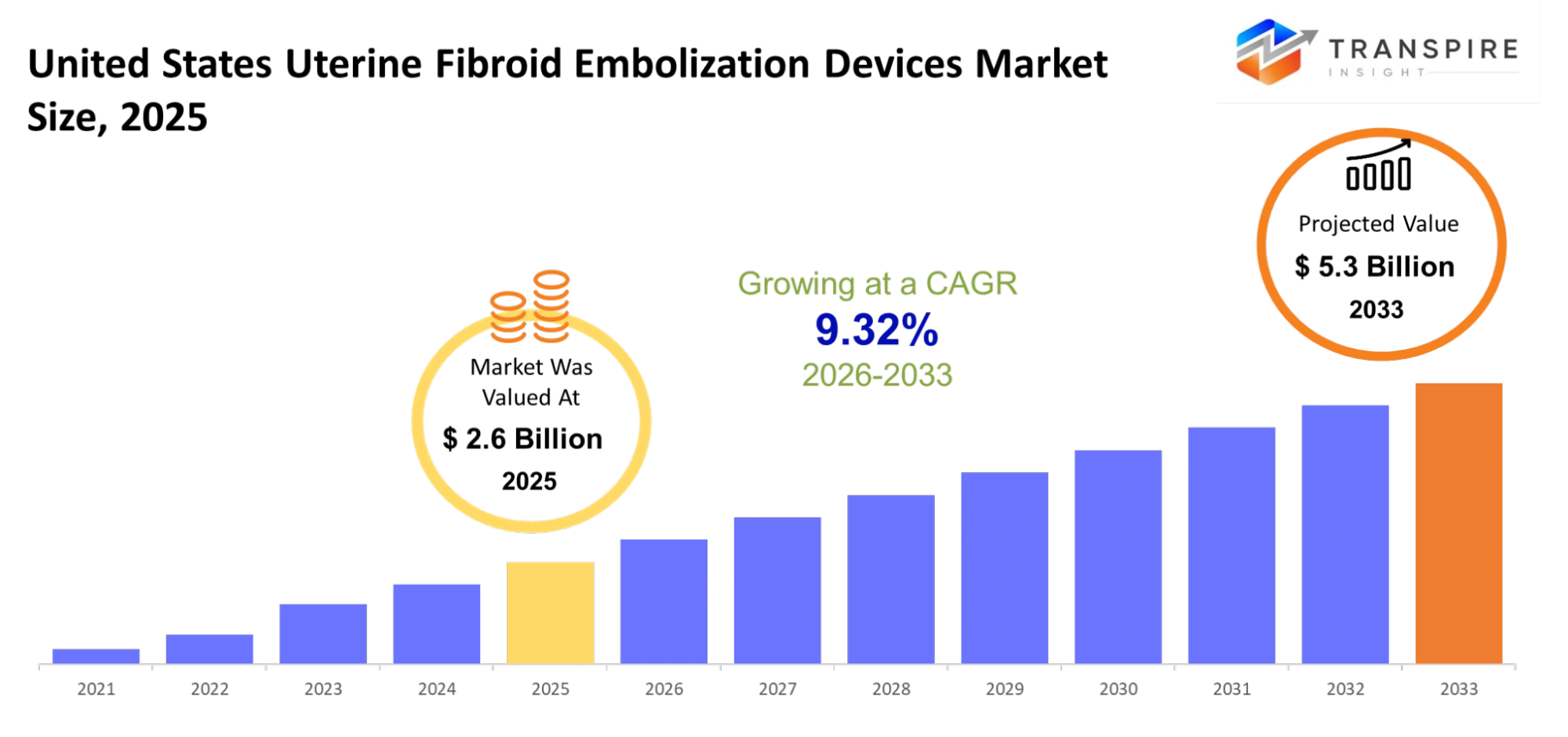
United States Uterine Fibroid Embolization Devices Market Size & Forecast:
- United States Uterine Fibroid Embolization Devices Market Size 2025: USD 2.6 BIllion
- United States Uterine Fibroid Embolization Devices Market Size 2033: USD 5.3 BIllion
- United States Uterine Fibroid Embolization Devices Market CAGR: 9.32%
- United States Uterine Fibroid Embolization Devices Market Segments:By Product (Microspheres, Embolic Agents, Catheters, Guidewires, Delivery Systems, Imaging Systems, Accessories), By Procedure Type (UFE, UAE, Minimally Invasive, Image-guided, Outpatient, Inpatient, Hybrid), By Application (Hospitals, Clinics, Ambulatory Centers, Specialty Centers, Research, Gynecology, Radiology), By End-User (Hospitals, Clinics, Surgeons, Patients, Diagnostic Centers, Specialty Clinics, Research Institutes), By Material (Polymer, Gelatin, PVA, Coated, Biodegradable, Synthetic, Hybrid).
To learn more about this report,  Download Free Sample Report
United States Uterine Fibroid Embolization Devices Market Summary:
The United States Uterine Fibroid Embolization Devices market size is estimated at USD 2.6 billion in 2025 and is anticipated to reach USD 5.3 billion by 2033, growing at a CAGR of 9.32% from 2026 to 2033. The United States uterine fibroid embolization devices market is experiencing steady growth because more people understand minimally invasive treatments and more women develop uterine fibroids. Patients now select embolization procedures instead of standard surgical methods because those procedures offer them shorter recovery times and reduced risk of complications. The development of imaging technologies together with new catheter-based systems leads to better results in medical procedures. The market shows potential for both innovation development and sustainable growth because healthcare facilities and trained workers create an environment that promotes market expansion.
Key Market Trends & Insights:
- Women select uterine fibroid embolization because this procedure offers them a noninvasive treatment option which enables their quicker recovery from the procedure. The shift shows that patients have increased understanding which drives them to select treatment methods that create less disturbance to their daily lives.
- The development of new microspheres together with improved catheters and advanced imaging methods leads to better accuracy and enhanced safety results. The medical field benefits from these technological breakthroughs because they help doctors achieve better outcomes for their patients while reducing their own health complications.
- Educational campaigns together with enhanced diagnostic methods help promote early fibroid detection. Patients who want to learn about UFE first research the procedure which they believe will replace surgical hysterectomy.
- The U.S. healthcare system benefits from its network of competent interventional radiologists and well-equipped medical facilities which enhance procedure implementation. Patients can reach advanced medical treatments more easily through efficient healthcare systems.
- UFE is increasingly performed in outpatient settings which leads to shorter hospital durations and decreased total expenses. The current trend corresponds with the industry-wide movement toward more affordable and easily accessible medical treatment options.
- The expansion of insurance coverage together with better reimbursement policies for UFE procedures makes the treatment more affordable for patients. The development leads to more women exploring embolization as their treatment choice.
- The medical field currently focuses more on developing fertility preservation methods while creating individualised patient care solutions. UFE serves this method by delivering effective treatment for symptoms while protecting the uterus from damage.
United States Uterine Fibroid Embolization Devices Market Segmentation
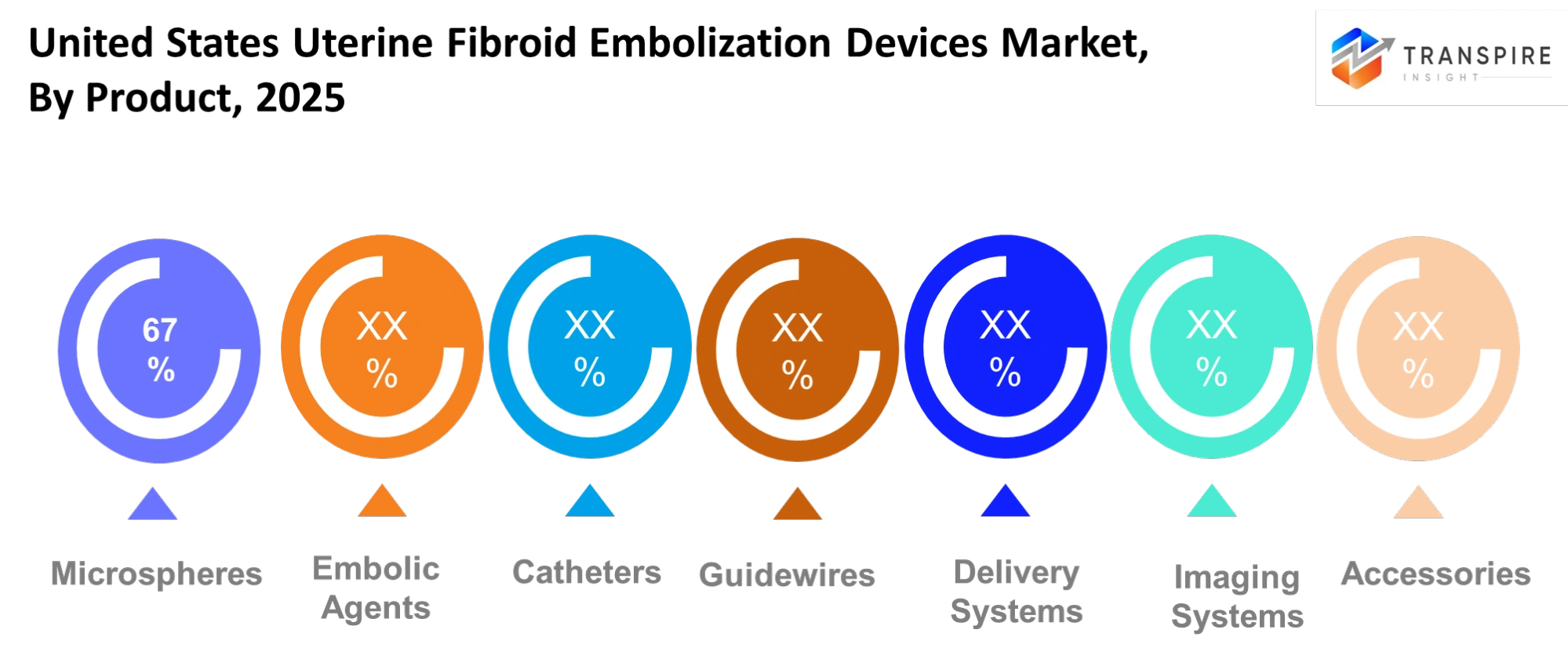
By Product
- Microspheres: The precision of microspheres allows them to effectively obstruct specific blood vessels which supply blood to fibroids. The treatment results improve because the system delivers treatments through its uniform particle size and scheduled output. The ongoing development process creates better biocompatibility and performance solutions which doctors choose because they provide consistent embolization results.
- Embolic Agents: Doctors use embolic agents to create blood flow blockages which lead to fibroid reduction and symptom improvement. The product line offers multiple treatment options through its different formulations which enable physicians to create personalized treatment plans. The need for reliable and efficient long-term solutions drives research development which increases their use within embolization treatments.
- Catheters: The medical field depends on catheters to send embolic materials to specific treatment zones. Physicians can achieve better operation results because better flexible systems enable them to navigate through medical procedures. The field of uterine fibroid embolization treatment benefits from technological progress which creates user-friendly systems that enable faster procedures and better patient results.
- Guidewires: Guidewires help with embryonic processes through their function in tracking vascular systems within complex networks. The combination of strength and flexibility with control capabilities allows operators to correctly place catheters. The development of new products creates better control abilities and safety measures which help medical workers complete their tasks quickly while minimizing potential dangers.
- Delivery Systems: Delivery systems operate to deliver embolic materials through their mechanisms which control their release times and quantities. The system operates to improve the accuracy of medical procedures while it works to decrease the possibility of making mistakes. Manufacturers are creating new systems which provide better operational performance since there is increasing need for less invasive medical solutions.
- Imaging Systems: Imaging systems provide essential support to real-time embolization procedures through their imaging capabilities. High-resolution imaging technology enables physicians to improve target vessel identification and treatment progress monitoring. The procedural safety and effectiveness of medical imaging systems have improved through technological advancements, which now serve as essential tools for contemporary uterine fibroid treatment methods.
- Accessories: The accessories which include syringes and connectors together with support tools create a pathway for efficient execution of medical procedures. The components remain hidden from view, yet they create an essential function, which maintains operational efficiency and protects worker safety. Research into accessory design has led to continuous improvements, which allow better handling of equipment and subsequent use during embolization procedures, thus benefiting the entire treatment process.
To learn more about this report, Download Free Sample Report
By Procedure Type
- UFE (Uterine Fibroid Embolization): UFE is a procedure that requires minimal invasiveness to treat fibroids through the process of cutting off their blood supply. The procedure enables patients to recover more quickly than they would after undergoing surgical treatment. Women who want effective non-surgical treatments show increasing preference for UFE because of its growing recognition and successful patient results.
- UAE (Uterine Artery Embolization): UAE is a surgical technique which uses embolization to obstruct blood vessels in the uterus for the purpose of decreasing uterine fibroid growth and its associated medical problems. The procedure has become a common medical practice because it delivers effective results while shortening the duration of patient hospitalization. The technique has gained more acceptance in clinical settings while its operational methods have improved which enables its increased adoption throughout American medical facilities.
- Minimally Invasive: Minimally invasive procedures gain popularity because they help people stay safe during surgical operations while they recover from medical procedures. Patients prefer these options for their convenience and lower complications. Healthcare providers are increasingly promoting such approaches, which align with the shift toward treatment methods that provide better patient experiences, while simultaneously reducing costs.
- Image-guided: The use of advanced imaging equipment in image-guided procedures enables accurate embolization targeting through enhanced imaging capabilities. This process improves both safety measures and operational efficiency. Real-time imaging technology establishes new standards for treatment accuracy because it empowers doctors to enhance their decision-making capabilities which results in better patient treatment outcomes.
- Outpatient: The healthcare system now allows more patients to undergo outpatient embolization procedures because these treatments offer convenient access and lower treatment costs. Patients can leave the hospital on the same day which helps decrease the amount of space occupied by patients. This trend shows how the healthcare sector prioritizes operational efficiency and patient satisfaction while maintaining effective treatment methods.
- Inpatient: Inpatient procedures stay valid for treating complicated cases which need thorough supervision. Hospitals deliver complete medical services while providing instant assistance during emergency medical situations. Inpatient care continues to play a critical role in high-risk patients who require treatment at advanced medical facilities despite the increasing preference for outpatient services.
- Hybrid: The hybrid procedure combines two distinct surgical methods which include traditional practices and minimally invasive approaches to achieve better patient results. The system enables medical professionals to handle challenging fibroid situations through its flexible treatment options. The approach receives increased recognition because it enables customized treatment development which combines effective treatment results with less invasive treatment methods and higher patient contentment.
By Application
- Hospital: The application segment of hospitals remains the dominant force because their advanced infrastructure enables skilled professionals to provide their services. The hospital system operates multiple embolization procedures which reach extreme difficulty when dealing with intricate medical situations. Hospitals serve as the main location for uterine fibroid embolization procedures because they possess comprehensive medical facilities and imaging technologies.
- Clinics: Clinics now provide embolization treatments which enable patients to receive custom medical treatment. The system provides medical services which enable patients to receive faster medical evaluations and treatment procedures. The United States sees clinics increase their operations for fibroid treatment because more people choose minimally invasive medical procedures.
- Ambulatory Centers: Ambulatory centers provide cost-effective medical solutions through their same-day procedure treatment system. Their operational procedures enable them to decrease patient waiting times while providing better convenience to their patients. The expansion of outpatient services has made these centers important players in the market for embolization medical devices.
- Specialty Centers: Specialty centers provide focused expertise in women’s health and interventional radiology. The specialized method of operation allows them to deliver exceptional medical services which match specific treatment requirements of their patients. The increasing patient demand for expert healthcare services has led to a rise in embolization procedure requests at specialized medical facilities.
- Research: Research applications serve as vital components which help scientists develop novel embolization methods and create new materials. Clinical studies and trials help improve treatment safety and effectiveness. Research activities which scientists continue to conduct will create new innovations that will determine the future development of uterine fibroid embolization devices.
- Gynecology: Gynecology departments play a central role in diagnosing and managing fibroids. The two medical specialties work together to provide patients with complete medical care. The rising referral rates for embolization procedures as a non-surgical treatment option show that gynecologists have developed better knowledge about these procedures.
- Radiology: The departments of radiology lead the execution of image-based embolization operations. The specialists use their knowledge to deliver correct diagnostic results which help create treatment strategies. The development of new imaging technologies enables radiology to provide accurate and effective treatments for fibroid conditions.
By End-User
- Hospitals: The ability of hospitals to conduct multiple medical procedures together with their advanced treatment capabilities makes them the most significant medical facility users of resources. The organization allocates substantial funds for purchasing state-of-the-art equipment and technological advancements. The organization maintains its essential function because it helps medical facilities throughout the nation implement embolization treatment techniques.
- Clinics: Patients who need immediate medical attention can visit clinics which provide diagnostic services and treatment for their conditions. The medical facility has developed its ability to perform less invasive procedures which now create more value for its services. Clinics are becoming an essential part of the treatment ecosystem in fibroid management.
- Surgeons: Interventional radiologists and surgeons function as the primary decision-making authorities who determine which embolization devices should receive approval for use. The selection of medical devices depends on their specialized knowledge and their personal preferences. The medical professionals who work in this field receive improvement through two methods which include ongoing education and new technology demonstrations.
- Patients: Patients today have more knowledge about their health conditions which enables them to make better decisions about their medical treatment. The demand for embolization procedures has increased because patients want surgical methods that provide them with faster recovery times. The growth of the market and the development of treatment methods depend on patient awareness and satisfaction.
- Diagnostic Centers: The diagnostic centers enable early fibroid detection through their advanced imaging capabilities. Their role supports timely intervention and better outcomes. The centers now play an essential role in helping patients choose their most suitable treatment options because screening has become better.
- Specialty Clinics: Specialty clinics provide specialised medical services for women's health needs while creating customised treatment solutions. Their specialised knowledge and dedication to patient needs have resulted in more patients choosing their effective fibroid management solutions. The market for embolization devices is gradually moving toward greater recognition of their presence.
- Research Institutes: Research institutes use their clinical research and technological development work to create new innovative solutions. The team develops embolization devices that provide both safer and more effective medical solutions. The healthcare provider partnerships create a healthcare market segment that continues to achieve its full potential.
By Material
- Polymer: The material properties of polymer-based materials enable their wide application because they offer both flexible characteristics and biocompatible features. The system enables doctors to perform accurate embolization procedures while maintaining stable operational functions. The system development process produces improved safety features which doctors prefer for their embolization procedures.
- Gelatin: The medical industry recognizes gelatin materials because they function as temporary occlusion solutions. The substance dissolves at a controlled pace which enables doctors to conduct their medical treatments in a managed way. The natural ingredients of the product together with its ability to work effectively make it suitable for particular medical situations which maintain its common use in embolization procedures.
- PVA (Polyvinyl Alcohol): PVA particles are commonly used because they provide dependable performance and economical pricing. The system provides enduring embolization results which remain steady throughout its operation. The medical community uses this treatment method extensively because it has established success for treating fibroid cases.
- Coated: Coated materials are designed to enhance delivery and reduce complications. The specialized surfaces of the product enable better compatibility together with improved control features. The field of advanced materials research has increased its development activities to create coated embolic products which will produce better results in medical treatments.
- Biodegradable: Biodegradable materials are becoming more popular because they possess the ability to decompose in the human body. The medical solution enhances patient protection while decreasing the chances of extended health problems. The increasing need for environmentally friendly solutions which benefit patients is driving the growing use of these materials.
- Synthetic: Synthetic materials provide both long-lasting strength and controlled operational capabilities for use in embolization treatments. The products are designed to deliver both precise performance and dependable results. The system undergoes constant development which leads to better performance results, making it an essential part of contemporary device production for embolization systems.
- Hybrid: Hybrid materials achieve their best performance through their use of materials which possess different characteristics. The system grants users better safety and operational effectiveness through its improved flexible design. The new method has become popular because it enables personalised medical solutions which lead to improved patient results.
Country Insights
The United States uterine fibroid embolization devices market reflects a well-established healthcare system that actively supports advanced, minimally invasive treatments. The high occurrence rate of uterine fibroids in women creates ongoing requirements for effective treatment options that substitute traditional surgical methods. The patient population shows a growing preference for uterine fibroid embolization because it provides them with faster recovery periods and shorter hospital admissions and lower chances of developing complications.
The country benefits from a strong network of skilled interventional radiologists and access to cutting-edge imaging technologies, which enhances procedural success rates. The combination of awareness campaigns and enhanced diagnostic tools results in increased demand for early medical treatment. The combination of reimbursement policies and insurance coverage creates better treatment access for patients to receive these medical procedures. The United States market maintains its development through innovative solutions together with patient-focused services and dedicated efforts to enhance female health results.
Recent Development News
In March 2026, UFE Recovery Timeline Improves Patient Confidence: Recent patient care updates show that recovery from UFE is faster than expected, encouraging more women to consider minimally invasive options.
In March 2026, UFE Emerges as Key Alternative to Surgical Fibroid Treatments: US healthcare providers emphasise embolisation as a uterus-preserving option, helping women avoid major surgery while achieving symptom relief.
|
Report Metrics |
Details |
|
Market size value in 2025 |
USD 2.6 BIllion |
|
Market size value in 2026 |
USD 2.84 BIllion |
|
Revenue forecast in 2033 |
USD 5.3 BIllion |
|
Growth rate |
CAGR of 9.32% from 2026 to 2033 |
|
Base year |
2025 |
|
Historical data |
2021 – 2024 |
|
Forecast period |
2026 – 2033 |
|
Report coverage |
Revenue forecast, competitive landscape, growth factors, and trends |
|
Country scope |
United States |
|
Key company profiled |
Boston Scientific, Merit Medical, Terumo, Medtronic, Cook Medical, Abbott, Cardinal Health, Johnson & Johnson, AngioDynamics, Teleflex, Becton Dickinson, Stryker, Olympus, Siemens Healthineers, GE Healthcare |
|
Customization scope |
Free report customization (country, regional & segment scope). Avail customized purchase options to meet your exact research needs. |
|
Report Segmentation |
By Product (Microspheres, Embolic Agents, Catheters, Guidewires, Delivery Systems, Imaging Systems, Accessories), By Procedure Type (UFE, UAE, Minimally Invasive, Image-guided, Outpatient, Inpatient, Hybrid), By Application (Hospitals, Clinics, Ambulatory Centers, Specialty Centers, Research, Gynecology, Radiology), By End-User (Hospitals, Clinics, Surgeons, Patients, Diagnostic Centers, Specialty Clinics, Research Institutes), By Material (Polymer, Gelatin, PVA, Coated, Biodegradable, Synthetic, Hybrid). |
Key United States Industrial Coating Company Insights
The United States uterine fibroid embolization devices market is shaped by a combination of established medical technology companies and emerging startups that develop minimally invasive medical solutions. Companies are developing specialised embolic materials and advanced delivery systems and imaging technologies to improve treatment results. Companies are expanding their market presence through strategic partnerships with hospitals and research institutions which help them achieve clinical adoption of their products. The company establishes a stronger market presence through its ongoing product safety activities and regulatory compliance efforts and physician training programmes. The competitive environment, which includes collaboration between companies, drives innovation and develops patient-centred healthcare solutions throughout the United States.
Company List
- Boston Scientific
- Merit Medical
- Terumo
- Medtronic
- Cook Medical
- Abbott
- Cardinal Health
- Johnson & Johnson
- AngioDynamics
- Teleflex
- Becton Dickinson
- Stryker
- Olympus
- Siemens Healthineers
- GE Healthcare
United States Uterine Fibroid Embolization Devices Market Report Segmentation
By Product
- Microspheres
- Embolic Agents
- Catheters
- Guidewires
- Delivery Systems
- Imaging Systems
- Accessories
By Procedure Type
- UFE
- UAE
- Minimally Invasive
- Image-guided
- Outpatient
- Inpatient
- Hybrid
By Application
- Hospitals
- Clinics
- Ambulatory Centers
- Specialty Centers
- Research
- Gynecology
- Radiology
By End-User
- Hospitals
- Clinics
- Surgeons
- Patients
- Diagnostic Centers
- Specialty Clinics
- Research Institutes
By Material
- Polymer
- Gelatin
- PVA
- Coated
- Biodegradable
- Synthetic
- Hybrid
Frequently Asked Questions
Find quick answers to common questions.
The approximate United States Uterine Fibroid Embolization Devices Market size for the market will be USD 5.3 BIllion in 2033.
The key segments of the United States Uterine Fibroid Embolization Devices Market are By Product (Microspheres, Embolic Agents, Catheters, Guidewires, Delivery Systems, Imaging Systems, Accessories), By Procedure Type (UFE, UAE, Minimally Invasive, Image-guided, Outpatient, Inpatient, Hybrid), By Application (Hospitals, Clinics, Ambulatory Centers, Specialty Centers, Research, Gynecology, Radiology), By End-User (Hospitals, Clinics, Surgeons, Patients, Diagnostic Centers, Specialty Clinics, Research Institutes), By Material (Polymer, Gelatin, PVA, Coated, Biodegradable, Synthetic, Hybrid).
Major players in the United States Uterine Fibroid Embolization Devices Market are Boston Scientific, Merit Medical, Terumo, Medtronic, Cook Medical, Abbott, Cardinal Health, Johnson & Johnson, AngioDynamics, Teleflex, Becton Dickinson, Stryker, Olympus, Siemens Healthineers, GE Healthcare.
The current market size of the United States Uterine Fibroid Embolization Devices Market is USD 2.6 Billion in 2025.
The United States Uterine Fibroid Embolization Devices Market CAGR is 9.32%.
- Boston Scientific
- Merit Medical
- Terumo
- Medtronic
- Cook Medical
- Abbott
- Cardinal Health
- Johnson & Johnson
- AngioDynamics
- Teleflex
- Becton Dickinson
- Stryker
- Olympus
- Siemens Healthineers
- GE Healthcare
Recently Published Reports
-
Apr 2026
AI in Diabetic Retinopathy Market
AI in Diabetic Retinopathy Market Size, Share & Analysis Report By Type (Screening AI Systems, Diagnostic AI Systems, and Predictive AI Models), By Application Segment (Hospitals, Ophthalmology Clinics, Diagnostic Centers, and Research and Development), and Geography (North America, Europe, Asia-Pacific, Middle East and Africa, South and Central America), 2021 - 2031
-
Apr 2026
Psychometric Tests Market
Psychometric Tests Market Size, Share & Analysis Report By Type (Personality Tests, Ability/Aptitude Tests, Skill/Knowledge Tests, and Others), By Application (Talent Acquisition and Talent Management), and Geography (North America, Europe, Asia-Pacific, Middle East and Africa, South and Central America), 2021 – 2031
-
Apr 2026
Rare Biological Sample Collection Market
Rare Biological Sample Collection Market Size, Share & Analysis Report By Type (Isolation Kits & Reagent, Blood Collection Tubes, and Others), By Application (Oncology, Transcriptomics, Pharmacogenomics, and Others), and Geography (North America, Europe, Asia-Pacific, Middle East and Africa, South and Central America), 2021 – 2031
-
May 2026
Patient Lift Pendant Market
Patient Lift Pendant Market By Product Type (Wired Pendants, Wireless, Programmable), By Operation Type(Manual, Electric), By End-Users (Healthcare Professionals, Patients), By Application (Hospitals, Homecare, Rehabilitation Centers, Others), By Industry Analysis, Size, Share, Growth, Trends, and Forecasts 2021-2033
Our Clients
.jpg)