
United States Fire Control System Market Size & Forecast:
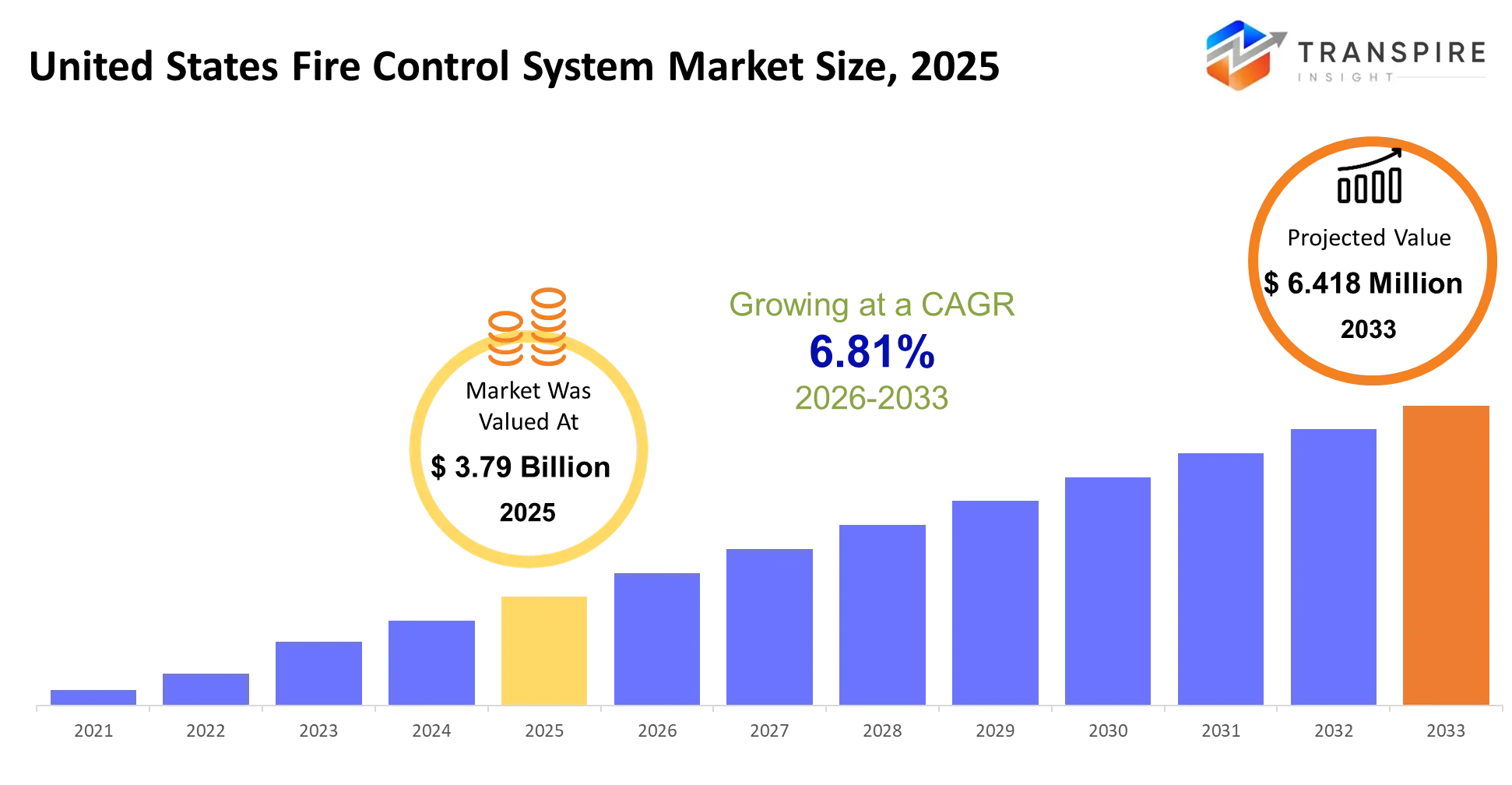
- United States Fire Control System Market Size 2025: USD 3.79 Billion
- United States Fire Control System Market Size 2033: USD 6.418 Billion
- United States Fire Control System Market CAGR: 6.81%
- United States Fire Control System Market Segments: By System Type (Weapon Control Systems, Target Acquisition Systems, Ballistic Computers, Radar Systems, Electro-optical Systems, Others); By Platform (Land-based Systems, Naval Systems, Airborne Systems, Vehicle-mounted Systems, Others); By Application (Defense Operations, Border Security, Surveillance Missions, Combat Operations, Others); By End User (Army, Navy, Air Force, Homeland Security, Others)
To learn more about this report,  Download Free Sample Report
United States Fire Control System Market Summary
The United States Fire Control System Market was valued at USD 3.79 Billion in 2025. It is forecast to reach USD 6.418 Billion by 2033. That is a CAGR of 6.81% over the period.
The United States fire control system market is basically at the center of modern defense missions, helping military platforms detect, track, compute, and then engage targets with speed plus precision across land, naval, and airborne settings. In real life, these systems handle a really big problem, which is turning sensor data into correct firing decisions even when combat conditions get messy, because timing and exactness can make or break a mission. Their job feels even larger now that platforms are more networked, and the threat picture keeps shifting, a lot faster than before.
In the last three to five years the market has seen a kind of structural turn, shifting away from standalone targeting systems toward integrated software driven combat management architectures, where things like artificial intelligence, sensor fusion, and real time data processing are combined into one approach. This change seemed to pick up after increased geopolitical tensions, especially the Russia-Ukraine conflict, which really highlighted how useful precision guided engagement is, and also how important electronic warfare resilience becomes. Because of that, U.S. defense procurement priorities have been tilting toward modernizing legacy solutions, and pushing interoperable next generation capabilities. so, revenue growth is coming from expanding retrofit programs, running more frequent software upgrade cycles, and compressing procurement timelines for advanced fire control functions.
Key Market Insights
- The Southern United States basically dominates the United States Fire Control System Market, grabbing around 38% market share in 2025, mainly because of major defense manufacturing hubs.
- Over in the Western region, things are moving quicker than the rest, projected to expand by more than 7.8% through 2032, with aerospace innovation and naval defense funding quietly powering that growth.
- Also, federal procurement clumping across Virginia, Texas, and California keeps boosting the regional industry footprint and helps defense technology get deployed faster.
- Radar integrated fire control systems are leading, they take roughly 42% of the United States Fire Control System Market share in 2025, partly due to their multi platform compatibility, and the way they slot into different operations.
- Meanwhile, electro optical targeting systems are the second biggest segment, backed by the ongoing rise in precision guided weapon requirements.
- AI-driven autonomous targeting solutions are the fastest growing part, and they’re expected to grow pretty much through 2032, especially as battlefield automation speeds up, kind of more than before.
- Naval combat use cases hold around 36% market share , which suggests investment remains steady for advanced vessel defense systems.
- The U.S. Department of Defense leads the way for end users, and it’s forecast to account for more than 68% of the United States Fire Control System Market revenue in 2025.
- Defense contractors that focus on retrofit modernization are coming in as the fastest growing end-user group across the forecast window , generally speaking.
- Meanwhile, homeland security and border surveillance agencies are starting to show interest , not just in simple targeting but in adaptive targeting systems too.
What are the Key Drivers, Restraints, and Opportunities in the United States Fire Control System Market?
The strongest driving force behind the United States fire control system market, is kinda the Department of Defense shift into multi-domain warfare capabilities. This move picked up speed after recent geopolitical conflicts showed the practical gaps in older targeting systems, especially when dealing with electronic countermeasures and hypersonic threats. So, U.S. defense spending is now leaning more heavily toward digital fire control upgrades, plus sensor fusion integration, and also software-defined targeting blueprints. That change tends to push market revenue forward, mainly by locking in long run procurement deals, retrofit work on existing naval and land platforms, and ongoing software modernization cycles. Those cycles, sometimes clearly continue well past the first hardware fielding date.
Still, the biggest obstacle is the long procurement and certification cycle tied to defense-grade fire control systems. This limitation is basically structural, because each system has to clear a large set of requirements around interoperability, cybersecurity and battlefield survivability, before it can actually be deployed. The validation timing often runs into multiple years, and especially when the solution gets folded into next-generation aircraft or naval vessels. As a consequence, contractors see slower commercial payback, technology replacement happens at a reduced pace, and short-term market revenue gets held back even if defense budgets stay strong.
The next big growth chance seems to be driven by artificial intelligence-enabled autonomous targeting systems, kind of like it was always there but now it matters more. U.S. military spending on collaborative combat aircraft and unmanned naval platforms is giving them a strong testing ground for adaptive fire control solutions. For instance, Pentagon-backed autonomous drone swarm efforts are pushing demand forward fast for systems that can do real time threat prioritization and make independent engagement decisions, which in turn opens up a high value lane for next generation fire control vendors.
What Has the Impact of Artificial Intelligence Been on the United States Fire Control System Market?
AI is increasingly automating target detection, threat classification, and even firing sequence optimization across land, naval, and airborne platforms, sort of all the time. In most modern fire control architectures the system processes inputs from radar, infrared sensors, and electro-optical devices in real time , which then enables automated threat prioritization. The result is that operator decision cycles get cut down by about 30 to 40 percent during simulated combat situations, or at least that’s what the test reports suggest. And yes, this sort of automation helps engagement accuracy too, while still letting crews respond quicker to fast changing dangers like drone swarms, and hypersonic projectiles.
At the same time, machine learning is strengthening predictive maintenance capabilities in a way that feels pretty practical. Defense contractors now deploy digital twin systems to keep watch over targeting modules, thermal imaging sensors, and tracking radars. They can spot component degradation before it turns into a real operational failure, rather than discovering it after the fact, which is… kind of the whole point. According to several defense modernization programs, this has boosted system uptime, and also lowered unscheduled maintenance spending across the board.
Then advanced analytics get involved and they enhance operational readiness by optimizing ammunition deployment, reducing targeting mistakes, and raising mission efficiency across multi domain operations. Still, AI adoption runs into a big limitation. Integrating machine learning into legacy weapons platforms takes costly software retrofits, plus extensive validation testing. On top of that, limited real-world combat data for autonomous targeting systems can constrain training accuracy, and that in turn drags out deployment timelines. Even with strong defense investment, it’s not always straightforward.
Key Market Trends
- Since 2022, somehow over 60% of new U.S. defense fire control contracts have been prioritizing software-upgradable systems rather than fixed-function hardware platforms, you know.
- The Russia-Ukraine conflict also kind of reshaped procurement behavior, it sped up Pentagon investment in precision targeting systems that are resilient against electronic warfare disruption by nearly 18%, which is notable.
- Since 2021, companies like Lockheed Martin and RTX Corporation have started shifting their R&D budgets toward AI-enabled threat recognition algorithms , pretty heavily.
- Fire control buyers are increasingly leaning on open-architecture systems, and interoperability requirements are showing up in more than 70% of major defense solicitations since 2023, almost as a baseline.
- Legacy platform retrofits have gained real momentum, because extending system life now costs around 30% less than full replacement across naval and armored vehicle fleets.
- And sensor fusion adoption has expanded sharply, with integrated radar-infrared targeting apparently cutting engagement decision cycles by up to 40% in recent field evaluations, at least in reports.
- Supply chain strategies changed after semiconductor disruptions in 2021, so U.S. contractors began localizing sourcing for critical targeting processors and control modules, as a kind of insurance.
- Since 2024, autonomous drone defense programs have been pushing fire control developers to redesign systems for real-time multi-target engagement capability.
- Competitive behavior shifted too, more firms are going for strategic partnerships, with Northrop Grumman and others increasingly collaborating with AI software specialists for battlefield analytics integration.
- Regulatory emphasis on cybersecurity certification has also intensified since 2023, lengthening validation cycles but steering vendors toward more secure, software-defined fire control architectures.
United States Fire Control System Market Segmentation
By System Type :
System type segmentation, kind of explains the functional roles that show up across fire control operations, like what each part is doing when it comes time to engage. Weapon control systems, handle firing sequences and also push accuracy forward in a bunch of different conditions. Target acquisition systems, they identify and continue tracking threats using sensors plus imaging tools. Ballistic computers, then they work out trajectory and the small environmental corrections, which keeps the engagement more precise.
Radar systems are used to detect distance, speed, and the movement patterns of objects, and that helps with long-range targeting. Electro-optical systems improve visibility with infrared and optical sensors, particularly when it’s low light or visibility is poor. Other options include integrated modules that merge multiple technologies together, and this creates a unified solution that improves coordination while also shrinking response time a bit.

To learn more about this report, Download Free Sample Report
By Platform :
Platform-based segmentation reflects deployment environments and the practical operational needs. Land-based systems support ground forces using stationary or mobile installations, and it helps the coordination on the battlefield stay tighter. Naval systems operate on ships and submarines, which allows accurate targeting in maritime conditions even with constant movement and all that environmental variation.
Airborne systems are installed on aircraft and helicopters, so they can deliver aerial targeting and surveillance capabilities. Vehicle-mounted systems give flexibility, because they can be deployed quickly across different terrains. Other platforms, like hybrid configurations for specialized missions, are designed so the setup stays adaptable across a range of operational settings, and it boosts overall defense readiness too.
By Application
Application segmentation kind of shows how things get used across different mission types, not just one. Defense operations tend to concentrate on defending national interests, through coordinated targeting together with response systems. Border security applications also help with monitoring and control of sensitive zones, which lowers the chance of unauthorized entry and improves the overall situational awareness in a way that makes sense.
Surveillance missions really depend on continuous tracking alongside data collection, which then backs up intelligence gathering as well as threat identification. Combat operations are more about direct engagement with hostile targets, so it needs high precision and reliability, every single time. Then you have other kinds of applications, like peacekeeping and disaster response support, where accurate targeting systems support controlled action and more efficient operations.
By End User :
End user segmentation is more about how fire control systems get deployed inside organizations. Army usage leans toward ground combat effectiveness, and it brings these systems together with infantry and armored units. Navy deployment is more maritime defense, making sure targeting stays accurate even in complex sea conditions.
Air Force applications focus on aerial superiority, using advanced targeting systems for precision strikes. Homeland security agencies use similar systems for internal protection plus emergency response coordination. Other users include specialized defense teams and allied organizations, and they typically want tailored solutions for their own operational demands which are a bit unique, even when the overall goal is the same.
What are the Key Use Cases Driving the United States Fire Control System Market?
Naval weapons control still seems like the main use case that keeps pulling in new customers across the United States fire control system market. Surface combatants, destroyers, and guided missile cruisers kinda depend on sophisticated targeting systems, not only to handle precision engagement but also to run threat interception and keep coordinated missile defense in sync. So yeah, naval modernization programs are still the biggest thing behind procurement spending.
That said, more expanding applications are starting to show up pretty clearly, especially on armored ground vehicles, and also on tactical airborne platforms. U.S. Army combat vehicle upgrade programs are increasingly folding in digital targeting solutions for quicker battlefield response and smoother targeting. Meanwhile, next generation fighter aircraft, lean on fire control technologies for multi sensor targeting, even in contested airspace where it gets really complicated. Homeland defense operators too are moving toward smaller, compact units for border surveillance and counter drone missions.
On top of that, some emerging use cases are getting attention, like autonomous unmanned surface vessels and collaborative combat aircraft under Pentagon experimental programs. These platforms need AI enabled fire control that can do independent target recognition, plus it has to make engagement decisions. Directed energy weapon systems are also seen as a future direction, as U.S. defense agencies accelerate testing for laser based air and missile defense platforms, because why not, right.
|
Report Metrics |
Details |
|
Market size value in 2025 |
USD 3.79 Billion |
|
Market size value in 2026 |
USD 4.048 Billion |
|
Revenue forecast in 2033 |
USD 6.418 Billion |
|
Growth rate |
CAGR of 6.81% from 2026 to 2033 |
|
Base year |
2025 |
|
Historical data |
2021 - 2024 |
|
Forecast period |
2026 - 2033 |
|
Report coverage |
Revenue forecast, competitive landscape, growth factors, and trends |
|
Geographic scope |
United States of America |
|
Key company profiled |
Lockheed Martin, Raytheon Technologies, Northrop Grumman, BAE Systems, Thales Group, Leonardo, Saab, Rheinmetall, Elbit Systems, General Dynamics, L3Harris Technologies, Honeywell, Bharat Electronics, Kongsberg Gruppen, Aselsan |
|
Customization scope |
Free report customization (country, regional & segment scope). Avail customized purchase options to meet your exact research needs. |
|
Report Segmentation |
By System Type (Weapon Control Systems, Target Acquisition Systems, Ballistic Computers, Radar Systems, Electro-optical Systems, Others); By Platform (Land-based Systems, Naval Systems, Airborne Systems, Vehicle-mounted Systems, Others); By Application (Defense Operations, Border Security, Surveillance Missions, Combat Operations, Others); By End User (Army, Navy, Air Force, Homeland Security, Others) |
Which Regions are Driving the United States Fire Control System Market Growth?
The Southern United States kind of leads the fire control system market, mostly because it has this dense cluster of defense manufacturing plants, military command centers, and naval shipbuilding infrastructure— you know, the whole “everything is nearby” situation. States like Virginia, Texas, and Florida also catch a lot of momentum from strong federal defense allocations that are linked to fleet modernization efforts and better weapons integration programs. And then there’s the ecosystem side of things, it’s fairly mature, with big prime contractors, subsystem suppliers, plus defense research institutions that help speed up procurement and system validation. With military demand , industrial capability and policy backing all staying pretty aligned , that is what keeps the South in a dominant spot for fire control system deployment.
Meanwhile, the Western United States shows up as the second-largest regional contributor, but the reasoning is a bit different. It’s less about raw purchasing volume and more about innovation depth. California, Arizona, and Washington keep a relatively steady pipeline going for aerospace and defense technology work, supported by long-term investment in advanced electronics, software-defined targeting approaches, and autonomous platform trials. Unlike the South where major defense installations tend to drive buy decisions, the West leans on a calmer commercial-defense technology crossover. That crossover then supports ongoing product development without as many “big procurement bursts.” So overall the region can maintain dependable revenue, from research agreements, prototype construction, and specialized subsystem integration that stays in step with newer requirements.
The Midwest is coming up as the quickest-growing place, as defense manufacturing reshoring sort of gains steam and advanced vehicle modernization programs get more attention. Lately the federal incentives for domestic semiconductor production and precision electronics manufacturing are really helping, and the regional supply chains for fire control parts are getting stronger. States like Ohio and Michigan are also seeing more work around armored vehicle upgrades, plus next-generation land combat systems. That kind of momentum, well it does open meaningful opportunities for suppliers and investors who want exposure to the growing defense electronics production window from 2026 to 2033.
Who are the Key Players in the United States Fire Control System Market and How Do They Compete?
The U.S. fire control system market is kinda highly consolidated, with rivalry mostly focused on a small cluster of defense contractors that end up controlling key procurement pathways and also long-running government contracts. Existing players tend to defend their share by leaning into tech differentiation, not so much price battles , because reliability in the field , interoperability, and even certification history tend to matter more than the actual factory or manufacturing cost. The real competitive fight has moved toward software-defined targeting, sensor fusion strengths and cybersecurity resilience too. Even if barriers to entry are still high thanks to regulatory qualification and verification, a few specialized companies that focus on AI and autonomy are starting to nudge the market—mainly by working through subcontracting arrangements with the bigger primes and letting those primes bring them in.
Lockheed Martin plays it by doing deep platform integration across naval combat systems and missile defense networks. The edge is in tying the fire control layer to a wider combat management architecture, so defense customers get one unified operational framework, not just a bunch of separate targeting modules. The company is also pushing forward with hypersonic defense collaborations and next-generation naval weapon programs, like a lot of adjacent expansion. RTX Corporation, on the other hand, differentiates with radar-guided targeting accuracy plus improved interceptor fire control abilities, backed by decades of missile defense deployment know-how. Its ongoing spend on software upgrades and classified defense collaborations helps keep modernization revenue coming back in, year after year.
Northrop Grumman really hones in on autonomous aiming and AI driven sensor fusion, especially for the next round of airborne platforms. This angle puts them in a pretty strong place for collaborative combat aircraft work, you know, where multiple systems coordinate. L3Harris Technologies goes a different route, they compete with modular fire control electronics, so retrofitting older fleets feels more straightforward or at least less disruptive. Meanwhile General Dynamics leans on its armored vehicle programs, and uses that momentum to push embedded fire control deployments further into land combat modernization efforts, bit by bit.
Company List
- Lockheed Martin
- Raytheon Technologies
- Northrop Grumman
- BAE Systems
- Thales Group
- Leonardo
- Saab
- Rheinmetall
- Elbit Systems
- General Dynamics
- L3Harris Technologies
- Honeywell
- Bharat Electronics
- Kongsberg Gruppen
- Aselsan
Recent Development News
In April 2026, Lockheed Martin secured a landmark U.S. Navy contract to integrate the PAC-3 Missile Segment Enhancement into the Aegis Combat System. This first-of-its-kind fire-control integration expands naval missile engagement capability and strengthens the U.S. fire control systems market through advanced shipborne targeting and intercept modernization.
Source https://news.lockheedmartin.com/
In April 2026, Leidos secured a $617 million U.S. Army contract for additional Indirect Fire Protection Capability Increment 2 launchers. The award accelerates deployment of next-generation ground-based fire control and air-defense systems, reinforcing domestic production and modernization of integrated fire control infrastructure.
Source https://www.reuters.com/
What Strategic Insights Define the Future of the United States Fire Control System Market?
Over the next five to seven years, the United States fire control system market is starting to shift, kind of structurally, toward autonomous software-defined engagement ecosystems that work across connected air, land, and naval platforms. And yeah, this shift feels less about the old weapons procurement rhythm, more tied to the Pentagon pushing multi-domain command integration, where fire control becomes a kind of broader decision intelligence network. So the vendors that can provide adaptive software layers and AI-enabled targeting logic, they will likely grab a disproportionate share of the value, because the hardware keeps turning into a standardized platform piece.
There’s also a quieter risk, not as loudly discussed. It’s that the market could end up more concentrated around a small group of prime contractors. As procurement keeps consolidating, innovation cycles might slow down, especially if subcontractor participation shrinks, and if emerging technology firms find themselves stuck behind certification barriers. On top of that, there’s pressure from semiconductor dependency for advanced targeting processors, and that can turn into bottlenecks during future supply disruptions.
On the opportunity side, there’s a pretty significant emerging one too, namely autonomous fire control for collaborative combat aircraft and unmanned surface vessels, with a particular pull from Midwest defense electronics expansion. Market players should lean hard into modular open-architecture design, and also line up early partnerships with AI software specialists. Interoperability, it seems, will probably shape contract access more than pure platform-specific performance, alone.
United States Fire Control System Market Report Segmentation
By System Type
- Weapon Control Systems
- Target Acquisition Systems
- Ballistic Computers
- Radar Systems
- Electro-optical Systems
By Platform
- Land-based Systems
- Naval Systems
- Airborne Systems
- Vehicle-mounted Systems
By Application
- Defense Operations
- Border Security
- Surveillance Missions
- Combat Operations
By End User
- Army
- Navy
- Air Force
- Homeland Security
Frequently Asked Questions
Find quick answers to common questions.
The United States Fire Control System Market size is USD 6.418 Billion in 2033.
Key segments for the United States Fire Control System Market are By System Type (Weapon Control Systems, Target Acquisition Systems, Ballistic Computers, Radar Systems, Electro-optical Systems, Others); By Platform (Land-based Systems, Naval Systems, Airborne Systems, Vehicle-mounted Systems, Others); By Application (Defense Operations, Border Security, Surveillance Missions, Combat Operations, Others); By End User (Army, Navy, Air Force, Homeland Security, Others).
Major United States Fire Control System Market players are Lockheed Martin, Raytheon Technologies, Northrop Grumman, BAE Systems, Thales Group, Leonardo, Saab, Rheinmetall, Elbit Systems, General Dynamics, L3Harris Technologies, Honeywell, Bharat Electronics, Kongsberg Gruppen, Aselsan.
The United States Fire Control System Market size is USD 3.79 Billion in 2025.
The United States Fire Control System Market CAGR is 6.81% from 2026 to 2033.
- Lockheed Martin
- Raytheon Technologies
- Northrop Grumman
- BAE Systems
- Thales Group
- Leonardo
- Saab
- Rheinmetall
- Elbit Systems
- General Dynamics
- L3Harris Technologies
- Honeywell
- Bharat Electronics
- Kongsberg Gruppen
- Aselsan
Recently Published Reports
-
Apr 2026
Aerospace Fluoropolymers Market
Aerospace Fluoropolymers Market Size, Share & Analysis Report By Type (PTFE, FEP, PFA, ETFE, and Others), By Application (Electrical Insulation, Seals & Gaskets, Coatings, and Others), By End User (Commercial Aviation, Military Aviation, General Aviation, and Others), and Geography (North America, Europe, Asia-Pacific, Middle East and Africa, South and Central America), 2021 - 2031
-
Apr 2026
Airborne SATCOM System Market
Airborne SATCOM System Market Size, Share & Analysis Report By Type (SATCOM Terminals, Transceivers, Airborne Radio, Modems and Routers, SATCOM Radomes, and Other), By Application (Government and Defense and Commercial), and Geography (North America, Europe, Asia-Pacific, Middle East and Africa, South and Central America), 2021 – 2031
-
Apr 2026
Ship Leasing Market
Ship Leasing Market Size, Share & Analysis Report By Vessel Type (Container Ships, Bulk Carriers, Tankers, and Specialized Vessels), By Lease Duration (Short-Term Lease (Less than 1 year), Medium-Term Lease (1-5 years), and Long-Term Lease (More than 5 years)), By Lease Type (Bareboat Charter, Time Charter, Financial Lease, and Others), By End-User Industry (Oil and Gas, Manufacturing and Industrial, Automotive, Agriculture and Food, Retail and Consumer Goods, and Others), and Geography (North America, Europe, Asia-Pacific, Middle East and Africa, South and Central America), 2021 – 2031
-
Apr 2026
Thread Rolling Dies Market
Thread Rolling Dies Market Size, Share & Analysis Report By Type (Flat Thread Rolling Dies, Circular (Cylindrical) Dies, Tangential Thread Rolling Dies, Planetary Thread Rolling Dies, and Other Types), By Material Type (High-Speed Steel (HSS), Carbide, Tool Steel, Alloy Steel, and Other Specialized Alloys), By Distribution Channel (Direct Sales, Distributors and Dealers, and Online Platforms), By Application (Automotive Industry, Aerospace and Defense, Construction and Infrastructure, Industrial Machinery, Electronics and Electrical Components, Medical Devices, and Fastener Production), and Geography (North America, Europe, Asia-Pacific, Middle East and Africa, South and Central America), 2021 – 2031
Our Clients