

United States Dot Net Development Service Market Size & Forecast:
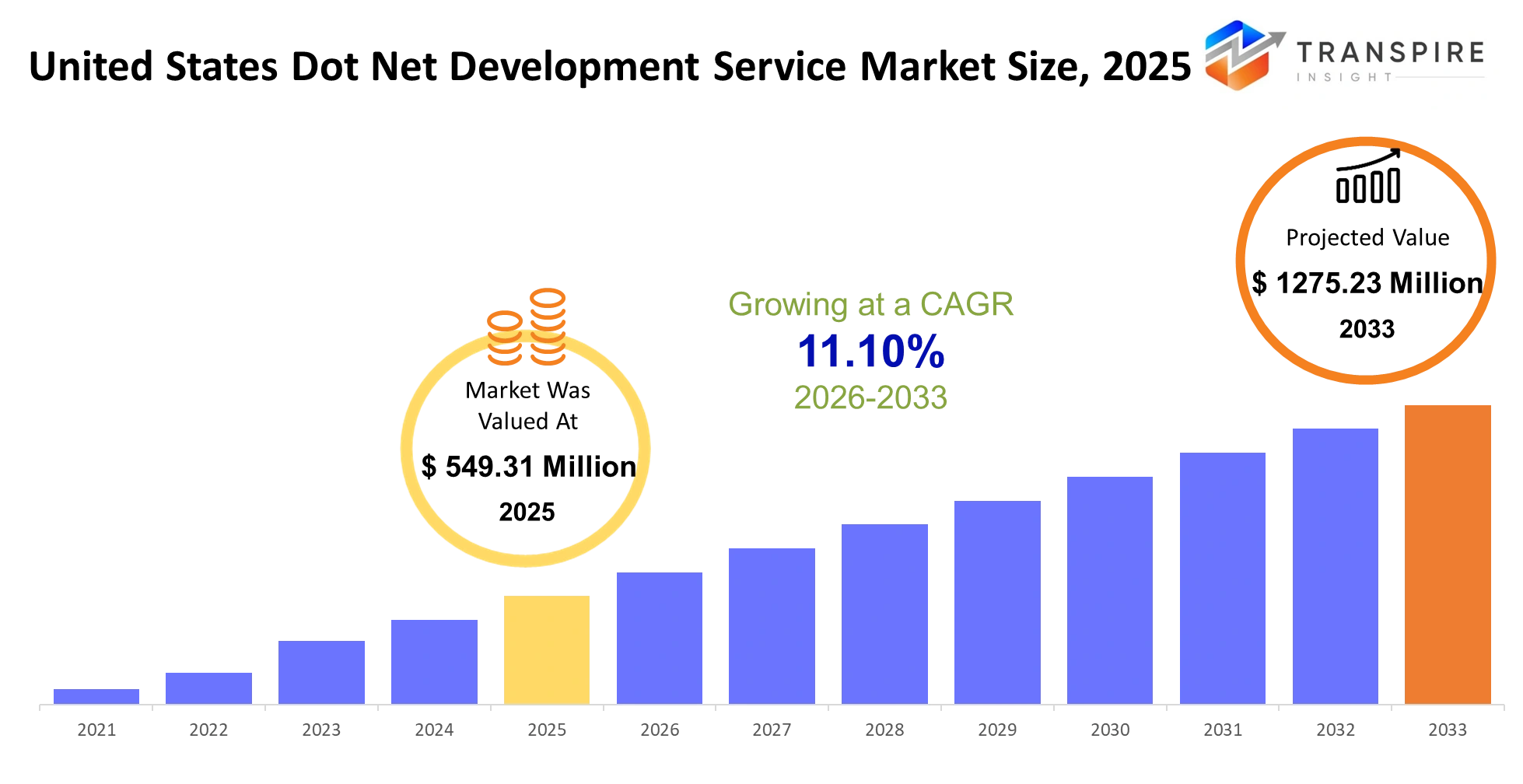
- United States Dot Net Development Service Market Size 2025: USD 549.31 Million
- United States Dot Net Development Service Market Size 2033: USD 1275.23 Million
- United States Dot Net Development Service Market CAGR: 11.10%
- United States Dot Net Development Service Market Segments: By Service Type (Web Development, Enterprise Application Development, Cloud Application Development, API Integration, Migration Services, Maintenance & Support, Others); By Deployment (Cloud-based, On-premise, Hybrid Deployment, SaaS Platforms, Others); By Enterprise Size (SMEs, Large Enterprises, Startups, Government Organizations, Others); By End User (BFSI, Healthcare, Retail, IT & Telecom, Manufacturing, Others).
To learn more about this report,  Download Free Sample Report
United States Dot Net Development Service Market Summary
The United States Dot Net Development Service Market was valued at USD 549.31 Million in 2025. It is forecast to reach USD 1275.23 Million by 2033. That is a CAGR of 11.10% over the period.
The United States dot net development service market sorta underpins a lot of the custom software framework that keeps enterprise operations running, from financial transfer systems and healthcare platforms to manufacturing resource planning and cloud based business apps. Honestly in practice these services help orgs modernize older legacy software, link together systems that were never really talking, and set up scalable digital stages that support day to day operations. Over the last three to five years the market has been doing this kind of structural shift, moving away from the old-school on-premise .NET framework development, toward cloud native engineering that leans on .
NET Core and cross platform architectures. That shift got way faster during the post pandemic digital overhaul, when remote work made it clear older enterprise systems had limits, so companies prioritized application modernization, more or less immediately. At the same time, supply chain interruptions and cybersecurity incidents kind of forced many organizations to swap out fragmented software stacks, for safer and interoperable ones. So service contracts got wider too beyond pure coding tasks into long term modernization, migration, and ongoing maintenance engagements, which in turn created stronger recurring revenue streams for development service providers.
Key Market Insights
- The North East part of the United States kinda leads the Dot Net Development Service Market, in 2025 it is taking almost 34% market share , mostly because financial services are digitizing pretty hard right now.
- Meanwhile, the West Coast is the fastest one, with growth expected to keep going through 2031 , that’s tied to strong SaaS builds plus cloud native adoption.
- The Southern United States is also pulling more share lately, more or less because enterprise IT outsourcing hubs are expanding across Texas and Florida , and people want new delivery models or whatever.
- Custom enterprise application development still dominates, landing around 39% of the United States Dot Net Development Service Market in 2025, driven by modernization demand and the need for fresher workflows.
- Application migration and integration services come in next, holding the second biggest share , supported by enterprise moves away from older .NET Framework setups.
- Cloud-native .NET Core development is kinda the fastest-growing portion, they project it could be growing above 16% each year through 2031, or something like that.
- Enterprise resource planning apps are out in front with almost a 31% share, and it seems organizations focus on operational efficiency plus the need for real-time analytics, all tied together.
- AI-enabled business automation platforms are starting to pop up more, and so they’re also the fastest-growing application area in the United States Dot Net Development Service Market.
- Healthcare workflow automation and fintech transaction systems keep pulling in strong investments for new app development across regulated industries, really consistently.
- Meanwhile large enterprises still dominate with more than 57% of the market share in 2025 , mainly because of the complicated infrastructure modernization programs they’re running.
What are the Key Drivers, Restraints, and Opportunities in the United States Dot Net Development Service Market?
The strongest force pushing the United States dot net development service market is this enterprise wide move toward cloud native modernization. It really picked up speed after 2020, when operational disruptions and all that remote infrastructure pressure showed the weaknesses of legacy on premise applications, the ones built on older .NET frameworks. Then the release, and pretty fast enterprise uptake of cross platform .NET Core and later the more unified .NET versions basically gave companies a workable migration route without throwing away their existing Microsoft centered ecosystem. That has directly boosted service revenues, because now organizations need big scale codebase migration , architecture redesign, and long term managed support contracts, not just a one off software upgrade thing.
The biggest structural roadblock is a shortage of highly specialized .NET architects who can actually manage modernization programs that get into microservices patterns, container orchestration, and hybrid cloud integration at the same time. That limitation can’t be fixed overnight either, since it takes years of enterprise level development experience plus deep platform know how. Because of this, delivery schedules often stretch by six to twelve months. That in turn lifts implementation spend, and it makes many mid sized firms postpone modernization investment, which then holds back wider market revenue growth.
The next big chance for growth sits in an integrated enterprise app development. Basically, organizations keep adding machine learning inside .NET platforms, for things like predictive analytics and automated workflows, and it kind of keeps going. You can see it clearly with Microsoft Azure OpenAI integrations, as a real-world example, especially across healthcare and financial services. In those areas the secure ai deployment frameworks are maturing quite fast and they’re making room for brand new, high value service contracts.
What Has the Impact of Artificial Intelligence Been on the United States Dot Net Development Service Market?
Artificial intelligence and advanced digital technologies are, for real, reshaping the United States .NET development service market quite a lot, like changing the whole way enterprise applications are built, watched, and tuned. In practice, many development providers are now putting AI-based automation inside .NET platforms to simplify system monitoring, handle compliance documentation more smoothly, and improve workflow orchestration across big business landscapes. Newer intelligent control systems are automating code testing, deployment validation, anomaly detection, and even infrastructure performance tracking, so there is less manual work involved and release cycles move faster.
Also, machine learning models are boosting predictive strength across enterprise software ecosystems. Developers are starting to embed predictive maintenance strategies into industrial management platforms so teams can spot potential infrastructure failures before they interrupt operations. In areas like manufacturing and logistics, these models study past system behavior to estimate downtime risks and refine application performance. It often results in better uptime , roughly 15 to 20 percent, while also bringing operational costs down. There are also AI-powered resource allocation tools that let enterprises use cloud capacity more efficiently and show clear reductions in infrastructure spending.
Still, a major bottleneck is the complexity of plugging AI into legacy .NET setups. A lot of enterprise systems run on fragmented architectures, with inconsistent data pipelines that can weaken model accuracy and raise implementation expenses. On top of that, the lack of strong training datasets for highly customized enterprise workflows limits wider adoption, especially for mid-sized organizations that have tighter digital transformation budgets.
Key Market Trends
- Since 2021, more than 60% of big U.S. organizations kind of moved away from .NET Framework support contracts, and toward cross-platform .NET Core modernization moves, kind of all at once.
- Microsoft’s more unified .NET releases since 2022 helped push migration cycles along faster, cutting enterprise rebuild windows by about 25% versus the older, slower platform reengineering paths.
- In banking and healthcare, companies upped their secure .NET cloud migration budgets by roughly 30% after stricter zero-trust cybersecurity rules started getting real regulatory pull in 2023.
- It also looks like buyers lean more toward multi-year managed modernization commitments now, with vendors like Accenture and Cognizant expanding their recurring service catalog from 2024 , almost like it’s the default purchase style.
- And on the AI side, adoption of AI-assisted coding jumped after 2023, with dev teams mentioning something like 35% faster code validation, thanks to automated testing integration and similar guardrail workflows.
- Competitive behavior started to shift, as providers more and more tend to buy up niche cloud engineering firms rather than grow their own internal teams, which in turn cuts the capability ramp up period by 12 to 18 months, kind of quickly.
- Meanwhile offshore and nearshore delivery models were a bit less in demand after 2022, because U.S. enterprises started placing more weight on domestic compliance know-how for regulated modernization efforts.
- Also, containerized microservices deployment has become mainstream from 2022 through 2025, replacing the whole monolithic application rebuild routine across manufacturing and logistics software ecosystems.
- And mid-sized enterprises became a stronger buyer group, after cloud infrastructure costs dropped about 18% between 2023 and 2025.
- Finally, strategic partnerships involving Microsoft , EPAM Systems and enterprise integrators are increasingly focused around AI-native .NET application frameworks.
United States Dot Net Development Service Market Segmentation
By Service Type:
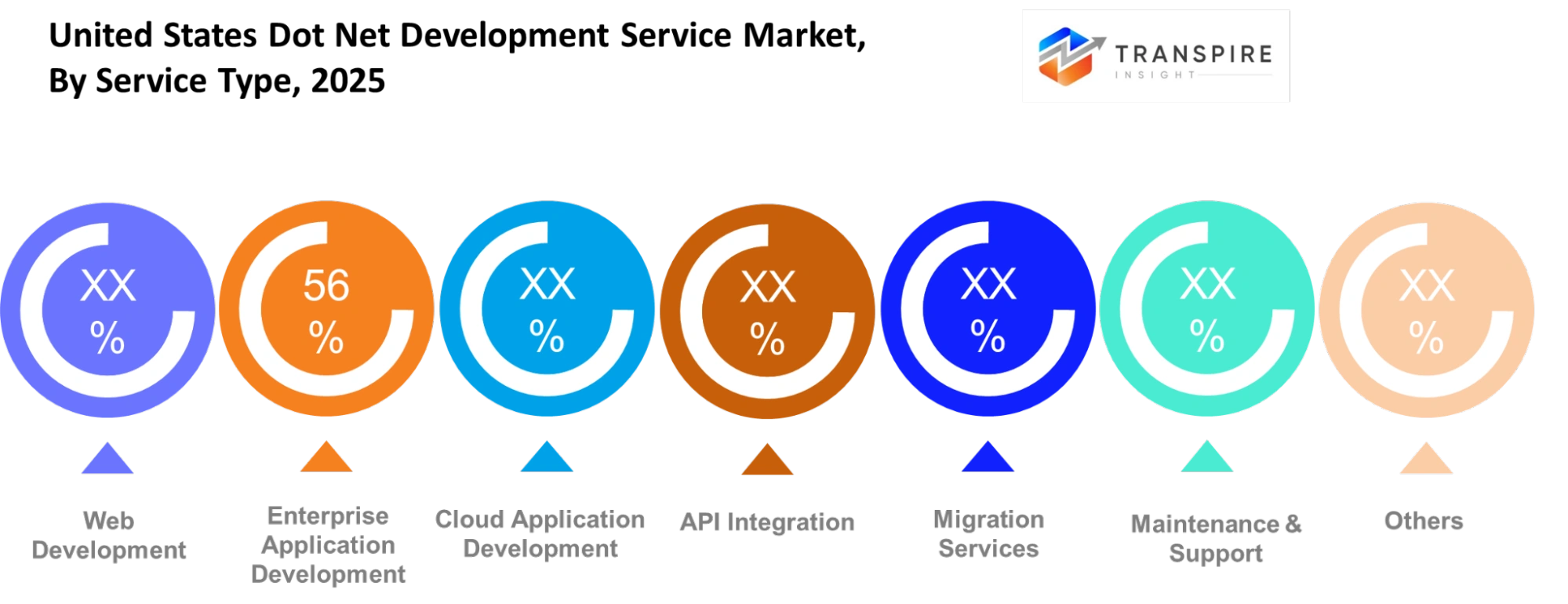
The United States Dot Net Development Service Market is shaped by a wide mix of service offerings that support different business needs. Web development remains a key area as businesses continue building websites and digital platforms that require steady performance and secure frameworks. Enterprise application development also holds strong demand because many large organizations depend on custom-built systems for internal operations and customer management. The growing shift toward cloud application development is creating fresh opportunities as businesses focus on flexible and scalable solutions.
API integration, migration services, and maintenance support also play an important part in keeping systems connected and updated. Businesses moving from older systems to modern .NET frameworks often require migration services to reduce technical issues and improve speed. Maintenance and support services continue to remain necessary because organizations need ongoing system monitoring, security updates, and technical improvements to keep applications running smoothly over time.
To learn more about this report, Download Free Sample Report
By Deployment:
Deployment models in the United States . Dot Net Development Service Market still keeps growing, like, organizations are looking for options that really line up with their operational targets and the way their infrastructure is set up. Cloud based deployment has kind of become the go to preference, mainly because it brings flexibility, less upfront spending, and quicker access to new updates . A lot of companies lean toward this setup so they can better support remote work systems and improve cooperation across different offices, sometimes even across multiple regions .
That said on-premise deployment doesn’t really fade away , it stays useful for businesses that need direct control over sensitive data and internal systems, especially in industries with strong security mandates. Hybrid deployment is getting more attention too, mostly because it offers a middle ground between adaptability and oversight. And then there are SaaS platforms, which push market momentum as they let organizations access applications via subscription models, so advanced software solutions are easier to take on, without having to sink a bunch of capital into additional hardware.
By Enterprise Size:
Enterprise size kind of drives the way demand shows up in the United States Dot Net Development Service Market. For small and medium enterprises, .NET development services are being adopted more and more, mainly because digital transformation is becoming this not-optional thing for keeping up in the market. These companies usually look for budget friendly but scalable solutions, that still help growth, without putting heavy pressure on internal technical resources.
At the same time, bigger enterprises still keep a major presence. They often have complex operations, plus they want customized software systems, because their workflows and compliance needs aren’t simple. Meanwhile startups also add to the overall momentum, since many of them use .NET frameworks for quicker product creation and for building solid backend systems. On top of that, government organizations bring a steady flow of demand through continued spending on digital public services, the need for secure internal platforms and modernization initiatives that really rely on dependable software development knowledge.
By End User:
The United States Dot Net Development Service Market supports a wide set of users, and honestly, each group has their own software needs so the work can look different. In BFSI for example, .NET development is almost central because secure banking applications, transaction systems, and customer service platforms all need that kind of reliability. On the healthcare side, hospitals and medical service providers keep pushing too, especially with digital record handling, telehealth platforms, and the kind of system integration that ties everything together.
Retail businesses are still moving forward with .NET development services, mostly for better e-commerce systems, customer engagement platforms, and inventory management tools. Meanwhile IT and telecom companies rely on the same services for software optimization and more advanced communication solutions. Manufacturing is also doing more, since digital systems are becoming a core part of production monitoring, supply chain management, and process automation, which can help improve efficiency and day to day operational control in multiple facilities.
What are the Key Use Cases Driving the United States Dot Net Development Service Market?
In the United States dot net development service market the dominant use case is kind of enterprise application modernization for banking, healthcare, and large-scale manufacturing operations, mostly. Those industries lean on custom .NET platforms for transaction handling, compliance workflows , and operational management so when it comes to migration plus performance optimization that ends up being the biggest driver of service demand
Nearby adjacent applications are also growing pretty fast in logistics and retail, and mid-sized firms are moving toward .NET based cloud integration platforms in order to connect inventory systems, automate supply chain visibility, and tune up customer-facing digital services. At the same time, insurance providers are putting more money into claims automation and secure policy management, like they really mean it.
Looking forward the emerging use cases are AI-powered decision support tools and digital twin integrations for industrial asset monitoring. Over the forecast horizon, smart factory operators and energy utilities are expected to take on .NET based predictive analytics platforms for real-time diagnostics , while regulated healthcare organizations explore secure generative AI integrations that help with clinical workflow automation.
|
Report Metrics |
Details |
|
Market size value in 2025 |
USD 549.31 Million |
|
Market size value in 2026 |
USD 610.29 Million |
|
Revenue forecast in 2033 |
USD 1275.23 Million |
|
Growth rate |
CAGR of 11.10% from 2026 to 2033 |
|
Base year |
2025 |
|
Historical data |
2021 - 2024 |
|
Forecast period |
2026 - 2033 |
|
Report coverage |
Revenue forecast, competitive landscape, growth factors, and trends |
|
Geographic scope |
United States of America |
|
Key company profiled |
Microsoft, Tata Consultancy Services, Infosys, Accenture, Cognizant, Capgemini, Wipro, HCL Technologies, Tech Mahindra, EPAM Systems, SoftServe, N-iX, ScienceSoft, Simform, Belitsoft. |
|
Customization scope |
Free report customization (country, regional & segment scope). Avail customized purchase options to meet your exact research needs. |
|
Report Segmentation |
By Service Type (Web Development, Enterprise Application Development, Cloud Application Development, API Integration, Migration Services, Maintenance & Support, Others); By Deployment (Cloud-based, On-premise, Hybrid Deployment, SaaS Platforms, Others); By Enterprise Size (SMEs, Large Enterprises, Startups, Government Organizations, Others); By End User (BFSI, Healthcare, Retail, IT & Telecom, Manufacturing, Others). |
Which Regions are Driving the United States Dot Net Development Service Market Growth?
The Northeast still feels like the biggest player in the United States .NET development service market, mostly because it has so many banks and insurers, healthcare networks , and federal technology contractors clustered together. The region also gets this mature regulatory vibe where cybersecurity compliance and data governance are basically front and center, plus enterprise resilience expectations, so modernization budgets tend to move upward. You also have those big technology corridors running through New York , Boston, and Northern Virginia, and it kind of ends up making a super dense network of cloud infrastructure providers , enterprise software companies, and really niche development talent. So yeah, between the regulatory pressure and the technical depth, the Northeast kind of keeps its edge with higher-value, large-scale modernization work , not just the quick fixes.
The Midwest is the next big regional contributor, but its strength looks more like industrial steadiness than fast digital disruption. Instead of the Northeast’s compliance-driven momentum, this area is shaped by manufacturing modernization, supply chain digitization, and those long-term upgrades to enterprise resource planning systems. Big manufacturers across Illinois, Ohio, and Michigan are still putting money into .NET-based operational platforms, mostly to boost production visibility and to automate the kind of plant-level decisions that used to be slower or more manual. It’s a measured approach, yes, but the consistency is what makes the Midwest a dependable source for national service revenues.
The West is starting to look like the fastest-growing region, mostly because cloud-native software adoption is picking up speed, and there is heavy investment in AI platforms too. In the last three years, things like the expansion of hyperscale cloud infrastructure, and venture-backed enterprise software development, have reshaped demand patterns across California, Washington and Colorado. A lot of organizations are now swapping out older legacy enterprise systems with containerized .NET architectures, those are designed for real-time analytics, and also for AI integration. So for market entrants, and investors, through 2026–2033, this kind of momentum really opens up solid chances in specialized cloud migration services. Also in AI-enabled platform engineering, and in advanced application modernization partnerships.
Who are the Key Players in the United States Dot Net Development Service Market and How Do They Compete?
The United States .net development service market still feels sort of moderately fragmented, with big global IT service firms out there competing against smaller cloud engineering boutiques that focus more narrowly. Lately, the whole competition seems to land more on actual technology capability and the service model, not only on pure cost, because enterprises are really trying to prioritize secure cloud migration, AI integration, and some kind of long-term platform management too. The bigger incumbents are actively defending their share by growing managed service portfolios , meanwhile smaller companies disrupt the landscape using a sort of niche capability in microservices architecture and DevOps automation. In practice buyers are now judging vendors on whether they can deliver end-to-end modernization , not just standalone development projects that end quickly.
Accenture stands out by running big transformation programs that blend .NET modernization with cloud, data, and AI integration, all under one unified contract structure. Their play is generally long duration engagements with Fortune 500 clients, plus they rely on partnerships with hyperscale cloud providers so deployments happen faster and with less friction. Cognizant leans into a platform led approach, where they embed industry specific accelerators for healthcare and banking workflows, which tends to cut customization time and makes clients stick around longer. EPAM Systems, on the other hand, competes through deep engineering know-how, especially when it comes to complex product development and digital platform design, and they often target clients that need high performance and scalable architectures.
Infosys kind of puts the focus on cost efficient delivery using its global talent network, while at the same time, investing in automation frameworks that help smooth things out for testing and deployment cycles, you know. Tata Consultancy Services keeps expanding via integrated service offerings ,where application modernization meets infrastructure management, so clients can consolidate vendors and lower operational complexity. Both companies are basically tightening their grip through acquisitions of cloud native specialists, growing regional delivery centers ,and continuing to put money into AI enabled development tools. All of that together boosts speed ,scalability and also makes their client engagements feel more differentiated in a practical way.
Company List
- Microsoft
- Tata Consultancy Services
- Infosys
- Accenture
- Cognizant
- Capgemini
- Wipro
- HCL Technologies
- Tech Mahindra
- EPAM Systems
- SoftServe
- N-iX
- ScienceSoft
- Simform
- Belitsoft
Recent Development News
In April 2026, Progress Software launched Telerik UI for ASP.NET Core 2026.1.415. The release introduced updated .NET component libraries and AI-oriented enhancements that strengthen enterprise-grade .NET application development capabilities, helping U.S. development service providers accelerate modern web app delivery and improve competitiveness in custom .NET solutions.
Source: https://www.telerik.com/
In February 2026, Progress Software launched Telerik UI for ASP.NET Core 2026 Q1 with new PromptBox and AI Smart Paste components. This product launch expanded AI-assisted .NET development tooling for U.S.-based software service firms, enabling faster implementation of intelligent enterprise applications and raising the technical benchmark across the .NET development services market.
Source: https://www.telerik.com/
What Strategic Insights Define the Future of the United States Dot Net Development Service Market?
Over the next five to seven years, the United States dot net development service market is, kind of, moving in a structural way toward platform-centric engineering models where modernization, AI integration, and managed lifecycle services kind of blend together into continuous delivery ecosystems. The big underlying force is the enterprise shift from isolated software upgrades into ongoing digital infrastructure renewal, pushed by cloud-native architecture requirements and also tighter cybersecurity compliance mandates. In practice this transition will start to favor providers who can combine application engineering with data orchestration, and AI deployment know-how too.
There is also a less visible risk that’s quietly growing: market concentration around hyperscaler-aligned service ecosystems. As enterprise buyers standardize around a smaller set of cloud and development platforms, the smaller providers may see margin compression, and less bargaining power overall. That can, in turn limit the innovation diversity across the market, because fewer teams are left to experiment with different approaches.
Now for a more emerging opportunity, there’s regulated AI deployment frameworks for healthcare and financial services, especially across the Northeast and West Coast, where compliance-focused digital transformation budgets are expanding. Companies that can build specialized accelerators for secure generative AI integration will probably get early traction, and in a way, that’s the bet many are already placing. What seems like the most effective strategic move for participants is to invest now in industry specific modernization frameworks that tie .NET migration together with AI governance, and then wrap it in zero-trust architecture know how, so they can end up with distinct capability stacks before this kind of specialization turns into a baseline, expectation.
United States Dot Net Development Service Market Report Segmentation
By Service Type
- Web Development
- Enterprise Application Development
- Cloud Application Development
- API Integration
- Migration Services
- Maintenance & Support
By Deployment
- Cloud-based
- On-premise
- Hybrid Deployment
- SaaS Platforms
By Enterprise Size
- SMEs
- Large Enterprises
- Startups
- Government Organizations
By End User
- BFSI
- Healthcare
- Retail
- IT & Telecom
- Manufacturing
Frequently Asked Questions
Find quick answers to common questions.
The United States Dot Net Development Service Market size is USD 1275.23 Million in 2033.
Key segments for the United States Dot Net Development Service Market are By Service Type (Web Development, Enterprise Application Development, Cloud Application Development, API Integration, Migration Services, Maintenance & Support, Others); By Deployment (Cloud-based, On-premise, Hybrid Deployment, SaaS Platforms, Others); By Enterprise Size (SMEs, Large Enterprises, Startups, Government Organizations, Others); By End User (BFSI, Healthcare, Retail, IT & Telecom, Manufacturing, Others).
Major United States Dot Net Development Service Market players are Microsoft, Tata Consultancy Services, Infosys, Accenture, Cognizant, Capgemini, Wipro, HCL Technologies, Tech Mahindra, EPAM Systems, SoftServe, N-iX, ScienceSoft, Simform, Belitsoft.
The United States Dot Net Development Service Market size is USD 549.31 Million in 2025.
The United States Dot Net Development Service Market CAGR is 11.10% from 2026 to 2033.
- Microsoft
- Tata Consultancy Services
- Infosys
- Accenture
- Cognizant
- Capgemini
- Wipro
- HCL Technologies
- Tech Mahindra
- EPAM Systems
- SoftServe
- N-iX
- ScienceSoft
- Simform
- Belitsoft
Recently Published Reports
-
Apr 2026
3D Optical Profiler Market
3D Optical Profiler Market Size, Share & Analysis Report By Type (Desktop 3D Optical Profiler, and Portable 3D Optical Profiler), By Technology (Confocal Technology, and White Light Interference), By End-Use Industry (Manufacturing, Research Institutions, Automotive, Aerospace and Defense, Medical Devices, and Other), and Geography (North America, Europe, Asia-Pacific, Middle East and Africa, South and Central America), 2021 - 2031
-
Apr 2026
Depth Sensor Market
Depth Sensor Market Size, Share & Analysis Report By Type (Infrared Depth Sensors, Time-of-Flight (ToF) Sensors, Stereo Vision Sensors, Structured Light Sensors, Ultrasonic Depth Sensors), By Application (Automotive, Robotics, Gaming, Consumer Electronics, Industrial Automation, Healthcare, Security & Surveillance, Others), By End Users (Automotive Manufacturers, Consumer Electronics Companies, Healthcare Providers, Industrial Companies, Security Agencies, Gaming Companies, Robotics Companies, Others), and Geography (North America, Europe, Asia-Pacific, Middle East and Africa, South and Central America), 2021 – 2031
-
Apr 2026
Digital Manufacturing Market
Digital Manufacturing Market Size, Share & Analysis Report By Component (Hardware, Software, and Services), By Technology (Robotics, 3D Printing, Internet of Things (IoT), and Others), By Application (Automotive and Transportation, Aerospace and Defense, Consumer Electronics, Industrial Machinery, and Others), By Process Type (Computer-Based Designing, Computer-Based Simulation, Computer 3D Visualization, Analytics, and Others), and Geography (North America, Europe, Asia-Pacific, Middle East and Africa, South and Central America), 2021 – 2031
-
Apr 2026
Digital Visa Services Market
Digital Visa Services Market Size, Share & Analysis Report By Type (Individual Travelers, Group Travelers), By Application (Tourism, Business Travel, Others), and Geography (North America, Europe, Asia-Pacific, Middle East and Africa, South and Central America), 2021 – 2031